Tag: executive influence

02 May 2026
Female executive presenting to a diverse group of senior stakeholders seated at a long boardroom table in a modern glass-walled boardroom

Winning Stakeholder Buy-In Presentation Course: What Actually Teaches the Skill

Quick Answer: A stakeholder buy-in presentation course worth the investment teaches three things: how to diagnose the real decision-blockers, how to structure a presentation around those blockers rather than the proposal, and how to earn commitment without needing approval in the room. The Executive Buy-In Presentation System (£499) is the structured self-paced programme covering this material. Most alternatives teach generic influence techniques; few teach the specific presentation mechanics that move senior stakeholder decisions.

Tomás had been trying to get cross-functional approval for a supply chain redesign for eight months. He had presented four times — to the executive committee, twice to operations, and once to a joint session of finance and procurement. Each time, the meeting ended with “interesting, let us think about it.” The proposal died quietly during the fifth attempt at scheduling.

The post-mortem was telling. Tomás had not failed to present. The slides were clean. The analysis was sound. The business case was defensible. What he had failed to do was diagnose why the senior stakeholders he needed were not actually making the decision. Three of the five were pattern-matching to a failed 2019 initiative. One was worried about losing headcount reporting lines. One simply did not engage because the finance person in the room had not signalled support. Tomás had spent eight months presenting the proposal to a decision that was never going to be made on proposal quality.

This is the gap that most stakeholder buy-in presentation courses do not address. Generic influence training teaches vocabulary and rhetorical technique. What Tomás needed — and what actually moves senior stakeholder decisions — is a structural discipline: diagnose the blockers, map the dependencies, and build the presentation around the specific decision mechanics rather than the proposal itself.

If this is the problem you are solving

The Executive Buy-In Presentation System is the structured self-paced programme for executives preparing high-stakes stakeholder presentations. Enrolment is open.

Explore the Programme →

Why stakeholder buy-in usually fails

Stakeholder buy-in is not primarily a persuasion problem. It is a diagnostic problem. Most presentations that fail to earn buy-in fail because the presenter is solving a problem the stakeholders do not have — at least not in the form presented. Three patterns recur.

First, the presenter has not identified who actually makes the decision. In senior stakeholder groups, decision authority is often distributed or informal. The person nominally responsible often defers to the person whose area is most affected, or the person whose credibility is highest on the specific topic. Presenting to the whole group without understanding this structure means nobody feels addressed.

Second, the presenter treats objections as information deficits. “Once they see the data, they will agree” rarely holds. Objections usually reflect risk positioning, political context, or pattern-matching to prior experience — not missing information. Adding more data to the deck does not address any of these.

Third, the presentation tries to earn commitment in the room. Senior stakeholders rarely commit live. They commit through a sequence: understanding, informal signalling to peers, a chance to surface objections privately, and finally a structured decision moment. A single presentation that tries to collapse this sequence into forty-five minutes almost always fails.

A stakeholder buy-in presentation course that does not teach diagnosis of these three failures is teaching rhetoric, not buy-in.

What a real buy-in course should teach

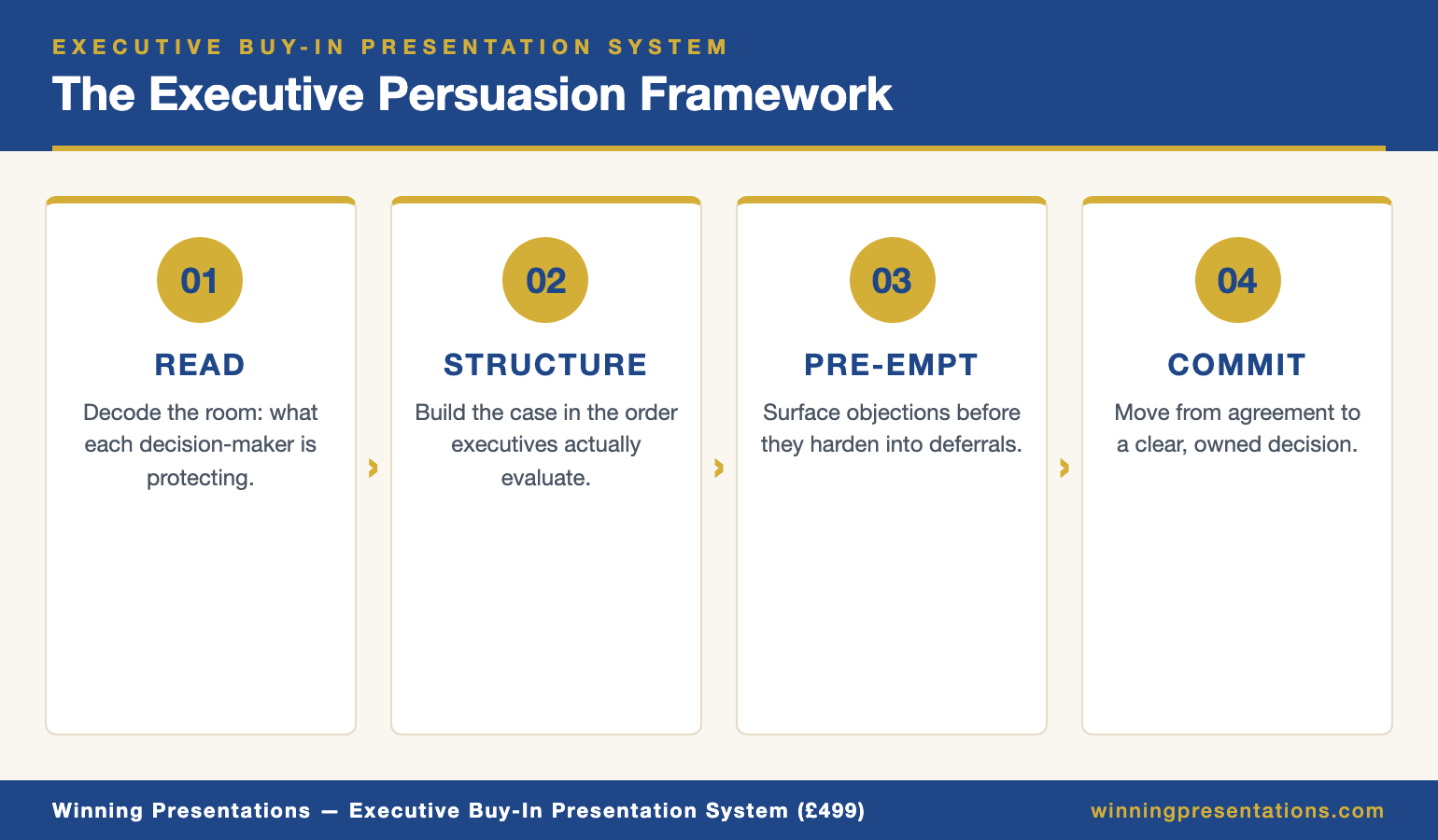
The material that actually changes presentation outcomes covers four areas:

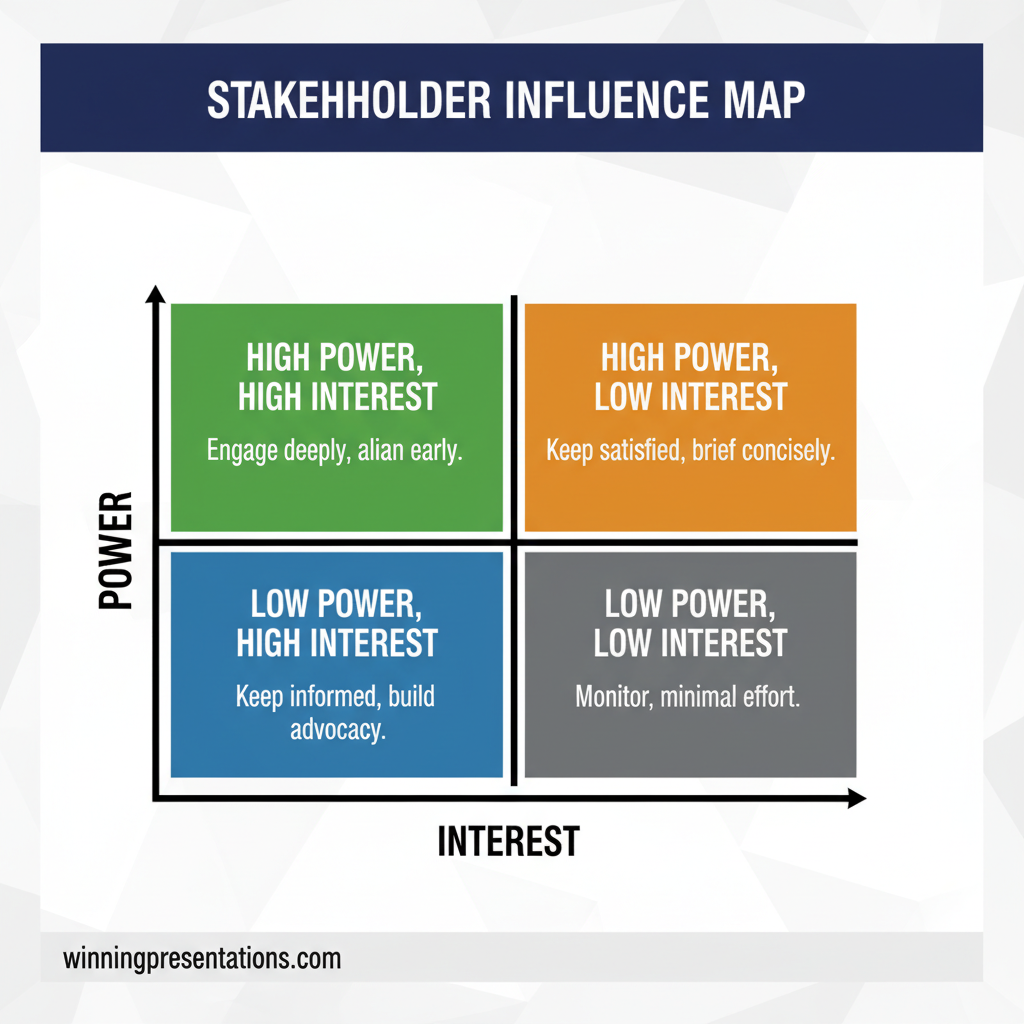
Stakeholder mapping. Who makes the decision, who influences the decision, who can veto the decision, who needs to be carried but not persuaded. Most presenters can name the attendees. Few can map the dynamics. The course should provide a concrete, repeatable method for mapping — not a general discussion.

Blocker diagnosis. For each stakeholder, what is the actual objection underneath the surface question? Is it risk appetite, political exposure, pattern-matching, or genuine technical disagreement? Each of these has a different response. Conflating them produces generic responses that work on none.

Presentation structuring around the blockers. Once the blockers are mapped, the presentation is built to address them in sequence. The deck structure is not generic — it is shaped by the specific blocker configuration of the specific room. A strong course teaches this as a repeatable method, not as a style exercise.

The sequencing of decision moments. Almost no significant stakeholder decision is made in a single meeting. The course should teach how to design the sequence — pre-meetings, informal soundings, structured objection surfacing, the decision meeting itself, and the follow-up that secures commitment. A course that focuses only on the main meeting teaches only a fraction of the skill.

Stacked cards infographic showing the four pillars of a real stakeholder buy-in presentation course: stakeholder mapping, blocker diagnosis, presentation structuring, and decision sequencing

THE EXECUTIVE BUY-IN PRESENTATION SYSTEM — £499

Stop losing eight months on initiatives that die in the buy-in phase

The Executive Buy-In Presentation System is a structured, self-paced programme that covers stakeholder mapping, blocker diagnosis, presentation structuring, and decision sequencing — the four disciplines that move senior stakeholder decisions. Optional live coaching sessions (fully recorded for watch-back). £499 per seat. Enrolment is open — join at your own pace.

Explore the Programme →

Designed for executives preparing multi-stakeholder, multi-meeting decision sequences.

What to avoid in a course

The market for presentation training is crowded. Not all of it is useful for the specific problem of stakeholder buy-in at senior levels. Four patterns to watch for.

Generic communication skills. If the course teaches “the power of storytelling”, “executive presence”, or “how to structure a great talk”, that is general presentation skills training — worth having, but not the same skill as buy-in. The diagnostic and sequencing work is distinct.

Rhetorical technique over structural method. Courses that focus heavily on vocabulary, phrasing, and delivery polish often skip the strategic work. Better delivery of the wrong presentation does not change the outcome. The course should spend at least as much time on what to present as on how to present it.

Motivational content. If a significant portion of the course is devoted to confidence, mindset, or identity work, you are probably buying a different product than the one you need. That material is valuable for people whose challenge is presentation anxiety. For people whose challenge is winning senior stakeholder approval, it is mostly filler.

Case studies without a transferable method. Case studies are useful illustration. They are not a substitute for method. A course should leave you with a repeatable structure you can apply to your next presentation — not a library of examples from other people’s industries.

Related: the stakeholder alignment workshop framework covers the pre-meeting discipline that most courses overlook entirely.

The Executive Buy-In Presentation System

The Executive Buy-In Presentation System is a structured, self-paced programme on the Maven platform (£499 per seat). It runs as a defined curriculum across eight modules, with optional live coaching sessions that are fully recorded for watch-back. Enrolment is continuous — new cohorts open monthly, participants join at their own pace.

The programme is built around the four-pillar structure: stakeholder mapping, blocker diagnosis, presentation structuring, and decision sequencing. Each pillar is taught as a repeatable method with worked examples from real executive decisions, followed by applied exercises on a presentation the participant is actively preparing.

The distinguishing feature of the programme is the applied element. Participants bring an actual upcoming high-stakes presentation. The programme is structured so the stakeholder map, blocker diagnosis, presentation structure, and decision sequence are built for that specific presentation during the programme. By completion, the participant has not only learned the method — they have applied it to a real decision. For most participants, that presentation is the one that justifies the programme cost by itself.

The optional live coaching sessions are twice during the cohort. They are optional and fully recorded. Participants who cannot attend live watch back and still get the full content. This makes the programme genuinely self-paced — no mandatory attendance.

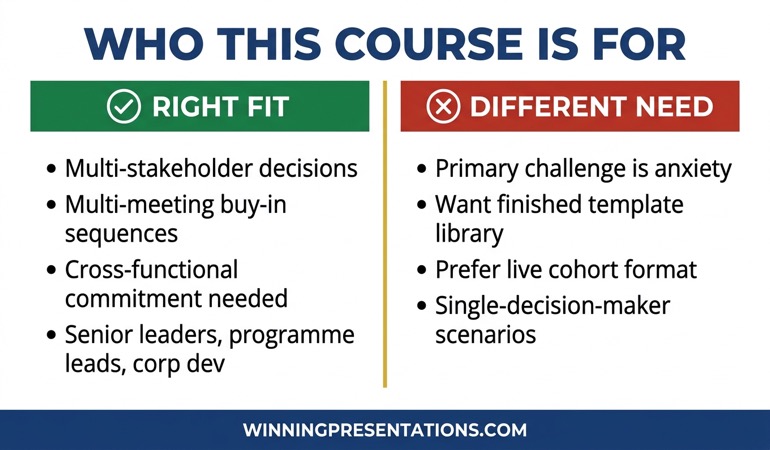
Who is this course for

The Executive Buy-In Presentation System is designed for a specific profile. It is most useful for:

  • Senior leaders and directors who regularly present to multi-stakeholder groups where decisions are distributed across several senior people.
  • Programme and change leads who need cross-functional commitment for initiatives with significant resource implications.
  • Corporate development and strategy executives preparing investment committee or board approval presentations.
  • Technology and digital leaders pitching transformation initiatives to business-side stakeholders who evaluate the proposal on commercial rather than technical criteria.
  • Internal consultants presenting recommendations to executive sponsors whose commitment determines whether the work gets implemented.

The common thread is multi-stakeholder, multi-meeting decisions where the presentation itself is only one component of the buy-in process. For single-decision-maker presentations, the material is still relevant but more than you need — simpler approaches apply. For genuinely committee-driven decisions where no individual stakeholder dominates, this is the right programme.

Split comparison infographic showing the profile of executives who benefit most from a stakeholder buy-in course versus those who need a different type of training

If you are dealing primarily with a single risk-averse decision-maker, the risk-averse CEO presentation framework covers that one-to-one dynamic. And if your challenge is specifically the objection-handling phase, the Q&A objection handling framework is the right starting point.

Who it is not for

Honest pre-qualification prevents mismatched expectations. The programme is not the right fit for:

People whose primary challenge is presentation anxiety. If the reason stakeholder buy-in feels difficult is that presenting itself feels difficult, the structural work in this programme will be useful but incomplete. The foundation needed is presentation confidence first.

People looking for a template library. The programme teaches a method, not a set of templates. Participants who want to download finished slide decks and reuse them will find the Executive Slide System a better fit for that need.

People who prefer pure live instruction. The programme is self-paced. Live coaching exists but is optional. Participants who specifically want a live, cohort-driven experience with real-time group work will find the self-paced structure less engaging than a fully live programme would be.

People preparing a single presentation with no cross-functional complexity. If the buy-in problem is genuinely one presentation to one decision-maker, a simpler approach applies. The programme’s complexity is structured for multi-stakeholder, multi-meeting decisions.

Related: the Executive Slide System is a lower-cost template library for executives whose challenge is building individual decks quickly rather than navigating complex stakeholder dynamics.

MULTI-STAKEHOLDER DECISIONS, SOLVED STRUCTURALLY

Applied method for the initiatives that actually need to land

The Executive Buy-In Presentation System — eight modules, optional recorded coaching, applied work on your actual upcoming presentation. Self-paced. £499 per seat. Enrolment is open — join at your own pace.

Explore the Programme →

Frequently Asked Questions

Is this programme live or self-paced?

Self-paced. Optional live coaching sessions are scheduled during the cohort, but they are fully recorded for watch-back. Participants who cannot attend live receive the full content. New cohorts open regularly — you join when ready and progress at your own pace.

What is the time commitment?

Most participants complete the programme in four to six weeks, working approximately two to four hours per week. The applied element — working on your own upcoming presentation — scales with how significant the presentation is. Some participants finish faster if their upcoming decision has a hard deadline. Others take longer if no immediate presentation is in play.

How is this different from other presentation courses?

Most presentation courses teach how to deliver content. This programme teaches how to diagnose the decision mechanics and structure a presentation around them. The focus is on multi-stakeholder, multi-meeting scenarios where delivery alone does not earn commitment. If your challenge is public-speaking confidence or slide design, a different course is the right fit.

Can multiple people from my organisation enrol together?

Yes. For organisations sending multiple participants, bring real, shared upcoming presentations. The programme’s applied work benefits from having colleagues who can cross-review each other’s stakeholder maps and decision sequences. Reach out directly for group enrolment arrangements.

Is there a guarantee?

The programme includes a standard Maven refund policy. Participants who decide within the first two weeks that the programme is not the right fit can request a refund. The programme is not a magic formula — it is a structured method. The refund policy exists because fit matters, and fit is clearest after a few modules of engagement.

Weekly frameworks for executive presentation moments

The Winning Edge is a weekly newsletter on the structural mechanics of high-stakes presentations. It includes frameworks that support the Executive Buy-In material but in concise weekly form.

Subscribe to The Winning Edge →

Partner post: For the related skill of reporting on mixed results to senior stakeholders, the investor update deck structure framework covers the recurring-meeting discipline that underlies buy-in retention.

Your next step: If you have a specific presentation coming up where the buy-in matters, the fastest diagnostic is to list every stakeholder who will be in the room and write one sentence next to each: “what would make them say no.” If you cannot write that sentence for each name, the diagnosis is where the work needs to start.

About the Author

Mary Beth Hazeldine is Owner & Managing Director of Winning Presentations Ltd. With 24 years of corporate banking experience at JPMorgan Chase, PwC, Royal Bank of Scotland, and Commerzbank, she advises executives across financial services, healthcare, technology, and government on structuring presentations for high-stakes funding rounds and approvals.

28 Apr 2026
Man in a navy suit stands at the head of a conference table addressing colleagues in a boardroom with a city skyline outside the window? (informative)

Senior Stakeholder Management Presentation Skills: How to Influence Decision-Makers at Board Level

Quick Answer

Senior stakeholder management presentation skills determine whether your recommendation is approved, deferred, or quietly shelved. The difference between executives who consistently secure buy-in and those who face repeated deferrals is rarely the quality of the analysis — it is the ability to map the room, pre-align key decision-makers, structure an argument that addresses competing priorities, and handle objections without losing the thread. These are learnable skills that follow a structural logic most professionals have never been taught.

Beatriz had spent three months building the business case for a regional expansion across Southern Europe. The analysis was thorough — market sizing, competitive landscape, regulatory mapping, a detailed financial model with three scenarios. When she presented to the investment committee, the CFO interrupted on slide six to ask whether the working capital requirement had been stress-tested against the group’s existing covenant structure. It had — on slide twenty-two. The Chief Operating Officer wanted to know about local hiring timelines. That was in the appendix. The committee chair, who had seemed supportive in corridor conversations, said nothing at all. The proposal was deferred for further review, which in practice meant it would compete with the next quarter’s priorities and likely lose. Beatriz had built the right case. She had presented it to the wrong version of the room — the version she imagined rather than the one that actually existed, with its competing concerns, unspoken priorities, and pre-formed positions she had never mapped.

Preparing a high-stakes presentation that requires executive buy-in? The Executive Buy-In Presentation System teaches the complete framework for structuring presentations that secure approval from senior decision-makers. Explore the Programme →

Why Senior Stakeholder Presentations Fail at Board Level

The most common reason a stakeholder management presentation fails is that the presenter treats the room as a single audience. A board or investment committee is not one audience — it is a collection of individuals with different mandates, different risk tolerances, and different definitions of what constitutes a good decision. The CFO evaluates financial exposure. The COO assesses operational feasibility. Non-executive directors look for governance risk. The chair is often managing a broader agenda that includes priorities the presenter knows nothing about.

When a presenter builds one argument for this collection of perspectives, the result is a presentation that partially satisfies everyone and fully convinces no one. The analysis might be sound, the recommendation might be correct, but the structure fails because it does not address what each stakeholder needs to hear in order to support the decision.

A second failure pattern is the assumption that the presentation itself is where the decision is made. In most board-level settings, the formal presentation is closer to a ratification event than a persuasion opportunity. The actual influencing happens before the meeting — in one-to-one conversations, in pre-reads, in the informal exchanges that shape a stakeholder’s position before they sit down. Executives who rely solely on the quality of their slides are operating with only part of the influence system.

The third pattern is failing to anticipate the objections that will arise from each stakeholder’s specific mandate. Understanding the psychology behind stakeholder buy-in reveals that objections are rarely about the content itself — they are about the stakeholder’s need to demonstrate due diligence in their area of responsibility. A finance director who does not challenge the cost assumptions is not doing their job. A risk committee chair who does not probe the downside scenario is failing in their governance role. Anticipating these challenges is not pessimism — it is stakeholder literacy.

Frameworks for Stakeholder Alignment

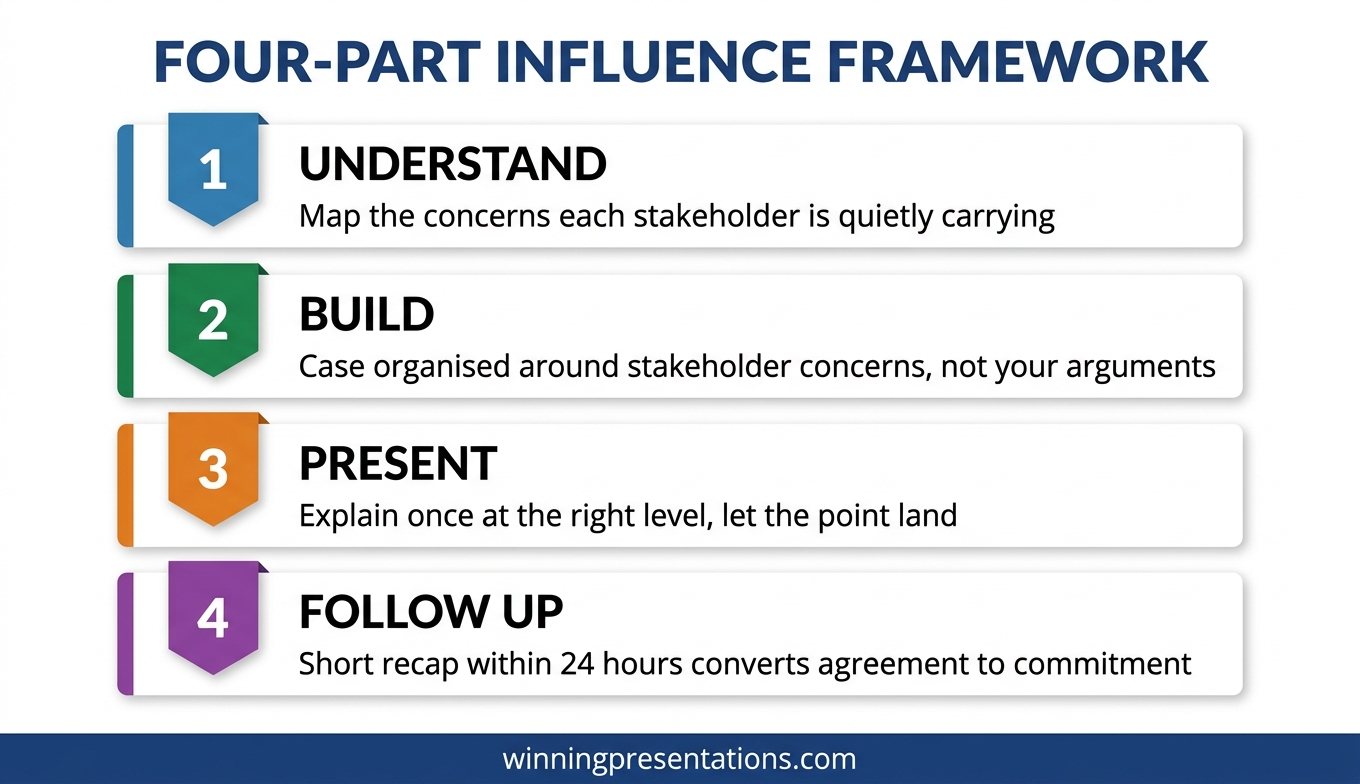
Effective stakeholder alignment begins with a structured map of the decision landscape. Before building a single slide, the presenter needs to answer four questions about every stakeholder who will be in the room: What is their primary concern? What would cause them to object? What would make them actively support the recommendation? And what is their relationship to the other stakeholders in the room?

The first framework is priority mapping. Each stakeholder operates within a mandate that determines what they pay attention to. A Chief Financial Officer will evaluate any proposal through the lens of capital allocation, return on investment, and covenant compliance. A Chief Technology Officer will assess technical feasibility and integration risk. Mapping these priorities before the presentation allows the structure to address each one explicitly rather than hoping the general argument covers them all.

The second framework is influence architecture. Not all stakeholders carry equal weight in a decision. In most boardroom settings, one or two voices carry disproportionate influence — the committee chair, the longest-serving non-executive, or the person who most recently experienced a failure in the area under discussion. Identifying these influence centres and structuring the argument to address their specific concerns first is not manipulation — it is strategic communication. A presentation that wins the support of the two most influential voices in the room is more likely to succeed than one that distributes its persuasion effort equally across all attendees.

The third framework is concession mapping. Before entering the room, experienced presenters identify what they are willing to concede and what is non-negotiable. This is not a defensive posture — it is preparation for the negotiation that high-stakes presentations inevitably become. Knowing in advance that you can offer a phased implementation timeline but cannot reduce the budget below a certain threshold gives you structured flexibility rather than improvised compromise.

Understanding how to build a board presentation structure that accommodates these multiple stakeholder perspectives is the bridge between strategic analysis and practical execution.

Secure Executive Buy-In With a Structured Framework

The Executive Buy-In Presentation System is a self-paced programme that teaches the complete framework for structuring presentations that win approval from senior stakeholders. £499 — new cohorts open monthly, with optional Q&A calls (all recorded).

  • ✓ Stakeholder mapping and influence architecture frameworks
  • ✓ Decision-framing techniques for board-level audiences
  • ✓ Objection anticipation and handling strategies
  • ✓ Self-paced modules with optional live Q&A calls (recorded)

Explore the Programme →

Self-paced · new cohorts monthly · designed for senior executives

Infographic showing three stakeholder alignment frameworks: priority mapping, influence architecture, and concession mapping — with key questions for each

Objection Handling in Board Settings

Board-level objections are fundamentally different from the pushback you encounter in team meetings or management presentations. In a boardroom, objections serve a governance function. Non-executive directors are required to challenge — it is part of their fiduciary duty. A proposal that receives no challenge is more likely to concern the chair than one that generates robust questioning. Understanding this dynamic changes how you prepare for and respond to objections.

The first principle of board-level objection handling is anticipation over reaction. For every stakeholder in the room, you should be able to predict their most likely objection based on their mandate and their known concerns. A finance director will challenge the cost assumptions. A risk committee member will probe the downside scenario. The chair may raise a timing concern related to other strategic priorities. Preparing a structured response to each anticipated objection — with supporting data readily accessible — transforms what feels like an attack into a demonstration of thoroughness.

The second principle is acknowledgement before response. When a senior stakeholder raises an objection, the instinct to defend immediately is strong — and almost always counterproductive. Acknowledging the concern first (“That is a valid concern, and it is one we have modelled explicitly”) signals that you have taken the stakeholder’s perspective seriously before you present your response. This sequence — acknowledge, validate, respond with evidence — reduces the adversarial dynamic and repositions the exchange as collaborative problem-solving.

The third principle is structured concession. Not every objection requires you to hold your ground. Some objections are invitations to negotiate, and the ability to concede on secondary points while holding firm on the core recommendation is a skill that distinguishes experienced boardroom presenters from those who treat every challenge as an attack on their proposal. Knowing which elements are negotiable — and preparing those concessions in advance — gives you the flexibility to accommodate concerns without undermining the recommendation.

For a deeper exploration of how alignment conversations before the meeting shape the objection landscape during it, the guide on stakeholder alignment presentation training covers the pre-meeting strategies that reduce the intensity and unpredictability of boardroom challenges.

The Executive Buy-In Presentation System teaches these objection-handling frameworks as part of its structured approach to securing approval from senior decision-makers.

Building Pre-Meeting Alignment

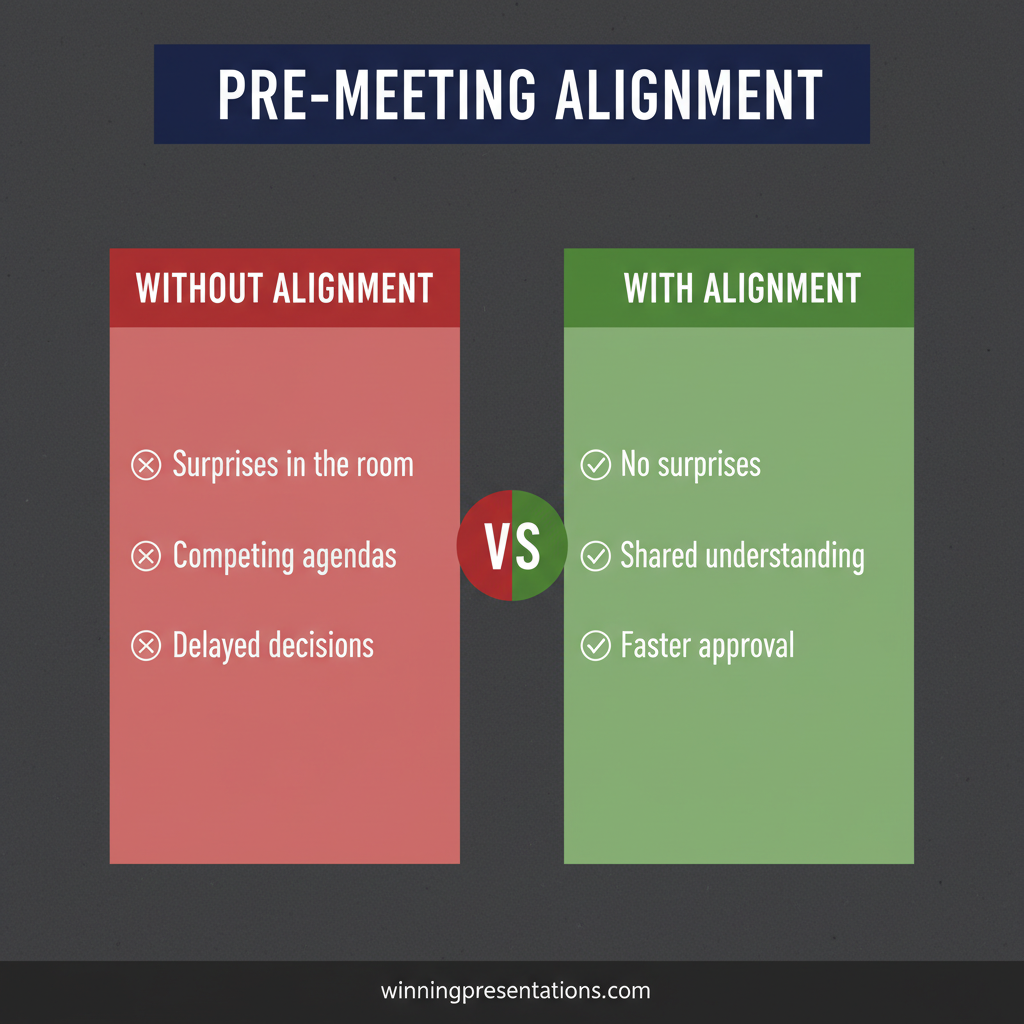
The most effective approach to presenting to senior stakeholders begins weeks before the presentation itself. Pre-meeting alignment is the process of having individual conversations with key stakeholders to understand their concerns, incorporate their perspective into the materials, and build informal support for the recommendation before the formal meeting takes place.

This is not lobbying. It is intelligence gathering and relationship management. A fifteen-minute conversation with the CFO before the board meeting — in which you share the headline financial assumptions and ask whether anything concerns them — achieves two things simultaneously. First, it surfaces objections you can address in the presentation rather than being caught off guard. Second, it signals respect for the CFO’s expertise, which makes them more likely to be constructive rather than adversarial in the formal setting.

The timing matters. For significant decisions, the optimal window is two to three weeks before the formal presentation — early enough to make meaningful changes, late enough that the proposal is sufficiently developed to discuss credibly.

The structure of the pre-meeting conversation follows a specific pattern. Open with the headline recommendation. Share the one or two data points most relevant to that stakeholder’s mandate. Ask directly: “Is there anything in this approach that concerns you?” Then listen. The purpose is to understand, not to sell. The persuasion happens when you incorporate their feedback into the presentation and they see that their perspective has been taken seriously.

Turn Stakeholder Complexity Into a Structured Advantage

The Executive Buy-In Presentation System covers the full influence process — from stakeholder mapping through pre-meeting alignment to boardroom delivery. Self-paced, with optional Q&A calls (recorded). £499.

Explore the Programme →

Self-paced · new cohorts open monthly · all sessions recorded

Measuring Influence Effectiveness

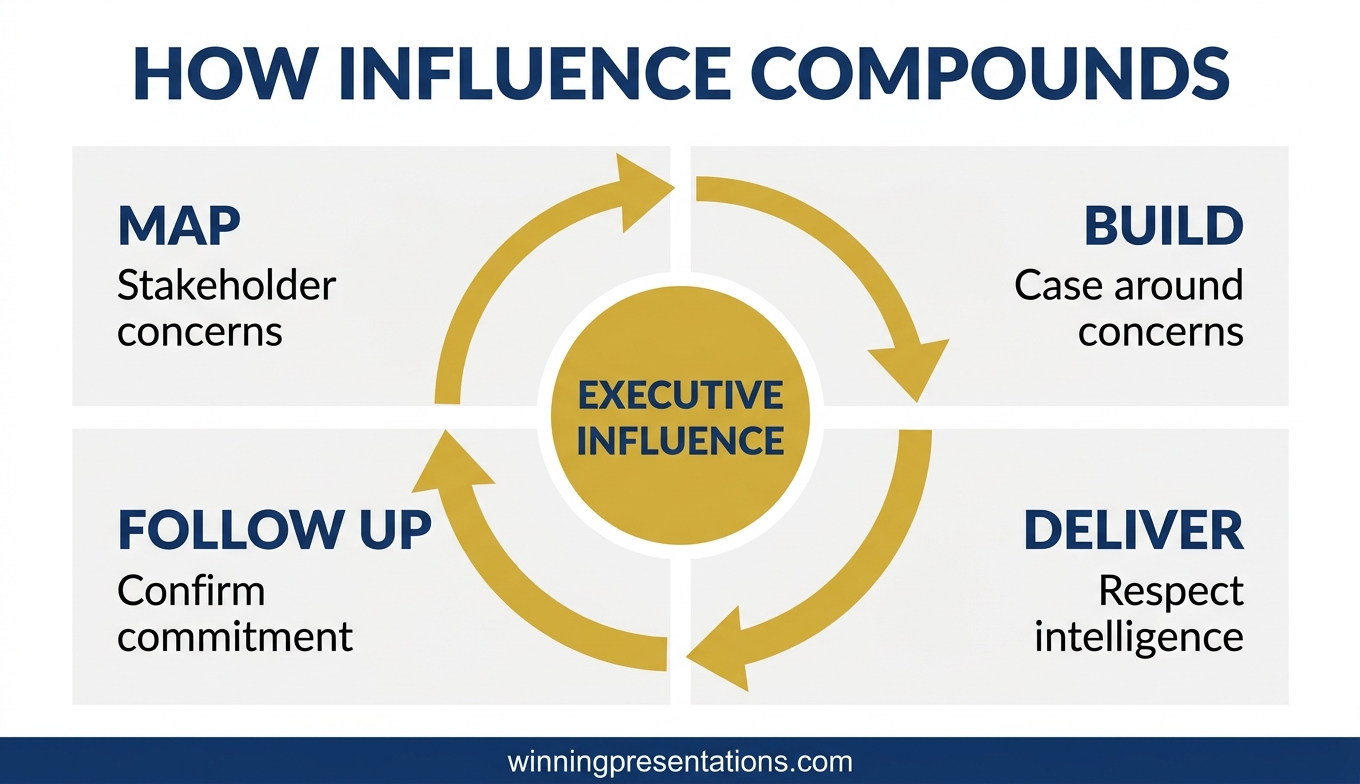
Stakeholder influence is difficult to measure because the most important outcomes are often invisible. Nevertheless, there are practical indicators that allow you to assess whether your ability to influence senior stakeholders through presentations is improving over time.

The first indicator is objection predictability. If the objections raised during the presentation are ones you anticipated and prepared for, your stakeholder mapping is working. If the challenges come from directions you did not expect, it signals a gap in your understanding of the room’s priorities. Over multiple presentations, tracking the ratio of anticipated to unanticipated objections provides a clear measure of your stakeholder literacy.

The second indicator is decision velocity. Decisions that are approved in the first meeting represent a different level of influence effectiveness than decisions that require multiple presentations, revised papers, and additional committee sessions. If your proposals consistently require follow-up sessions, the issue is likely structural — either the argument is not framed clearly enough for a first-meeting decision, or the pre-meeting alignment was insufficient to build the support needed for immediate approval.

The third indicator is stakeholder feedback quality. When senior stakeholders engage with constructive, specific questions rather than broad, sceptical challenges, it indicates the presentation has earned their intellectual respect. “Have you considered the impact on the European subsidiary?” is qualitatively different from “I am not sure this has been fully thought through.” The former suggests engagement; the latter suggests the argument has not landed.

For presentations involving significant capital expenditure or technology investment, the structural requirements are even more demanding. The guide on technology investment presentations applies these same stakeholder management principles to one of the most challenging approval scenarios — where technical complexity and financial risk intersect in front of a non-technical board.

Infographic showing three indicators of influence effectiveness: objection predictability, decision velocity, and stakeholder feedback quality — with measurement approaches

Frequently Asked Questions

What is the difference between stakeholder management and stakeholder engagement?

Stakeholder management is the strategic process of identifying, analysing, and influencing the people who have decision-making authority over your initiative. Stakeholder engagement is the broader relationship-building activity that supports it. In presentation contexts, the distinction matters because management requires you to map power dynamics, anticipate objections, and structure your argument around what each stakeholder needs to hear — not simply keep them informed. Effective presentations to senior stakeholders are built around the decision architecture of the room, while engagement activities happen before and after the formal presentation itself.

How do you handle conflicting stakeholder priorities in a single presentation?

When stakeholders in the room hold different priorities — a CFO focused on cost containment and a CTO focused on capability — the presentation must acknowledge both without appearing to favour one. The most effective approach is to frame the recommendation in terms that satisfy the shared objective (usually organisational risk reduction or strategic positioning) and then address each stakeholder’s specific concern in dedicated sections. Pre-meeting alignment conversations reduce the likelihood of open conflict during the presentation, but the structure must still accommodate divergent priorities visibly.

How far in advance should you begin stakeholder alignment before a board presentation?

For significant decisions — budget approvals, strategic pivots, organisational restructures — stakeholder alignment should begin at least two to three weeks before the formal presentation. This allows time for individual conversations with key decision-makers, the incorporation of their concerns into your materials, and the informal building of support before the formal meeting. Attempting to align stakeholders in the room itself is one of the most common causes of deferred decisions at board level.

Can stakeholder management presentation skills be learned online?

The structural and strategic elements of presenting to senior stakeholders — stakeholder mapping, objection anticipation, pre-meeting alignment frameworks, and decision architecture — can be learned effectively through self-paced online programmes. The Executive Buy-In Presentation System, for example, teaches the complete framework for securing executive-level buy-in through structured modules that cover stakeholder analysis, persuasion architecture, and objection handling. The advantage of self-paced learning is that participants can apply each framework to their own real stakeholder scenarios as they progress, rather than practising on hypothetical cases.

Join The Winning Edge

Weekly strategies for executive presentations, stakeholder influence, and board-level communication — delivered every Thursday.

Subscribe to The Winning Edge →

Your next step: Before your next high-stakes presentation, map every stakeholder who will be in the room. Write down their primary concern, their most likely objection, and the one thing that would make them actively support your recommendation. Then have a fifteen-minute conversation with the two most influential voices before the meeting. That single action will change what happens when you present.

Mary Beth Hazeldine | Owner & Managing Director, Winning Presentations. With 24 years of corporate banking experience at JPMorgan Chase, PwC, Royal Bank of Scotland, and Commerzbank, she advises executives across financial services, healthcare, technology, and government on structuring presentations for high-stakes funding rounds and approvals.