Tag: executive development

24 Jun 2026
Professional woman in a navy blazer presents to colleagues around a wooden table with laptops and reports on display.

Why Senior Presenters Plateau on 1:1 Coaching — and What Replaces It

Quick answer: Senior presenters who plateau on 1:1 coaching after six months are not running out of coachable material — they are running out of the friction that drives change. 1:1 coaching becomes therapeutic. The coach knows the leader, the leader knows the coach’s feedback before it arrives, and both unconsciously settle into a comfortable rhythm where new improvement requires new ground. Cohort coaching for executives reintroduces friction by replacing the single trusted reflector with a room of peers whose decks, scars, and blind spots are different from the leader’s own. The peers are not better presenters — they are differently broken, and the structural value of seeing six other senior leaders work through the same framework on six different decks is what 1:1 cannot supply. The plateau is a room problem, not a coach problem.

In 2018 I worked with a managing director at a mid-sized investment bank who had hired me for 1:1 presentation coaching at the recommendation of her boss. She was preparing for a major board pitch and wanted a structured pair of eyes on the deck. The first three sessions did serious work — we re-cut her opening, we rebuilt the recommendation slide, we changed how she handled the financial summary. By session six the deck was meaningfully sharper than where it started and the board pitch landed cleanly. We kept meeting monthly because we both enjoyed the conversation and because, on her side, the coaching had begun to feel like a useful ritual. Nothing dramatic happened in any individual session. The decks were marginally better each time. The work was good. It was also, after about six months, structurally finished and neither of us had noticed.

I noticed about a year in, when she sent me a deck for a different audience — an industry conference rather than a board — and my notes came back almost identical to my notes on a board deck from eight months earlier. I had developed a stable lens for her work and she had absorbed it. The notes she found useful were the ones that confirmed what she already half-knew. The notes that would have moved her further were the ones I no longer thought to give, because I had stopped seeing her fresh. A 1:1 coaching relationship that goes on long enough optimises toward comfort. The leader feels well-supported. The coach feels useful. The slides keep getting marginally better. Real change has quietly stopped.

(This article was created with AI assistance; all stories and insights are based on 35 years of real client work.)

The conversation that ended the plateau happened almost by accident. She had asked whether I knew anyone else doing the kind of work she was doing — not for hiring, just for benchmarking. I introduced her to two other senior leaders from different sectors who were also clients. The three of them met for coffee, brought decks, and spent ninety minutes critiquing each other. She emailed me afterward and said it was the most useful single session she had had on her own presentation work in years. That is the structural insight that produces cohort coaching for executives: at a certain point in a senior leader’s development, the most valuable feedback comes from peers facing different problems, not from the same coach giving the same lens to the same person.

If you have plateaued on 1:1 and want a different room:

The Executive Buy-In Presentation System is a self-paced programme with monthly cohort enrolment — 7 modules, no deadlines, no mandatory live attendance, optional Q&A calls fully recorded. The framework you work through privately; the cohort enrolment puts you alongside other senior leaders working the same material on different decks.

See the Executive Buy-In Presentation System →

The plateau most 1:1 coaching produces around month six

The first six months of a 1:1 coaching engagement with a senior leader who already presents reasonably well are usually the most productive six months of work either party has done together. The coach can see things the leader cannot. The leader can hear them, because the source is calibrated to their context. The decks improve. The deliveries tighten. The first board meeting after the engagement begins lands measurably better than the last one before. None of this is in dispute. The dispute — or rather, the unstated structural problem — arrives later, when the relationship continues past the point at which the coach has fully exported what they can see to the leader, and the leader has fully internalised it.

After that point, the marginal return on each session falls quickly. The coach’s feedback becomes predictable to the leader, which is partly because the leader has learned the lens and partly because the coach has stopped looking fresh. Both parties read this as “the coaching is working” because the leader can now produce the feedback herself before the coach gives it. In a real sense the coaching is working — the skill transfer has happened. But the engagement frequently continues for another six, twelve, or twenty-four months on a kind of ritual basis, with the leader believing each session adds something material when in fact each session is producing the satisfying feeling of having a trusted reflector available, without the underlying improvement curve that justified the engagement in the first place. This is not a bad thing to spend money on. It is just not coaching anymore. It is professional companionship.

The leaders who avoid this fate are the ones who, around month six or seven, do something that changes the structure of the room. Some hire a second coach with a different background to introduce a different lens. Some bring in a peer reviewer for specific high-stakes decks. The most structurally efficient move — the one that introduces the most new friction with the least transactional cost — is to move from 1:1 into a cohort room where six or seven other senior leaders are working through the same framework on completely different decks. The friction is not from being challenged personally, although that happens. It is from watching someone else handle a structural problem the leader has not yet encountered, and from realising mid-watching that they have been getting their own version of that problem wrong for years without anyone in their 1:1 sessions ever flagging it.

Why friction is the missing ingredient, not technique

The naive view of why coaching plateaus is that the leader has run out of techniques to learn. This is almost never true. Most senior leaders have unused range across the techniques they already know about — the openings they have heard described and never tried, the framework they bought a book on and never used, the question-handling approach they nodded at and then went back to their default. The unused range is enormous. The plateau is not a knowledge problem. It is a deployment problem — the leader knows what they could do differently, and they do not, because the conditions in their working life do not produce enough friction to make the alternative feel necessary.

1:1 coaching, after the first six months, becomes part of those low-friction conditions. The coach is a known quantity. The lens is familiar. The session is, in a structural sense, safe. The leader is not at any risk of being publicly wrong. The feedback they receive is delivered privately by someone they trust, calibrated to what they can absorb, and offered with care. This is exactly what makes 1:1 coaching good early in the engagement and increasingly limited later. The same conditions that enable a leader to hear hard feedback early on insulate them from the deeper hard feedback later. The reflector cannot be both the source of the comfort and the source of the discomfort that produces the next layer of change.

A cohort room reintroduces structural friction without being personally hostile. The friction does not come from the facilitator giving sharper notes than the 1:1 coach would. It comes from the leader watching another senior peer present a deck, recognising in real time that they have been making a structurally similar mistake on their own deck for years, and absorbing the lesson in a way that no second-hand description could deliver. The peer in that moment is not a coach. The peer is a mirror with a different angle, and the angle is what produces the change. For more on the structural decisions the system teaches, see the Executive Buy-In Masterclass overview; the comparison with the limits of 1:1 executive presentation coaching is the companion piece.
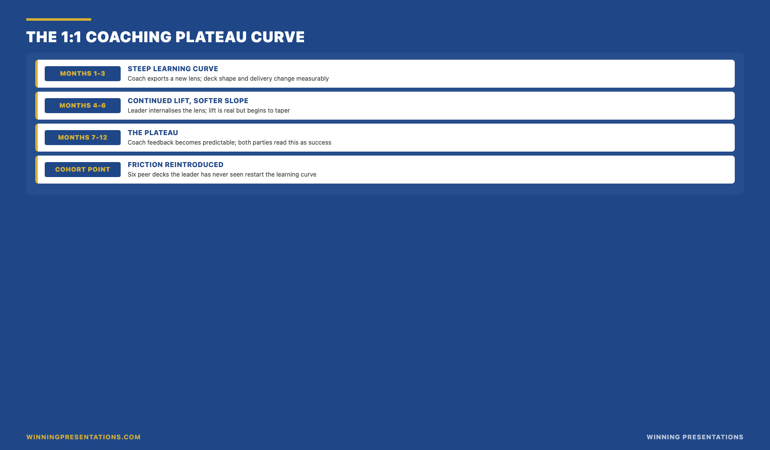
The 1:1 coaching plateau curve infographic: months 1-3 = steep learning curve as the coach exports a new lens to the leader; months 4-6 = continued improvement at a softer slope as the leader internalises the lens; months 7-12 = plateau as the coach’s feedback becomes predictable; the cohort intervention reintroduces friction by adding six peer decks the leader has never seen before, restarting the learning curve from a higher base.

What a cohort room actually does that 1:1 cannot

The structural advantage of a cohort room is not that the group somehow knows more than the coach. The facilitator’s expertise is identical to what a 1:1 coach would bring. The advantage is in what the room produces that no single coach-leader pair can produce: parallel-track exposure to the same framework being applied to seven different real decks at once. The leader who has only ever worked their framework against their own decks has, in effect, seen the framework in one colour. The leader who watches six peers work the same framework against six different decks has seen the framework in seven colours, and the depth of understanding that produces is structurally unavailable in a 1:1 setting no matter how long the engagement runs.

The Executive Buy-In Presentation System is built on this premise. The self-paced course content gives the leader the framework to internalise privately — 7 modules covering stakeholder analysis, case construction, and the presentation structures that hold up to senior scrutiny. The monthly cohort enrolment puts that leader alongside other senior people who are working through the same modules on their own real decks, with optional live Q&A calls that are fully recorded so attendance is never mandatory. The leader gets the framework in private and the multi-deck exposure in cohort, which is the combination that breaks the 1:1 plateau without losing the depth of work the 1:1 produced. A leader can enrol with the next cohort at any time; there are no deadlines and the materials are lifetime access.

Stop guessing what your stakeholders need to say yes.

The Executive Buy-In Presentation System is the self-paced framework for decoding stakeholder resistance and building the case that addresses it — 7 modules, monthly cohort enrolment, optional recorded Q&A calls. You work the modules at your own pace; the cohort enrolment puts you alongside other senior leaders working the same material on different decks. £499, lifetime access to materials.

  • 7 modules of self-paced course content covering stakeholder analysis, case construction, and presentation structure
  • Optional live Q&A / coaching calls, fully recorded — watch back anytime
  • Monthly cohort enrolment — join the next cohort whenever suits you
  • Lifetime access to all course materials, no deadlines

Join the next cohort — £499 →

When 1:1 is the right call, not the wrong one

None of this is an argument against 1:1 coaching in general. 1:1 is the right format for several specific situations and remains the most efficient delivery for them. The first is the early engagement — the first six months of work with a senior leader who has not yet been through a structured presentation framework. There is no substitute for individual attention while the framework is being installed. The second is preparation for a single high-stakes deck on a tight timeline. A board pitch in three weeks does not benefit from a six-month cohort cycle. The third is when the leader’s work is so sector-specific that the cohort would add limited parallel-track value — some highly specialised regulatory or scientific contexts fall in this category, although fewer than people assume.

What 1:1 is structurally worse at, after the first six months and outside those three specific situations, is producing the next layer of change. The cohort room is what produces the second layer. Many senior leaders run both at different points in their development — six to nine months of 1:1 to install the framework, a cohort cycle to break the plateau, and occasional 1:1 returns for specific high-stakes situations. The formats are complementary, not competitive. The mistake is treating 1:1 as the only format and then wondering why the improvement curve flattened a year in. The improvement curve flattened because the room did not change. The fix is to change the room. The Executive Buy-In Presentation System is the format that change usually takes, because the framework and the multi-deck exposure travel together in the same enrolment.
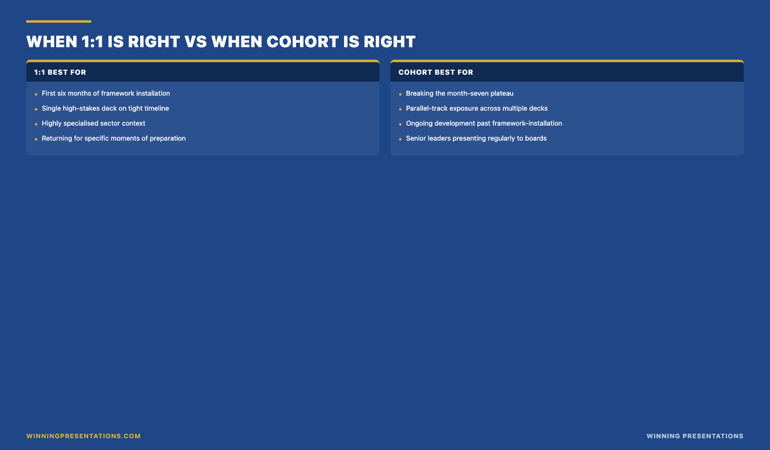
When to use 1:1 vs cohort coaching infographic: 1:1 best for — first six months of framework installation, single high-stakes deck on tight timeline, highly specialised sector context; cohort best for — breaking the month-seven plateau, exposure to parallel-track applications of the same framework, ongoing development past the framework-installation phase; combined approach is most common pattern for senior leaders who present regularly to boards.

A lower-cost path for leaders who want to deepen the structural side of the work without enrolling in a full cohort — or to supplement the cohort framework with the slide structure that lets the buy-in case land cleanly — is to pair the cohort with the Executive Slide System (£39). The slide system gives you the 26 templates, 93 AI prompts, and 16 scenario playbooks that the buy-in framework references in module five. Most cohort attendees who already own the slide system find the module five work goes about half the time it otherwise would, because the templates are already there.

Designed for senior professionals who present decisions to boards, investment committees, and executive sponsors.

The Executive Buy-In Presentation System — 7 self-paced modules covering the psychology and structure that earn serious approval. Monthly cohort enrolment, optional recorded Q&A sessions. £499, lifetime access to materials.

Reserve a cohort seat — £499 →

Frequently asked questions

Is cohort coaching worth it for someone who already has a long-standing 1:1 coach?

Usually yes, and the leaders who already have a strong 1:1 relationship tend to get the most from it because they have already done the framework-installation work the cohort builds on top of. The cohort is not a replacement for the 1:1 — it is the room that adds the parallel-track exposure the 1:1 cannot produce. Most leaders who run both find their 1:1 conversations become sharper after the cohort, because they bring back specific structural questions surfaced by watching peers handle problems the leader had not yet encountered. Treat them as complementary formats, not competing ones.

What is the most common mistake senior presenters make about choosing a coaching format?

Assuming the format that worked at the start of their development is the format that will work indefinitely. 1:1 is usually the right starting format and the wrong long-term-only format. The leaders who plateau on 1:1 have generally not failed to find the right coach — they have failed to recognise that the room itself stopped producing the friction that drove the early gains. The fix is structural, not relational. A different coach often produces a temporary lift that runs out for the same reason. A different room is the longer-lasting move.

How long does it take to see meaningful change from cohort coaching?

The framework-side change is usually visible inside the first month, as the leader works through the early modules privately and starts applying the structural moves to live decks. The cohort-side change — the parallel-track learning from watching peers work the same framework on different decks — usually shows up by the third or fourth real-world meeting after the cohort begins, because the new structural moves only earn their keep once they have been pressure-tested in the room. Most senior leaders who complete a cohort cycle report the most meaningful change in the six to nine months following the cohort, not during it.

Does this work for senior leaders presenting in highly specialised sectors?

Mostly yes, although the calibration varies. The framework is content-agnostic — the structural moves that get a board to approve a credit-policy change are the same moves that get a board to approve a clinical-trial design or a software-platform investment. Where specialised sectors need a small adjustment is in the case-construction module, where the proof types differ between regulatory, scientific, and commercial domains. The cohort handles this naturally, because the peer mix usually spans multiple sectors and the comparative work is one of the strongest learning surfaces in the room. The leaders who get least from the cohort are the ones whose work is so narrow that the parallel-track exposure adds limited value — this is rarer than people assume, but it does happen.

The Winning Edge — weekly newsletter

The Winning Edge is a weekly newsletter for senior professionals who present at the executive level. One short email a week on the structural moves that separate decks committees back from decks they defer. Subscribe to The Winning Edge →

For the wider library of presentation assets that pair with the buy-in framework — the slide system, the storytelling primer, the Q&A taxonomy, and the delivery references — the Complete Presenter bundle (£99) collects them in one place.

About the author

Mary Beth Hazeldine is Owner & Managing Director of Winning Presentations Ltd. With 24 years of corporate banking experience at JPMorgan Chase, PwC, Royal Bank of Scotland, and Commerzbank, she advises executives across financial services, healthcare, technology, and government on structuring presentations for high-stakes funding rounds, board approvals, and strategic decisions.

The next time your 1:1 coaching feels useful but not productive, do three things instead: ask yourself when the last piece of feedback genuinely surprised you; count how many other senior leaders’ decks you have seen worked through the same framework in the last twelve months; and reserve a seat in the next cohort if either answer is “not recently”. The friction your work needs is not in your coach’s notes any more — it is in the room you are not yet in.

24 Jun 2026
Commitment Anxiety: Why Senior Leaders Stall on Coaching They Know They Need

Commitment Anxiety: Why Senior Leaders Stall on Coaching They Know They Need

Quick answer: Senior leaders who stall on commitment to presentation coaching they already know they need are usually not avoiding the work — they are reacting to a structural feature of the typical coaching offer that triggers a quiet anxiety. Most coaching is sold as a scheduled commitment with mandatory live attendance, a fixed cohort calendar, and a structure that assumes the leader can clear their diary on the same days every week for six or eight weeks. For senior people whose diaries collapse unpredictably under operational reality, the live-attendance constraint is the actual blocker — not the decision to develop. Commitment anxiety on coaching is most often calendar anxiety in disguise. The format that resolves it is a self-paced programme with optional recorded calls, monthly enrolment, and lifetime access — which is structurally what the Executive Buy-In Presentation System is designed as. Removing the calendar constraint removes most of the hesitation. The work then happens at the leader’s own pace.

In late 2021 a senior managing director at a European insurance firm emailed me to ask about my coaching offer. She had three board meetings coming up over the next four months, she had been told her presentation work was the next development edge for her career, and she had been thinking about coaching for eighteen months without doing anything about it. The email was thoughtful and self-aware. She asked about pricing, structure, schedule, and what the time commitment would look like. We exchanged several emails. She did not enrol. I assumed she had decided against it, which happens regularly and is fine. Almost a year later she emailed again with a different question entirely — about a single deck she was preparing for a one-off committee meeting — and mentioned, in a P.S., that she still thought about the coaching question regularly and had still not made a decision. The thing she had not made a decision on for two years was a decision she had already made.

I asked her, in the next email, what specifically had kept her from enrolling when she had clearly already decided she wanted to. Her answer came back in two sentences. “My diary collapses on me every month and I cannot guarantee I will be in the right place on the right day. If I commit to a live programme and miss the first two weeks, I will hate myself for wasting the money, and I know I will miss them.” That was the entire blocker. It had nothing to do with the value of the work, the cost, the format, or the coach. It had to do with one structural feature of how most coaching is sold — live scheduled attendance — that her job structurally prevented her from committing to. The stall was not commitment anxiety. It was calendar anxiety the live-format constraint had created.

(This article was created with AI assistance; all stories and insights are based on 35 years of real client work.)

She enrolled in a self-paced programme with optional recorded sessions in the following week. The thing that had taken two years of email exchanges to decide took her about forty minutes once the calendar constraint was off the table. Most commitment anxiety on senior-leader coaching is structural anxiety about a specific feature of the typical offer, not psychological anxiety about the development itself. Naming the structural source — usually calendar, occasionally cohort-pace, occasionally public visibility — is what unlocks the decision the leader already made.

If the calendar is what has been stopping you:

The Executive Buy-In Presentation System is a self-paced programme with monthly cohort enrolment. No deadlines, no mandatory live attendance, optional Q&A calls fully recorded so you can watch back anytime. Enrol now and start at your own pace. Lifetime access to materials.

See the Executive Buy-In Presentation System →

The stall is calendar anxiety, not coaching anxiety

The leaders I have watched stall longest on commitment to coaching are almost never the ones who have decided the coaching is not for them. The ones who genuinely do not want it tend to be quick — one polite email, one declined conversation, one move on with their lives. The leaders who stall for months or years are the ones who have already decided they want it. The decision lives in their head as settled. What does not get settled is the specific transaction step of enrolling, and the reason that step does not happen is almost always traceable to a structural mismatch between the typical coaching offer and the leader’s working reality. Once you start naming the mismatch out loud, the stall usually resolves.

The most common mismatch is the live-attendance constraint. A senior leader running a business unit, a function, or a region does not have a diary that holds shape eight weeks out. Their diary holds shape four days out, and even that breaks. A coaching offer that requires them to be in the right place on the right day for six consecutive weeks is structurally asking them to commit to something their job will not let them deliver on, and they know it. The result is not that they refuse the offer. The result is that they hold the decision permanently open, which is the response a careful person has when the right answer is “yes” but the structural commitment is “no”. The decision sits in limbo until the structural feature changes or the leader gives up and the decision dies quietly.

The second-most-common mismatch is cohort-pace anxiety. A live cohort moves at the pace of the cohort, which the leader does not control. A senior person who has had a brutal week at work and needs to skip the next session knows they will fall behind and never quite catch up. A senior person who has finished the work three weeks ahead of the rest of the cohort cannot move forward. The leader who is structurally either ahead or behind the median cohort pace experiences the cohort as a constraint rather than a support, and the anticipation of that constraint shows up as commitment anxiety before enrolment, not after.

Why the standard live-cohort format creates the friction

The standard live-cohort format exists for good reasons. Live attendance creates accountability. Real-time interaction produces certain kinds of learning that recorded content cannot reproduce. Cohort pacing builds peer relationships. None of this is wrong, and for some categories of learner — typically earlier-career professionals with more predictable diaries — the live-cohort format is the right one. The mistake is generalising the format to populations it does not fit. The senior leader population is the most obvious example of a poor fit. Their diaries are unpredictable in a different category from earlier-career professionals. Their professional confidence does not need the accountability scaffolding live attendance provides. Their relevant peer group is small and rarely overlaps with any cohort they would actually be put into. The live-cohort design optimises for variables senior leaders do not have problems with, at the cost of variables they do.

What senior leaders need from a coaching format is the opposite shape. They need flexibility on attendance because their diaries demand it. They need the option of working at their own pace because they are often either dramatically ahead or dramatically behind the average. They need access to the live interaction surface when they can attend, without being penalised when they cannot. They need lifetime access to the materials because the work is too important to lose if they fall off the pace for a quarter. And they need the option of returning to the materials in two years when they have a different deck and want to re-run a specific module against new content. None of this is exotic. It is just structurally different from the live-cohort format, and the difference is what produces the commitment-anxiety pattern when the standard offer is the only thing on the table.

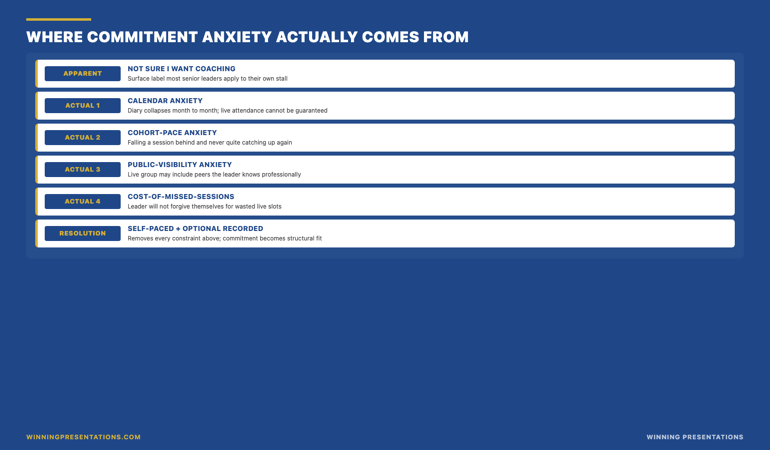
The commitment anxiety source map infographic: the apparent blocker is ‘not sure I want coaching’ but the actual blockers are structural — calendar anxiety (diary collapses month to month, cannot guarantee live attendance), cohort-pace anxiety (will fall behind a session or two and never catch up), public visibility anxiety (peer group in live calls may include people the leader knows professionally), cost-of-missed-sessions anxiety (the leader will not forgive themselves for wasted live slots) — with the resolution shown as self-paced + optional recorded + lifetime access + monthly enrolment removing each constraint.

What changes when the calendar constraint is removed

The leaders I have watched move from years of stalling to enrolment in a single week have almost all done so when the structural format changed. The decision they could not make against a live-cohort offer is the same decision they make easily against a self-paced offer with optional recorded calls. The Executive Buy-In Presentation System is structurally designed for this audience. It is self-paced. There are no deadlines. There is no mandatory live attendance. The optional Q&A calls are fully recorded so the leader who cannot attend any of them this month can still get the full value, and the leader who can attend all of them gets a structural lift on top. The monthly enrolment cadence means a leader can start at any time without waiting for the next intake window. The materials are lifetime access, so a leader who needs to pause for six weeks because the day job exploded can return without losing the work. Every one of those structural features is a direct response to the friction patterns that produce commitment anxiety on standard coaching offers.

The interesting effect of removing the calendar constraint is that the leaders who enrol against it almost always then attend more of the optional live calls than they expected to, because the absence of the obligation removes the resistance. The thing that stopped them committing was not the call itself — the call, when they sat in it, was useful. The thing that stopped them committing was the obligation of the call. Take the obligation away and the call becomes attractive. This is not a marketing observation; it is a pattern I have watched repeatedly across senior-leader populations and it is the single most counter-intuitive aspect of designing coaching for this audience. They will attend more if you require less. The optional structure produces higher engagement than the mandatory structure does, because the optional structure does not produce the anticipatory resistance that defers the enrolment in the first place. For more on the structural decisions the programme is built around, see the Executive Buy-In Masterclass overview; for the comparison with 1:1 formats, the 1:1 executive presentation coaching reference is the companion piece.

Stop dreading the commitment before the work has even started.

The Executive Buy-In Presentation System gives you the preparation framework that replaces last-minute panic with structured confidence — 7 self-paced modules, monthly cohort enrolment, optional Q&A calls fully recorded so attendance is never mandatory. No deadlines. Lifetime access to materials. The format removes the calendar constraint that creates most of the hesitation. £499.

  • Self-paced — work the 7 modules at whatever pace your diary allows
  • Optional live Q&A calls, fully recorded — no mandatory attendance, ever
  • Monthly cohort enrolment — start whenever suits you, no waiting for the next intake window
  • Lifetime access to all course materials — pause and resume without losing the work

Enrol at your own pace — £499 →

The permission a self-paced format gives that live formats cannot

The deeper effect of removing the calendar constraint is that the format gives the leader permission to take the work seriously without giving them anything additional to feel guilty about. A live-cohort format implicitly assumes the leader will succeed at attending, and any miss is a small failure. A self-paced format with optional recorded sessions assumes the leader will choose attendance based on what their diary allows that week, and any non-attendance is a non-event. The first format produces accumulated micro-guilt that compounds across the cohort cycle. The second format produces a clean working relationship with the material. Senior leaders are unusually sensitive to the difference. They have enough things in their working life that produce accumulated micro-guilt; they will not voluntarily add another one to the list. The format that does not add to the list is the format they will enrol in.

A lower-friction starting point for leaders who want to begin the work without enrolling in the full programme — or who want the slide structure that the buy-in framework references in module five — is the Executive Slide System (£39). The slide system gives the leader the templates, AI prompts, and scenario playbooks for executive decks immediately, with no cohort enrolment, no deadlines, and instant download. For leaders who are stalling because of the financial commitment scale rather than the calendar, the slide system is the right first move — it does the structural slide-side work the buy-in programme references and frequently surfaces the value of the deeper buy-in framework later.

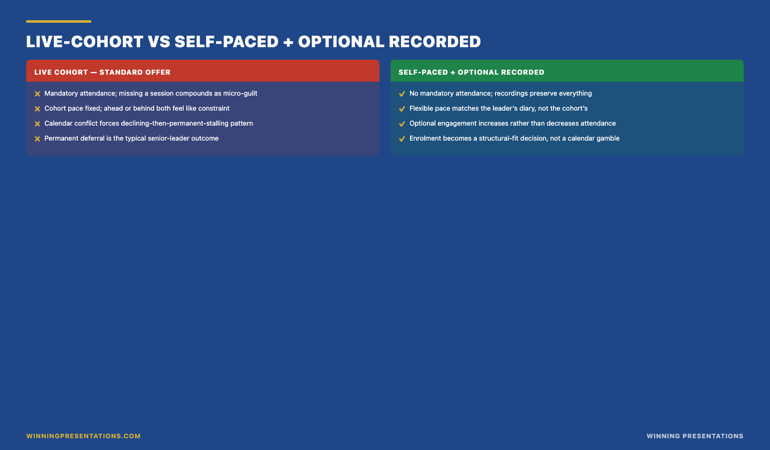
The format-permission infographic comparing live-cohort vs self-paced with recorded options: live cohort produces accumulated micro-guilt from missed sessions, fixed-pace anxiety when ahead or behind the median, calendar conflict that forces declining-then-stalling pattern; self-paced + optional recorded produces clean working relationship with material, flexible pace matching the leader’s diary, optional engagement with calls that increases rather than decreases attendance — the format-design that removes commitment friction without losing the depth of the work.

The complete system for senior professionals who need to secure approval at senior levels.

Executive Buy-In Presentation System — 7 self-paced modules, monthly cohort enrolment, optional recorded Q&A sessions. Lifetime access. £499.

Reserve a cohort seat — £499 →

Frequently asked questions

Is it really commitment anxiety if I have been thinking about coaching for over a year and haven’t enrolled?

Usually it is, although the word “anxiety” tends to make leaders flinch because it sounds psychological rather than practical. The pattern is more often practical than psychological — the leader has decided they want the work, they have not been able to find a format that fits their working life, and the unresolved transaction step accumulates as a low-grade background concern. The longer the stall lasts, the more it feels like indecision; in fact it is usually a correct response to a structural mismatch between the offer and the leader’s diary. Once the structural mismatch is named and a different format is on the table, the decision tends to happen quickly.

What is the most common reason senior leaders stall on coaching they say they want?

Live-attendance scheduling. A leader running a business unit, a function, or a region cannot reliably guarantee they will be in the right place on the right day eight weeks out. A coaching format that requires them to do exactly that is asking them to commit to something they know their job will prevent them from delivering on. The result is not refusal — it is permanent deferral. Once the live-attendance constraint is removed (typically via a self-paced format with optional recorded sessions), the same leaders who deferred for years tend to enrol within a week, because the practical objection has been resolved.

How long does it take to actually work through a self-paced presentation programme?

The honest answer is six to ten weeks for the focused work, plus or minus depending on the leader’s pace and the urgency of any specific upcoming meetings. A leader with a real board deck three weeks out typically front-loads the first four modules in the first ten days and finishes the remaining modules in the weeks after. A leader without a specific deadline tends to take eight to ten weeks at one module per week. The self-paced format allows either pattern — the work expands and contracts to the leader’s reality rather than the other way around. The lifetime access means a leader can also return to specific modules a year later for a different deck without re-enrolling.

Will I get less out of a self-paced programme than a live one?

The structural depth of the work is identical. What you get less of is the real-time interaction surface, which matters more for some learners than for others. Most senior leaders are net better served by the self-paced format because the alternative for them is not “live cohort” versus “self-paced” — it is “self-paced” versus “permanent deferral”. A programme they will actually enrol in and work through outperforms a programme they would in theory get more from but cannot reliably attend. The optional recorded Q&A sessions also mean leaders who can attend live get most of the real-time benefit anyway, and leaders who watch back asynchronously can review specific moments more than once, which live attendance does not allow.

The Winning Edge — weekly newsletter

The Winning Edge is a weekly newsletter for senior professionals who present at the executive level. One short email a week on the structural moves that separate decks committees back from decks they defer. Subscribe to The Winning Edge →

For the wider library of presentation assets that pair with the buy-in framework — the slide system, the Q&A taxonomy, the storytelling primer, and the delivery references — the Complete Presenter bundle (£99) collects them in one place.

About the author

Mary Beth Hazeldine is Owner & Managing Director of Winning Presentations Ltd. With 24 years of corporate banking experience at JPMorgan Chase, PwC, Royal Bank of Scotland, and Commerzbank, she advises executives across financial services, healthcare, technology, and government on structuring presentations for high-stakes funding rounds, board approvals, and strategic decisions.

The next time you notice you have been thinking about coaching for months without enrolling, do three things instead: name the specific structural feature of the offer that has been blocking the transaction step; ask whether the block is the work itself or the format of the work; and if the block is the format, look for a self-paced version that removes the constraint. The leader who names the structural source of the stall resolves it. The leader who keeps the stall labelled as commitment anxiety stays stuck inside it.

25 Jan 2026
Professional evaluating executive presentation coaching options to find a programme worth the investment

Executive Presentation Coaching: What to Look For in 2026

I spent £8,000 on presentation coaching that taught me nothing I could use.

The coach was credentialed. The programme was respected. But after six sessions, I was still freezing in front of the board—because everything I’d learned was theory that collapsed under pressure.

Quick answer: The best executive presentation coaching in 2026 focuses on frameworks you can apply under pressure, not concepts you understand intellectually. It should address both structure (how to build slides that work for executive audiences) and delivery (how to present with authority when stakes are high). Most coaching fails because it teaches presentation theory without accounting for the stress response that hijacks your performance when it matters most.

When you find the right coaching:

  • You stop dreading presentations and start seeing them as career accelerators
  • Your recommendations get approved faster—because executives trust how you communicate
  • The skills compound: each presentation builds on the last instead of starting from scratch

Written by Mary Beth Hazeldine — Owner & Managing Director of Winning Presentations, 24 years in corporate banking (JPMorgan Chase, PwC, RBS, Commerzbank), qualified clinical hypnotherapist, and someone who’s been on both sides of executive presentation coaching—as a client who wasted money, and now as someone who teaches what actually works. Last updated: January 2026.

🚨 Evaluating a coaching programme THIS MONTH? Ask these 3 questions:

  1. Can you show me the exact frameworks I’ll use? (If they can’t, it’s theory-based)
  2. How do you address performance under pressure? (If they don’t, skills won’t transfer)
  3. What measurable outcomes have past participants achieved? (Vague answers = vague results)

These questions separate programmes that transform from programmes that teach.

I’ve helped senior professionals transform their executive presentations at global banks, consulting teams, and Fortune 100 companies—environments where one presentation can determine funding, strategy, or careers.

→ Want a programme designed for senior professionals? See the AI-Enhanced Presentation Mastery curriculum — frameworks-first approach for executives who present to decision-makers.

📅 Investing in your presentation skills this quarter?

This guide will help you evaluate any programme—including mine—so you invest in coaching that actually delivers results.

That £8,000 I spent? It taught me what not to look for. Over the next decade—through hundreds of executive presentations and eventually training senior leaders myself—I learned what actually creates transformation versus what just sounds impressive.

The difference isn’t subtle. And in 2026, with AI changing how presentations are created, the gap between effective coaching and outdated approaches has never been wider.

Why Most Executive Presentation Coaching Fails

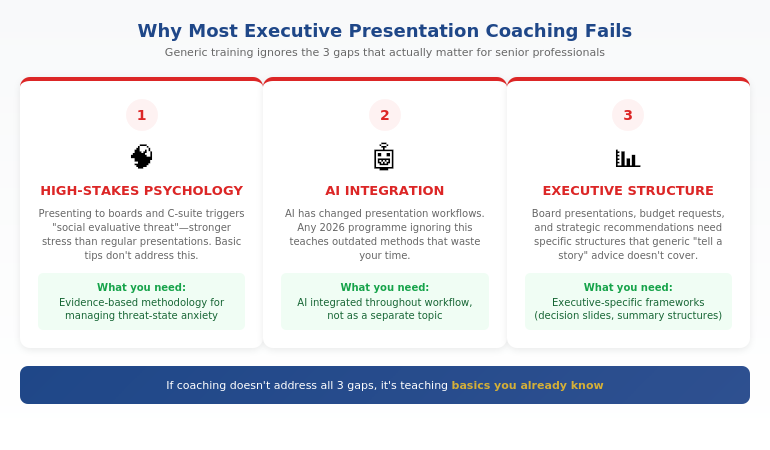
The presentation coaching industry has a dirty secret: most programmes don’t produce lasting change.

Executives complete the training, feel inspired for a week, then revert to their old patterns the moment they’re under pressure. The coaching “worked” in the safe environment of the training room—but collapsed in the boardroom.

Here’s why:

Problem 1: Theory Without Application

Most coaching teaches concepts: “Lead with your conclusion.” “Use the pyramid principle.” “Make eye contact.”

These aren’t wrong—but they’re incomplete. Understanding a concept intellectually doesn’t mean you can execute it when your nervous system is in fight-or-flight mode.

The insight: Effective executive presentation coaching must bridge the gap between knowing and doing. That requires frameworks specific enough to follow under pressure, plus techniques for managing the stress response that blocks execution.

Problem 2: Generic Approaches

Many programmes teach the same content to everyone: entry-level employees, middle managers, and C-suite executives all get the same “presentation skills” curriculum.

But presenting to a board is fundamentally different from presenting to peers. The expectations, the communication patterns, the decision-making dynamics—all different.

The insight: Executive-level coaching should focus specifically on high-stakes, senior-audience scenarios. Generic “presentation skills” won’t cut it.

Problem 3: Ignoring the Stress Response

Here’s what most coaches don’t understand: the anxiety that executives feel before high-stakes presentations isn’t a mindset problem. It’s a physiological response.

When your brain perceives threat (and being evaluated by people who control your career IS a threat), it triggers hormonal cascades that impair verbal fluency, working memory, and executive function—the exact cognitive skills you need to present well.

The insight: Any coaching that doesn’t address nervous system regulation will fail when stakes are high. “Just be confident” isn’t a technique—it’s a wish.

📚 Research note: The Trier Social Stress Test (Kirschbaum et al., 1993)—the gold standard for measuring social evaluative threat—consistently shows that being judged by high-status observers produces stronger cortisol spikes than other stressors. Research on anxiety and working memory (Eysenck & Calvo’s Processing Efficiency Theory) explains why intelligent, knowledgeable executives can “blank” during presentations: anxiety consumes cognitive resources needed for verbal retrieval. The expertise is intact, but access is blocked. Effective coaching must account for this biological reality.

For more on why training fails, see the hidden reasons most programmes don’t stick.

Diagram showing why most executive presentation coaching fails: theory without application, generic approaches, and ignoring the stress response

What Actually Works: The 5 Non-Negotiables

After spending too much money on coaching that didn’t work, and then developing programmes that do, I’ve identified five elements that separate effective executive presentation coaching from expensive disappointments.

Non-Negotiable 1: Frameworks, Not Concepts

Effective coaching gives you specific, repeatable structures—not abstract principles.

Concept: “Lead with your conclusion.”
Framework: “Your first slide headline should state your recommendation + key benefit. Example: ‘Approve £500K for Q4 Campaign (2.3x Projected ROI).’ Here’s the template.”

The difference? A framework tells you exactly what to do. A concept requires you to figure it out yourself—which you can’t do under pressure.

What to look for: Can the coach show you the exact templates, structures, or scripts you’ll use? If it’s all principles and no specifics, keep looking.

Non-Negotiable 2: Pressure-Tested Techniques

Skills learned in calm conditions don’t automatically transfer to stressful ones. Effective coaching builds in stress inoculation—practicing under conditions that simulate real pressure.

What to look for: Does the programme include practice with realistic scenarios? Do they address what happens when anxiety spikes mid-presentation? Do they teach recovery techniques for when things go wrong?

Non-Negotiable 3: Executive-Specific Content

Presenting to a board requires different skills than presenting to a team meeting. Effective executive coaching focuses specifically on:

  • Decision-oriented structures (not information dumps)
  • Managing challenging questions from senior stakeholders
  • Building credibility with time-poor, skeptical audiences
  • The specific dynamics of high-stakes approval scenarios

What to look for: Is the content designed for senior audiences, or is it generic “presentation skills” repackaged?

Non-Negotiable 4: Both Structure AND Delivery

Some coaching focuses only on slide design. Others focus only on speaking skills. Neither alone is sufficient.

You need both: the ability to structure content that works for executive audiences AND the ability to deliver it with authority under pressure.

What to look for: Does the programme address both what you present (structure, slides, messaging) and how you present it (delivery, presence, managing nerves)?

Non-Negotiable 5: Modern Integration

In 2026, any executive presentation coaching that ignores AI is incomplete. Not because AI replaces presentation skills—but because AI changes how presentations are created.

The executives who thrive use AI to accelerate the mechanical work (drafts, formatting, research synthesis) while applying human judgment to the strategic work (what to include, how to frame it, what story to tell).

What to look for: Does the programme address how to leverage AI tools effectively? Or is it stuck in a pre-2023 world?

💬 “The framework changed how I structure every board presentation. I used to spend 6+ hours on decks that got questioned. Now I spend 90 minutes and get approval on the first pass.” — Senior Director, Global Consulting Firm

⭐ A Programme Built on These 5 Non-Negotiables

AI-Enhanced Presentation Mastery was designed specifically for senior professionals who present to decision-makers. It’s frameworks-first (not theory), addresses the stress response, and integrates modern AI workflows.

What’s included:

  • Executive presentation frameworks (decision slides, board updates, stakeholder pitches)
  • Techniques for calm authority under pressure
  • AI integration for faster, higher-quality presentation creation

See the Full Curriculum →

Cohort-based programme for senior professionals. Limited seats per session.

The 2026 Coaching Landscape: What’s Changed

The executive presentation coaching market has shifted dramatically. Here’s what’s different now:

Change 1: AI Has Raised the Bar

When anyone can generate a “decent” presentation in minutes using AI, the baseline has changed. Decent isn’t enough anymore.

The executives who stand out are those who can take AI-generated foundations and elevate them with strategic thinking, audience insight, and executive-level polish. Coaching that doesn’t address this reality is already outdated.

Change 2: Remote + Hybrid Has Become Permanent

Many executive presentations now happen on video—or hybrid with some participants in-room and others remote. This changes everything: how you build rapport, how you read the room, how you maintain engagement.

Coaching designed for in-person only is incomplete. Look for programmes that address the specific challenges of presenting through screens.

Change 3: Decision Speed Has Increased

Executives have less patience than ever. The “let me walk you through this” approach that worked a decade ago now loses audiences before you’ve made your point.

Modern coaching should emphasise decision-oriented structures: recommendation first, evidence second, context only when asked.

Change 4: Credentialism Matters Less, Results Matter More

Traditional presentation coaching often leaned on credentials: “trained at [famous institution]” or “certified in [methodology].”

Smart buyers now ask: “What outcomes have your participants achieved?” Credentials don’t guarantee results. Ask for evidence of transformation, not badges.

For more on what separates top performers, see why most presentation training fails senior professionals.

Looking for a programme designed for the 2026 reality? AI-Enhanced Presentation Mastery integrates frameworks, stress management, and modern AI workflows—specifically for senior professionals.

Red Flags: When to Walk Away

Not all coaching is worth the investment. Here are the warning signs:

Red Flag 1: “Everyone Needs the Same Training”

If a programme promises to help “everyone from interns to executives,” it’s not executive-focused. Generic content won’t address the specific challenges of high-stakes senior presentations.

Red Flag 2: All Theory, No Templates

If the coach can’t show you specific frameworks, templates, or structures you’ll walk away with, you’re paying for concepts you could read in a book.

Ask: “Can you show me an example of a framework I’ll learn?” If the answer is vague, walk away.

Red Flag 3: No Mention of Pressure or Nerves

If the programme doesn’t address performance anxiety, stress response, or presenting under pressure, it’s incomplete. Skills learned in calm conditions often collapse when stakes are high.

Red Flag 4: Outdated Content

If there’s no mention of AI, remote/hybrid presenting, or modern executive communication patterns, the content may be years out of date.

Ask: “How has this programme evolved in the last two years?”

Red Flag 5: No Evidence of Results

If the coach can’t point to specific outcomes from past participants—faster approvals, promotions, successful pitches—the programme may not deliver transformation.

Ask: “What measurable results have past participants achieved?”

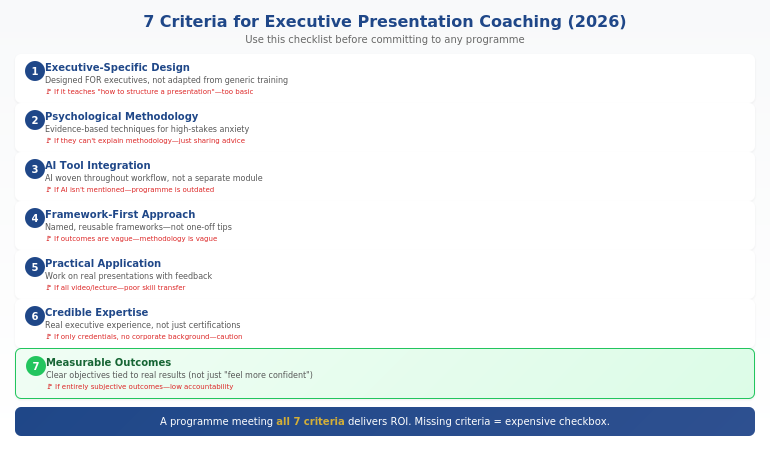
Red flags when evaluating executive presentation coaching: generic content, no templates, ignoring nerves, outdated material, no evidence of results

⭐ A Programme That Passes Every Test

AI-Enhanced Presentation Mastery includes specific frameworks you can review before enrolling, addresses performance under pressure, and is updated for 2026 realities—including AI integration and remote/hybrid presenting.

You’ll get:

  • Frameworks you can see before you enrol (no mystery content)
  • Techniques for managing the stress response
  • Modern AI workflows that save hours per presentation

See the Full Curriculum →

Designed for senior professionals presenting to boards, executives, and key stakeholders.

How to Evaluate Any Programme

Use this framework to assess any executive presentation coaching you’re considering—including mine:

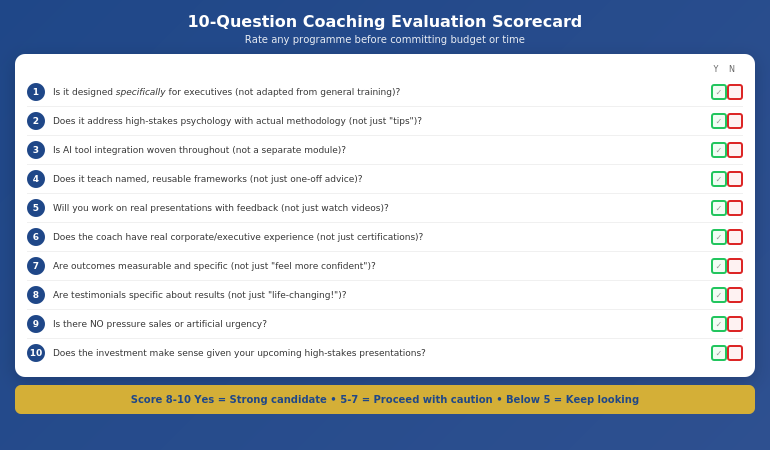
The 10-Question Evaluation

Content Quality:

  1. Is the content designed specifically for executive/senior audiences?
  2. Can they show you the exact frameworks and templates you’ll use?
  3. Does it address both structure (slides/content) AND delivery (presence/nerves)?
  4. Is it updated for 2026 realities (AI, remote/hybrid, decision speed)?

Practical Application:

  1. Does it include practice with realistic high-stakes scenarios?
  2. Do they address what happens when anxiety spikes mid-presentation?
  3. Will you walk away with tools you can use immediately?

Evidence of Results:

  1. Can they point to specific outcomes from past participants?
  2. Do they offer any guarantee or way to assess fit before full commitment?
  3. Does the programme structure support actual skill development (not just information transfer)?

Score it: If a programme doesn’t score at least 7/10, consider alternatives.

10-question coaching evaluation scorecard to rate any executive presentation coaching programme before committing

🎯 Choose Your Next Step Based on Your Timeline

If you present to ExCo/Board in the next 14 days: Focus on immediate fixes—review our decision slide framework and calm presence techniques. Long-term coaching can wait.

If you’re evaluating coaching this month: Use the 10-question scorecard above. Request curriculum details before any call. Compare at least 2-3 options.

If you’re planning Q1 development: Book now for early cohorts—quality programmes fill quickly in January. The AI-Enhanced Presentation Mastery next cohort has limited seats.

🎯 If you’re investing in coaching this quarter, do this TODAY:

  1. List the specific presentation challenges you need to solve (not vague “get better”—specific scenarios)
  2. Identify 2-3 programmes to evaluate using the 10-question framework above
  3. Request to see actual content before committing (frameworks, templates, curriculum)
  4. Ask for outcomes evidence from past participants in similar roles

This takes an hour. It prevents spending thousands on coaching that won’t deliver.

For more on presentation skill development, see what actually gets senior professionals ahead.

Want to evaluate AI-Enhanced Presentation Mastery? See the full curriculum and framework overview — you can review exactly what’s included before making any decision.

Frequently Asked Questions

How much should I expect to invest in executive presentation coaching?

Quality programmes range from a few hundred pounds for self-paced courses to several thousand for intensive 1:1 coaching. The question isn’t the absolute cost—it’s the return. A £500 programme that transforms your executive presentations delivers better ROI than a £5,000 programme that teaches theory you can’t apply.

Is 1:1 coaching better than group programmes?

Not necessarily. 1:1 offers personalisation; group programmes offer peer learning and accountability. The best choice depends on your learning style and specific needs. What matters more than format is whether the content meets the 5 non-negotiables.

How quickly should I expect results from coaching?

With framework-based coaching, you should see improvement in your very next presentation. Deep transformation—the kind that makes high-stakes presenting feel natural—typically takes 3-6 months of deliberate application.

Should I look for a coach with experience in my industry?

Industry experience can be helpful but isn’t essential. Executive presentation patterns are remarkably consistent across sectors. What matters more is whether the coach understands high-stakes, senior-audience dynamics—not the specifics of your industry.

Can AI tools replace executive presentation coaching?

AI can help you create slides faster, but it can’t teach you to present with authority under pressure. The mechanical parts of presentation creation are being automated; the human elements—strategic thinking, executive presence, managing the room—remain irreplaceable. The best coaching helps you leverage AI for efficiency while developing the skills AI can’t provide.

What if I’ve tried coaching before and it didn’t work?

The failure was likely in the approach, not in you. Most coaching fails because it’s theory-based, generic, or ignores the stress response. Use the evaluation framework in this article to find a programme that addresses those gaps. Don’t give up on coaching—find better coaching.

Does coaching work for people who are naturally nervous presenters?

Yes—in fact, naturally nervous people often see the biggest transformation. Here’s why: coaching that addresses the stress response (not just “presentation tips”) gives anxious presenters specific techniques to manage their physiology. They’re not trying to “stop being nervous”—they’re learning to present effectively despite the nerves. Many of the most composed executive presenters you see are naturally anxious people who’ve learned to channel that energy rather than display it.

Is This Right For You?

✓ Executive coaching is right for you if:

  • You present to boards, executives, or senior stakeholders
  • Your presentations affect decisions on funding, strategy, or career advancement
  • You want frameworks and techniques, not just theory
  • You’re ready to invest time in deliberate practice

✗ Executive coaching is NOT right for you if:

  • You mainly present to peers or direct reports (lower stakes)
  • You’re looking for quick tips rather than skill development
  • You’re not willing to practice between sessions
  • You expect transformation without applying what you learn

⭐ The £8,000 I Wasted Taught Me What Works

That expensive coaching that failed? It taught me exactly what to avoid—and what to build. AI-Enhanced Presentation Mastery is everything I wish that programme had been: frameworks-first, pressure-tested, and designed specifically for executives who present to decision-makers.

What you’ll get:

  • Executive presentation frameworks (not theory—templates you can use immediately)
  • Techniques for calm authority under pressure
  • Modern AI integration for faster, better presentations

See the Full Curriculum →

Cohort-based programme on Maven. Review the full curriculum before deciding.

📧 Optional: Get weekly executive presentation strategies in The Winning Edge newsletter (free).

Your Next Step

The right executive presentation coaching can transform how you communicate with decision-makers—and by extension, how your career progresses.

But the wrong coaching wastes thousands and leaves you no better than before. The difference is in knowing what to look for.

Use the 10-question evaluation on any programme you’re considering. Demand to see frameworks before you commit. Ask for evidence of results. And don’t settle for theory-based coaching that collapses under pressure.

Your ability to present to executives is one of the highest-leverage skills you can develop. Invest in coaching that actually delivers transformation—not just inspiration.

To review a programme designed around these principles, see the AI-Enhanced Presentation Mastery curriculum.

P.S. If your immediate challenge is structuring slides for executive approval, see how to build decision slides that get “yes” in 60 seconds. If it’s managing nerves when presenting to senior leadership, see how to sound calm and credible under pressure.

About the Author

Mary Beth Hazeldine is the Owner & Managing Director of Winning Presentations and a qualified clinical hypnotherapist. The £8,000 coaching failure that opens this article is real—and the decade that followed taught her what actually creates transformation in executive presentations.

After 24 years in corporate banking at JPMorgan Chase, PwC, Royal Bank of Scotland, and Commerzbank—where presenting to senior leadership was unavoidable—she now teaches the frameworks and techniques that actually work under pressure.

Book a discovery call | View services