Tag: ESS

19 Apr 2026

How to End a Presentation: The Executive Closing Framework

Quick Answer

To end a presentation effectively, close with a single decision request, a named next step with an owner and a date, and one concrete reason why acting now matters more than deferring. The final 90 seconds determine whether your work produces a decision or another review cycle. Most executives end with “any questions?” — the single most reliable way to hand the decision back to the room.

Valentina spent six weeks building the case. The data was solid. The recommendation was clear. Every likely objection had been addressed in the appendix. She walked into the steering committee knowing she had done everything right — and for 28 minutes, she was correct.

Then she reached the last slide.

“So… that covers the overview. Any questions?”

Three weeks later she was told the committee needed more time to review the financial modelling. The project was deferred. It had nothing to do with the quality of her analysis. It had everything to do with the final 60 seconds. She had done the hardest part of the work — built the argument, earned the room — and then handed the decision back rather than asking for it.

This is not an unusual outcome. It is the default outcome when executives end presentations the way they were trained: summarise, thank the room, open the floor. That structure works in educational settings and team briefings. In a high-stakes decision meeting, it works against you.

Need a complete presentation structure for your next high-stakes meeting?

The Executive Slide System includes closing slide templates and scenario playbooks designed for board meetings, budget approvals, and executive decision settings.

Explore the System →

Why the Last Two Minutes Determine the Decision

How people feel at the end of an experience shapes how they judge the whole of it — a well-documented principle in behavioural psychology. In a presentation context, this means your closing does not just wrap up what came before. It is the frame through which the entire preceding 25 minutes is interpreted and acted upon.

A weak close retroactively weakens strong content. When a presentation ends with “any questions?” after a carefully constructed argument, the implicit signal is: I have given you information; I am leaving the conclusion to you. For a senior audience who expected a recommendation, that reads as uncertainty. And uncertainty from a presenter is one of the most effective reasons to defer a decision.

A strong close, by contrast, frames everything that came before as evidence for a specific action. It tells the room: here is what I need from you, here is who is responsible, here is when it needs to happen. That is not pressure. That is the clarity that senior executives are paid to produce — and to respect when they see it in others.

The Executive Closing Framework infographic showing three elements: Decision Request (what you need approved), Action Assignment (who does what by when), and Reason to Act Now (the cost of delay)

The “Any Questions?” Trap and Why It Kills Approvals

“Any questions?” is not neutral. It is a structural signal that you have finished presenting and are handing control of the meeting back to the room. In most social and educational settings, this is appropriate. In an executive decision meeting, it is a strategic error.

When you ask for questions, three things reliably happen. First, the most vocal person in the room asks about the detail that interests them most — which is rarely the detail most relevant to the decision. Second, someone raises an objection that opens a discussion you had not prepared for. Third, the person with decision authority says nothing, because they are waiting to see how the rest of the room responds before committing.

By the time two rounds of questions have been answered, the energy has dispersed. The thread connecting your recommendation to a specific action has dissolved. The meeting closes with “let’s take this offline” or “we’ll review and come back to you” — and the decision clock resets entirely.

The alternative is not to eliminate questions. Questions are expected and valuable. The alternative is to sequence correctly: close before you open. Ask for the decision first. Then invite questions inside that framework, so any discussion that follows moves toward a commitment rather than away from it.

The Decision-Action-Reason Framework

The executive closing framework has three components delivered in sequence. Each takes under 30 seconds. Together they take a presentation from “informative” to “actionable.”

1. The Decision Request

State precisely what you need the room to approve. Not “I would welcome your thoughts on this.” Not “we are hoping to move forward.” A direct request: “I am asking for approval to proceed with Phase 1 at a budget of £240,000, with implementation beginning 5 May.” One sentence. One number. One date.

2. The Action Assignment

Name the next step, the owner, and the deadline. “If approved today, Henrik in Finance issues the purchase order by the 22nd, and we brief the vendor team the following Monday.” This collapses the gap between approval in the room and work starting in the building. It also signals that you have already thought through the consequences of a yes — which is the strongest form of preparation credibility.

3. The Reason to Act Now

Give one concrete reason why this decision is better made today. Not manufactured urgency — a real one. A contract window, a regulatory deadline, a competitive pressure, a resource availability issue. “The vendor holds our preferred pricing until the 30th of this month. A decision today locks that rate; a deferral to the next meeting costs an additional £18,000.” That is a reason to act now.

This sequence works because it removes ambiguity from the moment that matters most. The room knows what is being asked, who does what next, and why waiting has a cost. That is the structure of every decision that gets made cleanly.

What Your Final Slide Should Contain

Most executives end with either a “Thank You” slide or a dense recap of everything they just covered. Both are errors. The “Thank You” slide is the visual equivalent of “any questions?” — it signals completion without requesting action. The summary slide gives the room something to read rather than something to respond to.

Your final slide should contain three things: your recommendation in one complete sentence, the next action with an owner and a date, and a single contact detail for private follow-up. No bullet points. No appendix links. No “for more information, see slide 22.”

The recommendation line should be a full sentence containing the decision: “Recommended: Approve Phase 1 of the infrastructure modernisation programme at a total budget of £850,000, commencing Q3 2026.” Not a headline. A recommendation.

The action line should name a specific person: “Priya (PMO Director) to issue the project mandate by 30 April.” Naming someone in the room creates a social commitment that a generic “next steps” section never achieves.

The contact detail handles the executives who prefer to follow up privately — which is more common in board and committee settings than public questions. Include your email and direct line. Make a quiet yes easy to convert into a confirmed one.

Final slide structure infographic: three elements only — Recommendation (one sentence with decision), Action Assignment (owner and date), Contact Detail (email and direct line)

When the Room Pushes Back at the Close

Pushback at the close is not failure. It is information. When a senior executive challenges your recommendation in the final moments rather than the middle, it means they were engaged enough to form a specific objection. That is a better outcome than polite silence followed by a deferral.

Distinguish between two types. Informational pushback means they want more data before committing: “Can you send the full cost model?” or “What contingency is built into that figure?” Respond by acknowledging the question and naming a specific follow-up: “I’ll send the full breakdown by close of business today. Does that allow us to confirm by Thursday?” You have answered the objection and preserved the decision timeline.

Positional pushback means someone has a strategic concern that data alone will not resolve: “I am not sure the timing is right given current market conditions.” This requires a different move — not more numbers, but a question: “What would need to be true for the timing to feel right?” That surfaces the actual concern, which you can then address directly rather than arguing past it.

In both cases, your goal is the same: preserve the decision timeline. The presentation closing framework exists to keep that timeline intact even when the conversation becomes complicated. You can give more information. You can address a concern. What you should not do is allow “let’s revisit this” without attaching a specific date and a specific commitment.

Adapting Your Close for Board, Budget and Pitch Formats

The Decision-Action-Reason structure works across formats, but the emphasis shifts depending on the meeting type.

Board presentations require the sharpest decision request. Board members are there to make decisions, not review process. Lead with the decision, spend the most time on the reason, and keep the action step brief. If the board approves, the operational team handles the implementation detail.

Budget presentations require the strongest reason to act now. Finance audiences are trained to identify costs and risks — their default position on any budget request is scepticism. Your closing reason must be cost-of-delay rather than cost-of-approval. “Deferring this to Q4 means we miss the procurement window and pay spot rates, adding 23% to the total cost” is more persuasive to a CFO than any benefit statement. The multi-year budget proposal framework builds this kind of close into the full structure from first slide to decision request.

Pitch presentations require the clearest action assignment. In a sales or partnership context, the close is about commercial commitment, not internal approval. The action step should be specific and low-friction: “I would like to suggest a 30-minute call with your procurement lead next week to walk through the implementation timeline. Would Tuesday or Wednesday work?” A specific ask produces a specific answer. “Let us know when you are ready” produces nothing.

In all three formats, the underlying principle holds: a presentation outline that does not build toward a specific close is a report. The difference is not in the quality of the analysis. It is in whether you ask for the decision. For opening-to-close consistency, the how to start a presentation guide covers the techniques that prime the room for a decision-ready close from the first slide.

If you are rebuilding your closing sequence before an upcoming board or budget presentation, the Executive Slide System includes closing templates for every major executive meeting format.

Build a Closing Slide That Gets the Decision

The Executive Slide System — £39, instant access — includes closing slide templates and scenario playbooks for executive decision settings. Stop ending with “any questions” and start ending with a named decision, a clear next step, and a reason to act today.

  • Closing slide templates for board meetings, budget approvals and project sign-offs
  • Framework guides for structuring the final 90 seconds of any high-stakes presentation
  • 51 AI prompt cards to build your closing sequence in under 10 minutes
  • 15 scenario playbooks covering executive meeting formats

Get the Executive Slide System →

Designed for executives who need board-ready decks without spending three days in PowerPoint.

Five Closing Mistakes to Eliminate Before Your Next Meeting

Beyond “any questions?”, four other habits consistently undermine strong presentations.

The summary recap. Starting your close with “so, to summarise what we covered today…” treats the room as if they were not listening. Senior executives were listening. They do not need a recap — they need a direction. Skip the summary and move directly to the decision request.

The passive recommendation. “We believe this is the right approach and would welcome your feedback.” This positions you as an adviser rather than a decision owner. Own the recommendation: “I recommend we proceed” is more credible than “we feel this could work.”

The overstuffed final slide. A closing slide with six bullet points, three logos, and a disclaimer signals that you have not decided what matters most. Clarity on the final slide is a proxy for clarity in your thinking. One recommendation. One action. One contact.

The time apology. “I know we are running short on time, so I will skip ahead…” undermines your authority in the final moments. If you are running long, cut from a content section in the middle — never from the close. The close is the only part the room must hear to make a decision.

The open-ended handover. “I will leave it with you to review and come back when you are ready.” This has no decision, no timeline, and no owner. The presentation becomes a document in someone’s inbox rather than a meeting with an outcome. Always leave the room with a specific next step and a named date.

Need the Full Deck Structured, Not Just the Close?

The Executive Slide System — £39, instant access — provides slide templates and AI prompt cards for every section of an executive presentation, from opening to decision request.

  • 22 PowerPoint templates covering executive, board and investor scenarios
  • 51 AI prompt cards to draft, refine and polish every section in minutes

Get the Executive Slide System →

Designed for executives preparing decision-stage presentations under time pressure.

Frequently Asked Questions

How long should the closing section of a presentation be?

For a 30-minute executive presentation, your close should take no more than 90 seconds to deliver. The decision request takes 20 seconds. The action assignment takes 20 seconds. The reason to act now takes 30 seconds. A brief pause and the invitation for questions takes the remainder. If your closing is running longer than 90 seconds, you are recapping rather than closing — and recapping in the final moments signals uncertainty to the room.

What if the decision-maker is not ready to commit at the end of the meeting?

Ask for a conditional commitment rather than a full approval. “If the financial model I send today confirms the figures, can we confirm this decision by Thursday?” A conditional commitment is far more useful than an open-ended deferral. It gives you a specific follow-up action, a named deadline, and a clear criterion for the decision. Most deferrals happen because no one defines what “more information” actually means. Your job at the close is to make that definition concrete.

Is it appropriate to end a presentation with a question?

Yes — but the right question. “Any questions?” is not a close; it is an abdication of the decision moment. A closing question that works presupposes forward motion: “Which of these two implementation options fits better with your Q3 planning cycle?” or “Is there anything that would prevent us from confirming this today?” These questions move the conversation toward a decision. The distinction is between a question that opens an undefined conversation and one that frames a specific choice.

What should I do if my presentation goes over time and I have to shorten the close?

Never shorten the close. If you are running long, cut from a content section in the middle — specifically the section that contains the most detail the audience already knows or can read in a supporting document. The opening, the recommendation, and the close are non-negotiable. An executive who hears your recommendation and your decision request, even without the full supporting argument, is better positioned to make a decision than one who has all the context but no direction on what to do with it.

The Winning Edge — Weekly Executive Communication Insights

Each Thursday: one high-stakes communication technique, one real case study, one action you can apply before your next meeting.

Subscribe to The Winning Edge →

Download the free Executive Presentation Checklist — a one-page structure review you can run through the day before any high-stakes meeting.

About the Author

Mary Beth Hazeldine is the Owner & Managing Director of Winning Presentations. With 25 years of corporate banking experience at JPMorgan Chase, PwC, Royal Bank of Scotland, and Commerzbank, she has delivered high-stakes presentations in boardrooms across three continents.

A qualified clinical hypnotherapist and NLP practitioner, Mary Beth advises executives across financial services, healthcare, technology, and government on structuring presentations for high-stakes funding rounds and approvals.

Book a discovery call | View services

19 Apr 2026

Multi-Year Budget Proposal: The 3-Horizon Framework for Executive Approval

Quick Answer

A multi-year budget proposal earns approval when structured around three planning horizons: the investment case for Year 1 (what you are asking for today), the return trajectory for Years 2–3 (when and how value accumulates), and the strategic cost of not proceeding. Finance committees do not reject well-analysed proposals because the numbers are wrong. They reject them because the structure does not make the decision easy.

Henrik had the numbers. Three years of financial modelling. Sensitivity analysis across four scenarios. A phased investment plan that any finance director would recognise as thorough. He walked into the capital allocation committee certain that rigour would carry the proposal.

The committee deferred it in 22 minutes.

The feedback was not that the numbers were wrong. It was that the committee could not see “what we are being asked to approve today versus what comes later.” The proposal had been built as a document, not a decision structure. Every year’s costs were present. The decision logic — what the committee needed to commit to now, and why — was absent.

Multi-year budget proposals fail at this exact point more than any other. The financial analysis is usually sound. The presentation structure is not built for how finance committees actually make multi-year decisions.

Need a complete budget presentation structure?

The Executive Slide System includes budget request templates and framework guides designed for multi-year investment cases and CFO-level review committees.

Explore the System →

Why Most Multi-Year Proposals Fail at the First Committee

Finance committees reviewing multi-year proposals are not asking “is this a good investment?” in the abstract. They are asking a specific question: “What are we committing to today, and what does that commit us to over three years?” These are different questions, and most proposals are structured to answer only the first.

The most common structural failure is presenting all three years as equivalent decisions. Year 1, Year 2, and Year 3 costs appear in the same table, at the same level of detail, as if the committee is being asked to approve all three simultaneously. Finance committees make phased commitments. They approve Year 1 funding while noting Year 2 and Year 3 dependencies. Conflating the approval decision with the forward commitment is the source of most first-committee deferrals on multi-year proposals.

The second failure is front-loading cost without front-loading rationale. When the first slides a committee sees are tables of expenditure, the default cognitive response is scepticism — which is the appropriate professional reaction to cost proposals. If the rationale for the investment has not been established before the numbers appear, every figure is evaluated against “why are we spending this?” rather than “is this the right level of investment for the return?”

The third failure is the absence of a cost-of-delay argument. Multi-year proposals are particularly vulnerable to deferral because they feel like decisions that can wait. Without a credible, specific cost of not proceeding this planning cycle, you are giving the committee permission to defer without consequence.

The 3-Horizon Framework Explained

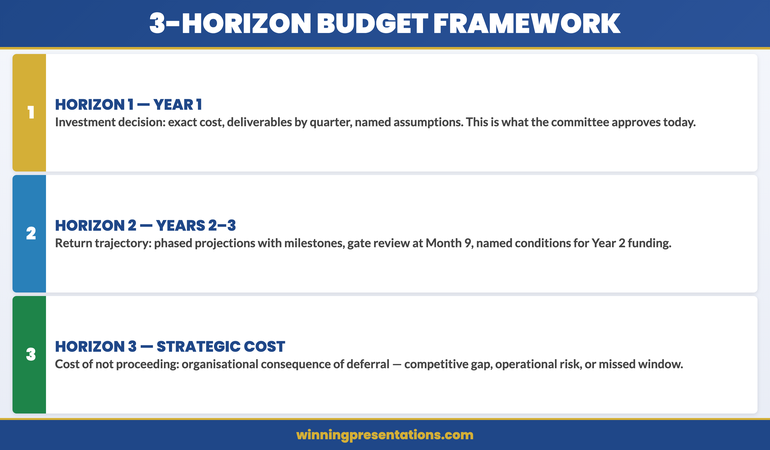
The 3-horizon framework restructures a multi-year proposal around how finance committees evaluate long-range investment, rather than how financial models are typically built.

Horizon 1 covers the immediate investment decision: what is being committed to this financial year, at what cost, and for what specific outcome. This is the only horizon the committee needs to approve today.

Horizon 2 covers the return trajectory: how value accumulates in Years 2 and 3, under what conditions, and what the key milestones are that signal whether the programme is on track. This horizon tells the committee what they are agreeing to in principle when they approve Horizon 1.

Horizon 3 covers the strategic context: what the organisation’s competitive or operational position looks like if this investment does not proceed. This is the cost-of-delay argument — the most often absent element, and the most important for overcoming the default deferral instinct.

The framework works because it matches the structure of a finance committee’s decision-making process rather than the structure of a financial model. It separates the approval decision from the forward commitment from the strategic rationale, and presents each in the order a committee needs to process them.

Three planning horizons infographic: Horizon 1 — Year 1 investment decision, Horizon 2 — Years 2 and 3 return trajectory, Horizon 3 — cost of not proceeding

Horizon 1: Building the Year 1 Investment Case

The Year 1 investment case is the most specific and most detailed section of your proposal. This is what the committee is being asked to approve today, and it needs to hold up under direct scrutiny. Every figure should be supportable, every assumption named, every dependency identified.

Structure the Year 1 case around four elements: the problem being addressed, the investment required, the outputs delivered by year-end, and the risk of not investing at this level. The problem statement should quantify the current state using operational data you can defend. “Our current process takes 12 days and introduces rework at roughly one in six outputs” is defensible. “We are 40% less efficient than best practice” is not — the comparison is unverifiable and finance committees notice.

The Year 1 output statement should describe deliverables, not benefits. Benefits belong in Horizon 2. Year 1 deliverables are what you will have produced by year-end: infrastructure built, system deployed, team trained, pilot completed. These are verifiable. They give the committee something concrete to hold you to, which builds credibility rather than eroding it.

Horizon 2: Showing the Return Trajectory

The return trajectory for Years 2 and 3 should be presented at a coarser level of detail than Year 1. Finance committees expect long-range projections to carry wider confidence intervals. Presenting Year 3 figures with Year 1 precision signals either that you have not thought carefully about uncertainty, or that you are suppressing it. A range with named assumptions is more credible than a specific number that implies false precision.

The key elements of Horizon 2 are the milestones that signal the programme is on track, the trigger points that would prompt a review or a pause decision, and the cumulative return projection with its named dependencies. Being explicit about what Years 2 and 3 figures assume — which market conditions, which internal capacity, which decisions not yet made — demonstrates analytical maturity. Finance committees are far more comfortable with named uncertainty than with projections that appear to ignore it.

Present Horizon 2 as a conditional commitment: “Approving Year 1 today gives you visibility of the Year 2 cost envelope. Year 2 funding would be subject to a gate review at Month 9, where we present against the delivery milestones.” This is how large programmes are actually managed. Presenting it explicitly signals governance competence, which builds more confidence with a finance committee than any spreadsheet.

Horizon 3: The Cost of Not Proceeding

Horizon 3 is not about what happens to the project if it is not approved. It is about what happens to the organisation. The two produce very different responses from finance committees. “We will not achieve our efficiency targets” is a project consequence. “Our unit cost per transaction will remain 34% above sector median while competitors who have made this investment begin undercutting our contract pricing” is an organisational consequence. The second creates a decision imperative that the first does not.

The cost-of-delay argument is also where you introduce the competitive, regulatory, or technology context that a three-year investment is typically responding to. If there is a market shift, a regulatory deadline, or a technology window that makes this planning cycle the optimal one for investment, state it in Horizon 3. This reframes the question from “should we do this?” to “is this the right time?” — which most finance committees will answer in your favour if the evidence is credible and specific.

⭐ Maven Flagship — Executive Buy-In

Walk into your next approval meeting prepared

The Executive Buy-In Presentation System gives you 7 self-paced modules covering stakeholder analysis, case construction, and the presentation structures that hold up to scrutiny.

Monthly cohort enrolment — £499, lifetime access.

Enrol in the Executive Buy-In System →

Slide Structure for the Proposal Deck

The slide order for a multi-year budget proposal should follow the 3-horizon logic, not the financial model structure. The sequence that earns finance committee approval:

Slide 1 — Decision Summary. One slide: what you are recommending, what it costs in Year 1, what it returns over three years, and the consequence of not proceeding. Readable in 60 seconds.

Slides 2–3 — The Problem Being Addressed. Current state data establishing why the investment is necessary. Operational metrics, competitive positioning, or regulatory context — whichever is most relevant. This comes before the cost because it frames the cost as a response rather than a request.

Slides 4–6 — Horizon 1 Investment Case. Year 1 cost breakdown, deliverables by quarter, assumptions, and risks. This is the most detailed section because it is the decision being made today.

Slides 7–8 — Horizon 2 Return Trajectory. Phased return projection with named milestones, gate review points, and the conditions under which Years 2 and 3 funding would be confirmed.

Slide 9 — Decision Request. What you need approved today, in one sentence, with the action assignment and the timeline. This is the closing structure that ensures your proposal ends with a decision rather than a deferral — the same principle behind every effective executive presentation close.

For proposals that have already gone through one failed submission, the budget resubmission framework covers how to restructure after rejection without undermining your credibility on the second attempt. For ongoing tracking once a budget is approved, the budget variance presentation structure gives finance committees the accountability view they expect in subsequent review cycles.

When your organisation uses zero-based budgeting rather than prior-year baselines, the zero-based budget presentation approach runs alongside the three-horizon structure to justify every line of Year 1 investment from first principles.

The Executive Slide System includes budget request templates and AI prompt cards for building the three-horizon narrative quickly before a capital allocation deadline.

Preparing for CFO-Level Questions

Finance directors and CFOs reviewing multi-year proposals will focus on a predictable cluster of questions. Preparing specific answers before the committee meeting is the minimum standard for a proposal of this size.

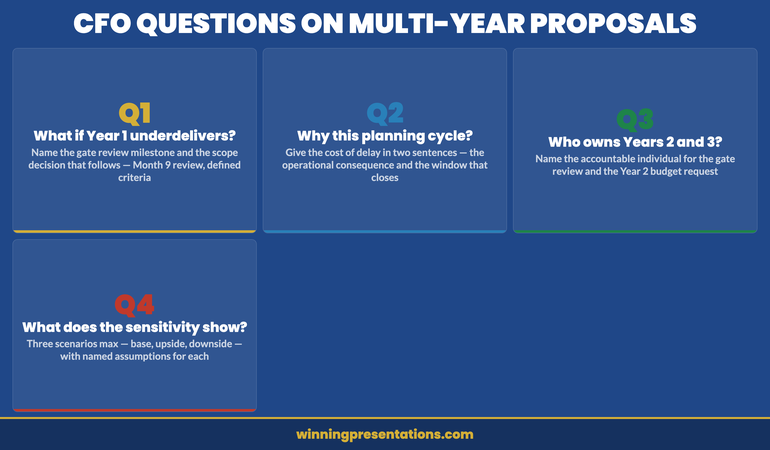
“What happens if Year 1 underdelivers?” This tests whether you have a contingency plan. The answer should name the gate review milestone, define what “underdelivers” means specifically, and describe the decision that follows. “If we are behind Month 9 delivery milestones by more than 15%, we bring a revised scope to the Q4 committee rather than proceeding to Year 2 funding.”

“Why now rather than next planning cycle?” This is the Horizon 3 question in direct form. Your answer is the cost-of-delay argument in two sentences: the operational or competitive consequence of waiting, and the specific factor that makes this planning cycle the right one. Without a credible answer to this question, the proposal is at high risk of deferral regardless of how good the analysis is.

“Who owns the Year 2 and Year 3 commitments?” Finance committees need clear programme ownership before approving multi-year investment. Name the individual accountable for the Month 9 gate review and the Year 2 budget request. If they are not in the room, explain when they will be briefed.

Finance committee Q and A preparation infographic: three CFO questions on multi-year proposals and the response structure for each

Build the Full Case, Not Just the Financial Model

The Executive Slide System — £39, instant access — includes templates, AI prompt cards and framework guides for budget proposals at every seniority level, from departmental requests to capital allocation committees.

  • Budget Request template structured for phased, multi-year investment
  • AI prompt cards to build the three-horizon narrative quickly under deadline

Get the Executive Slide System →

Designed for senior budget owners who need approval at the first committee meeting.

Frequently Asked Questions

How far ahead should a multi-year budget proposal project?

For most corporate planning cycles, a three-year horizon is standard. Year 1 should be presented at budget-line level of detail. Years 2 and 3 are typically shown at programme or workstream level, with clear acknowledgement that they are indicative and subject to gate reviews. Projecting beyond three years in a single proposal usually signals that the scope is too large to be decided in one committee meeting and may need restructuring as a phased programme with separate approval stages.

Should the proposal include a sensitivity analysis?

Yes, but keep it brief and specific. One slide showing the outcome under three scenarios — base case, upside, and downside — with the assumptions that drive each. Finance committees expect sensitivity analysis on investment proposals of this size. However, a sensitivity analysis with more than three scenarios or more than four variables per scenario suggests you are not confident in your base case, which creates the opposite impression from the one you intend.

What is the right length for a multi-year budget proposal presentation?

Nine to twelve slides is the appropriate range for a finance committee presentation. The detailed financial model belongs in a supporting document or appendix, not in the main deck. Finance committees need to make a decision; they do not need to review every assumption in the room. If the committee wants the detailed model, they will ask for it. Present the decision case, not the workings.

How do you handle a committee that wants to reduce Year 1 scope before approving?

Prepare for this in advance by identifying which Year 1 elements are critical-path dependencies for Years 2 and 3 outcomes, and which are not. If the committee wants to reduce scope, offer a restructured Year 1 that protects the dependencies while deferring the discretionary elements. This is more credible than defending the full scope, and it signals that you understand programme priority rather than treating everything as equally essential.

The Winning Edge — Weekly Executive Communication Insights

Each Thursday: one high-stakes communication technique, one real case study, one action you can apply before your next meeting.

Subscribe to The Winning Edge →

Download the free Executive Presentation Checklist — a one-page structure review for any high-stakes meeting.

About the Author

Mary Beth Hazeldine is the Owner & Managing Director of Winning Presentations. With 25 years of corporate banking experience at JPMorgan Chase, PwC, Royal Bank of Scotland, and Commerzbank, she has delivered high-stakes presentations in boardrooms across three continents.

A qualified clinical hypnotherapist and NLP practitioner, Mary Beth advises executives across financial services, healthcare, technology, and government on structuring presentations for high-stakes funding rounds and approvals.
Book a discovery call | View services

19 Apr 2026

Internal Transfer Pitch: The Presentation That Gets You to the Role You Want

Quick Answer

An internal transfer pitch succeeds when it is structured as a business case rather than a personal preference statement. The decision-maker needs to see three things: what the organisation gains by approving the move, what you bring that is directly relevant to the new role, and what the cost or risk of not moving you is. An internal pitch that frames itself around your career goals is a request. One that frames itself around organisational value is a proposal.

Tomás had been in the same division for eight years. When a senior role opened in a part of the business he had been angling towards for two years, he put himself forward, prepared a thorough self-assessment, and requested time with the divisional director to discuss it.

The conversation lasted 11 minutes. The director told him the role would be filled externally.

What went wrong was not Tomás’s track record, which was strong. What went wrong was the structure of what he said. He spent the 11 minutes explaining why he wanted the role. The director spent those same 11 minutes silently calculating what losing Tomás from his existing team would cost him. Neither of them was having the conversation the situation required.

Internal transfer pitches fail in this way constantly. The candidate frames the conversation around their development. The decision-maker evaluates it through the lens of organisational disruption. Those two frames are not compatible, and without a structure that addresses both, the conversation ends in a polite “we’ll let you know” that usually means no.

Need a presentation structure for a high-stakes career conversation?

The Executive Slide System includes proposal templates and framework guides designed for making the business case in internal and external career-stage presentations.

Explore the System →

Why Internal Pitches Fail When External Pitches Would Succeed

The most counterintuitive aspect of an internal transfer pitch is that your existing relationship with the organisation makes the conversation harder, not easier. External candidates start from zero. You start from a set of existing perceptions, existing dependencies, and existing political dynamics that shape how every word you say is received.

Your current manager hears your transfer pitch as a signal that their team is about to lose a high-performer. The hiring manager in the new division may have concerns about whether you can reposition yourself from a known role into an unknown one. The HR function is evaluating whether approving your move sets a precedent they are comfortable with. None of these stakeholders are against you, but none of them are reading your pitch as a neutral observer.

This means the internal pitch requires a more sophisticated structure than an external interview. An external candidate needs to establish credibility, demonstrate capability, and close on the opportunity. An internal candidate needs to do all three of those things and also address the costs and concerns that come with internal movement. The pitch has to make it easy for multiple stakeholders to say yes, not just the hiring manager.

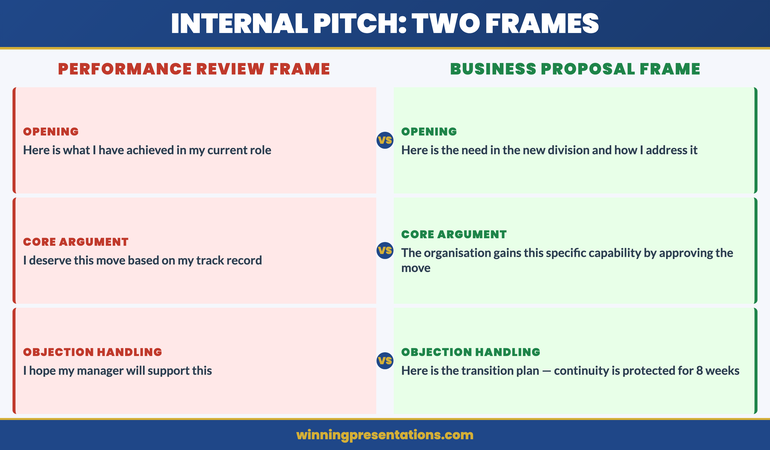
The failure mode for most internal pitches is treating the conversation as if it were a performance review rather than a business proposal. The structure of a performance review is backward-looking: here is what I have done, here is how well I have done it, here is why I deserve the next thing. The structure of a business proposal is forward-looking: here is the problem that needs solving, here is my capability to solve it, here is what the organisation gets by backing this move. The second frame is far more persuasive in a decision setting.

Internal pitch frame comparison: Performance Review frame (backward-looking: what I have done) versus Business Proposal frame (forward-looking: what the organisation gains)

The Three Elements Every Internal Pitch Must Address

An internal transfer pitch that earns approval addresses three questions in sequence. These questions correspond to the concerns of the different stakeholders involved in the decision.

1. What does the organisation gain? This is the organisational value question, and it is the frame that makes an internal pitch a business proposal rather than a personal request. The answer should connect your specific skills and experience to a named need in the target role or division. Not “I have strong analytical capability” but “the new division is building a client-facing data function and I have spent three years building exactly this capability on the service delivery side, which is the experience they currently lack on the team.”

2. What do you bring that is directly relevant? This is not your full CV. It is the two or three pieces of your existing experience that are most directly transferable to the requirements of the new role. Be specific about the capability, and be explicit about the mechanism of transfer — not just “I have done X” but “the X I did on Project Meridian translates directly to the Y challenge I understand the new team is facing.” Internal decision-makers are generally more sceptical about transferability than external ones, because they have a clearer picture of the gap between your current role and the new one.

3. What is the cost or risk of the move not happening? This is the element most often absent from internal pitches, and it is the one that converts a polite conversation into a decision moment. The cost of the move not happening is rarely about you personally — it is about the organisational opportunity that is left unaddressed. “Without someone with this profile in the new team, the risk is that the function is built by people who understand the technology but not the client relationship dynamics. That is a gap that costs significantly more to correct after the fact.” This reframes the decision from “should we approve Tomás’s transfer?” to “what does it cost us not to put the right person in this role?”

How to Frame the Move as a Business Decision

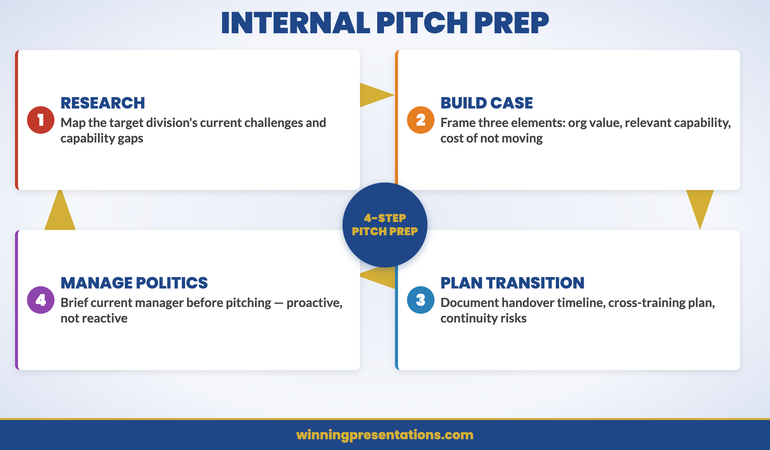
The business case frame for an internal transfer pitch requires you to research the target role with the same rigour you would apply to any significant business proposal. Before the conversation with the decision-maker, you should be able to answer three questions about the division you are moving into: what are the current performance challenges, what capability does the team currently lack, and what is the strategic priority that the role is expected to support?

This information is almost always available if you look for it. Department heads discuss their challenges in all-hands meetings and in conversations with peers. Annual reports and strategy presentations are public. If you have a contact in the division, a single conversation will surface the specific pressure points the team is dealing with. The point is to do this research before the pitch, so your opening framing is not “I would like to move to your team” but “I understand the team is building out its [specific capability] function, and I have direct experience in that area from my current role.”

This opening immediately repositions the conversation. Instead of a candidate asking for a favour, you are a senior professional who has identified a specific organisational need and is presenting a solution. That is the frame in which business proposals are evaluated, and it is far more likely to generate a substantive conversation than a general expression of interest.

The political dimension of an internal transfer pitch is real and ignoring it does not make it disappear. Your current manager will find out about the pitch, if not from you then from the person you are pitching to. Managing that conversation proactively is always better than having it reactively.

The timing of when you inform your current manager is a judgment call that depends on the strength of your relationship and the culture of your organisation. In most settings, informing them before rather than after the pitch is the right move, framed as a professional courtesy rather than a request for permission. “I wanted you to hear this from me directly before I speak with anyone else: I am going to explore the opportunity in [division]. I am not planning to leave the team immediately — this is a longer-term development move — and I want to make sure we handle any transition in a way that does not leave the team exposed.”

This conversation also gives you an opportunity to address the most immediate concern your current manager has: continuity. If you can demonstrate that you have a clear transition plan before the pitch even happens, you remove the most significant source of resistance to an internal move. A manager who knows the handover will be handled well is far less likely to block or slow an internal transfer than one who feels the departure will be disruptive and unplanned.

The broader political landscape also includes relationships with peers who may be affected by the move or who have competing interests in how the new role is filled. It is worth thinking through who the decision influences and ensuring none of them are surprised in a way that creates unnecessary friction.

Presenting Your Transition Plan

Including a transition plan in your internal pitch is one of the most effective ways to signal that you are thinking about this as a business decision rather than a personal one. Most internal candidates do not do this. The ones who do demonstrate a level of organisational maturity that sets them apart from those who present only their own interests.

A transition plan for an internal pitch addresses three things: who takes over your current responsibilities, over what timeline, and what the risk to the current team’s output is during the transition period. It does not need to be detailed. A single slide or a two-paragraph summary is sufficient. The purpose is not to hand over the operational planning to the current manager — it is to demonstrate that you have already considered the disruption your departure causes and have a structured approach to minimising it.

“I would expect a transition of approximately eight weeks. In that time, I would document the [specific process] and cross-train Ngozi, who already has the background to take it on. The two areas of highest continuity risk are [X] and [Y], and I have a plan for both.” That is a transition plan. It takes two minutes to deliver and it removes the primary objection that most internal decision-makers have.

Once the transfer is approved and you are into the new role, the 90-day presentation framework for a new role covers how to structure your first significant update to the new team’s leadership — a presentation that signals you have arrived with a plan and are already making an impact. And for anyone stepping into a board-facing role for the first time, preparing for your first board presentation in a new role addresses the specific challenges of presenting to a board that does not yet have a relationship with you.

Build the Slides for Your Internal Pitch

The Executive Slide System — £39, instant access — includes proposal and initiative templates designed for making the business case in high-stakes internal conversations, including career-stage and role transition presentations.

  • Initiative Proposal slide template adaptable for internal transfer business cases
  • Strategic Recommendation template for framing the organisational value argument
  • AI prompt cards to draft your three-element pitch narrative in under 20 minutes
  • Framework guides for presenting transition plans and capability transfer arguments

Get the Executive Slide System →

Designed for executives making the business case in high-stakes internal conversations.

Handling the Objections That Always Come Up

Three objections appear consistently in internal transfer conversations. Preparing for them before the pitch is not optional.

“We need you where you are.” This is the most common objection and the most straightforward to handle, because the transition plan directly addresses it. “I understand that, and I have thought about the handover carefully. Here is how I would ensure continuity in my current role…” If you have done the transition planning work, this objection collapses on contact. If you have not, it is fatal.

“You don’t have experience in [specific area].” This is a capability gap objection. The response is to acknowledge the gap directly and then reframe it: “You are right that I have not done X in this context. What I have done is Y, which required the same underlying judgment in a different environment. I am confident the learning curve on the technical aspect of X is manageable; the harder part is the [specific judgment or relationship skill], and that is where my existing experience is directly relevant.” Acknowledging the gap first makes you more credible, not less.

“The hiring decision has not been finalised yet.” This is a timing objection, and it requires a specific response: “I understand. I am not asking for a decision today. I am asking for your awareness that I am interested and that I believe I can make a strong business case for the move. Can we schedule 20 minutes when the process is at the right stage for you to discuss it formally?” This keeps the conversation alive without pressuring a decision that has not yet been reached.

For the pitch structure itself, the executive presentation outline framework covers the sequencing principles that make a business case land well with senior decision-makers, whether the pitch is for an internal move, an external role, or a project proposal. And if you are doing this presentation virtually — which is increasingly common for internal conversations across different office locations — the virtual presentation energy guide covers the camera-presence techniques that ensure you read as authoritative and confident even through a screen.

If you are building the supporting slides for your internal pitch, the Executive Slide System includes initiative proposal templates and AI prompt cards for making the business case quickly.

Internal transfer pitch objection handling infographic: three common objections and the response structure for each — We need you where you are, capability gap, and timing

Ready to Build the Slides for Your Business Case?

The Executive Slide System — £39, instant access — includes proposal templates and AI prompt cards you can use to build a structured internal pitch deck in under an hour.

  • Initiative Proposal and Strategic Recommendation templates
  • AI prompt cards for making the capability and business value arguments quickly

Get the Executive Slide System →

Designed for executives making high-stakes internal cases under time pressure.

Frequently Asked Questions

Should I prepare a formal presentation for an internal transfer pitch, or keep it conversational?

It depends on the culture of your organisation and the seniority of the decision-maker. At director level and above, a brief structured document or slide deck signals that you are treating this as a professional business proposal rather than an informal request — which is the right impression to create. At manager level, a well-prepared verbal conversation with a clear structure may be more appropriate. In all cases, the structure of what you say should follow the business case framework: organisational value, relevant capability, cost of not moving. Whether you use slides or not, that is the argument that needs to be made.

How do I pitch for a lateral move when I am already at a senior level?

Lateral moves at senior levels require the most careful framing, because the default assumption is that a senior professional who wants to move sideways is either dissatisfied in their current role or unable to progress vertically. The pitch needs to address this assumption directly. Frame the lateral move in terms of breadth of experience that prepares you for a specific future progression, or in terms of the strategic value to the organisation of having your specific capability in the new function. “I have taken my current division as far as I can in the current structure. Moving to the international team gives me the cross-regional experience that will make me a stronger candidate for the MD role when it becomes available” is a credible lateral pitch for a senior executive.

What if my current manager has already told me they will not support the move?

This is a common and genuinely difficult situation. The first step is understanding the specific objection your current manager has — whether it is genuinely about team continuity, or whether it reflects a different concern (e.g., they do not want to lose you from their headcount, or they have a relationship with the hiring manager that makes this awkward). Once you understand the actual objection, you can address it directly. If the objection is about continuity, a detailed transition plan is the most effective tool. If the objection is more political, you may need to involve HR or a senior sponsor to navigate the decision above the level of the immediate manager.

How long should an internal transfer pitch meeting be?

Twenty to thirty minutes is the appropriate range for an initial pitch conversation. This is long enough to present the business case, address the primary objections, and agree a next step, and short enough to respect the decision-maker’s time and signal that you have prepared efficiently. If the conversation runs beyond 30 minutes, it is usually a good sign — it means the decision-maker is engaged enough to explore the details. The worst outcome is a 10-minute conversation that ends politely, because it means you did not get deep enough into the case for the decision-maker to form a view.

The Winning Edge — Weekly Executive Communication Insights

Each Thursday: one high-stakes communication technique, one real case study, one action you can apply before your next meeting.

Subscribe to The Winning Edge →

Download the free Executive Presentation Checklist — a one-page structure review for any high-stakes meeting.

About the Author

Mary Beth Hazeldine is the Owner & Managing Director of Winning Presentations. With 25 years of corporate banking experience at JPMorgan Chase, PwC, Royal Bank of Scotland, and Commerzbank, she has delivered high-stakes presentations in boardrooms across three continents.

A qualified clinical hypnotherapist and NLP practitioner, Mary Beth advises executives across financial services, healthcare, technology, and government on structuring presentations for high-stakes funding rounds and approvals.

Book a discovery call | View services