

Quick answer: Senior leaders who stall on commitment to presentation coaching they already know they need are usually not avoiding the work — they are reacting to a structural feature of the typical coaching offer that triggers a quiet anxiety. Most coaching is sold as a scheduled commitment with mandatory live attendance, a fixed cohort calendar, and a structure that assumes the leader can clear their diary on the same days every week for six or eight weeks. For senior people whose diaries collapse unpredictably under operational reality, the live-attendance constraint is the actual blocker — not the decision to develop. Commitment anxiety on coaching is most often calendar anxiety in disguise. The format that resolves it is a self-paced programme with optional recorded calls, monthly enrolment, and lifetime access — which is structurally what the Executive Buy-In Presentation System is designed as. Removing the calendar constraint removes most of the hesitation. The work then happens at the leader’s own pace.
JUMP TO:
In late 2021 a senior managing director at a European insurance firm emailed me to ask about my coaching offer. She had three board meetings coming up over the next four months, she had been told her presentation work was the next development edge for her career, and she had been thinking about coaching for eighteen months without doing anything about it. The email was thoughtful and self-aware. She asked about pricing, structure, schedule, and what the time commitment would look like. We exchanged several emails. She did not enrol. I assumed she had decided against it, which happens regularly and is fine. Almost a year later she emailed again with a different question entirely — about a single deck she was preparing for a one-off committee meeting — and mentioned, in a P.S., that she still thought about the coaching question regularly and had still not made a decision. The thing she had not made a decision on for two years was a decision she had already made.
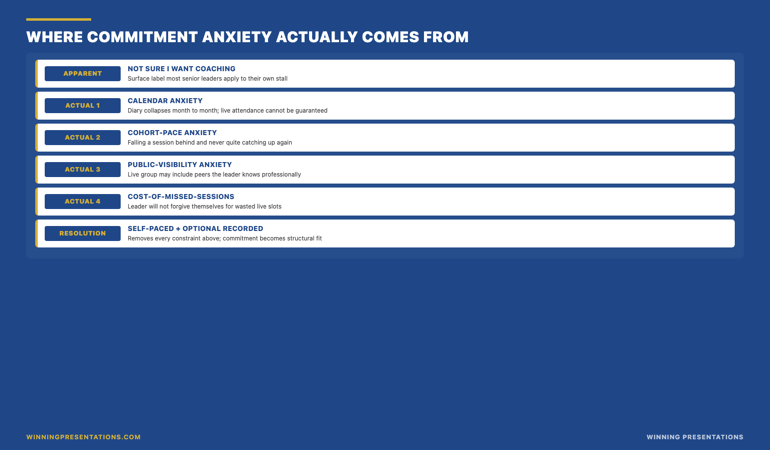
I asked her, in the next email, what specifically had kept her from enrolling when she had clearly already decided she wanted to. Her answer came back in two sentences. “My diary collapses on me every month and I cannot guarantee I will be in the right place on the right day. If I commit to a live programme and miss the first two weeks, I will hate myself for wasting the money, and I know I will miss them.” That was the entire blocker. It had nothing to do with the value of the work, the cost, the format, or the coach. It had to do with one structural feature of how most coaching is sold — live scheduled attendance — that her job structurally prevented her from committing to. The stall was not commitment anxiety. It was calendar anxiety the live-format constraint had created.
(This article was created with AI assistance; all stories and insights are based on 35 years of real client work.)
She enrolled in a self-paced programme with optional recorded sessions in the following week. The thing that had taken two years of email exchanges to decide took her about forty minutes once the calendar constraint was off the table. Most commitment anxiety on senior-leader coaching is structural anxiety about a specific feature of the typical offer, not psychological anxiety about the development itself. Naming the structural source — usually calendar, occasionally cohort-pace, occasionally public visibility — is what unlocks the decision the leader already made.
If the calendar is what has been stopping you:
The Executive Buy-In Presentation System is a self-paced programme with monthly cohort enrolment. No deadlines, no mandatory live attendance, optional Q&A calls fully recorded so you can watch back anytime. Enrol now and start at your own pace. Lifetime access to materials.
The stall is calendar anxiety, not coaching anxiety
The leaders I have watched stall longest on commitment to coaching are almost never the ones who have decided the coaching is not for them. The ones who genuinely do not want it tend to be quick — one polite email, one declined conversation, one move on with their lives. The leaders who stall for months or years are the ones who have already decided they want it. The decision lives in their head as settled. What does not get settled is the specific transaction step of enrolling, and the reason that step does not happen is almost always traceable to a structural mismatch between the typical coaching offer and the leader’s working reality. Once you start naming the mismatch out loud, the stall usually resolves.
The most common mismatch is the live-attendance constraint. A senior leader running a business unit, a function, or a region does not have a diary that holds shape eight weeks out. Their diary holds shape four days out, and even that breaks. A coaching offer that requires them to be in the right place on the right day for six consecutive weeks is structurally asking them to commit to something their job will not let them deliver on, and they know it. The result is not that they refuse the offer. The result is that they hold the decision permanently open, which is the response a careful person has when the right answer is “yes” but the structural commitment is “no”. The decision sits in limbo until the structural feature changes or the leader gives up and the decision dies quietly.
The second-most-common mismatch is cohort-pace anxiety. A live cohort moves at the pace of the cohort, which the leader does not control. A senior person who has had a brutal week at work and needs to skip the next session knows they will fall behind and never quite catch up. A senior person who has finished the work three weeks ahead of the rest of the cohort cannot move forward. The leader who is structurally either ahead or behind the median cohort pace experiences the cohort as a constraint rather than a support, and the anticipation of that constraint shows up as commitment anxiety before enrolment, not after.
Why the standard live-cohort format creates the friction
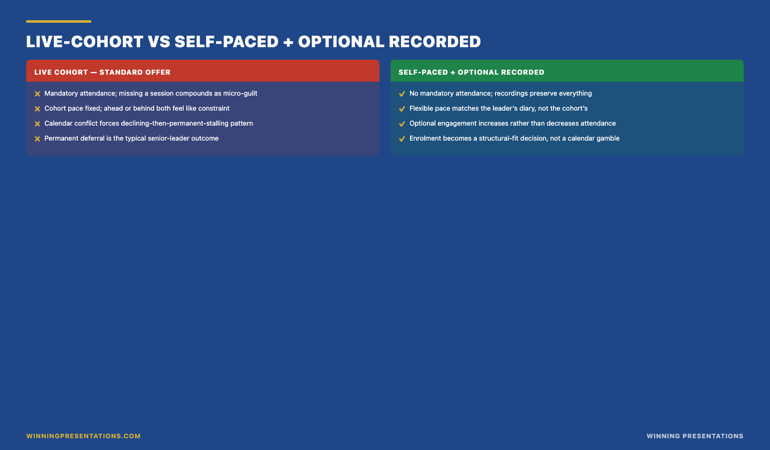
The standard live-cohort format exists for good reasons. Live attendance creates accountability. Real-time interaction produces certain kinds of learning that recorded content cannot reproduce. Cohort pacing builds peer relationships. None of this is wrong, and for some categories of learner — typically earlier-career professionals with more predictable diaries — the live-cohort format is the right one. The mistake is generalising the format to populations it does not fit. The senior leader population is the most obvious example of a poor fit. Their diaries are unpredictable in a different category from earlier-career professionals. Their professional confidence does not need the accountability scaffolding live attendance provides. Their relevant peer group is small and rarely overlaps with any cohort they would actually be put into. The live-cohort design optimises for variables senior leaders do not have problems with, at the cost of variables they do.
What senior leaders need from a coaching format is the opposite shape. They need flexibility on attendance because their diaries demand it. They need the option of working at their own pace because they are often either dramatically ahead or dramatically behind the average. They need access to the live interaction surface when they can attend, without being penalised when they cannot. They need lifetime access to the materials because the work is too important to lose if they fall off the pace for a quarter. And they need the option of returning to the materials in two years when they have a different deck and want to re-run a specific module against new content. None of this is exotic. It is just structurally different from the live-cohort format, and the difference is what produces the commitment-anxiety pattern when the standard offer is the only thing on the table.
What changes when the calendar constraint is removed
The leaders I have watched move from years of stalling to enrolment in a single week have almost all done so when the structural format changed. The decision they could not make against a live-cohort offer is the same decision they make easily against a self-paced offer with optional recorded calls. The Executive Buy-In Presentation System is structurally designed for this audience. It is self-paced. There are no deadlines. There is no mandatory live attendance. The optional Q&A calls are fully recorded so the leader who cannot attend any of them this month can still get the full value, and the leader who can attend all of them gets a structural lift on top. The monthly enrolment cadence means a leader can start at any time without waiting for the next intake window. The materials are lifetime access, so a leader who needs to pause for six weeks because the day job exploded can return without losing the work. Every one of those structural features is a direct response to the friction patterns that produce commitment anxiety on standard coaching offers.
The interesting effect of removing the calendar constraint is that the leaders who enrol against it almost always then attend more of the optional live calls than they expected to, because the absence of the obligation removes the resistance. The thing that stopped them committing was not the call itself — the call, when they sat in it, was useful. The thing that stopped them committing was the obligation of the call. Take the obligation away and the call becomes attractive. This is not a marketing observation; it is a pattern I have watched repeatedly across senior-leader populations and it is the single most counter-intuitive aspect of designing coaching for this audience. They will attend more if you require less. The optional structure produces higher engagement than the mandatory structure does, because the optional structure does not produce the anticipatory resistance that defers the enrolment in the first place. For more on the structural decisions the programme is built around, see the Executive Buy-In Masterclass overview; for the comparison with 1:1 formats, the 1:1 executive presentation coaching reference is the companion piece.
Stop dreading the commitment before the work has even started.
The Executive Buy-In Presentation System gives you the preparation framework that replaces last-minute panic with structured confidence — 7 self-paced modules, monthly cohort enrolment, optional Q&A calls fully recorded so attendance is never mandatory. No deadlines. Lifetime access to materials. The format removes the calendar constraint that creates most of the hesitation. £499.
- Self-paced — work the 7 modules at whatever pace your diary allows
- Optional live Q&A calls, fully recorded — no mandatory attendance, ever
- Monthly cohort enrolment — start whenever suits you, no waiting for the next intake window
- Lifetime access to all course materials — pause and resume without losing the work
The permission a self-paced format gives that live formats cannot
The deeper effect of removing the calendar constraint is that the format gives the leader permission to take the work seriously without giving them anything additional to feel guilty about. A live-cohort format implicitly assumes the leader will succeed at attending, and any miss is a small failure. A self-paced format with optional recorded sessions assumes the leader will choose attendance based on what their diary allows that week, and any non-attendance is a non-event. The first format produces accumulated micro-guilt that compounds across the cohort cycle. The second format produces a clean working relationship with the material. Senior leaders are unusually sensitive to the difference. They have enough things in their working life that produce accumulated micro-guilt; they will not voluntarily add another one to the list. The format that does not add to the list is the format they will enrol in.
A lower-friction starting point for leaders who want to begin the work without enrolling in the full programme — or who want the slide structure that the buy-in framework references in module five — is the Executive Slide System (£39). The slide system gives the leader the templates, AI prompts, and scenario playbooks for executive decks immediately, with no cohort enrolment, no deadlines, and instant download. For leaders who are stalling because of the financial commitment scale rather than the calendar, the slide system is the right first move — it does the structural slide-side work the buy-in programme references and frequently surfaces the value of the deeper buy-in framework later.
The complete system for senior professionals who need to secure approval at senior levels.
Executive Buy-In Presentation System — 7 self-paced modules, monthly cohort enrolment, optional recorded Q&A sessions. Lifetime access. £499.
Frequently asked questions
Is it really commitment anxiety if I have been thinking about coaching for over a year and haven’t enrolled?
Usually it is, although the word “anxiety” tends to make leaders flinch because it sounds psychological rather than practical. The pattern is more often practical than psychological — the leader has decided they want the work, they have not been able to find a format that fits their working life, and the unresolved transaction step accumulates as a low-grade background concern. The longer the stall lasts, the more it feels like indecision; in fact it is usually a correct response to a structural mismatch between the offer and the leader’s diary. Once the structural mismatch is named and a different format is on the table, the decision tends to happen quickly.
What is the most common reason senior leaders stall on coaching they say they want?
Live-attendance scheduling. A leader running a business unit, a function, or a region cannot reliably guarantee they will be in the right place on the right day eight weeks out. A coaching format that requires them to do exactly that is asking them to commit to something they know their job will prevent them from delivering on. The result is not refusal — it is permanent deferral. Once the live-attendance constraint is removed (typically via a self-paced format with optional recorded sessions), the same leaders who deferred for years tend to enrol within a week, because the practical objection has been resolved.
How long does it take to actually work through a self-paced presentation programme?
The honest answer is six to ten weeks for the focused work, plus or minus depending on the leader’s pace and the urgency of any specific upcoming meetings. A leader with a real board deck three weeks out typically front-loads the first four modules in the first ten days and finishes the remaining modules in the weeks after. A leader without a specific deadline tends to take eight to ten weeks at one module per week. The self-paced format allows either pattern — the work expands and contracts to the leader’s reality rather than the other way around. The lifetime access means a leader can also return to specific modules a year later for a different deck without re-enrolling.
Will I get less out of a self-paced programme than a live one?
The structural depth of the work is identical. What you get less of is the real-time interaction surface, which matters more for some learners than for others. Most senior leaders are net better served by the self-paced format because the alternative for them is not “live cohort” versus “self-paced” — it is “self-paced” versus “permanent deferral”. A programme they will actually enrol in and work through outperforms a programme they would in theory get more from but cannot reliably attend. The optional recorded Q&A sessions also mean leaders who can attend live get most of the real-time benefit anyway, and leaders who watch back asynchronously can review specific moments more than once, which live attendance does not allow.
The Winning Edge — weekly newsletter
The Winning Edge is a weekly newsletter for senior professionals who present at the executive level. One short email a week on the structural moves that separate decks committees back from decks they defer. Subscribe to The Winning Edge →
For the wider library of presentation assets that pair with the buy-in framework — the slide system, the Q&A taxonomy, the storytelling primer, and the delivery references — the Complete Presenter bundle (£99) collects them in one place.
About the author
Mary Beth Hazeldine is Owner & Managing Director of Winning Presentations Ltd. With 24 years of corporate banking experience at JPMorgan Chase, PwC, Royal Bank of Scotland, and Commerzbank, she advises executives across financial services, healthcare, technology, and government on structuring presentations for high-stakes funding rounds, board approvals, and strategic decisions.
The next time you notice you have been thinking about coaching for months without enrolling, do three things instead: name the specific structural feature of the offer that has been blocking the transaction step; ask whether the block is the work itself or the format of the work; and if the block is the format, look for a self-paced version that removes the constraint. The leader who names the structural source of the stall resolves it. The leader who keeps the stall labelled as commitment anxiety stays stuck inside it.