

Quick answer: When the data is ambiguous, a board is not really judging your numbers — it is judging whether you know where your evidence ends and your judgement begins. The move that builds trust is to label every headline claim on a data slide as one of three tiers and to say the label out loud: know, what is verified and you can stand behind; infer, a reasoned judgement drawn from incomplete evidence; bet, your recommendation under genuine uncertainty. This is the three-tier read. The diagnostic is the tier test: for every headline number, decide whether it is know, infer, or bet, and if you cannot decide, you have not yet understood your own figure. Naming the tier does not weaken your case — it lets the board calibrate how much weight to put on each claim and still act. Before your next data review, mark every headline K, I, or B and say the label aloud as you present it.
JUMP TO:
In 2006, during my time in corporate banking, I sat in an investment committee at one of the institutions I worked for and watched an analyst present a market-sizing. He was good with numbers and he had clearly done the work. The trouble was the slide. It carried a single forecast figure for the size of the opportunity, set in the same confident type as everything else on the page, with no signal anywhere that it rested on a chain of assumptions rather than on observed fact. He talked to it as though it were settled. A director two seats down from the chair, a woman who had sat on that committee for years and rarely said much, put her pen down on the printed pack and asked: “Is that a number or a guess?” The analyst hesitated — just a beat too long — and in that beat the room changed. From that line on the committee stopped trusting not only the forecast but the whole model behind it, and the proposal was sent back for “a clearer view of what is known versus assumed.”
The work had not been the problem. The forecast may well have been the best available read of the market. What undid him was that he had blurred the line between what he could prove and what he was estimating, and a senior room can smell that blur instantly. When the data tells a clean story, presenters get away with this because nothing tests the seam. When the data is ambiguous — which at the executive level it almost always is, because the questions that reach a board are the ones without tidy answers — the seam is exactly where the room pushes. A director who cannot tell your verified figures from your estimates has no way to weigh your recommendation, so the safe move, the one boards default to, is to distrust all of it.
(This article was created with AI assistance; all stories and insights are based on 35 years of real client work.)
The fix is not better data and it is not a more confident delivery. It is a structural honesty about where each claim sits, applied openly enough that the room can see it. The framework I now teach senior leaders for exactly this situation is the three-tier read: before you present any data slide, you sort every headline claim into one of three tiers — know, infer, or bet — and then you name the tier out loud as you present, so the board can see precisely where your evidence ends and your judgement begins. It is not about sounding more certain. It is about being legibly honest, which under genuine uncertainty is the single most credible thing a presenter can be.
If your data slides keep blurring the line between what you know and what you are estimating:
The Executive Slide System ships 26 executive templates and 93 AI prompts built to separate verified figures from judgement on the page itself — data layouts that flag assumptions, sensitivity callouts, and a tier-labelling pattern for headline claims — plus 16 scenario playbooks covering board and investment-committee reviews and 7 checklists. It gives you a slide structure that carries an honest read of uncertainty instead of one you have to talk your way around in the room.
“Is that a number or a guess?” — the question that sinks an ambiguous slide
The director’s question was not hostile. It was diagnostic. She was not trying to embarrass the analyst; she was trying to do her job, which was to decide how much weight a committee could safely place on a forecast before committing capital against it. To do that she needed to know one thing the slide refused to tell her: was the figure something he had measured, or something he had estimated? A measured figure she could lean on. An estimate she would treat with caution and probe for its assumptions. A figure that could be either — a figure presented as fact but possibly built on a stack of guesses — she could not use at all, because she had no way to size the risk in trusting it. The slide gave her no signal, so she asked for one directly, and the asking exposed that the presenter himself had not drawn the line clearly in his own mind.
This is the trap of presenting uncertain data with uniform confidence. Every claim on the slide looks equally solid, which means the moment one claim turns out to be softer than it appeared, the room has no reason to believe the rest are any firmer. Uniform confidence is not reassuring to senior people; it is a tell. Experienced directors know that real analysis of an ambiguous question produces a mix — some things you can verify, some you can reasonably infer, some you are frankly betting on — and a slide that flattens all of that into one confident surface reads as either naivety or spin. Either way the room’s response is the same: it stops trusting the surface and starts digging, and once a board is digging rather than deciding, you have lost the meeting. The same instinct sits behind why saying “I don’t know” well can strengthen rather than weaken a presenter.
What the director wanted was not certainty. Boards live with uncertainty for a living; they are not expecting you to have eliminated it. What they want is for you to have mapped it — to know exactly which parts of your case are solid and which are exposed, and to tell them, so they can do their own weighing. The presenter who maps the uncertainty out loud hands the board the thing it actually needs to make the decision. The presenter who hides the uncertainty behind a confident slide forces the board to map it for him, in real time, by interrogation — and no one survives that process looking good.
Build data slides that show the board exactly where your evidence ends.
The Executive Slide System gives you the three-tier read as a ready slide structure — data layouts that separate verified figures from inferences and recommendations, assumption callouts, and sensitivity panels you can turn to under questioning. It ships 26 executive templates, 93 AI prompts for turning your own analysis into honestly-labelled slides, 16 scenario playbooks covering board approval, investment committee, and strategy review, plus 7 checklists. Built for senior presenters who take ambiguous numbers into high-stakes rooms. £39, instant download, lifetime access.
- 26 executive slide templates — data layouts that flag what is verified versus estimated
- 93 AI prompts — for labelling every headline claim know, infer, or bet from your own figures
- 16 scenario playbooks — board approval, investment committee, strategy review, finance review
- 7 checklists — including the pre-meeting tier test for every data slide
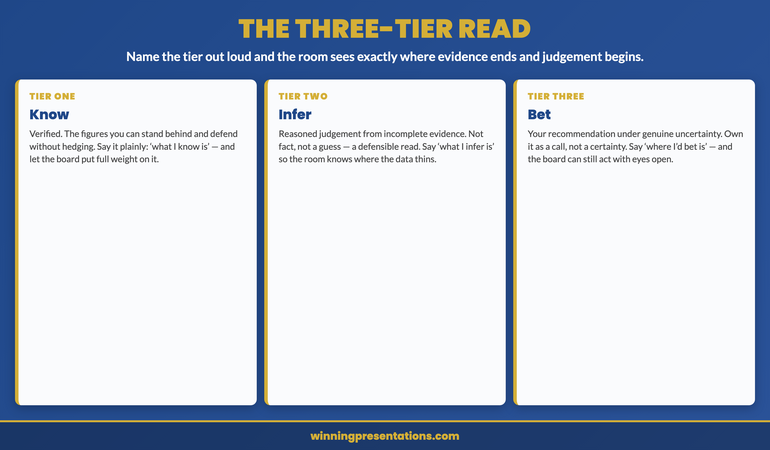
The three-tier read: know, infer, bet
The three-tier read works because it matches the way senior people already think about evidence. Every director on a board is, consciously or not, sorting your claims into roughly these categories as you speak — deciding which figures to lean on, which to question, and which to discount. All the framework does is bring that sorting onto the slide and into your voice, so you are doing it with them rather than leaving them to do it against you. The first tier is know: the figures that are verified, that you have measured or sourced and can stand behind without hedging. These carry full weight. When you present them you say so plainly — “what I know is” — and the board can build on them as solid ground. The discipline here is honesty in the other direction too: do not promote an estimate into the know tier just because you would like it to be firmer than it is.
The second tier is infer: reasoned judgement drawn from incomplete evidence. This is the largest tier in most ambiguous analyses and the one presenters most often disguise as fact. An inference is not a guess — it is a defensible read built from partial data, analogy, or expertise — but it is not verified either, and the board needs to know which it is. When you say “what I infer is, based on the three quarters we can see and the pattern in the comparable market,” you are telling the room exactly how much weight to give the claim and inviting them to test the reasoning rather than the messenger. The third tier is bet: your recommendation under genuine uncertainty. There is a point in every hard decision where the evidence runs out and a call still has to be made, and pretending otherwise insults the room. The strong move is to own it — “where I’d bet is” — framing your recommendation as a considered wager you are prepared to defend, not a certainty you are smuggling past them.
I watched the full effect of this in 2017, coaching a strategy director preparing for a planning review. Her board contained a non-executive with a reputation for taking forecasts apart line by line; she had been picked over by him before and dreaded it. We went through her deck and re-labelled every headline claim — know, infer, bet — and built the labels into how she would speak to each slide. When she presented, she opened each data point by naming its tier: what she knew, what she was inferring, where she was making a call. The notoriously sceptical non-executive, who normally treated these reviews as cross-examinations, listened through to the end and said it was “the first honest forecast this board has been shown.” The discussion that followed was not about her methodology, which is where it usually died. It was about the decision. By telling the room where her evidence ended, she had moved the conversation from whether to trust her to what to do — which is the only conversation a planning review is actually for. This is the same shift the partner work on the board pre-read strategy is built to create before the meeting even starts.
To build the deeper habit of using AI to construct executive-grade slides that handle data honestly:
AI-Enhanced Presentation Mastery is a self-paced programme — 8 modules, 83 lessons — on using AI to build presentations that hold up at executive level, including how to draft data slides that separate what is verified from what is inferred rather than letting a model flatten everything into confident prose. No deadlines, no mandatory session attendance; two optional live coaching sessions, fully recorded so you can watch them back anytime. Monthly cohort enrolment, lifetime access to materials. £499.
The tier test: label every headline before the board does
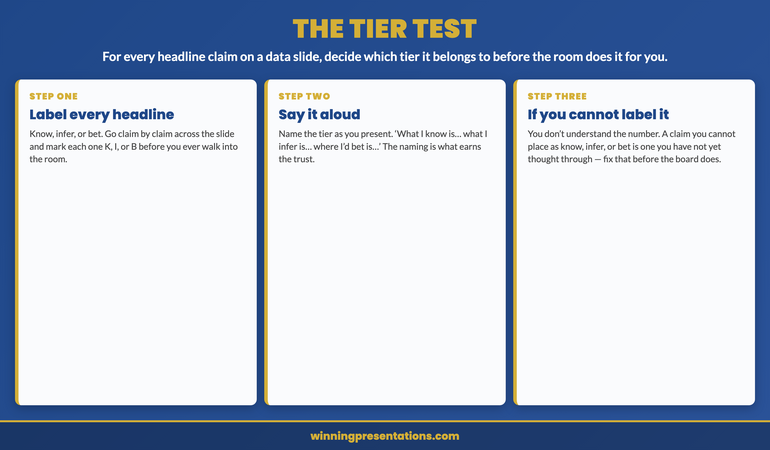
The framework is only useful if you can apply it cleanly to your own slides, and that is what the tier test is for. The test is a single discipline run against every headline claim on a data slide: label it know, infer, or bet. Take the claim — the market is worth this much, the cost will land here, the risk is contained — and force yourself to assign it one of the three tiers. Is this something you have verified and can stand behind? Then it is know. Is it a reasoned read from partial evidence? Then it is infer. Is it a call you are making where the evidence genuinely runs out? Then it is bet. The labelling has to be deliberate, claim by claim, not a vague sense that the deck is “mostly solid.” The whole value lies in the precision of forcing each individual headline into a single tier.
The diagnostic power of the test is in what happens when you cannot decide. If you pick up a headline claim and genuinely cannot tell whether it is something you know, something you are inferring, or something you are betting on, that is not a labelling problem — it is a signal that you have not understood your own number. You do not yet know what is holding it up. That is precisely the claim the sharpest person in the room will find, because the uncertainty in your own mind leaks into how you present it, and senior people are exquisitely tuned to that leak. So the test doubles as a preparation tool: every claim you struggle to label is a claim to go back and dismantle until you know exactly what it rests on, before the board does it for you, less kindly. By the time you walk in, every headline should carry a clean K, I, or B in your own notes, and you should be able to say each label aloud without hesitation.
There is a second discipline the test makes obvious, which is that the labelling must be spoken, not just done. Sorting your claims privately into tiers and then presenting them all with the same uniform confidence wastes the entire exercise — the board cannot read your notes. The trust is built in the saying. “What I know is the current run-rate. What I infer, from the comparable launches, is roughly this trajectory. Where I’d bet is that we clear the threshold by year three.” Said aloud, that sentence does in fifteen seconds what no amount of confident delivery can: it tells the room exactly how to weigh you. The work on building data slides that earn this kind of trust is the same work senior leaders bring into coaching for board-level rooms — the figures are usually fine; the labelling is what is missing.
Why naming uncertainty builds trust instead of eroding it
The objection every senior leader raises to this is intuitive and wrong: surely admitting where you are inferring and betting makes the board trust your numbers less? It feels as though confidence is the currency and any concession of uncertainty spends it down. But that gets the psychology of a senior room backwards. A board is not looking for a presenter with no uncertainty — they know the question is hard, which is why it reached them — they are looking for a presenter who has command of their uncertainty. Naming your tiers does not reveal weakness; it reveals that you have done the harder work of mapping exactly where your case is strong and where it is exposed. That is the work that separates someone a board can hand a bigger decision to from someone they cannot, and it is invisible until you make it audible.
What actually erodes trust is the opposite move — the uniform confidence that hides the seams. When a presenter treats every claim as equally settled and then one claim cracks under a question, the board does not just lose that claim; it loses faith in the presenter’s judgement, because they have just learned that this person cannot or will not tell solid from soft. From that point every other figure is suspect. The three-tier read inoculates you against this. When you have already told the room that a figure is a bet, a director probing it is not catching you out — they are doing exactly what you invited, and you are ready, because you flagged it yourself. You have converted the most dangerous moment in an ambiguous presentation, the exposed-assumption moment, into a moment you scripted. The board sees a presenter who anticipated the soft spot rather than one who got caught at it.
There is a final, quieter return. Naming your tiers changes the room’s relationship to the decision. When the board can see what is known, what is inferred, and what is a bet, they can do their own job properly — they can calibrate, put real weight on the solid parts, probe the inferences, and make a clear-eyed collective call on the bets. They become partners in weighing the uncertainty rather than adversaries trying to expose it. That is the deepest reason the strategy director’s sceptic called her forecast honest and then moved straight to the decision: she had given the board the one thing an ambiguous presentation usually withholds, which is an accurate map of its own confidence. A board that trusts the map will act on it, even when the territory is uncertain.
One slide system. Every committee. No subscription, no renewal.
Instant download, lifetime access to the Executive Slide System — 26 templates, 93 AI prompts, 16 scenario playbooks, 7 checklists. A one-off £39, no subscription to maintain and no licence to renew. Built for senior presenters who would rather start every data review from a structure that already separates what they know from what they are inferring and betting, than rebuild that honesty into a deck from scratch the night before.
Frequently asked questions
Won’t admitting uncertainty make the board trust my numbers less?
It does the opposite, provided you do it precisely. A board already assumes a hard question carries uncertainty — that is why it reached them. What they are weighing is whether you have command of that uncertainty. Naming which claims are verified, which are inferred, and which are bets shows you have mapped exactly where your case is strong and where it is exposed, which is the work that earns a board’s confidence. What erodes trust is uniform confidence that hides the soft spots, because the moment one claim cracks under a question, the board loses faith in all of them. Labelling your tiers protects you from that by putting the honesty on the table before anyone has to dig for it.
What is the most common mistake senior leaders make when the data is ambiguous?
Presenting every claim with the same confident surface, so the board cannot tell a verified figure from an estimate. It feels safer to project certainty, but to a senior room uniform confidence is a tell rather than a reassurance, because experienced directors know real analysis of a hard question produces a mix of solid and soft. When the surface is flat, the room has no way to calibrate, so it defaults to probing everything — and once a board is digging instead of deciding, the meeting is lost. The fix is the tier test: label each headline know, infer, or bet, and say the label aloud, so the board can weigh each claim accurately instead of distrusting all of them.
How do I actually present a forecast I am genuinely unsure about?
Place it in the bet tier and own it as a considered call rather than a fact. Walk the room through the parts you can stand behind first — “what I know is” for the verified figures, “what I infer is” for the reasoned reads from partial evidence — and then frame the forecast itself with “where I’d bet is,” making clear it is your recommendation under uncertainty and stating what you are basing the call on. This does not weaken the forecast; it tells the board precisely how much weight to give it and invites them to make the call with you. A bet you have named and can defend reads as judgement. A bet you have disguised as certainty reads as the thing that unravels under the first sharp question.
How is this different from just adding a disclaimer slide to my deck?
A disclaimer slide quarantines uncertainty into one place and then lets every other slide carry on as if it were fact, which is the very blur the board is trying to see through. The three-tier read works claim by claim, in the live narrative, where the decision is actually made. You are not adding a caveat at the end; you are labelling each headline number as you present it, so the board can weigh that specific claim in the moment. A disclaimer asks the room to remember a general caution while reading confident slides; the tier read removes the need to remember anything, because the honesty is attached to each number where it sits. One is legal cover. The other is a working map the board can act on.
The Winning Edge — weekly newsletter
The Winning Edge is a weekly newsletter for senior professionals who present at the executive level. One short email a week on the structural moves that separate presentations a board acts on from presentations it merely sits through. Subscribe to The Winning Edge →
For the wider library of presentation assets senior leaders draw on — slide system, storytelling primer, confidence and delivery references — the complete presenter library (£99) collects seven products plus three bundle-only bonuses, worth over £190, in one place — slides, storytelling, confidence, and delivery. See the wider set of board-readiness resources on the services page, and the partner article on the board pre-read strategy.
About the author
Mary Beth Hazeldine is Owner & Managing Director of Winning Presentations Ltd. With 24 years of corporate banking experience at JPMorgan Chase, PwC, Royal Bank of Scotland, and Commerzbank, she advises executives across financial services, healthcare, technology, and government on structuring presentations for high-stakes funding rounds, board approvals, and strategic decisions.
The next time you present a number you are not certain of, do three things instead of dressing it in uniform confidence: run the tier test on every headline claim and mark each one K, I, or B before you walk in; go back and dismantle any claim you cannot cleanly label, because that is the one the sharpest person in the room will find; and say the tier aloud as you present each number — what you know, what you infer, where you’d bet. The board is not asking you to be certain about an uncertain thing. It is asking you to know exactly where your evidence ends and your judgement begins, and to be honest enough to show them the line.