Tag: change management presentation

24 Mar 2026
Executive presenting restructuring announcement to team in modern glass boardroom with trust and clarity

The Restructuring Presentation: A Slide Framework That Keeps Team Trust Intact

When you announce a restructuring, you have 90 seconds to preserve trust or lose it. Most executives use that time to explain the business case. That’s backwards. A restructuring presentation succeeds because the *framework* signals respect for your people first, then delivers the difficult message. This article walks through the exact slide sequence, word choices, and structural decisions that keep your team’s confidence intact when roles are changing.

Quick Navigation

The Story: Anya’s Restructure That Nearly Broke Her Team’s Trust

Anya led a 40-person commercial operations team at a luxury goods manufacturer. Last September, the board mandated a restructure: two lateral layers were being collapsed into one. Twelve roles would shift. Four team members would move to a different function entirely. On the face of it, no redundancies—but the reshuffle felt like betrayal waiting to happen.

Anya’s first draft was a PowerPoint: seven slides, heavy on org chart before-and-afters, structured around “why we’re doing this” (supply chain efficiency, margin protection, headcount optimisation). Clear. Logical. Completely soulless.

She showed it to her peer, Henrik, who’d navigated a similar restructure two years earlier. His feedback stopped her cold: “You’re explaining why *you* made the decision. Your team doesn’t care why yet. They care whether you think *they’re* still valuable.”

Anya scrapped the deck. She rebuilt it around a different spine: respect for what the current team had built, acknowledgement of uncertainty, clarity on *how* she’d manage the transition, and then the business rationale. She led with people, not process. When she presented it, the room’s tension visibly shifted. People asked harder questions—but they asked them like they trusted her to have thought through the answers.

Building a restructuring presentation?

The Executive Slide System includes slide templates designed for organisational change announcements.

Why Restructuring Presentations Fail (Even When the Logic Is Sound)

Most restructuring presentations collapse because they’re built on a technical assumption: *If I explain the business case clearly, people will understand and accept the change.* That’s not how restructures work. The business case is downstream. The first question in your team’s mind isn’t “Is this strategically sound?” It’s “Do I still matter?”

A restructuring presentation fails on three predictable faults:

1. Leading with the org chart. Showing the “after” structure first forces people to map themselves into (or out of) the new world before you’ve given them any emotional permission to trust you’re thinking about them. It triggers threat response immediately.

2. Over-explaining the “why.” When you spend four slides defending the business rationale, you signal that you know your people are unhappy and you’re bracing for pushback. That defensive posture *increases* scepticism. People hear: “I expect you to disagree, so here’s my armour.”

3. Burying the human transition plan. Most executives bury the practical details (How will I find a new role? Will my salary change? What happens this week?) in slide five or six, or punt them to an email after the meeting. People stop listening after slide two if you haven’t told them how this affects *them* specifically.

The result: even if the restructure makes perfect sense, your team leaves the room thinking you’ve prioritised process over people. Trust fractures before the new structure even launches.

Slide framework for restructuring presentations showing trust-first sequence

The Trust-First Framework: Structure Before Content

A restructuring presentation that keeps team trust follows this sequence. Notice that the org chart doesn’t appear until slide five. That’s intentional.

Slide 1: Acknowledgement & Context. “We’ve decided to restructure how the commercial operations team is organised. This affects everyone in this room. I’m going to walk you through what’s changing, why, and how we’ll manage the transition. I know there’s uncertainty right now—that’s normal and I’ll do my best to answer your questions.”

This is 30 seconds of spoken word with a single, simple visual (your team name, the word “Restructure”, maybe a single supporting image). The goal isn’t information. It’s permission to continue. You’re saying: “I know this is uncomfortable. I’m not pretending it isn’t. We’re going to talk about it directly.”

Slide 2: What We’re Keeping (Your Anchor). What has this team done well? What are you proud of? What *won’t* change? Name three specific, credible wins from the past 12 months. “You’ve taken customer onboarding from 18 days to 9. You’ve reduced invoice errors by 34%. You’ve built relationships with every regional director that actually mean something.” This isn’t cheerleading. It’s a foundation. You’re saying: “What you’ve built matters. That didn’t change yesterday.”

Slide 3: Why Now (Business Context, Not Defence). Present the market condition or internal shift that makes this necessary. One slide. Three bullet points maximum. “Margin pressure from overseas competitors has increased 12% this year. We need to flatten decision-making to respond faster. That means organisational layers need to shift.” This isn’t justification. It’s context. You’re answering: “Why is this real, and why is it real now?”

Slide 4: What’s Changing (The Honest Bit). “The commercial operations team will be restructured from three layers to two. Twelve roles will shift. Four team members will transition to the finance function. Some roles will change title. Some will have expanded responsibility. Some will have a different manager.” This is the moment you say the thing people are afraid of. Say it plainly. Don’t soften it, and don’t over-explain it yet.

Slide 5: The New Structure. Now show the org chart. Annotate it to show where movement is happening. Use colour or markers to highlight “New Team” vs. “Expanded Role” vs. “Moved to Finance.” People can map themselves. This is information, not emotion.

Slide 6: Your Individual Transition (The Critical Slide). “Your role in the new structure is [X]. Your new manager is [Y]. You’ll report on this formal date. Between now and then, here’s what I need from you: [three things]. Here’s what I’m committing to: [three things, including specific one-on-one timing].” One slide, tailored for each audience cohort if necessary. This is where you move from “team” to “you.”

This six-slide structure takes 12–15 minutes to deliver. It respects your audience’s intelligence and their emotional reality. You’re not hiding anything. You’re presenting it in an order that makes it *possible* for people to hear it.

Slide Templates Built for These Scenarios

The exact slide sequence above comes alive with the right visual templates. Pre-built layouts remove the cognitive load of designing whilst managing the emotional weight of the message. The Executive Slide System includes six ready-to-edit templates for restructuring scenarios.

  • ✓ Trust-first slide sequence templates (6 slides, not 20)
  • ✓ Org chart templates that highlight change, not just structure
  • ✓ Prompt cards for difficult questions and follow-ups

Explore the System

Designed for high-stakes executive announcements

Slide Sequence: What Goes On Each Slide (Detailed Design Choices)

The framework is clear. Now let’s talk visual execution—because a well-structured message can still fail if your slides look like you’ve delegated the design to someone’s nephew.

Slide 1 (Acknowledgement): Minimal Visual, Maximum Presence. White or soft grey background. Your team name at the top in a clear sans-serif, 60pt. Single image below—maybe your office, maybe a symbolic image of change (a path splitting, a bridge) that doesn’t try too hard. One sentence of text: “Restructuring: How we’ll stay strong together.” (Or similar, in your voice.) The visual purpose is to hold attention while you speak. Your voice carries the real message.

Slide 2 (What We’re Keeping): Achievement-Focused Layout. Three boxes or three rows, each highlighting one concrete win. Include metrics if honest (not inflated). Use your brand colour for the header, but keep backgrounds neutral. Font: 18pt body, 28pt headers. “Customer onboarding: 9 days (down from 18)” is stronger than “We’ve improved efficiency significantly.” Specificity builds credibility.

Slide 3 (Why Now): Context, Not Justification. Three bullet points. A single supporting visual on the right—maybe a chart showing market conditions, or a simple icon for each point. Avoid red colours or “declining” imagery (even if accurate—you’re presenting context, not catastrophe). Dark text on light background. 20pt font. This is functional; make it clear.

Slide 4 (What’s Changing): Honest and Unadorned. Four bullet points, plain text. No icons, no illustrations. You’re delivering difficult news. Overdesigning it looks manipulative. Font size 20pt, clear hierarchy. “Some roles will shift to the finance function” doesn’t need visual flourish. It needs clarity.

Slide 5 (The New Structure): Org Chart That Shows Change. Use colour or line weight to distinguish new reporting lines from existing ones. Annotate with dates: “Effective 1 April.” Include names (or placeholder names if confidential). Keep it to 60% of the slide; don’t cram it all in. People need to be able to read it in a room of 30 people on a projector. If your org is complex, show it in two layers: “Commercial Operations leadership” on one slide, “Your team assignments” on another.

Slide 6 (Individual Transition): Personal and Actionable. This slide should have *your* name and photo at the top. “Here’s what I need from you in the next three weeks” (then three specific, achievable things). “Here’s what I’m committing to” (then three things you can actually deliver, including “One-to-one with each of you by Friday of this week”). Use your brand colour for the headers. Font 18pt for easy reading.

The overall design philosophy: trust is built through clarity, not through visual magic. Your slides should disappear; your message should remain.

Language That Maintains Trust vs. Language That Destroys It

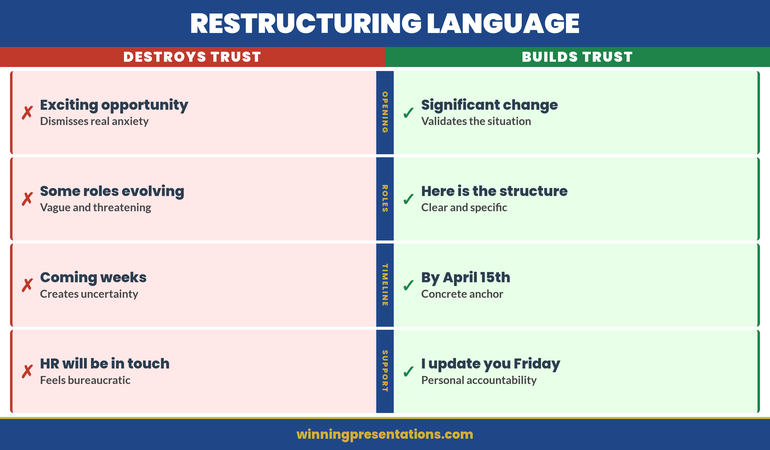
Your words matter more than your slides. Restructuring announcements live or die on precise language choices.

Avoid: Euphemism. “We’re right-sizing” sounds like you’re hiding something. Your team will hear “layoffs are coming” even if that’s not true. Say what you mean. “We’re restructuring” or “We’re reorganising” or “We’re consolidating layers.” Simple, honest, unvarnished.

Use: Specific Transition Language. Instead of “Your role will evolve,” say “Your role will expand to include customer data analysis in addition to vendor management.” Instead of “There will be some changes to reporting lines,” say “You’ll report to Sarah instead of Michael, starting 1 April.” Specificity signals competence. Vagueness signals panic.

Avoid: Spin. “This is actually a great opportunity for growth” might be true, but when you say it in a restructuring announcement, it sounds patronising. Let people decide whether it’s an opportunity. Your job is to be clear and respectful, not to sell them on the silver lining.

Use: Empathy Without Apology. “I know this creates uncertainty, and you’ll likely have questions I can’t answer today” is honest. “I’m really sorry we have to do this” is apologising for the business decision, which undermines your credibility. Own the decision, acknowledge the impact, commit to managing the transition well.

Avoid: Over-Explanation in Real Time. If you’re 10 minutes into a restructuring presentation and people are asking “Why are we doing this?” or “Did the board force this?”, you don’t answer in the moment. You acknowledge it, stay on script, and say “That’s a fair question—I’ll come back to that in Q&A. Right now I want to make sure everyone understands what’s changing and what the timeline is.”

Use: Pause. After you announce the restructure (Slide 4), pause for three full seconds. Let it land. People need processing time. If you fill that silence, you’ll rush into defensive explanation. Don’t.

Executive communicating restructuring message with confidence and clarity

Handling the Q&A When Emotions Run High

The presentation itself is 12 minutes. The Q&A is where your team decides whether you’ve lost them.

Expect Three Categories of Questions:

The Practical Question. “When does this take effect?” “Will my salary change?” “How do I apply for the new role?” These are your allies. They mean people are already thinking about implementation. Answer them briefly and directly. Use this moment to reinforce your timeline and your next steps.

The Uncertainty Question. “What if I don’t want the new role?” “Is there a chance this changes in three months?” “Are we hiring in the new structure?” These are harder because the honest answer is often “I don’t know yet.” Say that. “That’s a fair question. I don’t have a definitive answer, but here’s what I know [then the boundary], and here’s when you’ll know more [then the date].”

The Challenge Question. “Isn’t this just cost-cutting?” “Why wasn’t the team consulted?” “Did the board make this decision, or did you?” These questions are testing whether you’ll stay honest under pressure. Answer them. Don’t defend. “Yes, it is partly cost-driven—margin pressure is real. It’s also about moving faster. Both are true. Both matter.” If it was a board decision, say so. If you disagree with part of it, don’t pretend otherwise, but stay aligned on the execution.

Your Role in Q&A: Listen fully before answering. Repeat the question back (“So you’re asking whether your benefits package changes?”). Answer the question asked, not the question you wish they’d asked. If you don’t know, say “I don’t know, I’ll find out by Thursday, and I’ll email you.” Then actually do it. These follow-ups matter more than your slides.

If the room becomes emotionally charged, pause. “I can see this matters deeply. That’s appropriate. Let’s take it offline—I’m going to schedule 20 minutes with each of you in the next week. We’ll talk through your specific situation.” Then close the meeting on time. Running 45 minutes over won’t convince anyone. It signals you’ve lost control.

Implementation: What Happens After the Slides Close

Your restructuring presentation isn’t a one-off event. It’s the beginning of a managed transition. Most executives end the meeting and assume they’ve done the hard part. They haven’t.

Within 24 hours: Send a written summary of what you announced. Include dates, names, reporting lines, and links to resources (intranet page, FAQ, HR support contact). Don’t add new information—just codify what you said. This gives people something concrete to share with their partners or to read again when they’re processing.

Within one week: One-to-one conversations with every direct report. Not HR—you. 20 minutes each. The agenda is their specific situation: What’s changing for them? What’s not? What’s the next step they need to take? What do they need from you? Listen more than you talk. Many people won’t raise their real concern in the group setting.

Within two weeks: Publish an updated team page or document showing the new structure, new role descriptions, and the new team charter (how you’ll work together differently). This gives people certainty that the restructure is real and deliberate, not provisional.

Then, every week for the first month: A short team update on implementation progress. Keep it brief: “This week we finalised the new vendor management process. Next week we’ll train everyone on the new system.” These updates do two things: they signal momentum (reducing uncertainty), and they prove you’re thinking about how to make the transition smooth.

Your restructuring presentation keeps trust in the moment. Your follow-up execution keeps trust alive. Miss either, and you’ll have announced a reorganisation only to discover your best people are already interviewing elsewhere.

Need the Templates, Not Another Article?

If the restructuring presentation structure is clear but your slides still aren’t built, the Executive Slide System gives you ready-to-edit layouts for high-stakes change announcements. Also see the project delay presentation framework for sequencing difficult announcements across your organisation.

View Templates

Frequently Asked Questions

Should I rehearse a restructuring presentation differently than other presentations?

Yes. Rehearse it twice: once for technical accuracy (slides, timing, order), then once for emotional tone. Have someone watch the second rehearsal and tell you honestly: “Do you sound defensive?” “Do you sound like you care about the impact on people?” “Are you going too fast?” This is harder than rehearsing a financial update, but the stakes are higher.

What if people ask me questions I can’t answer in the meeting?

Write it down. Say: “That’s a really important question. I don’t have the answer right now, but I will by [specific date], and I’ll email you and the team.” Then do it. Credibility during a restructure is built on following through on what you say you’ll do, even small things.

Should I announce the restructure in person or can I do it via video call?

In person if at all possible, especially if your team is co-located. Video works if your team is remote and you can’t travel, but the lack of physical presence makes tone harder to read. If you do it by video, be extra clear about your emotional intent: “I know this is harder to absorb on a call. I’m committing to one-to-ones this week so we can talk through your specific situation.”

How do I present a restructure if I disagree with how it’s been designed?

This is a conversation with your leadership before the presentation, not during it. Once you’re delivering the message, you own it. If you visibly distance yourself from the decision (“The board made me do this”), you lose your team’s confidence that you’re in control. Disagree upstairs; align downstairs.

The Winning Edge

Weekly presentation strategies for executives who present under pressure.

Subscribe Free

Not ready to invest? Start with the free Executive Presentation Checklist — a quick-reference guide for your next high-stakes presentation.

About the Author

Mary Beth Hazeldine is Owner & Managing Director of Winning Presentations. With 24 years of corporate banking experience at JPMorgan Chase, PwC, Royal Bank of Scotland, and Commerzbank, she advises executives across financial services, healthcare, technology, and government on structuring presentations for high-stakes funding rounds and approvals.

Book a discovery call | View services

Related reading: How to Build Executive Presence Into Your Presentation | Town Hall Presentation: Rebuild Trust After Layoffs | Stop the Dry Mouth Before Presenting

05 Mar 2026
Executive presenting innovation proposal to traditional corporate board using protective framing language

The Innovation Pitch Inside a Traditional Company: Why Disruption Language Kills Your Budget

Your innovation proposal lost in the boardroom the moment you used the word “disruption.”

When you pitch innovation inside a traditional company, the language you choose determines whether executives green-light your project or push back. The strategies that work at startups—celebrating disruption, breaking the mould, challenging established practice—trigger defensive resistance in conservative organisations. Instead, you need an anti-disruption framing that positions your innovation as a natural evolution, not a threat to the way things work. This framework reorients the entire pitch around stability, incremental improvement, and protecting what’s already valuable.

Lost pitches? Wrong language.

The Executive Slide System includes a complete anti-disruption pitch template, tested with CFOs and board members at traditional enterprises. Get the framework that wins conservative boards.

Explore the Framework

The £4M Deal Lost in 30 Minutes: What Really Happened

I watched a brilliant innovation proposal collapse in a boardroom last year. The pitch was solid: new software platform, 18-month rollout, projected £4.2M in annual efficiency gains. The product development director had done her homework. She’d analysed the market, tested user adoption, benchmarked against competitors.

Then she opened her first slide.

“This platform will disrupt the way we’ve been managing operations for the last 20 years.”

The CFO’s face went blank. The Head of Operations leaned back in her chair. The Managing Director exchanged a look with the board chair—the kind of look that says “we’re about to spend two hours explaining why we don’t want this.”

Five seconds in, the decision was made. Not consciously. Not stated. But made.

The proposal eventually died in committee. Not because the innovation was flawed. Not because the ROI didn’t stack up. It died because the language triggered a protection response in a traditional company environment. When you tell a CFO at a 40-year-old organisation that you’re going to “disrupt” their operations, their brain hears: “I’m going to break what’s working and risk what we’ve built.”

That 5-second mistake cost £4.2M in potential value and 18 months of competitive advantage. The innovation pitch inside a traditional company demands a completely different language strategy.

The Anti-Disruption Pitch Framework Wins Board Approval

  • Strategic Reframing: Position innovation as protection and evolution of your core strengths, not replacement of established practice
  • Conservative Language Patterns: Vocabulary and framing tactics proven to reduce executive resistance by avoiding threat triggers
  • Stakeholder-Specific Messaging: Different slides and talking points for CFOs, Operations heads, and board-level decision makers
  • Risk Mitigation Structure: How to lead with safety, reversibility, and phase-gate approvals that signal control, not chaos
  • Proven Pitch Deck Templates: Slide sequences that have won £2M+ budgets across banking, insurance, and manufacturing sectors

Get the Executive Slide System → £39

Includes complete anti-disruption pitch template + stakeholder-specific decks

Why “Disruption” Language Fails Inside Traditional Companies

The word “disruption” has become synonymous with innovation in startup culture and venture capital. It’s heroic language. It signals boldness. Investors love it.

But inside a traditional company—a bank, an insurance firm, a manufacturing business with 50 years of operational history—disruption language activates a threat response.

Traditional organisations have built processes, relationships, and revenue streams on established ways of working. The CFO’s confidence in financial forecasting rests on stability. The Operations director’s credibility comes from keeping systems running. The board’s fiduciary duty requires them to protect shareholder value through predictable, controlled growth.

When you tell them you’re about to “disrupt” operations, their unconscious read is: “This person is about to introduce risk and unpredictability.” Whether or not that’s true, the language has done the damage.

The psychological mechanism is simple: threat → defensive thinking → risk aversion → budget rejection. It happens before the CFO has consciously evaluated your financial model.

The Conservative Leadership Brain Under Threat

Traditional company executives live in a world where downside risk is more salient than upside potential. A £1M gain means nothing if a poorly executed implementation causes a £2M loss or alienates key customers.

Disruption language puts them immediately into threat-assessment mode. Their questions change. Instead of “How can we implement this?” they ask “What could go wrong?” Instead of “What’s the timeline?” they think “How do we control the risk?”

You’ve lost the frame before you’ve made your case.

The Anti-Disruption Framework for Innovation Pitches

The anti-disruption framework reorients your entire pitch around five core premises that align with conservative leadership thinking:

1. Evolution, Not Revolution

Frame your innovation as a natural next step in how the organisation already operates. You’re not replacing the system; you’re extending it. You’re not breaking what works; you’re building on it.

Language shift: Instead of “We’ll disrupt how we manage accounts,” say “We’ll strengthen account management by adding real-time visibility to our existing process.”

2. Protection, Not Replacement

Position the innovation as protecting what’s valuable against external threats. Competitors are disrupting the market. Regulations are tightening. Customer expectations are rising. Your innovation protects the organisation’s market position and revenue stability.

Language shift: Instead of “We’ll replace the legacy system,” say “We’ll fortify our operational resilience against competitive pressure by modernising how we handle data.”

3. Controlled Rollout, Not Big Bang

Propose phased implementation with clear go/no-go gates, not company-wide transformation. Pilot with one business unit, measure results, then expand. This signals control and reduces perceived risk.

Language shift: Instead of “Full implementation in Q3,” say “Phase 1: pilot with the North region (8 weeks), review outcomes at gate, then decide on Phase 2 expansion.”

4. Proven Practices, Not Experimental

Show that similar organisations—ideally in the same sector—have already implemented this innovation successfully. You’re not experimenting. You’re adopting a proven approach.

Language shift: Instead of “This is a cutting-edge technology,” say “Three comparable banks have deployed this platform successfully in the last two years, with documented ROI.”

5. Incremental Value, Not Moonshot Returns

Conservative leaders are suspicious of promises of transformational returns. They trust incremental gains more than 10x improvements. Pitch conservative numbers with clear assumptions, then deliver more.

Language shift: Instead of “This could generate £5M in new revenue,” say “Based on conservative adoption assumptions, we project £800K in efficiency gains by month 18, with additional upside in customer retention.”

Reframing Your Innovation as Protection, Not Revolution

The most powerful reframe is shifting from “here’s what’s new” to “here’s what we’re protecting.”

A bank pitching a new lending platform doesn’t lead with “AI-powered decisioning will transform underwriting.” It leads with “Competitors are automating underwriting faster. Without this platform, we’ll lose market share in our core segment. This investment protects our position.”

An insurance company pitching claims automation doesn’t say “We’ll revolutionise claims processing.” It says “Customer expectations for claims speed are rising. Manual processing is becoming a competitive disadvantage. This system protects our Net Promoter Score and retention.”

Notice the psychological shift. In the first frame, the executive is being asked to embrace change. In the second, they’re being asked to defend against loss. The second is far more persuasive inside conservative organisations.

Anti-disruption framing: protecting core business against competitive threats

Need the exact language for your pitch?

The Executive Slide System includes a complete lexicon of conservative-friendly language patterns for every section of your innovation pitch.

Get Access Now

Real Examples: How Conservative Organisations Approved Major Innovation

The Manufacturing Plant That Won a £2.3M Automation Budget

A plant operations director at a 60-year-old manufacturing company needed to pitch a £2.3M automation investment to a board that had historically rejected “modernisation” proposals.

She didn’t lead with the technology. She led with the threat: “Our labour costs are rising 3% annually. Two competitors have already automated the assembly line. Without this investment, our gross margin falls below target in 24 months.”

Then she outlined the solution in protective terms: “This investment protects our profitability, maintains our current employment levels through redeployment, and keeps us competitive. Importantly, we can pilot in one production line (£340K pilot cost) before committing to full deployment.”

The board approved not just the pilot—they approved the full £2.3M budget based on gate reviews.

The Insurance Firm That Modernised Claims Without Triggering Resistance

An insurance company’s Head of Claims wanted to introduce AI-assisted claims triage. The CFO was nervous about technology risk. The board was suspicious of “automation replacing staff.”

The pitch reframed the entire proposal: “Customer feedback shows we’re losing retention because claims take too long. We’re also seeing rising costs per claim due to increased manual review. This system strengthens both our customer experience and our cost structure by having AI flag straightforward claims for faster approval, while our experienced staff focuses on complex cases.”

The key wasn’t hiding the automation. It was framing automation as protection of their competitive position and staff capability, not replacement of people.

Phased gate-based rollout structure for conservative board approval

Stop Pitching Like a Startup. Pitch Like an Operator.

  • Complete Pitch Architecture: Slide sequences specifically designed for conservative boards and CFOs
  • Stakeholder-Specific Decks: Customised talking points for Finance, Operations, and Board-level decision makers

Get the Executive Slide System → £39

Pitching to a CFO this month?

The Executive Presentation Checklist walks through every element CFOs and conservative boards actually care about—and the most common mistakes that kill pitches.

Get the Free Checklist

Building Your Anti-Disruption Pitch Deck

The Core Slide Sequence (In This Order)

Slide 1: The Threat (Not the Opportunity)

Lead with why this matters for the organisation’s survival or competitive position. Don’t lead with your idea. Lead with the external pressure that makes action necessary.

Slide 2: How We’re Exposed

Show specifically how the organisation is vulnerable if you don’t act. Use concrete metrics: customer churn, market share loss, cost disadvantage, regulatory risk.

Slide 3: The Protection Strategy (What You Propose)

Now introduce your solution, but as a protective measure. Frame it as “how we strengthen our position,” not “how we transform.”

Slide 4: Proof Points

Show that comparable organisations—especially those in your sector—have successfully implemented this. You’re following a proven path, not experimenting.

Slide 5: Conservative Financial Case

Present modest financial projections with clear assumptions. Overestimate costs slightly, underestimate benefits. You’ll exceed expectations when you deliver.

Slide 6: The Phase-Gate Approach

Show the pilot, the measurement criteria, the gate decision point, and the expansion phases. This signals control and allows executives to back out if early results disappoint.

Slide 7: Risk Mitigation

Address what could go wrong, not as possibility, but as “here’s how we’ve planned against it.” Reversibility, rollback plans, key success metrics.

Slide 8: Next Steps and Timeline

Clear, immediate actions. Not “let’s discuss this again” but “here’s when we need the board’s decision to stay on schedule.”

The Words That Work (And Don’t)

USE: Strengthen, Protect, Fortify, Advance, Evolve, Extend, Enhance, Modernise, Safeguard, Competitive advantage, Market position, Proven approach, Controlled rollout, Phase-gate, Resilience, Sustainable, Measured, Conservative estimate

AVOID: Disrupt, Revolutionary, Transform, Break the mould, Cutting-edge, Bleeding-edge, Bold move, Game-changer, Moonshot, Innovation (unless paired with “proven”), Radical, Overhaul, Shake up

Anticipating the CFO’s Questions

Q: “What happens if adoption is slower than forecast?”

A: “Our financial model assumes 60% adoption in Year 1, which is conservative compared to the three industry implementations we’ve benchmarked. Even at 40% adoption, we achieve ROI within 18 months. The pilot gives us clear go/no-go metrics to decide on wider rollout.”

Q: “What’s the risk if the vendor fails to deliver?”

A: “The vendor is a market leader with 200+ implementations in our sector. Our contract includes clear delivery milestones tied to payment tranches. We’ve also planned a 12-week exit path if Phase 1 results don’t meet our success criteria.”

Q: “How do we protect existing team members?”

A: “This is a strengthening play for our team, not a replacement. We’re automating routine decisions, which frees our experienced staff to focus on complex cases and client relationships. We’ve committed to redeploying, not redundancy.”

Is This Anti-Disruption Framework Right For Your Situation?

This approach is essential if you’re pitching inside a traditional, risk-conscious organisation where:

  • The CFO or Finance function has veto power over major investments
  • The board is composed primarily of long-tenure executives with deep ties to current operations
  • The organisation has a history of caution around “transformational” initiatives
  • Market conditions are stable enough that change feels optional, not urgent
  • The proposed change affects core operations or customer-facing processes

If you’re pitching at a startup or to a Chief Innovation Officer explicitly mandated to drive disruption, the conventional innovation pitch works fine. But if you’re operating inside the traditional company structure, this anti-disruption framing is your most powerful advantage.

The Executive Slide System: Proven for Conservative Boards

  • 10 Complete Pitch Templates: Innovation, strategic change, technology adoption, cost reduction, efficiency—all anti-disruption framed
  • Stakeholder-Specific Decks: CFO version, Operations version, Board-level version of each pitch
  • Language Guide: 50+ proven phrases and framings tested with CFOs and board members
  • Financial Modelling Slides: Conservative financial cases, ROI scenarios, sensitivity analysis
  • Q&A Preparation: Anticipated objections and tested responses from 100+ board pitches

Get the Executive Slide System → £39

Used by innovation leaders at FTSE 100 companies, regional banks, and major insurers

Frequently Asked Questions

Q: Won’t conservative boards see through the “protection” framing as just marketing?

A: Only if the threat is fabricated. If competitors genuinely are moving faster, if customer expectations genuinely have shifted, or if regulatory pressure genuinely exists, the protection framing is honest and powerful. The frame isn’t deception—it’s honest problem definition that resonates with how CFOs actually think about risk. You’re not inventing a threat; you’re leading with the threat that already exists.

Q: If we lead with the threat, does that undermine confidence in leadership?

A: The opposite. Leading with the threat and a clear solution demonstrates strategic awareness and proactive leadership. You’re not panicking. You’re identifying a risk early and proposing a measured, phase-gated response. That’s exactly what boards want from their executives.

Q: Should we present the same pitch to the CFO and the Operations director?

A: No. Customise each stakeholder’s version. The CFO cares about ROI, financial risk, and payback timeline. The Operations director cares about implementation burden, team disruption, and operational control. The Board cares about competitive threat and fiduciary duty. Same core narrative, different emphasis for each audience.

Q: What if the organisation has a history of rejecting new initiatives?

A: That history likely reflects proposals framed in change-driven language rather than threat-driven language. A pilot approach is even more critical. Instead of asking for a £2M commitment, ask for a £300K pilot with a 12-week decision gate. Most conservative organisations will approve a limited, measurable test when they’d reject a large transformation. Prove success incrementally.

Get Strategic Presentation Insights Every Week

The Winning Edge newsletter shares frameworks, real examples, and pitch-specific strategies for executives presenting to conservative boards. Subscribe for free.

Subscribe to The Winning Edge

🆓 Free resource: mbhazeldine.gumroad.com/l/executive-presentation-checklist — a free guide to strengthen your presentation preparation.

About the Author

Mary Beth Hazeldine teaches executives and innovation leaders how to win budget and approval for strategic change inside traditional organisations. Her frameworks are used by FTSE 100 companies, regional banks, and major insurers. She publishes weekly in The Winning Edge and maintains the Executive Slide System, a complete collection of pitch templates for conservative boards.

Ready to pitch your innovation without triggering resistance? Start with the Executive Slide System. You’ll have a complete anti-disruption pitch deck ready to customise for your organisation within 30 minutes. Then watch how different the board’s questions become.

11 Feb 2026
Engaged steering committee reviewing transformation program wins on boardroom screen

Transformation Program Updates That Make Executives Want to Fund You

The CEO leaned forward and said five words I’d never heard in a steering committee: “How can we do more?”

My client had just finished her transformation update. Same programme that six months earlier had executives checking their watches. Same steering committee that used to rush through her slot to get to “more important” agenda items.

But something had changed. Not the programme — the programme was on track, same as before. What changed was how she presented it.

She’d stopped reporting status. She’d started showcasing momentum. And suddenly, the executives who had been passive observers became active champions.

I’m seeing a shift in 2026: executives are drowning in transformation initiatives — digital, AI, sustainability, operating model. The programmes that survive aren’t necessarily the best-run ones. They’re the ones whose leaders know how to make the steering committee feel invested in their success.

Quick answer: The transformation updates that generate executive enthusiasm share three characteristics: they lead with outcomes achieved (not activities completed), they make wins visible and credit shared, and they create opportunities for executives to contribute rather than just observe. Structure your updates around momentum and possibility rather than status and risk, and you’ll transform passive steering committees into active sponsors who fight for your budget.

The transformation my client led wasn’t unusual — a digital modernisation programme at a mid-sized financial services firm. Good progress, reasonable challenges, nothing dramatically wrong or right.

But her first six months of updates had been… forgettable. Milestone trackers. RAG statuses. Risk registers. The steering committee nodded politely and moved on.

When we redesigned her approach, we didn’t change the facts. We changed the story. Instead of “here’s where we are,” she started telling “here’s what we’ve unlocked.” Instead of “here’s what might go wrong,” she started asking “here’s where you can help us go further.”

The executives didn’t just approve her next phase. They volunteered resources from their own teams. One board member mentioned the programme in an investor call — as an example of “the innovative work we’re doing.”

Same programme. Different narrative. Completely different level of sponsorship.

The Momentum Mindset

Most programme managers think their job is to report status. It’s not. Your job is to maintain momentum — and momentum is as much about perception as reality.

Consider two ways to present the same fact:

Status mindset: “Phase 2 is 73% complete. We have 14 tasks remaining. Timeline is on track.”

Momentum mindset: “Phase 2 unlocked three capabilities that weren’t possible last quarter. Operations is already using the new workflow, and they’re asking when Phase 3 features arrive.”

Both are true. But one sounds like a progress report, and the other sounds like a success story. Guess which one makes executives want to invest more?

Why Momentum Matters More Than Status

Transformation programmes live or die by executive sponsorship. And executive sponsorship depends on executives feeling that:

  • Their investment is paying off — They can see tangible returns, not just completed tasks
  • The team is winning — There’s energy and progress, not just competent execution
  • They’re part of something important — The programme matters to the organisation’s future
  • Their involvement makes a difference — They have a role beyond rubber-stamping updates

Status updates address none of these. Momentum updates address all of them.

📊 The Executive Slide System

Build updates that generate executive enthusiasm, not polite nods. The Executive Slide System includes momentum-focused templates, outcome showcase frameworks, and structures that turn steering committees into active champions for your programme.

Get the Executive Slide System → £39

Instant download. Includes transformation update templates, executive engagement frameworks, and sponsor activation guides.

The 5-Slide Structure That Builds Champions

After working with transformation leaders across banking, consulting, and FTSE 100 companies, this is the structure that consistently turns passive steering committees into active advocates:

Slide 1: The Win Wall (60 seconds)

Start with what’s been achieved — not completed, achieved. There’s a difference.

“Completed” is internal: “We finished the data migration.”

“Achieved” is external: “Customer service teams now resolve queries 40% faster because they have unified data access.”

Your Win Wall should feature 3-4 outcomes that matter to the business. Each one framed as: what changed, who benefits, and what it enables next.

This slide sets the tone for everything that follows. It says: “This programme is delivering value. Now let’s talk about how to deliver more.”

Slide 2: The Momentum Metrics (30 seconds)

Show movement, not position. Executives don’t need to know you’re “73% complete.” They need to know you’re accelerating, on pace, or (if necessary) recalibrating.

Choose 3-4 metrics that demonstrate forward motion:

  • Adoption velocity: How fast are people using what you’ve built?
  • Value realisation: What benefits are already being captured?
  • Capability unlocks: What can the organisation do now that it couldn’t before?
  • Stakeholder sentiment: How do users and sponsors feel about progress?

Notice: none of these are “tasks completed” or “budget spent.” Those are inputs. Executives care about outputs.


Transformation program update structure showing momentum-focused 5-slide format

Slide 3: The Spotlight Story (90 seconds)

Every month, feature one specific success in detail. A team that’s transformed their workflow. A customer outcome that exceeded expectations. A capability that’s generating unexpected value.

This does three things:

  • Makes abstract progress concrete and human
  • Gives executives a story they can retell (“Did you hear what the transformation team achieved in operations?”)
  • Creates heroes within the organisation who become programme advocates

Rotate your spotlight across different areas of the programme. Everyone who gets featured becomes invested in overall programme success.

Slide 4: The Opportunity Horizon (60 seconds)

This is where you invite executive engagement — not by asking them to solve problems, but by showing them possibilities.

“Based on what we’ve learned in Phase 2, we see three opportunities to accelerate value in Phase 3…”

“The operations team is asking whether we could extend this capability to [adjacent area]. If the steering committee sees strategic value, we could scope this for Q3…”

You’re not asking for permission. You’re asking for guidance on where to create more value. That’s a conversation executives want to have.

The Executive Slide System (£39) includes “Opportunity Horizon” templates that frame expansion possibilities in ways executives find compelling.

Slide 5: The Ask (30 seconds)

End with one clear request — but make it an opportunity to contribute, not a problem to solve.

Instead of: “We need budget approval to continue Phase 3.”

Try: “Phase 3 is ready to launch. We’d like your endorsement to proceed — and your input on which business units should pilot first.”

The difference: one positions executives as gatekeepers. The other positions them as strategic partners. Guess which one generates more enthusiasm?

⚡ Presenting this week?

If your Slide 1 doesn’t state the outcome achieved and the decision ask in one line, executives assume you don’t have one. Fix it in 60 seconds with ready-to-use templates.

Get the Executive Slide System → £39

How to Showcase Wins Without Bragging

Some programme managers resist the momentum approach because it feels like self-promotion. “I don’t want to oversell. What if we hit problems next month?”

Here’s the reframe: showcasing wins isn’t about you. It’s about the organisation.

The Credit Distribution Principle

Every win you present should credit someone other than your programme team:

  • “The operations team embraced the new workflow and found three efficiency improvements we hadn’t anticipated.”
  • “Finance’s early adoption created the proof points that convinced other departments to accelerate their timeline.”
  • “The steering committee’s decision to prioritise data quality in Q1 is why we’re seeing these customer experience gains now.”

When you distribute credit, you’re not bragging — you’re celebrating collective success. And everyone you credit becomes an advocate for continued programme investment.

The “Because Of” Frame

Connect wins to decisions executives made:

“Because the board approved accelerated investment in January, we were able to deliver three months ahead of the original timeline.”

“Because the CFO championed cross-functional data sharing, we’re seeing benefits that weren’t in our original business case.”

This isn’t flattery. It’s accountability — showing that executive decisions produced executive-level results. It makes them feel invested in your success because they’re partly responsible for it.

🏆 Templates That Celebrate Without Overselling

The Executive Slide System includes Win Wall templates, Spotlight Story frameworks, and credit distribution guides — everything you need to showcase momentum while keeping executives invested in your continued success.

Get the Executive Slide System → £39

Built for steering-committee and C-suite updates in banking and consulting-style environments. Instant download.

Turning Observers Into Advocates

The ultimate goal isn’t just approval — it’s advocacy. You want steering committee members actively championing your programme in conversations you’re not part of.

Create Retellable Moments

Executives talk to other executives. Board members talk to investors. Your updates should give them stories worth retelling.

A forgettable update: “The transformation programme is on track.”

A retellable moment: “The new customer portal went live in 8 weeks instead of 6 months, and NPS jumped 15 points in the first month.”

When you give executives impressive specifics, they become your marketing team.

Assign Meaningful Roles

Don’t just inform executives — involve them. Specific, valuable involvement:

  • “We’d value your perspective on which market segment to pilot next.”
  • “Could you introduce us to your counterpart at [partner company] who faced a similar integration?”
  • “The board presentation would benefit from your narrative on strategic alignment.”

Each ask makes them more invested. Each contribution makes them more likely to defend the programme when budget pressures arise.

The sponsor engagement frameworks in the Executive Slide System (£39) show you exactly how to create these involvement opportunities.

Maintaining Energy Across the Programme Lifecycle

Transformation programmes are marathons, not sprints. Maintaining executive energy over 18-24 months requires deliberate effort.

The Energy Curve Challenge

Most programmes follow a predictable pattern:

  • Launch: High executive attention, lots of enthusiasm
  • Middle months: Attention fades, “business as usual” takes over
  • Final stretch: Renewed interest as outcomes become visible

The middle months are where programmes lose sponsorship — not because anything went wrong, but because executives stopped paying attention.

Breaking the Attention Fade

Combat mid-programme drift with deliberate momentum markers:

Quarterly “State of Transformation” sessions: Bigger than monthly updates. Invite broader leadership. Celebrate cumulative progress.

Value realisation milestones: Don’t wait until the end to show ROI. Identify early wins that demonstrate the business case is working.

External validation: Industry recognition, analyst mentions, customer testimonials. Third-party credibility renews internal enthusiasm.

Expansion announcements: “Based on success in Division A, we’re extending to Division B.” Growth signals success.

The Narrative Arc

Think of your transformation as a story with chapters. Each steering committee update should feel like progress in that story — not a disconnected status report.

“Last month we unlocked the foundation. This month we’re seeing the first benefits. Next month we’ll expand to new areas.”

Executives stay engaged with stories. They disengage from spreadsheets.

📋 Everything You Need for Champion-Building Updates

The Executive Slide System gives you:

  • 5-slide momentum update template
  • Win Wall and Spotlight Story frameworks
  • Momentum metrics dashboard structure
  • Opportunity Horizon presentation format
  • Credit distribution and sponsor engagement guides
  • Quarterly “State of Transformation” template

Get the Executive Slide System → £39

Instant download. Transform your steering committees from passive observers to active champions.

📬 PS: Weekly strategies for executive communication and transformation leadership. Subscribe to The Winning Edge — practical tactics from 24 years in corporate transformation.

Frequently Asked Questions

What if my programme has genuine problems I need to report?

Report them — but in context. Problems within a momentum narrative sound different: “We hit a vendor delay that pushed integration back three weeks. We’ve already recovered two of those weeks and expect to be back on timeline by month end.” Challenges within progress feel manageable. Challenges within a status report feel like failure.

How do I showcase wins when we’re still in early stages?

Early wins exist — you just need to recognise them. Successful stakeholder alignment, strong team formation, faster-than-expected technical setup, enthusiastic pilot volunteers. Frame early progress as “foundation that enables everything that follows.” The story arc matters even before the climax.

Won’t executives see through this as spin?

Momentum framing isn’t spin — it’s emphasis. You’re not inventing wins or hiding problems. You’re choosing to lead with what’s working rather than what might go wrong. Executives appreciate leaders who can see and communicate progress. That’s confidence, not deception.

How do I handle a steering committee that only wants to discuss risks?

Give them a dedicated risk section — but don’t lead with it. “Before we discuss risks, let me show you what we’ve achieved this month.” Once executives see momentum, risk discussions become problem-solving sessions rather than anxiety spirals. Context changes everything.

Related: Even positive updates can trigger presentation anxiety. If your voice or confidence falters in steering committees, read When Your Voice Cracks Mid-Sentence: The Recovery Nobody Teaches for techniques that work in high-pressure executive settings.

That CEO who asked “How can we do more?” became my client’s biggest advocate. He mentioned the programme in three board meetings, secured additional funding without being asked, and personally called to congratulate the team when they hit a major milestone.

None of that happened because the programme suddenly got better. It happened because the story changed.

Your transformation programme is probably doing good work. The question is whether your steering committee knows it — whether they feel it, whether they want to be part of it.

Stop reporting status. Start showcasing momentum. Lead with wins. Create champions.

The executives in your steering committee want to support something exciting. Give them that story, and they’ll fight for your budget, your timeline, and your success.

About the Author

Mary Beth Hazeldine is the Owner & Managing Director of Winning Presentations. With 24 years in corporate banking at JPMorgan Chase, PwC, Royal Bank of Scotland, and Commerzbank, she has led transformation communications and supported programme leaders across major change initiatives on three continents.

A qualified clinical hypnotherapist and NLP practitioner, Mary Beth combines executive communication expertise with evidence-based techniques for high-pressure presentation environments. She helps transformation leaders turn steering committees from passive observers into active champions.

Book a discovery call | View services

07 Feb 2026
Female executive delivering a restructuring announcement at a corporate town hall with employees in background

Restructuring Announcement Presentation: What HR Won’t Tell You

I watched a CEO destroy ten years of trust in twelve minutes.

The restructuring was necessary. Everyone in the room knew the numbers didn’t work. But the way he delivered it — reading from a script that Legal had clearly written, avoiding eye contact, rushing through the “people impact” slide like it was a quarterly metric — turned necessary change into organisational trauma.

Three months later, 40% of the people he’d asked to stay had already left. Not the ones he’d let go. The ones he’d kept.

I’ve witnessed many restructuring announcements at JPMorgan Chase, Royal Bank of Scotland, and Commerzbank. I’ve sat in rooms where careers ended and futures became uncertain. And I’ve learned that how you deliver this news matters as much as the news itself.

HR will give you the legal language. Legal will give you the liability protection. But neither will tell you how to keep your credibility — and your remaining team — intact.

That’s what this guide is for.

Quick answer: Restructuring announcements fail when leaders prioritise legal protection over human connection. The most effective structure has three phases: Context (why this is happening), Impact (who is affected and how), and Path Forward (what happens next for everyone). Lead with honesty, not corporate euphemisms. Acknowledge the human cost before discussing business rationale. And never, ever read from a script.

⚡ Announcing a restructuring tomorrow?

If you’re short on time, focus on these three things:

  1. Open with acknowledgment, not business case. “I know this news will be difficult” before “Here’s why we’re doing this.”
  2. Be specific about what you know and don’t know. Vagueness breeds fear. “Decisions will be finalised by Friday” beats “over the coming weeks.”
  3. Tell people what to do next. Uncertainty is paralysing. Give everyone a concrete next step, even if it’s just “Your manager will meet with you individually by 3pm today.”

These won’t make the news easy. But they’ll preserve trust when you need it most.

📊 If you must use slides, here are the only 4 you need:

Slide Purpose
1. Timeline Key dates: when decisions are final, when transitions begin, when support ends
2. Support Available Severance, outplacement, counselling, references — what people can expect
3. Who to Contact HR contacts, manager availability, confidential questions channel
4. Next Steps (Today) What happens in the next 2-4 hours for everyone in the room

Everything else — the why, the context, the acknowledgment — should come from you directly, not a screen.

Why Most Restructuring Announcements Fail

Most restructuring announcements are designed by committee — Legal, HR, Communications, Finance — each adding their requirements until the message becomes a corporate word salad that protects the company but alienates the people.

Here’s what typically goes wrong:

The euphemism problem. “Right-sizing.” “Workforce optimisation.” “Strategic realignment.” Everyone knows what these words mean. Using them signals that you think your audience is stupid — or that you’re too cowardly to say what’s actually happening. Neither builds trust.

The script problem. Reading from prepared remarks in a restructuring announcement sends a devastating message: this moment doesn’t matter enough for me to speak to you directly. People can tell when you’re reading Legal’s words versus speaking your own.

The speed problem. Leaders often rush through restructuring announcements because they’re uncomfortable. But speed signals callousness. When you’re telling someone their job is at risk, moving quickly through slides feels like you’re trying to get it over with — because you are.

The sequence problem. Most announcements lead with business rationale: market conditions, financial pressures, strategic imperatives. By the time you get to the human impact, you’ve already signalled that spreadsheets matter more than people.

The vagueness problem. “Some positions will be affected.” “Changes will be implemented over the coming weeks.” “We’ll share more details soon.” Vagueness might feel kinder, but it creates anxiety that’s worse than bad news. People fill uncertainty with worst-case scenarios.

For more on delivering difficult news effectively, see my guide on how to present bad news without destroying credibility.

Structure High-Stakes Announcements With Confidence

The Executive Slide System includes frameworks for the presentations that matter most — including restructuring announcements, difficult news delivery, and crisis communication. Slide structures that maintain credibility when the stakes are highest.

Get the Executive Slide System → £39

Built from 24 years in corporate banking and leadership communication delivery.

The Three-Phase Announcement Structure

Effective restructuring announcements follow a specific structure that balances honesty, clarity, and humanity. Here’s the framework I’ve used across three banks and dozens of organisational changes:

The three-phase restructuring announcement framework showing Context Impact and Path Forward with timing guidelines

Phase 1: Context (3-5 minutes)

Before you explain what’s happening, you need to acknowledge the moment. This is where most leaders go wrong — they jump straight to business rationale.

Start with humanity:

“I want to begin by acknowledging that what I’m about to share will be difficult to hear. I wish I were standing here with different news. But I owe you honesty, and I owe you the full picture.”

Then, and only then, provide context:

  • What market or business conditions have changed
  • What options were considered and why this path was chosen
  • What this means for the organisation’s future

Keep this section factual but not detached. You’re explaining why, but you’re doing it as a human being who understands the weight of what you’re saying.

Phase 2: Impact (5-7 minutes)

This is the hardest part — and the part most leaders rush through. Don’t.

Be specific about:

  • How many roles are affected (exact number, not “some”)
  • Which teams or functions are impacted
  • The timeline for decisions and transitions
  • What support will be provided (severance, outplacement, references)

Be equally specific about what’s NOT changing. People in unaffected roles need reassurance that this news doesn’t apply to them — otherwise everyone spends the next week assuming the worst.

Crucially: if you don’t know something yet, say so explicitly. “Individual decisions will be communicated by Friday” is better than vague promises of “soon.”

Phase 3: Path Forward (3-5 minutes)

After delivering difficult news, people need to know what happens next. Not just for the organisation — for them, personally, today.

Cover three things:

  1. Immediate next steps: “Your manager will meet with you individually within the next two hours to discuss how this affects your role specifically.”
  2. Resources available: “HR will be available in Conference Room B until 5pm for questions. Here’s the email address for confidential concerns.”
  3. Your commitment: “I will be here. I will answer your questions. And I will not hide behind process or policy.”

End with your door being open — and mean it.

For more on structuring town hall presentations, see my guide on town hall presentation templates for leaders.

What to Say (And What Never to Say)

The words you choose in a restructuring announcement carry enormous weight. Here’s what works — and what destroys trust:

Say this:

  • “We’re eliminating [X] positions” — Direct and honest
  • “I wish I had different news” — Acknowledges the human cost
  • “Here’s exactly what happens next” — Reduces anxiety through clarity
  • “I don’t know yet, but I will by [specific date]” — Honest about uncertainty
  • “This was my decision” — Takes accountability (if true)

Never say this:

  • “We’re right-sizing the organisation” — Corporate euphemism that insults intelligence
  • “This is actually an exciting opportunity” — Tone-deaf and dismissive
  • “We’re all in this together” — You’re not; some people are losing their jobs
  • “It’s not personal” — It’s deeply personal to the people affected
  • “We had no choice” — There’s always a choice; own the one you made

The accountability principle:

If you made this decision, say so. “I decided” is more trustworthy than “It was decided.” Passive voice in restructuring announcements signals that no one is willing to own the impact — which makes everyone distrust leadership more.

If the decision came from above you, you can acknowledge that while still taking responsibility for how you’re implementing it: “The board made this decision, and I’m accountable for how we execute it and how we treat people through this process.”

The 48 Hours After: What Most Leaders Miss

The announcement is just the beginning. What you do in the 48 hours after determines whether you keep or lose your remaining team.

Be visible. The instinct after a difficult announcement is to retreat to your office and let HR handle the fallout. Resist it. Walk the floor. Be available. Let people see that you’re not hiding.

Follow through on every commitment. If you said managers would meet with people by 3pm, that needs to happen by 3pm. If you said HR would be available until 5pm, they need to be there until 5pm. Broken commitments after a restructuring announcement compound the damage exponentially.

Listen more than you talk. People need to process. They need to vent. They need to ask questions — sometimes the same questions multiple times. Your job in these 48 hours is to absorb, not to convince anyone that the decision was right.

Watch for the second wave. The people you’re keeping often have stronger reactions than the people you’re letting go. Survivor guilt, fear of being next, anger at losing colleagues — these emotions surface in the days after the announcement, not during it.

Document what you’re hearing. The questions and concerns that surface after a restructuring announcement are valuable data. They tell you what wasn’t clear, what fears remain, and what you need to address in follow-up communications.

For more on crisis communication, see my guide on crisis communication slides: the 5 things you must never say.

Navigate High-Stakes Presentations With Confidence

The Executive Slide System gives you proven structures for the presentations that define careers — restructuring announcements, board presentations, budget requests, and strategic recommendations. Frameworks that work when the stakes are highest.

Get the Executive Slide System → £39

Built for board-level and town-hall moments where credibility matters.

Frequently Asked Questions

Should I use slides for a restructuring announcement?

Minimal slides, if any. A restructuring announcement should feel like a human conversation, not a presentation. If you use slides, limit them to factual information people will want to reference later: timeline, support resources, who to contact, next steps. Never put the “why” on slides — that needs to come from you directly, not from a screen.

How do I handle questions I can’t answer yet?

Be honest that you don’t have the answer, and be specific about when you will. “I don’t know yet” is acceptable. “I don’t know yet, but I will have that answer by Thursday at noon and will email everyone directly” is better. The key is converting uncertainty into a specific commitment.

What if I disagree with the restructuring decision?

If you’re delivering the announcement, you need to own it — regardless of whether you agreed with the decision. You can acknowledge complexity (“This was a difficult decision with no perfect answer”) without undermining the decision itself. If you genuinely can’t support the decision, consider whether you should be the one delivering it. Half-hearted delivery is worse than no delivery.

How do I handle emotional reactions in the room?

Expect them and don’t rush past them. If someone is visibly upset, acknowledge it: “I can see this is hitting hard. That’s understandable.” Don’t try to fix the emotion or move quickly to the next point. Give people space to react. Silence after difficult news isn’t awkward — it’s necessary.

Your Next Step

If you’re facing a restructuring announcement, remember: the news itself is fixed, but how you deliver it is entirely in your control.

Lead with humanity. Be specific about impact and timeline. Take accountability for the decision. And be visible in the aftermath.

The people you’re keeping are watching how you treat the people you’re letting go. That’s what they’ll remember long after the restructuring is complete.

Need a structure for your next high-stakes presentation?

Get the Executive Slide System → £39

📧 Get the Winning Edge Newsletter

Weekly insights on executive communication, crisis leadership, and high-stakes presentations — from 24 years in corporate banking.

Subscribe free →

Related reading: Delivering a restructuring announcement is one of the highest-anxiety presentation moments a leader faces. If you’re struggling with the night before, read The Night Before the Biggest Presentation of Your Career for techniques that actually help.

About the Author

Mary Beth Hazeldine is the Owner & Managing Director of Winning Presentations. With 24 years of corporate banking experience at JPMorgan Chase, PwC, Royal Bank of Scotland, and Commerzbank, she has delivered restructuring announcements, led teams through organisational change, and learned firsthand what preserves trust when delivering difficult news.

Now she teaches senior professionals how to navigate high-stakes communication moments with confidence and credibility. She combines executive communication expertise with evidence-based techniques for managing difficult conversations.