

Quick answer: Presenting to your CEO versus presenting to your manager calls for four shifts — vocabulary (commitment language replaces task language), pace (slower, with more pause), density (less information per slide), and posture (peer framing replaces reporting framing). The shifts are not optional. A presentation that uses manager-level vocabulary and pace with a CEO audience reads as too granular and signals operational thinking. The same content, sequenced and paced for the higher altitude, reads as strategic. Most senior presenters learn the shifts by getting them wrong once.
Jump to:
Astrid had presented the quarterly review to her manager dozens of times. The format was the same each quarter — twenty-five slides, detailed metric coverage, talk through every section, take questions at the end. It had become routine. When her manager asked her to present the same review to the CEO at next month’s executive committee meeting, she assumed the only adjustment would be tightening the slides slightly. The first dry-run with her sponsor lasted forty-eight minutes for what was supposed to be a twelve-minute slot. Her sponsor stopped her at slide five. “You are presenting this the way you present to me. He is going to read it differently. Let me explain the difference.”
The conversation that followed was uncomfortable and useful. Her sponsor was not telling her the content was wrong. The content was strong. He was telling her that the audience was reading at a different altitude — and that the way she sequenced, paced, and worded the material would land badly with someone reading at that altitude. The shift was not about making the deck shorter. It was about making the deck right for a different reader.
The four shifts below are what changes between presenting to a manager and presenting to a CEO. They are vocabulary, pace, density, and posture. Each shift is small in isolation. Together they produce a presentation that reads as strategic rather than operational. Most senior leaders learn the shifts by getting them wrong once — the embarrassment of the first CEO meeting that did not land is what produces the adjustment for the second one. Reading about the shifts in advance can shorten that learning curve substantially.
If your first CEO presentation is producing more anxiety than your manager presentations ever did
Conquer Your Fear of Public Speaking is a practical programme for senior professionals managing acute presentation anxiety in high-stakes settings — exactly the kind of nerves that arrive with a first executive committee or CEO presentation. Self-paced, designed around the physiological and cognitive patterns that produce performance under pressure.
Why the audiences read so differently
Your manager is reading your presentation as someone who shares your context. They know the team. They know the projects. They know the constraints. They are listening for whether the work is on track, whether the right things are getting prioritised, and whether anything needs surfacing for their own management chain. The deck does not have to set context for them. It can move at task-level pace, with task-level vocabulary, and the manager will follow.
The CEO is reading from a different position. They do not share your day-to-day context. They are reading the presentation for what it implies about the function — whether the function is being run well, whether the right priorities are being set, whether the team has the right read on the strategic environment. The deck has to set its own context, in two or three sentences, before the substance arrives. Without that framing, the CEO is decoding while listening, which compresses the time available to actually engage with the case.
The asymmetry is structural, not personal. Your manager’s questions are about the work itself. The CEO’s questions are about what the work signals. A presentation that fits one audience tends to misfit the other. The fix is not effort. It is calibration — the same content, sequenced and paced and worded for the audience actually in the room. Senior presenters who do not calibrate end up presenting two different audiences with the same deck and watching it land well with one and badly with the other.
Four shifts that change everything
The shifts are vocabulary, pace, density, and posture. Each one is recognisable in the deck and in the delivery. None of them require new content — they require a different presentation of the same content. Senior presenters tend to apply all four shifts when presenting up several levels. First-timers tend to apply two and miss two — and the two that get missed are usually density and posture.
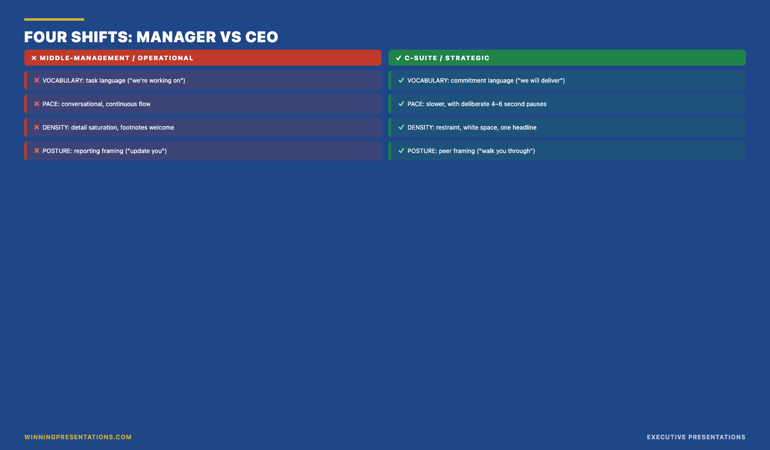
Shift one — vocabulary. Manager-level vocabulary is task language. “We’re working on X.” “The team is delivering Y.” “Z is in flight.” CEO-level vocabulary is commitment language. “We are committing to X by Q3.” “Y delivers £Z of measurable outcome by Q1.” “We have decided to prioritise A over B because…” Task language is appropriate for manager audiences who are tracking the work. Commitment language is appropriate for CEO audiences who are deciding what the function is accountable for. Same content, different vocabulary, very different read.
Shift two — pace. Manager-level pace is conversational and continuous. CEO-level pace is slower, with more pause. The pause is not for effect. It is for the room to absorb the implication of what was just said. A statement like “this requires reallocating two FTEs from programme Y” needs four to six seconds of silence afterwards for the implication to land. Manager audiences do not need the pause — they are tracking the task and waiting for the next one. CEO audiences are reading the implication and benefit from the silence to do so.
Shift three — density. Manager-level slides can carry detail. CEO-level slides cannot. The density that is appropriate when the audience shares your context becomes a barrier when the audience does not. CEO slides carry one headline, three to five supporting points, white space. The detail moves to the appendix or to the verbal narration around the slide. The discipline is uncomfortable for first-time CEO presenters because it feels like the deck is too thin. The thinness is the point. The slide is a frame for the conversation, not a substitute for it.
Shift four — posture. Manager-level posture is reporting. CEO-level posture is peer framing — even when the speaker is several levels below the CEO. Peer framing does not mean overclaiming the relationship. It means addressing the audience as someone with the same authority you have over the topic — “I want to walk you through where I see this and what I’m asking us to decide” rather than “I’d like to update you on the status”. Peer framing produces a meeting where the CEO engages substantively. Reporting framing produces a meeting where the CEO receives information passively and the substantive conversation drifts elsewhere.
For senior leaders managing the nerves of a first CEO presentation
Conquer Your Fear of Public Speaking — practical strategies for high-stakes presentation anxiety
A first CEO presentation produces a particular kind of nerves — the audience-mismatch anxiety that arrives when the room reads at a different altitude than the rooms you are used to. Conquer Your Fear of Public Speaking is a self-paced programme for senior professionals managing acute presentation anxiety, with practical techniques for the physiological and cognitive patterns that produce performance under pressure.
- Self-paced techniques for managing acute presentation anxiety
- Practical strategies for the physiological symptoms that arise in high-stakes meetings
- Cognitive patterns for staying composed when the audience is more senior than usual
- Designed for senior professionals, not for novice presenters
£39 · Instant download · Lifetime access
Why CEO meetings amplify the nerves
A first CEO meeting produces a recognisable physiological response in many senior presenters who have presented to managers comfortably for years. The hands shake on the laser pointer. The voice tightens. The breathing accelerates. The cognitive effects follow — the mind goes blank on a familiar slide, the next sentence does not arrive, the body feels the time stretching out. The reaction is not weakness. It is what the autonomic nervous system does when the social stakes shift suddenly.
The shift is real. Manager presentations have known stakes — the relationship survives a stumble. CEO presentations have less-known stakes — the relationship has less history to absorb a stumble. The body reads the asymmetry and responds accordingly. The response is appropriate. The job is not to suppress it. The job is to channel it so the meeting still goes well.
The first ninety seconds are the hardest. Once the speaking has started and the body has adjusted to the room, the nerves typically reduce within the first slide or two. Most of the visible signs of anxiety dissipate by minute three or four. The strategy is to plan the first ninety seconds carefully — open on a slide where the words are well-rehearsed, deliver the recommendation at the slow CEO pace, and pause deliberately after the recommendation lands. The pause is not just for the room. It is for the body to register that the meeting has started and the worst-feared moment has passed.
The body settles when the words are familiar. Rehearsed words travel from memory more reliably than improvised ones under acute stress. The most rehearsed sentences in the deck — the recommendation, the trade-off statement, the close — are the ones the body delivers cleanly even when the autonomic system is firing. The least rehearsed sections are the ones where the nerves break through. Heavy rehearsal of the opening, the transitions, and the close is what carries the meeting through the nervous opening minutes.
Visible nerves are not as visible as they feel. The internal experience of presentation anxiety is far more intense than the external presentation looks. Audiences rarely register the level of nerves the speaker is feeling. A presenter who feels their voice is shaking visibly is usually being heard as composed by the room. This is not a reason to ignore the nerves — but it is a reason not to apologise for them or draw attention to them. The audience is seeing a much steadier presenter than the speaker feels they are being.
Preparation that makes the shifts feel natural
The four shifts feel awkward when imposed at the last minute. They feel natural when the deck is built around them from the start. The preparation that makes the shifts feel natural is structural — it changes how the deck is built, not just how it is delivered. The broader executive presentation skills draw from the same playbook.
Build the deck for the CEO from the start, not for the manager and then trim. Trimming a manager deck for a CEO audience produces a watered-down version of the manager deck — the structure is still wrong, the density is still too high, the posture is still reporting. Building from scratch for the CEO audience produces a different deck shape — recommendation first, trade-off explicit, decision-close. The two decks have different jobs. Starting from the manager version and editing usually produces something neither audience reads well.
Rehearse the opening at CEO pace, not at manager pace. The pace difference is one of the hardest shifts to apply in the moment. Practising the opening at the slower pace, with the deliberate pauses, in advance — out loud, multiple times — is what makes the pace stick under pressure. A presenter who has rehearsed at manager pace and then tries to slow down in the meeting tends to revert to manager pace within the first slide. The body does what the body has practised.
Get a peer to test the vocabulary. Ask someone whose judgement you trust to read the first three slides aloud and tell you which words sound task-language and which sound commitment-language. Most first-time CEO presenters have more task-language in their drafts than they realise — habits from manager presentations carry over invisibly. The peer test surfaces them. The fix is usually a small set of word substitutions that change the read substantially.
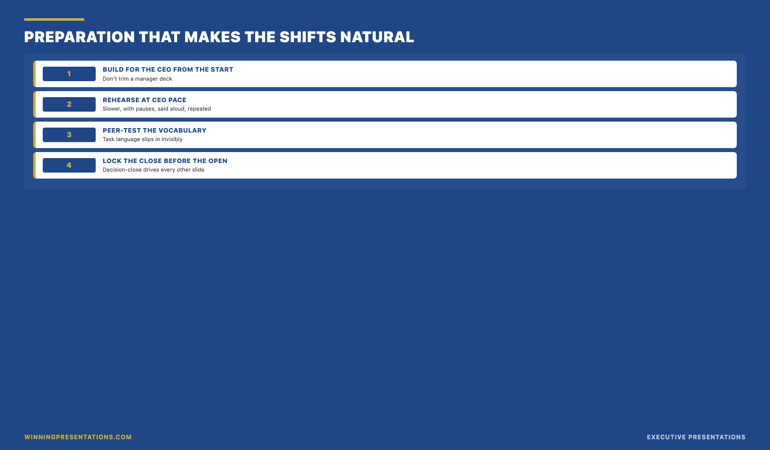
Lock the close before the open. The decision-close is what produces sign-off in the meeting. First-time presenters tend to write the close last, treat it as a wrap-up, and improvise it on the day. Senior presenters write the close first, treat it as the conversation closer, and rehearse it more than any other slide. Locking the close before the rest of the deck means every other slide is built backwards from the close — every slide earns its place by setting up the close that ends the meeting.
The free Executive Presentation Checklist
Structural questions senior presenters work through before any executive deck is designed
Before the deck gets built, the structural questions that determine whether the deck will hold are worked through on paper. The free Executive Presentation Checklist covers the audience-reading, recommendation-clarity, vocabulary, and pace questions every CEO-level presentation needs to answer in advance. Download the checklist →
Frequently asked questions
My CEO is informal in meetings — should I still apply the four shifts?
Yes. Informality is a stylistic surface. The structural reading habits underneath are the same — top-down sequencing, commitment vocabulary, density restraint, peer framing. An informal CEO is still reading the deck for the recommendation, the trade-off, and the decision. The informality affects tone and warmth, not structure. Senior presenters with informal CEOs sometimes mistake the surface for the structure and produce decks that feel friendly but read as operational. The structural shifts hold regardless of the CEO’s interpersonal style.
What if my manager wants to review the CEO deck before I present?
This is common and useful — and it requires care. Your manager will read the deck through their own lens, which is the manager-level lens. Some of their feedback may push the deck back toward manager-level density and pace, which is the wrong direction. The right approach is to take the substantive feedback (factual corrections, framing improvements, things you missed) and respectfully not implement the structural pushback (more detail, more context, slower build). A short conversation with your manager about why you have built the deck differently for the CEO audience usually clears the misunderstanding. Most managers, once they see the rationale, become helpful editors rather than restorers of the manager-level version.
Should I send the deck to the CEO in advance?
Yes — if the CEO’s office expects pre-reads. Most do. Forty-eight hours before the meeting is the convention. Send a tightened pre-read version (one or two pages) rather than the full deck if the meeting culture supports that. The pre-read does the work the deck cannot do — it lets the CEO arrive with the case already in mind, which means the meeting becomes a conversation about specific concerns rather than a first encounter with the proposal. Skipping the pre-read is the most common cause of meetings that feel like they did not land — the CEO was reading the deck for the first time during the presentation, which compresses the substantive discussion to whatever time remains.
How do I handle a CEO who interrupts mid-presentation?
Take the question. CEOs interrupt because they are reading and reacting in real time — the interruption is a signal that the audience is engaged, not that the presentation is going badly. Answer the question concisely, name where the answer fits in the rest of the deck, and continue from where the question landed. Do not restart from the slide before. The flow recovers more quickly when the presenter treats the interruption as part of the conversation rather than as an interruption to be recovered from. Most senior presenters report that meetings with engaged interruption produce decisions more reliably than meetings where the CEO listens silently throughout.
Self-paced programme for high-stakes presentation anxiety
When the audience changes altitude, the body responds — Conquer Your Fear of Public Speaking gives you practical patterns for managing it
First CEO meetings, board appearances, executive committees — the meetings where the audience reads at a different altitude tend to amplify presentation anxiety in ways your routine meetings do not. The programme covers the physiological and cognitive patterns senior professionals use to stay composed when the stakes shift.
£39 · Instant download · Lifetime access
The Winning Edge — weekly
One short note each Thursday on board-level presentation patterns, structural shortcuts, and the behaviours senior presenters use under scrutiny. Written for professionals who do not have time for newsletters that read like newsletters.
Want a structural starting point first? The free Executive Presentation Checklist covers the structural fundamentals senior presenters use before designing the deck.
For the companion piece on first-time C-suite preparation, see presenting to the C-suite for the first time — the seven-day protocol that addresses the structural side of the same shift.
Next step: Pull up the deck you would normally show your manager. Read the first three slides aloud. Replace task language with commitment language. Cut the density by about half. Rewrite the close as a decision rather than a thank-you. The deck will feel uncomfortable to you. That discomfort is the right signal — the deck is now closer to the audience the CEO is reading from.
Mary Beth Hazeldine is the Owner & Managing Director of Winning Presentations. With 25 years of corporate banking experience at JPMorgan Chase, PwC, Royal Bank of Scotland, and Commerzbank, she advises senior professionals across financial services, healthcare, technology, and government on structuring presentations for high-stakes board meetings, executive committees, and investor sessions. She speaks German and works extensively with the German-speaking financial markets.