

Quick answer: The best presenting-to-the-C-suite training programmes online cover four things most off-the-shelf courses miss — how the audience reads (top-down, decision-first), how to structure the deck (recommendation, trade-off, alternative, controls, decision), how to handle the Q&A that follows (where the meeting is actually decided), and how to manage the physiological response that arrives in the first minutes. Generic public-speaking courses focus on delivery. Generic presentation courses focus on slides. Senior-level training has to address audience, structure, Q&A, and composure together — because the C-suite reads all four at once.
Jump to:
Mei spent two days searching for “presenting to the C-suite training online” after her first executive committee presentation did not land the way she had hoped. The search returned dozens of options. Generic public-speaking courses promising to make her a more confident presenter. Presentation-skills courses focused on slide design and storytelling. Executive-coaching programmes that looked promising but cost a multiple of what she had budgeted. Most of what was on offer was not actually built for the situation she was in — a senior professional with substantive experience presenting up the chain who needed to develop a different style for executive committee audiences specifically.
The mismatch is not unusual. The “presenting to the C-suite” search query brings together professionals at very different stages of seniority looking for very different things. Some are first-time presenters preparing for their initial executive committee meeting. Others are mid-career senior leaders who present to executive audiences regularly but want to sharpen the work. Others are operating at board level already and looking to refine specific elements. The training programmes that genuinely serve the C-suite use case are a smaller subset of what the search results return.
This article is a structural guide to what the best programmes actually cover, what most off-the-shelf courses miss, and how to choose a programme that matches your stage. It is not a comparison of named courses. The right programme depends on your situation. Knowing the four pillars to look for makes the choice substantially easier — most programmes are quickly disqualified once the pillars are explicit.
If you are evaluating presenting-to-the-C-suite training right now
The AI-Enhanced Presentation Mastery course is a self-paced programme with 8 modules and 83 lessons covering executive-grade presentation work — from audience analysis to deck structure to Q&A handling. 2 optional live coaching sessions, fully recorded. Monthly cohort enrolment.
Why C-suite training is different from other presentation training
Most presentation training is built around delivery. Voice, pace, body language, eye contact, slide design, storytelling structure. The skills are real and the training is useful at certain stages of a career. The skills are not what determine whether a C-suite presentation lands. C-suite audiences read primarily for structure — the recommendation, the trade-off, the controls, the decision — and only secondarily for delivery. A delivery-focused programme can produce a more confident, more polished presenter who still misfits the audience because the structural work has not been addressed.
The same applies to slide-design courses. Better slides do not produce better C-suite presentations. Better-structured cases produce better C-suite presentations, and the slides follow. A senior presenter with a clear recommendation, an honest trade-off, and a tight decision-close will outperform a presenter with beautiful slides and a meandering structure every time. The pretty deck is recognisable to C-suite audiences as a tell — it usually correlates with weak underlying authorship.
C-suite training has to address the layer above delivery and slides — audience reading, case structure, Q&A handling, composure under scrutiny. The programmes that do this well usually have practitioners in the room rather than communications coaches. People who have presented to executive committees themselves, who have absorbed the structural reading habits of those audiences, and who can teach the patterns from the inside. Generic public-speaking instructors, however skilled, often cannot do this work at the same level.
Four pillars the best programmes cover
A C-suite training programme that genuinely serves senior professionals covers four pillars. None of them are optional, and a programme that covers three out of four leaves the participant exposed in predictable ways.
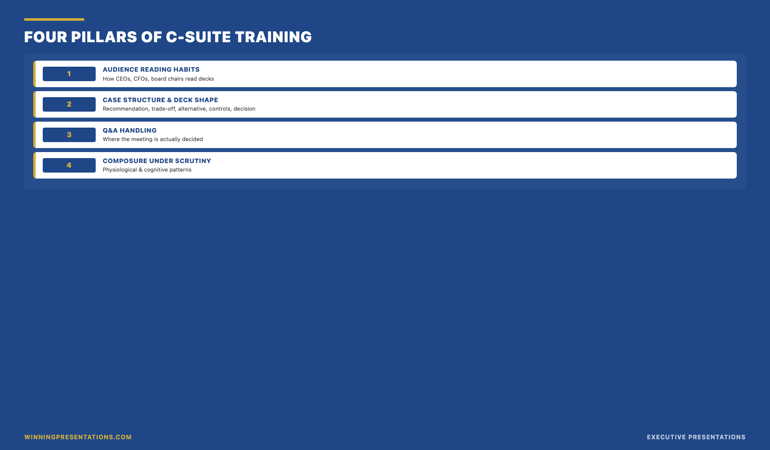
Pillar one — audience reading habits. The programme has to teach how C-suite audiences read decks. Top-down sequencing. Recommendation-first reading. The implicit search for the trade-off, the alternative, the resource implication. The compression that happens when twelve to fifteen minutes is the actual presenting time. A programme that does not address how the audience reads is teaching the speaker to talk into a microphone with no model of who is on the other side.
Pillar two — case structure and deck shape. The structural work that produces a deck the C-suite can actually read at the speed it reads. The recommendation slide. The trade-off slide. The alternative-considered slide. The risk-and-mitigation slide. The controls slide. The decision-close. Each is a specific structural element with specific expectations. A programme that teaches “tell a story” without teaching the structural elements is teaching a stylistic lens that will produce decks the C-suite reads as soft.
Pillar three — Q&A handling. Most C-suite decisions are made in the Q&A, not in the prepared remarks. The programme has to teach the Q&A patterns — the four-step answer pattern, the holding tactics for tough questions, the bridge phrases that move from question to substantive answer, the techniques for managing hostile or sceptical follow-ups. Programmes that focus on the prepared content and treat Q&A as an afterthought produce presenters who deliver a clean opening and then fall apart under questioning.
Pillar four — composure under scrutiny. The physiological and cognitive response to high-stakes audiences is real and learnable. The programme has to address the physical patterns (breathing, voice, hand position) and the cognitive patterns (the blank moment, the racing mind, the time-distortion effect) that arrive in the first minutes of a high-altitude presentation. Programmes that ignore composure tend to assume the participant will figure it out — and many do, eventually, by getting it wrong once or twice. The training is meant to shorten that learning curve.
For senior professionals presenting to executive audiences with AI assistance
AI-Enhanced Presentation Mastery — 8 modules, 83 lessons, self-paced
A self-paced programme for senior professionals using AI (including Copilot) to build executive-grade presentations. The course covers prompt engineering for executive content, structural frameworks the C-suite reads for, and the editorial judgement that turns AI drafts into board-ready output.
- 8 modules, 83 lessons of self-paced course content
- 2 optional live coaching sessions with Mary Beth — fully recorded, watch back at your own pace
- No deadlines, no mandatory live attendance
- Monthly cohort enrolment — enrol any time, start with the next cohort
- Lifetime access to all course materials
£499 · Self-paced · Lifetime access · Optional recorded coaching sessions
What most off-the-shelf programmes miss
The reason most presenting-to-the-C-suite training programmes do not land at the senior level is structural. They are generic presentation programmes with C-suite vocabulary added on. The exercises are the same. The frameworks are the same. The role-plays are the same. Only the language has been adjusted. A senior professional who completes the programme often emerges with a slightly more polished version of the same delivery they had before — and the structural problems that produced the misfit at executive committee level are not addressed.
Audience-specific reading habits are usually absent. Most programmes teach “know your audience” as a generic principle and stop there. The specifics of how a CEO reads versus how a CFO reads versus how a board chair reads are rarely covered. A senior presenter who needs to handle all three — common at executive committee level — is left to figure out the calibration alone. The best programmes teach the differences explicitly, with examples, and then practise the calibration in role-plays that simulate the differences.
Trade-off framing is rarely taught. Most presentation training treats trade-offs as something the audience might bring up in Q&A. C-suite training has to treat trade-offs as the headline. The trade-off slide is one of the highest-leverage elements of any executive committee deck, and many programmes teach it as a footnote rather than as the structural backbone. The fix in the programme is to teach the trade-off slide as a slide format, with examples, with rewriting exercises, until the presenter can write a trade-off slide cleanly under time pressure.
The decision-close is glossed. Many programmes spend significant time on opening and on the body of the presentation, and treat the close as “summarise and thank”. The decision-close is not a summary. It is the conversation closer — the explicit ask, the timing, the next action. A programme that does not teach the decision-close as its own skill produces presenters who close their meetings with thank-yous and watch their cases drift toward “let me think about it”. The decision-close should have its own module, with examples and rehearsal time.
Q&A is treated as separate from the deck. The deck and the Q&A are one continuous unit at C-suite level. The deck sets up the questions the audience will ask. The Q&A reveals whether the deck has been properly prepared. Programmes that treat Q&A handling as a separate module — done after the deck training, with different exercises — miss the integration. The best programmes teach deck construction with the anticipated Q&A in mind from the start, and the Q&A practice happens against the actual deck the participant has built. The companion piece on presenting to a CFO covers some of the same Q&A patterns at audience-specific level.
Choosing a programme that matches your stage of seniority
Senior professionals at different career stages need different things from C-suite training. A first-time presenter needs the structural fundamentals and the composure work. A mid-career senior leader needs the trade-off framing, the Q&A handling, and the calibration across audience types. A senior executive working at board level needs the refinements — the sharper close, the more deliberate pace, the practised handling of unusual or hostile questions. The same programme rarely serves all three stages well.
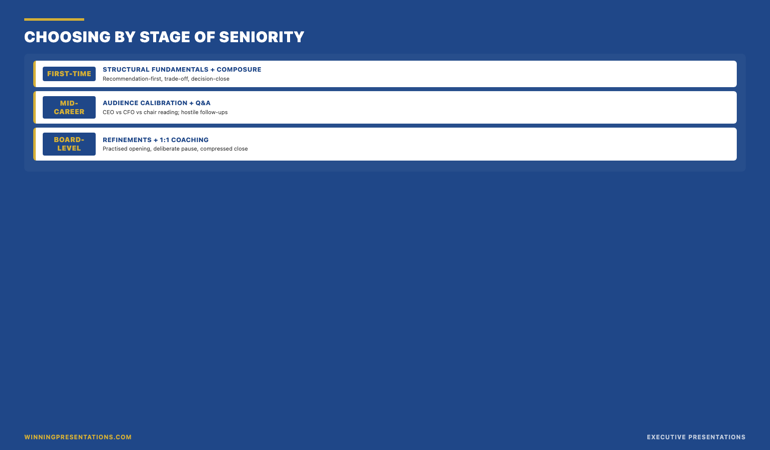
For first-time C-suite presenters. The priority is the structural fundamentals — recommendation-first sequencing, trade-off framing, decision-close — and the composure work to manage the physiological response to a first executive committee meeting. The programme should include role-plays simulating the audience compression and the Q&A pressure, with feedback from someone who has presented at this level themselves. Self-paced is fine if the programme is well-structured. Live cohort can add accountability for participants who would otherwise procrastinate the rehearsal.
For mid-career senior leaders. The priority is calibration across audience types and Q&A handling. A programme that goes deep on how CEO reading differs from CFO reading differs from board chair reading is the highest-leverage investment at this stage. The Q&A handling needs to address hostile questions, sceptical follow-ups, and the tactical patterns for handling questions that the presenter genuinely does not have a complete answer to. Practitioners-as-instructors matter more at this stage — generic communications coaches usually cannot teach the calibration with enough specificity to be useful.
For executives operating at board level. The priority is the refinements — the practised opening that takes ten seconds longer than instinct suggests, the deliberate pause after the recommendation, the compressed close that handles the time-cut interruption. Most senior executives at this level benefit more from one-to-one coaching than from a group programme — but a high-quality online programme with optional coaching sessions can supplement the work effectively, particularly for executives who have a specific upcoming high-stakes meeting and want a structured preparation framework.
Slide structures the C-suite reads for
The Executive Slide System — board-ready templates for executive committee decks
Whether or not you enrol in a training programme, the structural slide work matters. The Executive Slide System covers 26 templates, 93 AI prompts, and 16 scenario playbooks — including the recommendation slide, trade-off layout, alternative-considered structure, and decision-close formats designed for executive committee and board audiences. £39, instant download. Explore the slide system →
Self-paced versus live-cohort: format trade-offs
The format question — self-paced versus live cohort — comes up frequently in evaluations of online C-suite training. Each format has structural advantages, and the right choice depends more on the participant’s situation than on the inherent superiority of one over the other.
Self-paced advantages. Time flexibility — senior professionals with unpredictable schedules cannot reliably commit to weekly live sessions. Re-watchability — the same lesson on Q&A handling becomes more useful on the second or third viewing, particularly when applied to a specific upcoming meeting. Depth — self-paced participants can spend more time on the modules that matter most for their specific situation, and skim the ones that do not. Cost — self-paced programmes typically cost less than live-cohort equivalents.
Live-cohort advantages. Accountability — the weekly schedule keeps participants engaged who would otherwise procrastinate. Peer interaction — discussion with other senior professionals at similar stages can surface insights the curriculum does not address directly. Live feedback — for participants comfortable with public role-play, real-time coaching can produce faster improvement than self-recorded work. Networking — some senior professionals value the connections made during a cohort more than the curriculum itself.
Hybrid is usually best. The most effective format for senior professionals tends to be self-paced core content with optional live coaching sessions. The self-paced material allows the depth and re-watchability the curriculum needs. The optional live sessions provide the accountability and peer interaction without forcing weekly attendance commitments that working senior professionals often cannot keep. Programmes structured this way tend to have higher completion rates and stronger participant outcomes than pure self-paced or pure live-cohort alternatives.
Frequently asked questions
How long should presenting-to-the-C-suite training take to complete?
A well-designed online programme should be completable in eight to twelve hours of focused work over four to eight weeks, depending on how deeply the participant engages with the rehearsal exercises. Programmes that promise transformation in a weekend are typically delivery-focused with no real structural depth. Programmes that stretch over six months with weekly mandatory sessions usually include filler that working senior professionals do not need. The right length is enough to cover the four pillars meaningfully, with rehearsal time built in, and to give the participant a few weeks between modules to apply the learning to actual meetings.
Should I look for accredited training or are senior practitioners more useful?
Senior practitioners are usually more useful at the C-suite training level. Accreditation matters in regulated training contexts (compliance training, professional certifications) but does not correlate strongly with the quality of presentation training at the senior level. The strongest signal is whether the instructor has presented at executive committee or board level themselves, repeatedly, in environments comparable to your own. Practitioners with that experience tend to teach the patterns the C-suite is actually reading for. Communications coaches without that experience often teach the patterns that look good but do not match how the audience reads.
Is it worth doing C-suite training before my first executive committee presentation?
Yes — and the timing matters. The most useful window is two to six weeks before the meeting. That gives enough time to absorb the structural fundamentals, build the deck around them, and rehearse the opening at the slower CEO pace. Less than two weeks is usually too compressed — the structural shifts feel forced when applied at the last minute. More than six weeks before the meeting and the practical learning fades unless the participant has another senior-audience meeting on the calendar to practise on. Senior professionals who do the training without a near-term application meeting often retain less than those who apply it within weeks.
What if I cannot expense the training and have to fund it personally?
Most online C-suite training programmes range from a few hundred to several thousand pounds. The decision usually comes down to expected return — how often you present at executive committee or board level over the next few years, and what a single material improvement in those meetings is worth to your trajectory. Senior professionals who present at this level four or five times a year typically find that even a single sharper presentation justifies the investment. Senior professionals who present at this level once or twice a year may find the structural slide work and a free checklist sufficient. The middle case — three to four C-suite presentations a year, with several of them genuinely consequential — is where the case for training is usually strongest, and where the investment tends to compound over time.
Maven cohort enrolment — open this month
For senior professionals using AI to build executive-grade presentations — including the structural work the C-suite reads for
AI-Enhanced Presentation Mastery covers the prompt engineering, structural frameworks, and editorial judgement that produce board-ready output. 8 modules, 83 lessons, self-paced. Monthly cohort enrolment.
£499 · Self-paced · Lifetime access · 2 optional recorded coaching sessions
The Winning Edge — weekly
One short note each Thursday on board-level presentation patterns, structural shortcuts, and the behaviours senior presenters use under scrutiny. Written for professionals who do not have time for newsletters that read like newsletters.
Want a structural starting point first? The free Executive Presentation Checklist covers the structural fundamentals senior presenters use before designing the deck.
For the practical companion piece on a first C-suite presentation, see presenting to the C-suite for the first time — the seven-day preparation protocol senior leaders use before the meeting.
Next step: List the four pillars on a piece of paper. Walk through any presenting-to-the-C-suite training programme you are evaluating against the list. Cross out any pillar the programme does not cover meaningfully. The result usually narrows the field substantially. The remaining options are the ones worth a serious look.
Mary Beth Hazeldine is the Owner & Managing Director of Winning Presentations. With 25 years of corporate banking experience at JPMorgan Chase, PwC, Royal Bank of Scotland, and Commerzbank, she advises senior professionals across financial services, healthcare, technology, and government on structuring presentations for high-stakes board meetings, executive committees, and investor sessions. She speaks German and works extensively with the German-speaking financial markets.