Quick answer: An executive stakeholder management course online is worth taking when senior leaders are spending more energy on persuading colleagues than on the underlying work — typically when promoted into roles where the technical content is no longer the limiting factor. The right course covers four things: stakeholder mapping at executive level (not RACI charts), the structural psychology of senior decision-making, the communication architecture for buy-in (slides, narratives, sequencing), and the management of dissenting voices in committee settings. Most courses cover one or two of these. The ones built specifically for senior professionals cover all four and use scenarios that match what executive committees actually look like.
JUMP TO:
- Why senior stakeholder management becomes the limiting factor
- What executive stakeholder management is not
- The four things a senior course must cover
- The format question: self-paced vs live cohort vs 1:1
- How to evaluate a course before buying
- Price range and what to expect
- Frequently asked questions
Mei runs a healthcare technology business unit inside a large hospital group in Singapore. For the first five years of her career, the limiting factor on her work was technical capacity — solving the operational and engineering problems that defined what the business unit could deliver. Three years ago she was promoted to lead the whole unit, and the calculus shifted. The technical problems were still real, but they were no longer what determined whether her team could move. What determined that was whether the executive committee, the medical directors, and the parent hospital’s board were aligned with her direction. She found, to her own surprise, that she had no formal training in any of that. She had been promoted into a role whose central skill she had never been taught.
This is the story most senior leaders eventually find themselves in. The skills that earn promotion are usually not the skills the new role requires. Stakeholder management at executive level — turning reluctant colleagues into active advocates, getting boards to approve, sequencing the conversations that have to happen before the formal meeting — is a craft, not a personality trait. The good news is that it can be learned. The complicated news is that most online courses on the topic are calibrated for early-career project managers, not senior leaders, and applying their tools to executive settings produces awkward results.
This article walks through what an executive stakeholder management course online should actually cover, how to evaluate one before you buy, and the price ranges to expect. It is for senior professionals — typically director and above — for whom the work is no longer the bottleneck.
If you are evaluating courses already:
The Executive Buy-In Presentation System is a self-paced programme covering the structure, psychology, and preparation that earns serious approval — built for senior professionals presenting decisions to boards and executive sponsors.
Why senior stakeholder management becomes the limiting factor
The structural shift happens at roughly the director level in most organisations. Below that line, the work is largely defined by the operational or technical content of what you do. Above that line, the work is largely defined by the agreement of the people whose support you need to do anything substantive.
This shift is not always obvious from the inside. It tends to show up in indirect signals first. Decisions you used to make alone now require briefings to two or three other senior people. Initiatives you used to launch in weeks now take months because of stakeholder alignment. Your calendar fills with one-to-one conversations with peers about issues that, on the merits, would not need a meeting at all. The hours you used to spend on the work now go to managing the conditions under which the work happens.
None of this is dysfunction. It is the new shape of senior roles. The question is whether you have built the muscle to do it well or whether you are doing it by improvisation, picking up patterns from observation and trial-and-error. Improvisation works for years; eventually it costs you a major decision that should have gone your way and did not, because the stakeholder work upstream was not done well. That moment is what usually triggers the search for a course.
What executive stakeholder management is not
Three things are commonly confused with executive stakeholder management. They are different skills, and online courses that teach them under the stakeholder management label tend to leave senior professionals frustrated.
It is not project stakeholder management. RACI charts, communication matrices, escalation protocols, status reports — these are project-management tools designed for delivery work below the executive level. They have their place, but they are calibrated for keeping projects on track, not for moving senior decisions. Applying them to an executive committee setting feels mechanical because it is.
It is not networking. “Build relationships across the organisation” is real advice, but it is the long-term enabling condition, not the craft. Senior stakeholder management is what happens when you have a specific decision to move and need to navigate the politics, sequencing, and persuasion to get it across the line. Networking helps; it is not the skill.
It is not soft-skills training. “Improve your influence.” “Build executive presence.” “Communicate with confidence.” These are useful but unspecific. Executive stakeholder management is concrete. It is structured around specific scenarios — getting a budget approved, navigating a contested strategic decision, managing a hostile peer in committee, securing sign-off from a board — and the techniques are scenario-specific, not general.
The four things a senior course must cover
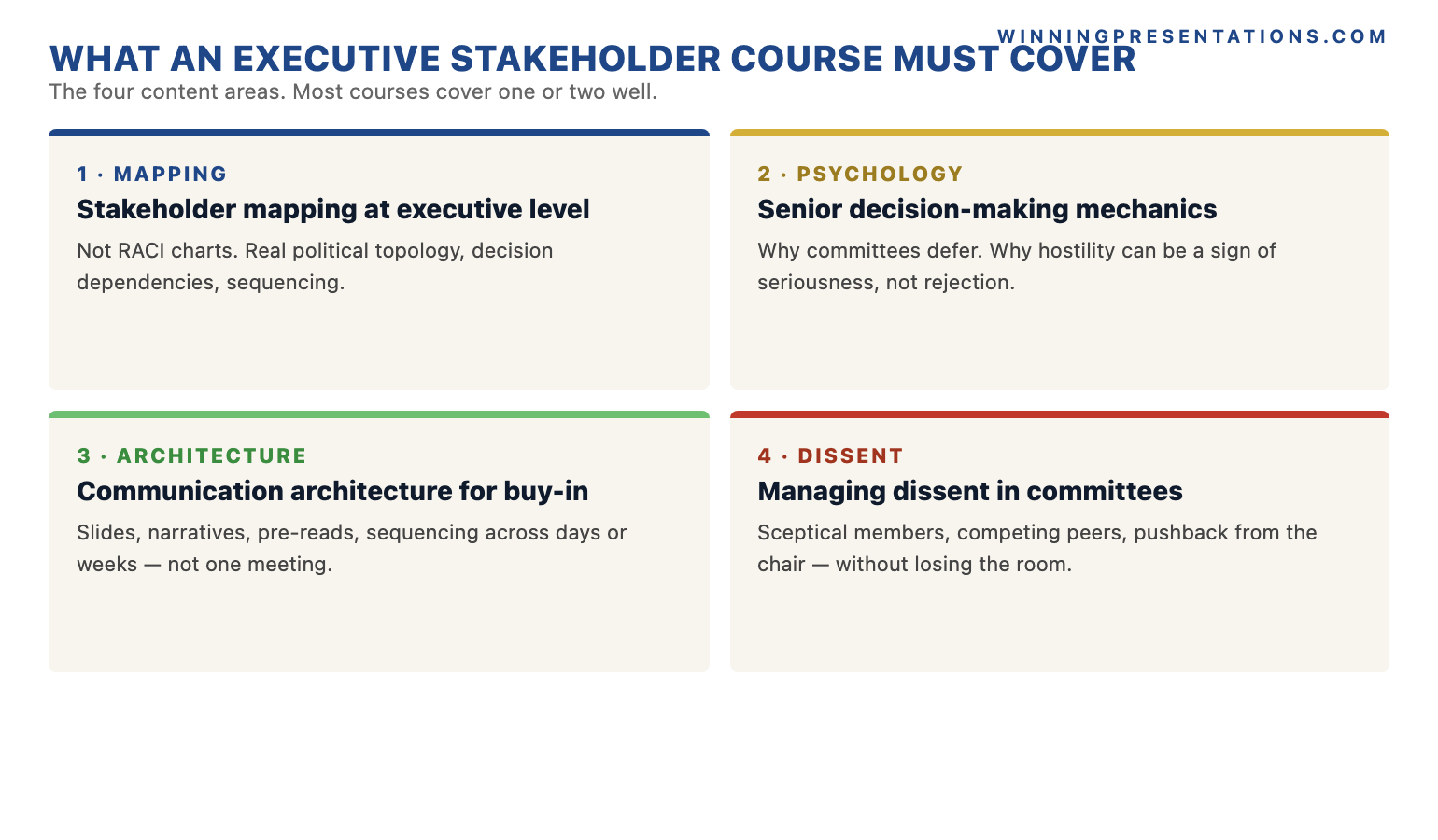
A senior stakeholder management course should be evaluated against four content areas. Most courses cover one or two well; the ones built for executive contexts cover all four.
One. Stakeholder mapping at executive level. Not the four-quadrant power-interest matrix that fits inside a workshop slide. The actual mapping work — identifying which decisions live with which individuals (formal and informal), where the alignment dependencies are, where the political sensitivities sit, and what the sequencing of conversations needs to look like before a formal decision is brought to a meeting. Senior stakeholder maps are messier than the templates suggest because real organisations are messier than the templates suggest.
Two. The structural psychology of senior decision-making. Why senior committees defer decisions even when the case is strong. Why a recommendation can lose because of how it was sequenced rather than what it argued. Why the most articulate person in the room is often not the one who carries the decision. Why hostility in a meeting is sometimes a signal of seriousness rather than rejection. This is the analytical layer that sits underneath the technique. Without it, the technique is mechanical.
Three. The communication architecture for buy-in. The slide structures, the narrative arcs, the order of conversations, the timing of pre-reads, the choice of channel (email vs. one-to-one vs. formal meeting), the management of written artefacts that circulate after the meeting. Buy-in is not a single conversation; it is an architecture of conversations across days or weeks, with different content tailored to different stakeholders, all converging on the moment the formal decision is made. Most courses skip the architecture and teach only the formal-meeting moment.
Four. The management of dissenting voices in committee settings. What to do when one member of the committee is consistently sceptical of your work. How to handle a peer who is competing for the same scope. How to respond when the chair pushes back without losing the room. How to read the moment when the formal “no” is actually a “not yet” and the moment when “yes” is actually conditional. This is the most senior layer of the craft and the one most often missing from generic courses.
For the buy-in side specifically, built for senior settings.
The Executive Buy-In Presentation System is a self-paced programme — 7 modules covering the structure, psychology, and preparation that earns serious approval from boards, executive sponsors, and committees. Self-paced with monthly cohort enrolment. Optional Q&A calls (fully recorded — watch back anytime). £499, lifetime access to materials.
- The decision-readiness framework that earns senior approval
- Stakeholder analysis and pre-meeting positioning protocols
- The slide structures that hold up under board scrutiny
- Hostile question handling and recovery techniques
- Optional bonus Q&A calls (fully recorded — watch back anytime)
Explore the programme — £499 →
Self-paced. Lifetime access to materials.
The format question: self-paced vs live cohort vs 1:1
Three formats dominate the market. They are calibrated for different needs, and choosing the wrong format is the most common reason senior professionals end up frustrated with a course that should, on the content, have worked.
Self-paced programmes work well for senior professionals who already have a real upcoming meeting or decision to anchor the work to. The compression effect of an actual board meeting or executive committee in three weeks’ time turns the material into something you apply immediately, which is what makes it stick. Self-paced is also the format that respects the calendar of senior leaders — no scheduled call you cannot move, no peer-group meeting you have to plan around. The downside is that without an upcoming meeting to anchor the work, self-paced material can sit unconsumed on a shelf.
Live cohort programmes work well when peer learning is part of the value — when hearing how other senior professionals are handling similar stakeholder situations is itself the lesson. The downside is the calendar tax. Senior schedules are unpredictable; a cohort that requires attendance at six live sessions over four weeks has a meaningful drop-off rate among the people most likely to benefit from it. Recording the sessions helps but does not replace live attendance entirely, because the peer interaction is where most of the learning happens.
1:1 coaching engagements work well for specific high-stakes upcoming decisions where bespoke preparation is the right investment. The price tier is much higher (£3,000–£15,000 typically), and the format is calibrated for one or two specific situations rather than building a transferable skill. Most senior professionals use 1:1 coaching selectively — for a particular major board presentation or a difficult promotion case — rather than as a general developmental investment.
For most senior professionals, the right shape is self-paced as the foundation, with selective 1:1 coaching for the highest-stakes specific situations.
How to evaluate a course before buying
Five questions to ask before paying for any executive stakeholder management course. Apply them to the course landing page and to anything the course creator has published publicly.
One. Who is the course designed for? If the answer is “anyone who works with stakeholders,” the course is calibrated for early-career professionals. Senior-level courses name their audience specifically — director-and-above, senior leaders presenting to boards, executives preparing for committee decisions. The specificity matters because the techniques that work in junior settings often misfire in senior ones.
Two. What scenarios does the course use? Look for board, executive committee, investment committee, regulatory committee, or board sub-committee scenarios. If the examples are mostly about cross-functional projects and steering committees inside a delivery organisation, the course is calibrated below the level you need.
Three. Who is the instructor? Senior stakeholder management is taught best by people who have actually presented to senior committees. Executive coaches with corporate banking, consulting, or executive operating backgrounds tend to have direct experience of the rooms the course is preparing you for. Trainers who have built their entire career as trainers can teach the frameworks but may not have experienced the moments of pressure the frameworks are designed to handle.
Four. What is the assessment of success? Vague outcomes (“improve your influence”, “build executive presence”) signal a lack of operational definition. Specific outcomes (“structure a board recommendation that earns approval”, “handle hostile questions in committee without losing composure”) signal that the course has been designed against concrete situations. Specific is better.
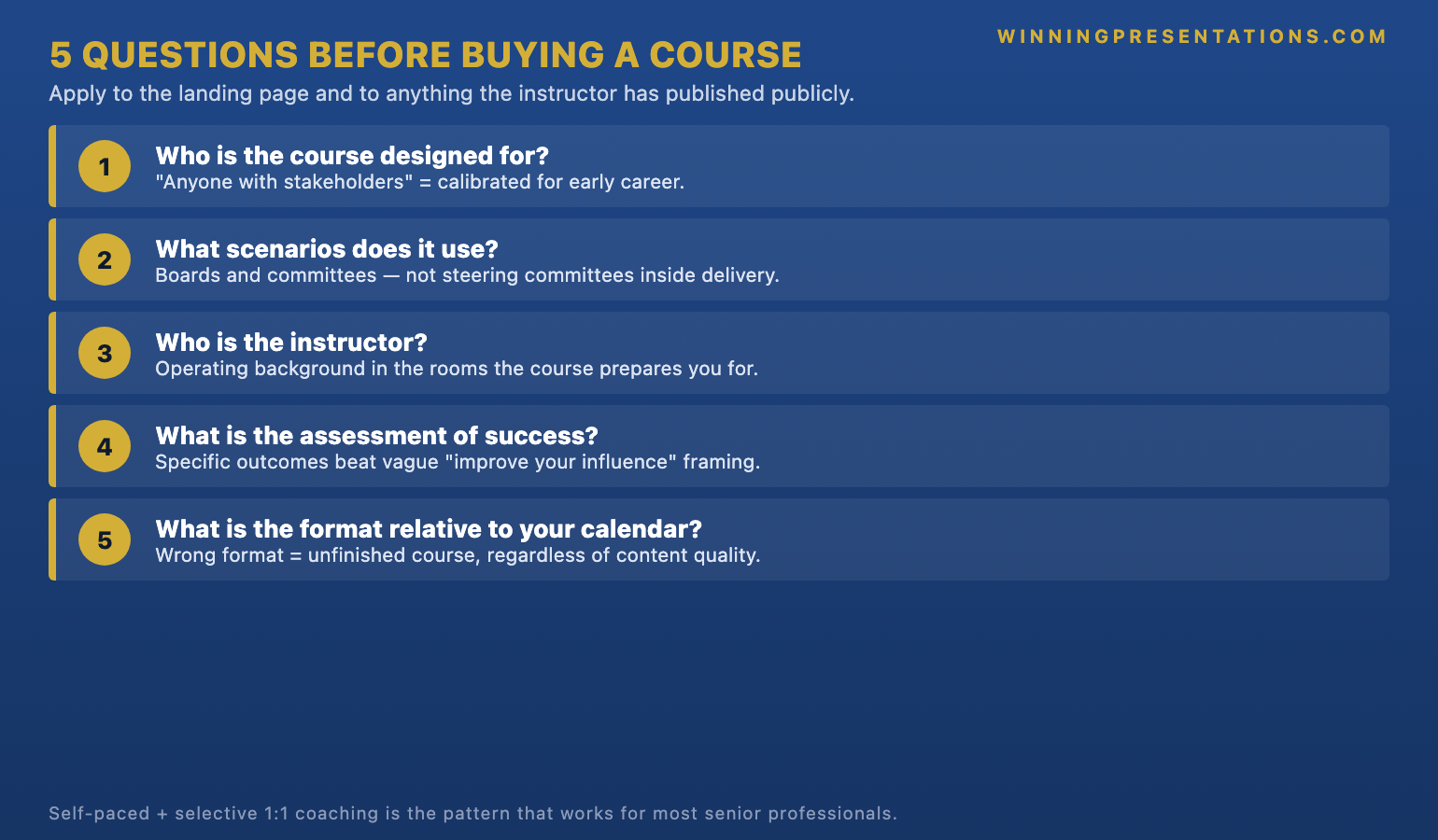
Five. What is the format relative to your calendar? A live cohort that requires six fixed sessions in four weeks is great if your calendar can hold it. A self-paced programme is great if you have a real upcoming decision to anchor the work to. A 1:1 engagement is great if you have a specific high-stakes situation. The wrong format for your calendar is the single most common reason senior professionals do not finish courses they have paid for.
Price range and what to expect
Four price tiers cover most of what is on the market. Each has its place; the question is which one matches your situation.
£0–£100 — short courses on general platforms (LinkedIn Learning, Udemy, Coursera). Useful as foundational content for early-career professionals. Rarely deep on senior-level scenarios. Worth the price for orientation; do not expect much beyond that for executive-level work.
£200–£800 — specialist self-paced programmes. The price tier where senior-specific material starts to appear. Look for instructors with operational executive experience and scenarios calibrated for board and committee settings. Most senior professionals get the highest return-per-pound at this tier when the course is well-targeted.
£1,000–£3,000 — live cohort programmes. Premium tier for cohort-based learning. The peer dimension adds real value; the calendar tax is significant. Typically delivered by recognised instructors with strong specialist focus.
£3,000–£15,000 — 1:1 executive coaching engagements. Bespoke. Calibrated to a specific upcoming situation or a multi-month development arc. Most useful when the stakes of a specific decision justify the investment, less useful as general developmental work for which a self-paced programme would be enough.
For the slide-structure side that goes with stakeholder work:
The Executive Slide System gives you 26 templates, 93 AI prompts, and 16 scenario playbooks for board, investment committee, and executive decision presentations. £39, instant access — useful as a parallel investment when stakeholder work and slide structure are both bottlenecks.
Frequently asked questions
How long does an executive stakeholder management course take to complete?
Self-paced senior programmes vary. Most senior professionals work through the core content in 6–12 hours, spread over two to six weeks depending on calendar pressure. Anchoring the work to a real upcoming decision compresses the timeline naturally — six weeks of light study suddenly becomes two weeks of focused application when there is a board meeting on the horizon.
Is an online course as effective as in-person executive coaching for stakeholder work?
For different things. In-person 1:1 coaching is the highest-touch format for a specific upcoming situation. Online courses give you the structural and psychological framework at a lower price point and on your timeline. For most senior professionals, the right pattern is online course as the foundation, with selective 1:1 coaching for specific high-stakes situations where stakes justify the investment.
Will a course teach me how to handle a specific difficult stakeholder I am dealing with right now?
Indirectly, not directly. A good course gives you the frameworks for analysing the situation, the techniques for the kinds of moves that work, and the structural psychology of why senior decision-makers behave the way they do. It will not give you a script for your specific colleague — that is what 1:1 coaching does. The combination of a solid course and a few targeted coaching conversations tends to be more useful than either on its own.
Can I expense an executive stakeholder management course through my employer?
Most employers will fund senior development if you frame it correctly. The case is usually easier when the course is positioned against a specific business outcome (a major upcoming decision, a recent promotion, a strategic initiative requiring board approval) rather than as general professional development. Many senior professionals have learning and development budgets they have not fully used; courses in the £200–£800 range often fall comfortably inside those allowances.
For the buy-in work that stakeholder management exists to enable.
The Executive Buy-In Presentation System covers the structure, psychology, and preparation that earns serious approval from boards and executive sponsors. Self-paced, monthly cohort enrolment, optional recorded Q&A calls. £499, lifetime access to materials.
Get The Winning Edge newsletter
A weekly note from Mary Beth on the structure, psychology, and preparation that earns senior approval. One idea, one application, one specific scenario — every Thursday morning.
Next step: Identify the next senior stakeholder decision you need to influence in the next 90 days. That is the anchor a course needs to actually move the needle. Without one, even the best course is theory; with one, the course becomes the structure for work you would be doing anyway.
About the author
Mary Beth Hazeldine is Owner & Managing Director of Winning Presentations Ltd, founded in London in 1990. With 24 years of corporate banking experience at JPMorgan Chase, PwC, Royal Bank of Scotland, and Commerzbank, she advises executives across financial services, healthcare, technology, and government on structuring presentations for high-stakes funding rounds and board approvals.