Quick answer: Executive storytelling training online teaches senior professionals to convert dense analytical content into a structured narrative that senior committees follow, remember, and back. Serious training in this category does not teach delivery polish or TED-Talk pastiche; it teaches structural narrative frameworks, stakeholder mapping, the data-into-story workflow, and the compressed narrative shape senior decision committees actually respond to. Most public-speaking and storytelling courses online are built for a general audience, which is why senior leaders preparing for a specific board or committee presentation rarely find them useful.
The senior leader who arrives at the search query “executive storytelling training online” is usually three weeks out from a specific high-stakes presentation. The bullet-point version of the deck has been circulated. The feedback has been quiet, in the way feedback gets quiet when the audience cannot follow the argument but is too senior to say so directly. The leader has rebuilt the deck twice and is now looking for a way to land the substance differently — not because the analysis is wrong, but because the analysis is not landing as a decision the committee can back. Storytelling, in this context, is not a soft skill. It is a structural problem the leader is trying to solve in days, not months.
This article is a buyer’s guide for senior professionals in that specific situation. It walks through what serious executive storytelling training online actually covers, how to evaluate the options, why most public-speaking and general business storytelling courses do not work for the senior level, and how to choose between a tactical self-paced course and a flagship structural programme. The detail matters because the cost of choosing the wrong training is not the fee — it is walking into a board meeting in three weeks with the same deck dressed in different language and watching the decision get deferred again.
If the bullet-point version of the deck isn’t landing and the meeting is in weeks, not months:
The Executive Buy-In Presentation System is a self-paced Maven programme covering the structural framework for securing buy-in from senior stakeholders — including the narrative shape senior committees actually follow. 7 modules, no deadlines, no mandatory live attendance. Built for senior professionals walking into a specific approval meeting prepared.
Explore the Buy-In Programme →
Who searches for executive storytelling training online
The senior professionals who arrive at this query divide into three groups. The largest is the leader preparing for a specific upcoming presentation — a board pitch, an executive committee paper, a C-suite strategy review — who has reached the conclusion that the technical and analytical work is sound but the audience is not following the argument as constructed. They are not looking for a long-term skill-building programme. They want to fix the next presentation, and they want training that produces a usable structural shift in days. Time horizon is short. Stakes are high. Patience for general storytelling theory is low.
The second group is the senior leader who has noticed a pattern across multiple presentations: dense, well-evidenced material that consistently produces “interesting, let us think about it” rather than backed decisions. This group is further along the diagnostic curve. They have read the books, attended the workshops, and concluded that the issue is not delivery but structure — that the way the case is being narrated to senior stakeholders is asking the committee to do too much synthesis in the room. They are looking for training that teaches the structural narrative discipline rather than the performative side.
The third group is the leader stepping into a new level of senior responsibility — first capital case, first board-facing role, first programme of strategic change to communicate. They are searching the term proactively, before a problem appears. This group benefits the most from senior-level storytelling training because the structural habits are easier to build before bad ones form. All three groups are looking for the same thing: training that respects their seniority, assumes baseline competence, and focuses on the structural moves that compound at executive level rather than on TED-Talk-style performance.
Why most public-speaking courses miss
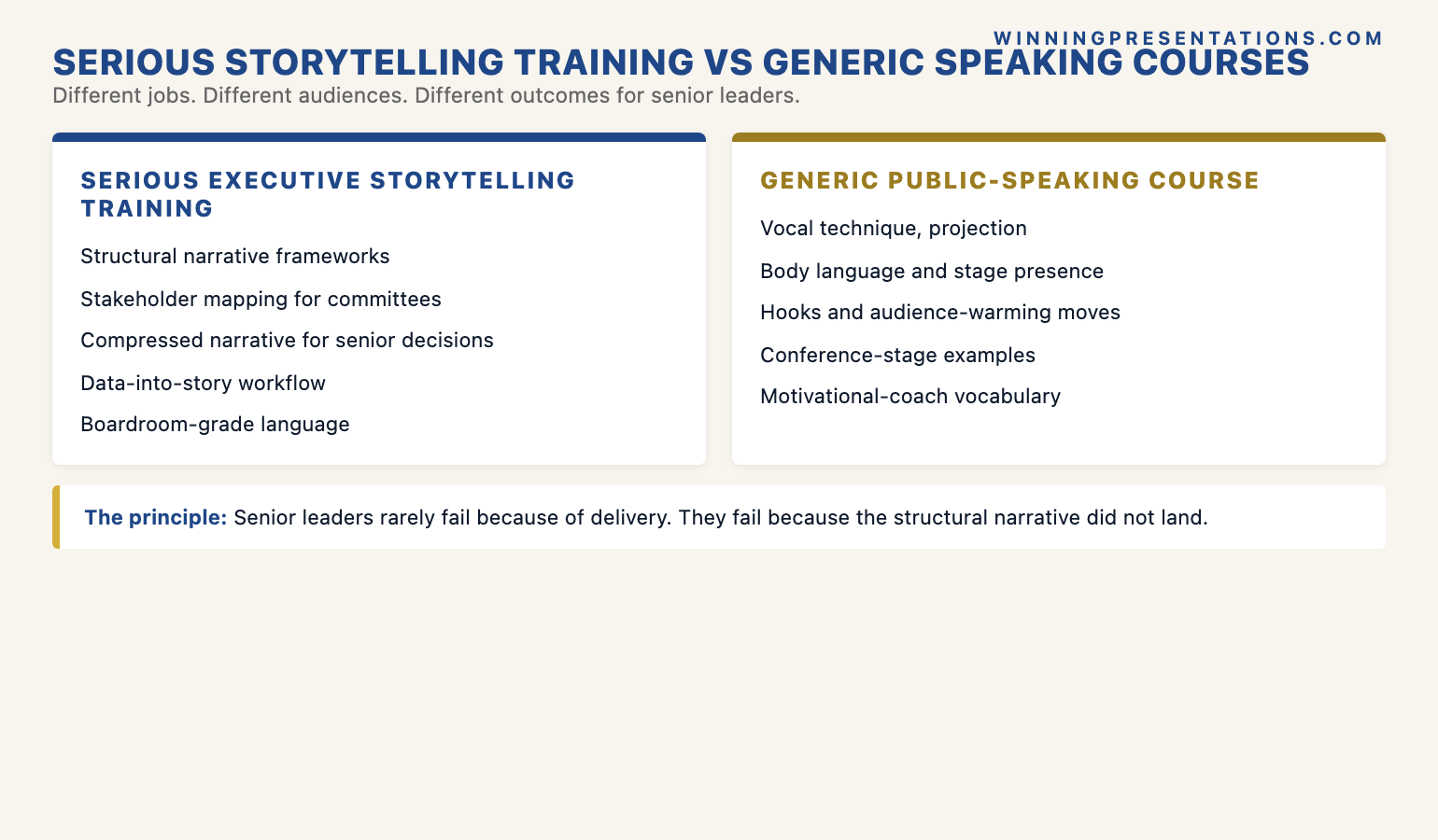
Most online courses indexed under “storytelling training” or “executive storytelling” are, structurally, public-speaking courses with a storytelling overlay. They focus on delivery — vocal modulation, body language, stage presence, emotional resonance, how to open with a hook. Useful for a TEDx talk. Largely irrelevant for a senior leader presenting a £40m capital case to an investment committee, where vocal warmth is not what is missing and emotional resonance is not what the committee is weighing.
The structural problem at senior level is upstream of delivery. It is in how the narrative is shaped before the senior leader opens their mouth — which evidence appears, in which order, anchored against which decision request, with which trade-offs named. Shaping that order — conclusion first, then the evidence that earns it — is the discipline behind the Pyramid Principle. Senior committees do not respond to storytelling in the public-speaking sense. They respond to compressed, structurally clean narrative that lets them follow the leader’s reasoning without needing to do the synthesis themselves. That discipline is rarely taught in courses built for a broader audience because the broader audience has not yet hit the structural ceiling that exposes the gap.
The second pattern in courses that miss is the over-reliance on personal anecdote as the unit of storytelling. “Open with a story about your grandmother.” “Tell us about the time you failed.” This works for keynote speaking and conference panels. It does not work for senior decision presentations, where the narrative the committee needs is not about the leader at all — it is about the business problem, the evidence, the trade-offs, and the recommendation. Personal-anecdote storytelling courses are a category mismatch for the audience searching this query, and the leader who follows their advice into a board meeting will produce a presentation that feels structurally wrong to the committee even when the leader cannot identify why.
For the editorial discipline of building narrative around executive data — rather than around the leader — see the foundation piece on storytelling for business presentations.
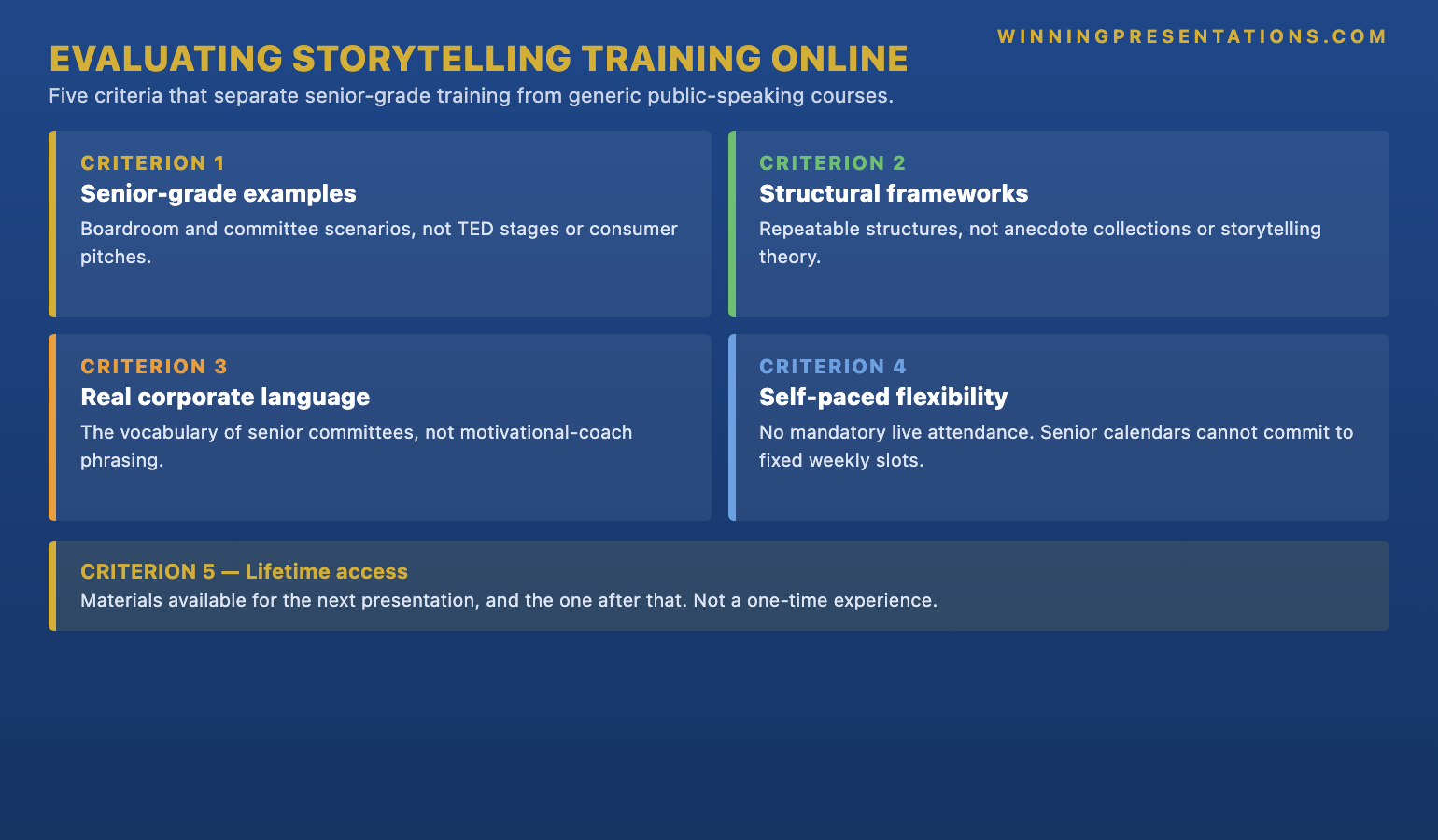
Five criteria for evaluating senior-level training
The first criterion is who the curriculum is built for. A course that names its audience as “senior professionals presenting at board, executive committee, or C-suite level” is a different product from a course that markets itself to “anyone who wants to be a better storyteller”. The audience naming is rarely cosmetic. It signals what the curriculum assumes about baseline competence, what examples will be used, and which structural problems will be treated as worth solving. Senior leaders should screen out general-audience courses early. The fee is not the cost; the time is.
The second criterion is whether the curriculum spends material time on structural narrative frameworks rather than on delivery technique. A course that allocates two-thirds of its time to vocal work, body language, and confidence-building is a delivery course. A course that allocates two-thirds to narrative structure, stakeholder mapping, evidence sequencing, and the compressed narrative shape for senior committees is a structural course. Senior leaders looking for storytelling training are almost always looking for the second category, even when they cannot articulate the distinction at the point of search.
The third criterion is the language of the course materials. Examples drawn from real corporate situations — capital cases, strategy reviews, change communications, board updates — signal a course built for the senior audience. Examples drawn from TED talks, conference keynotes, and motivational speaking signal a course built for a different audience. The leader can usually tell within five minutes of reviewing a course outline which category it sits in. The senior-corporate vocabulary is recognisable. So is its absence.
The fourth criterion is format. Senior calendars do not accommodate fixed weekly live sessions reliably across multi-week schedules. A self-paced format with optional recorded live components is the only structurally compatible format for the senior audience. Live cohort courses with mandatory weekly attendance are difficult to complete at this level — not because the senior leader cannot make time, but because the calendar irregularity makes consistent attendance unrealistic. A serious course in this category solves the format problem rather than asking the senior leader to.
The fifth criterion is access model. A course you can return to two years later when a new presentation context surfaces is structurally more useful than a course that ends with the cohort. Lifetime access to materials, recordings of any live components, and a structured way to re-engage with specific modules later all matter for training at this level. Senior leaders encounter different presentation contexts across their career — board, investment committee, regulator, all-hands, capital case — and the training should be available when each one arrives.
What serious training covers
Serious executive storytelling training online covers four areas. Structural narrative frameworks come first. The senior leader learns the compressed narrative shape that senior committees follow without effort — situation, complication, decision request, trade-offs, recommendation, first thirty days — and the discipline of forcing every piece of evidence to anchor against that shape rather than appearing because it exists. This is the core editorial move. It is rarely intuitive. It produces decks that read as structurally clean to senior audiences and feel structurally uncomfortable to leaders who have spent years building context-first decks.
Stakeholder mapping comes second. The course teaches how to identify, before writing a single slide, who is in the room, what each one cares about, what each one is most likely to push back on, and which one or two stakeholders will determine the outcome regardless of the wider committee. The mapping shapes which evidence appears, which trade-offs are named explicitly, and where the narrative spends its weight. Senior leaders who skip this step consistently produce decks that answer the wrong objections — the objections the leader anticipated rather than the ones the room actually has.
The data-into-story workflow comes third. This is the discipline of converting analytical evidence — financial models, customer data, operational metrics — into narrative structure that the committee can follow without doing the analytical work in their heads. Senior committees do not read complex tables in real time. They follow the leader’s reasoning. The workflow teaches how to surface the two or three numbers that anchor the case, how to compress secondary evidence into supporting structure, and how to handle the inevitable challenge to a specific number without losing the narrative thread. For more on this specific discipline, see data storytelling for executive audiences.
Build the case your stakeholders can’t dismiss.
The Executive Buy-In Presentation System is a self-paced Maven programme covering the framework for securing buy-in from senior stakeholders — narrative structure, stakeholder mapping, the data-into-story workflow, and compressed narrative for senior committees. 7 modules, no deadlines, no mandatory session attendance. Optional live Q&A sessions, fully recorded — watch back anytime. New cohort opens every month. £499, lifetime access to materials.
- 7 self-paced modules covering the structural framework for senior buy-in
- Optional live Q&A sessions with Mary Beth — recorded, watch back anytime
- Monthly cohort enrolment — join when it suits you, no fixed start date
- Designed for senior professionals walking into board, committee, and C-suite approval meetings
Explore the Buy-In Programme — £499 →
The fourth area is compressed narrative for senior committees. This is the specific discipline of taking a sixty-page strategy paper or a forty-slide investment case and compressing it into the twelve-minute narrative arc senior committees actually consume. Compression is harder than expansion. It requires editorial judgment about what to leave out, which is the move most experienced senior leaders are least practised at because their professional habit is to add evidence rather than remove it. A serious course spends real time on the discipline of subtraction, on the editorial sentences that compress structural moves into single lines, and on the rehearsal pattern that exposes whether the compressed version still carries the load.
Business storytelling vs senior committee storytelling
Business storytelling and senior committee storytelling are different disciplines, and conflating them is the most common reason senior leaders enrol in the wrong course. Business storytelling — as taught in most general business storytelling courses — focuses on customer narratives, brand stories, internal communications, and motivational anecdote. It is useful for marketing, internal change campaigns, and external communication. It is not the right framework for a senior leader presenting a capital case to a board.
Senior committee storytelling is structurally tighter. The audience is small (typically five to fifteen senior decision-makers). The narrative window is short (often ten to fifteen minutes of presentation followed by structured discussion). The decision being requested is specific. The trade-offs being weighed are real and consequential. There is no room for opening hooks that do not earn their place, for personal anecdotes that do not anchor against the decision, or for emotional resonance that distracts from the evidentiary work the committee is doing in real time. The narrative discipline is closer to a structured legal argument than to a TED talk.
The leader who enrols in a general business storytelling course and applies its lessons to a senior committee presentation will produce a deck that feels structurally wrong to the committee. The hooks will land awkwardly. The personal anecdotes will read as off-topic. The emotional resonance will register as distracting from the analytical case. The committee will not say any of this directly — they will simply defer the decision and ask for “a tighter version next time”. The training mismatch is invisible at the point of enrolment and obvious only after the meeting.
For more on the senior-committee narrative discipline as it applies to vision and strategy work, see presenting a vision to senior leaders.
How to choose between £29 and £499
Two products serve this audience at different price points and different commitment levels. The choice is structural rather than budgetary — different products are right for different situations.
The Business Storytelling Mini-Course (£29, self-paced, instant access) is the right call for senior leaders who want a starter framework for narrative structure around executive data. It teaches frameworks for narrative structure around executive data in a compressed, tactical format. It is a good fit for the leader who has a single specific presentation in three weeks, wants to upgrade their narrative shape for that meeting, and is not ready to commit to a full structural programme. It is also a good fit for the leader who wants to test whether structural storytelling training is the right diagnostic before investing in the flagship programme.
For the tactical starter framework before committing to the flagship:
The Business Storytelling Mini-Course (£29, self-paced, instant access) covers frameworks for narrative structure around executive data. Designed as a tactical starter for senior leaders preparing for a specific upcoming presentation who want to upgrade narrative shape without committing to a full structural programme.
Explore the Business Storytelling Mini-Course →
The Executive Buy-In Presentation System (£499, self-paced Maven programme, monthly cohort enrolment, lifetime access) is the right call for senior leaders who have concluded the issue is structural and who want the full framework for securing buy-in from senior stakeholders — not just narrative shape, but the full architecture of stakeholder mapping, decision framing, trade-off naming, and compressed narrative for senior committees. It is a fit for leaders who present at board or executive committee level multiple times a year, who recognise the stakes are high enough to justify a structural investment, and who want training they can return to across the rest of their career.
The clean way to think about it: the £29 course gives the senior leader a sharper narrative shape for the next presentation. The £499 programme gives them the structural architecture they will use for the rest of their senior career. Neither is “better”; they are answers to different questions. Leaders who buy the £29 course and find the framework valuable often graduate to the £499 programme later, which is a sensible sequence rather than a redundant one. For the editorial backbone of how storytelling integrates with the broader executive presentation discipline, see business storytelling for executive presentations.
Walk into your next approval meeting prepared.
The Executive Buy-In Presentation System (£499, lifetime access) is the structural framework for senior professionals presenting strategic decisions to boards and committees. 7 self-paced modules, monthly cohort enrolment, optional recorded live Q&A with Mary Beth.
Explore the Buy-In Programme — £499 →
Frequently asked questions
Is executive storytelling training online different from a public-speaking course?
Yes, structurally. A public-speaking course focuses on delivery — voice, pacing, presence, body language. Executive storytelling training online, when built for the senior audience, focuses on the structural narrative moves that come before delivery — narrative shape, stakeholder mapping, the data-into-story workflow, and compressed narrative for senior committees. The two skill sets overlap in surface ways but solve different problems. A senior leader whose decks are visually polished and well delivered but consistently produce deferred decisions is dealing with a structural narrative issue, not a delivery issue, and a public-speaking course will not address it.
How quickly can I apply storytelling training to a specific upcoming presentation?
The structural moves in serious training take effect from the first presentation that uses them. A senior leader who works through the narrative shape, stakeholder mapping, and compressed narrative modules can apply them to a presentation three weeks out and see a different rate of committee engagement immediately. The deeper editorial discipline — what to leave out, where the narrative spends its weight, how to handle the moment a number is challenged — compounds across two to three presentation cycles. The first presentation already shows improvement; the long-term shift is in the underlying habit.
Can a corporate L&D budget cover executive storytelling training online?
Usually yes. Most corporate L&D budgets support training that is directly tied to a current senior role responsibility, and presenting strategic cases to boards or executive committees almost always qualifies for that test. A self-paced programme at £499 sits well below most senior L&D approval thresholds and is typically routine to expense. The conversation with the manager is usually about timing — when the leader will work through the material — rather than about justification. For the £29 starter course, expense approval is generally automatic at this level.
Should I take the £29 course first, or go straight to the £499 programme?
If the issue is a single specific upcoming presentation in two to four weeks and the leader wants a tactical narrative-shape upgrade without a longer commitment, the £29 mini-course is a sensible starting point. If the leader has concluded the issue is structural across multiple presentations, presents at senior level multiple times a year, and wants the full architecture for senior committee approval work, the £499 programme is the right starting point and the £29 course will feel partial by comparison. Both products are valid; the right answer depends on the situation rather than the budget.
Is the Executive Buy-In Presentation System suitable if my role is technical or specialist rather than general management?
Yes, if the role involves presenting recommendations or cases to senior committees that need to back them. Many of the senior leaders who benefit most from the programme are in technical or specialist roles — finance, technology, risk, operations, regulatory affairs — where the analytical work is strong but the case-making to non-specialist committees is where decisions get deferred. The structural moves in the programme are not specific to general management; they apply wherever a senior professional is asking a committee to back a recommendation that involves consequential trade-offs.
The Winning Edge — weekly newsletter
The Winning Edge is a weekly newsletter for senior professionals who present at the executive level. One short email a week, focused on the structural narrative moves that separate decks committees back from decks they defer. Subscribe to The Winning Edge →
Not ready for the full programme? Start here instead: download the free Executive Presentation Checklist — a one-page reference for the structural moves senior leaders run before every committee deck.
About the author
Mary Beth Hazeldine is Owner & Managing Director of Winning Presentations Ltd. With 25 years of corporate banking experience at JPMorgan Chase, PwC, Royal Bank of Scotland, and Commerzbank, she advises executives across financial services, healthcare, technology, and government on structuring presentations for high-stakes funding rounds, board approvals, and strategic decisions.