Tag: budget presentation anxiety

05 Jun 2026
Budget Presentation Dread: Why the Finance Review Triggers More Anxiety Than Any Board Meeting

Budget Presentation Dread: Why the Finance Review Triggers More Anxiety Than Any Board Meeting

Quick answer: Budget presentation dread is the highest-anxiety category most senior professionals report — often higher than board meetings, investor pitches, or external speaking. Three factors drive it. The audience tests assumptions you cannot fully defend, the consequences land on your team rather than on you abstractly, and the format gives the audience permission to interrupt at any point. The dread is not irrational; it reflects a real structural asymmetry between the presenter and the room. The rebuilding pattern that works treats the dread as structural rather than personal — naming the three drivers explicitly, rebuilding the deck so it pre-empts the audience’s hardest moves, and rehearsing the meeting in the form it will actually take rather than the form you wish it would take.

Tomás, a divisional finance director at a Madrid-headquartered industrial firm, has presented to investor calls of 600 people, defended an acquisition rationale to the board, and given a keynote at an industry conference of 1,200. None of those triggered the level of anxiety he feels in the week before the annual budget review with the group CFO. He sleeps badly for three nights before the meeting. He rehearses the deck obsessively. He runs the variance model in his head while waiting for his daughter at the school gates. The first time he described this to me, his framing was self-critical: he is twenty years into a senior career and “should be past this by now”. The framing is wrong. The dread is structural, not developmental. The rebuilding works on the structure, not on him.

This is not unusual. In conversations with senior professionals about which presentation triggers the most dread, the budget review with finance leadership comes up more often than the full board meeting, the investor day, or the external speaking event. The intuition that an external 600-person audience should be more frightening than a six-person internal review turns out to be wrong. The internal review carries structural features that no external audience does — the audience knows your numbers in detail, has the right to interrupt at any point, and will make decisions that affect your team for the year ahead. Those features compound into a level of anxiety that many senior people find disproportionate to the meeting’s apparent stakes.

This piece walks through why budget presentation dread is the worst category for many senior professionals, the three structural drivers that produce it, why standard preparation often makes it worse rather than better, and the rebuilding pattern that resets both the meeting and the experience of preparing for it. The goal is not to eliminate the anxiety; it is to make the anxiety proportionate to the meeting and to give it somewhere useful to go. Anxiety that has a structural target — a slide to rewrite, a question to pre-empt, a sensitivity to model — is anxiety that does the work for you. Anxiety with no target is the dread.

If the rebuilding pattern below resonates, the deeper framework is worth a look.

Conquer Your Fear of Public Speaking is a structured framework for the kind of anxiety that does not respond to standard “calm down” advice — designed for senior professionals whose nerves predate the role and have outlasted seniority. Built on the techniques that worked for me after five years of acute presentation anxiety in my own banking career.

Explore the Framework →

Why budget reviews trigger more dread than board meetings

Most senior professionals expect external high-visibility events — board meetings, investor pitches, conference keynotes — to trigger the worst anxiety, because those events involve the largest audiences and the most public consequences. The reverse is often true. A keynote to 1,200 people is a one-way performance: the audience cannot interrupt, cannot test the speaker on details they hold expertly, and cannot make a decision in the room that affects the speaker’s team for the next year. The structural features that drive the anxiety simply are not there. The performance can be rehearsed; the audience’s reaction is broadly supportive; the consequences are reputational and diffuse.

The internal budget review has the opposite structural shape. The audience is small, but they know the firm’s finances in detail and many of them know the variance lines as well as the presenter does. The interruption rights are unrestricted — a finance committee will stop a presentation at any point to ask about a number, an assumption, or a comparison. The decisions made in the room translate directly into next year’s budget allocation, which translates into hiring, into project funding, into the team’s ability to deliver. The asymmetry between the presenter’s investment in the outcome and the audience’s analytical leverage over the decision is what produces the dread.

The intensity tends to surprise senior people because seniority normally protects against this kind of anxiety. A division head who has handled crisis communications, integration announcements, and difficult M&A conversations may still find themselves sleepless before a routine quarterly budget review. The seniority does not transfer because the structural features that drive budget dread are independent of role — they are features of the meeting format and the audience composition. A 25-year veteran feels the same dread as a first-year director on these reviews, because the structure of the room is the same. For the closely related discipline behind preparing for the specific anxiety pattern that finance committees produce, see our CFO presentation nerves piece.

The three structural drivers of budget presentation dread

The first driver is assumption exposure. A budget request is built on a small number of assumptions that are inherently uncertain — volume growth, cost inflation, foreign exchange, a major contract closing on time. The presenter chose the assumptions on the basis of the best information available, but they cannot fully defend them because the information itself is uncertain. The audience knows this and has the right to test it. A question like “what if your volume assumption is 10 per cent low?” is structurally unanswerable in the moment beyond pointing to the sensitivity work in the appendix; the assumption is, by its nature, an estimate. The dread is the anticipation of being asked to defend the indefensible — not because the assumption is bad, but because no assumption can be perfectly defended.

The second driver is consequence concentration. Most high-stakes presentations have diffuse consequences — a board meeting may shape strategy, but the strategic shape lands on many people; an investor presentation may move a share price, but the share price affects no specific colleague directly. A budget review has concentrated consequences. The decisions made in the room land on the presenter’s team for the next year. Hiring decisions, project decisions, training decisions, sometimes promotion decisions all flow from the budget approved that morning. The presenter is presenting their team’s year; that level of consequence concentration is qualitatively different from the diffuse consequence of most senior presentations.
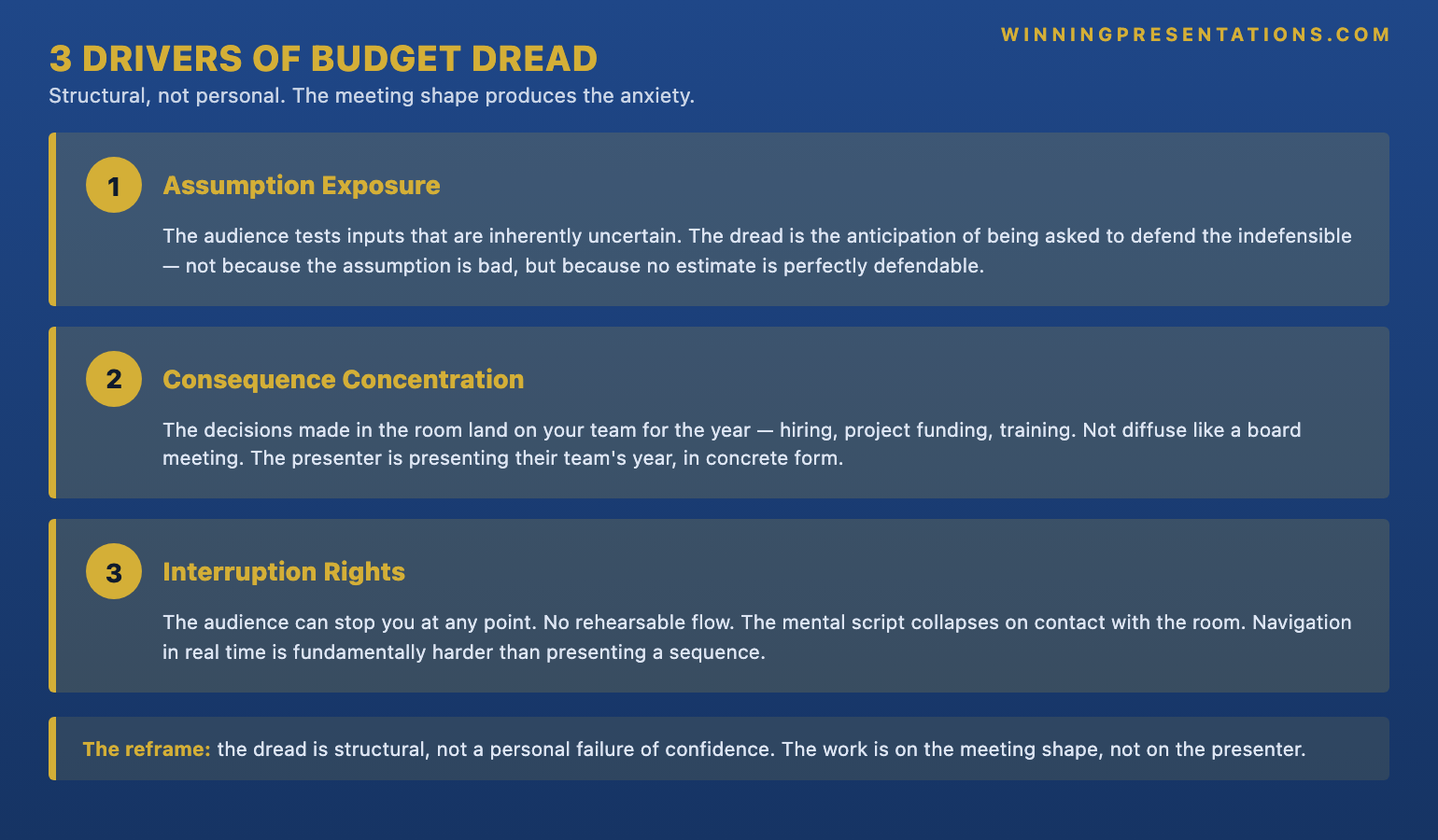
The three structural drivers of budget presentation dread infographic showing each driver: 1 Assumption Exposure (audience tests inputs you cannot fully defend, dread is anticipation of defending the indefensible), 2 Consequence Concentration (decisions land on your team for the year, not diffuse like a board meeting), 3 Interruption Rights (audience can stop you at any point, no rehearsable flow, mental script collapses on first interruption) — with the principle that budget dread is a structural response to the meeting shape, not a personal failure of confidence.

The third driver is interruption rights. A board meeting often has a chair who manages the flow; an investor presentation has a defined Q&A window after the deck. A budget review with finance leadership has neither. The CFO and the FP&A team can interrupt at any point — to ask about a number on slide three, to query an assumption on slide eight, to push back on a comparison on slide twelve. The presenter cannot rely on a rehearsed flow; the rehearsed flow will not survive the first interruption. The mental script the presenter built in preparation collapses on contact with the room, and the presenter has to navigate the meeting in real time. That is a fundamentally harder cognitive task than presenting a rehearsed sequence, and the anticipation of it produces a specific category of dread.

Why standard prep makes the dread worse, not better

The standard advice for presentation anxiety — rehearse the deck, walk through the slides aloud, practise the opening — is calibrated for performances. It works well for a conference keynote or an external pitch where the presenter controls the flow. It works badly for a budget review where the flow will be interrupted in the first three minutes. A presenter who spends the week before a budget review rehearsing the deck slide by slide is rehearsing a meeting that is not going to happen. They will arrive on the day having practised a flow they cannot use, which means the in-room experience is one of constant cognitive disruption — every interruption pulls them out of a script they had over-prepared.

The over-rehearsal also amplifies the dread mechanism. A presenter who has rehearsed a flow ten times has built an expectation that the flow will hold. When it does not — when the first interruption arrives at slide three — the breach of expectation registers as failure, even though the interruption is normal and expected. The presenter then enters the rest of the meeting feeling that something has already gone wrong, which raises baseline anxiety for the remainder of the session. Standard preparation, applied to this meeting format, produces an anticipated experience that is worse than under-preparation would.

The other issue with standard prep is that it puts the cognitive work in the wrong place. The energy the presenter spends rehearsing the deck would be better spent on the work the meeting actually requires — predicting the audience’s three or four hardest questions, building the response structure for each, and stress-testing the assumptions in the model in the way the audience will. That work reduces the dread because it gives the anxiety a target. Anxiety with a structural target — “I’m worried about the FX assumption, so let me model the sensitivity at three different levels” — is anxiety that produces useful preparation. Anxiety with no target — “I’m worried about the meeting” — is the dread itself.

The rebuilding pattern that resets the meeting shape

The rebuilding pattern starts by accepting the meeting’s actual shape rather than the wished-for shape. The actual shape is: the presenter will get through the first one or two slides, will be interrupted, will spend the next several minutes in question-and-answer, will return to the slides for a brief stretch, will be interrupted again, and will exit the meeting having spent perhaps 20 per cent of the time presenting and 80 per cent of the time responding. The deck is the trellis the conversation grows on, not the script the presenter performs. Recalibrating the preparation around that shape is the first move in reducing the dread.

The second move is to rebuild the deck so the slides survive interruption. The deck that works in this format has each slide stand alone — the variance slide makes sense out of order, the assumption slide makes sense out of order, the request slide makes sense out of order. A slide-by-slide narrative deck does not survive interruption because each slide depends on the slide before. A deck of stand-alone slides, each carrying its own headline number and one-line cause, can be navigated in any order the room demands. This is structural pre-emption: the deck is built to handle the actual meeting shape, not the wished-for one. For the wider discipline behind building a finance deck this way, see our how to present to a CFO piece.
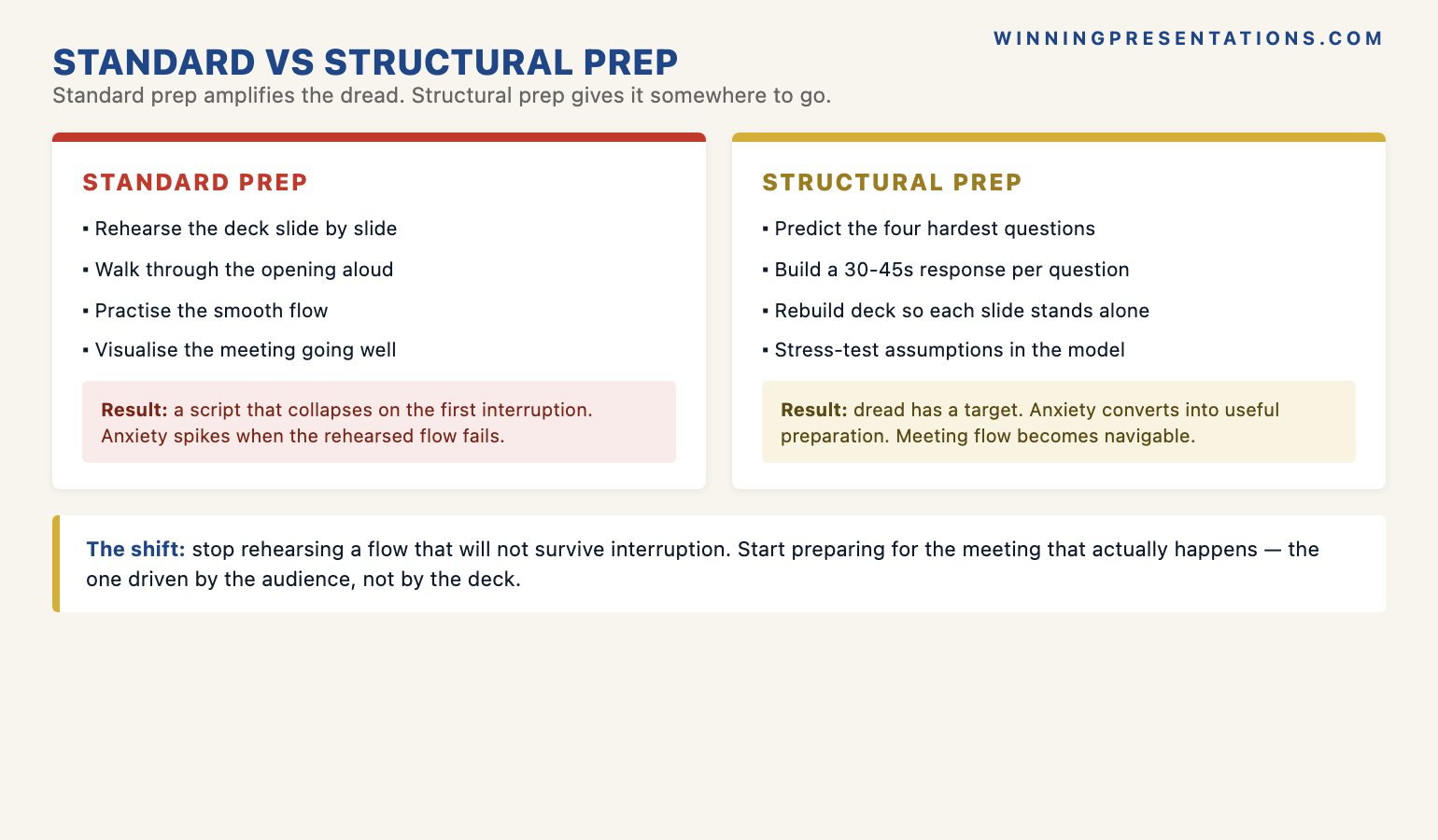
The budget review preparation reset infographic showing the shift from standard preparation that amplifies dread to structural preparation that reduces it: standard prep rehearses a flow that will not survive interruption, structural prep predicts the four hardest questions and builds response structures for each, with the principle that giving the anxiety a target turns dread into useful preparation.

The third move is to predict the audience’s four hardest questions in advance and build the response structure for each. Not bullet-point answers — response structures. For the volume assumption question, the structure is: name the assumption, name the source, name the sensitivity, name the trigger that would cause us to revise. For the cost overrun question, the structure is: acknowledge the variance, name the structural driver, name the corrective action, name the milestone we will report against. Each response is roughly 30 to 45 seconds. Rehearsing four response structures replaces the futile rehearsal of the linear deck. It also reduces the dread because the unknown — what they might ask — has been narrowed to a known set the presenter has rehearsed for. The dread feeds on the unknown.

A structured framework for the kind of presentation anxiety that does not respond to “just calm down”.

Conquer Your Fear of Public Speaking is a structured framework built on the techniques I used to recover from five years of acute presentation anxiety in my own banking career. Designed for senior professionals whose nerves predate the role and have outlasted seniority — the asymmetric anxiety the budget review reliably triggers.

  • The structural reframe that separates pre-meeting anxiety from in-meeting performance
  • The cognitive rebuild for the night before, the morning of, and the 90 seconds before
  • Techniques designed for senior professionals where standard advice has failed
  • Built on lived experience, not theoretical models
  • £39, instant download, lifetime updates

Get Conquer Your Fear of Public Speaking (£39) →

In the room: what to do when the dread spikes mid-meeting

Even with structural rebuilding, there is a moment in many budget reviews where the dread spikes — typically in the second or third minute, when the first hard interruption arrives, or in the middle of the meeting, when a sequence of questions has compounded and the presenter has lost the thread of where the deck was supposed to go. The cognitive symptoms are familiar: the deck loses its shape in the presenter’s mind, the question seems harder than it actually is, the next sentence will not arrive. This is a physiological event as much as a cognitive one. The body has gone into a stress response and has narrowed cognitive bandwidth.

The recovery move is short and specific: pause. Two seconds, maybe three. The instinct is to fill the pause with words, but the pause is what allows the parasympathetic system to come back online and the cognitive bandwidth to widen. Two seconds is long enough to feel uncomfortable to the presenter and unremarkable to the audience. After the pause, return to the question at the level of structure rather than the level of detail: “Let me name the assumption, then walk through the sensitivity.” The structural opening recovers the cognitive shape and gives the rest of the answer somewhere to go. Most experienced presenters do this without naming it as a technique; they have learned that the pause is what makes the recovery possible.

If the in-the-room moments are where the dread does the most damage:

Calm Under Pressure is a focused set of rapid-response techniques for the physical symptoms of presentation anxiety — shaking hands, racing heart, trembling voice — methods you can use in the room, in the moment, without anyone noticing. Pairs with the rebuilding work above.

Explore Calm Under Pressure (£19.99) →

The other thing worth knowing about in-the-room recovery is that the audience usually does not register the spike at all. The presenter experiences the moment as a visible failure; the audience experiences it as a brief pause before a structured answer. The asymmetry between internal experience and external perception is wide and consistent. A presenter who has been told this and believes it tends to recover faster, because the recovery move is not also carrying the weight of “they all noticed”. For the closely connected piece on the structural moves that produce the deck this kind of meeting needs, see our companion article on the board budget presentation 6-slide format.

Frequently asked questions

Is budget presentation dread the same as imposter syndrome?

No, although the two can compound. Imposter syndrome is a generalised belief that one does not belong in the role; budget presentation dread is a specific anxiety triggered by the structural features of one specific meeting format. A senior professional can feel entirely confident in their role for 51 weeks of the year and still feel acute dread in the week of the budget review. The dread is meeting-specific, not role-specific. Treating it as imposter syndrome leads to interventions that target the wrong thing — broad confidence work, when what is needed is structural meeting work. Naming the dread accurately is the first step in addressing it.

Why does the dread get worse with seniority, not better?

For many senior professionals, it does. Seniority increases the consequence concentration — a junior manager presenting a £200,000 budget has fewer downstream decisions resting on the outcome than a director presenting a £20m budget. Seniority also raises the audience’s analytical leverage — junior decks face questions about line items, senior decks face questions about strategy and assumptions, which are inherently harder to defend. And seniority typically removes the option of saying “I’ll get back to you on that” — senior leaders are expected to know their numbers in the room. Each of these factors increases the structural difficulty of the meeting, so the anxiety can scale with the role rather than diminish.

Should I tell my CFO I find this meeting hard?

Not in those terms, generally. Most CFOs will read it as a confidence flag rather than as the structural observation it actually is. The more useful thing to do is to ask the CFO in advance what their main areas of focus will be — phrased not as “I’m anxious about your questions” but as “I want to make sure the deck addresses what you most want to discuss; what should I emphasise?” That question is professionally normal, signals preparation rather than anxiety, and frequently surfaces information that lets you reduce the dread by knowing more about what is coming. Many CFOs welcome the question and respond directly; some do not, and that is also useful information.

Will the dread ever go away completely?

Probably not, and that is fine. A small amount of pre-meeting alertness sharpens preparation and improves in-room performance. The work is not to eliminate the anxiety but to make it proportionate to the meeting and to give it somewhere useful to go. Senior professionals who have been doing budget reviews for fifteen years often report that the dread has reduced from “couldn’t sleep for three nights” to “alert and focused the morning of”. That is the realistic shape of progress. The full disappearance of all anxiety would probably indicate either complacency or a meeting that has lost its stakes — neither of which is desirable.

The Winning Edge — weekly newsletter

The Winning Edge is a weekly newsletter for senior professionals who present at the executive level. One short email a week, focused on the structural moves that separate decks committees back from decks they defer. Subscribe to The Winning Edge →

Not ready for the full framework? Start here instead: download the free 10 Questions Every CFO Asks (+ Scripts) — knowing what is coming is one of the most reliable ways to reduce the dread of the unknown.

About the author

Mary Beth Hazeldine is Owner & Managing Director of Winning Presentations Ltd. With 25 years of corporate banking experience at JPMorgan Chase, PwC, Royal Bank of Scotland, and Commerzbank, she advises executives across financial services, healthcare, technology, and government on structuring presentations for high-stakes funding rounds, board approvals, and strategic decisions.

26 May 2026
Featured image for CFO Presentation Nerves: Why Finance Committees Trigger More Anxiety Than Any Other Audience

CFO Presentation Nerves: Why Finance Committees Trigger More Anxiety Than Any Other Audience

Quick answer: CFO presentations trigger more anxiety than any other audience for three structural reasons: the audience is asymmetric in expertise, the questioning pattern is forensic rather than conversational, and the consequences of weakness are visible across the rest of the organisation. The nerves are not a personal failing — they are a rational response to a structurally harder audience. The fix is not to feel less. The fix is to prepare differently and to use the physiological techniques senior presenters use under sustained scrutiny.

Eshe had presented to boards. She had presented to regulators. She had handled hostile press conferences during a sector crisis. None of them produced the level of dread that CFO presentations did. Days before the meeting she would lose sleep. The morning of, her hands would shake. In the meeting, her voice would catch on the financial slides — the slides she knew best. The pattern was reliable enough that she had started to assume something was wrong with her.

Nothing was wrong with her. CFO presentations are structurally harder than most other senior audiences, and the anxiety she was feeling was a rational response to that structure rather than a personal weakness. Once she understood why finance committees trigger more nerves than any other audience, the nerves became something she could prepare for rather than something to be ashamed of. They did not disappear. They became smaller, and they stopped derailing the meeting.

CFO presentation nerves are not the same nerves as general public speaking anxiety. They have a specific shape. Recognising the shape is the first step to handling them. The work is partly structural — preparing the case in a way that reduces the surface area for hostile questioning — and partly physiological — using the techniques senior presenters rely on when the nerves arrive in the room despite preparation. Both pieces are necessary. Neither is sufficient on its own.

If CFO meetings have started to take a disproportionate emotional toll

Conquer Your Fear of Public Speaking covers the structural and physiological techniques senior professionals use under sustained scrutiny — including the patterns that work specifically for finance committee anxiety. Built around 25 years of presenting to credit committees, boards, and regulators. Instant download.

Explore the system →

Why CFO audiences are structurally harder

Not all senior audiences are the same. A board listening to a strategic update has a different posture from a CFO reviewing a budget proposal. The board wants the story; the CFO wants the model. Most public-speaking anxiety advice is calibrated for storytelling audiences — boards, conferences, internal town halls — where the audience is open to being persuaded. Finance audiences are not in that posture. They are in a verification posture.

Verification posture changes the shape of the questioning. Instead of “tell me what this means”, the question becomes “show me that this holds up”. The presenter is not being asked to inspire; they are being asked to defend. Defence is harder than persuasion. It places the presenter in a structurally weaker position because every claim is implicitly tested against a model the CFO is mentally running in parallel.

The shift from persuasion to defence is what makes the nerves feel different. The presenter senses, correctly, that the room is not on their side in the way a board or a town hall would be. The room is professionally neutral, which feels — until you are used to it — like opposition. It is not opposition. It is the working posture of a CFO doing their job. Recognising the posture is the first step in lowering the anxiety it produces.

The three reasons the nerves are rational

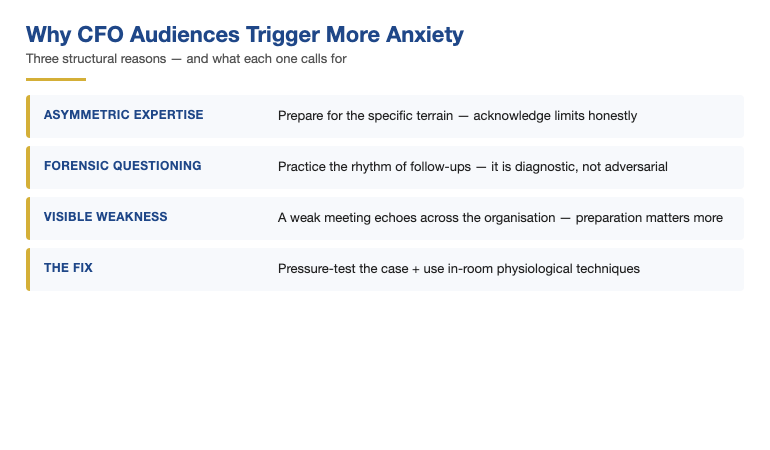
Reason one — asymmetric expertise. The CFO usually knows more about the financial structure of the proposal than the presenter. The presenter knows the operational case. The CFO knows the financial case. The asymmetry is real, and pretending otherwise tends to backfire. Anxiety in this context is partly anticipation of being challenged on terrain the CFO is more fluent in. The fix is not to pretend the asymmetry does not exist. The fix is to prepare for the specific terrain on which the CFO is most likely to push, and to acknowledge limits honestly when they appear.

The three structural reasons CFO presentations trigger more anxiety than other audiences: asymmetric expertise, forensic questioning pattern, organisational visibility of weakness — with the response strategy for each

Reason two — forensic questioning pattern. CFOs ask questions in a forensic style. Each question is a test of a specific element of the case. A good answer earns the next question, which is a different test. The pattern is not adversarial — it is diagnostic — but it feels adversarial because the rhythm is unfamiliar. Most other senior audiences ask conversational questions where one good answer ends the line of inquiry. CFOs do not. They ask follow-ups, and the follow-ups go deeper. The presenter who has not experienced this rhythm reads it as a sustained challenge to their competence rather than as the normal working pattern of a finance review.

Reason three — organisational visibility of weakness. A weak presentation to a board is contained. A weak presentation to a CFO is not. CFOs talk to each other across organisations, brief their teams in the days afterwards, and shape the standing perception of the proposal owner across the rest of the senior leadership. The downstream cost of a weak finance committee meeting is materially larger than the downstream cost of a weak board meeting. The anxiety is partly about the meeting and partly about the meeting’s reputation effects, which are real.

Preparation moves that reduce the nerves

Most CFO presentation nerves are produced by under-preparation in a specific area: the financial pressure-test of the case. A presenter who has prepared the strategy slides thoroughly but has not stress-tested the financial assumptions walks into the room knowing, somewhere, that there is a vulnerability. The body translates that knowledge into anxiety. Closing the vulnerability closes most of the anxiety with it.

Pressure-test the model with someone who is not on your team. A finance partner from another part of the organisation, a former colleague, an external advisor — anyone who will challenge the model the way the CFO will. The conversation will surface gaps that internal review tends to miss. The gaps surfaced before the meeting can be closed. The gaps surfaced in the meeting cannot. Most of the nerves come from the second category.

Write the answers to the predictable questions. CFO budget questions cluster into about fifteen predictable forms. Writing a one-paragraph answer to each — sensitivity, comparable benchmarks, downside case, half-case, opportunity cost, controls — surfaces the gaps that improvisation would not. The act of writing is what reduces the anxiety. Reading written answers in the meeting is unnecessary. Having written them is what changes the nervous system response.

Pre-brief the friendliest senior figure. Most CFO meetings have at least one senior figure who is on your side, even quietly. A pre-brief with that person — twenty minutes is usually enough — accomplishes two things. It surfaces the questions the CFO is most likely to ask, and it builds an ally in the room who will help carry the conversation if a question lands hard. The presence of an ally lowers nervous-system arousal independently of the substance of the case.

Walk the deck out loud. Most senior presenters review the deck silently. Reading it aloud once or twice in the days before the meeting surfaces transitions that look fine on paper but stumble in delivery — the joins between slides, the introduction of comparative numbers, the transition to the controls slide. These are the points where the voice tends to catch under pressure. Walking them out loud beforehand reduces the in-the-room catch by a substantial margin.

For senior leaders whose nerves spike specifically around finance committees

Conquer Your Fear of Public Speaking — the system that works under sustained scrutiny

Built from 25 years of presenting to credit committees, boards, and regulators — many of which produced exactly the kind of finance-committee dread CFO meetings produce. The system covers the cognitive reframes, the preparation routines, and the in-the-room physiological techniques senior leaders use to stay composed when the questioning is forensic and sustained.

  • The cognitive reframes that reduce anticipatory anxiety in the days before the meeting
  • Preparation routines designed for forensic-questioning audiences
  • In-the-room techniques for shaking hands, racing heart, voice catch on financial slides
  • Recovery patterns for when an answer has not landed and the room knows it

£39 · Instant download · Lifetime access · Built from 25 years of presenting under sustained financial scrutiny

Get the system →

In-the-room techniques when the nerves arrive anyway

Even with thorough preparation, the nerves often arrive in the room. The body responds to the verification posture and the forensic questioning pattern even when the case is strong. The work then is to manage the physiological response rather than to suppress it. Suppression rarely works. Management routinely does.

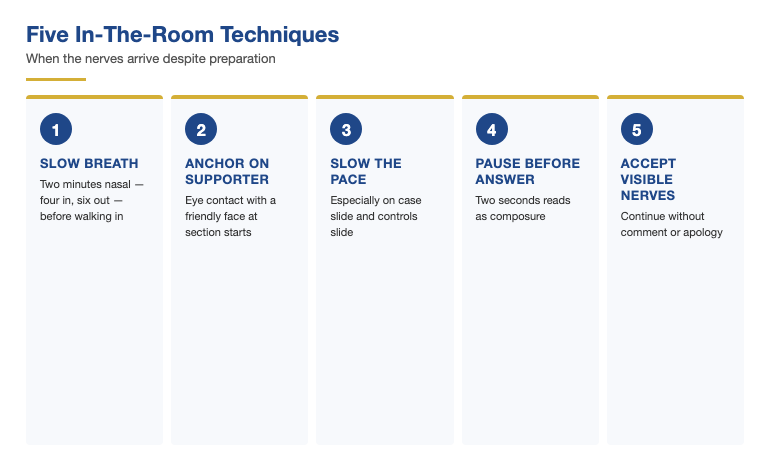
Slow the breath before walking in. Two minutes of slow nasal breathing — four seconds in, six seconds out — before entering the room reduces sympathetic nervous system activation enough to shift voice tone, hand steadiness, and reaction time. The technique is not new. It is consistently effective. It is also unobtrusive, which matters when the meeting is in a corporate environment.

Five physiological techniques senior presenters use in CFO meetings: slow breathing pre-meeting, anchor on the supporter, slow on the financial slides, pause before answering, accept and continue when nerves visible — with what each technique does

Anchor on the supporter. Most rooms have at least one face that reads as broadly supportive — neutral curiosity, attentive posture, no sceptical body language. Anchor on that face for a few seconds at the start of the deck and at the start of each new section. Eye contact with a friendly face reduces nervous-system arousal more reliably than a deep breath. The body reads supportive eye contact as evidence that the room is not hostile, even when the questioning has not yet started.

Slow down on the financial slides. The instinct under nerves is to speed up. The instinct is wrong. Slowing the pace on slides three (the case) and seven (the controls) signals composure to the room and gives the presenter time to register the wording of any follow-up question before answering. Speed reads as defensive. Pace reads as authoritative. The CFO is not in a hurry. The room takes its rhythm from the presenter, not the other way around.

Pause before answering, every time. A two-second pause before answering a CFO question is universally read as composure rather than hesitation. The pause has two functions: it gives the brain time to route the question through the prepared answer pattern, and it signals to the room that the answer is being chosen rather than improvised. Both functions reduce in-the-room anxiety because the body senses that it is in control of the response timing.

Accept the visible nerves and continue. Sometimes the hands shake or the voice catches despite the preparation. Trying to hide it amplifies it. Accepting it and continuing — without comment, without apology — usually causes the room to register it as briefly human and then move on. Most senior audiences are far more forgiving of visible nerves than presenters expect. The damage done by trying to hide visible nerves is almost always larger than the damage done by the nerves themselves.

Five mistakes that amplify CFO presentation anxiety

Mistake one — over-rehearsing the wrong things. Many senior presenters rehearse the deck delivery thoroughly but skip the question pressure-test. The deck is the easy part. The questions are the hard part. Rehearsing the deck without rehearsing the questions tends to produce more anxiety, not less, because the body knows which preparation is missing.

Mistake two — comparing yourself to the CFO. The CFO is more financially fluent because the CFO does this all day. Treating that asymmetry as a personal failing rather than a structural fact amplifies anxiety substantially. The room does not expect the presenter to match the CFO’s financial fluency. The room expects the presenter to be fluent in the case. Those are different things.

Mistake three — apologising for nerves. Visible apology — “sorry, I’m a bit nervous” — almost always lowers the room’s read of the presenter rather than humanising it. Senior audiences are not looking for relatability. They are looking for composure. The apology signals that the presenter is uncertain about their authority to be in the room. Better to accept the visible nerves quietly and continue.

Mistake four — over-stocking the deck with reassurance. Anxious presenters tend to load the deck with caveats, qualifications, and reassuring footnotes. The CFO reads this as defensiveness rather than as rigour. A confident deck with three or four key risks named directly outperforms a hedged deck with twelve risks softened. The deck reads to the room the way the presenter feels writing it. Confident decks have to be written from a calm state, which is why preparation matters.

Mistake five — running the meeting alone. Many senior presenters insist on running CFO meetings without the support of a sponsor or a senior advocate. The meeting is structurally harder alone. A sponsor in the room performs invisible work — endorsing implicitly, moderating tone, picking up tough questions if asked. A presenter who runs the meeting alone is taking on additional stress that does not need to be carried alone.

Frequently asked questions

Why do I get more nervous for the CFO than for the CEO or the chair?

Because CFO meetings are forensic in posture, while CEO and chair meetings are usually more conversational. The CFO is testing the model. The CEO is testing the strategy. Testing the model produces a different rhythm of follow-up questions, and that rhythm is unfamiliar to most operational presenters. Familiarity reduces the anxiety. Two or three CFO meetings in close succession usually shift the nerves from “intense” to “elevated but manageable” — the structure of the meeting becomes recognisable and the body adapts.

Does experience eventually remove the nerves?

Experience reduces the nerves rather than removing them entirely, and that is the right outcome. Mild residual nerves are functional — they sharpen attention, lift performance, and signal to the body that the meeting matters. Senior presenters who have done many CFO meetings still feel a quickening before walking in. They have learned to channel it rather than to expect its absence. The goal is not to feel nothing. The goal is to feel something that does not derail the meeting.

What if my hands shake visibly during the financial slides?

Rest the deck or the laser pointer on the table rather than holding it in the air. Hand position fixes most of the visible shake. If the shake is in the speaking voice rather than in the hands, slow the pace deliberately for two slides until the body settles. Visible nerves rarely persist for more than a few minutes once the meeting has started — the speaking itself usually reduces the autonomic response. The first ninety seconds are the hardest. Plan to start on a slide where the words are well-rehearsed.

Should I tell my sponsor I find these meetings difficult?

Selectively, yes. A sponsor who knows the meeting is hard for you can perform a number of small supportive moves — making eye contact with you at key moments, picking up a question if it lands hard, adjusting their own tone to ease the room. The conversation needs to be brief and matter-of-fact, not a confession. “These meetings are intense for me — appreciate any support in the room” is enough. Most senior sponsors are familiar with the dynamic and respond constructively.

Built from 25 years of presenting under sustained scrutiny

Walk into the next CFO meeting with the techniques senior leaders use under forensic questioning

Conquer Your Fear of Public Speaking covers the cognitive, structural, and physiological techniques behind composed performance under sustained finance-committee pressure. £39, instant download.

£39 · Instant download · Lifetime access

Get the system →

If much of the nerves come from how the slides will be received

The Executive Slide System — finance-ready slide structures that reduce the surface area for hard questions

A clean deck reduces the number of unnecessary follow-up questions. The Executive Slide System covers 26 templates and 16 scenario playbooks designed for finance audiences — recommendation slides, comparative options layouts, controls slides. £39, instant download. Explore the slide system →

The Winning Edge — weekly

One short note each Thursday on board-level presentation patterns, structural shortcuts, and the behaviours senior presenters use under scrutiny. Written for professionals who do not have time for newsletters that read like newsletters.

Subscribe to The Winning Edge →

Want a structural starting point first? The free Executive Presentation Checklist covers the structural fundamentals senior presenters use before designing the deck.

For the broader audience considerations, see the related piece on how to present to a CFO — the audience patterns the techniques in this article are designed to navigate.

Next step: Pick the next CFO meeting on your calendar. Block twenty minutes in the week before to write down a one-paragraph answer to each of the most predictable questions. Block another twenty minutes the morning of for a slow-breath warm-up. The combination of structural and physiological preparation will not remove the nerves entirely, but it will move them from intense to manageable. The meeting becomes a conversation about the case rather than a stress test on you personally.

Mary Beth Hazeldine is the Owner & Managing Director of Winning Presentations. With 25 years of corporate banking experience at JPMorgan Chase, PwC, Royal Bank of Scotland, and Commerzbank, she advises senior professionals across financial services, healthcare, technology, and government on structuring presentations for high-stakes board meetings, investment committees, and executive sessions. She speaks German and works extensively with the German-speaking financial markets.