

- Why Nervous Movement Signals Uncertainty to Senior Audiences
- The Difference Between Purposeful Movement and Anxious Pacing
- How Anxiety Produces Unhelpful Physical Patterns
- Three Movement Patterns That Undermine Your Credibility
- Building Physical Confidence for High-Stakes Presentations
- Practising Movement Control Before You Enter the Room
- Frequently Asked Questions
Valentina knew her material. She had spent three evenings preparing the numbers and had rehearsed the key points twice the night before. Walking into the steering committee room, she felt reasonably prepared — until she reached the front of the room and realised there was no lectern, no table to stand behind, and sixteen people seated in a horseshoe facing her directly.
She started well. But by the third slide, she noticed she had moved to the left side of the room and was unconsciously pacing — small, repetitive steps that she could feel herself making but could not seem to stop. The movement was not covering any ground purposefully. It was simply the physical expression of the discomfort she was managing internally. A colleague told her afterwards that one of the committee members had whispered something to the person beside him around slide four. She spent the drive home convinced it was about her movement.
What Valentina experienced was not unusual. The physical symptoms of presentation anxiety — the activated nervous system, the heightened muscle tension, the excess energy that has no natural outlet in a formal presentation setting — often manifest as movement. The movement feels like it is helping, because it is releasing physical tension. But to the audience watching, particularly a senior one, it reads as something else entirely.
If physical symptoms — including nervous movement, tension, and restlessness — are affecting how you come across in high-stakes presentations, Calm Under Pressure provides a structured approach to managing those physical responses in the room.
Why Nervous Movement Signals Uncertainty to Senior Audiences
Senior audiences read physical signals faster than most presenters realise. Before the first sentence has been completed, the room has already formed an impression based on how the presenter entered the space, where they stood, and what their body was communicating before they spoke. Nervous movement is one of the clearest physical signals that an audience receives and interprets — often without consciously registering that they are doing so.
The reason nervous movement reads as uncertainty is grounded in how people interpret physical behaviour in high-stakes contexts. A presenter who is comfortable with the material and comfortable in the room typically uses their body deliberately — they move to make a point, to shift the audience’s attention, or to manage the physical space of the room. When movement is random, repetitive, and disconnected from the content, it signals that the body is reacting to internal discomfort rather than engaging with the external environment.
For senior audiences — particularly boards, investment committees, and executive leadership teams who have spent years assessing presentations — this interpretation happens quickly and often with limited generosity. They are not wrong to notice it. Movement under pressure is genuinely informative about a presenter’s internal state. The question is not whether the audience will read it, but what you are giving them to read.
Understanding the relationship between movement and perceived authority is part of the broader discipline of executive physical presence. For related reading on how hand and arm positioning affects credibility, the article on presentation gestures and executive authority covers how deliberate gesture use reinforces rather than contradicts what is being said.
Calm Under Pressure — £19.99, instant access
Manage the Physical Symptoms of Presentation Anxiety — In the Room, in Real Time
Calm Under Pressure is a practical resource for executives who experience physical symptoms of anxiety in high-stakes presentations — shaking, sweating, voice changes, restlessness, and the kind of nervous energy that shows up in your body before the room has had a chance to form an opinion. It provides in-the-moment physical management techniques designed for professional settings where you cannot pause and regroup.
- In-the-moment techniques for managing physical symptoms under pressure
- Methods for grounding restless movement and nervous energy before you speak
- Physical reset protocols for use between slides and during Q&A
- Frameworks for maintaining composed physical presence through challenging moments
Designed for executives and professionals who present under pressure and need practical in-the-moment physical management.
The Difference Between Purposeful Movement and Anxious Pacing
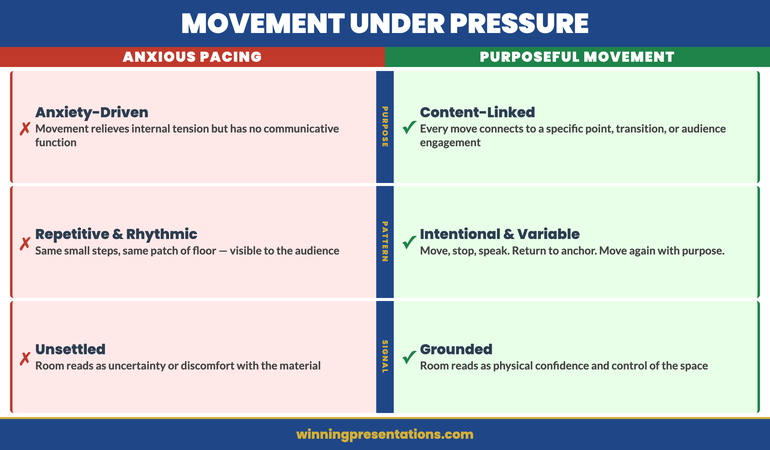
Not all movement during a presentation signals anxiety. Skilled presenters move deliberately and purposefully — and that movement enhances rather than undermines their authority. The distinction between purposeful movement and anxious pacing is not primarily a matter of how much you move, but whether the movement has an intentional relationship to the content and the audience.
Purposeful movement serves a communicative function. Walking toward a specific audience member while making a key point closes the physical distance and increases the sense of direct communication. Moving to a different part of the room when transitioning between sections of content signals to the audience that something has shifted — it provides a physical marker for a structural change in the presentation. Pausing in stillness to allow a significant point to land is a form of deliberate non-movement that communicates confidence and control.
Anxious pacing is characterised by repetitiveness and disconnection from the content. The pacing presenter moves because the internal discomfort demands a physical outlet — not because the movement serves any communicative purpose. The steps are often small, often rhythmic, and often cover the same patch of floor. The audience recognises this pattern not because they have analysed it consciously, but because it lacks the intentionality that deliberate movement carries.
A useful internal test during rehearsal: if you ask yourself why you moved just then and the honest answer is “I don’t know” or “I needed to,” the movement was anxious. If the answer is “I moved to emphasise that point” or “I moved to shift the audience’s attention to the screen,” the movement was purposeful. This distinction, practised in low-stakes rehearsals, builds the habit of intentional physical communication before you enter a room where the stakes are high.
How Anxiety Produces Unhelpful Physical Patterns
Presentation anxiety produces two distinct physical responses that affect how you occupy space in a room. The first is excess activation — the kind of nervous energy that manifests as pacing, hand movements, weight shifting, and restlessness. The second is physical freezing — a paradoxical stiffness that can set in when the anxiety is high enough that the nervous system pulls the body into a contracted, protective posture.
Both patterns — the overactive and the frozen — communicate anxiety to observers, but they do so in different ways. The overactive presenter reads as unsettled, unfocused, or uncertain about whether they should be in the room. The frozen presenter reads as stiff, disconnected, or under-prepared. Neither pattern is neutral in the way that a presenter might hope when they are simply trying to manage an internal physical state that they cannot directly control.
The anxiety-movement link is physiological. When the body perceives a threat — and a high-stakes presentation to a senior audience is interpreted by many nervous systems as a form of threat — it activates the sympathetic nervous system. Adrenaline and cortisol are released. Muscles are tensed in preparation for physical action that never comes. The body’s physical tension has nowhere to go in a boardroom, so it emerges as movement or as rigidity.
Understanding this mechanism is the first step toward managing it. You are not choosing to pace or to freeze — you are experiencing a physiological response to a perceived threat. The management strategies that work address the physiological state directly, not just the surface behaviour. Telling yourself to stop moving is rarely effective because the underlying activation has not changed. Physical grounding — through breath, through intentional muscle tension and release, through deliberate postural choices — works at the level of the nervous system, not just the conscious instruction.
For executives who experience the pre-presentation activation period as particularly difficult to manage, the article on morning presentation protocols covers how to structure the hours before a high-stakes presentation to reduce the peak of that activation before you enter the room. Managing your physical state ahead of time is more effective than trying to manage it in the moment.
Three Movement Patterns That Undermine Your Credibility
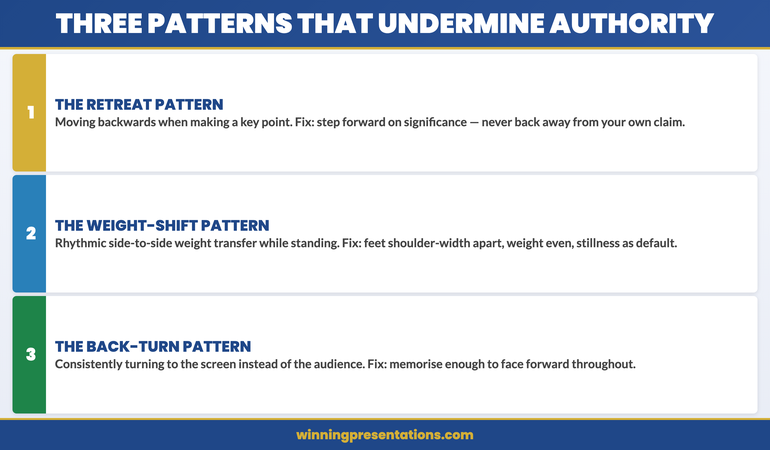
Most presenters have one or two default physical habits that they cannot easily observe in themselves during a presentation. These habits tend to be more visible in video recordings than in live self-assessment — which is one reason that rehearsing on camera, even informally, is such a reliable diagnostic tool. Three patterns appear most commonly in senior executive presentations where movement is unmanaged.
The first is the retreat pattern — moving backwards or sideways away from the audience when making a significant point. This pattern appears when the presenter is unconsciously protecting themselves from the perceived exposure of making a strong claim. The body retreats even as the words advance. The audience reads this as ambivalence — a presenter who is not fully behind what they are saying. Moving forward, toward the audience, on significant points is the correction.
The second is the weight-shift pattern — rhythmically transferring weight from foot to foot while standing in place. This is one of the most common physical habits in presentations and one of the most distracting to observe. It creates a visual rhythm that draws the eye and that reads as restlessness even when the presenter feels relatively calm. The corrective posture is feet shoulder-width apart with weight distributed evenly — a stance that feels slightly over-deliberate in rehearsal but reads as grounded to the audience.
The third is the back-turn pattern — consistently turning toward the screen or slide deck rather than maintaining eye contact with the audience. This pattern often emerges when a presenter is anxious about their content and uses the slides as a prompt. The act of turning away from the audience reduces the physical engagement with the room and signals that the presenter is not fully present with the people in front of them. Managing slides from a position that maintains forward facing — whether through memorisation, a presenter view on a laptop, or deliberate practice — removes the need for the back-turn entirely.
For practical techniques for maintaining eye contact and physical engagement with senior audiences, the article on eye contact techniques in executive presentations covers the specific disciplines for distributing attention across a room of senior decision-makers without triggering the anxiety response that makes sustained eye contact difficult.
If physical symptoms — including these movement patterns — are a persistent challenge in high-pressure presentations, Calm Under Pressure provides in-the-moment physical management techniques designed specifically for professional presentation contexts where the standard approach of taking a break or regrouping is not available.
Building Physical Confidence for High-Stakes Presentations
Physical confidence in presentations is not a personality trait — it is a practised competence. Presenters who appear naturally composed in high-stakes rooms have typically developed that composure through deliberate rehearsal, feedback, and the accumulated experience of managing their physical state under pressure. The composure looks natural because it has become habitual; it was not natural at the start.
Building physical confidence begins with establishing a default physical position that feels stable under pressure. For most presenters, this means a grounded stance — feet approximately shoulder-width apart, weight evenly distributed, hands in a neutral position either clasped lightly in front or resting at the sides. This position may feel unnatural at first, particularly if the body’s default response to pressure is to contract or to move. Practising it in low-stakes contexts until it feels comfortable is the only way to make it available when the stakes are genuinely high.
Physical confidence also develops through deliberate movement practice. Rather than waiting for high-stakes presentations to discover your physical habits, rehearsing in a space that mimics the presentation environment — a similar-sized room, a similar physical arrangement — allows you to map out your movement choices before they become reactive. Where will you stand for the opening? Where will you move to on the first key point? Where will you position yourself for the Q&A? Making these decisions in rehearsal means you are not making them for the first time in the room.
The link between physical confidence and voice quality is also worth noting here. When the body is tense and movement is anxious, breath becomes shallow, and the voice loses both depth and steadiness. A grounded physical position supports fuller breathing, which in turn supports a more controlled and authoritative vocal delivery. Physical confidence and vocal confidence are not independent qualities — they reinforce each other in both directions. For related reading on this connection, the companion article on voice control during executive Q&A covers how physical grounding and breath management combine to maintain vocal authority under questioning.
Practising Movement Control Before You Enter the Room
The most effective physical preparation for a high-stakes presentation happens in the minutes immediately before the session, not only in the days of rehearsal leading up to it. The body’s activation state in those final minutes — the cortisol and adrenaline already circulating, the muscles already tensed — will shape how you move and stand once you enter the room. Working with that state deliberately, rather than hoping it will settle on its own, makes a measurable difference to how you present.
One of the most reliable pre-entry practices is deliberate physical grounding. Before entering the presentation room, find a private space — a corridor, an empty office, a bathroom — and spend ninety seconds in the default grounded stance described earlier. Feel the weight distributed evenly through both feet. Relax the muscle tension in the shoulders and jaw, which are typically the first places anxiety concentrates. Take three slow, extended exhales. The purpose is not to eliminate the activation — that would be neither possible nor desirable. It is to establish a physical baseline that is closer to composed than to reactive.
Entering the room early, when it is still empty or occupied only by support staff, also allows you to establish your physical relationship with the space before the audience arrives. Stand where you plan to stand. Walk the movement path you have rehearsed. Make the space familiar to your body before it is occupied by the people whose judgement you are managing your anxiety about. Familiarity with the physical environment reduces the additional activation that comes from encountering an unfamiliar space while simultaneously managing the presentation itself.
The pre-room preparation window is also the right time to set your physical intention. Not your content objective — your physical one. A simple internal instruction — “I will stand still unless I am moving with a purpose” — functions as a behavioural anchor that can interrupt habitual anxious movement patterns before they take hold. The instruction does not need to be complex. It needs to be specific enough that you will remember it in the room when the activation is high and the habits are pulling in a familiar direction.
Calm Under Pressure — £19.99, instant access
Manage Physical Symptoms and Nervous Energy in High-Stakes Presentations
Calm Under Pressure provides in-the-moment physical management techniques for executives who experience shaking, nervous movement, voice changes, or physical tension during presentations. It is designed for professional settings where you cannot pause, retreat, or visibly manage your anxiety.
Designed for executives and senior professionals who need to present with composure under genuine pressure.
Frequently Asked Questions
Is it better to move around the room or stay in one place during a presentation?
Neither is inherently better — the quality of the movement determines whether it helps or hinders. Purposeful movement that connects to specific moments in the content — walking toward an audience member when making a key point, shifting position to signal a transition between sections — enhances presence. Staying in one place with genuine composure and intentional stillness also communicates authority. What undermines credibility is not the presence or absence of movement, but the repetitive, disconnected movement that signals physical restlessness rather than deliberate engagement with the room.
What should I do with my hands if I am not gesturing?
The two most neutral hand positions for a standing presentation are a light clasp in front of the body — hands lightly held at roughly waist height — or hands resting naturally at your sides. Both feel more self-conscious than they look to the audience. Hands in pockets, arms crossed, or hands gripping a lectern all carry stronger negative signals than either neutral position. If you tend to fidget with rings, pens, or clothing during high-stress moments, removing the prop before entering the room removes the fidgeting opportunity.
How do I stop pacing when I cannot tell I am doing it in the moment?
The most reliable method is to use a physical anchor — a specific spot in the room that you return to as your default position after any deliberate movement. If you have established this anchor in rehearsal, returning to it becomes a habit that interrupts the pacing pattern without requiring you to consciously monitor your movement during the presentation itself. Video review of rehearsal recordings is also valuable: most people are surprised by their movement habits when they see them on screen, and that visual feedback is more effective at building awareness than verbal feedback from observers.
The Winning Edge — Weekly Newsletter
One Insight Per Week on Executive Communication
Each week, The Winning Edge delivers one focused insight on executive communication — structure, delivery, influence, and the mechanics of getting senior audiences to yes. Straightforward, applicable, and written for people who present under pressure.
About the Author
Mary Beth Hazeldine — Owner & Managing Director, Winning Presentations
With 25 years of corporate banking experience at JPMorgan Chase, PwC, Royal Bank of Scotland, and Commerzbank, and 16 years training executives in high-stakes communication, Mary Beth advises professionals across financial services, healthcare, technology, and government on presenting with authority and composure under genuine pressure. Winning Presentations is her specialist advisory practice.