

Quick answer: Technical presentation training for engineers is not about polish, slides, or stage presence — it is about closing the one gap that keeps brilliant technical people below the level their competence deserves: the gap between presenting lab-grade detail and presenting board-grade decisions. Good training develops four specific capabilities, and you can diagnose your own gaps against them today. Structure: do you lead with the recommendation, or build up to it from the foundations? Translation: can a non-expert repeat your central point back accurately? Composure: can you name the three questions you most dread and answer them calmly? Decision framing: does your presentation ask for a specific decision, or just inform? Rate yourself honestly on each — most technically excellent engineers are strong on none of them, because none was ever taught or rewarded on the way up. The training that works treats these as learnable skills with testable components, not as innate charisma, and develops them in the order a board experiences them.
JUMP TO:
- Why the gap exists — and why it is not your fault
- The Board-Readiness Diagnostic: four capabilities
- What good training actually develops
- Self-study, course, or coaching: choosing the right depth
- Why this is a career skill, not a presentation skill
- One thing to do this week
- Frequently asked questions
In 2015 I was asked to coach a principal engineer who had been passed over for a director role twice, despite being, by universal agreement, the strongest technical mind in his division. The feedback he kept receiving was a phrase that infuriated him because it explained nothing: he “wasn’t quite ready for the board.” When I watched him present, the gap was obvious within four minutes, and it had nothing to do with his engineering. He opened a strategic proposal with the technical architecture, never stated a clear recommendation, answered the first challenge by retreating into detail, and never once asked the executives to decide anything. The board had read all of that, correctly, as “brilliant, but not yet operating at our altitude.” He thought he was being judged on his competence. He was being judged on whether he could make his competence usable to people who would never share it. Six months of deliberate work on exactly that, and he got the role on the next cycle — same engineer, same brilliance, a different gap closed.
(This article was created with AI assistance; all stories and insights are based on 35 years of real client work.)
I have coached enough technical specialists — engineers, data scientists, actuaries, clinicians, architects — to know that his story is the rule, not the exception. The thing holding back technically excellent people from senior roles is almost never the technical work; it is the inability to translate it into decisions a board can make. This piece is about closing that gap deliberately. It gives you the Board-Readiness Diagnostic, a four-part self-assessment that shows you exactly where your gaps are; it explains what good technical presentation training actually develops, so you can tell the substantial from the superficial; and it helps you choose the right depth of development for where you are, whether that is a free template, a self-paced programme, or something more. The skill is learnable. It was simply never on the syllabus that made you a brilliant engineer.
The single fastest improvement most engineers can make is structural: lead with the answer, then prove it.
The free Pyramid Principle one-pager gives you the structure executives expect — conclusion first, three supporting reasons, evidence underneath — which is the opposite of the foundations-up order engineers default to. It is the cheapest way to test whether structure is your gap before you invest in developing the rest. Free download, no email gate.
Why the gap exists — and why it is not your fault
The technical-to-board gap is built into how technical careers are made. For fifteen or twenty years, an engineer is rewarded for depth, rigour, and the ability to show their working to other experts who can evaluate it. Every promotion to that point has been earned by being more thorough, more precise, more correct than peers who were also thorough, precise, and correct. Then, at the threshold of senior leadership, the rules invert without warning: the board does not want depth, cannot evaluate rigour, and is actively slowed down by your working. The very habits that earned you the seat at the table are the ones that now hold you back at it, and nobody told you the rules had changed because the people promoting you mostly learned the new rules by accident and cannot articulate them.
This is why the feedback is always so useless. “Not ready for the board,” “needs more gravitas,” “too in the weeds” — these are descriptions of the symptom, not the cause, offered by people who sense the gap but cannot name its components. The principal engineer heard “not ready” and reasonably concluded either that he needed to be even more impressive technically, which made it worse, or that the door was political and closed. Neither was true. He needed four specific, learnable skills that no one had ever broken down for him. The pattern across technical-expert presentations is identical regardless of discipline: the work is sound and the translation is missing.
Recognising that the gap is structural and not personal matters, because it changes what you do about it. If the problem were that you are “not a natural presenter,” there would be little to do but suffer. But the problem is that you were trained for one altitude and are now operating at another, and altitude is a skill, not a personality. The engineers who close this gap are rarely the most naturally charismatic; they are the ones who treated board-readiness as an engineering problem — decomposable, learnable, improvable with deliberate practice — rather than as a verdict on who they are. That framing is itself half the battle.
The Board-Readiness Diagnostic: four capabilities
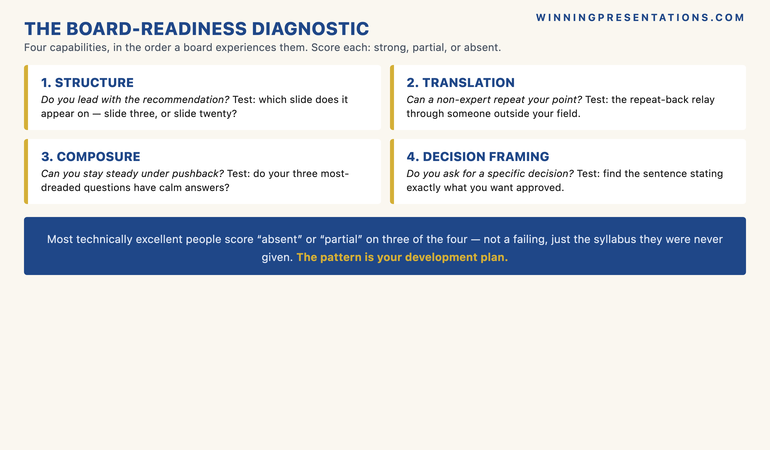
The Board-Readiness Diagnostic breaks the gap into four capabilities, each with a concrete self-test you can run on your last presentation. They are listed in the order a board experiences them, because that order is also the order in which to develop them — structure first, because it is the most common gap and the highest-leverage fix. Score yourself honestly on each: strong, partial, or absent. Most technically excellent people score “absent” or “partial” on three of the four, which is not a failing — it is simply the syllabus they were never given.
The four capabilities are these. One, Structure. Do you lead with the recommendation or build up to it? Test: open your last deck and find the slide where your actual recommendation appears. If it is slide three, you have structure; if it is slide twenty, you do not. Two, Translation. Can a non-expert accurately repeat your central point? Test: explain your main point to someone outside your field and ask them to brief a third person — if the business implication survives the relay, you can translate; if only jargon survives, you cannot. Three, Composure under challenge. Can you stay steady when a board pushes back? Test: write down the three questions you most dread, and ask whether you have calm, rehearsed answers to each — if the questions make your stomach drop, composure is a gap. Four, Decision framing. Do you ask for a specific decision? Test: find the sentence in your last presentation where you stated exactly what you wanted the board to approve — if there is no such sentence, you informed when you should have asked.
The diagnostic is useful precisely because it is specific. “Get better at presenting” is not actionable; “my recommendation appears on slide nineteen and I never state an ask” is. Run it on your last three presentations and a pattern will emerge — almost everyone has one or two capabilities that are consistently their weak point. That pattern is your development plan. There is no value in working on composure if your real gap is structure, and the diagnostic stops you spending effort on the wrong skill, which is the most common way self-directed improvement fails. Training aimed specifically at getting board approval works because it targets these four capabilities rather than presentation in the abstract.
What good technical presentation training actually develops
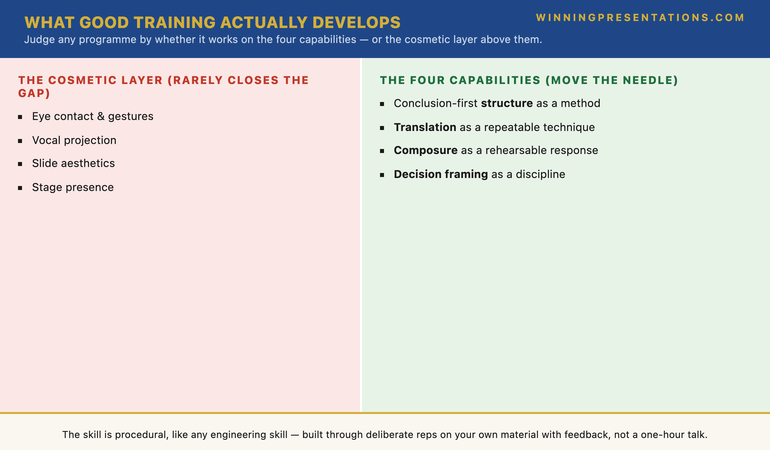
Once you know your gaps, the question is what kind of development closes them — and the market is full of training that polishes the wrong things. A great deal of presentation training focuses on delivery mechanics: eye contact, gestures, vocal projection, slide aesthetics. None of that is the technical presenter’s gap. An engineer with perfect eye contact who still opens with the architecture and never states an ask is exactly as stuck as before, now with better posture. The training that moves the needle for technical people develops the four capabilities directly: it teaches conclusion-first structure as a method, translation as a repeatable technique, composure as a rehearsable response to challenge, and decision framing as a discipline. Judge any programme by whether it works on those four or on the cosmetic layer above them.
The best development is also sequenced and practised, not just explained. Knowing that you should lead with the recommendation does not make you able to do it under the weight of fifteen years of foundations-up habit; that takes deliberate reconstruction of real decks, ideally with feedback, repeated until the new order becomes the default. This is why a one-hour talk on “executive communication” rarely changes anything, while structured work over weeks — applying each capability to your own material, getting it wrong, adjusting — does. The skill is procedural, like any engineering skill, and procedural skills are built through reps, not through understanding alone.
The structured way to develop all four capabilities — built for the people who need board approval, not just better slides.
The Maven Executive Buy-In Presentation System is the self-paced programme for senior professionals who present decisions to boards, investment committees, and executive sponsors. It works directly on the four capabilities this article diagnoses — conclusion-first structure, translating technical work into decisions, handling challenge with composure, and framing a clear ask — rather than on delivery polish.
- 7 modules covering the structure, psychology, and delivery that turn a sound case into an approved one
- Self-paced with monthly cohort enrolment — start with the next cohort, work through at your own pace
- No deadlines, no mandatory attendance; optional live Q&A sessions, fully recorded so you can watch back anytime
- Lifetime access to all course materials — £499
Self-study, course, or coaching: choosing the right depth
The right depth of development depends on the size of your gap and the stakes of your next few presentations, and matching them honestly saves both money and time. If your diagnostic shows a single gap — usually structure — and your presentations are important but not career-defining, a focused self-study resource may be enough: a template library and a clear method you apply to your own decks. If you have multiple gaps, or the next year holds presentations that genuinely move your career — a director-level case, a major capital approval, a board you must win over repeatedly — then a structured programme that works through all four capabilities with examples and a defined path is the better investment, because the gaps interact and addressing them piecemeal is slow.
The mistake to avoid in both directions is mismatching the depth to the need. Buying intensive development to fix a single structural habit is overkill, and a free one-pager will fix it faster. But trying to close four interacting gaps with scattered free resources is a false economy that has stalled many capable careers — the engineer reads a dozen articles, improves slightly on each dimension, and still does not clear the bar, because board-readiness is a system and improving its parts in isolation does not assemble the whole. Be honest about which situation you are in. A single gap wants a focused tool; a systemic gap wants a structured programme. A board presentation training course earns its cost when the gap is genuinely systemic and the stakes are genuinely high.
If your gap is structure and slides, the fix can be as simple as the right templates.
The Executive Slide System is the template library technical specialists use to put the decision first and keep the proof in the appendix — 26 executive templates, 16 scenario playbooks, 93 AI prompts, and 7 checklists, including recommendation-first layouts and tabbed appendices built for exactly the structural gap most engineers have. £39, instant download, lifetime access. The focused fix when structure is the only thing standing between you and a board-ready deck.
Why this is a career skill, not a presentation skill
In 2019 I worked with a lead data scientist who had decided, after one too many “not ready” conversations, to treat board-readiness as seriously as she treated her modelling. She ran the diagnostic, found her gaps were translation and decision framing, and worked at them deliberately over a few months — rebuilding real presentations, rehearsing the pushback, forcing herself to state an explicit ask every time. The change in how she was perceived was out of all proportion to the effort. Within a year she was the person her function sent to the board, then the person the board asked for by name, then a head of function. Her modelling had not improved; her ability to make her modelling decidable had transformed, and the organisation rewarded the second far more than it had ever rewarded the first.
This is the part technical people most underestimate: the return on closing this gap compounds, because board-readiness is the gate to every senior room, and once you are through it you are in those rooms repeatedly. The engineer who cannot present to a board is not merely worse at presentations; they are locked out of the level where strategic decisions are made, regardless of how good their judgement on those decisions would be. The engineer who can present is handed influence that has nothing to do with presenting — they shape decisions because they are trusted in the room where decisions happen. The skill is a key, and the door it opens leads to a different career, not just a better meeting.
It is also, bluntly, a rare skill among technical people, which is exactly why it is so valuable. Most engineers never close this gap, so the ones who do stand out sharply — not as better engineers, but as the engineers leadership can use. In a field crowded with technical excellence, board-readiness is a genuine differentiator, and unlike technical depth, which has fierce competition and diminishing returns, the supply of technically excellent people who can also translate to a board is small. Developing this skill is one of the highest-return investments a technical specialist can make, precisely because so few of your equally-capable peers will make it.
One thing to do this week
This week, run the Board-Readiness Diagnostic on your last three presentations, properly and in writing. For each presentation, score the four capabilities: find the slide your recommendation appears on (Structure), test whether a non-expert can repeat your central point (Translation), write down the three questions you dreaded and whether you had calm answers (Composure), and find the sentence stating exactly what you asked the board to approve (Decision framing). Mark each strong, partial, or absent. The pattern across the three will show you your one or two consistent gaps — and that, not “get better at presenting,” is your development plan. Then match the depth to the need: a focused tool if it is a single gap, a structured programme if the gap is systemic and the stakes are real. You will have turned an unactionable “not ready for the board” into a specific, fixable list — which is the first thing the principal engineer ever did that actually moved him forward.
Frequently asked questions
I already present regularly and it goes fine — is structured training worth £499 for me?
“Fine” is the honest place to ask the question, because fine is where most technically capable presenters plateau — competent enough not to fail, not sharp enough to be the person the board asks for by name. Run the diagnostic before you decide: if you score strong on all four capabilities, you genuinely may not need a programme, and you should not buy one. But most people who present “fine” score partial on translation or absent on decision framing, and those gaps are precisely what keeps fine from becoming influential. A £499 self-paced programme is worth it when the next year holds presentations that move your career and your diagnostic shows more than one real gap — the cost is trivial against a single director-level approval won or a promotion cycle cleared. If your gap is genuinely just structure, start with the £39 template system instead and save the rest.
Is the Maven Executive Buy-In programme live, and will I have to attend sessions at fixed times?
No — it is a self-paced programme, not a live course, which is the point most people get wrong about it. You enrol with a monthly cohort, but the cohort is just the enrolment batch; there are no deadlines and no mandatory session attendance. You work through the seven modules at whatever pace suits you, around your actual job. There are optional live Q&A sessions, and they are fully recorded, so if you cannot make one — or simply prefer to — you watch it back whenever you like. You also keep lifetime access to all the materials, so you can return to a module before a specific high-stakes presentation months later. It is built for senior professionals with no spare time and unpredictable calendars, which is to say, for engineers and technical leaders.
How long does it take to see a difference in how I’m perceived?
Faster than most people expect, because the gaps are specific and the highest-leverage fix — structure — can change a single presentation immediately. Leading with your recommendation and stating a clear ask are things you can apply to your very next deck, and a board notices the difference in one meeting. The deeper capabilities, translation and composure, take longer because they are habits rather than one-time changes, and habits take reps; expect a few months of deliberate practice on real presentations before the new behaviour becomes your default under pressure. The data scientist in this article saw her perception shift within a year, but the first visible improvements came within weeks of changing how she structured and asked. The compounding — becoming the person the board asks for — is the part that takes a year, because it requires several good meetings to accumulate.
I’m an introvert and not a natural presenter — can this actually be learned?
Yes, and introversion is largely irrelevant to it, because none of the four capabilities is about extroversion or charisma. Structure is a method; translation is a technique; composure is a rehearsable response; decision framing is a discipline. All four are procedural skills that quiet, analytical people often develop faster than naturally gregarious ones, because they are exactly the kind of decomposable, learnable problems a technical mind is good at. The engineers who close this gap are rarely the most charismatic in the room — they are the ones who treated board-readiness as an engineering problem and practised the components. If anything, the board prefers the composed, precise, well-structured introvert to the charming presenter who never quite states the ask. You are not trying to become a performer; you are trying to make your competence usable, and that is squarely an introvert’s game.
The Winning Edge — weekly newsletter
The Winning Edge is a weekly (Thursday) newsletter for technical professionals moving toward senior roles. One short email a week on the skills that turn deep expertise into board-level influence. Subscribe to The Winning Edge →
For the full set of skills behind board-readiness — slides, storytelling, confidence, and delivery — the Complete Presenter, a bundle of seven products, brings them together as a single resource — £99 for everything, lifetime access.
About the author
Mary Beth Hazeldine is Owner & Managing Director of Winning Presentations Ltd. With 24 years of corporate banking experience at JPMorgan Chase, PwC, Royal Bank of Scotland, and Commerzbank, she helps technical specialists across financial services, insurance, consulting, and technology develop the board-readiness that turns deep expertise into senior influence.