

Quick answer: When you have to cut board deck slides under time pressure, the goal is not to shorten the deck evenly — it is to protect the decision. Identify the one slide the board must see to approve, the one slide that frames the risk, and the one slide that names the ask. Everything else becomes optional, deferred to appendix, or verbal. Cut by function, not by length, and the remaining slides still land the decision even when you have lost half your time.
Jump to
Imogen Fairbairn is Head of Group Strategy at a FTSE 250 insurer. Last quarter she had a forty-minute slot at the operational risk and reinsurance committee to walk through a proposed change to the catastrophe cover programme. Five minutes before the meeting, the chair messaged her: the agenda had over-run twice already, and her slot was now twenty minutes, not forty. She had one lift ride to decide what to cut.
What Imogen did was the wrong thing. She tried to shorten every section evenly — trim a bullet here, drop an exhibit there, speed-talk through the market context. The result was a deck that still felt like forty minutes’ worth of material crammed into twenty, with no slide given breathing space to land. She got to the ask at minute nineteen, presented it in forty seconds, and the chair said “we will need to come back to this next session — there is not enough on the table to decide today.” The cover renewed two months late.
The lesson Imogen took away is that cutting a board deck under time pressure is not a length problem. It is a structure problem. The presenter who shortens every section by a quarter ends up with a deck that has no spine. The presenter who decides which three slides must survive intact, and treats everything else as optional, lands the decision in twenty minutes that they would have struggled to land in forty.
Want the structural toolkit for building decks that survive being cut?
The Executive Slide System is the templates-and-prompts library senior professionals use to structure board decks so the decision still lands when time is short. Twenty-six templates, ninety-three AI prompts, sixteen scenario playbooks, and a master checklist — built around the structural choices that hold under pressure.
Why most last-minute cuts make the deck worse
The instinct under time pressure is to shorten everything proportionally. The instinct feels safe because it preserves the deck’s overall shape. The shape is exactly what it should not preserve.
A board deck built for forty minutes is paced for forty minutes. The market framing slide does work that takes ninety seconds to land. The risk-quantification slide does work that takes two minutes. The recommendation slide depends on the audience having absorbed the earlier slides. When you cut every section by a quarter, you do not deliver a twenty-minute version of the argument. You deliver a forty-minute argument with the air taken out, and a board that follows none of it.
The second reason proportional cuts fail is that boards do not weigh slides equally. The slide that names the recommendation matters more than the slide that quantifies the addressable market. The slide that shows the downside scenario matters more than the slide showing competitor positioning. Cut bullets evenly across the deck and you have removed the same volume from a slide that mattered as from a slide that did not. The deck loses load-bearing content and keeps decorative content. The decision then has nothing to rest on.
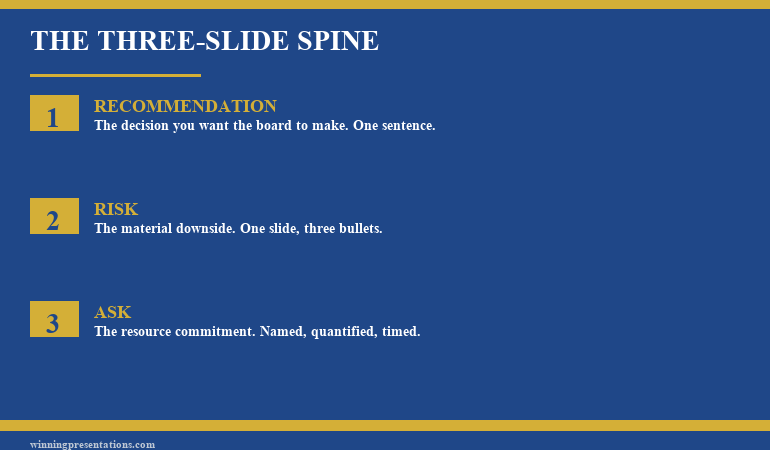
The three-slide spine: what must survive every cut
Every board deck, regardless of topic, has three slides that carry the decision. The recommendation slide — the one that names what you are asking the board to approve. The risk slide — the one that frames the most material downside and how it is being managed. The ask slide — the one that states clearly what is needed from the committee, by when, and on what terms. These three slides are the spine. Every other slide in the deck supports one of them.
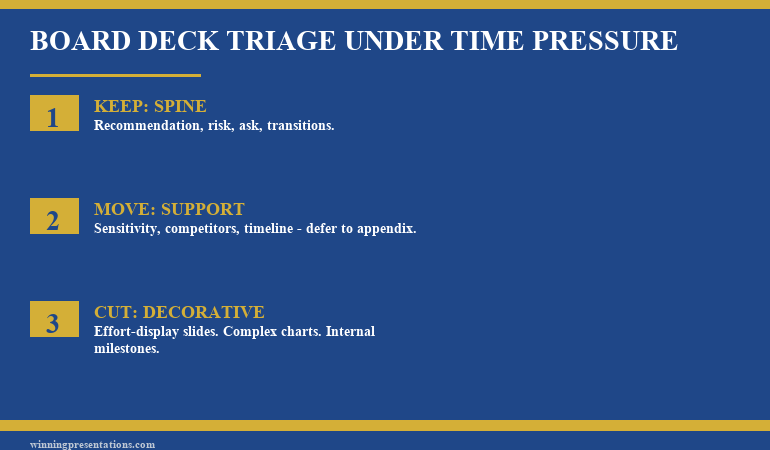
When time is cut, the spine must remain intact. It does not get shortened. It does not get summarised. It gets the same airtime it would have had in the longer deck — possibly more, because the surrounding context has been compressed. Everything else is triaged in service of the spine: kept if it strengthens the recommendation, deferred if it is supportive but not essential, dropped if it was decorative.
The structural toolkit for board decks that survive being cut
The Executive Slide System gives you the templates and structural patterns to build board decks that hold up when the slot is shortened, the chair speeds you up, or the agenda runs over. £39, instant access, complete system, lifetime use of materials.
- 26 executive slide templates covering recommendation, risk, and ask structures
- 93 AI prompts for drafting board headlines, executive summaries, and decision slides
- 16 scenario playbooks for board, investment committee, and steering committee work
- Master checklist for the pre-meeting structural review
- Framework reference covering the structural choices behind every template
Explore the Executive Slide System →
Designed for senior professionals who present to boards and investment committees under real time pressure.
Identifying the spine is a discipline that should happen before the deck is built, not in the lift on the way to the meeting. If you know which three slides carry the decision, you can build the surrounding twenty slides as supporting material rather than as primary content. When time gets cut, you already know which slides go and which slides stay.
Most presenters do not know their spine because the deck was built section by section, with each section receiving roughly equal attention. The fix is not stylistic — it is structural. Start the deck with the recommendation, the risk, and the ask defined first. Build the supporting slides afterwards. The deck then has a load-bearing core that survives compression, and a flexible periphery that can absorb the cut.
Cut by function, not by length
Once the spine is identified, every other slide in the deck has a function. Market context. Competitive framing. Quantitative justification. Sensitivity analysis. Implementation timeline. Stakeholder mapping. Each of these functions is doing work for the recommendation, the risk, or the ask. When time is short, you cut by function, not by length.
The first cut is decorative function. Slides that exist to demonstrate effort rather than to support the decision — the elaborate market-sizing chart, the multi-quadrant competitor map that takes a minute to explain, the timeline that shows every internal milestone. These slides flatter the presenter’s preparation but do not move the board towards the decision. They go first, and they go entirely.
The second cut is overlapping function. Many decks contain two slides making the same argument from different angles — a quantitative and a narrative version of the risk, or two scenario analyses leading to similar conclusions. Pick the stronger one and remove the other. Verbal acknowledgement (“we also modelled a downside case which I can talk you through if helpful”) preserves credibility without consuming time. This is the logic an executive deck before-and-after audit tends to surface — most decks contain redundant slides that survive only because no one ever asked which was load-bearing.
The third cut is supportive function that can move to verbal. The implementation timeline does not need a slide if you can name the three milestones aloud. The stakeholder map does not need a slide if you can summarise it in two sentences. Anything that can be replaced by a sentence belongs in your speaking notes, not on the screen.
What you should not cut is the spine, the appendix, or the transitions between spine slides. Transitions are the connective tissue of the argument and the part that suffers most from compression. A clear transition sentence between the recommendation and the risk slide is worth more than a third bullet on either of them.
When you cut slides, the questions get harder.
Defer detail to appendix and the board will probe it in Q&A. The Executive Q&A Handling System — £39, instant access — is the framework for handling exactly that pattern: structured responses for hostile, technical, and political questions when the deck no longer carries the full answer.
The mid-meeting cut: when you realise live
The harder version of this problem is the cut you make mid-meeting. You are eight minutes into a twenty-minute slot, you have covered three slides, and you realise the chair is checking the clock. You need to lose five slides between here and the recommendation without breaking the rhythm of the room.
The move that works is the announced jump. “I am going to skip the next four slides — the detail is in the appendix and I am happy to come back to it in questions — and go straight to the recommendation on slide eighteen.” This sentence does three things. It signals to the chair that you have noticed the time. It tells the board that the omitted material is available, so they do not feel short-changed. It commits you to the ask. What executives actually read on slides in the moment of decision is the headline and the recommendation — the supporting detail is value-added, not load-bearing, and the announced jump treats it that way.
What does not work is the silent jump — clicking through slides quickly without explanation. The board sees motion they cannot follow, registers that you are flustered, and starts losing confidence in the recommendation that follows. The same omission, framed as a deliberate structural choice, reads as discipline. Framed as panic, it reads as unpreparedness.
The discipline this requires is knowing your slide numbers. If you cannot say “skip to slide eighteen” because you do not know what slide eighteen is, the announced jump becomes a fumble. Number every slide. Know which slide carries the recommendation, which carries the risk, and which carries the ask. Even rehearsing the sentence aloud once makes it land cleanly under pressure.
Deferring detail without losing credibility
The fear behind most last-minute cuts is that the board will think you are unprepared. The opposite is usually true. The presenter who walks in, acknowledges the change in slot, names what they are going to cover, and refers to the rest as appendix material reads as senior. The presenter who tries to deliver the full forty-minute deck in twenty reads as junior.
The credibility move when deferring detail is to name what you are deferring and where it lives. “The full sensitivity analysis is in appendix B. The competitor pricing comparison is in appendix C. I have not walked through them today, but I am happy to take any of those slides in questions.” The board now knows the work was done, knows where to find it, and knows you are willing to defend it. Treating the appendix as a working part of the deck rather than a place to dump cut content is the structural shift that makes this credible — appendix slides should be designed to stand alone, with their own headline, evidence, and conclusion.
The opposite — quietly removing slides without referencing them — costs credibility when a board member who has read the pre-read asks where the sensitivity analysis went. “We had to cut it for time” is a worse answer than “it is in appendix B and I can pull it up now.” One reads as material lost; the other reads as material managed. The discipline of deferring well, rather than apologising, is built into the Executive Slide System — its sixteen scenario playbooks include the time-pressed board brief, with the exact spine-and-appendix structure that survives a last-minute cut.
A board deck under time pressure is not a shorter version of the long deck. It is a different deck with the same spine, a smaller surrounding body, and an appendix promoted from filler to working reference. The presenter who knows the difference walks out of a twenty-minute slot with the decision they came in for.
Stop building decks that fall apart when the slot gets cut.
Most decks break under time pressure because they were built without a load-bearing spine. The Executive Slide System — £39, instant access — gives you the structural framework and scenario playbooks that build the spine in first, so the cut is a trim, not a rescue job.
Get the Executive Slide System →
Designed for executives presenting to boards, investment committees, and senior stakeholders.
FAQ
How many slides should I cut if my time is halved?
Fewer than you would think — but the slides you cut should be cut entirely, not shortened. A forty-minute deck of twenty-two slides cut to twenty minutes does not become eleven slides each running half as long. It becomes eight to ten slides running at full pace, structured around the recommendation, risk, and ask. The other twelve to fourteen slides move to appendix or are dropped. The pace of the surviving slides stays the same as the original deck because that pace is what makes them land.
What if the board has read the pre-read and I cut a slide they expect to see?
Reference it explicitly and offer to come back to it. “I have not walked through the sensitivity analysis from page nine of the pre-read in the interest of time, but I am happy to take it in questions.” This protects the board’s expectation that the work was done while preserving your time. Boards rarely insist on walking through a deferred slide if the recommendation lands.
Can I add slides back if I get more time than I expected?
Sometimes the chair will recover time and offer you back five or ten minutes mid-presentation. The instinct is to add slides back. The better move is to use the recovered time on the spine — particularly the risk slide and the recommendation slide — rather than on slides you had already decided to cut. Boards remember a clear recommendation defended thoroughly; they do not remember a market-context slide that ran an extra ninety seconds.
The Winning Edge — Thursday newsletter
Every Thursday, The Winning Edge delivers one structural insight for executives presenting to boards, investment committees, and senior stakeholders. No general tips. No motivational framing. One specific technique, one executive scenario, one action. Subscribe to The Winning Edge →
Not ready for the full system? Start here instead: download the free Executive Presentation Checklist — a single-page review you can run on any board deck before you walk in, including a quick spine-check question for time-pressure scenarios.
Next step: open the next board deck on your calendar and identify the three slides that carry the decision — the recommendation, the risk, and the ask. Mark them. Then look at the surrounding slides and decide which would be the first to go if your slot were halved. That five-minute exercise is the difference between a deck that survives a time cut and a deck that does not.
Related reading: how to design executive appendix and backup slides that earn their keep, and an executive deck before-and-after audit showing what actually changed and why.
About the author. Mary Beth Hazeldine is Owner & Managing Director of Winning Presentations Ltd, founded in 1990. With 25 years of corporate banking experience at JPMorgan Chase, PwC, Royal Bank of Scotland, and Commerzbank, she advises executives across financial services, healthcare, technology, and government on structuring presentations for high-stakes funding rounds, approvals, and board-level decisions.