Tag: board presentation Q&A

01 Jun 2026
When a Board Member Says "Just Give Me the Facts": Why They Actually Want the Story

When a Board Member Says “Just Give Me the Facts”: Why They Actually Want the Story

Quick answer: When a senior board member interrupts with “just give me the facts”, they almost never mean raw numbers. They mean the structural narrative behind the numbers — compressed into one or two sentences. Presenters who hear “facts” and respond with data lose the room; presenters who hear “facts” and respond with the compressed storyline keep it. The four-step response — Pause, Acknowledge, Compress, Resume — is the move experienced senior presenters use under cross-examination. The interruption is rarely an attack. It is a request for editorial leadership.

Idris, a divisional managing director at a UK insurance group, was seven slides into a strategy update when the chair leaned forward and said, “Idris, just give me the facts.” Idris did what most senior leaders do in that moment. He heard the word “facts” and reached for data. He pulled up the numbers behind slide 7, walked the chair through the three-year revenue trajectory, then offered to share the underlying actuarial model. Within ninety seconds, two non-executives had glazed over and the chair had turned to a side conversation with the CFO.

The chair had not asked for numbers. The chair had asked Idris to step out of the slide and tell him, in one or two sentences, what the strategy actually was — what was changing, why now, and what it meant for the next eighteen months. The “facts” the chair wanted were narrative facts. Idris had given him data points. By the time he realised the gap, the room had decided this was not the meeting where the strategy would be backed.

“Just give me the facts” is the most misread interruption in board presentations. Senior board members rarely want raw data when they say it. They want the structural narrative behind the data, expressed in compressed form. The leader who can decode that request in real time keeps the room. The leader who responds with numbers loses it.

If you want a structured way to handle board interruptions like “just give me the facts”:

The Executive Q&A Handling System is a structured Q&A handling framework with techniques designed for hostile questions and the difficult moments that derail presentations — the interruption at slide 7, the cross-examination, the “let’s cut to the chase” moment. Self-paced, instant access.

Explore the Q&A Handling System →

Why “just give me the facts” is the most misread interruption

The phrase trips presenters because it sounds literal. The word “facts” carries an implicit instruction — drop the framing, drop the context, give me the underlying data. Most leaders take the instruction at face value. They reach for the next layer of analysis, the source numbers, the underlying model. They are doing exactly what the interruption appears to ask for. And they lose the room.

The reason is that the word “facts”, in senior committee usage, almost never means data. It means signal. The chair is signalling that the current pace of the presentation is too slow, that the level of abstraction is too high, or that the structure is meandering. “Just give me the facts” is the polite version of “land this for me”. The board member has decided that the deck is not going to deliver the headline at the pace they need it, and they are taking executive control of the conversation by demanding compression.

Read literally, the interruption asks for more detail. Read structurally, it asks for less. The presenter who responds with more data confirms exactly what the chair was reacting against — too much information, not enough editorial. The presenter who responds with one compressed sentence — the strategy in a line, the trade-off in a line, the recommendation in a line — gives the chair the editorial leadership they were asking for. The room snaps back into attention.

This is the move “walk me through the numbers” shares with “just give me the facts”. Both interruptions sound like requests for data. Both are usually requests for narrative. Decoding the structural ask — rather than the literal one — is the central discipline of senior Q&A.

Three signals that decode what they actually want

The phrase “just give me the facts” travels under three different intents, depending on who says it and when in the presentation it lands. Reading the right intent in real time is what separates the presenter who keeps the room from the one who loses it.

Signal 1 — the slide number. When the interruption lands early — slide 3, slide 4 — it almost always means “you are walking through context I have already read in the pre-read; jump to the substance”. The board member is signalling that the meeting time should not be spent on material they have already absorbed. The right response is to compress everything from the current slide forward into a single sentence and continue from the load-bearing slide. When the interruption lands late — slide 12, slide 15 — it usually means “I am losing the thread; pull this back to the headline”. The right response is to compress the argument so far into one sentence, name the recommendation, and let the room re-engage from there.
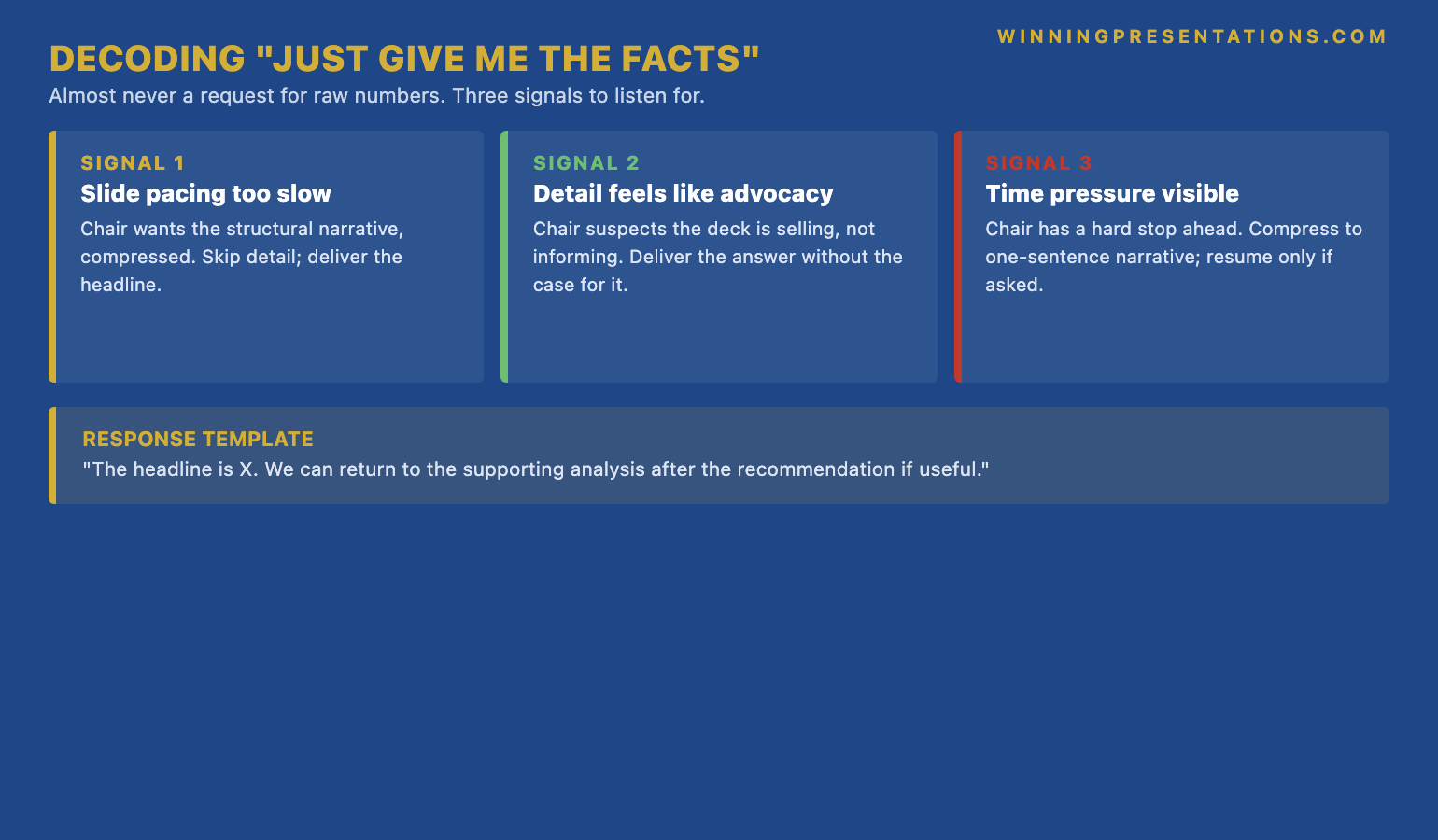
The 'just give me the facts' decoder infographic showing what board members actually want when they say it: not raw numbers, but the structural narrative behind the numbers — with three signals to listen for to diagnose the real ask, and the three response patterns that work.

Signal 2 — the speaker’s seniority and role. Chairs and senior non-executives almost always mean “compress to narrative”. They have read the pack, they want the headline, and they are asking the leader to take editorial control. CFOs and committee members with sector specialism sometimes do mean “show me the numbers” — particularly if the interruption follows a claim that contains a specific figure. Reading the speaker matters. A chair asking for facts is asking for story; a CFO asking for facts after a margin claim is asking for the underlying calculation.

Signal 3 — the tone and the words around the phrase. “Just give me the facts” delivered with a slight smile and a hand gesture toward the deck is almost always editorial — “speed this up”. “Just give me the facts” delivered flat, with no smile, immediately after a specific claim, is more often analytical — “back that number up”. The lean of the speaker, the eye contact, and the half-sentence that usually follows (“…what is actually changing here?”, “…what is the headline?”, “…where is the £40m?”) tell the presenter which intent is in play. Most experienced senior presenters listen for the half-sentence before responding, even if it costs them a one-second pause.

The four-step response framework: Pause, Acknowledge, Compress, Resume

The four-step framework — Pause, Acknowledge, Compress, Resume — is the move experienced senior presenters use under this kind of cross-examination. Each step does specific work. Skipping any step weakens the response.

Handle the interruptions and hostile questions that derail board presentations.

The Executive Q&A Handling System is a structured Q&A handling framework with techniques designed for hostile questions, interruptions, and the difficult moments that derail presentations at senior level. Designed for senior professionals who present to boards, executive committees, and investment panels. £39, self-paced, instant access, no subscription.

  • Structured frameworks for handling the moments that derail presentations — interruptions, hostile questions, cross-examination, “let’s cut to the chase”
  • Techniques designed for the difficult question patterns senior leaders meet at board and committee level
  • Sample language and response patterns calibrated for senior committee tone, not generic Q&A advice
  • Designed for senior professionals presenting to boards, executive committees, and investment panels

Get the Q&A Handling System — £39 →

Step 1 — Pause. One full second before responding. Most leaders skip this step because it feels uncomfortable. The pause does three things at once. It signals that the presenter heard the interruption rather than reacting to it. It buys the half-second the presenter needs to decode which intent — editorial or analytical — is in play. And it tells the room that the leader is in command of the pace, not being dragged by it. Skipping the pause and rushing into a response is the single most common mistake in board Q&A.

Step 2 — Acknowledge. A short sentence that lands the interruption rather than ignoring it. Not a thank-you. Not an apology. An acknowledgement: “fair point — let me pull this back to the headline”. The acknowledgement does the structural work of accepting the chair’s editorial authority. The presenter is not pushing back against the interruption; they are hearing it and adapting. Senior audiences read this move accurately. It signals confidence.

Step 3 — Compress. One sentence that delivers the structural narrative the interruption was asking for. Not a paragraph. Not three points. One sentence. “We are reallocating £40m from the legacy book into the new platform over eighteen months, with phase-1 in Q3, because the legacy unit economics will not survive the 2027 regulation change.” The compression is the hardest step. It requires the presenter to know — before they walk into the room — what the one-sentence version of their argument is. Leaders who have not pre-built the compression cannot deliver it under pressure.

Step 4 — Resume. A short sentence that hands the meeting back to the structure: “I can either expand on the £40m allocation or move to the trade-offs slide — which is more useful?” The resume step is often skipped. It matters. It tells the chair that the presenter heard the interruption, delivered the compressed answer, and is now offering the chair editorial control over the next move. Most chairs, given the choice, will say “move on”. A handful will ask for the expansion. Either way, the presenter is back in command of the agenda.

For a related discipline on handling the funding-comparison version of this interruption, see “why fund this over X?”, which uses a similar compression-and-resume structure.

Sample language that works at senior committee level

Sample language matters because senior committees are tone-sensitive. The right move delivered in the wrong register reads as defensive. The phrases below are calibrated for board and executive-committee tone — measured, confident, not performatively humble.
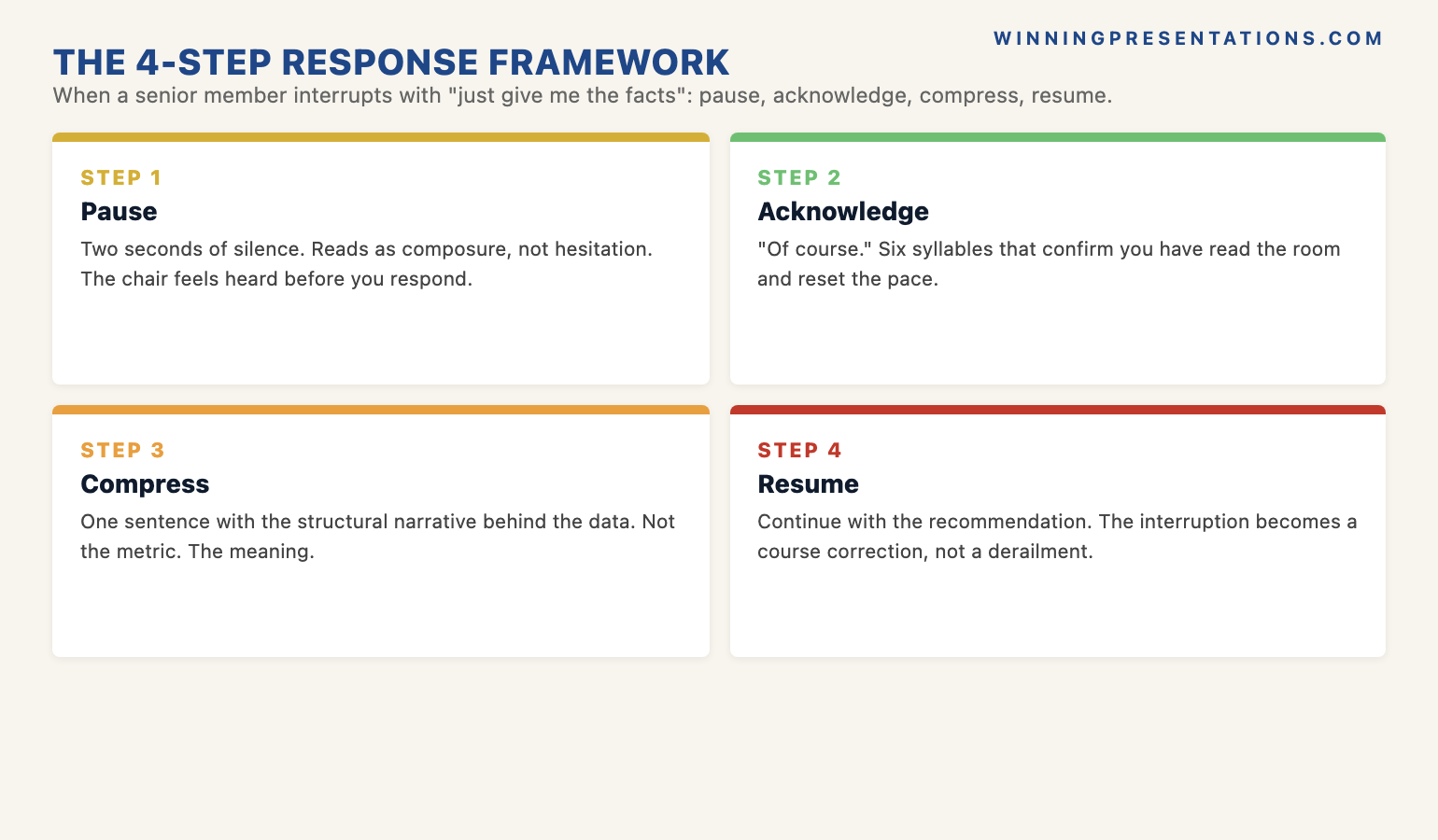
The four-step response framework infographic for handling 'just give me the facts' interruptions — Pause, Acknowledge, Compress to one-sentence narrative, Resume — with sample language for each step that experienced senior presenters use under cross-examination.

Acknowledgement phrases that work: “Fair point — let me land the headline.” “Useful — the short version is this.” “Right — the core of it is that…” “Understood — pulling this back…” Each carries the structural acknowledgement without slipping into apology. Phrases to avoid: “Of course — I’m sorry, I should have…” (apologetic), “Yes, well, the thing is…” (defensive), “If you’ll allow me to finish…” (combative). The chair is offering editorial direction; the response should accept that direction rather than push against it or grovel under it.

Compression sentences that work follow a structural pattern: change + reason + horizon. “We are [doing X] because [reason] over [time horizon].” “We are exiting the legacy product line because the regulatory cost has crossed the revenue line, with full exit by Q4 2027.” “We are moving from a four-region to a two-region operating model because the cost of duplicated headcount no longer justifies the local optimisation, with implementation through 2026.” The pattern is short enough to deliver under pressure and structured enough to be remembered by the room.

Resume phrases that work: “I can expand on [specific point] or move to the recommendation — which is more useful?” “Happy to take that into the trade-offs slide if helpful, or move to the close.” “I can hold the detail for the appendix and move us to the decision — would that work?” Each phrase hands the editorial decision back to the chair without abdicating control of the agenda. The presenter is offering structured options, not asking for permission to continue.

The next board interruption is coming. Pre-build the compressed narrative now, not in the room.

The Executive Q&A Handling System gives senior leaders the structured frameworks to prepare for the interruptions and hostile questions that derail board presentations — before the meeting, not during it. Self-paced, instant access. £39.

Get the Q&A Handling System — £39 →

When “just give me the facts” actually does mean raw data

The exception exists, and it is rare. About one time in seven, “just give me the facts” is a literal request for the underlying numbers — usually from a CFO or sector-specialist non-executive, almost always immediately after a specific claim, and almost always in a tone that lacks the editorial impatience of the more common version.

The diagnostic is structural. If the interruption follows a numerical claim — “this generates £14m of margin uplift” — within one or two sentences, and the speaker is the financial or analytical specialist on the committee, the request may genuinely be for the source data. The presenter who hears that intent and has the underlying number ready demonstrates command of the detail. The presenter who responds with narrative compression in this case sounds evasive — exactly the opposite of the right move for the more common editorial version.

The discipline is to listen for the half-second after the phrase. A literal “just give me the facts” usually carries on: “…what is the actual margin number?”, “…what was the like-for-like comparison?”, “…what did the modelling assume?” An editorial “just give me the facts” carries on differently: “…what is changing?”, “…what is the headline?”, “…where is this going?” The same five words signal opposite requests. Listening for the second half of the sentence — and pausing the half-second needed to hear it — is what allows the presenter to respond accurately rather than by reflex.

For more on the underlying confidence work that supports this kind of real-time decoding, see CFO presentation nerves, which covers the preparation that makes the half-second pause feel possible rather than terrifying.

The closely related move — handling boards that ask for the story rather than the data — is covered in the partner article on the three-story minimum for board presentations.

Frequently asked questions

What if I genuinely do not have the one-sentence compression ready in the moment?

Buy time honestly rather than dishonestly. “Let me give you the cleanest version of that — one moment” is far stronger than fumbling through an attempt at compression that does not land. The pause itself signals seriousness. What does not work is filling the gap with more data while the brain catches up; the room reads that move as evasion. The structural fix is upstream — pre-build the one-sentence version of the argument before the meeting, rehearse it out loud, and treat it as the load-bearing sentence of the entire presentation. If the compression is not ready before the room, it will not arrive in the room.

Is it ever right to push back on the interruption rather than accept it?

Rarely, and only with care. Pushing back works in one specific scenario — when the interruption lands at a moment where compression genuinely loses important nuance, and the presenter has the standing in the room to ask for thirty seconds. The phrase that works: “Happy to compress — but the next sentence is the one that matters; may I land it before I summarise?” The move signals confidence rather than defensiveness. It works for senior leaders with established credibility in the room. For a presenter who is newer to the committee, accepting the interruption and adapting is almost always the safer move.

What if the chair interrupts again with the same phrase later in the meeting?

A second “just give me the facts” later in the same meeting is a stronger signal — usually that the level of compression in the first response was not enough. The right move is to compress harder, not to repeat the previous response. If the first compression was a sentence, the second response should be half a sentence. “Net of all this — we are recommending the £40m allocation, with the trade-off being a 4 per cent margin compression in 2026.” Senior committees rarely interrupt with the same phrase three times. If they do, the presentation has a structural problem that needs addressing offline, not in the room.

Does this framework work for hostile questions, or only for editorial interruptions?

The four-step framework — Pause, Acknowledge, Compress, Resume — works for both, but the compression sentence carries different weight in a hostile question. With editorial interruptions, the compression is the structural narrative. With hostile questions, the compression is usually the honest concession plus the structural answer. “You’re right that the 2024 forecast missed by 12 per cent — what we changed is the underlying methodology, and the 2026 outlook is built on the revised model.” The move is the same; the load on the compression sentence is heavier. Hostile questions reward presenters who can hold both the concession and the case in one breath.

The Winning Edge — weekly newsletter

The Winning Edge is a weekly newsletter for senior professionals who present at the executive level. One short email a week, focused on the structural moves that separate decks committees back from decks they defer. Subscribe to The Winning Edge →

About the author

Mary Beth Hazeldine is Owner & Managing Director of Winning Presentations Ltd. With 24 years of corporate banking experience at JPMorgan Chase, PwC, Royal Bank of Scotland, and Commerzbank, she advises executives across financial services, healthcare, technology, and government on structuring presentations for high-stakes funding rounds, board approvals, and strategic decisions.

13 Apr 2026
Male CFO responding calmly to a challenging board question — composed expression under Q&A pressure, other board members visible, executive boardroom with navy and gold tones, editorial photography style

How to Pressure-Test Your Presentation Q&A Before the Meeting

Quick Answer

Presentation Q&A preparation moves from reactive to systematic when you pressure-test your answers before entering the room. This means categorising the questions you are likely to face, identifying the gaps your data does not cover, rehearsing with an adversarial questioner, and building a response framework for the questions you cannot fully answer. Rehearsing answers you already know is not preparation — it is confirmation. Real preparation stress-tests the limits of what you know.

Kwame had run the numbers six times. As CFO of a mid-size logistics company, he had presented budget proposals to the board before — but this one was different. The proposal involved a £4.2 million capital commitment to upgrade a fleet management system, and the board had already pushed back twice on discretionary spending. He had built what he believed was an airtight case.

The presentation itself went well. The slides were clear, the narrative was coherent, and the ROI model was thorough. Then, at the twelve-minute mark, the Chairman asked a question Kwame had not seen coming: “Before we go further, Kwame — what assumptions are you making about fuel price movements over the implementation period, and have you stress-tested the ROI against a thirty per cent increase?”

Kwame knew the answer in principle. But he had not built that specific scenario into the model. He hedged. He said he could run those numbers after the meeting. The Chairman nodded, but the energy in the room shifted. Two other board members asked follow-up questions he handled less confidently than the main presentation had suggested he would. The proposal was deferred for a second meeting.

Afterwards, the CFO of the parent company — who had been in the room as an observer — pulled Kwame aside: “The proposal was solid. But you walked in having rehearsed what you know and hoping they wouldn’t ask what you don’t. That’s not preparation. That’s optimism.”

Systematic presentation Q&A preparation is not about practising the answers you already have. It is about identifying the assumptions embedded in your case, finding the weakest points in your data, and constructing a response framework that holds up even when the question lands outside your prepared territory.

Need a systematic Q&A preparation framework?

The Executive Q&A Handling System gives you a structured method for anticipating, categorising, and preparing responses to the questions that derail executive presentations — before you walk into the room. Explore the System →

Why rehearsing your answers is not enough

Most executives who prepare for Q&A do so by thinking through the questions they expect to receive and running through their answers mentally or verbally. This is better than no preparation. But it has a fundamental limitation: you are rehearsing a conversation you have already imagined, which means you are only testing your ability to deliver answers you have already constructed.

Real Q&A pressure does not come from the questions you expected. It comes from the question you did not see coming — the one that probes an assumption you made but did not flag, the one that connects two data points in a way that reveals a tension in your model, or the one that is framed in a way that makes any direct answer politically difficult. Rehearsing expected questions builds fluency in territory you already control. It does not build resilience in territory you do not.

The distinction matters most in the moments after a difficult question lands. An executive who has only rehearsed their prepared answers will feel a spike of alarm when the unexpected question arrives, because it signals that they are outside the plan. That alarm shows — in the hesitation before they speak, in the way their answer trails off rather than concluding, in the eye contact that breaks rather than holds. An executive who has actively pressure-tested the limits of their case approaches the unexpected question differently: they know the shape of their uncertainty, which means they can navigate it without being surprised by it.

For a related approach to handling the most confrontational form of unexpected question, see how to handle a hostile question in a board meeting without losing the room.

The four categories of pressure question every executive faces

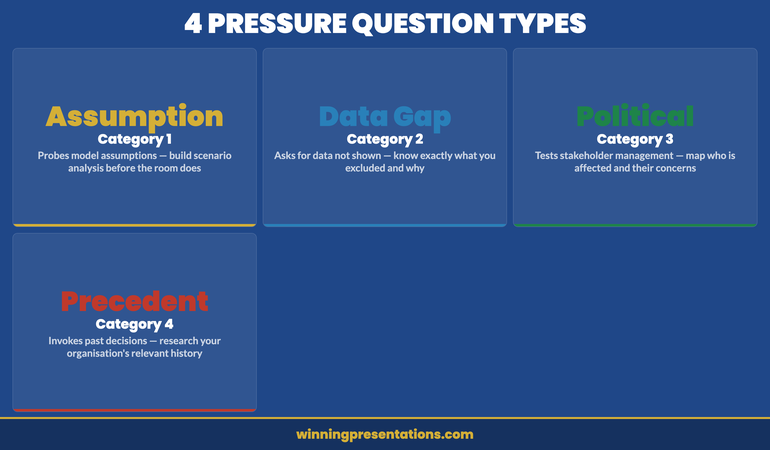
Pressure questions in executive presentations fall into four distinct categories. Understanding which category a question belongs to is the first step in building a preparation method that covers all of them.

The four categories of pressure question in executive presentations: assumption challenges, data gap questions, political implication questions, and precedent questions — dashboard infographic with preparation method for each

Category 1: Assumption challenge questions. These questions probe the assumptions embedded in your model, forecast, or recommendation. “What are you assuming about interest rates over that period?” “Have you modelled the downside scenario?” “What happens to the ROI if adoption is slower than forecast?” These questions are often the most embarrassing to be caught unprepared for, because the assumptions are visible to anyone who looks closely at your analysis — which suggests you have not looked closely enough yourself.

Preparation method: For every key number in your presentation, write down the two or three assumptions that number depends on. Then build a simple scenario: what does the model look like if each assumption is twenty per cent worse than your base case? You do not need to present these scenarios — you need to know the answers so you can give them when asked.

Category 2: Data gap questions. These questions ask about data you have not included, either because you chose not to or because you did not have it. “Do you have a comparable from another division?” “What does the competitor analysis show?” “Have you validated this with the operational team?” These questions can reveal either that your analysis is incomplete or that you have made a deliberate choice not to include something — and the audience will wonder why.

Preparation method: Before finalising your deck, ask yourself what data an informed sceptic would expect to see but cannot find in your slides. Either include it or prepare a clear explanation of why you have not.

Category 3: Political implication questions. These questions are not really about your analysis — they are about the politics of the decision. “How does this affect the northern division?” “Has this been discussed with the operations board?” “Who owns the implementation risk?” These questions signal that the questioner has a stakeholder interest in the outcome and is testing whether you have addressed it. They can feel like hostile questions but are usually legitimate governance concerns.

Preparation method: Map the stakeholders who will be affected by your recommendation and anticipate the concern each one would raise. Prepare a one-sentence response to each concern that acknowledges it and names how it is being managed.

Category 4: Precedent questions. These questions invoke a previous decision or a comparable situation to test the consistency of your current recommendation. “When we approved a similar programme in 2023 it took twice as long as the forecast — why will this be different?” “We had a similar analysis for the IT project and it underestimated the integration costs. Have you accounted for that?” These questions require specific knowledge of the precedent being cited and a clear, factual explanation of what is different this time.

Preparation method: Research your organisation’s relevant history before the presentation. If there are obvious precedents the audience will raise, address them proactively in the deck rather than waiting for the question.

Executive Q&A Handling System

Anticipate, Prepare, and Handle Every Pressure Question

The Executive Q&A Handling System — £39, instant access — gives you a structured system for predicting the questions your specific audience is likely to ask, building response frameworks for each category of pressure question, and managing the Q&A process so that difficult questions strengthen rather than undermine your credibility.

  • System for predicting and categorising executive Q&A questions
  • Response frameworks for assumption challenges, data gaps, and political questions
  • Adversarial rehearsal guides for high-stakes presentation settings
  • Recovery strategies for questions that expose genuine gaps in your analysis

Get the Executive Q&A Handling System →

Designed for executives who face high-stakes Q&A in board, committee, and investor settings.

The stress-test method: how to run an adversarial Q&A

The most effective Q&A preparation method is the adversarial rehearsal — a structured session in which a trusted colleague, mentor, or adviser tries to find the weaknesses in your case by asking the most difficult questions they can generate. This is fundamentally different from a practice run, where the colleague asks supportive clarifying questions and you deliver your prepared answers. An adversarial rehearsal has a specific goal: to find the questions that you cannot answer well and identify what that reveals about your preparation.

The setup matters. Give your adversarial questioner the following brief before the session: “Your job is not to help me practise. Your job is to find the weakest point in my case and keep pushing until I either give you a satisfying answer or we identify a genuine gap. Ask the same question differently if I give you a vague answer. Escalate if I give you a deflection. I need to know where my preparation is thin.”

During the adversarial rehearsal, track the questions you struggle with in three categories. Questions you struggled with because you do not know the answer are a preparation gap — you need to either find the answer or prepare an explicit response to not knowing it. Questions you struggled with because the answer reveals a tension in your case are a content gap — you may need to adjust the recommendation or explicitly acknowledge the tension in the presentation. Questions you struggled with because the framing caught you off-guard are a rehearsal gap — you need to practise responding to the same content delivered in different, more challenging framings.

One session of genuine adversarial questioning will reveal more about the vulnerabilities in your Q&A preparation than ten sessions of practising your prepared answers.

Pressure-testing your data and the numbers behind your slides

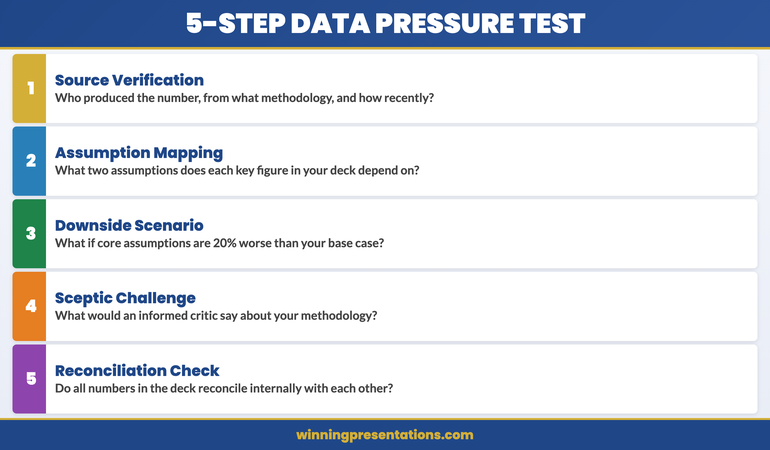
Every number that appears on a slide in a high-stakes executive presentation will be interrogated by at least one person in the room. The question is whether that interrogation will happen before or after you walk in. Pressure-testing your data means asking, for every significant number: what is the source, what are the assumptions, what happens if the assumptions are wrong, and what would a sceptic say about the methodology?

Five-step data pressure test framework for executive presentations: source verification, assumption mapping, downside scenario, sceptic methodology challenge, and reconciliation check — stacked cards infographic

The source question is the most basic and the most frequently neglected. If you are presenting a market size figure, a cost estimate, or a timeline, you should be able to state immediately who produced that number and how recently. A number from a report published two years ago presented as current market data is a vulnerability. An estimate produced internally without external validation is a vulnerability. Neither of these need prevent you from using the number — but you need to know they are vulnerabilities before someone else identifies them.

The reconciliation check is particularly important in financial presentations. Every number in your deck should reconcile with every other related number. If your cost estimate on slide four implies a certain unit cost, and your volume forecast on slide seven implies a different unit cost, a sharp analyst in the room will find the inconsistency. Running a systematic reconciliation across your slides — not just checking individual numbers but checking that the numbers are internally consistent — is a discipline that most presenters skip and most experienced audiences notice the absence of.

For a structured approach to buying time when a data question catches you short, see buying time in Q&A: techniques for managing questions you need a moment to answer.

If you want a structured system for building and running this kind of adversarial Q&A preparation before high-stakes presentations, the Executive Q&A Handling System includes question prediction frameworks, adversarial rehearsal guides, and response strategies for each category of pressure question.

Building a framework for questions you cannot fully answer

Pressure-testing will sometimes reveal that you genuinely do not have the answer to a question the audience is likely to ask. This is not a failure of preparation — it is the purpose of preparation. Finding these gaps before the room does is exactly what the process is designed to do. The question is what to do with them once you have found them.

There are three legitimate responses to a question you cannot fully answer, and one illegitimate one. The illegitimate response is to deflect — to give an answer that sounds responsive but does not actually address the question. Experienced questioners recognise deflection immediately, and it damages credibility far more than an honest acknowledgement of a gap.

The first legitimate response is to close the gap before the meeting. If pressure-testing reveals that you do not know your fuel price assumptions, get the answer before the presentation. Many gaps that feel large in the preparation phase are actually addressable with a few hours of additional analysis or a conversation with a colleague.

The second legitimate response is to acknowledge the gap explicitly in the presentation, frame it as a known uncertainty, and name how you are managing it. “The model does not include a scenario for a thirty per cent fuel price increase. We have not modelled that because it falls outside the range our supply chain team considers realistic — but if the board would find it useful, I can run that scenario and bring it to the next meeting.” This response is far stronger than being caught by the question.

The third legitimate response is to answer the spirit of the question without answering the exact question: “I don’t have that specific number with me, but the broader point you’re making about input cost sensitivity is addressed in the sensitivity analysis on slide nine — would it help to walk through that section?” This only works when the redirect is genuinely responsive to the concern behind the question, not a deflection dressed up as engagement.

For a structured bridging technique that supports these responses in the moment, see the bridging technique for difficult presentation questions: how to navigate without losing credibility.

When pressure-testing reveals a real gap

Occasionally, adversarial Q&A preparation does not just identify a question you cannot answer — it reveals that the case you are making has a genuine substantive weakness. The numbers do not hold up to a simple sensitivity analysis. The recommendation depends on an assumption that is clearly contestable. The implementation plan has a dependency that has not been addressed.

When this happens, the temptation is to press ahead anyway — the presentation is scheduled, the slides are built, and the gap might not come up. This is the wrong choice. A real gap that emerges in the room — that you were aware of and chose not to address — damages your credibility as a presenter and as an analyst in ways that take much longer to recover from than a delayed presentation.

The appropriate response is to decide, before the meeting, whether the gap is material enough to delay the presentation. If the gap would change the recommendation — or would change the conditions under which the recommendation holds — it is material, and the presentation should be delayed until the gap is addressed. If the gap is peripheral — it does not affect the core recommendation but represents a risk the audience should be aware of — it should be disclosed proactively in the presentation, not concealed in the hope it will not be raised.

Executives who earn lasting credibility in high-stakes Q&A settings are those who demonstrate that they have stress-tested their own analysis before presenting it. That quality of rigour is visible — in the specificity of their answers, in their ability to name the assumptions in their model, and in their comfort with the limits of what they know. It is the quality that adversarial Q&A preparation builds.

For a companion resource on presenting with confidence in the room, see presentation gestures: the body language signals that build executive credibility.

Executive Q&A Handling System — £39

The System Behind Executives Who Handle Tough Q&A With Clarity

The Executive Q&A Handling System — £39, instant access — gives you a structured method for predicting and preparing for every category of pressure question, running adversarial rehearsals, and managing the Q&A process so that difficult questions strengthen rather than undermine your credibility in the room.

Get the Executive Q&A Handling System →

Designed for executives who face high-stakes Q&A in board, committee, and investor settings.

Frequently Asked Questions

How much time should I allocate to Q&A preparation before a major presentation?

For a high-stakes presentation — board, investor, or senior committee — allocate at least as much time to Q&A preparation as to slide preparation. In practice, this is rarely done: most executives spend ninety per cent of their preparation time on the deck and twenty minutes on Q&A. The imbalance is understandable, because slide preparation is a creative task with a clear output, whereas Q&A preparation is an analytical task with an uncomfortable one. The adversarial rehearsal session should run for at least sixty minutes for a significant presentation. Data pressure-testing — checking sources, assumptions, and internal consistency — is a separate exercise and should be treated as a quality check on the analysis, not just the communication.

Is it better to ask a colleague or a senior mentor to run the adversarial Q&A?

A senior mentor or someone from outside your team is typically more effective than a close colleague. The problem with colleagues is that they are often too familiar with your context to ask genuinely challenging questions — they fill in the gaps with their own knowledge rather than exposing the gaps as the audience would. A mentor or trusted senior peer who does not know your specific project in detail is more likely to ask the naïve but important question that the audience will also ask. If you do use a colleague, brief them explicitly to ask the questions they think the sceptics in the room will ask — not the questions they themselves would ask as a supportive peer.

What should I do if I get a question in the room that I am genuinely not able to answer?

Say so — specifically and without apology. “I don’t have that figure with me, and I don’t want to give you a number I haven’t verified. I’ll get it to you by close of business today.” This response is more credible than a hedged estimate, more respectful than a deflection, and far less damaging than a wrong answer given confidently. What damages credibility is not the absence of an answer but the pretence of having one. Most experienced decision-makers have significantly more patience for honest uncertainty than for confident inaccuracy.

The Winning Edge

Weekly executive communication insight — every Thursday

Practical, no-filler analysis of Q&A strategy, board presentation technique, and executive communication — from 25 years of experience in high-stakes business settings.

Subscribe to The Winning Edge →

About the Author

Mary Beth Hazeldine — Owner & Managing Director, Winning Presentations

With 25 years of corporate banking experience at JPMorgan Chase, PwC, Royal Bank of Scotland, and Commerzbank, Mary Beth advises executives across financial services, healthcare, technology, and government on structuring presentations and managing the Q&A dynamics that determine whether decisions are made or deferred.