

Quick answer: Most directors do not read your board pack the way you wrote it. They read it late, tired, in the last hour before bed, skimming for two things only — what are you asking them to approve, and what is the single biggest risk in saying yes. By the time you stand up to present, they have already formed a leaning, and you are mostly confirming or fighting a view that hardened the night before. The structure that survives that 11pm skim is the decision-first pre-read: a one-page decision memo at the front carrying the recommendation, the ask, and the one number that says whether it is safe; a structured body ordered the way a director verifies a case rather than the order you built it; and section labels so a director can jump straight to the thing they doubt. The test is the skim test — if a senior colleague cannot tell you the ask and the biggest risk after ninety seconds, the pre-read has failed before the meeting starts.
JUMP TO:
In 2007, a relationship director at one of the banks where I worked took an annual credit review to committee. He knew the relationship inside out and he was proud of the file. To do it justice he sent the committee a sixty-page pack with no summary at the front — it opened straight into the relationship history, then the financials, then the covenants, then the risk grading, in the order he had worked through them. He assumed the chair would read it the way he had written it, building understanding page by page until the recommendation made itself obvious. When the pack came back to him after the meeting, the only page the committee chair had touched was page one. There were three question marks in the margin and nothing else on the document. The review had been deferred before the meeting reached the numbers at all — the chair wanted a fuller ‘so what’ at the front before the committee would spend its time on the detail. Sixty pages of genuine work, and the file never got read, because the one page the chair actually read did not tell him what he was being asked to decide.
I have since worked with somewhere around fifty senior leaders preparing decisions for boards, credit committees, investment committees, and executive committees. The pattern in that 2007 pack is the one I see most often, and it is almost never a failure of work. It is a failure of order. The relationship director had everything a committee could want; he simply put it in the sequence that made sense to the person who built it, not the person who has to verify it at 11pm with four other papers still to read. Directors do not arrive at your pack fresh and patient. They arrive at it last, tired, and scanning — and what they take from the first page is, more often than not, the view they bring into the room.
(This article was created with AI assistance; all stories and insights are based on 35 years of real client work.)
The fix is not a longer pack or a better-written history. It is a deliberate structure I now teach every senior leader before a board paper goes out: the decision-first pre-read. It has three parts — a one-page decision memo at the very front, a body ordered the way a director verifies a case, and navigation labels that let a tired reader jump to the thing they doubt. Built this way, the pack works on the director the night before, so they walk into the meeting already inclined toward the answer you want rather than forming their first impression while you are still on your opening slide.
If you are staring at a finished pack the night before and dreading the ‘so what’ page:
The Executive Slide System ships 26 executive templates built around the decision-first shape — a front decision page plus structured supporting layouts — with 16 scenario playbooks covering board approval and committee review and 7 checklists, including a pre-meeting sort that puts the ask and the headline number where a director will actually look. It gives you the structure as a starting point rather than something you reverse-engineer from a sixty-page document at midnight.
What actually happens to your pack the night before
Picture the director you are presenting to. They are not a full-time member of your organisation; they sit on two or three other boards, run something of their own, and receive your pack alongside several others for the same meeting. They open it the night before, often after a full day, with limited time and a finite supply of patience. They are not reading to learn your subject. They already trust that you know it — that is why you have the meeting. They are reading to answer two questions for themselves: what am I being asked to approve, and what is the one thing most likely to go wrong if I do. If the first page does not answer those questions, they do not patiently work through the document to find the answers. They form a provisional judgement from whatever they can extract in the time they have, and that judgement is what walks into the room.
This is the uncomfortable truth a lot of senior presenters resist: the decision is substantially made before you speak. The meeting is not where directors form their view from a blank slate; it is where they pressure-test a view they brought with them. A director who finished your pack thinking ‘clear ask, manageable risk, I am inclined to approve’ comes in looking for reasons to confirm that. A director who finished it thinking ‘I am not even sure what they want’ comes in looking for the gap — and your live presentation is now spent recovering ground you should never have lost. Where the pre-read genuinely earns its keep is the harder cases — the ones built on incomplete or contested numbers, where the way you handle presenting ambiguous data to executives in the body of the pack decides whether a director trusts the recommendation at all.
The practical implication is that the most important audience for your pack is not the boardroom — it is one tired director at a desk lamp the night before. Everything in the decision-first pre-read is designed for that reader: short enough to land in the time they will actually give it, ordered so the answer to their two questions is unmissable, and labelled so that when they want to check the one thing they doubt, they can find it without reading the rest. You are not writing to be read in full. You are writing to be skimmed correctly.
Write packs a tired director skims to the right conclusion — not ones they give up on.
The Executive Slide System gives you the decision-first structure as a ready starting point: a front decision page plus supporting layouts ordered the way a board verifies a case. It ships 26 executive templates, 93 AI prompts for turning your own figures into a clean front page and a sorted body, 16 scenario playbooks covering board approval, credit and investment committee, and finance review, plus 7 checklists. Built for senior presenters who take a decision to a committee more than once a quarter. £39, instant download, lifetime access.
- 26 executive templates — decision-first front pages plus structured supporting layouts
- 93 AI prompts — for drafting the one-page decision memo from your own analysis
- 16 scenario playbooks — board approval, credit committee, investment committee, finance review
- 7 checklists — including the pre-send skim check for the night-before reader
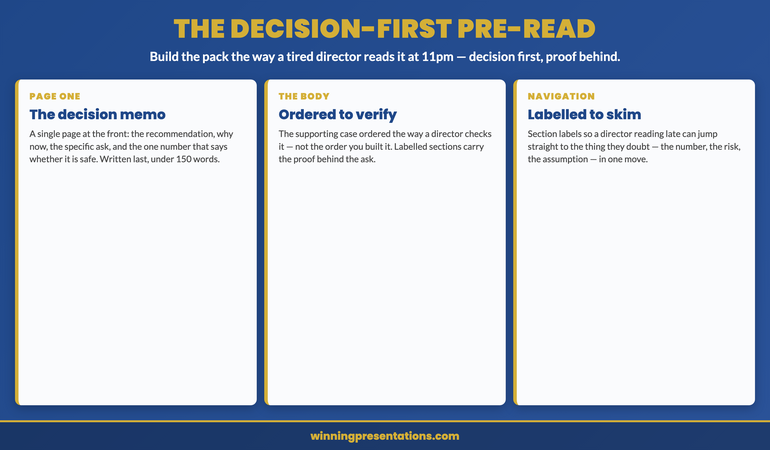
The decision-first pre-read
The first component is the cover decision memo: a single page at the front of the pack, before the history, before the context, before anything you built. It carries four things and nothing else — the recommendation in one sentence, why this matters now, the specific approval you are asking the board to give, and the one number that tells a director whether the decision is safe. That number is the figure a director would reach for to sanity-check the whole proposition: the return, the exposure, the payback, the headroom against a limit. Put it on page one in plain sight. A director who reads only this page should be able to close the pack and tell a colleague exactly what is being decided and on what basis. If they cannot, no amount of detail later in the pack will rescue it, because most directors will never reach the detail with a fresh enough mind to weigh it.
The second component is the structured body, and the discipline here is counter-intuitive: order it the way a director verifies the case, not the way you assembled it. You built the case by gathering facts, then analysing them, then reaching a conclusion. A director works in reverse — they start from your conclusion and look for the evidence that would make them doubt it. So the body should be sequenced to answer ‘is this recommendation sound?’ in the order a sceptic checks: the load-bearing numbers first, then the assumptions those numbers rest on, then the main risk and how it is mitigated, then the supporting detail. Each section should be labelled for what it answers. A director who doubts the central number should be able to find the working behind it without wading through the relationship history, and a director who only worries about the downside should be able to go straight to the risk section.
The third component is navigation, and it is the one most packs ignore entirely. A director reading at 11pm with limited time does not read linearly — they jump. They read your decision memo, form a question, and want to verify that one thing immediately. If the only way to find it is to scroll or flick through forty pages, they will either give up and carry the doubt into the room, or worse, conclude the pack is hiding something. Clear section labels — a contents line on the decision page, headed sections in the body, a label on every table that says what it shows — let a director land on the thing they doubt in one move. The skill of pointing a reader straight to the evidence is the same one that underpins knowing how to say ‘I don’t know’ in a presentation — in both cases you are showing command of where the answer lives rather than pretending nothing is uncertain.
The 2015 case that made this concrete for me was a divisional finance lead I coached. Her board paper was solid and dense, and she was convinced the problem was that the board did not read carefully enough. We did not change a single number or rewrite the body. We added one thing: a one-page decision memo at the very front of the otherwise unchanged pack — recommendation, why now, the ask, and the one number. She sent it for the next meeting braced for the usual slow grind. The board approved in roughly eighteen minutes. A director told her afterwards that it was ‘the clearest paper the division had sent.’ Same analysis, same evidence, same person. The only change was that the first page now did the job the first page is for.
For the full method behind building a case that a board reaches yes on:
The Executive Buy-In Presentation System is a self-paced programme of 7 modules covering stakeholder analysis, case construction, and the structures that hold up at board and executive committee level — the same discipline of leading with the decision and ordering the proof the way a director checks it. There are no deadlines and no mandatory sessions; optional live Q&A sessions are fully recorded so you can watch them back anytime, with monthly cohort enrolment and lifetime access to the materials. It is the deeper framework behind the one-page approach in this article. £499.
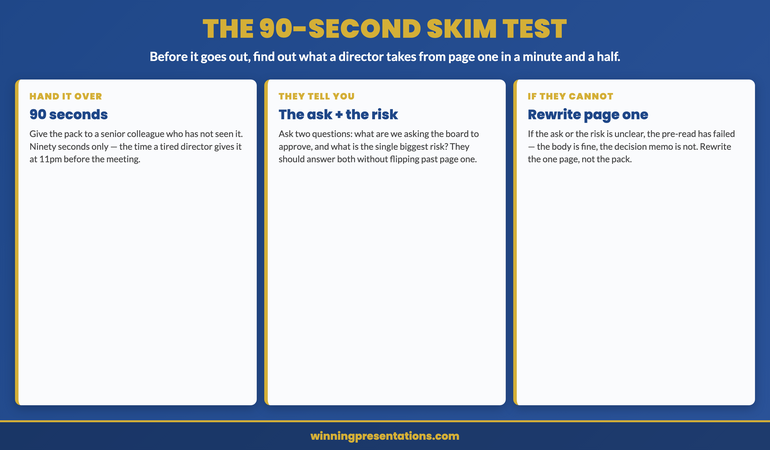
The skim test: ninety seconds that predict the meeting
You cannot judge your own pack as a director will, because you know what it is supposed to say. The decision memo reads perfectly to you because you wrote the recommendation it is summarising. The only reliable way to know whether your pre-read works is to run it past someone who comes to it as cold as a director will — and to give them no more time than a director will. That is the skim test, and it is the diagnostic at the centre of the decision-first pre-read. Hand the finished pack to a senior colleague who has not been involved, give them ninety seconds, then take it back and ask two questions: what am I asking the board to approve, and what is the single biggest risk in approving it.
If they can answer both, cleanly, in their own words, your pre-read works. A director reading it the night before will extract the same two things and form a leaning in your favour. If they cannot — if they say ‘I think it is something about expanding the programme but I am not sure what you actually need’, or if they name a risk you do not consider the main one — the pre-read has failed, and it has failed in a way you would never have caught by reading it yourself. The failure is almost always on page one. The body may be excellent; the decision memo is not doing its job. The fix is to rewrite the one page, not the pack — which is far less work than the panic of rebuilding everything the night before a deferral.
The most useful thing about the skim test is what it stops you doing. It stops you adding. The instinct when a pack feels uncertain is to put more in — more context, more caveats, more supporting tables — on the theory that completeness protects you. The skim test shows you that completeness is not the problem; clarity of the ask is. A colleague who cannot find the ask in ninety seconds will not find it faster with three more pages of detail. They will find it faster with a sharper first page. Run the test, watch where your reader stumbles, and fix that — usually by cutting and sharpening, almost never by adding. For the wider set of high-stakes situations this applies to, the executive coaching work on board-level rooms uses the same skim test as a standard pre-send check.
One structure for every board paper. No subscription, no rebuild.
Instant download, lifetime access to the Executive Slide System — 26 templates, 93 AI prompts, 16 scenario playbooks, 7 checklists. Pay once at £39; there is no renewal to track and no licence to maintain. It is built for senior presenters who would rather open every board paper from a structure that already puts the decision first and orders the proof the way a director checks it than reverse-engineer a ‘so what’ page from a finished sixty-page pack at midnight.
Frequently asked questions
Won’t a one-page decision memo make me look like I’ve oversimplified?
It is the reverse, as long as the full case sits behind it. A director reads a sharp one-page memo backed by a structured, labelled body as the work of someone who understands the proposition well enough to say what matters in a sentence — which is harder than writing forty pages, not easier. The risk of looking thin comes from a short summary with nothing behind it, not from a short summary that opens a deep pack. The memo signals judgement: you have decided what the board needs to weigh first. In practice the directors I have watched respond to a decision-first front page with more confidence in the author, because it shows command of the case rather than a hope that volume will be read as rigour.
What is the most common mistake senior leaders make with a board pack?
Ordering it the way they built the case instead of the way a director verifies it, and leaving the recommendation to emerge at the end. The author works forwards — facts, analysis, conclusion — and assumes the reader will follow the same path. A director works backwards from the conclusion, looking for what would make them doubt it, and a tired one never reaches a conclusion buried on page forty. The fix is to lead with the decision on page one and sequence the body around a sceptic’s checks: the load-bearing number, the assumptions under it, the main risk, then the detail. Same content, reordered for the person who has to approve it rather than the person who wrote it.
When should I write the decision memo — first or last?
Last, after the rest of the pack is finished. Writing it first tends to produce a memo that describes what you hope to argue rather than what the evidence actually supports, and you then bend the body to fit it. Build the case first, let the evidence settle the recommendation and the one number that proves it, then write the memo as a faithful one-page distillation of what the pack already says. Keep it under roughly 150 words, and read it aloud the way a tired director would at 11pm. If it sounds clear and decisive read cold and fast, it will work on the page. If you stumble or have to explain it, the body is not yet pointing cleanly enough at a single ask.
What if the board genuinely wants all the detail in the pre-read?
Then give them all of it — behind the decision memo, not instead of it. A board that asks for detail is asking to be able to verify the case in their own time, not to have the recommendation withheld until page forty. The decision-first structure serves both readers at once: the director who wants only the leaning gets it from page one, and the director who wants to check every assumption finds the depth, clearly labelled, in the body. The two are not in tension. A full, structured body with a one-page memo at the front respects the director who wants to dig and the director who only has ninety minutes for five papers, without forcing either to read the way the other prefers.
The Winning Edge — weekly newsletter
The Winning Edge is a weekly newsletter for senior professionals who present at the executive level. One short email a week on the structural moves that separate papers a board approves from papers it merely receives. Subscribe to The Winning Edge →
For the wider library of presentation assets senior leaders draw on — slide system, storytelling primer, Q&A taxonomy, delivery references — the complete presenter library (£99) bundles seven products plus three bundle-only bonuses, worth over £190, covering slides, storytelling, confidence, and delivery in one place. See the wider board-readiness work on the services page, and the companion article on presenting ambiguous data to executives.
About the author
Mary Beth Hazeldine is Owner & Managing Director of Winning Presentations Ltd. With 24 years of corporate banking experience at JPMorgan Chase, PwC, Royal Bank of Scotland, and Commerzbank, she advises executives across financial services, healthcare, technology, and government on structuring presentations for high-stakes funding rounds, board approvals, and strategic decisions.
The next time you build a board pack, do three things instead of trusting the board to read it the way you wrote it: put a one-page decision memo at the very front carrying the recommendation, the ask, and the one number that says whether it is safe; order the body the way a director verifies a case — load-bearing number, assumptions, main risk, then detail — with every section labelled so a tired reader can jump to the thing they doubt; and before it goes out, run the ninety-second skim test on a colleague who has not seen it. The director who reads a decision-first pack at 11pm walks into the room already leaning your way. The director who reads sixty pages with no ‘so what’ on page one walks in with three question marks — and you spend the meeting answering them instead of winning the vote.