Tag: board meeting questions

10 Apr 2026
Female CFO responding with composed authority to a hostile question from a board member during a high-stakes presentation, investment committee setting, navy and gold tones, editorial photography style

Personal Attack Disguised as a Question: How to Identify and Defuse It

Quick Answer: A personal attack disguised as a question is a challenge framed as a request for information — but its actual purpose is to undermine your credibility, expose a weakness, or shift the power dynamic in the room. Recognising one when it arrives is the first skill. The second is responding in a way that addresses the surface question without rewarding the attack underneath it. Treating it as a genuine information request is the most common mistake; so is becoming visibly defensive.

Priya was presenting the Q3 financial results to the investment committee when a non-executive director she had never met before raised his hand. “Forgive me,” he said, with a smile that suggested he required no forgiveness, “but I’m curious — has someone with your background actually managed a portfolio this size before?” The room went quiet. The question was framed as curiosity. It was not curiosity.

Priya had two seconds to decide how to respond. She had seen this before — the surface question was about experience, but the actual message was a challenge to her authority in the room, delivered publicly, at the moment of maximum exposure. She took a breath and paused before answering. “That’s a fair question to raise. I’ve managed portfolios at a comparable scale in two previous roles, and I’m happy to share the specifics afterwards if that’s useful. What I’d like to focus on here is the Q3 performance and the Q4 outlook — which is what the committee has the data to assess today.”

She moved on. She didn’t apologise. She didn’t over-explain. She didn’t take the bait of defending herself at length in response to an ambush question. The NED asked one more question — a genuine one this time — and the dynamic shifted back to her. The recognition of the attack, and the calibrated response, were the entire difference between a presentation that regained its footing and one that didn’t.

Preparing for a high-stakes Q&A session?

The Executive Q&A Handling System gives you a framework for predicting difficult questions, structuring responses, and handling hostile or loaded challenges in real time — designed for board meetings, investment committees, and senior leadership forums.

Explore the System →

How to Recognise a Personal Attack Disguised as a Question

The defining characteristic of a personal attack disguised as a question is the gap between its grammatical form and its actual function. Grammatically, it asks for information. Functionally, it delivers a challenge to your credibility, experience, authority, or judgement. Recognising this gap in real time — before you begin formulating a response — is the foundational skill.

Several signals help identify an attack question quickly. The first is the framing device: attack questions often open with disarming language — “forgive me,” “I’m just curious,” “perhaps I’ve missed something” — that creates a veneer of reasonableness while signalling something less reasonable underneath. The disarming opener is frequently the giveaway. Genuine questions from engaged participants rarely begin with pre-emptive apologies for asking.

The second signal is the specificity mismatch. A genuine clarifying question is specific to something in the presentation — a data point, an assumption, a recommendation. An attack question is often specific to you rather than to the content: your experience, your credentials, your previous decisions, your organisation’s track record on something unrelated to the current matter. The target is you, not the presentation.

The third signal is the timing. Attack questions frequently arrive at moments of maximum exposure — immediately after a difficult number, during a complex section where you’re already managing complexity, or in the first few minutes before the room has had time to form a view. The timing is strategic, not coincidental.

Understanding how these questions differ structurally from loaded questions is useful — a loaded question embeds a false assumption; a personal attack question uses the question form as a vehicle for a challenge. The response frameworks differ accordingly.

The Four Most Common Forms of Attack Question

Personal attacks disguised as questions tend to cluster into recognisable patterns. Identifying the pattern before you respond helps you choose the right response structure rather than improvising under pressure.
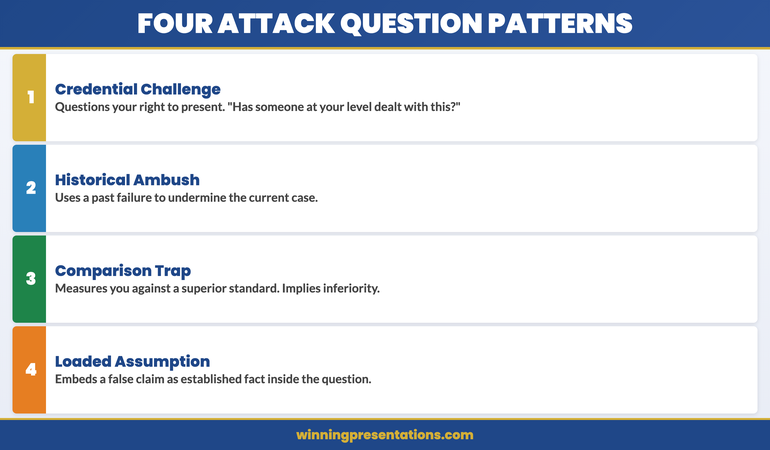
Recognising Attack Questions infographic showing four patterns: The Credential Challenge (questioning your authority), The Historical Ambush (citing past failures), The Comparison Trap (measuring against a superior standard), and The Loaded Assumption (embedding a criticism in the question)

The Credential Challenge. This questions your authority or experience directly: “Has someone at your level actually dealt with this before?” or “I’m wondering whether the team has the expertise to handle something of this complexity.” The grammatical form is a question. The actual content is a challenge to your right to be presenting at all. Responding to the literal question (by listing your credentials at length) is the most common mistake. The correct response acknowledges the question briefly and redirects to the substantive matter.

The Historical Ambush. This introduces a past failure — yours or your organisation’s — as a question: “Given what happened with the X project last year, I’m curious how you’d address the same risk here?” The question has legitimate surface content, but it is deployed in a way designed to establish a damaging narrative before the room has heard your current case. The correct response separates the historical reference from the current matter clearly, without becoming defensive about the history.

The Comparison Trap. This measures you against a superior standard in the form of a question: “Organisation Y manages to do this at half the cost — can you explain the gap?” The implied message is that your approach is inferior. The correct response examines whether the comparison is valid before engaging with it, rather than accepting the premise of the question and attempting to justify a gap that may not exist as framed.

The Loaded Assumption. This embeds a criticism in the question structure: “Given that this approach has already failed once, what makes you think it will work this time?” The word “failed” is doing significant work here — it is presented as established fact when it may be contested or misrepresented. The correct response surfaces and challenges the embedded assumption before addressing the question itself. Related technique: handling hostile questions in board meetings covers the broader category of adversarial Q&A in governance contexts.

Build a System for Handling Executive Q&A

The Executive Q&A Handling System gives you a structured approach to predicting the difficult questions that arise in board meetings, investment committees, and senior leadership forums — including hostile, loaded, and attack-style questions — and responding in a way that protects your credibility and controls the room.

  • Framework for predicting and categorising difficult questions in advance
  • Response structures for hostile, loaded, and personal attack questions
  • Bridge and redirect techniques for maintaining control of Q&A
  • Preparation system for high-stakes Q&A sessions

Get the Executive Q&A Handling System — £39

Designed for executives presenting to boards, investment committees, and senior leadership forums where challenging Q&A is expected.

What Drives Them: Motivation, Not Malice

Understanding the motivation behind a personal attack question changes how you respond to it — and, more usefully, how you feel about it in the moment. Most attack questions are not expressions of personal malice. They are expressions of something else: anxiety about a decision, a political position being asserted, a desire to demonstrate analytical rigour to others in the room, or a test of whether you can hold your ground under pressure.

The board member who challenges your credentials in front of the investment committee is often doing so because they are managing their own accountability — they want the record to show that they asked tough questions before approving a decision. The NED who deploys a historical ambush may be genuinely concerned about a pattern they believe they’ve identified, but expressing it through a challenge rather than a direct statement because that is the conversational norm in their context.

This matters practically because it changes your framing. A personal attack question is not evidence that the room is hostile to you. It is evidence that one person in the room is either managing their own agenda or testing your composure — and often both. Responding as though the whole room shares the sentiment of the questioner is the error that compounds the damage. In most cases, the rest of the room is watching to see how you handle it. How you handle it is the presentation.

The strategic pause technique is your most reliable first tool in this moment — a pause of three to five seconds before responding signals composure and creates the space for a considered response rather than a reactive one.

For a complete system for predicting and handling the full range of difficult Q&A scenarios — including attack questions, hostile challenges, and loaded assumptions — the Executive Q&A Handling System provides the preparation framework and response structures in one place.

The Response Framework: Defuse Without Surrendering Ground

The response to a personal attack disguised as a question needs to do several things simultaneously: acknowledge the surface question without accepting the attack embedded in it, respond with enough substance to be credible, and redirect to the matter at hand without appearing to flee from the challenge. This is a specific sequence, not a general principle of being calm or confident.
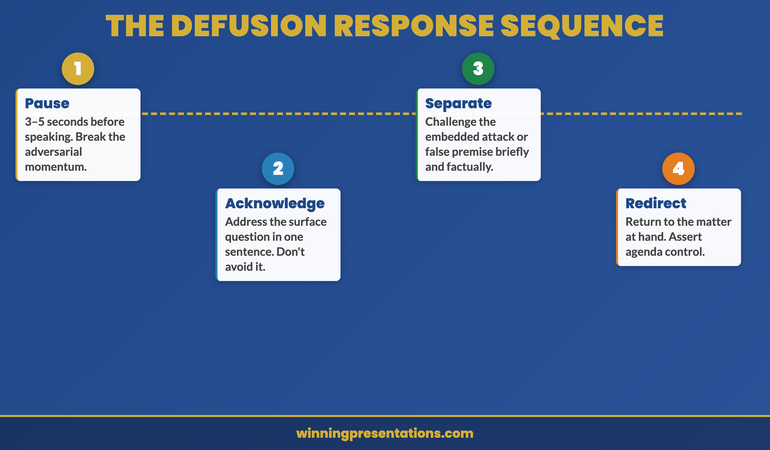
The Defusion Response Sequence roadmap infographic showing four steps: Pause (3–5 seconds, break adversarial momentum), Acknowledge (address the surface question in one sentence), Separate (challenge the embedded attack briefly and factually), Redirect (return to the substantive matter and assert agenda control)

Step 1 — Pause. Take three to five seconds before speaking. This breaks the adversarial momentum the question is designed to create and signals that you are choosing your response rather than reacting to provocation. It also gives the room a moment to register that you are not rattled.

Step 2 — Acknowledge the surface question briefly. Address what was literally asked in one sentence. For a credential challenge: “That’s a fair question to raise.” For a historical ambush: “The X project is worth addressing.” This prevents the questioner from repeating the challenge with the accusation that you avoided it.

Step 3 — Separate yourself from the embedded attack. This is the key move. Provide a short, factual response to the substance of the challenge — not a defensive monologue, but enough to remove the premise of the attack without inviting further discussion on that ground. For a credential challenge: one sentence on relevant experience, then stop. For a loaded assumption: name the assumption explicitly — “the premise of your question is that X has already been established; my reading of the situation is different” — then state your reading once.

Step 4 — Redirect. Return immediately to the matter the presentation is actually about. “What I’d like to bring the committee back to is…” This is not an avoidance move — it is an assertion of agenda control. The presenter who redirects cleanly after handling an attack question is demonstrating exactly the composure and authority that the question was designed to test.

See also the bridging technique for difficult questions — the bridge move in Step 4 is a specific skill that benefits from preparation in advance of the presentation.

Prepare for High-Stakes Q&A With a Structured System

The Executive Q&A Handling System gives you the preparation framework and response structures to handle the full range of difficult questions — from genuine challenges to hostile attacks — in board meetings and senior leadership forums.

Explore the Q&A Handling System

Designed for executives who present to boards, investors, and senior leadership forums where Q&A can be adversarial.

What Not to Do: The Three Most Common Mistakes

Understanding the correct response to a personal attack question is only half the preparation. Equally important is knowing the three response patterns that consistently make the situation worse — because under pressure, all three feel instinctively appropriate in the moment.

Mistake 1: Treating it as a genuine information request. The most common response to an attack question is to answer it as though it were a sincere request for information. This typically produces a lengthy, detailed response to the surface question — a full recitation of credentials, a complete account of the historical project, an exhaustive explanation of the methodology. The length of the response signals defensiveness even when the content is accurate. It also rewards the questioner by allowing them to occupy significant airtime with a move that was designed to destabilise rather than inform. A short, factual response followed by a redirect is the correct alternative.

Mistake 2: Becoming visibly defensive. A sharp change in posture, a faster speaking pace, or an audible increase in the emotional register of your voice — all of these signal to the room that the attack found its target. The questioner’s objective in most cases is to demonstrate that you can be destabilised under pressure. Visible defensiveness confirms the hypothesis they were testing. The correct response is composed, measured, and neither warm nor cold — factual in tone without being wooden.

Mistake 3: Inviting the questioner to elaborate. “That’s an interesting point — could you say more about what you mean?” This is a perfectly appropriate response to a genuine question. It is a damaging one in response to an attack question, because it hands the floor back to the person who has just challenged your authority and invites them to expand on the challenge at greater length. If clarification is genuinely needed, ask a very specific question: “When you say ‘someone at my level,’ what specific aspect of this presentation are you referring to?” This forces precision and often reveals the lack of a substantive underlying concern.

Frequently Asked Questions

Is it appropriate to address a personal attack question directly in front of the room?

Yes — briefly, and without displaying emotion. Attempting to avoid the question or deflect immediately signals discomfort. A short, factual acknowledgement followed by a redirect is the correct approach. The goal is to demonstrate that you noticed the nature of the question and chose how to respond to it — not that you were rattled by it or were unaware of what it was. The room notices the distinction and forms judgements accordingly.

What if the personal attack question contains a legitimate point?

Acknowledge the legitimate point directly and briefly. “There is a real question in there about X, and I’m happy to address it.” Then address X, and stop. The error is either to use the legitimate point as cover for ignoring the attack element entirely, or to become so focused on the attack element that you fail to address a genuine underlying concern. Separating the two — “the substantive question here is X; the framing of the question is a different matter” — is the cleanest approach.

How do you handle a personal attack question when it comes from the most senior person in the room?

The response framework is the same, but the tone calibrates upward. You are not adjusting the substance of your response based on seniority — you are still acknowledging briefly, providing a factual short answer, and redirecting to the substantive matter. What changes is the formality of the language and the explicit deference in tone. “That’s a fair challenge to raise, and I want to address it directly” works in any hierarchy. The key principle is that seniority of the questioner does not change your right to maintain the agenda of the presentation and the substance of your case.

The Winning Edge Newsletter

Weekly strategies for executive Q&A, difficult question handling, and high-stakes presentation preparation. Practical frameworks you can apply before your next board meeting.

Subscribe Free →

About Mary Beth Hazeldine

With 25 years of corporate banking experience at JPMorgan Chase, PwC, Royal Bank of Scotland, and Commerzbank, Mary Beth Hazeldine is Owner and Managing Director of Winning Presentations. She advises executives across financial services, healthcare, technology, and government on handling high-stakes Q&A and structuring responses to difficult and adversarial questions in board and investment committee contexts. View services | Book a discovery call

21 Mar 2026
Senior executive standing at a boardroom lectern preparing strategic response cards for contingency questions in a high-stakes presentation setting

What’s Your Plan B? — The Contingency Questions That Define Senior Presentations

You’ve built an airtight case for your recommendation. You’ve walked through the numbers, the timeline, the expected outcomes. And then a board member leans forward and asks: “But what if it fails?” Everything you said before that moment—the entire case—suddenly feels irrelevant. Because they weren’t testing your recommendation. They were testing your contingency thinking.

Quick Answer: Senior executives ask contingency questions in Q&A to assess your strategic depth and risk awareness—they’re testing whether your recommendation survives when reality deviates from your plan. The five core question types (Assumption Failure, Timing Deviation, Competitive Response, Resource Constraint, and Demand Collapse) follow predictable patterns, so you can prepare systematically instead of hoping you won’t be caught off-guard. Learning to recognise these patterns and respond with credible fallback positions is what separates presenters who survive boardroom scrutiny from those who collapse under it.

Do You Have a Contingency Blind Spot?

You might need this system if any of these sound familiar:

  • You’ve been caught off-guard by “What if your key assumption doesn’t hold?” and had no credible answer
  • You’re confident in your recommendation but haven’t fully mapped what breaks if you’re wrong
  • Senior audiences ask why you haven’t considered Plan B, and you sense they’re not convinced by “We’ll adapt”
  • You’ve presented to boards or senior committees and felt the Q&A was testing something deeper than your numbers
  • You’re strong on execution but weaker on contingency frameworks—and you know it matters at senior level

If yes to 2+ of these: You’re not missing execution rigour. You’re missing the contingency thinking that executives expect to see in strategic decisions.

The Board Member’s Question Revealed Everything

Fadilah had spent two weeks perfecting her recommendation. Market analysis, competitive positioning, three-year financial model, implementation roadmap. It was thorough. It was clear. By the time she reached slide 6, everyone in the room understood the strategic rationale.

Then the longest-serving board member—the one who never asked questions—raised his hand.

“This works if everything unfolds as you’ve written it. But what happens at the first deviation? What’s your Plan B?”

Fadilah paused. She had execution contingencies. But she didn’t have strategic contingencies—she hadn’t mapped what would change her recommendation if key assumptions shifted. So she did what most presenters do: she hedged. “We’d adapt as we go. We’re flexible.”

She saw it in his face. That wasn’t the answer. He wasn’t testing her optimism. He was testing her thinking. And she’d just told him she hadn’t fully thought through what would actually break her recommendation—or what she’d do about it.

That’s when she understood: contingency thinking isn’t a side conversation. It’s the central conversation in senior Q&A.

Know the Contingency Questions Before They’re Asked

The Executive Q&A Handling System (£39, instant download) walks you through how senior executives ask contingency questions, what they’re really testing for, and exactly how to build fallback positions that demonstrate strategic depth rather than optimism.

You’ll learn to predict 80% of the questions before they land—because they follow patterns. And you’ll know how to answer them credibly, without hedging or waffling.

Learn the System →

If contingency questions keep catching you flat-footed, the problem isn’t your content — it’s that you haven’t mapped the question patterns.

The Executive Q&A Handling System walks through the five contingency question types senior decision-makers use, how to predict them before the meeting, and how to answer without hedging.

Explore the system →

The Five Core Contingency Question Types

Contingency questions in senior Q&A aren’t random challenges. They follow a taxonomy. Once you recognise the pattern, you can prepare systematically instead of hoping you won’t be caught off-guard.

These five types account for roughly 75% of the contingency questioning you’ll encounter in boardrooms and senior Q&A.

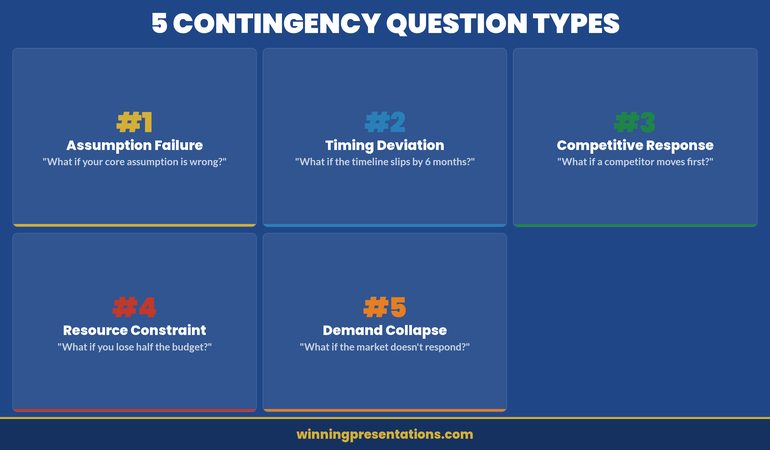
Five Contingency Question Types infographic showing Assumption Failure, Timing Deviation, Competitive Response, Resource Constraint, and Demand Collapse as numbered steps executives test in Q&A

Assumption Failure: “What if you’re wrong?”

This is the most direct contingency question. An executive picks apart one of your core assumptions and asks what happens if it doesn’t hold.

Example: “You’re assuming 60% of the existing customer base will migrate to the new platform. What if that migration rate is only 35%?”

This question is testing whether your entire recommendation collapses if that assumption breaks. The executive isn’t being hostile—they’re doing risk assessment. They want to know if you’ve thought past your base case.

How to answer: Don’t defend the assumption. Instead, show what you’ve modelled if it shifts. “If migration is 35%, we’d expect revenue to lag by 18 months, but we’d still hit break-even in Y3 because the lower initial spend means we’ve held cost discipline.” You’re not predicting the assumption is wrong. You’re demonstrating you’ve mapped the failure path.

Timing Deviation: “What if it takes longer?”

Executives have seen countless projects slip. They want to know whether your contingency planning accounts for the real world—not the project plan.

Example: “You’ve outlined a 12-month rollout. What’s our position if regulatory approval takes an extra quarter?”

The question is straightforward: Can your recommendation survive when timelines stretch? This is particularly acute in regulated industries, where “six weeks” often means “six months”.

How to answer: Show the cost of delay without pretending delay won’t happen. “A quarter-long approval lag reduces Year 1 revenue by approximately 18%, but it doesn’t change the unit economics—it just pushes our break-even to Q2 of Year 2 instead of Q4 of Year 1. We’ve already budgeted for three months of contingency cost.” You’re not predicting everything will go to plan. You’re showing you’ve funded the waiting period.

Competitive Response: “What if they copy this?”

In strategic Q&A, executives ask what happens when competitors respond to your move. This is particularly acute for innovation presentations.

Example: “If we launch this service and it’s successful, what prevents a competitor from replicating it within six months?”

They’re not asking you to guarantee competitive advantage. They’re asking whether your contingency plan accounts for a world where your first-mover advantage erodes faster than you’ve modelled.

How to answer: Show what you’d do if competitive positioning changed. “If competitive response accelerates our timeline to differentiation, we’d shift budget into the proprietary data layer—that’s where the moat is. We can do that within existing spend because we’ve ring-fenced 15% of Year 1 budget as a competitive response reserve.” You’re not claiming you’ll stay unique forever. You’re showing you’ve planned for the commoditisation curve.

Resource Constraint: “What if budget gets cut?”

This is the perennial boardroom question. CFOs and boards always ask: What happens if funding doesn’t materialise as planned?

Example: “This plan depends on the full £2M investment. What if the board only approves £1.5M?”

This isn’t pessimism. This is governance. They want to know whether your recommendation is fragile or robust.

How to answer: Show the phased fallback without reframing the recommendation. “At £1.5M, we’d defer the international expansion to Year 2, but the core UK implementation stays intact. That means we hit our break-even target 12 months later, but the risk profile is actually lower because we’re validating the model before expanding scope. We’d just need to ring-fence the £1.5M for the full year rather than phase it.” You’re not saying the recommendation doesn’t need funding. You’re showing where you can compress without abandoning strategy.

Demand Collapse: “What if adoption is slower than forecast?”

This is the inverse of your growth assumption. Executives ask this because they’ve seen products with brilliant features and zero demand.

Example: “You’re forecasting 2,000 sign-ups in Year 1. What if the market gives you 400?”

They’re testing whether your recommendation survives if you’re optimistic about market pull.

How to answer: Show the contingency without claiming it won’t happen. “At 400 sign-ups, we’d be cash-flow negative through Year 1, but our contingency is the partnership route—we have pre-qualified channels that could accelerate adoption. We’d activate those in Q3 if organic adoption lags. That doesn’t guarantee we hit 2,000, but it gives us a credible path to breakeven without additional capital.” You’re not defending your forecast. You’re showing you have levers to pull if the market doesn’t cooperate.

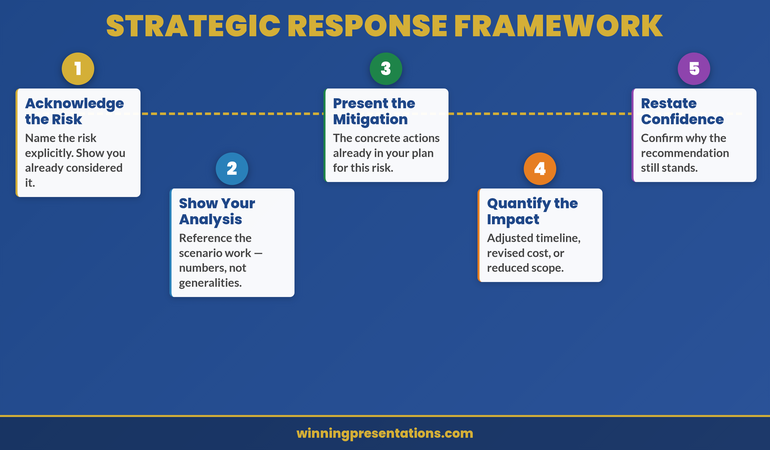
Contingency Answers comparison infographic contrasting unprepared responses versus strategic responses across three common Plan B question scenarios

Learning to recognise these five question types gives you a system. You’ll stop feeling blindsided.

Explore the Q&A System →

Stop Getting Caught Without a Plan B

Every time you walk into a boardroom without a credible fallback position, you’re betting that no one will ask about risk. The Executive Q&A Handling System (£39, instant download) teaches you how to build contingency positions that earn credibility—not defensiveness.

Get the System →

Is This Right For You?

This system is built for senior presenters who:

  • Present to boards, executive committees, or C-suite audiences regularly
  • Know that Q&A is where credibility is built or lost—and want to control the narrative
  • Have been caught by contingency questions and want a framework to prepare systematically
  • Understand that “I’ll figure it out” doesn’t work in executive rooms
  • Want to walk into Q&A knowing what’s coming and how to respond

Not for you if: You’re presenting to audiences without governance mindsets, or you’re still building foundational presentation skills rather than mastering strategic Q&A.

People Also Ask

How do you answer ‘What’s your Plan B?’ in a presentation?

Your Plan B should never feel like you don’t believe in Plan A. Instead, show the contingency levers you’d pull if key assumptions shift. Focus on what you’d do first to adapt (cost reduction, timeline adjustment, scope compression), not on worst-case fantasy scenarios. The answer demonstrates strategic flexibility, not pessimism.

What are contingency questions in executive Q&A?

Contingency questions are the ones executives ask to test whether your recommendation survives when reality deviates from your plan. They fall into five types: Assumption Failure, Timing Deviation, Competitive Response, Resource Constraint, and Demand Collapse. They’re not objections—they’re risk assessments. Learning to recognise them lets you prepare credible fallback positions instead of being caught off-guard.

Why do boards ask about Plan B?

Boards ask about Plan B because they’re evaluating risk management, not just execution confidence. They want to know whether you’ve thought systemically about what breaks your recommendation and whether you have credible levers to pull. It’s a governance question disguised as a contingency question. The answer tells them whether you’re prepared for the real world or just the project plan.

Frequently Asked Questions

Should I include contingency plans in my presentation slides, or wait for Q&A?

Build your primary recommendation on the slides, but have your contingency thinking fully mapped and ready to articulate in Q&A. You don’t need a “Plan B slide”—that muddies your core message. But you absolutely need credible fallbacks to show when someone asks. This separates presenters who have contingency thinking from those who only have presentations.

How do you prepare for contingency questions you haven’t thought of?

You can’t prepare for questions you haven’t imagined, but you can prepare for the pattern. Once you recognise that most contingency questions fit into one of five types, you can stress-test your recommendation against each one systematically. That covers 75% of what you’ll hear. For the remaining 25%, your answer is structural: acknowledge the question, show the thinking process, and outline how you’d approach that new contingency. That builds credibility even when you’re improvising.

What’s the difference between contingency planning and lack of conviction?

Lack of conviction sounds like “We’re not sure this will work, so we have a backup.” Contingency planning sounds like “This recommendation works on our base case. Here’s what we’d do if Assumption X shifts, because we’ve thought it through.” The first sounds defensive. The second sounds strategic. The difference is in the framing: you’re not hedging your recommendation, you’re demonstrating that you’ve thought past it.

Get the Winning Edge

New frameworks, Q&A patterns, and execution strategies delivered every week.

Subscribe to the Newsletter

About the Author

Mary Beth Hazeldine has spent 25 years coaching executives, watching boardrooms think, and teaching presenters how to handle Q&A with confidence. She’s worked with companies ranging from FTSE firms to scale-ups, helping leaders move from good presentations to boardroom credibility. Her frameworks focus on what actually happens in senior Q&A—not what presentation theory says should happen.

20 Feb 2026
Why Executives Ask Questions They Already Know the Answer To (And What They're Really Testing)

Why Executives Ask Questions They Already Know the Answer To (And What They’re Really Testing)

Quick answer: When executives ask questions during your presentation, they usually aren’t looking for information — they’re running a trust test. They want to know whether you understand the real issue, whether you’ve thought beyond your slides, and whether you stay composed under pressure. Once you learn to decode what’s actually being tested, handling executive questions becomes a completely different skill.

The Question That Wasn’t Really a Question

The CFO already knew the answer. I could see it on his face.

We were in a quarterly review at Royal Bank of Scotland. I’d just presented the client retention numbers — solid figures, well-structured slide. Then the CFO leaned forward and asked: “What’s driving the 3% attrition in the Northern portfolio?”

I knew the answer. He knew I knew the answer. He already had the regional breakdown on his desk — I’d seen it there when I walked in.

But I panicked. I started over-explaining. I gave him the complete history of the Northern portfolio, the market conditions, the competitive dynamics. By the time I finished, two minutes had passed and the room had glazed over.

A colleague presented after me. The CFO asked her a similar question. She said: “Two factors. The repricing in March caught three mid-tier clients off guard, and our response time on renewals was too slow. We’ve already addressed both — I can share the specifics if useful.”

Twelve seconds. She was done. The CFO nodded and moved on.

That’s when I understood something that took me years to fully appreciate across 24 years in corporate banking: executive questions during presentations are almost never about getting information. They’re about testing whether you understand the information well enough to be trusted with what comes next.

Once I learned to decode what executives are actually testing — rather than just answering what they’re literally asking — handling questions in board presentations and senior leadership meetings became the strongest part of my presentations, not the most feared.

Stop Guessing What Executives Actually Want to Hear

The Executive Q&A Handling System gives you frameworks for decoding questions, structuring 15-second answers, and recovering when you don’t know — without losing credibility.

Get the Q&A Handling System → £39

Built from 24 years of boardroom experience across banking and consulting environments.

Why Executive Questions Are Never Really About the Question

Here’s what most presenters get wrong: they hear a question and immediately try to answer it. They treat executive Q&A like an exam — as if the goal is to prove they know the material.

But executives rarely ask questions to learn basic facts. They have analysts, reports, and dashboards for that. They ask questions to evaluate you. Specifically, they’re evaluating three things: your depth of understanding, your judgement, and your composure. This is why getting executive buy-in depends as much on how you handle questions as on what’s in your slides.

I saw this dynamic play out hundreds of times across my banking career. A managing director at JPMorgan once told me something I never forgot: “I already know 80% of what’s in your presentation before you start. The questions are how I figure out the 20% that matters — and whether you know which 20% that is.”

That single insight changes everything about how you prepare for executive Q&A. You stop memorising facts and start thinking about what the questioner is actually evaluating.

The Trust-Test Framework showing three types of executive questions: Knowledge Test, Alignment Test, and Pressure Test with what each is really evaluating

The Trust-Test Framework: 3 Types of Executive Questions

Every question an executive asks during your presentation falls into one of three categories. Once you can identify which type you’re facing, the correct response becomes obvious.

Type 1: The Knowledge Test. This is the question from my CFO story. They already know the answer — they’re testing whether you do. The trap is over-explaining. When you give a two-minute answer to something that requires ten seconds, you signal insecurity. You’re telling the room: “I’m not confident enough to be brief.”

❌ Wrong response to a Knowledge Test: “Well, there are several factors at play here. If you look at the Northern portfolio historically, we’ve seen a trend since Q3 of last year where the mid-tier segment has been under pressure from competitor repricing, and additionally our internal response times on renewal processing have been impacted by the system migration…”

✅ Right response: “Two factors: competitive repricing in March and slow renewal response times. Both addressed — happy to go into specifics.”

The right response does three things: it proves you know the answer, it shows you can prioritise, and it hands control back to the executive. If they want more detail, they’ll ask. If they don’t, you’ve just demonstrated exactly the kind of judgement they were testing for.

Type 2: The Alignment Test. This is the question that sounds like a challenge but is actually a check on whether you’ve thought about the issue from their perspective. At PwC, I watched a partner ask a senior consultant: “How does this recommendation affect the timeline for the regulatory submission?” The consultant’s recommendation was sound. But the partner wasn’t questioning the recommendation — he was checking whether the consultant had considered the one thing keeping him up at night.

❌ Wrong response to an Alignment Test: “The timeline shouldn’t be affected. Our analysis shows that the current approach is the most efficient option based on the data.”

✅ Right response: “It adds approximately two weeks to the regulatory timeline. I’ve mapped out how to absorb that within the existing buffer — slide 8 has the detail if you’d like to see it.”

The Q&A Handling System teaches you to decode what’s really being asked — and respond in 15 seconds or less, every time.

Get the Q&A Handling System → £39

The wrong response defends your work. The right response acknowledges the executive’s concern, shows you’ve already thought about it, and offers proof. That’s the difference between someone who presents information and someone who demonstrates judgement.

Type 3: The Pressure Test. This is the question designed to see how you react when challenged. It might sound aggressive: “Why should we believe this forecast when the last one was 15% off?” It might sound sceptical: “Isn’t this just what we tried in 2023?” At Commerzbank, I watched a board member deliberately challenge a strong proposal just to see if the presenter would fold or hold.

❌ Wrong response to a Pressure Test: “Well, the circumstances were different then, and I think if you look at the methodology we’ve used this time, you’ll see that we’ve improved our approach significantly, and the margin of error is much lower now…”

✅ Right response: “Fair challenge. The 2023 forecast used a single-scenario model. This one stress-tests three scenarios — worst case still delivers 8% above breakeven. The methodology comparison is on slide 14 if that’s useful.”

Notice what the right response does: it doesn’t get defensive, it doesn’t apologise, and it doesn’t over-explain. It acknowledges the challenge (“Fair challenge”), gives the key differentiator in one sentence, provides proof, and offers more detail only if the executive wants it.

The Wrong vs. Right Pattern That Applies to Every Executive Question

Across all three trust-test types, the pattern is the same. Here’s the formula that works in every executive-level presentation:

❌ Wrong pattern: Hear question → feel threatened → start explaining → add context → add more context → hope the executive stops you → realise you’ve been talking for 90 seconds → trail off weakly.

✅ Right pattern: Hear question → identify the trust test → give the headline answer (one sentence) → offer proof or a slide reference → hand control back.

The entire right pattern takes 10-15 seconds. That’s not a guess — I’ve timed hundreds of executive Q&A sessions across my career. The answers that build the most trust are almost always under 20 seconds. The answers that destroy trust are almost always over 60 seconds.

Here’s one more wrong/right comparison that captures the principle perfectly:

❌ What most people do when a board member asks “What’s the risk here?”: They list every risk they can think of, show they’ve done thorough analysis, and end up making the proposal sound dangerous. Two minutes later, the room is more worried than when the question was asked.

✅ What experienced presenters do: “The primary risk is execution timing — specifically the Q3 integration window. We’ve built in a two-week buffer and a fallback option. The risk register is in the appendix.” Fifteen seconds. The board member nods. The proposal still has momentum.

Wrong versus right response pattern showing the long rambling answer compared to the Trust-Test response of headline answer plus proof plus control handback

Turn Q&A Into the Strongest Part of Your Presentation

The Executive Q&A Handling System includes frameworks for predicting questions, structuring 15-second answers, and handling “I don’t know” moments — all built for boardroom-level conversations.

Get the Q&A Handling System → £39

Built from 24 years in banking and consulting environments. Used in board meetings, steering committees, and investor presentations.

What to Say When You Genuinely Don’t Know the Answer

Not every question is a trust test you can decode and pass. Sometimes you genuinely don’t know the answer. And this is where most presenters make the worst mistake of all: they bluff.

I watched a VP at Commerzbank try to answer a technical question about derivatives exposure that he clearly didn’t have the numbers for. He improvised for about 45 seconds. The CFO let him finish, then said: “That’s not what I asked.” The room went silent. His credibility for the rest of the meeting was gone.

The correct response when you don’t know is the simplest one — and the one that actually builds trust:

❌ Wrong: “That’s a great question. I believe the figure is somewhere around… let me think… I want to say it’s approximately 12%, but I’d need to verify that. The general trend has been…”

✅ Right: “I don’t have that specific figure to hand. I’ll confirm it by end of day and send it through. What I can tell you now is that the overall trend supports the recommendation — the exact number won’t change the direction.”

That response does four things: it’s honest, it commits to a specific follow-up action, it gives the executive something useful right now, and it reframes the gap as non-critical to the decision. Executives respect all four of those things far more than a guess.

If you struggle with the pressure of these high-stakes moments — where your career credibility is on the line — you’re not alone. Many of the executives I work with find that having a reliable presentation structure for career-defining conversations reduces the anxiety of Q&A significantly.

Knowing what to say — and what NOT to say — when you don’t have the answer is one of the most valuable executive communication skills. The Q&A Handling System covers exactly this.

Get the Q&A Handling System → £39

Common Questions About Handling Executive Questions in Presentations

Why do executives ask questions they already know the answer to?

Executives use questions as trust tests — not information requests. They’re evaluating whether you understand the material deeply enough to be brief, whether you’ve considered their priorities, and whether you stay composed under challenge. The question itself is rarely the point. Your response reveals your judgement, your preparation, and your confidence — all of which influence whether the executive trusts you with bigger responsibilities and decisions.

How do you handle tough questions from senior leadership in a presentation?

Identify which type of trust test you’re facing: a Knowledge Test (they know the answer — be brief), an Alignment Test (they want to know you’ve considered their concern — acknowledge and show you’ve planned for it), or a Pressure Test (they’re challenging to see your composure — acknowledge the challenge, give one differentiator, offer proof). In all three cases, keep your answer under 20 seconds and hand control back to the questioner.

What do board members want to hear during presentation Q&A?

Board members want brevity, honesty, and evidence of judgement. They want to hear that you understand the core issue (not just the surface question), that you’ve considered the risks and trade-offs, and that you can distinguish between what matters and what doesn’t. The fastest way to build trust in board Q&A is to answer in one sentence, offer a proof point, and let the board member decide if they want more detail.

The Q&A Is Where Decisions Actually Get Made

Your slides set up the case. The Q&A is where the executive decides whether to trust it. The Executive Q&A Handling System gives you the frameworks to pass every trust test — whether you know the answer or not.

Get the Q&A Handling System → £39

Built from 24 years in banking and consulting. Used in board meetings, steering committees, and investor presentations.

Optional: The Q&A Handling System is also available as part of The Complete Presenter (£99) — seven products covering slides, storytelling, confidence, and delivery.

Frequently Asked Questions

What if the executive question is genuinely hostile — not a trust test?

Genuine hostility is rarer than people think, but it happens. The response is the same: acknowledge, answer briefly, and don’t get defensive. “I hear your concern. Here’s what the data shows…” works in hostile environments because it refuses to escalate. The executive either accepts your response or pushes further — but either way, the room sees you as composed. That composure is itself a trust signal, and it often matters more than the content of your answer.

Can I prepare for trust-test questions in advance?

Yes — and you should. Before any executive presentation, identify the three questions the most senior person in the room is most likely to ask. For each one, prepare a headline answer (one sentence), a proof point, and a slide reference. This takes ten minutes and eliminates 80% of Q&A anxiety. The remaining 20% is unpredictable, but the framework still applies: identify the trust test, give the headline, offer proof, hand back control.

Does this work in virtual presentations where you can’t read body language?

The Trust-Test Framework works regardless of format because it’s about the structure of your answer, not the visual cues you’re reading. In virtual settings, the framework actually matters more because you have fewer signals to work with. The 15-second answer discipline is especially critical on video calls where attention spans are shorter and rambling is more noticeable. One practical adjustment: pause for a beat before answering. On video, this reads as thoughtful rather than slow.

What if my boss is in the room and the executive’s question reveals something my boss didn’t want raised?

This is one of the most politically sensitive Q&A scenarios — and one of the most common. The framework still applies: answer honestly but briefly, and don’t volunteer additional context that expands the issue. “That’s something we’ve identified and are addressing — I can share the plan after this meeting” buys you time without lying, deflecting, or putting your boss in a difficult position. The key is to never throw anyone under the bus and never make up an answer to cover for a gap. Executives can spot both instantly.

📬 Get Weekly Presentation Intelligence

Q&A frameworks, executive communication strategies, and the techniques that work in real boardrooms — delivered every week. No fluff. No spam.

Join the Newsletter

Related: If you’re preparing to present to the person who controls your pay, the Q&A portion is often where the real conversation happens. Read Presenting to the Person Who Will Decide Your Bonus — the 6-slide structure that reframes the entire conversation.

Your next step: Before your next executive presentation, identify the three most likely questions from the most senior person in the room. For each one, write a headline answer in one sentence. That’s it. That ten-minute exercise will change how you experience Q&A — permanently.

Want the complete framework for handling any executive question — including the ones you can’t predict?

Get the Q&A Handling System → £39

About the Author

Mary Beth Hazeldine is the Owner & Managing Director of Winning Presentations. With 24 years of corporate banking experience at JPMorgan Chase, PwC, Royal Bank of Scotland, and Commerzbank, she specialises in executive-level presentation skills and Q&A preparation.

A qualified clinical hypnotherapist and NLP practitioner, Mary Beth combines executive communication expertise with evidence-based techniques for managing presentation anxiety. She has spent 15 years training executives and supporting high-stakes board presentations, steering committee updates, and decision meetings.

Book a discovery call | View services