

Quick answer: When multiple board members pile on — one challenge follows another in quick succession, often from different angles — the presenter loses the room within sixty seconds unless they de-escalate explicitly. The move that works is structural, not interpersonal: stop, name the pattern, ask the chair to help sequence the questions, and answer them one at a time at the right altitude. This restores control without conceding any substance and signals to the room that you are still in command of the meeting.
Jump to:
Ngozi was eight minutes into a forty-minute presentation to her group’s investment committee. The first question, from a non-executive director, was about the assumed market growth rate. Before she could finish answering, the head of risk interrupted with a question about the competitor’s pricing trajectory. As she turned to address that, the CFO came in with a third question about working capital. Within ninety seconds, three senior people had asked three separate challenges from three different angles, and Ngozi was answering the third while the first two were still unresolved.
She felt the room shift. Two more board members started conferring quietly. The chair was watching but not intervening. Ngozi tried to keep up — she answered each question as quickly as she could, layering responses on top of each other. By the time she had finished her third answer, none of the questioners looked satisfied, and the proposal had visibly lost momentum.
Afterwards, the investment committee chair gave her unfiltered feedback. He said the questions had not been a coordinated attack — none of the three challengers had been working together. They had each had their own concern. The problem was that Ngozi had not slowed the room down. By trying to keep up with the pace of the questions, she had let the rhythm of the meeting fall out of her control. That is what the rest of the board had read as weakness, not the substance of any individual answer.
Pile-ons happen in board meetings, executive committees, investment panels, and steering groups. They are rarely coordinated. They are often the natural result of three or four senior people having three or four legitimate concerns that surface in close succession. The presenter who can de-escalate in real time keeps control. The one who cannot, loses it within ninety seconds.
If you face boards or committees with multiple senior challengers
The Executive Q&A Handling System covers the de-escalation move, sequencing techniques, and the question pattern library that prepares you for the questions before they arrive. Three files, instant access. Designed for senior professionals who present to boards and executive committees regularly.
What a pile-on actually is
A pile-on, in the technical sense, is when three or more challenges arrive in close succession from different sources before the presenter has finished answering the first one. It is distinct from a single hostile question, which can be handled with a structured response shape. It is distinct from a back-and-forth dialogue, which has its own rhythm. The pile-on is structurally different because it overwhelms the presenter’s ability to sequence answers.
There are three sub-patterns. The first is the parallel pile-on, where three or four challengers each have a separate question and they fire in close succession because the meeting structure has not given them an order. The second is the cascading pile-on, where the first question prompts a second from a different challenger because the first one’s framing has opened a new line of attack. The third is the rare coordinated pile-on, where two or three board members have aligned beforehand and are working a presenter from multiple angles deliberately.
For all three sub-patterns, the de-escalation move is the same. It would be tempting to handle each differently, but the structural problem is identical: the presenter is being asked to compose answers faster than they can think, and the room is watching the loss of pace as a signal of weakness. Restoring pace is the move regardless of why the pile-on happened.
Why it happens
Pile-ons happen for predictable reasons that have nothing to do with the presenter’s competence. The first is the size and seniority of the room. When five to eight senior people each have decision authority and a different lens on the topic, three legitimate concerns can surface within ninety seconds without any of the challengers acting unreasonably.
The second reason is the absence of a strong chair. Some chairs sequence questions actively — they will say “hold on, let Ngozi finish that point before you come in”. Others run a more permissive room. The presenter who only knows how to handle Q&A in actively-chaired rooms is exposed in permissively-chaired ones, which are increasingly common in modern board governance.
The third reason is the structure of the proposal itself. Some proposals have multiple decision dimensions — financial, operational, strategic, governance — and a senior board will probe each dimension in turn. If the dimensions are not clearly separated in the slides, the questions can land in any order, which makes the room feel chaotic even when no one is acting in bad faith.
The fourth reason is rare but important: a coordinated pile-on. Some boards have factions. Some board members have political reasons to work together against a particular proposal or sponsor. The presenter who has read the room well in advance will know whether this risk is present. The presenter who has not is likely to mistake coordination for parallel concerns.
The four wrong responses
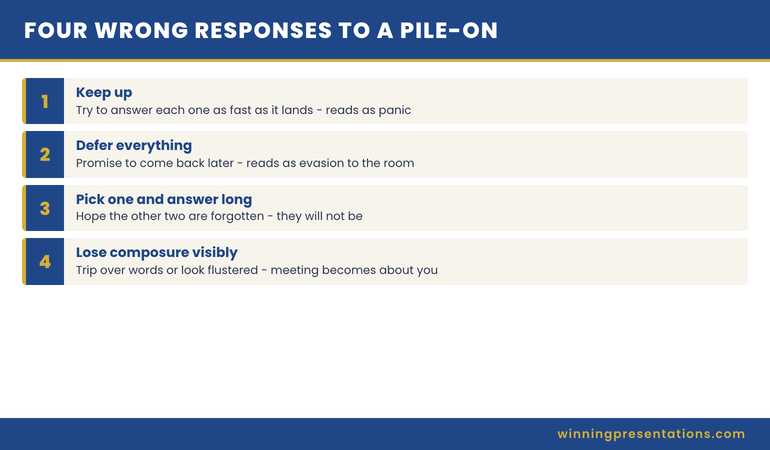
There are four wrong responses to a pile-on, all of them tempting under pressure. Recognising them is the first step to not making them in the room.
Wrong move one: keep up. Trying to answer each question as fast as it lands. This is the most common failure. The presenter feels the pressure to demonstrate competence by responding rapidly. The result is short, low-substance answers that satisfy no one and signal panic. The room reads it as overwhelm.
Wrong move two: defer everything. Saying “those are all good questions, let me come back to you on each of them”. This is the opposite failure. It looks measured but reads as evasion. The board needs answers in the room. Deferring them all signals that the presenter cannot hold the substance of any of them, which is worse than answering one badly.
Wrong move three: pick one and answer it long. Choosing the easiest of the three challenges and answering it in detail, hoping the others get forgotten. They will not. The other two challengers will follow up before the meeting ends, and now they are also irritated that their questions were ignored. The pile-on extends rather than resolves.
Wrong move four: lose composure visibly. Becoming visibly flustered, tripping over words, or showing physical signs of pressure. This is rarely a deliberate choice. It is what happens when none of the first three moves work. The room reads it as weakness, and the rest of the meeting becomes about the presenter’s composure rather than the substance of the proposal.
For senior presenters who face board pile-ons
A structured library of board Q&A patterns and the moves that restore control
The Executive Q&A Handling System covers the de-escalation move, the sequencing technique, the bridging and blocking mechanics, and the eleven hostile question patterns most often seen at board level. Designed for senior professionals presenting to boards, investment committees, and executive sponsors.
- De-escalation move with sequencing language
- Question pattern library covering pile-ons and single hostile questions
- Response shapes for forty-five-second structured answers under pressure
- Three files, instant access, designed for repeat use before high-stakes meetings
£39 · Instant access · Designed for executive Q&A scenarios
The de-escalation move
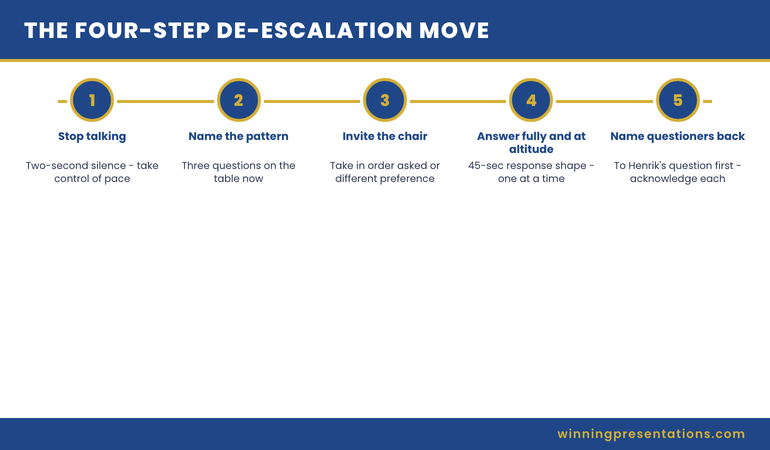
The de-escalation move has four steps. It can be executed in roughly fifteen seconds and is the single highest-leverage Q&A technique senior presenters can have in muscle memory.
Step one: stop talking. The instinct under pile-on pressure is to keep the words flowing. The de-escalation requires the opposite. A deliberate two-second silence is the most powerful single move available. It signals to the room that you are taking control of the rhythm. It interrupts the pile-on cadence. It also gives your nervous system a chance to settle.
Step two: name the pattern explicitly. “There are three separate questions on the table now, and I want to take them in order.” This is one sentence. It does several things at once. It signals to the room that you have heard all three. It signals that you are not going to answer them in a panic. It implicitly asks the room to wait for the response. And it acknowledges the questioners without favouring any of them.
Step three: invite the chair into the sequencing decision. “Chair, would it be helpful if I take them in the order they were asked, or do you have a different preference?” This is the move most senior presenters miss. Bringing the chair in does three things: it transfers part of the pacing burden to a procedural authority who has the standing to enforce it, it signals respect for the chair’s role, and it creates a small interruption that breaks the pile-on momentum.
Step four: answer the first question fully and at the right altitude before moving to the second. Once the order is established, give each answer the full forty-five seconds it deserves. Do not rush. The room is now waiting for structured answers. Anything less than a structured answer at this point would undo the de-escalation.
The four steps are sequential. Skipping any of them undermines the move. Stopping without naming the pattern reads as freezing. Naming the pattern without inviting the chair leaves the pacing burden on the presenter. Inviting the chair without then delivering structured answers makes the de-escalation feel like delay. All four are necessary.
What to do after the de-escalation
A successful de-escalation gives you the rhythm back. What you do with it determines whether the meeting recovers or just stabilises.
Acknowledge each questioner by name when you address their question. “To Henrik’s question first…” This is a small move with a large effect. It signals that you took each question seriously. It also means each questioner sees their concern given dedicated attention, which neutralises the irritation that builds up when a board member feels their question was lost in a pile-on.
If the questions are related, name the relationship. “These three questions are all touching the same underlying risk, which is X. Let me address that, and then come back to the specific dimensions each of you raised.” This is rarely the right move on the first pass — the structured separate answers come first — but it can be the right second-pass move. It also demonstrates strategic thinking, which earns credibility back from the pile-on.
If the questions are unrelated, do not force a synthesis. The temptation after a successful de-escalation is to look strategic by tying everything together. If the underlying concerns are genuinely separate, forcing a synthesis comes across as evasion. Treat them as separate, answer them separately, and let the room conclude that they are separate.
Resist the urge to apologise for the de-escalation. Some presenters, after asserting structural control, follow up with “sorry, I just wanted to make sure I addressed each of you”. This undoes the move. Asserting control and then apologising for it signals that you do not believe you had the standing to do what you did. The de-escalation is a legitimate, authoritative move and should be treated as such.
If you handle Q&A regularly, the related companion piece on handling tough questions in presentations is worth reading alongside this one.
Preparing for likely pile-ons
The de-escalation move works in any pile-on. But preparation reduces the chance of one happening, and reduces the height of the spike when it does.
Read the board’s recent history. Most senior presenters know the personalities of the people they will present to. Fewer have systematically reviewed the last three or four meetings to see which questions were asked, which board members tend to interrupt, and which dimensions of every proposal get probed first. An hour of this preparation often surfaces the structural concerns that are most likely to drive a pile-on.
Brief the chair in advance if appropriate. For high-stakes proposals, a brief pre-meeting with the chair can establish that you would appreciate active sequencing of questions. Most chairs will respond well to this — it makes their job easier — and the conversation primes them to step in if a pile-on starts. This is not always available, but it is under-used when it is.
Structure the slides to separate dimensions clearly. A proposal that has three financial slides, three operational slides, and three strategic slides invites questions on each dimension as that dimension is presented. A proposal that mixes dimensions invites questions on any dimension at any time, which makes pile-ons more likely. This is one of the few cases where slide structure has a direct effect on Q&A behaviour.
Rehearse the de-escalation move on three example pile-ons. Three is enough for the four-step shape to be in muscle memory. The example pile-ons should reflect the actual pattern you expect — three concerns from three different angles in sixty seconds. Rehearsing the move out loud makes it available under pressure. The first time you use it should not be in the room.
Frequently asked questions
Will the chair be offended if I invite them into the sequencing decision?
Almost never. Most chairs see active sequencing as part of their role. Bringing them in is a sign of respect for that role, not an imposition on it. The few chairs who would prefer not to be involved will simply say “carry on, you take them in whatever order works” — which is also a useful signal, because it tells you the room expects you to control the pace yourself.
What if the chair is the source of the pile-on?
Rare but possible. In this case the de-escalation move is harder, but not impossible. Skip step three — do not invite the chair into the sequencing — and instead use a slight modification of step two: “There are three separate questions on the table, including yours. I want to address each one in turn — let me start with…” This signals that you have heard the chair’s question without conceding the rhythm to them.
Is two seconds of silence really long enough?
Yes. Most senior presenters under-estimate how powerful a two-second silence is. From the presenter’s perspective, two seconds feels like ten because of the cortisol. From the room’s perspective, two seconds reads as deliberate and authoritative. Longer than three seconds starts to feel like freezing. Two is the sweet spot.
What if the pile-on is genuinely coordinated?
The de-escalation move still works. A coordinated pile-on relies on momentum and rhythm just as parallel ones do. Naming the pattern explicitly and inviting the chair to sequence the questions is harder for a coordinated faction to push through than to ride. The substance of the answers may be where the meeting is won or lost, but the structural move is the same.
If you present to senior boards or committees regularly
The structured Q&A library senior presenters use to keep control of high-stakes rooms
The Executive Q&A Handling System gives you the de-escalation move, the eleven hostile question patterns, the bridging and blocking mechanics, and the response shapes that hold up under pressure. Designed for repeat use across boards, investment committees, and executive sessions.
- De-escalation and sequencing techniques for pile-ons
- Question pattern library and response shapes for single hostile challenges
- Bridging, blocking, and the combined move with selection rules
- Three files, instant access, designed for senior peer rooms
£39 · Instant access · Designed for executive Q&A scenarios
The Winning Edge — weekly
One short note each Thursday on board Q&A, de-escalation moves, and the structural techniques senior presenters use under pressure. Written for professionals who do not have time for newsletters that read like newsletters.
Want a starting point first? The free Executive Presentation Checklist covers the structural fundamentals before you commit to a paid system.
For a wider view of how senior-level Q&A is handled, see the companion article on Q&A handling training for presentations.
Next step: Identify one upcoming meeting where a pile-on is likely. Write three questions you expect from three different challengers. Rehearse the four-step de-escalation move out loud, with those three questions as the trigger. That is your preparation for the meeting.
Mary Beth Hazeldine is the Owner & Managing Director of Winning Presentations. With 24 years of corporate banking experience at JPMorgan Chase, PwC, Royal Bank of Scotland, and Commerzbank, she advises senior professionals across financial services, healthcare, technology, and government on board-level Q&A, hostile question handling, and the structural moves that restore control in high-stakes meetings. She speaks German and works extensively with the German-speaking financial markets.