

Quick answer: When a board director asks a newly promoted executive “Are you ready for this?” about their recent promotion, they are not asking what the question literally sounds like. They are asking whether the executive has thought carefully about the gap between the role they just left and the role they have just stepped into — and whether they have a credible plan for closing that gap. The wrong answers all share a structural shape: they assert readiness without naming the gap. The right answer names the gap explicitly, names the plan to close it, and offers a specific timeline. “I am ready for most of it; the area I am working on most actively is X, and the way I am closing that gap over the next ninety days is Y” lands cleanly. Asserting “yes, I am ready” without naming a single gap is the answer that produces the deepest board scepticism, even when the underlying competence is real.
JUMP TO:
In 2018 I coached a newly appointed managing director of a UK-based asset management firm through her first appearance at the parent group’s investment committee. She had been promoted six weeks earlier from a deputy position. The committee meeting was scheduled, in normal circumstances, to last ninety minutes and to cover a specific allocation question her team had prepared. About eleven minutes into her presentation, one of the longest-serving committee members — a former chief investment officer who had been on the committee for nine years — interrupted her with a question that had nothing to do with the allocation paper in front of him. He asked, with a slight half-smile and a tone that managed to be friendly and serious at the same time: “Are you ready for this?” The room went quiet for approximately three seconds. The managing director, to her credit, did not flinch visibly. She answered. The answer she gave determined the next eight months of her relationship with the committee.
The answer she gave was structurally one of the wrong answers. She said, calmly, “Yes, I am ready.” She then attempted to return to the allocation paper. The committee member nodded politely, the meeting continued, the allocation paper was approved on its merits, and from the outside the moment looked like a routine exchange. Inside the room, however, something else happened. The committee member had not actually been asking the question the words suggested. He had been offering her, in a deliberately under-articulated way, a chance to demonstrate that she had thought seriously about the gap between deputy and managing director — that she could speak honestly and specifically about what she was still building into the role. Her two-word answer foreclosed that demonstration. The committee read the foreclosure as evidence she had not yet done the thinking. Her credibility took a small but real hit she did not register at the time, and it took most of a year to fully recover.
(This article was created with AI assistance; all stories and insights are based on 35 years of real client work.)
I have now watched some version of the “are you ready for this?” question land on newly promoted executives in board, committee, and investment committee rooms perhaps thirty times. The question is so consistent in its shape and so consistent in its underlying intent that I now treat it as a near-standard board question for any newly promoted senior leader appearing in front of a serious oversight body for the first or second time. The directors who ask it are not being hostile and they are not trying to trap the executive; they are using a deliberately ambiguous opening question to test whether the executive has done the self-aware reflection on the gap between the role they just left and the role they just entered. The answer that lands has a specific structural shape, and the three wrong answers also have specific structural shapes, all of which I have watched executives fall into in real time and all of which produce predictable damage to the board’s read of the executive’s readiness.
If you have a board or committee appearance coming up after a recent promotion:
The Executive Q&A Handling System covers the structural patterns of board-level questions including the under-articulated kind described in this article. It is the reference for tough questions, calm authority, and decision-safe answers in 45 seconds. Newly promoted leaders working through the system most often use the “ambiguous opening question” module before their first one or two board appearances.
What the board is actually asking when they ask this
The “are you ready for this?” question almost always arrives from one of two sources. The first is a long-serving director who has watched multiple cycles of executive promotion at this organisation and has a particular interest in how the current candidate is approaching the transition. The second is a non-executive director with significant prior executive experience of their own who is half-remembering their own version of the same moment from earlier in their career. In neither case is the question hostile. In neither case is it intended to embarrass the executive. The question is structurally a “show me what you know about your own position” prompt, delivered in deliberately under-articulated form so that the executive’s response reveals how they have thought about the gap rather than how they have rehearsed the talking points.
The ambiguity is the point. A more direct question — “what are the specific gaps between your previous role and your new role, and what is your development plan for the first six months?” — would invite a rehearsed answer. The newly promoted executive would have a prepared script, would deliver it competently, and the director would learn very little about how the executive actually thinks. The ambiguous version invites a real-time answer rather than a rehearsed one. The director gets to watch the executive’s mind work in the moment. If the executive has done the reflection, the answer comes back specific, honest, and time-bounded. If the executive has not done the reflection, the answer comes back either as a denial of any gap, an overstatement of every gap, or a deflection toward generic readiness language. Each of those three failure modes has its own particular flavour, and experienced directors can distinguish them inside ten seconds.
The second thing the question is testing is whether the executive can hold a moment of genuine ambiguity in front of a senior audience without rushing to fill it. Senior leadership at board level requires the regular capacity to sit with an unclear question for a beat before answering — to think, in the room, in front of the room. The executive who answers a deliberately ambiguous question instantaneously and confidently has just demonstrated that they treat all questions as occasions for assertion rather than as occasions for thought. That demonstration sits poorly at board level, where the directors want to see judgement being exercised in real time, not delivered as a finished product. A four-second pause before the answer is structurally appropriate. A four-second pause followed by a specific, honest answer is one of the strongest demonstrations of board readiness an executive can make.
The three wrong answers that newly promoted executives reach for
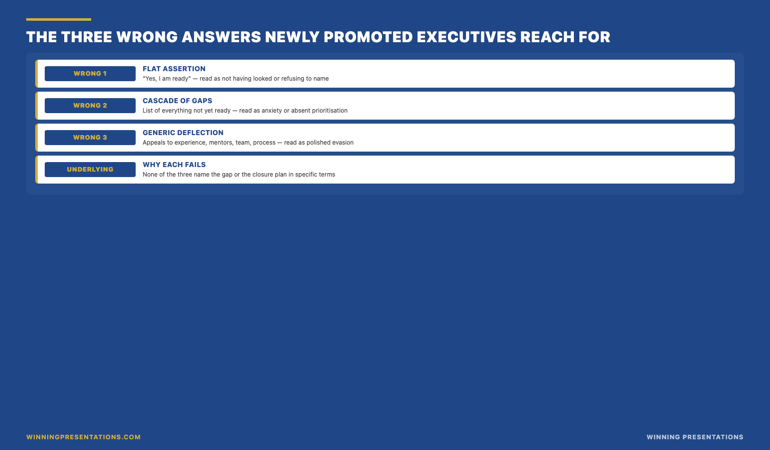
The first wrong answer is what the managing director in 2018 reached for: the flat assertion of readiness, usually delivered confidently and quickly. “Yes, I am ready.” Or its close variants: “Absolutely”, “Without question”, “I have been preparing for this role for years”. The answer signals to the room that the executive has not thought specifically about the gap, because nobody who has thought specifically about the gap would describe themselves as flatly ready. Every newly promoted executive has gaps; the only question is which ones. An answer that does not name a single gap is read as either not having looked or not being willing to name what was found. Both readings are problematic at board level, where willingness to name your own limits is treated as a baseline competence rather than as a vulnerability.
The second wrong answer is the over-correction in the opposite direction: the cascade of self-deprecating gap-naming that drowns the room in everything the executive is not yet ready for. “Honestly, there’s so much — the strategic positioning, the board relationships, the international piece, the regulatory landscape, the technology transformation, the cultural change work…” The list goes on for forty-five seconds. The executive thinks they are demonstrating humility and self-awareness. The room reads it as either anxiety or as evidence that the executive does not actually have a working judgement about what matters most in the gap. The cascade fails because it lacks the prioritisation that distinguishes a thoughtful gap-analysis from a list of insecurities. Senior judgement at board level requires the ability to identify the two or three gaps that matter most rather than to enumerate every gap that exists.
The third wrong answer is the deflection toward generic readiness language: “I have been incredibly fortunate in the breadth of experience that has prepared me for this role.” Variations include the appeal to mentors (“my predecessor has been generous with his time”), the appeal to the team (“I am surrounded by an extraordinarily talented executive committee”), and the appeal to the process (“the selection process was rigorous and I am grateful for the confidence the board has shown”). All of these are technically true, all of them sound polished, and none of them answer the question the director actually asked. The room reads the deflection as polished evasion. The director who asked the question almost always follows up, gently, with a more specific version of the same question, and the executive who reached for the generic readiness language on the first attempt has now committed to the same approach for the follow-up, which compounds the problem. For more on the structural patterns of board-level questioning, see the Executive Q&A Handling System overview and the broader catalogue of board question handling resources.
The structural shape of the answer that lands
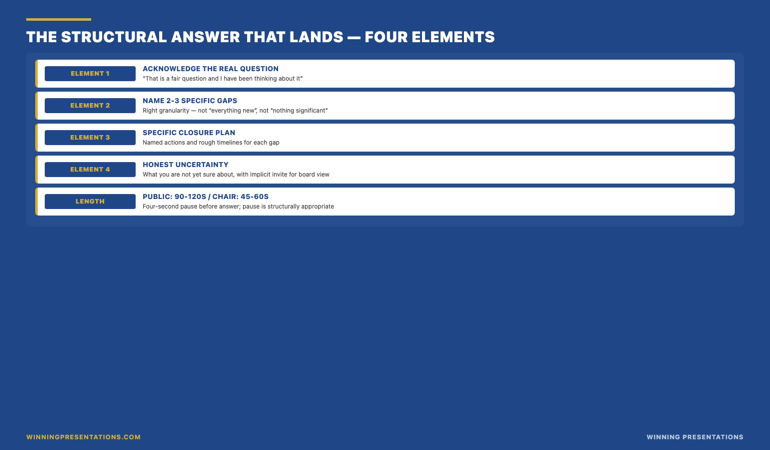
The answer that lands has four elements in roughly this sequence. First, a brief acknowledgement that the question is the real question, delivered without ceremony — “That’s a fair question and I’ve been thinking about it.” Second, a specific naming of the two or three areas where the gap is largest, identified at the right level of granularity — not “everything is new”, not “nothing significant is new”, but the genuinely material things. Third, the specific plan for closing each gap, with named actions and rough timelines. Fourth, an honest indication of what the executive is not yet sure they will close in the available time, with the implicit invitation for the board to help if they have views. The whole answer takes ninety seconds to two minutes. It is not a script; it is a structure the executive holds in their head and fills with the actual content of their actual reflection.
A live example, paraphrased from the actual answer a chief operating officer of a mid-cap insurance group gave at her first board appearance in 2020: “It’s a fair question and I’ve been working it through. The two areas where I am most actively building are the regulatory relationships at the FCA and the PRA, which I am inheriting rather than having built personally, and the chair-of-audit-committee dynamic, which is structurally different from anything in my deputy role. On the regulators, I am scheduling individual meetings with the lead supervisors over the next six weeks and have asked my predecessor to make warm introductions. On the audit committee, I am sitting in on the next two meetings as observer before chairing in November. The piece I am genuinely not sure about is how quickly I will read the chair himself; that is a relationship that builds at its own pace, and I am being patient with it.” The board director who had asked the question nodded once and the meeting continued. Her credibility in the room moved up sharply in the next twenty minutes.
What made that answer work was not eloquence and not delivery; it was the structural completeness. The acknowledgement signalled the executive had heard the real question. The named gaps signalled she had done the specific reflection. The named plan signalled she had operational intent rather than just self-awareness. And the honest “I am not yet sure” element signalled that she could hold the limits of her own knowledge in public, which at board level is read as one of the strongest possible signals of seniority. The whole answer was approximately one hundred and eighty seconds long. The board took about four of those seconds at the end to recalibrate their read of her, which they did upward. The same answer in shorter form — thirty to forty-five seconds — is what most situations actually need; the longer version is for the first appearance, where the director is doing extended diligence.
Stop losing control in Q&A on the under-articulated questions that matter most.
The Executive Q&A Handling System covers the structural patterns of board-level questions — the deliberately ambiguous opening question, the chair’s follow-up, the hostile detail check, the late-meeting curveball. Tough questions, calm authority, decision-safe answers in 45 seconds. The system newly promoted executives use most in their first eighteen months at board level.
The chair variant: when it lands as a private question rather than in the room
A second version of the same question often arrives privately rather than publicly — usually from the chair, in a corridor conversation or at a pre-board dinner, two to six weeks after the promotion is announced. The chair version is structurally slightly different. The phrasing is often softer — “Settling in alright?” or “How are you finding the new shape of things?” — but the underlying intent is the same. The chair is testing whether the executive has done the reflective work and whether they are able to speak about it honestly outside the structured setting of a meeting. The private setting changes the surface texture of the question but not the underlying structural test. The executive who answers the corridor version with “Fine, thank you, all going well” is giving the same flat-assertion answer as the public version, and the chair reads it the same way.
The chair variant should be answered with the same structural completeness as the public version, but in slightly more conversational language and at slightly shorter length — forty-five to sixty seconds rather than ninety to one hundred and twenty. “Settling, mostly. The two things I’ve been most actively working are X and Y; on X I’ve [specific action]; on Y I’m taking my time because [specific reason]. There’s a third thing I’m still figuring out, which is [specific area], and I’d be grateful for any view you’ve formed on how my predecessor used to think about it.” That last move — the explicit ask for the chair’s view — is one of the highest-leverage moves an executive can make in the first six months of a senior role. The chair almost always responds with substantive guidance, the executive gets information they would not otherwise have had, and the relationship deepens in a single thirty-second exchange.
The corridor conversation is not a small moment. Many chairs use the corridor moment as their primary diligence on whether the newly promoted executive is going to develop into the role, because the structured setting of the formal meeting does not give them the same read. The chair who has had three or four substantive corridor conversations with a new executive in the first six months and has formed a positive read of how the executive thinks about their own development is structurally one of the strongest internal advocates the executive can have. The executive who treats the corridor conversation as small talk has missed the chair’s actual diligence and has left the relationship at the formal-meeting level, which is significantly less developed than the corridor relationship would be. The same structural answer pattern applies. The setting is different; the test is the same.
Frequently asked questions
What if I genuinely do not think there are significant gaps?
Then you have not yet looked carefully enough. Every promotion at senior level contains real gaps; the only question is which ones. If the honest reflection has not yet surfaced material gaps, that itself is the most important signal to flag — it usually means the executive is comparing the new role to the old role on the dimensions where the two roles look similar, and has not yet started comparing them on the dimensions where they look different. The answer in that case is “I am still working out the answer to your question, and I want to come back to you in a month when I have a more honest read.” That answer is structurally far stronger than asserting no gaps exist, because it signals both self-awareness about the limits of the current reflection and the discipline to defer rather than fabricate.
Does this only apply to brand-new promotions, or does the question come back later?
It comes back, in modified form, at every significant role transition for the rest of an executive’s career. The first board appearance after a promotion is the most acute moment, but the same question reappears after a major expansion of scope, after a turnaround mandate, after the executive moves between divisions, and at the start of any second-term reappointment. The structural shape of the answer is always the same: acknowledge, name the gap, name the plan, name the honest uncertainty. The cadence of the question reduces with seniority — long-tenured chief executives may not hear it for years — but the answer pattern is the same when it does arrive. Executives who internalise the pattern early carry it for the rest of their career.
What is the most common mistake newly promoted executives make on board questions like this?
Treating board questions as content questions when they are usually positioning questions. The “are you ready for this?” question is not testing whether the executive knows the content of their new role; it is testing whether the executive understands their own position in the room and can speak about it honestly. Most newly promoted executives have been trained, by years of operating-level work, to treat questions as requests for content — you give the content, you give it confidently, you move on. At board level the same questions are usually positioning probes, and the content answer misses what the questioner is actually trying to learn. The shift from content answers to positioning answers is one of the most consequential adjustments newly promoted executives have to make, and the “are you ready?” question is often the first place they encounter it.
How long should I pause before answering?
Three to four seconds, which feels longer in the room than it sounds in writing. The pause does two things at once: it signals that the question is being treated as a question worth thinking about rather than a cue for a rehearsed answer, and it gives the executive enough time to actually select the right two or three gaps to name. Executives who answer instantly almost always reach for one of the three wrong answers, because the instant response is whichever pattern they have used most often before. The pause is a small intervention with disproportionate effect. Most senior leaders find the pause uncomfortable initially and stop finding it uncomfortable after about six deliberate uses of it in a real meeting. After that it becomes habitual and the answer quality climbs noticeably.
The Winning Edge — weekly newsletter
The Winning Edge is a weekly newsletter for senior professionals who present at the executive level. One short email a week on the structural moves that separate decks committees back from decks they defer. Subscribe to The Winning Edge →
For the wider library of presentation assets that pair with the Q&A taxonomy on senior-leader board work — the slide system, the storytelling primer, the delivery references — the Complete Presenter bundle (£99) collects them in one place.
About the author
Mary Beth Hazeldine is Owner & Managing Director of Winning Presentations Ltd. With 24 years of corporate banking experience at JPMorgan Chase, PwC, Royal Bank of Scotland, and Commerzbank, she advises executives across financial services, healthcare, technology, and government on structuring presentations for high-stakes funding rounds, board approvals, and strategic decisions.
The next time a board director asks “Are you ready for this?” about your recent promotion, do four things instead: take the four-second pause; acknowledge the question is the real question; name the two or three gaps you are actively working on with the specific actions and timelines; and name the one thing you are not yet sure about, with the implicit invitation for the room to weigh in. The executive who answers this question with structural completeness gets read as ready. The executive who answers with the flat assertion, the self-deprecating cascade, or the generic deflection gets read as not yet, regardless of the underlying competence. The question is the test; the answer pattern is the demonstration.