

Quick Answer: An evidence-first answer structure flips the default response pattern. Instead of stating your opinion and then defending it, you lead with proof — a data point, a precedent, a concrete example — and let the evidence carry your conclusion. This structure builds trust because your audience reaches your conclusion alongside you, rather than being asked to trust your judgment before seeing the reasoning.
Your Q&A Is Losing Credibility If: You’re answering senior questions with “I think…” or “In my experience…” before providing evidence. Executive audiences trust data more than opinions. If your answers start with conclusions, you’re asking the room to take your word for it — and in high-stakes meetings, that’s a credibility risk. The fix: reverse your answer structure so evidence arrives first and your point lands as the inevitable conclusion.
Jump to Section
Stopped on Slide 4
The CEO stopped a presenter on slide 4. The Director of Operations had been walking through a project status update — clean slides, clear data, well-rehearsed delivery. But then the CEO asked: “What’s the risk to the Q2 timeline if this vendor delays by two weeks?”
The Director answered immediately: “I think we’ll be fine. We’ve built in buffer.”
The CEO leaned forward. “You think we’ll be fine. What does the data say?”
Silence. The Director didn’t have the data ready. She had the answer — and it was correct — but she’d led with her opinion instead of her evidence. In that room, with that audience, opinion without proof wasn’t an answer. It was a guess.
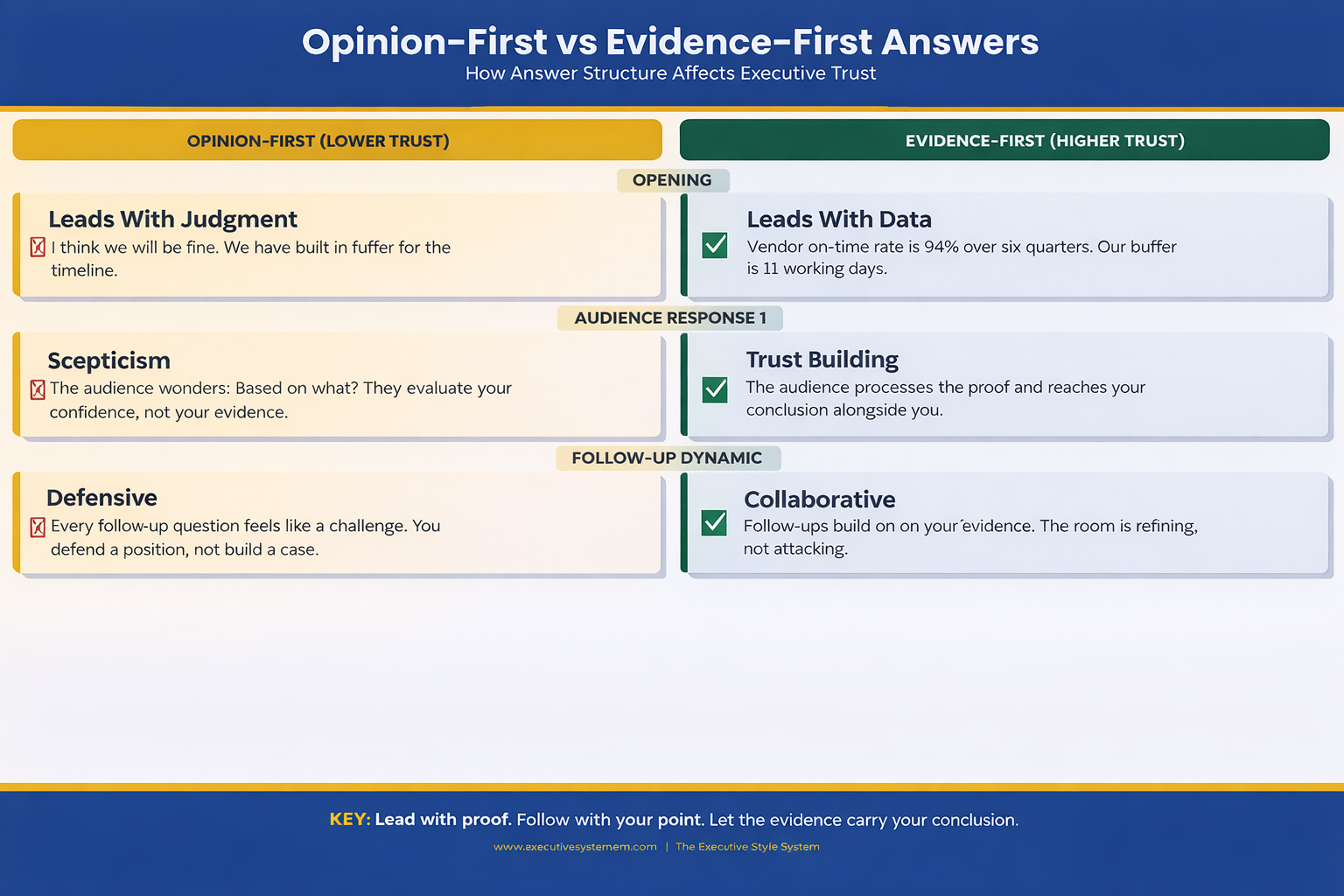
The following week, she restructured her approach. Same question, different format: “The vendor’s current delivery rate is 94% on-time over the last six quarters. Our buffer is 11 working days. Even a two-week delay leaves us three days inside the Q2 deadline.” The CEO nodded and moved on. Same conclusion. Different structure. Completely different credibility.
That’s the evidence-first answer structure in action — and it changes how every question you receive builds or erodes trust.
Why Opinion-First Answers Lose the Room
Most professionals answer questions the way they think: conclusion first, reasoning second. “I think we should delay the launch” (conclusion) “because the testing hasn’t been completed” (evidence). This feels natural. It’s how conversations work. But in executive Q&A, it creates a credibility problem.
When you lead with your opinion, you’re asking the audience to extend trust before they have evidence. The listener’s internal response is: “Based on what?” Even if they don’t say it aloud, they’re evaluating your conclusion against an evidence gap. And in that gap, doubt lives.
Executive audiences are particularly sensitive to this because their job is to make decisions based on data, not on the confidence of the person speaking. A VP who says “I believe we’ll hit target” gets a different reception than a VP who says “Current run rate is £2.1 million against a £2.4 million target, and our pipeline coverage ratio is 1.8x — which historically converts at our target.” Same underlying confidence. Radically different credibility.
The opinion-first pattern also creates a defensive dynamic. Once you’ve stated a conclusion, every follow-up question feels like a challenge. “Why do you think that?” “What makes you confident?” “Have you considered the alternative?” You end up defending a position instead of building a case. The evidence-first structure eliminates this because the audience hears the evidence before the conclusion — so the conclusion feels earned, not asserted.
If you’ve ever had a question go hostile mid-answer, the strategy for handling hostile questions becomes much simpler when you’re leading with evidence. There’s nothing to attack when the proof arrives before the opinion.
The Evidence-First Framework (Proof → Point → Implication)
The framework has three components, delivered in this exact sequence:
Proof (5–15 seconds): One concrete piece of evidence that directly addresses the question. Not three pieces. Not a data dump. One. The strongest, most relevant data point you have. “Our retention rate for Q1 was 94%, up from 87% in the same period last year.”
Point (5–10 seconds): The conclusion that follows logically from your evidence. “That tells us the onboarding changes we made in November are working.” This should feel inevitable. If you’ve chosen the right evidence, the point writes itself.
Implication (5–10 seconds): What this means for the decision the room is trying to make. “So I’d recommend we continue with the current approach for Q2 rather than introducing new variables.” This connects your evidence-based answer to the room’s actual agenda.
Total answer length: 15–35 seconds. That’s it. Executive Q&A rewards precision, not volume. Most people answer questions for 60–90 seconds because they’re padding opinion with filler. The evidence-first structure removes the padding because the evidence does the heavy lifting.
Here’s the structure applied to a common executive question — “Are we going to hit our revenue target this quarter?”
Opinion-first (what most people do): “Yes, I’m confident we’ll hit target. Our team has been performing well and we have strong pipeline. The deals in progress look solid and I think we’ll close them.”
Evidence-first (what builds trust): “Current booked revenue is £1.7 million against a £2.4 million target. Pipeline weighted at 60% probability adds another £900,000 — giving us £2.6 million in projected revenue. Based on that, we’re tracking to exceed target by approximately 8%.”
Same answer. Same confidence. But the second version never asks the audience to trust the speaker’s instinct. The numbers speak first. The conclusion follows. Trust is built through the structure of the answer, not the authority of the person giving it.
The Complete Evidence-First Answer System for Executive Q&A
The Executive Q&A Handling System gives you the Proof → Point → Implication framework with scenario-specific templates for every common executive question type — from budget challenges to timeline risks to stakeholder objections.
- The evidence-first answer framework with worked examples across 12 executive scenarios
- Question prediction maps: anticipate what they’ll ask before the meeting starts
- The “evidence library” builder — how to prepare your proof points before you walk in
- Recovery scripts for when you don’t have the evidence (how to buy time without losing credibility)
Get the Executive Q&A Handling System → £39
Built from 25 years of fielding executive questions at JPMorgan Chase, PwC, and Royal Bank of Scotland — where “I think” wasn’t an acceptable answer.
Five Question Types and How Evidence-First Handles Each
Not every question requires the same kind of evidence. The Proof → Point → Implication structure stays constant, but the type of proof changes depending on what the question is actually asking.
1. The data question. “Where are we on budget?” This is the simplest evidence-first answer. Your proof is a number. “We’ve spent £340,000 of the £500,000 budget, with 60% of deliverables completed. That puts us slightly ahead of pace.” Lead with the figure. Let it do the talking.
2. The opinion question. “Do you think this strategy will work?” This is where most people slip into opinion-first mode. Instead: “Comparable strategies in our sector have shown a 30% improvement in conversion rates over 12 months. Our current baseline is lower than theirs was, which suggests even higher upside. So yes — the evidence supports this working.” Your opinion is the same, but it arrives after the evidence.
3. The challenge question. “Why didn’t you deliver on time?” This feels like an attack, which triggers a defensive response. Evidence-first defuses it: “The vendor delivered their component nine days late, which compressed our testing window from 15 days to six. We prioritised the three critical test scenarios and completed them within the reduced window. The two lower-priority scenarios will complete by Friday.” Facts first. Accountability included. No defensiveness.
4. The hypothetical question. “What happens if we lose the contract?” Hypotheticals are designed to test your thinking. Use precedent as evidence: “When we lost the Meridian contract in 2024, revenue impact was £1.2 million over two quarters. We recovered by redirecting the team to three smaller accounts within 60 days. A similar approach here would cover approximately 80% of the gap.” Precedent makes hypotheticals concrete.
5. The political question. “Does the other department agree with your approach?” These are loaded. Evidence-first protects you: “I shared the proposal with their leadership team on Tuesday. Their written feedback confirmed alignment on scope and timeline, with one open question on resource allocation that we’re resolving this week.” Written evidence, specific dates, named actions. No room for interpretation.
Handle every question type with confidence?
When to Break the Rule (And Lead With Your Point)
Evidence-first is the default. But there are moments when leading with your conclusion is the right call.
When the room is impatient. If the CEO has asked a direct question and the room is tight on time, lead with a one-sentence answer, then support it: “Yes, we’ll hit target. Current pipeline coverage is 1.8x with 60% probability weighting.” The conclusion comes first because that’s what the room is waiting for. But the evidence still follows immediately — you’re not asking for trust without proof, you’re just resequencing for speed.
When the answer is binary. “Are we on track?” “Will this be ready by Friday?” “Do you have budget approval?” These questions want a yes or no. Deliver it, then support: “Yes. The approval came through on Tuesday with full budget confirmed.” Evidence arrives as confirmation, not as buildup.
When you’re the recognised expert. If the room already trusts your expertise on this specific topic, leading with evidence can feel like over-explaining. The CFO asking the Head of Tax a question about tax implications doesn’t need evidence-first — they need a direct answer from a trusted expert. Save evidence-first for when you’re building credibility, not when you’ve already got it.
The judgement call: if the person asking trusts you and wants a fast answer, lead with the point. If the person asking is evaluating you, lead with evidence. When in doubt, lead with evidence. It costs you three extra seconds and builds trust every time.
People Also Ask: What if I don’t have evidence for the question being asked?
Say so directly and offer what you do have. “I don’t have the specific conversion data for that segment. What I can tell you is the overall conversion rate is 12%, and I’ll have the segment breakdown by end of day tomorrow.” This is infinitely more credible than guessing. Executives respect honesty about gaps far more than fabricated confidence.
People Also Ask: How do I prepare evidence for unexpected questions?
You don’t prepare for every possible question — you build an evidence library around the five to seven themes your audience cares about. For a budget review, that’s spend-to-date, forecast accuracy, variance explanation, and resource utilisation. Having these numbers ready covers most questions that could arise. Question prediction maps help you identify which themes to prepare for.
People Also Ask: Does evidence-first work in informal conversations?
It works everywhere, but calibrate the formality. In a corridor conversation, you wouldn’t say “the data shows…” But you’d still lead with the concrete fact: “We just got the numbers back — retention is at 94%.” The structure translates naturally into conversational language. The principle — proof before opinion — applies regardless of setting.
Never Get Caught Without an Evidence-Based Answer Again
The Executive Q&A Handling System includes the evidence library builder and question prediction maps so you walk into every meeting with your proof points ready.
- Evidence library template for seven common executive meeting themes
Get the Executive Q&A Handling System → £39
Designed for executives who present to boards, leadership teams, and stakeholders where every answer either builds or erodes credibility.
Building Your Evidence Library Before the Meeting
The evidence-first structure only works if you have evidence ready. Walking into a meeting planning to “wing it” with data is the same as planning to fail. The preparation isn’t about memorising numbers — it’s about building a reference set of proof points around the themes your audience cares about.
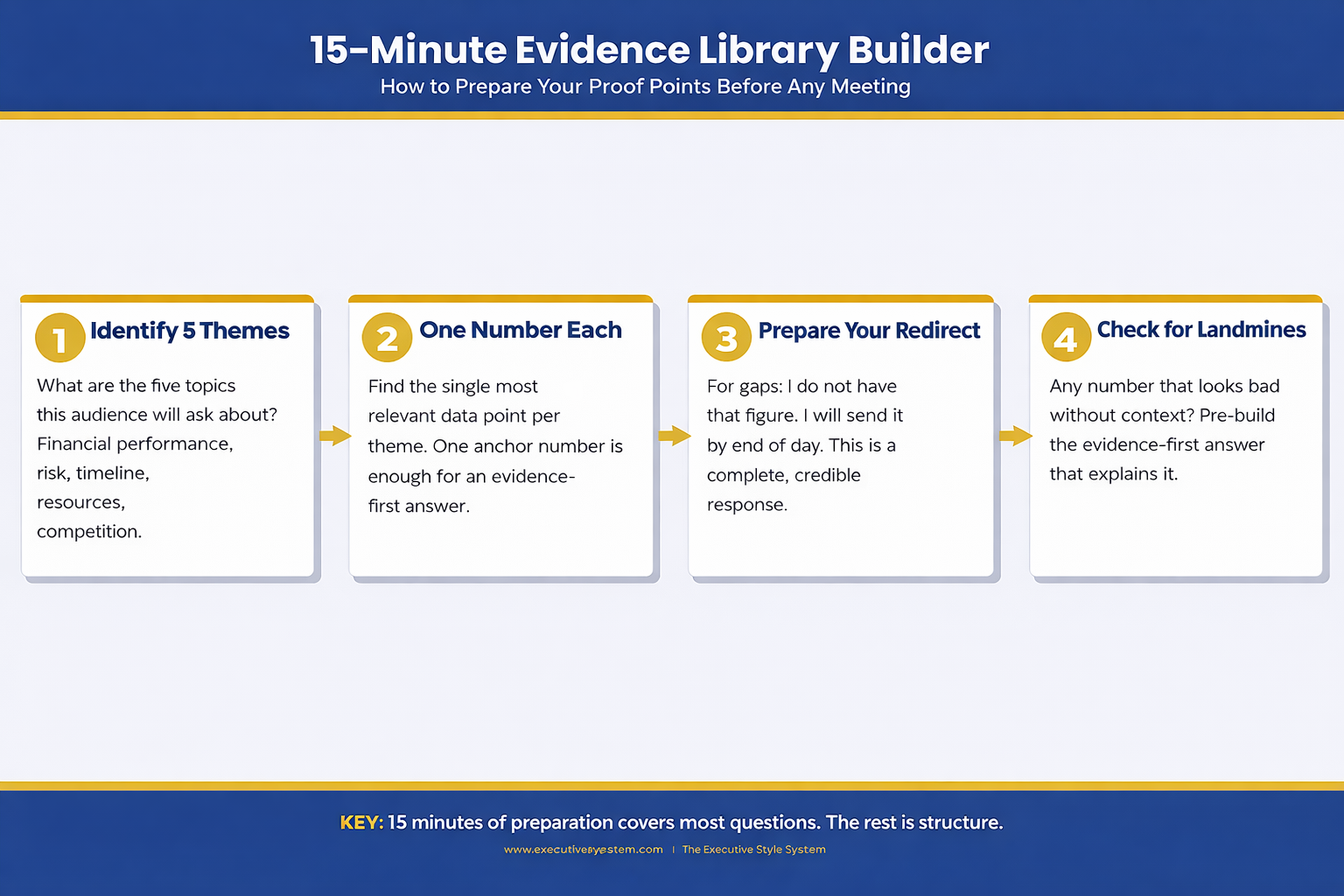
Here’s how to build an evidence library in 15 minutes before any meeting:
Step 1: Identify the five themes. What are the five topics this audience will ask about? For a board meeting: financial performance, risk, timeline, resources, competitive position. For a project review: budget, deliverables, blockers, team, next milestones. Write them down.
Step 2: Find one number for each theme. Not five numbers. One. The single most relevant data point for each theme. “Budget: spent £340K of £500K.” “Timeline: 3 days ahead of schedule.” “Risk: 2 open items, both mitigated.” One data point per theme is enough to anchor an evidence-first answer. More than one and you’re preparing a presentation, not a Q&A.
Step 3: Prepare your “I don’t know” answer. For any theme where you don’t have current data, prepare the redirect: “I don’t have that figure with me. I’ll send it to you by [specific time].” This is a complete answer. It’s credible. It’s professional. It prevents you from guessing — which is the single fastest way to lose credibility in executive Q&A.
Step 4: Check for landmines. Is there a number that looks bad without context? Prepare the context in advance. “Attrition is up to 14% — driven entirely by the planned restructuring. Voluntary attrition is actually down to 3%.” If you know a number will trigger a follow-up, pre-build the evidence-first answer that explains it before it becomes a challenge.
This 15-minute preparation makes the difference between walking into Q&A with a safety net and walking in hoping for the best. The executives who seem naturally confident in Q&A aren’t naturally anything — they’ve done this preparation so many times it’s become invisible.
If you’ve ever struggled with the anticipation before a meeting turning into something more debilitating, the shame spiral after a bad Q&A session can be interrupted before it becomes a pattern. Preparation is the first defence.
And for situations where your presentation format itself affects how Q&A unfolds, consider whether presenting without slides might actually give you more control over the conversation. Without a deck, the Q&A becomes a dialogue rather than an interrogation.
Putting It Together: Your Next Q&A
The evidence-first answer structure isn’t complicated. It’s three components delivered in sequence: proof, point, implication. The entire answer takes 15–35 seconds. It works for data questions, opinion questions, challenges, hypotheticals, and political questions. And it builds trust every single time because you never ask the room to take your word for it.
The preparation takes 15 minutes: five themes, one number each, one “I don’t know” script. Do it before every meeting with a senior audience. Within a few weeks, it becomes automatic — and the way your audience responds to your answers will change measurably.
The Executive Q&A Handling System gives you the full framework: the evidence-first structure, question prediction maps, the evidence library builder, and recovery scripts for when you’re caught without data. (See the Money Blocks above for details.)
For questions you can anticipate, the approach is even more powerful. Addressing objections before they’re asked lets you embed your evidence directly into the presentation — so the Q&A becomes a confirmation of what you’ve already demonstrated rather than a test of what you know.
Your next Q&A is this week — walk in prepared?
Is This Right For You?
✓ This is for you if:
- You present to senior audiences and your answers sometimes land as opinion rather than evidence
- You’ve been caught without data during Q&A and felt your credibility slip in real time
- You want a repeatable structure that works for every question type, not just the ones you’ve rehearsed
- You’re preparing for a high-stakes meeting this week and need to walk in with your evidence ready
✗ Not for you if:
- Your Q&A sessions are casual team conversations where formality would feel out of place
- You’re already the recognised expert in the room and your audience trusts your judgment implicitly
- Your primary challenge is delivery nerves rather than answer structure — this framework helps, but nervous-system work comes first
Walk Into Every Q&A With Your Evidence Ready
The Executive Q&A Handling System gives you the complete evidence-first framework: the answer structure, the preparation method, the question prediction tools, and the recovery scripts that protect your credibility even when you don’t have the data.
- Proof → Point → Implication framework with 12 scenario-specific worked examples
- 15-minute evidence library builder (the five-theme method)
- Question prediction maps for boards, leadership meetings, and stakeholder reviews
- Recovery scripts: how to handle “I don’t know” without losing the room
- The hostile question protocol: evidence-first structure for adversarial situations
Get the Executive Q&A Handling System → £39
Built from 25 years of answering executive questions in banking, consulting, and corporate boardrooms — where evidence was the only currency that mattered.
Frequently Asked Questions
Won’t leading with evidence make my answers sound robotic?
Only if you deliver it like a data readout. The evidence is the backbone, not the personality. A natural evidence-first answer sounds like: “Interesting question — the retention data from Q1 actually tells us something useful here. We’re at 94%, up from 87% last year, which means the onboarding changes are working. I’d recommend we stay the course.” That’s evidence-first and conversational. Structure doesn’t eliminate personality — it gives personality something solid to stand on.
What if the evidence contradicts the answer I want to give?
Then the evidence is doing its job. If the data doesn’t support your preferred conclusion, say so: “The data doesn’t support the timeline we originally proposed. Current velocity suggests we’ll miss by two weeks. I’d recommend we adjust the deadline now rather than compress quality at the end.” This is exponentially more credible than bending data to fit a predetermined conclusion. Executives respect intellectual honesty above almost everything else.
How do I use evidence-first when the question is about feelings or team morale?
Use qualitative evidence instead of quantitative. “In the last three one-to-ones, two team members raised concerns about workload sustainability. The anonymous pulse survey showed a 15-point drop in engagement scores. That tells me morale is a genuine concern, not just anecdotal.” Qualitative data — named conversations, survey results, observable behaviour — is still evidence. It’s just not numerical.
Does this structure work for external presentations (clients, investors)?
It’s even more important externally. Clients and investors are evaluating your credibility in real time. Every answer that leads with evidence builds their confidence in your professionalism. Every answer that leads with opinion invites scepticism. The Proof → Point → Implication structure is particularly effective in investor Q&A because it mirrors how investors themselves think: data first, conclusions second.
The Evidence Speaks First
Your next meeting has a Q&A section. Someone will ask a question that matters. The difference between an answer that builds trust and one that erodes it comes down to sequence: do you lead with what you think, or what you know?
Lead with what you know. Let the evidence carry your conclusion. Watch the room respond differently.
Stay Updated
New frameworks for high-stakes presentations land in The Winning Edge newsletter every Friday. Subscribe for frameworks you can use immediately.
About the Author
Mary Beth Hazeldine is the Owner & Managing Director of Winning Presentations. With 25 years of corporate banking experience at JPMorgan Chase, PwC, Royal Bank of Scotland, and Commerzbank, she has delivered high-stakes presentations in boardrooms across three continents.
A qualified clinical hypnotherapist and NLP practitioner, Mary Beth combines executive communication expertise with evidence-based techniques for managing presentation anxiety. She works with senior professionals across financial services, healthcare, technology, and government on high-stakes presentation preparation.