Quick answer: A town hall anonymous question that names you by first name and challenges your compensation, your leadership, or a recent decision is the moment most senior leaders lose the room — not because the question is unfair, but because they default to defending themselves. The response that gets the room back is a four-move sequence: (1) read the question aloud, fully, even if the framing is uncomfortable, so the room sees you have not edited it; (2) acknowledge the cost — name what made the question land for whoever submitted it; (3) answer the substantive part directly, without softening or minimising; (4) hand the room a next step that names what happens after the meeting. The diagnostic on whether the response worked is whether the room re-engages within ninety seconds. If a second similar question appears in the anonymous queue immediately afterwards, the first response did not land and the room is telling you so.
JUMP TO:
- Why the anonymous question that names you is the hardest one
- Why defending yourself loses the room every time
- The four-move response, in order
- The ninety-second diagnostic and the second-question signal
- What to do before your next town hall Q&A
- The two leaders, the two outcomes
- Frequently asked questions
In 2016, the chief operating officer of a publicly-listed industrials manufacturer in the north of England stood at the front of a Tuesday-morning quarterly all-hands. Around four hundred staff were in the room; another nine hundred were dialled in from three regional sites. The format was the one most large employers had settled on by that point: a thirty-minute business update, followed by twenty minutes of live Q&A from an anonymous submission inbox that staff had been pushing questions into all week. The moderator — the head of internal communications — was standing to the COO’s right with a small stack of printed slips, the questions she had triaged from the inbox that morning. The AV technician at the back of the room could see the full unedited inbox on his second screen. The COO had a black coffee cup in his right hand, half-drunk, and was leaning slightly against the lectern. The third question the moderator read out, off a slip she handled visibly more slowly than the previous two, began with the COO’s first name. It asked, in a sentence and a half, why his published total compensation had risen by a figure the questioner stated to two decimal places in the same year the company had paused its annual pay review for the operational grades. The room went quiet in the specific way a room goes quiet when everybody in it knows the question is real and is watching what happens next. The COO put the coffee cup down, said “well, that’s a direct one”, and started to explain the difference between his base salary and his long-term incentive plan. Two minutes into the explanation, the room had stopped listening. The internal Slack channel for the operational sites lit up across all three regions. The engagement-score dip that followed the town hall did not show up in the next survey cycle; it showed up in the one after, when the operational sites’ scores fell by eight points and stayed there for three quarters. The COO had not done anything wrong on the substance. He had defended himself. That is the move that lost the room.
(This article was created with AI assistance; all stories and insights are based on 35 years of real client work.)
This piece walks through why the town hall anonymous question that names you is structurally different from any other tough question a senior leader will face, why the instinct to defend yourself is the move that costs you the room, and the four-move response sequence senior leaders are using in 2026 to handle the named-and-targeted question without flinching and without conceding. The piece is built around two anchored stories, a year apart, of senior leaders who walked into the same moment and walked out with two very different outcomes. The format will not protect you from a question whose substance is genuinely indefensible; it will give a defensible position a fair hearing, and it will keep the room with you while you make the answer.
Before the next town hall, a one-page structural check is worth a look.
The Executive Presentation Checklist walks through the structural moves senior leaders use to hold the room through difficult Q&A — the read-aloud rule, the acknowledge-then-answer sequence, and the named next step that closes the exchange. Free download, no email gate.
Why the anonymous question that names you is the hardest one
The anonymous question that names you by first name and challenges something personal — your compensation, a recent restructuring decision, your handling of a senior departure, your visible behaviour in a previous meeting — is structurally different from the hostile question that arrives in person. The in-person hostile question carries a face, a job title, and an implicit social contract. The questioner has to live with their colleagues afterwards. They will, almost always, soften the framing slightly, signal good faith somewhere in the sentence, and stop short of the most pointed version of what they actually want to ask. The anonymous question carries none of those guardrails. The questioner has the protection of the inbox and uses it. The framing is sharper, the specifics are sharper, and the room knows the framing is sharper. The leader who answers the anonymous question as though it were a softened in-person question reads, to the room, as though they did not register what was actually asked.
The anonymous channel also changes who is watching. An in-person hostile question is, in the room’s reading, a conversation between the leader and the questioner. An anonymous question is a conversation between the leader and the room. The room is the questioner, by proxy. The room is also the audience for the answer, and the room is the channel through which the answer travels to the people who were not in it. The Slack thread, the corridor recap, the message back to the operational site that the leader-on-stage did not see — those are the second-order audiences. The leader who answers the in-person hostile question well will get away with answering it slightly inside the room. The leader who answers the anonymous question well has to answer it for the room, for the absent listeners on the regional sites, and for the Slack thread that will form within ninety seconds of the meeting closing.
The third difference is the most easily missed. The anonymous question that names you by first name is, almost always, a question the questioner believed could not be asked any other way. The person who submitted it has, in their reading, tried other channels and reached this one. That reading may or may not be accurate — sometimes the question is opportunistic, sometimes it is a wind-up — but the room reads the question as though it is the third reading, not the first. The room assumes the question was asked anonymously because asking it on-record was not safe. The leader who treats the question as opportunistic, or as a wind-up, or as a misunderstanding, is contradicting the room’s reading of why the question exists at all. That contradiction is what produces the engagement dip the COO from the 2016 scene saw eight points of, three quarters running.
Why defending yourself loses the room every time
The defensive response has a specific structure and the room recognises it instantly. The leader hears the named, pointed question, the body’s stress response triggers, and the brain reaches for the most-rehearsed adjacent material — the explanation of the underlying decision, the context behind the published number, the procedural reasoning that produced the outcome the questioner is challenging. The leader starts speaking in that adjacent material, and the room hears, immediately, that the leader is not answering the question; the leader is explaining around it. The 2016 COO who started talking about base salary versus long-term incentive plan was not lying, was not evading deliberately, and was not technically off-topic — the underlying explanation was substantively correct. He was, however, answering a different question. The room had asked why the gap existed. He answered how the gap was constructed. Those are not the same answer, and the room registers the substitution within about fifteen seconds.
The defensive response also lengthens. Every additional sentence the leader adds in defensive mode reads, to the room, as another sentence of justification, and the room’s reading of “this person is justifying themselves” gets stronger with every clause. The leader feels, internally, that they are giving the room the complete picture; the room is hearing that the leader cannot bear to stop talking until the questioner is contradicted. The asymmetry is brutal. The leader is doing more work, in real time, and the room is moving further away with every sentence. The structural moves that hold under hostile questioning are covered in more depth in the partner piece on tough questions; the specific defensive-lengthening trap is one of the four failure modes that piece walks through.
The third element of the defensive response is the one the leader cannot see from inside their own delivery. Defending yourself signals to the room that the question landed somewhere it should not have. The body language tells. The pace of speech changes; the eye-contact pattern changes; the leader stops looking at the room and starts looking at a middle-distance point on the back wall while they construct the sentence. The room reads the body-language shift before the room registers the content shift, and the room reaches a conclusion about how the leader feels about the question before the leader has finished the first clause of the answer. By the time the answer is complete, the room has formed its view, and the view is not “they handled that well”. The view is “they did not want that question to be asked, and they did not have an answer ready.”
The four-move response, in order
The response that holds the room is a four-move sequence, in this order, with no reordering and no omitting. Each move does a specific job and the room reads each one as it lands.
Move one: read the question aloud, fully, even if the framing is uncomfortable. When the moderator reads the question and hands the leader the floor, the leader’s first action is to read the question back to the room, in the framing the questioner used, in full. Not a paraphrase. Not a softened version. Not “the gist of the question is…”. The exact words. The room has, at that moment, three possible readings of the leader. One: the leader did not register the framing and is going to answer something easier. Two: the leader registered the framing and is going to edit it before answering. Three: the leader registered the framing, is willing to repeat it to the room unedited, and intends to engage with what was actually asked. Reading the question aloud, fully, is the only move that produces the third reading. It is also the move most leaders skip, because reading the pointed framing aloud is the bit that feels uncomfortable. The discomfort is the signal that the move is doing its work. The room is watching for whether the leader can sit inside the framing for the eight to twelve seconds it takes to read the question, and the room concludes from those eight to twelve seconds whether the answer that follows is worth listening to.
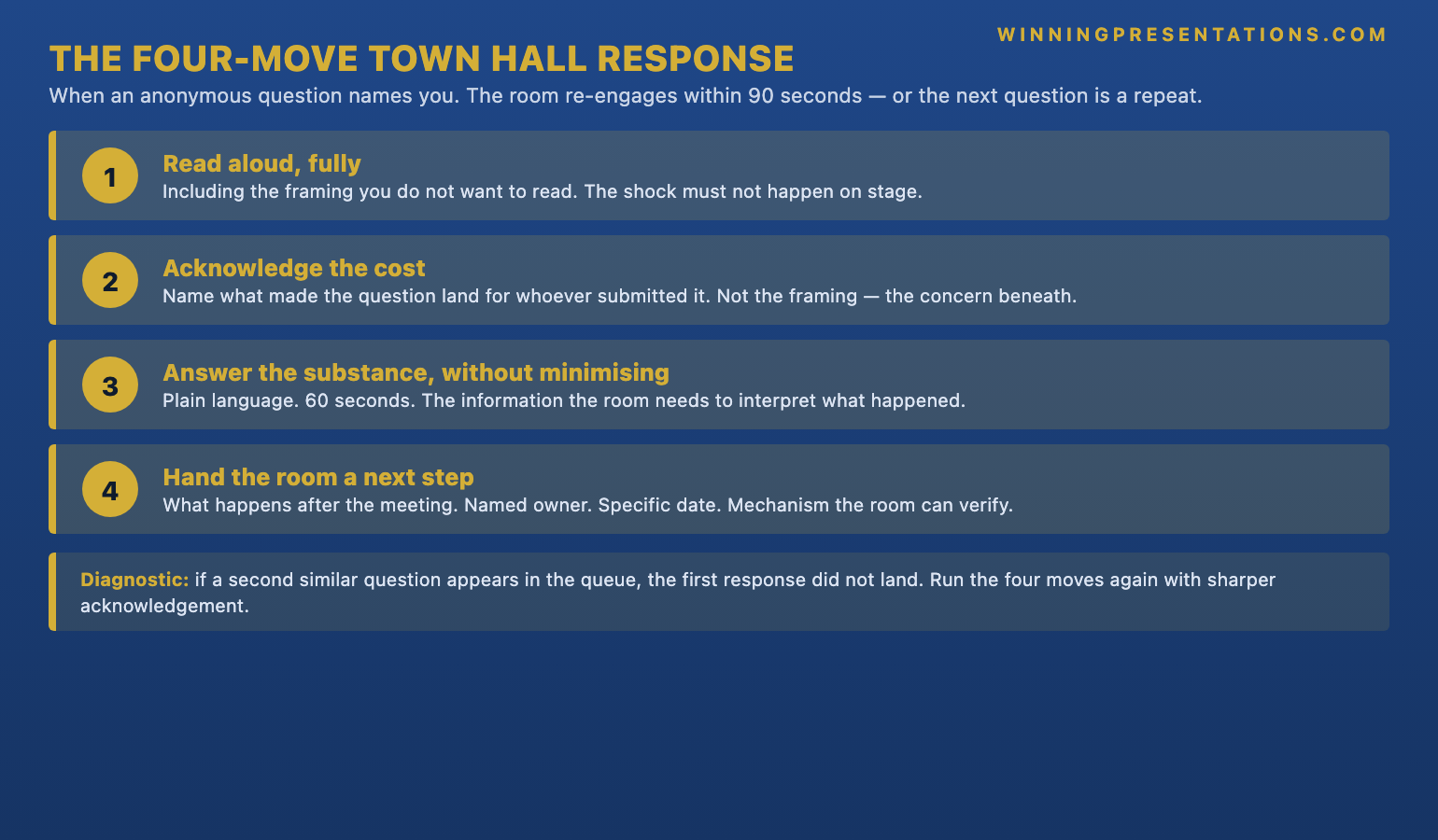
Move two: acknowledge the cost — name what made the question land for whoever submitted it. The second move is to name, explicitly, what the question is responding to. Not why the questioner is wrong. Not why the framing is unfair. What it is responding to. “The reason this question is being asked is that the published compensation figure landed at the same time as the pay-review pause, and to someone on an operational grade, those two pieces of information sitting next to each other on the same page of the annual report look like a single message about how the business treats different parts of the workforce.” That sentence is hard to say. It is also the sentence that takes the question out of the abstract and into the lived experience of the questioner. The room hears the acknowledgement and registers that the leader has understood why the question exists. Acknowledgement is not concession. The leader has not agreed that the underlying decision was wrong; the leader has named what the question is reacting to. The room can distinguish between those two things, and the room reads the distinction in roughly the first eight seconds of the acknowledgement.
Move three: answer the substantive part, directly, without minimising. The third move is the substantive answer, and the rule for the substantive answer is the same rule the headline-and-variance pattern uses in any executive setting: name the answer in the questioner’s vocabulary, not in your own. “The reason the compensation figure rose in the year the pay review paused is that the long-term incentive vesting cycle, which was set three years earlier and is governed by the remuneration committee on a separate timeline from the annual pay review, came due in that year. The board’s decision to pause the annual review was taken after the vesting cycle had already concluded, and the two decisions sat against each other in the annual report in a way that, looking back, reads worse to the operational grades than the underlying sequence supports.” The answer is the same content the defensive response would have produced, with one structural difference: it follows the acknowledgement. The room reads the same content differently when it arrives after the cost has been named than when it arrives as the first words out of the leader’s mouth. The order is the move.
Move four: hand the room a next step — what happens after the meeting. The fourth move is the one most leaders forget under pressure, and it is the move that closes the exchange in a way the room can carry. The leader names a specific, dated thing that will happen after the town hall in response to the question. Not a vague commitment to look at it. A specific item. “I will ask the remuneration committee to publish a one-page note alongside the next annual report that walks through the timing of the long-term incentive cycle and the annual pay review, so the two are not read as a single message. That note will be circulated before the AGM in May.” The room hears the next step and registers that the answer is not just words. The Slack thread that forms ninety seconds after the meeting now has something to point to. The corridor recap has something to repeat. The absent listeners on the regional sites have something to receive in writing afterwards. The exchange has closed on a commitment that the room can hold the leader to, and the holding-to-account is, paradoxically, what restores the room’s trust. The leader who says “I will publish a one-page note before the AGM” has bound themselves to do it, and the room hears the binding as the answer to the question’s underlying ask.
The ninety-second diagnostic and the second-question signal
The four-move response either lands or it does not, and the room tells you which within about ninety seconds. The diagnostic is observable from the lectern. After the fourth move, the moderator goes to the next question in the queue. Two things can happen. One: the next question is on a different topic, or it is a related question framed in a substantive, build-on-the-answer register. The room has re-engaged. The four-move response worked. Two: the next question in the queue is another version of the same challenge, in similar or sharper framing, from the same anonymous channel. That is the signal. The room is telling you, through the moderator’s printed slip, that the first response did not land. The second similar question is not a coincidence and it is not bad luck; it is the room’s collective second attempt to get the answer it did not receive the first time.
The leader who recognises the second-question signal has a narrow window to respond to it well. The temptation is to treat the second question as more of the same and to dig further into the defensive justification that did not work the first time. The response that does work is to acknowledge the signal directly. “This is the second question in this round on the same theme, and I want to address that the first answer I gave did not land. Let me try again.” That sentence is hard to say in front of four hundred people. It is also the sentence that pulls the room back. The room has been telling the leader that the first answer missed; the leader who hears it and names it has demonstrated that the channel between the room and the leader is open. The leader who does not name it confirms the channel is closed, and the engagement dip that follows the meeting will show up not just in the next survey cycle but in the one after.
The third element of the diagnostic is what happens in the room immediately after the four-move response, before the next question is read. The leader should not fill the silence. The moderator will take three to five seconds to choose the next slip. Those seconds belong to the room. The leader who fills them with an additional sentence — a clarifying caveat, a softer restatement, a thank-you to the questioner — reads as anxious about whether the response was sufficient. The leader who holds the silence reads as having said what they needed to say and trusting the room to process it. The held silence is uncomfortable. It is also the structural artefact that tells the room the answer is complete.
A senior leader who handles the named anonymous question well has rehearsed the response sequence — not memorised scripts, but practised the four moves until they hold under pressure.
The Executive Q&A Handling System is the structured method senior leaders are using to walk into town halls, board reviews, and analyst Q&A with the four-move response embedded as a default, not a hope. Tough questions • calm authority • decision-safe answers in 45 seconds. Frameworks for hostile, ambiguous, personal, and challenge questions. Lifetime access, instant download. £39.
- Response frameworks for the four hardest question types — hostile (the anonymous-named question), ambiguous (the long-paragraph question with three asks inside it), personal (the question that targets a decision you made), and challenge (the question that disputes your premise)
- The 45-second answer architecture — the read-aloud move, the acknowledge-the-cost move, the substantive answer in the questioner’s vocabulary, and the named next step that closes the exchange
- The ninety-second diagnostic — how to read whether the room re-engaged and what to do when the second-question signal appears in the queue
- Pre-meeting checks for the anonymous Q&A inbox — the read-aloud-in-private discipline that takes the surprise out of the room and puts it where it belongs, the night before
- Lifetime access, instant download — £39
What to do before your next town hall Q&A
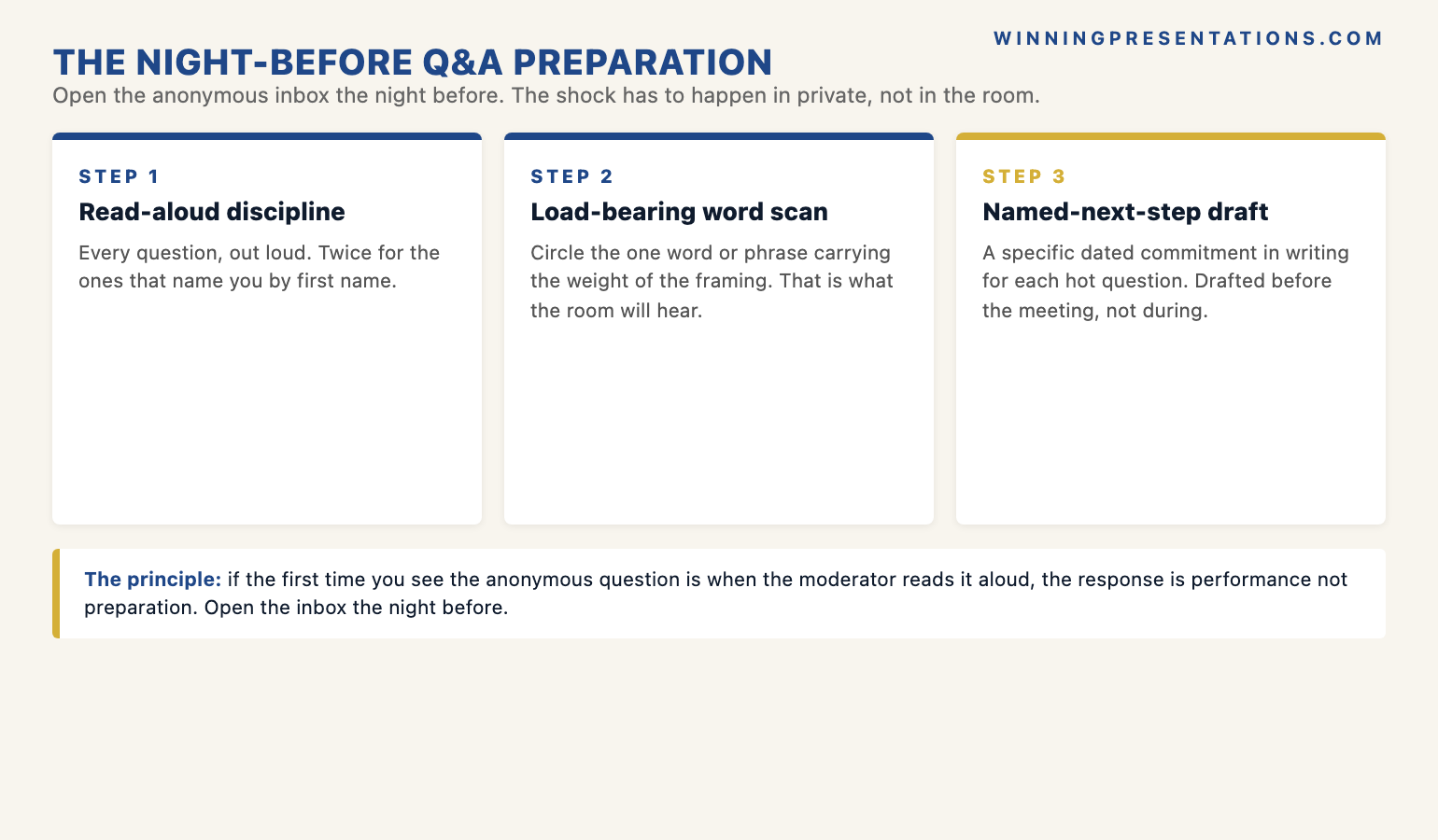
Open your anonymous Q&A inbox the night before. Read every question aloud, including the ones you do not want to read. The shock has to happen in private, not in the room. The discipline matters because the body’s stress response to the named-and-pointed question is real, and the response is sharper when the question is read for the first time in front of four hundred people than when it has been read once already, the night before, in a kitchen or a study or an empty office. The night-before reading does two things. It takes the surprise out of the room. It also gives the leader the eight to ten hours of overnight processing that the brain does well and the in-the-moment scan does not. The four-move response is much easier to deliver when the leader walked into the room knowing the question would be asked, in roughly that framing, and had already drafted the acknowledgement sentence in the shower that morning.
The read-aloud-in-private discipline has a specific sub-rule for the questions that name you. Read those out twice. Once at full speed, the way the moderator will read them. Once slowly, paying attention to the specific words the questioner chose. The named question almost always has a single word or phrase that carries the weight of the framing — “increase of [specific figure]”, “while the operational grades”, “in the same year”. The leader who has noticed the load-bearing word in private will, in the room, deliver the acknowledgement sentence in language that names what the questioner actually meant. The leader who has not noticed it will deliver an acknowledgement that misses the load-bearing word, and the room will hear the miss. The broader pre-meeting Q&A preparation discipline is worth reading alongside the read-aloud rule; the two practices compound.
The second concrete pre-meeting action is to draft, in writing, the named next step for the three or four questions you expect to be asked in some form. Not the substantive answer — the substantive answer can be assembled live if the read-aloud-in-private discipline has been done. The named next step is the one element of the four-move response that benefits most from being drafted in advance. Under pressure, the brain produces vague commitments — “we will look at this”, “this is something we are taking seriously”. The drafted version produces specific commitments — “we will publish a one-page note before the AGM in May”. The specific commitment is what closes the exchange. Drafting it the night before, on paper, is the move that makes the specific commitment available to the leader in the room.
The two leaders, the two outcomes
The 2016 COO from the opening scene defended himself. He explained the difference between base salary and long-term incentive plan. He did not read the question aloud. He did not acknowledge what made it land. He answered the construction of the gap, not the existence of it. He offered no named next step. The room registered the response in the first thirty seconds and the engagement-score dip showed up in the survey cycle after next, eight points down across the operational sites, holding for three quarters. The Slack threads on the regional sites recorded the specific phrase he had used — the “well, that’s a direct one” opener — and the phrase circulated for months afterwards as a shorthand for the leadership team’s distance from the operational grades. The substance of the answer was correct. The response sequence lost the room.
In 2019, the chief executive of a different publicly-listed business, at a different all-hands, took an anonymous question that named her and challenged her on a redundancy decision announced six weeks earlier. She read the question aloud, in the framing the questioner had used, including a sharp adjective the moderator had visibly winced reading. She paused. She said: “The reason this question is being asked is that the announcement of the redundancies and the announcement of the new senior hires happened in the same fortnight, and to anyone on a grade where redundancy is a real risk, those two pieces of news next to each other read as a single message about who this business values. I want to address that directly.” She then walked the substantive answer — the timing was driven by board cycles that did not align with internal communications, the senior hires were funded by a separate budget line that the redundancies would not have changed, the substance of why both decisions were necessary. She closed with a named next step: “I will publish a written note next week, before the regional briefings, that walks through the two budget lines and the timing. The note will go to all-staff, not just the leadership grades.” The next question in the moderator’s queue was on a different topic. The Slack threads that followed the meeting recorded the read-aloud move — the fact that she had said the sharp adjective in her own voice — as the signal that the response was honest. The engagement scores that quarter held. The four-move response held the room.
The two scenes are six weeks of preparation discipline apart and a four-move response sequence apart. Neither leader had an easier underlying position. The 2016 COO’s compensation could have been defended on the substance, given the timing of the vesting cycle. The 2019 CEO’s redundancy decision could have produced an internal Slack catastrophe, given how it was timed. The difference was the response sequence. The leader who read the question aloud and answered the substance got the room back. The leader who softened it, deflected it, or addressed it sideways did not.
Most senior leaders walk into the named anonymous question without a rehearsed response — and the room reads the absence of rehearsal in the first thirty seconds.
The Executive Q&A Handling System gives senior leaders the response architecture for hostile, ambiguous, personal, and challenge questions before the next town hall — so the four-move sequence is the default rather than the move you hoped you would remember under pressure. Frameworks, scripts, and pre-meeting checks. Lifetime access. £39.
Frequently asked questions
Won’t reading the anonymous question aloud, including the harsh framing, look weak?
It looks weak only when it is delivered as though the framing has wounded the leader. Delivered as the first move of a rehearsed response sequence, reading the question aloud reads as the opposite of weakness; it reads as the leader signalling they are willing to engage with what was actually asked, rather than the easier question they would have preferred. The room is watching for whether the leader edits the framing before answering. The leader who edits reads as defensive; the leader who reads the framing in full reads as honest. The discomfort of saying the pointed words is the structural cost of the move, and the room registers that cost being paid as the signal that the answer that follows is worth listening to.
What is the most common mistake senior leaders make with anonymous questions that target them?
The most common mistake is to skip the acknowledgement move and go straight to the substantive answer. The leader hears the named question, the stress response triggers, and the brain reaches for the explanation it has rehearsed. The explanation is delivered, correctly on the substance, and the room receives it as defensive because the leader has not named what the question is reacting to. The acknowledgement move is the single highest-impact structural shift a senior leader can make in town hall Q&A. It costs eight to fifteen seconds, it does not require conceding the underlying decision, and it changes how the room reads the same substantive answer when it arrives afterwards. The leaders who learn this move report it changes the texture of their town halls within two cycles.
What if the question contains a factual claim I disagree with — do I correct it before answering?
Read it aloud anyway, acknowledge it, then correct the factual claim inside the substantive answer rather than before it. The order matters. Correcting the claim before reading the question aloud reads, to the room, as the leader picking the question apart before engaging with it. Reading the question aloud, acknowledging what made it land, and then naming the factual correction inside the substantive answer — “the figure quoted is closer to [the correct number], and the reason the published figure differs is…” — reads as the leader engaging with the question on its terms and then bringing the correction in cleanly. The same correction lands very differently in the second position than in the first. The order is the move.
How does the four-move response work when the question is a long paragraph, not one sentence?
The long-paragraph question almost always contains two or three asks bundled together, and the four-move response handles it by separating them at the acknowledgement stage. The leader reads the paragraph aloud in full, then in the acknowledgement move names the two or three distinct asks the paragraph contains — “this question is doing three things: it is asking about the timing, it is challenging the rationale, and it is naming a concern about the communications around it.” The substantive answer then addresses each of the three asks in turn, briefly. The named next step closes the exchange. The four-move structure does not change; what changes is that the acknowledgement move does an additional piece of work in separating the bundled asks. The room can follow the answer because the leader has shown them the structure.
Should I prepare scripted answers, or won’t that sound rehearsed?
Prepare the structure, not the script. The four-move sequence is what gets rehearsed — the read-aloud move, the acknowledgement framing, the discipline of answering in the questioner’s vocabulary, and the named next step. The specific words are assembled live, from the question as it is actually asked, against the structure that has been rehearsed. Scripted answers do sound rehearsed and the room hears them as such; rehearsed structure with live language sounds like a leader who has thought about how they want to engage with hard questions and is doing so in real time. The pre-meeting drafting of the named next step is the one element worth writing in advance, because under pressure the brain produces vague commitments, and the drafted version produces specific ones.
The Winning Edge — weekly newsletter
The Winning Edge is a weekly (Thursday) newsletter for senior professionals who present at the executive level. One short email a week, focused on the structural moves that hold under pressure — in town halls, board reviews, and high-stakes Q&A. Sign up to The Winning Edge →
For the broader picture across slides, storytelling, confidence, delivery, and Q&A handling, the seven-product Complete Presenter library is the bundle most senior leaders find useful as a single reference — £99 for everything, lifetime access.
About the author
Mary Beth Hazeldine is Owner & Managing Director of Winning Presentations Ltd. With 24 years of corporate banking experience at JPMorgan Chase, PwC, Royal Bank of Scotland, and Commerzbank, she advises executives across financial services, healthcare, technology, and government on structuring presentations and Q&A handling for high-stakes town halls, board approvals, and strategic decisions.