

The CEO opened with “I’m excited to share our new direction.”
Twelve minutes later, 200 employees were mentally updating their CVs.
I was consulting for a mid-sized tech company when this happened. The CEO had genuinely good news—a pivot that would create opportunities, not cuts. But by the time he finished, the Slack channels were on fire. “What does this mean for us?” “Reading between the lines here…” “Anyone else feel like that was rehearsed?”
The content was fine. The delivery destroyed trust.
That meeting cost them 14 resignations over the next quarter. Not because the strategy was wrong—but because the presentation of that strategy broke something that couldn’t be easily repaired.
Quick answer: The most common all-hands meeting presentation mistakes aren’t about slides or timing—they’re about trust. Leaders fail when they lead with corporate messaging instead of human acknowledgment, when they avoid difficult realities employees already sense, when they fill time instead of respecting it, when they perform rather than communicate, and when they treat Q&A as a threat rather than an opportunity. The all-hands meeting that builds morale does the opposite: it acknowledges reality first, delivers substance over polish, respects employees’ intelligence, and creates genuine dialogue. This article covers the five mistakes that destroy morale and the structure that builds trust instead.
⚡ All-Hands This Week? The 10-Minute Trust Check
Before you present, ask yourself these four questions:
- What’s the elephant in the room? Name it in your first 60 seconds—or employees will assume you’re hiding something.
- What would a skeptical employee think? Address that concern directly, not defensively.
- Can you cut 30%? Respect their time. Say less, mean more.
- Is your Q&A genuinely open? If you’re screening questions, they know—and trust erodes.
These four checks won’t fix structural issues, but they’ll prevent the most damaging mistakes. For the complete framework, keep reading.
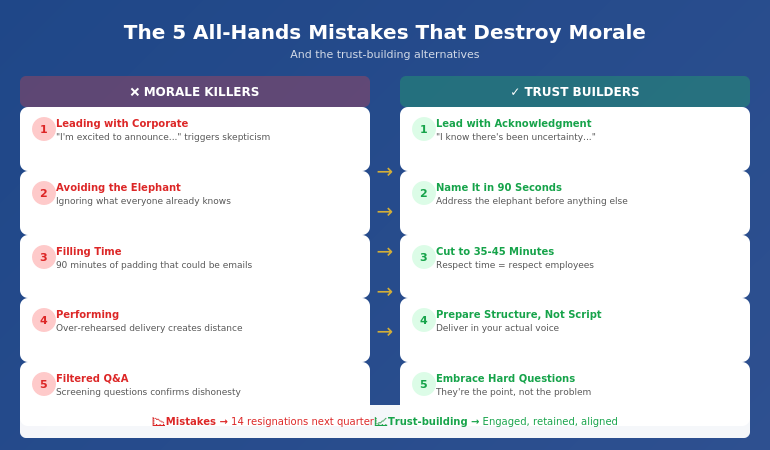
Mistake 1: Leading with Corporate, Not Human
“I’m excited to announce…” “We’re thrilled to share…” “This is an incredible opportunity…”
The moment employees hear corporate enthusiasm, their guard goes up. They’ve been trained by years of experience: when leadership sounds excited, something uncomfortable is coming.
The tech CEO I mentioned opened with excitement about “transformation” and “new horizons.” What employees heard: “I’m about to tell you something you won’t like, and I’m pretending it’s good news.”
The fix: Lead with acknowledgment, not enthusiasm.
“I know there’s been uncertainty about our direction. Today I want to address that directly.” This signals respect. It says: I know you’re not naive. I’m not going to insult you with spin.
Acknowledgment before announcement. Reality before vision. Human before corporate.
For more on this approach, see my guide on presenting difficult news without destroying credibility.
Mistake 2: Avoiding What Everyone Already Knows
In every organisation, there are things “everyone knows” but leadership pretends don’t exist. The product that’s failing. The competitor that’s winning. The restructure that’s coming. The executive who’s struggling.
When you stand in front of your entire company and don’t mention the elephant, you don’t make it disappear. You confirm that leadership either doesn’t know (incompetent) or won’t say (dishonest).
Neither builds trust.
I watched a CFO give a 45-minute all-hands without mentioning that Q3 results were 40% below target. Every employee in the room knew the numbers. The Slack messages afterwards weren’t about the content of the presentation—they were about what it revealed about leadership’s honesty.
The fix: Name the elephant in the first 90 seconds.
“Before I get into our plans, let’s acknowledge what’s on everyone’s mind. Q3 was significantly below where we needed to be. That’s not a secret, and I’m not going to pretend otherwise. Here’s what we’re doing about it…”
You don’t have to have all the answers. But you have to acknowledge the questions.
Mistake 3: Filling Time Instead of Respecting It
The standard all-hands runs 60-90 minutes. Why? Because that’s how long all-hands meetings are supposed to be.
But here’s what actually happens: 15 minutes of substance gets stretched to fill the slot. Department updates that could be emails. Metrics that are already in the dashboard. Celebrations that feel forced because they’re wedged between filler.
Employees aren’t fooled. They know when you’re wasting their time. And every unnecessary minute costs you credibility.
The fix: Cut ruthlessly. Then cut more.
A 25-minute all-hands with genuine substance builds more trust than a 90-minute meeting with padding. Respecting employees’ time signals that you value their contribution more than the appearance of thorough communication.
Ask yourself: If employees were billing you £200/hour each, would you still include this section?
🎯 Build Slides That Build Trust
The Executive Slide System includes templates specifically designed for high-stakes company communications—including all-hands meetings, town halls, and leadership updates. Structure that respects your audience’s intelligence.
What’s included:
- Town hall and all-hands frameworks
- Opening slides that acknowledge reality
- Q&A preparation structures
- Templates that cut filler automatically
Get the Executive Slide System → £39
Instant download. Built for high-stakes leadership communications.
Mistake 4: Performing Instead of Communicating
Over-rehearsed delivery. Memorised transitions. The corporate voice that sounds nothing like how the CEO actually talks.
Performance creates distance. Employees can feel when someone is delivering lines versus sharing thoughts. And in an all-hands—where the entire point is connection—that distance is fatal.
The irony: leaders rehearse to seem confident. But over-rehearsal signals the opposite. It says: “I’m so worried about how this will land that I’ve scripted every word.”
The fix: Prepare your structure, not your script.
Know your key points. Know your opening acknowledgment. Know how you’ll handle the hard questions. But deliver in your actual voice, with your actual personality, including your actual uncertainty where it exists.
Employees don’t need you to be polished. They need you to be real.
“I don’t have all the answers yet” builds more trust than a perfectly delivered non-answer.
📊 Need a structure you can make your own? The Executive Slide System (£39) gives you frameworks to prepare thoroughly while still sounding human.
Mistake 5: Treating Q&A as Damage Control
Screened questions. Pre-selected softballs. The classic “we’re running out of time” when hard questions start coming.
Employees see through all of it. And each evasion confirms what they suspected: leadership doesn’t want honest dialogue.
The worst version: anonymous questions that are clearly filtered, so everyone knows the difficult ones were removed. You’ve now combined dishonesty with the appearance of openness—the most damaging combination.
The fix: Embrace the hard questions. They’re the point.
The question that makes you uncomfortable is exactly the question that needs answering. When you address it directly—even if the answer is “I don’t know yet, and here’s why”—you build trust that no amount of polished presentation can create.
If you’re afraid of what employees might ask, that fear is data. It’s telling you something about the gap between what you’re saying and what they’re experiencing.
For more on handling difficult questions, see my guide on executive presentation structure.
💡 Q&A Is Where Trust Is Won or Lost
The questions that make you uncomfortable are exactly the questions that need answering. When you address them directly—even if the answer is “I don’t know yet, and here’s why”—you build trust that no amount of polished slides can create. The Executive Slide System includes Q&A preparation frameworks for anticipating and handling the hard questions.
The All-Hands Structure That Builds Trust
After watching hundreds of company meetings—the ones that built trust and the ones that destroyed it—here’s the structure that works:
1. Acknowledge First (2-3 minutes)
Name what’s on everyone’s mind. Don’t spin. Don’t pivot to positivity immediately. Just acknowledge.
“I know the last quarter has been difficult. I know there’s uncertainty about what’s coming. I want to address that head-on today.”
2. Context Before Content (3-5 minutes)
Before you share decisions, share the thinking behind them. What did you consider? What trade-offs did you make? What would you do differently?
This transparency builds trust because it treats employees as partners in understanding, not just recipients of announcements.
3. Substance Over Padding (10-15 minutes)
Deliver your actual content. Cut everything that could be an email. Cut department updates that don’t affect everyone. Cut metrics that are already visible. Keep only what requires the entire company’s attention.
4. Honest Q&A (15-20 minutes)
Open the floor genuinely. Don’t screen questions. When you get a hard one, pause, acknowledge its importance, and answer as honestly as you can—even if that answer is incomplete.
5. Close with Commitment (2-3 minutes)
What specifically are you committing to? When will you follow up? What can employees hold you accountable for?
Vague inspiration erodes trust. Specific commitments build it.
Total time: 35-45 minutes. Not 90. Not 60. Less time, more substance, more trust.
For a detailed template, see my town hall presentation template.
🎯 The Complete Executive Communication System
The Executive Slide System gives you everything in this article as ready-to-use templates—plus frameworks for board presentations, stakeholder updates, and every other high-stakes executive communication. Build slides that build trust.
Includes:
- All-hands and town hall frameworks
- Trust-building opening templates
- Q&A preparation structures
- Board presentation formats
- Stakeholder update templates
Get the Executive Slide System → £39
Instant download. Transform your next all-hands from morale-killer to trust-builder.
Frequently Asked Questions
What should you not do in an all-hands meeting?
The five biggest mistakes: leading with corporate enthusiasm instead of human acknowledgment, avoiding topics everyone already knows about, filling time with content that could be emails, over-rehearsing until you sound scripted, and treating Q&A as damage control rather than genuine dialogue. Each mistake signals that leadership values appearance over substance—and employees notice immediately.
How do you make an all-hands meeting engaging?
Engagement comes from trust, not entertainment. Acknowledge reality in your opening, share the thinking behind decisions (not just the decisions themselves), cut ruthlessly to respect people’s time, deliver in your actual voice rather than a corporate performance, and embrace hard questions as opportunities to build credibility. A 30-minute meeting with genuine substance beats a 90-minute meeting with forced energy.
Why do all-hands meetings fail?
Most all-hands meetings fail because they prioritise information delivery over trust-building. Leaders focus on what they want to say rather than what employees need to hear. They avoid difficult realities, pad time with filler, and treat Q&A as a risk to manage. The result: employees leave feeling more disconnected than before, regardless of the content.
How long should an all-hands meeting be?
As short as possible while covering genuine substance—typically 30-45 minutes including Q&A. The standard 60-90 minutes exists because of tradition, not effectiveness. Shorter meetings that respect employees’ time build more trust than longer meetings padded with updates that could be emails. If you can’t fill 30 minutes with content that requires the entire company’s attention, you don’t need an all-hands meeting.
Should you allow anonymous questions at all-hands?
Only if you’ll actually answer them—including the difficult ones. Filtered anonymous questions are worse than no anonymous questions at all, because employees know the hard questions were removed. If you allow anonymous submission, commit to addressing every question (you can group similar ones). If you’re not willing to do that, better to have live Q&A and demonstrate openness through your genuine responses to real-time challenges.
How do you deliver bad news at an all-hands meeting?
Lead with it. Don’t bury bad news in the middle or save it for Q&A. Acknowledge it in your first 90 seconds: “I want to start with something difficult.” Then provide context (why this happened), impact (what it means), and path forward (what you’re doing about it). Employees can handle bad news; what destroys trust is the sense that you’re hiding it or spinning it.
What’s the best structure for an all-hands meeting?
Acknowledge first (2-3 minutes)—name what’s on everyone’s mind. Context before content (3-5 minutes)—share thinking behind decisions. Substance over padding (10-15 minutes)—only content that requires company-wide attention. Honest Q&A (15-20 minutes)—unfiltered, genuine responses. Close with commitment (2-3 minutes)—specific accountabilities, not vague inspiration. Total: 35-45 minutes maximum.
📧 The Winning Edge Newsletter
Weekly insights on executive communication, leadership presentations, and what actually builds trust in corporate settings. From 24 years in banking boardrooms.
📋 Free: Executive Presentation Checklist
A pre-presentation checklist for any high-stakes executive communication—including the trust check, audience analysis, and Q&A preparation. Use it before your next all-hands.
About the Author
Mary Beth Hazeldine is the Owner & Managing Director of Winning Presentations. With 24 years of corporate banking experience at JPMorgan Chase, PwC, Royal Bank of Scotland, and Commerzbank, she has delivered high-stakes presentations in boardrooms across three continents—and watched countless all-hands meetings build or destroy organisational trust.
A qualified clinical hypnotherapist and NLP practitioner, Mary Beth combines executive communication expertise with evidence-based techniques for managing presentation anxiety. She works with thousands of executives on high-stakes funding rounds and approvals.
Your Next Step
Before your next all-hands meeting, run the trust check. Ask yourself: What’s the elephant in the room? Am I acknowledging it—or avoiding it?
The five mistakes in this article are easy to make and hard to recover from. But they’re also easy to avoid once you see them clearly.
Your employees are smart. They see through spin, they feel performance, and they remember evasion. The all-hands meeting that builds trust is the one that treats them as the intelligent partners they are.
Lead with acknowledgment. Deliver substance. Respect their time. Embrace the hard questions.
That’s it. That’s the whole system.
Related: If presenting in front of groups triggers anxiety—even when you’re the one in charge—see today’s companion article on what to do when emotions overwhelm you mid-presentation. It happens to more leaders than you’d think.