
Tag: AI slides executive

25 Feb 2026
Executive with glasses evaluating AI-generated presentation on laptop screen, chin resting on hand in critical thought, printed slide documents on desk beside him

AI Presentation Structure: AI Can Write Your Slides. It Can’t Structure Your Argument.

I watched a board ignore 22 perfect AI-written slides — because not one of them asked for a decision.

Quick Answer: AI generates content — clear sentences, reasonable data points, professional formatting. What it can’t generate is AI presentation structure: the decision architecture that determines which slide goes where, what the room needs to decide, and why the evidence is sequenced to lead them there. If you ask AI to “create a board presentation,” you’ll get 15-20 slides of competent content with no argument. The fix: build the structural skeleton first (what decision, what recommendation, what evidence in what order), then use AI to fill each section.

A client — a VP at a technology company — sent me his board presentation and asked for feedback. It was 22 slides. Beautifully written. Consistent formatting. Every slide had clear bullet points and supporting data.

He’d used ChatGPT to build it, and the output was impressive. Clean language. Professional tone. Relevant content.

One problem: nowhere in 22 slides did it say what decision the board needed to make.

There was no recommendation. No “I’m asking for X by Y date.” No comparison of options with trade-offs. No cost of inaction. Just 22 slides of well-written information, sequenced in the order the AI had generated it — which was the order of his prompt, not the order of a decision-first argument.

I asked him: “If the board reads only slide 1, do they know what you’re asking for?” He looked at slide 1. It was a project overview. They wouldn’t know the decision until slide 19.

We restructured in 90 minutes. Same data, same AI-written content — but reorganised around a decision architecture. Recommendation on slide 2, evidence supporting it, options with trade-offs, specific ask with a deadline.

The board approved it in the first 10 minutes.

🚨 Built a presentation with AI and it feels flat? Quick check: Does slide 1 tell the room what decision you need? If the decision is on slide 15+, you have a content deck, not an argument.

→ Need the structural skeleton that makes AI output land? Get the Executive Slide System → £39

The Difference Between Content and Structure (And Why AI Only Gives You One)

Content is what your slides say. Structure is the order they say it in and why.

AI is extraordinarily good at content. Ask ChatGPT to “write a slide about Q3 revenue performance” and you’ll get a clear, professional summary with relevant data points. Ask it to “write 15 slides for a board presentation on Project Phoenix” and you’ll get 15 clear, professional slides.

What you won’t get is an argument. Because an argument requires something AI doesn’t have: knowledge of the decision-maker, the political context, the urgency, the alternatives, and the specific outcome you need from the room.

AI presentation structure fails because AI sequences content in the order it was prompted, not in the order that leads a room to a decision. It generates in narrative order (background → context → analysis → findings → recommendation) when executive communication requires decision-first order (recommendation → evidence → options → ask).

This is the fundamental gap. It’s not about better prompts, more specific instructions, or a different AI tool. It’s about the structural logic that determines what goes on slide 1, what goes on slide 5, and what the room is doing on slide 10.

For more on the difference between AI-enhanced and AI-generated presentations, see the full comparison.

Why do AI-generated presentations fail with executives?

Because executives read slides in decision mode — they’re looking for the recommendation, the risk, the cost, and the ask. AI generates slides in information mode — sequenced to inform, not to persuade. When an executive hits slide 5 and still doesn’t know what you’re asking for, they check out. The content might be better than anything you’d write manually. But without decision architecture, it’s like having a perfectly worded email with no subject line.

Why AI Presentations Fail in Executive Settings

After reviewing hundreds of AI-generated executive decks — from clients using ChatGPT, Copilot, Gamma, and others — I see the same three structural failures every time.

Failure 1: The recommendation is buried. AI typically generates in chronological or logical order: background first, analysis second, conclusions third, recommendation last. In a 20-slide deck, the recommendation lands on slide 17-20. By then, three executives have left and two more are on their phones. Executive presentations need the recommendation on slide 1 or 2 — everything after that is evidence supporting the ask.

Failure 2: No options or trade-offs. AI generates a single recommendation because that’s what it was asked for. But decision-makers need options. “I recommend A” gives the room two choices: yes or defer. “Here are three options with costed trade-offs, and I recommend A because…” gives them agency. AI doesn’t create options unless specifically prompted — and even then, it doesn’t quantify the trade-offs the way an executive audience needs.

Failure 3: No cost of inaction. The most powerful slide in any decision deck is the one that shows what happens if the room doesn’t decide. AI never generates this slide because it doesn’t understand that executive meetings exist to make decisions, and that deferral is the default outcome unless you make it expensive. The decision slide structure includes this by default — AI doesn’t.

⭐ Give AI the Structure It’s Missing — Then Let It Do What It’s Good At

The Executive Slide System gives you 22 structural skeletons — the decision architecture AI can’t generate. Each template tells you what goes on every slide and why. Then the 51 matched AI prompts (Draft → Refine → Executive Polish) fill the structure with content that sounds like you.

Your structure-first AI toolkit:

  • 22 executive slide templates — the structural skeleton for board decks, status updates, proposals, and recommendations
  • 51 AI prompts in 3 stages: Draft (generate content), Refine (sharpen for audience), Polish (stress-test as a skeptical CEO)
  • 15 scenario playbooks — find your exact situation, follow the template + prompt sequence like a recipe
  • Decision architecture built into every template — recommendation, options, cost of inaction, specific ask

Get the Executive Slide System → £39

Built from 24 years of executive presentations — the structural logic AI doesn’t have.

The Structure-First AI Workflow: Decision → Skeleton → AI

The fix is simple but counterintuitive: you need to build the structural skeleton BEFORE you open AI. Most people do the opposite — they prompt AI first, then try to restructure the output. That’s backwards.

Step 1: Define the decision. Before you write a single prompt, answer: “What specific decision do I need from this room?” Not “inform them about the project.” Not “update them on progress.” A decision: “Approve £400K additional budget by March 7.” If you can’t state the decision in one sentence, you’re not ready to build slides — with or without AI.

Step 2: Build the skeleton. Choose a template that matches your scenario. A board presentation needs a different skeleton than a project status update, which needs a different skeleton than an investment proposal. The skeleton determines what goes on each slide and in what order — recommendation first, evidence second, options third, ask last.

Step 3: Prompt AI to fill each section. Now — and only now — use AI. But not with a single prompt like “create a board presentation.” Instead, prompt section by section: “Write the executive summary for a £400K technology investment. The recommendation is to approve. The key evidence is…” When AI fills a pre-built structure, the output has the decision architecture the room needs.

This is the approach that turned my client’s 22-slide information deck into a 12-slide decision deck — same data, same AI-generated language, fundamentally different outcome.

For a library of proven prompts, see the complete guide to ChatGPT prompts for presentations.

The 3-Prompt System: Draft → Refine → Executive Polish

One prompt doesn’t produce executive-quality output. Three prompts do — if they’re sequenced correctly.

Prompt 1: Draft. Generate the content for a specific slide or section. Be specific about the scenario, the audience, and the data. “Create content for a Q3 business review for the finance committee. Include: revenue vs target, three significant wins with quantified impact, two challenges with root causes, and three priorities for next quarter.”

Prompt 2: Refine. Sharpen the output for the specific audience. “Make this more impactful for a CFO audience. Each win should quantify business impact. Challenges should include what we’re doing about them. Remove metrics that don’t connect to business outcomes.”

Prompt 3: Executive Polish. Stress-test it. “Review this through the eyes of a CEO with five other meetings today. What would they skip? What questions would they ask? Strengthen the ‘so what’ for each point. Ensure the decision is specific and time-bound.”

Each prompt layer adds something the previous one didn’t: the Draft gives you content, the Refine makes it audience-specific, and the Polish makes it decision-ready. Without the structural skeleton underneath, all three layers produce better-written information. With the skeleton, they produce an argument.
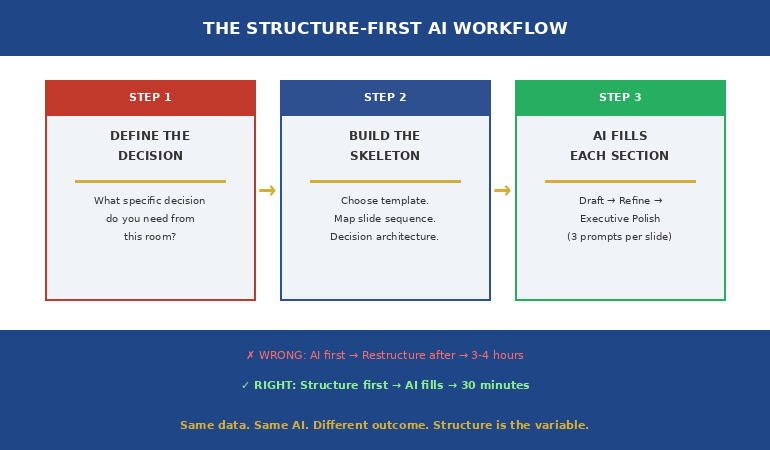
The Structure-First AI Workflow showing three steps from decision definition through structural skeleton to AI content filling

The 51 AI prompts in the Executive Slide System are pre-written in the Draft → Refine → Polish sequence for every template — so you’re not writing prompts from scratch. Open the template, run the three matched prompts, and the structural skeleton fills itself with executive-quality content. Get the Executive Slide System → £39

What AI IS Good At (Once the Structure Exists)

This isn’t an anti-AI article. AI is transformative for presentations — but only when it fills a structure rather than creating one.

Once you have the decision architecture in place, AI excels at: generating clear, professional language for each section; stress-testing your content from the audience’s perspective; finding gaps in your logic that you’ve become blind to; polishing language to be more concise and direct; and creating supporting data visualisations.

The combination of human structure + AI content is more powerful than either alone. You bring the judgement (what decision, what audience, what politics). AI brings the execution speed (clear language, consistent tone, gap identification). The structural skeleton is the interface between the two.

The professionals who are most effective with AI aren’t the ones writing the best prompts. They’re the ones who know what the room needs BEFORE they open ChatGPT. Structure first. AI second. That’s the workflow that gets decisions.

⭐ Stop Getting 22 Slides of Information and Zero Decisions

The Executive Slide System is the structural skeleton that makes AI output actually work in executive meetings. Each of the 22 templates includes the decision architecture — recommendation position, evidence sequence, options framing, specific ask — that AI can’t generate on its own.

Your structure-first AI deliverables:

  • 22 structural templates — recommendation-first, decision-ready, each with mapped slide sequence
  • 51 matched AI prompts — 3 per template (Draft → Refine → Executive Polish), pre-written and ready to paste
  • 15 scenario playbooks — find your exact situation, follow template + prompt sequence in under 30 minutes
  • 6 checklists — verify decision readiness, argument logic, and executive clarity before presenting

Get the Executive Slide System → £39

The structural logic from 24 years of executive banking + 51 AI prompts that fill it in minutes. Structure first. AI second. Decisions always.

The 15 scenario playbooks in the Executive Slide System tell you which template to open AND which AI prompts to run for your specific situation — so the structure-first workflow takes 30 minutes, not 3 hours. Get the Executive Slide System → £39

Is This Right For You?

✓ This is for you if:

  • You’ve used AI for presentations but the output feels flat, informational, or doesn’t get decisions
  • You want the structural logic that makes AI-generated content land with executive audiences
  • You want pre-written AI prompts matched to specific executive scenarios

✗ This is NOT for you if:

  • You don’t use AI for presentations and don’t plan to start
  • You’re looking for visual design templates (this is structural logic, not design)

⭐ 24 Years of Board-Level Decision Decks — Now a Structure AI Can’t Mess Up

Every template in the Executive Slide System was built from real executive approvals — board papers, SteerCo recommendations, ExCo investment cases. The decision architecture that got those approved is now the skeleton your AI fills.

Your AI-ready decision architecture:

  • Decision slide order that forces “what are you asking for?” onto slides 1–2 (not slide 19)
  • Options + trade-off slide formats executives actually use to decide — with costed consequences
  • Cost-of-inaction slide prompts — the missing slide in 90% of AI-generated decks
  • 51 matched AI prompts (Draft → Refine → Executive Polish) pre-written for every template

Get the Executive Slide System → £39

Built from board approvals, SteerCo recommendations, and ExCo investment cases at JPMorgan, RBS, PwC, and Commerzbank. Instant download. 30-day money-back guarantee.

Frequently Asked Questions

Can’t I just write better prompts instead of using templates?

Better prompts produce better content — but content isn’t the problem. The problem is structural logic: what goes on slide 1, what goes on slide 5, why the evidence is sequenced the way it is. No prompt, however sophisticated, gives AI the knowledge of your decision-maker, the political dynamics in the room, or the specific decision the meeting exists to make. Templates provide the structural skeleton that prompts can’t. Then prompts fill it brilliantly.

Does this work with ChatGPT, Copilot, and other AI tools?

Yes — because the structural problem is universal across all AI tools. ChatGPT, Copilot, Gamma, Claude, and every other AI presentation tool generates content in information mode. None of them generate in decision-first mode unless you provide the structure first. The templates work with any tool. The 51 AI prompts are written for ChatGPT-style interfaces but adapt to any conversational AI.

How long does the structure-first workflow take?

About 30 minutes for a complete executive deck. Five minutes to choose the right template for your scenario (the playbooks tell you which one). Five minutes to define the decision, recommendation, and key evidence points. Twenty minutes to run the three prompts per section and review the output. Compare that to 3-4 hours of prompt-iterate-restructure-prompt cycles when starting with AI alone.

What if my presentation is informational, not decision-based?

Most presentations that claim to be “informational” actually contain an implicit decision. A project status update implicitly asks “should we continue as planned?” A quarterly review implicitly asks “is this team performing?” If you genuinely need to inform without seeking a decision — a training session or a knowledge-share, for example — AI alone works fine. But for any presentation to leadership, there’s almost always a decision embedded. Find it, make it explicit, and build the structure around it.

📬 The Winning Edge — Weekly Newsletter

One executive presentation insight per week. AI workflows, structural frameworks, and the decision-first thinking that makes both work. No filler.

Subscribe Free →

Read next: AI handles slides. Q&A handles everything else. Read When You Don’t Know the Answer: 3 Responses That Save You in Q&A — the scripts for when AI can’t help.

Read next: If your next presentation involves giving sensitive feedback, read The Sandwich Feedback Trap: Why It Fails When You Critique Up (And the Mirror Structure That Works).

If your board pack goes out tomorrow morning — or your SteerCo pre-read is due by 5pm — don’t let AI decide the slide order. Build the structural skeleton first. Then let AI fill it. That’s how 22 slides of information become 12 slides that get a decision.

About the Author

Mary Beth Hazeldine is the Owner & Managing Director of Winning Presentations. With 24 years of corporate banking experience at JPMorgan Chase, PwC, Royal Bank of Scotland, and Commerzbank, she has delivered high-stakes presentations in boardrooms across three continents.

A qualified clinical hypnotherapist and NLP practitioner, Mary Beth combines executive communication expertise with evidence-based techniques for managing presentation anxiety. She has trained thousands of executives and supported presentations for high-stakes funding rounds and approvals.

Read more articles at winningpresentations.com

05 Feb 2026
Executive woman reviewing AI-generated presentation output on laptop in corporate office

Prompt Layering: The Technique That Makes AI Output Executive-Ready

I asked ChatGPT to write an executive summary for a £3 million infrastructure proposal. It gave me something that read like a university essay.

Same tool. Same data. But the output was unusable in any boardroom I’ve ever sat in.

The problem wasn’t AI. It was how I was prompting it — one instruction, one shot, hope for the best. Most professionals do exactly this, and most get exactly this result: technically correct, strategically useless.

Then I discovered prompt layering. Not a single clever instruction, but a sequence of four prompts that build on each other — each one refining the output until it reads like something a senior leader actually wrote.

That single shift changed how I teach AI presentation prompts to executives. And it’s the technique that separates “AI-assisted” slides from “AI-generated” ones.

Quick answer: Prompt layering is a technique where you build AI presentation output through four sequential prompts — Role, Context, Task, Constraints — instead of cramming everything into one instruction. Each layer refines the previous output, producing executive-quality slides that sound like you wrote them. Senior leaders who use this approach report cutting revision time from hours to minutes while getting output their audience actually respects.

🎯 Presenting tomorrow? Copy these 4 prompts in order:

Prompt 1 (Role): “You are a senior strategy consultant who has written executive presentations for FTSE 100 boards. Your writing is concise, direct, and recommendation-led.”

Prompt 2 (Context): “I’m presenting to [AUDIENCE] about [TOPIC]. They care about [KEY CONCERN]. The decision I need is [SPECIFIC ASK]. Here’s my background data: [PASTE DATA].”

Prompt 3 (Task): “Create a [NUMBER]-slide executive presentation. Lead with the recommendation. Each slide should have one main message as the title. No bullet points longer than 8 words.”

Prompt 4 (Constraints): “Rewrite the output using these rules: no jargon, no passive voice, every slide answers ‘so what?’, and the entire deck could be understood by reading only the slide titles.”

Fill in the brackets. Run them in sequence (not all at once). Each prompt builds on the last.

A client — VP of Operations at a logistics company — showed me his “AI presentation workflow.” He’d type a paragraph-long prompt, get a full deck back, then spend three hours rewriting every slide.

“It’s faster than starting from scratch,” he said. He was right. But only barely.

I showed him the layering technique. Same AI tool, same topic, but four prompts instead of one. The first set the voice. The second loaded the context. The third defined the structure. The fourth applied the constraints.

His next board presentation took 40 minutes to build. Not 40 minutes of editing AI output — 40 minutes total, from blank screen to finished deck. His exact words afterwards: “It actually sounds like me now.”

That’s what prompt layering does. It doesn’t make AI smarter. It gives AI enough information to produce something you’d actually present.

Why Single-Prompt AI Fails at Executive Level

The standard approach to AI presentations looks like this: write one detailed prompt, hit enter, get a deck. Every tutorial teaches it. Every professional tries it. And almost everyone gets the same result — slides that are technically complete but strategically empty.

Here’s why. When you give AI one prompt, you’re asking it to simultaneously figure out your voice, understand your audience, structure your argument, and apply formatting constraints. That’s four cognitive tasks compressed into one instruction. Even experienced professionals can’t do all four at once. AI certainly can’t.

The output reveals the problem. Slide titles become generic (“Overview,” “Key Findings,” “Next Steps”). Content reads like a report, not a presentation. The recommendation — if there is one — gets buried on slide 9 instead of leading on slide 1.

I’ve seen this pattern across hundreds of executive presentations. The executives who get the worst AI output are often the ones who write the longest, most detailed single prompts. More instructions in one shot doesn’t mean better output. It means more confusion.

Prompt layering solves this by separating those four tasks into four sequential prompts. Each one does one job. And each one builds on the output of the last.

The 4-Layer Prompt Stacking Technique

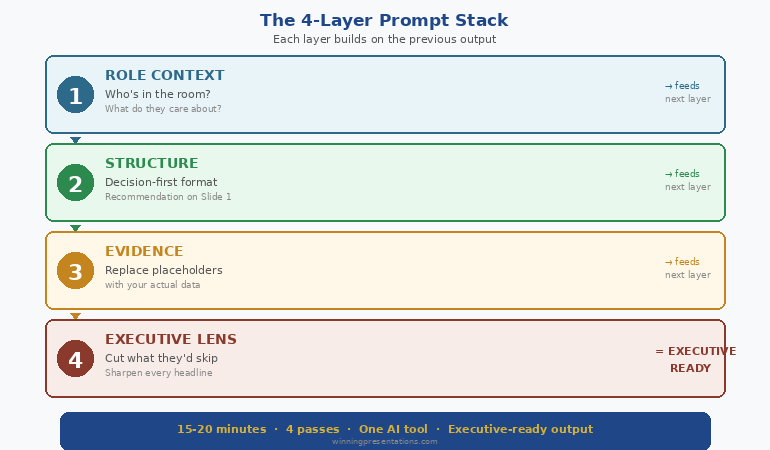
The technique works because it mirrors how senior leaders actually think through a presentation — not all at once, but in layers. Role first. Context second. Structure third. Polish fourth.


The 4-layer prompt stacking technique showing Role then Context then Task then Constraints for executive-ready AI presentation output

Layer 1: Role (Set the Voice)

Before you ask AI to create anything, tell it who it is. This isn’t a gimmick. Role-setting changes the vocabulary, sentence length, and level of assumption in every output that follows.

Weak role: “You are a helpful assistant.”

Strong role: “You are a senior strategy consultant who has written board-level presentations for FTSE 100 companies. Your writing style is direct, recommendation-led, and assumes the reader is time-poor and sceptical.”

The difference in output is immediate. With the strong role, AI stops explaining basics, drops the hedging language, and leads with conclusions instead of background.

Layer 2: Context (Load the Intelligence)

This is where most professionals fail. They give AI the topic but not the situation. A board presentation about Q3 performance is completely different depending on whether results exceeded targets or missed them by 15%.

The context layer includes: who you’re presenting to, what they care about, what decision you need, what resistance you expect, and the raw data or talking points they need to see.

Paste your data here. Meeting notes, spreadsheet summaries, previous feedback — give AI the same briefing you’d give a junior analyst preparing your slides.

Layer 3: Task (Define the Structure)

Now — and only now — do you tell AI what to build. The task layer specifies slide count, format requirements, what goes on each slide, and how the argument flows.

Because AI already has the voice (Layer 1) and the intelligence (Layer 2), the structural output is dramatically better. Slide titles become specific. Content maps to what your audience actually needs to decide. Recommendations lead rather than follow.

Layer 4: Constraints (Apply the Polish)

The final layer is a rewrite instruction. You take the output from Layer 3 and run it through quality filters: no jargon, no passive voice, every slide answers “so what?”, slide titles tell the full story when read in sequence.

This layer is where generic becomes executive. It’s the equivalent of a senior partner reviewing a junior associate’s slides and saying “tighter, sharper, more direct.”

Four prompts. Four minutes. Output that used to require three hours of manual rewriting.


The Complete AI Presentation System

Prompt layering is one module inside AI-Enhanced Presentation Mastery — the self-study programme that teaches the full executive AI workflow. Modules release weekly. Live Q&A calls included. Join anytime and get everything released so far.

Join AI-Enhanced Presentation Mastery (See Dates & Pricing) →

Self-study modules + live Q&A calls. All sessions recorded.
The course is live now, with new modules releasing through April 2026. Join today and get instant access to everything released so far — plus every module as it drops.

Before and After: Real Executive Output

Theory is useful. Seeing the difference is convincing. Here’s what prompt layering actually produces compared to the standard single-prompt approach — using the same AI tool, same topic, same data.

Scenario: Q3 Board Update (Results Below Target)

Single prompt output — Slide 1 title: “Q3 2025 Performance Overview and Key Metrics Summary”

Layered prompt output — Slide 1 title: “Q3 Revenue Missed Target by 8%. Here’s the Recovery Plan.”

The first tells the board they’re about to see data. The second tells them exactly what happened and what you’re doing about it. One wastes their first 30 seconds. The other earns their attention immediately.

Scenario: Budget Request Presentation

Single prompt output — Closing slide: “Summary and Recommendations for Consideration”

Layered prompt output — Closing slide: “Approve £450K Q1 Investment. Payback by Month 9. Here’s Why Delay Costs More.”

The difference isn’t AI capability. It’s prompt architecture. The layered approach forces AI to write like a decision-maker rather than a report-generator.

The 3 Layering Mistakes That Ruin Executive Output

Prompt layering isn’t foolproof. I’ve watched senior professionals adopt the technique and still get mediocre output because of three specific errors.

Mistake 1: Combining Layers

The temptation is efficiency — why send four prompts when you can send two? Because combining layers defeats the purpose. When you merge Role and Context into one prompt, AI gives equal weight to voice and data. The voice gets diluted. The context gets summarised instead of absorbed.

Four separate prompts. Every time. The two minutes you “save” by combining costs you twenty minutes in rewrites.

Mistake 2: Skipping the Constraints Layer

Layers 1-3 produce good output. Layer 4 produces executive output. The constraints prompt is what removes jargon, tightens language, forces the “so what?” test, and ensures slide titles tell a complete story. Skipping it is like submitting a first draft to the board.

Mistake 3: Restarting Instead of Building

If Layer 3 output isn’t right, the instinct is to start over with a new prompt. Don’t. Instead, add a corrective instruction that builds on what’s already there: “Keep the structure but make the recommendation on slide 1 instead of slide 8.” AI retains context from previous layers. Starting over throws that context away.

Going deeper: The complete layering protocol — including audience-specific role templates and the editing loop that catches what Layer 4 misses — is covered in the AI-Enhanced Presentation Mastery programme. Join anytime — get instant access to all modules released so far, plus new ones dropping through April 2026.

When to Use Prompt Layering (And When Not To)

Prompt layering is the right technique for any presentation where the audience is senior, the stakes are real, and “good enough” isn’t good enough. Board updates. Budget requests. Client pitches. Investor decks. Steering committee presentations.

For internal team updates, training materials, or quick status slides, a single well-written prompt is perfectly fine. The 4-layer technique adds four minutes to your process. That investment pays off when the audience is a CFO. It’s overkill when the audience is your own team.

The decision framework I use: if the presentation could affect a decision, a budget, or your reputation, layer your prompts. If it’s informational, don’t.

Also worth noting: prompt layering fits inside a broader AI presentation workflow that includes research, structure, and rehearsal phases. The prompts are one part of a larger system.

And if the presentation you’re preparing also involves getting the format right for a CEO audience, the role layer becomes especially critical — the voice you set in Layer 1 needs to match the expectations of the room.

People Also Ask

What are the best AI prompts for executive presentations?

The best AI prompts for executive presentations use a layered approach — setting role, loading context, defining structure, then applying constraints in four separate prompts. This produces recommendation-led, jargon-free output that mirrors how senior leaders actually communicate. Single-prompt approaches consistently produce generic, report-style slides.

How do you make AI-generated slides look professional?

Professional AI slides come from professional prompting. The constraints layer — applied after structure is set — forces AI to remove jargon, eliminate passive voice, and ensure every slide answers “so what?” Most professionals skip this step and spend hours manually fixing what one additional prompt would solve.

Can AI replace presentation designers for executives?

AI replaces the content creation and structuring work, not the visual design. Executive AI workflows focus on argument architecture, slide messaging, and narrative flow — the strategic work that determines whether a presentation succeeds or fails. Visual polish is a separate step.


Learn the Full Executive AI Workflow

Prompt layering is one technique inside a complete system. AI-Enhanced Presentation Mastery covers the full workflow — from research to rehearsal — in self-study modules with live Q&A support. The programme is already in progress. Join anytime and access everything released so far, plus all future modules.

Join AI-Enhanced Presentation Mastery (See Dates & Pricing) →

Self-study. Weekly modules. Live Q&A calls recorded. Study at your own pace.
Join anytime — get instant access to all modules released so far, plus new ones dropping through April 2026

Frequently Asked Questions

Does prompt layering work with any AI tool or just ChatGPT?

The 4-layer technique works with any large language model — ChatGPT, Claude, Gemini, Copilot. The principle is universal: separating role, context, task, and constraints into sequential prompts produces better output regardless of which tool you use. The specific prompt wording may vary slightly between tools, but the layering structure remains the same.

How long does prompt layering add to my workflow?

Approximately four minutes for the prompting phase. Most professionals report saving 60-90 minutes on the back end because the output requires far less manual rewriting. The net time saving is significant — particularly for board presentations and budget requests where revision cycles typically consume hours.

I’ve tried detailed prompts before and the output was still generic. How is this different?

Detailed single prompts overload the AI with competing instructions. Layering separates each instruction type so AI can focus fully on one task at a time. The key difference is sequence: you’re building output in stages rather than asking for everything simultaneously. The constraints layer alone — applied to already-structured content — typically transforms generic output into something presentation-ready.

Can I use prompt layering for presentations I need to give tomorrow?

Yes. The four-prompt sequence takes under five minutes. The copy-paste prompts at the top of this article are designed for exactly that scenario. Fill in the brackets, run them in order, and you’ll have a structured draft in minutes. For high-stakes presentations, allow an additional 15-20 minutes for your own review and refinement.

📬 The Winning Edge Newsletter

Weekly AI presentation techniques, executive communication strategies, and frameworks for senior professionals. No fluff. Practical every time.

Subscribe free →

Quick win: Start with my free prompt pack — 10 tested prompts for executive presentations, including a role-setting template you can use immediately.

Get the Free Prompt Pack →

Related today: If the presentation you’re building needs the format your CEO actually wants, the role layer in prompt layering is where you set that expectation. And if nerves are the bigger issue, here’s what to do when you freeze mid-presentation.

Your Next Step

Open your AI tool. Don’t type a prompt yet.

Instead, write the role first. Who should this AI be when it writes for you? A senior strategy consultant? A CFO who’s reviewed a thousand budget presentations? A board secretary who knows what directors actually read?

Set that role. Then load your context. Then define the task. Then constrain the output.

Four prompts. Four minutes. Executive-quality output that sounds like you — not like a machine.

If you want the complete system — role templates for every audience type, the editing loop, the workflow senior leaders actually use, and the refinement protocol that catches what the constraints layer misses — explore AI-Enhanced Presentation Mastery.

Stop writing one prompt and hoping. Start layering — and watch your AI output become something you’d actually present.

About the Author

Mary Beth Hazeldine is the Owner & Managing Director of Winning Presentations. With 24 years of corporate banking experience at JPMorgan Chase, PwC, Royal Bank of Scotland, and Commerzbank, she has created hundreds of executive presentations — first manually, now with AI assistance.

A qualified clinical hypnotherapist and NLP practitioner, Mary Beth combines executive communication expertise with evidence-based techniques. She has helped senior professionals and teams create presentations that secure funding, approvals, and high-stakes decisions across three continents.

Book a discovery call | View services