

Quick answer: The decision fatigue presenter problem is not that the late-day pitch is harder than the morning one — it is that the presenter walks in with meaningfully less cognitive bandwidth than they had at 9am, and the deck they built that morning has no scaffolding for the depleted version of themselves who will deliver it. Anxiety amplifies the gap. The structural fix is three moves between 3pm and 4.45pm: a 3pm read-aloud to reload the working narrative, a one-page cold-open card that holds the first two minutes if the opening blank-mind moment arrives, and a ninety-second physiological reset in the corridor. Install the three moves and the 5pm room feels like a 9am room. Rely on willpower and adrenaline and the room reads the pitch as “tired” without knowing why.
JUMP TO:
- Why depletion compounds presenter anxiety
- The physiological mechanism behind the 5pm gap
- The 3pm read-aloud
- The cold-open card and a counter-example
- The depletion-correction diagnostic
- The failure pattern: willpower as compensation
- One thing to do before your next late-day pitch
- Frequently asked questions
In late spring 2007, a senior director at one of the European consumer-banking groups I worked alongside walked into a 5.15pm pitch she had been preparing for three weeks. The room was a glass-walled twelfth-floor boardroom with the long windows facing west and the early-evening sun coming in flat across the table at the angle that bleached the top half of the projector screen. The meeting had been moved twice from its original 10am slot, finally landing at quarter past five because it was the only window the group operations director’s diary held open. She had presented the same material to the divisional finance team at 9am the previous Tuesday and it had landed cleanly. Her deck had not changed. By minute four of the 5.15pm version, I watched the most senior of the divisional MDs — a long-tenured operations man in his late 50s, sitting at the far end of the table with his back to the bleached half of the screen — tilt his chair back a half-inch and start clicking the cap of his pen, slowly, against the inside of his wrist. By minute six she had said the phrase “as I mentioned earlier” three times, each time looking at a slide she had not yet covered. By minute eight she had reordered the second section in her head and started speaking it out of sequence. She walked out knowing it had gone badly and not knowing exactly why. What she had not yet understood was that she was, in cognitive terms, a different presenter at 5.15pm than she had been at 9am, and the deck she had built for the 9am version of herself had no scaffolding to hold the 5.15pm version up.
(This article was created with AI assistance; all stories and insights are based on 35 years of real client work.)
This piece walks through what decision fatigue does to a presenter across the working day, how anxiety amplifies the depletion gap, and the three-part structural compensation that lets a depleted presenter deliver a 5pm pitch with the composure of the 9am version. The fix is structural, not motivational. It depends on three small moves made deliberately in the ninety minutes before the room.
Before the next late-day pitch, a one-page pre-meeting check is worth a look.
The Executive Presentation Checklist includes the late-day pitch preparation page — the 3pm read-aloud sequence, the cold-open card structure, and the ninety-second reset protocol senior presenters use to compensate for end-of-day depletion. Free download, no email gate.
Why depletion compounds presenter anxiety in ways that do not feel like anxiety
The decision fatigue presenter problem is, at root, a mismatch between two versions of the same person. The presenter who built the deck at 10am that morning was operating with full cognitive bandwidth — sharp working memory, clean access to the underlying argument, the unhurried sentence-construction that lets a presenter improvise a clean answer to a side-question without losing the spine of the pitch. The presenter who delivers the same deck at 5.15pm has spent the preceding eight hours making somewhere between 200 and 350 small decisions. That accumulation is not visible. It does not feel like fatigue. It feels like a slightly thinner version of normal cognition, a marginally slower retrieval of names. It is depletion, which is a different physiological state from exhaustion, and the presenter is structurally unaware of how much of their working bandwidth the day has consumed.
The reason this matters for anxiety is that depletion lowers the threshold at which the nervous system reads a room signal as a threat signal. The pen-cap click from the divisional MD at minute four, in the 9am version of the same room, is read as a fidget and dismissed inside half a second. The same pen-cap click at 5.15pm, in a depleted presenter, is read as disengagement, escalated to scepticism, then to active resistance, before the presenter can consciously interrupt. The next sentence arrives with the over-explanation that depleted anxiety always produces — the “as I mentioned earlier” before they have mentioned anything, the parenthetical defence of a slide that did not need defending. The room reads the over-explanation as uncertainty and recalibrates engagement downwards, which the presenter reads as further disengagement, and the spiral compounds. None of this feels like anxiety. It feels like the room being harder than expected.
The physiological mechanism behind the 5pm gap
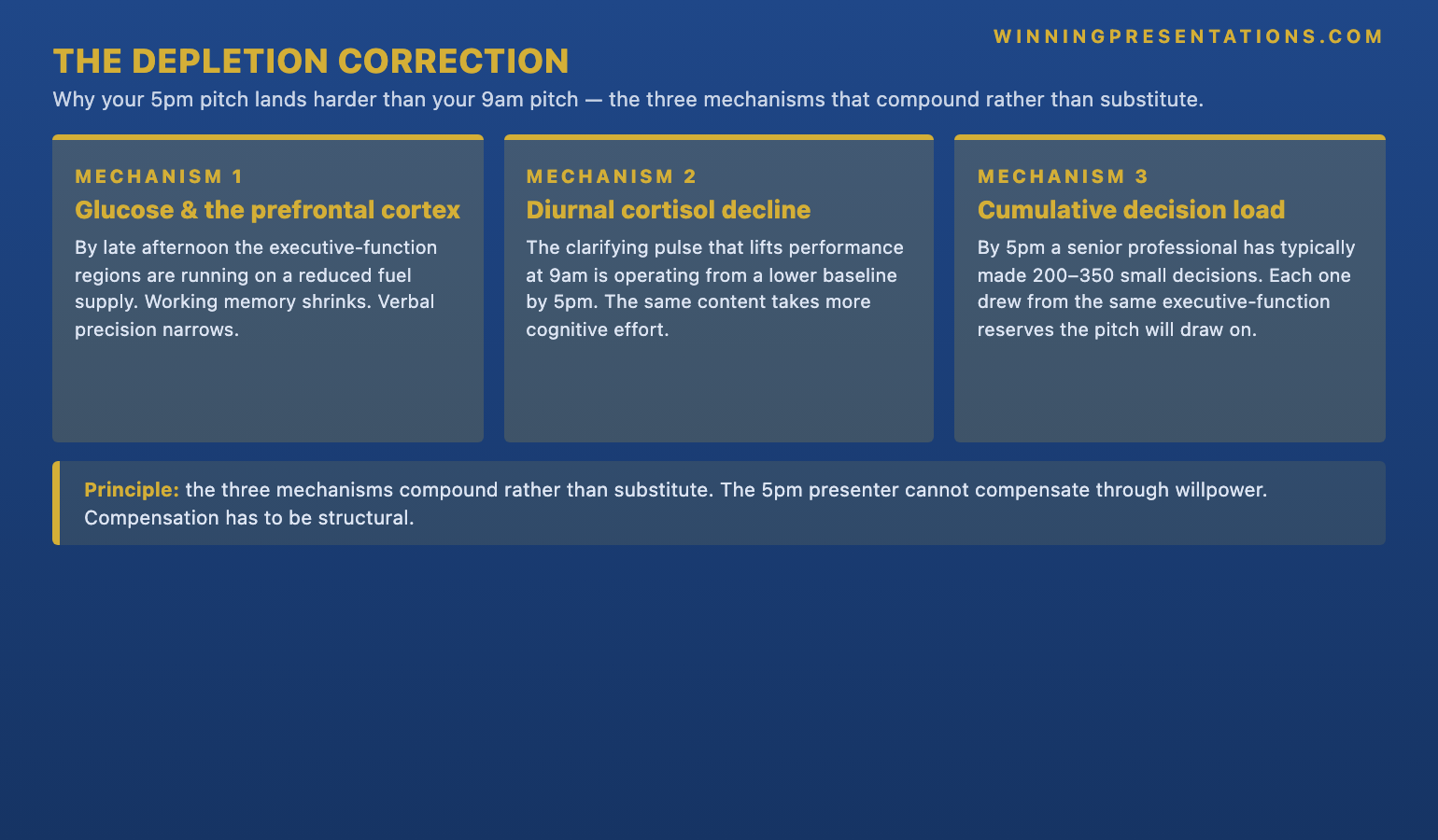
The 5pm gap is not a moral failure of attention and not a sign the presenter is “not built for late meetings”. It is a physiological mechanism with three concurrent components. One: glucose and the prefrontal cortex — the executive-function regions that handle room-reading, answer-construction, and working-memory load are particularly sensitive to circulating blood glucose, and the presenter who has worked through lunch is running their prefrontal cortex on a reduced fuel supply. Two: the diurnal cortisol curve — cortisol levels decline through the day, which means the small clarifying pulse that ordinarily sharpens thinking under pressure is operating from a lower baseline. Three: the cumulative-decision-load mechanism described above. The three components compound rather than substituting for each other. The calm-under-pressure presenting routine covers the broader physiology-first approach for high-stakes meetings generally; the late-day pitch is a specific application of it.
The 3pm read-aloud: reload the working narrative before the room
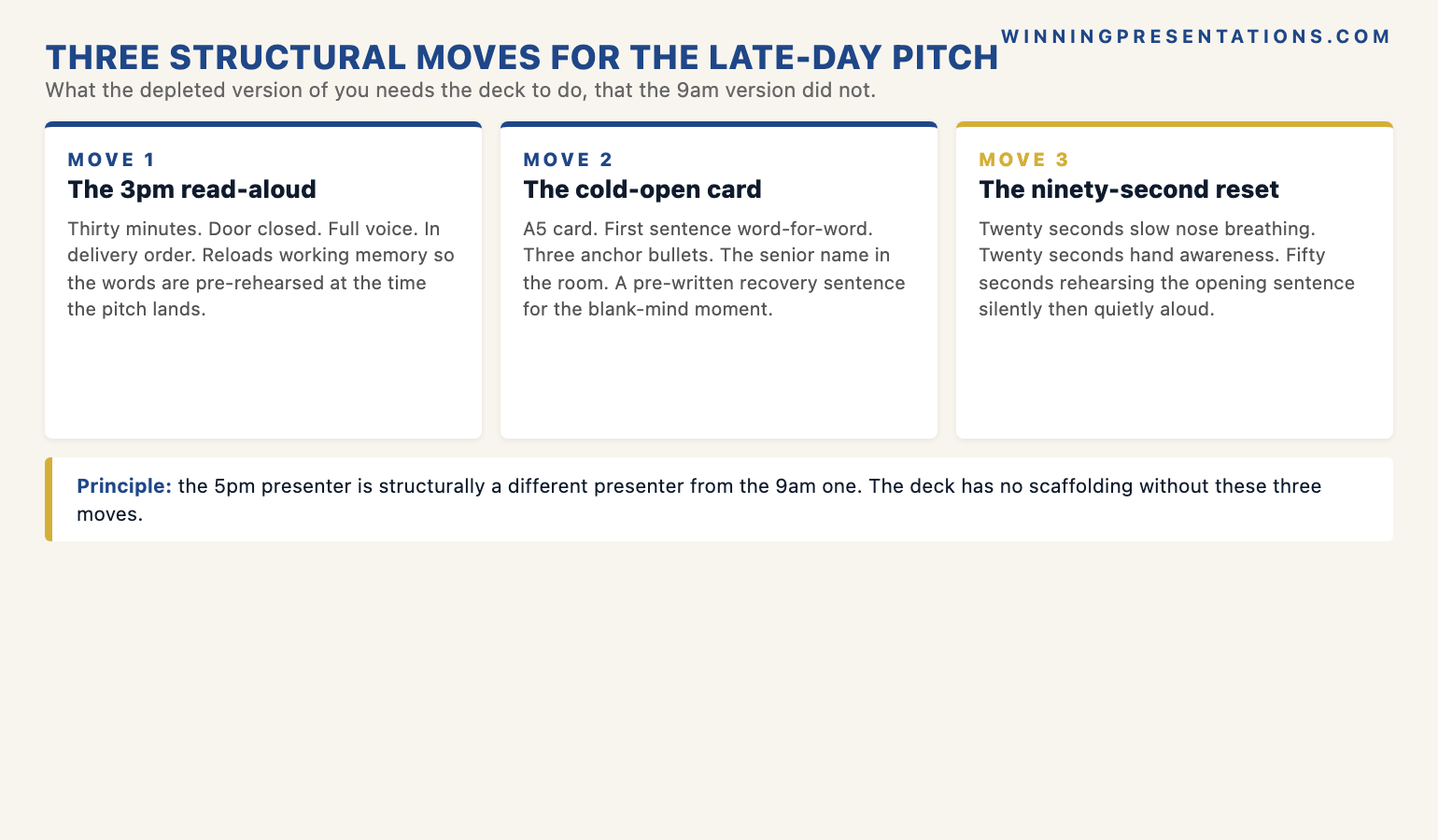
The first compensation is the 3pm read-aloud. Block thirty minutes at 3pm on the day of the late-day pitch — not 4.30pm, not while walking between rooms. Sit somewhere with a closed door and read the deck aloud from start to finish in delivery order. Aloud, not in the head. The purpose is not to rehearse the pitch — rehearsal happened earlier in the week. The purpose is to reload the working narrative into active working memory, in the depleted state, so that the 5pm version of the presenter has the spine of the argument sitting at the top of their cognition rather than two layers down. The mechanism is the difference between recognition and recall. The presenter has the content stored, but in a depleted state retrieval is slower, and the depleted presenter mistakes the slower retrieval for not knowing the material. That produces the over-explanation, the “as I mentioned earlier” loop, and the in-flight reordering. The 3pm read-aloud reloads the content from storage into active working memory, where retrieval is instant.
The discipline is that it has to be done out loud. Silent reading recruits a different set of neural pathways from spoken delivery, and the working-memory reload only happens when the presenter is constructing sentences aloud at delivery pace. The closed door matters because the depleted presenter cannot do the read-aloud properly with the awareness of being overheard. The most common reason senior presenters do not install this move is that thirty minutes at 3pm feels like a luxury when the diary is full. The thirty minutes is the difference between the 5pm pitch landing and the 5pm pitch unspooling in the second section.
If the late-day pitch fear is not just depletion — if it is the dread that builds across the afternoon and the blank-mind moment in the opening — that is the work Conquer Your Fear of Public Speaking was built for.
Mary Beth spent five years terrified of presenting before she found the structural method that ended it. Conquer Your Fear of Public Speaking is the self-paced programme she built from that work — for senior professionals whose anxiety is real and specific to high-stakes meetings. Instant download, lifetime access. £39.
- The eight-step structural method for acute presentation anxiety
- The pre-pitch dread protocol — what to do in the ninety minutes before the room
- The in-the-room threat-signal reset for when pen-clicks start reading as scepticism
- The post-pitch rumination cut-off — closing the loop on a difficult meeting before it consumes the evening
- Instant download, lifetime access, lifetime updates — £39
The cold-open card and a counter-example of a presenter who held the room
The second compensation is the cold-open card. One sheet of A5, held in the left palm or placed face-down beside the laptop, containing exactly four things: the first sentence of the pitch written out word-for-word, the three bullets that anchor the first two minutes, the name of the most senior person in the room, and a single sentence pre-written for the moment when the mind goes blank. The card is not a script. It is a recovery scaffold for the specific risk a depleted presenter carries: the half-second blank moment in the opening, where working memory misses and the depleted presenter does not have the bandwidth to improvise a recovery. The 9am presenter recovers in half a second and the room never notices. The 5pm presenter, without the card, recovers in four seconds, by which point the room has noticed and the rest of the pitch is being delivered into a room that has already calibrated expectations downwards.
The counter-example I think about often is a senior commercial director at one of the European logistics groups I worked alongside in 2011, pitching a contract-renegotiation strategy to her group commercial committee at 6.30pm. She had been on her feet since 7.45am. She walked into the room visibly tired in a way the chief of staff in the corner had already noticed. She placed a folded A5 card face-down on the table, took a clean breath, and opened with the sentence written on it: “Tonight I want to walk you through one decision and two options, and the reason the decision in front of you tonight is harder than the one this committee took eighteen months ago.” She did not look at the card again. She held the room for forty-five minutes, took twenty minutes of questions, and walked out at 7.50pm with the recommendation approved. The chief of staff, who had watched her in three previous late meetings without the card, told me afterwards that the difference was visible from the second sentence: not in her energy, which was clearly low, but in the absence of the small recovery hesitations that had characterised her previous late-day pitches.
The depletion-correction diagnostic and the ninety-second reset
The third compensation is the ninety-second physiological reset, run in the corridor outside the room two minutes before the meeting. The diagnostic has three questions. First: am I currently constructing the opening sentence in my head, or am I currently rehearsing what the room will think of me. If the second, the presenter is in threat-mode rather than delivery-mode. Second: is my breathing shallow and in the upper chest, or low and slow into the abdomen. If shallow, the cortisol baseline is elevated above where it should be for opening. Third: am I aware of my hands, or are they invisible to me. Hand awareness is a fast proxy for somatic grounding, and the depleted presenter who has lost track of their hands has lost the most reliable grounding signal available before the room.
The reset takes ninety seconds in three components. Twenty seconds of slow nose breathing with the exhalation longer than the inhalation, which downregulates sympathetic-nervous-system tone. Twenty seconds of deliberate hand awareness — pressing fingertips together, feeling the weight of the laptop bag, registering the temperature of corridor air on the palm. Fifty seconds of the cold-open card’s first sentence repeated silently three times, then once aloud quietly enough that no-one passing hears it but audibly enough that the vocal apparatus registers it. It is a three-system reset — respiratory, somatic, vocal — that takes the presenter from threat-mode to delivery-mode before the room. The wider presentation anxiety pattern covers the version where depletion is chronic rather than acute.
The failure pattern: willpower and adrenaline as substitutes for structure
The depleted presenter who has not installed the three moves reaches, almost without exception, for one of three substitutes — willpower, caffeine, or a pre-meeting psyche-up. Willpower means walking in intending to concentrate harder, which a depleted prefrontal cortex cannot deliver on; what shows up is a presenter visibly working harder, which the room reads as effortful rather than authoritative. Caffeine addresses the cortisol curve partially but does nothing for the working-memory reload, and in the over-caffeinated version sharpens reactivity to ordinary room signals in exactly the wrong direction. The pre-meeting psyche-up further depletes executive-function reserves and produces an opening that is high-energy but cognitively thin. The cost is paid over months: each late-day pitch becomes slightly more aversive, the rumination heavier, and willingness to take on the next one declines. The visible career cost is the senior leader who quietly stops accepting late-afternoon slots. The longer-arc presentation-confidence pattern covers what happens when the compensations are installed consistently.
The depletion is real, but the anxiety underneath it is often the larger structural issue.
If the late-day pitch is the meeting you have been quietly declining for months, if the dread is building across the afternoon rather than only in the corridor, if the post-meeting rumination is the part that takes the longest to come down from — those are signs the underlying work is the anxiety itself, not just the depletion. Conquer Your Fear of Public Speaking is the eight-step programme Mary Beth built from her own five years of presentation terror. Self-paced, lifetime access, instant download, £39.
One thing to do before your next late-day pitch
Block thirty minutes at 3pm in the diary today, for the next late-day pitch on your calendar. Not 4.45pm, not on the move, not in the head. Thirty minutes, closed door, full voice, deck read aloud in delivery order. Write the cold-open card on an A5 sheet before you start — first sentence word-for-word, three anchor bullets, senior name, pre-written blank-mind recovery sentence. Slip it into the inside pocket of the laptop bag. Two minutes before the room, run the three-question diagnostic and the ninety-second reset. Walk in. Open with the first sentence on the card. The senior director on the twelfth floor in 2007 walked out of the 5.15pm pitch knowing it had gone badly and not knowing why. The version of her who installed these three moves the following quarter walked into her next 5pm meeting with the same depletion and a different outcome. The deck had not changed. The presenter had not changed. The scaffolding had.
Frequently asked questions
Won’t a cold-open card make me look unprepared or like I’m reading from notes?
The opposite reaction is the consistent one in senior rooms. The card sits face-down or in the palm and is referenced for the first sentence only. What the room sees in the first two minutes is a presenter who opens cleanly and holds the spine of the argument without hesitation. Senior audiences read a clean opening as evidence of preparation; the physical artefact, if noticed at all, is read as professional rather than tentative. The presenter who appears under-prepared is the one who opens with a hedged sentence and visibly searches for the spine of the pitch in the first thirty seconds — which is what happens to a depleted presenter without the card. The card is the difference between looking prepared and looking depleted.
I can’t block thirty minutes at 3pm — what is the minimum version that still works?
Fifteen minutes works, with one cost. It is enough for one pass of the deck out loud in delivery order, but not the second backwards-then-forwards pass that consolidates the reload. The presenter retains the spine but is more fragile to mid-flight reordering — if the room pulls the pitch off-sequence with an early question, recovery takes a beat longer. The cold-open card and the ninety-second reset are non-negotiable; the 3pm read-aloud is the component that flexes if the diary will not hold thirty minutes. What does not work is the silent skim in the four minutes before the meeting — that is a different exercise entirely.
Is this really anxiety, or is it just tiredness?
It is both, and the two interact. Late-day depletion lowers the threshold at which the nervous system reads room signals as threat signals, which produces a low-grade anxiety state that does not feel like the acute panic most senior presenters associate with the word. It feels like the room being harder than expected, the small over-explanation creeping into sentences, the half-second blank moment in the opening. That is anxiety operating at the depletion-amplified level, and it is the version most senior presenters experience most often. The acute version — the racing heart, the dry mouth, the dread in the corridor — is the same mechanism at a higher amplitude. Conquer Your Fear of Public Speaking is the resource built for the acute version specifically.
Does the time of day actually matter, or is this really about cognitive load regardless of when?
Both matter, and the time of day is a proxy for the cognitive load accumulated by then. A presenter with an unusually heavy morning can arrive at a noon pitch in the same depleted state another presenter would only reach by 5pm. The three compensations are calibrated to depletion, not to the clock. The reason the late-day pitch is the canonical case is that depletion is cumulative across a working day. The corridor diagnostic is the more reliable signal; the clock is a useful default trigger.
The Winning Edge — weekly newsletter
The Winning Edge is a weekly (Thursday) newsletter for senior professionals who present at the executive level. One short email a week, focused on the structural moves that separate pitches the room remembers from pitches that disappear into the meeting log. Subscribe to The Winning Edge →
For the broader picture across slides, storytelling, confidence, and delivery beyond the late-day pitch specifically, the seven-product Complete Presenter library is the bundle most senior leaders find useful as a single resource — £99 for everything, lifetime access.
About the author
Mary Beth Hazeldine is Owner & Managing Director of Winning Presentations Ltd. With 24 years of corporate banking experience at JPMorgan Chase, PwC, Royal Bank of Scotland, and Commerzbank, and 16 years coaching senior professionals through high-stakes presentations, she works with executives across financial services, healthcare, technology, and government on the structural and psychological scaffolding that makes difficult meetings — including the late-day pitch — land. She spent five years terrified of presenting before building the structural method that ended it.