

The Two-Hour Protocol Senior Leaders Use Before Delivering News They Don’t Personally Agree With
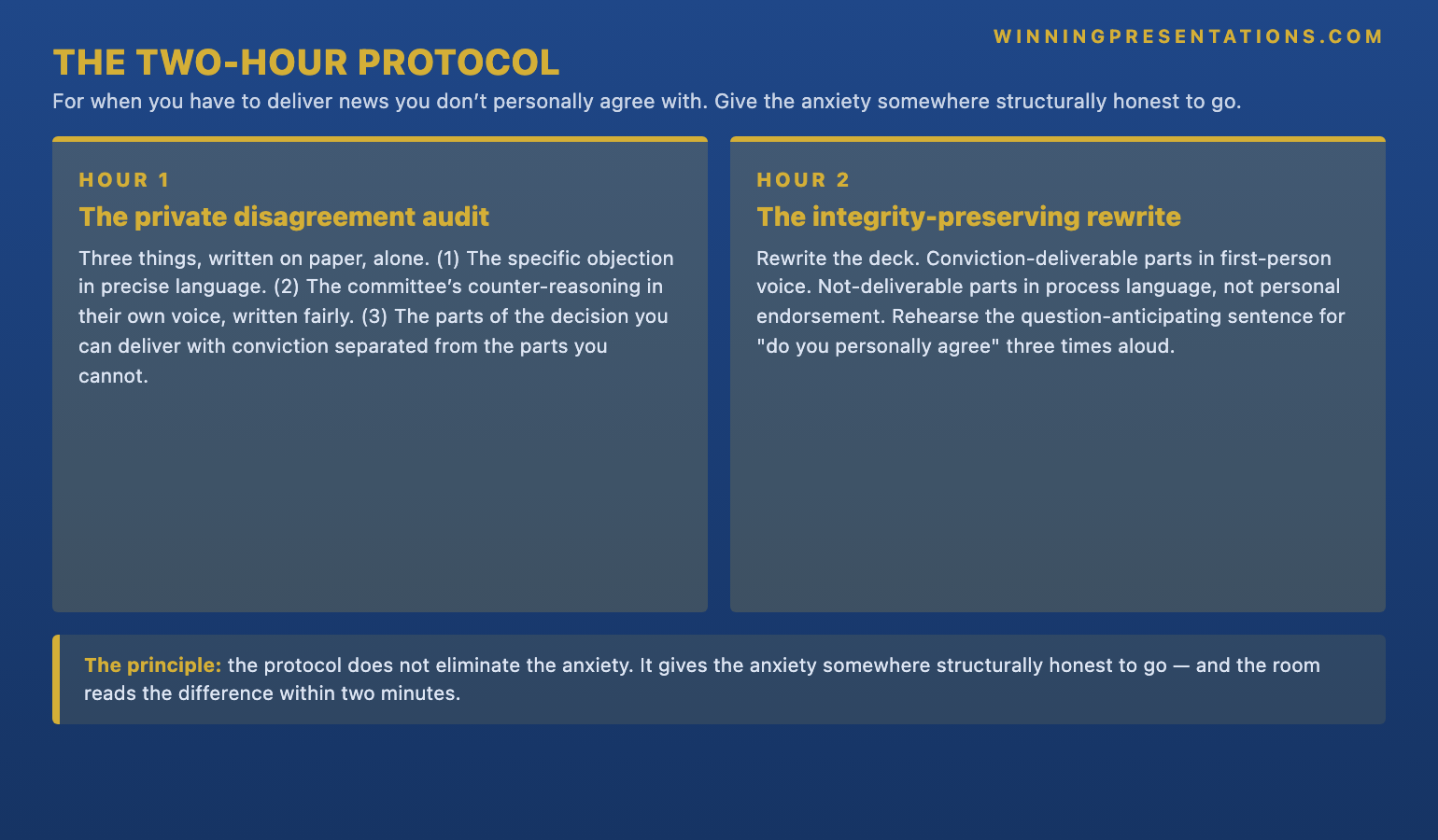
Quick answer: When you have to deliver news you don’t agree with, the anxiety that surfaces in the 24 hours before the announcement is not stage fright. It is the friction between private disagreement and public delivery, and faking conviction makes it worse rather than better. The two-hour protocol senior leaders use: hour one is the private disagreement audit — write the specific objection you carry, write the executive committee’s counter-reasoning in their own voice, and identify which parts of the decision you can deliver with structural conviction and which parts you cannot. Hour two is the integrity-preserving rewrite — rewrite the announcement around the parts you can deliver with structural conviction, build the rest around process commitments rather than personal endorsements, and rehearse the sentence you will use if asked directly whether you personally agreed with the decision. Two hours, the day before the announcement, alone with paper. The protocol does not eliminate the anxiety; it gives the anxiety somewhere structurally honest to go.
JUMP TO:
- Why this anxiety is different from stage fright
- Hour one: the private disagreement audit
- Hour two: the integrity-preserving rewrite
- The question you will be asked and the sentence to rehearse
- On the day: the calm that comes from structural honesty
- After the meeting: the conversations that test whether the protocol held
- Frequently asked questions
In late 2019, a senior leader I had been coaching for about six months — a divisional finance director at one of the European insurance groups I was supporting, in her mid-40s and three years into the role — phoned me on a Sunday evening. She was due to deliver a major restructuring announcement to her division the following Tuesday morning, and she had spent the weekend in the kind of low-grade physical anxiety she had not experienced in fifteen years of senior presenting. She slept poorly, woke at 4am with a knot in her chest, and could not focus on the holiday-weekend reading she had set aside for herself. She had presented to bigger rooms, on more contentious topics, with more career risk, and had handled all of it cleanly. What was different about this announcement was that she did not personally agree with the substance of the decision being announced. The executive committee had signed off a restructuring she had argued against in three separate meetings over the previous quarter, the decision had gone the other way, and she was now the leader whose job it was to deliver it to her division. The anxiety she was carrying was not stage fright. It was the friction between her private position and the public delivery she had to make, and she could not find a way to think about the announcement that did not feel like a kind of personal dishonesty. The week before, she had tried to talk herself into believing the decision was right; that had not worked. She had tried to compartmentalise — “the executive committee’s decision is the company’s decision, my job is to deliver it” — and that had not worked either. The compartmentalising had made the anxiety worse, because she could feel herself preparing to fake a conviction she did not actually carry, and the room she was about to walk into included three people who had been with her through the original arguments and would notice the gap.
(This article was created with AI assistance; all stories and insights are based on 35 years of real client work.)
This piece walks through the two-hour protocol senior leaders use when they have to deliver news they don’t personally agree with — the structural work that converts private disagreement into delivery the room can trust without requiring the leader to fake conviction. The protocol covers the private disagreement audit, the integrity-preserving rewrite, the sentence to rehearse for the question that may come, the calm that comes from structural honesty on the day, and the conversations after the meeting that test whether the protocol held. The article does not promise that the anxiety will disappear. It promises that the anxiety will have somewhere structurally honest to go, which is usually enough.
Before the next announcement that carries this kind of friction, a one-page structural check is worth a look.
The Executive Presentation Checklist walks through the structural moves senior leaders use to land difficult announcements — the disagreement audit, the integrity-preserving rewrite, the personal-commitment language that doesn’t require faked conviction, and the post-meeting conversation list. Free download, no email gate.
Why this anxiety is different from stage fright
The anxiety that surfaces in the 24 to 72 hours before delivering news the leader privately disagrees with is structurally different from stage fright, and the two require different responses. Stage fright is anticipatory anxiety about whether the leader will perform competently on the day — whether the voice will hold, whether the deck will work, whether the questions will be answerable, whether the room will be hostile. The body responses are familiar: shallow breathing, dry mouth, racing thoughts, the feeling of being watched. The standard preparation work — rehearsal, breath work, sleep, micro-rituals before walking in — addresses stage fright competently because stage fright responds to mastery of the material and the room.
The anxiety of delivering news the leader doesn’t agree with is not about competence and does not respond to rehearsal. It is integrity friction — the unconscious recognition that the body is being asked to deliver something the mind has privately judged to be wrong, and that the room will be watching for the gap. The body responses are different from stage fright in subtle but recognisable ways: the anxiety surfaces earlier (often three or four days before the announcement rather than the night before), it interferes with sleep more deeply than stage fright typically does, it shows up as a sense of personal heaviness rather than as racing thoughts, and it cannot be talked away by reminding the leader that they have presented competently to harder rooms. Rehearsal does not help because the issue is not whether the leader can deliver the words; it is whether the leader can deliver them without feeling that they are personally lying. Breath work helps the physical symptoms but does not address the source.
The mistake most senior leaders make at this point is to try to resolve the integrity friction by converting their private disagreement into private agreement — talking themselves into believing the executive committee was right after all, finding the reasoning that makes the decision feel acceptable, building internal alignment retrospectively. The conversion attempt almost never works, because the original disagreement was usually well-considered and the new reasoning is generated under pressure to relieve the anxiety rather than from genuine reconsideration. The conversion attempt also damages the leader’s judgement going forward, because it trains them to override their own well-reasoned positions when the institutional pressure becomes uncomfortable. The two-hour protocol works differently: it does not try to convert the disagreement; it gives the disagreement somewhere structurally honest to live, and rewrites the announcement around the parts the leader can deliver with structural conviction.
Hour one: the private disagreement audit
Hour one of the protocol is the private disagreement audit. The discipline is to write, on paper, alone, with no screen open, three things. First: the specific objection the leader carries, in the most precise language they can manage. Not “I don’t think this is the right call” — that is too vague to work with. The specific version: “I think the consolidation of the regional teams sacrifices the customer-proximity advantage we built over four years, and the projected cost savings of fifteen percent will be offset by within-eighteen-months attrition in the regional commercial talent we lose because they joined for the regional model.” The specificity matters. The disagreement audit is the place to give the objection its sharpest form, because that is the only way the rest of the protocol can work cleanly on it.
Second: the executive committee’s counter-reasoning, written in the executive committee’s own voice, as fairly as the leader can manage. Not the cartoon version of their reasoning. The honest version. “The executive committee’s position is that the cost structure of three regional teams is unsustainable at current revenue, the customer-proximity advantage is real but smaller than the operating cost it carries, and the consolidation preserves the customer relationship through the new account-director model even if it loses some of the field-level proximity. They judge that within-eighteen-months attrition is a manageable risk and within the budgeted programme cost.” The discipline of writing the counter-reasoning in their voice is uncomfortable because it requires the leader to engage seriously with the argument they lost. The discomfort is the work. The two-hour protocol cannot work if the counter-reasoning is written as a strawman; it has to be written as if the leader were trying to win the argument from the other side, because that is the only way the leader can see what parts of the decision they can deliver with structural conviction.
Third: the parts of the decision the leader can deliver with structural conviction, separated from the parts they cannot. This is the most important output of hour one. The audit almost always reveals that the leader can deliver substantially more of the decision with structural conviction than the global private disagreement initially suggested. The cost-structure analysis is usually solid. The implication-by-function timing is usually accurate. The consultation process is usually fair. The personal commitments to the affected teams are usually ones the leader can make in their own voice. What the leader typically cannot deliver with conviction is one or two specific elements — the strategic judgement about customer proximity, the projection about attrition rates, the assessment of competitive position. Those one or two elements need different language in the announcement. The rest can be delivered straight. The audit makes that separation visible and writeable.
Hour two: the integrity-preserving rewrite
Hour two is the integrity-preserving rewrite of the announcement. The discipline is to take the deck the leader has been planning to deliver, and rewrite it so that the parts the audit identified as deliverable-with-conviction are spoken in the leader’s own first-person voice, and the parts identified as not-deliverable-with-conviction are spoken in process language rather than as personal endorsements. The rewrite usually involves about a third of the deck. The other two thirds were already fine.
The mechanics of the rewrite for the not-deliverable-with-conviction sections: replace “I believe this is the right approach” with “The executive committee has reached this decision after [specific process detail], and my role is to deliver it cleanly and chair the consultation period through to a fair outcome”. Replace “This is the strategic move our division needs to make” with “This is the decision the executive committee has signed off, and the implementation work over the next two quarters is what I will personally chair”. Replace “I am confident this will deliver the results we need” with “The committee’s analysis projects [specific outcome] over [specific timeframe], and the consultation period and the implementation reviews will test that projection against operational reality”. The pattern is consistent: personal endorsement language becomes process language; first-person belief becomes first-person operational commitment; future projection becomes named-process accountability. The room reads the difference and reads it as honesty rather than as the leader hedging.
The mechanics for the deliverable-with-conviction sections: keep them in the first-person voice, with no softening. “I am committing personally to chairing the weekly consultation review through to 14 April. I will write personally to every individual whose role is at risk by Friday next week. I will be in this room every Wednesday at 4pm through the consultation period.” These sentences carry the leader’s own voice because they are about the parts of the decision the leader can deliver with structural conviction — their personal commitments to the consultation process, regardless of their private view of the underlying decision. The first-person voice on these commitments is the structural artefact that holds the room’s trust. The leader who delivers the not-deliverable-with-conviction sections in process language AND the deliverable-with-conviction sections in personal voice is signalling that they have done the integrity work and are absorbing the difficulty rather than performing through it. The room reads the difference within the first few minutes of the announcement.
The anxiety of delivering news you don’t agree with does not respond to rehearsal or breath work. It responds to structural honesty, and that requires preparation discipline rather than mindset work.
Conquer Your Fear of Public Speaking is the structured preparation system senior professionals use when the anxiety is not stage fright but integrity friction — difficult announcements, decisions inherited from above, personally-uncomfortable institutional positions. The system covers the preparation discipline that gives the anxiety somewhere structurally honest to go, the language patterns that hold the room without requiring faked conviction, and the post-meeting recovery work that prevents the residue from compounding into future announcements. Designed for senior professionals across financial services, healthcare, technology, and government. £39, instant download, lifetime access.
- Structured preparation framework for the three different anxiety patterns — stage fright, integrity friction, and recovery from a presentation that went sideways — with the protocol for each
- Language pattern library for the high-friction sentences — how to deliver inherited decisions without faking conviction, how to acknowledge difficulty without performing emotion, how to handle the direct “do you personally agree” question
- Post-meeting recovery work — the two-day protocol for resolving the physical residue of a difficult announcement before it compounds into the next one
- Designed for senior leaders, not for first-time presenters — built around the structural sources of senior anxiety, not the basics of public speaking
- Instant download, lifetime access, lifetime updates — £39
The question you will be asked and the sentence to rehearse
The question that most likely surfaces in the Q&A, in the corridor walk afterwards, or in the one-to-one with a long-tenured operating director three days later is the direct one: “Do you personally agree with this decision?” The leader who has not prepared for the question typically does one of three things, all of which damage the trust the rest of the announcement was building. They overclaim conviction (“Absolutely, this is exactly the right call”) and the room reads the overclaim within seconds; they deflect to process (“The executive committee has made the decision, my role is to deliver it”) and the room reads the deflection as a non-answer that confirms the disagreement; or they undercommit (“I had some concerns but I am here to deliver the decision”) and the room reads the undercommitment as the start of a public airing of internal dissent that puts the asker in an awkward position. None of the three is the right answer.
The right answer is a single sentence the leader rehearses in advance, during hour two of the protocol, and delivers in the same calm voice as the rest of the announcement. The structural shape: acknowledge the legitimacy of the question, name the relationship between the personal view and the institutional decision honestly without disclosing the substance of the private disagreement, and return the conversation to the consultation period. The sentence the divisional finance director eventually used: “I argued the case for and against during the executive-committee discussions, the committee weighed the options and reached the decision we’re implementing, and the work I’m focused on now is making sure the consultation period gives every affected person a fair hearing and gets us to the right operational outcome.” The sentence acknowledges that the leader was part of the deliberation, signals without disclosing that there were arguments on both sides, names the executive committee’s authority to make the call, and returns the focus to the consultation period where the leader’s personal commitment is unambiguous.
The rehearsal of the sentence is not optional. The leader who has not said the sentence aloud at least three times before the meeting will deliver it under pressure with the wrong rhythm, the wrong emphasis, or the wrong follow-on, and the asker will read the unevenness as evidence of deeper disagreement than the leader actually intended to signal. Saying the sentence aloud the night before, three times, in the same voice the leader will use on the day, is the work that makes the sentence land cleanly when the question comes. The rehearsal is also the moment the leader notices whether the sentence itself is honest — if the sentence reads as evasive when said aloud, it needs to be rewritten until it reads as honest, because the room will hear what the leader hears in the rehearsal. The role-change anxiety protocol for presenters in new functions covers the parallel rehearsal work for leaders presenting outside their existing vocabulary; the structural discipline is the same.
On the day: the calm that comes from structural honesty
On the day of the announcement, the calm that the leader experiences is not the calm of having resolved the disagreement — the disagreement is still there, sitting privately where it was when the leader walked into hour one of the protocol the day before. The calm is the calm of having a structurally honest place for the disagreement to live, and a clean separation between the parts of the announcement the leader can deliver with conviction and the parts they cannot. The body responses change measurably between the warmth-first announcement the leader would have delivered without the protocol and the integrity-preserving version they deliver with it. The leader who has done the protocol typically sleeps better the night before, has less of the physical heaviness that the integrity friction produces, and delivers the announcement with the kind of low-grade composure that the room reads as someone who has absorbed the difficulty rather than as someone who is suppressing it.
The room reads the difference within the first two minutes of the announcement. The integrity-preserving rewrite produces sentences that sound different from the warmth-first version: the personal commitments in first person, the inherited-decision sections in process language, the question-anticipating sentence rehearsed the night before. The combination signals to the room that the leader has done the structural work of separating their personal view from their delivery responsibility, which is the work the room would do for itself if it were standing where the leader is standing. The room respects the work even when it does not consciously identify what the work is. The respect is what shows up as the calm responsiveness from the affected functions during the Q&A, the willingness to ask substantive questions rather than to challenge the leader’s motives, and the absence of the corridor speculation that the warmth-first announcement would have triggered. The calm of the leader and the calm of the room are produced by the same structural artefact: the integrity-preserving rewrite that hour two of the protocol produces.
The other physical signal worth naming is what happens at the end of the announcement, in the ten minutes between closing the deck and leaving the room. Leaders who delivered a faked-conviction version of the announcement typically experience a particular kind of post-meeting heaviness in those ten minutes — a sense of having performed something they did not personally own, which compounds the integrity friction rather than relieving it. Leaders who delivered the integrity-preserving version typically experience the opposite — a sense of relief that is structurally clean, because nothing they said in the announcement required them to fake conviction they did not carry. The post-meeting state is the diagnostic for whether the protocol worked. If the leader walks out feeling structurally clean, the protocol worked. If the leader walks out feeling that they performed something dishonest, the integrity-preserving rewrite did not reach far enough into the deck and one of the sections still requires the leader to fake conviction they do not carry. The fix, for the next announcement, is to extend the rewrite to that section.
When the announcement is one the leader cannot fake conviction on — an inherited decision, a politically difficult restructuring, a strategic shift the leader argued against — the integrity work is only half of what holds the room.
The Executive Buy-In Presentation System covers the structural work that complements the integrity-preserving rewrite — the framework for pre-handling the operating sponsors who will be in the room, mapping the affected functions’ likely objections to the inherited decision, and designing the consultation-period commitments that let the leader hold trust without requiring faked conviction. 7 modules, self-paced with monthly cohort enrolment, optional recorded Q&A calls. £499, lifetime access to materials.
After the meeting: the conversations that test whether the protocol held
The conversations that test whether the protocol held are the ones that happen in the 48 to 72 hours after the announcement, with three specific people: the long-tenured operating director who was in the room and read the structural sequence; the chief of staff who knows the leader well enough to notice the difference between the warmth-first version and the integrity-preserving version; and the affected-function leader the announcement most directly affects. The leader who has done the protocol should expect to have one substantive conversation with each of these three people, usually within the first 48 hours, usually unscheduled, and usually framed by the other party as “I just wanted to check in” rather than as a formal feedback meeting. The substance of those conversations is the most honest signal the leader will get about whether the protocol worked.
The signals worth listening for: the long-tenured operating director will, in their own way, signal whether the room read the announcement as honest or as performed. The signal rarely comes as direct feedback; more often it comes as the operating director offering to chair a specific consultation conversation, to convene a specific affected-function meeting, or to write personally to a particular at-risk individual the leader was planning to write to themselves. The offer is the signal that the operating director trusts the leader’s handling of the difficulty enough to lend their own operational capital to the consultation. The chief of staff’s signal is usually different and more direct — a comment on whether the announcement felt structurally clean or whether something jarred. The chief of staff who has worked with the leader for several years can tell the difference between the integrity-preserving version and the faked-conviction version, often within the first ninety seconds of the announcement, and their post-meeting comment is worth listening to closely. The affected-function leader’s signal is the most operational: do they engage with the consultation process as a co-ordination or do they engage with it as a defensive posture. The first signals the protocol held; the second signals the integrity friction in the announcement leaked into the affected function’s reading and now sits inside the consultation period as friction that has to be worked through.
The work after the meeting, regardless of how the announcement landed, is to debrief the protocol with someone outside the situation — a peer in a different organisation, an external coach, a former colleague the leader trusts. The debrief is not a performance review of the announcement; it is a structural review of whether the protocol worked, where the integrity-preserving rewrite reached far enough, and where it did not. The leaders who do the post-meeting debrief consistently are the leaders who get better at delivering inherited decisions over time, because each debrief sharpens the next protocol. The leaders who skip the debrief carry the residual integrity friction into the next announcement, and the friction compounds across four or five announcements until something gives. The upstream restructuring board briefing covers the structural sequencing work for the executive-committee approval meeting that precedes the announcement; the announcement-day protocol described here is what follows downstream.
One thing to do the day before the next difficult announcement
Block two hours, the afternoon before the announcement, alone with paper and no screen. Hour one: write the three audit outputs — the specific objection, the executive committee’s counter-reasoning in their voice, the parts of the decision the leader can deliver with structural conviction separated from the parts they cannot. Hour two: rewrite the announcement around the conviction-deliverable parts in first person and the not-deliverable parts in process language. Rehearse the question-anticipating sentence aloud three times. Walk into the announcement the next morning with the two pages from the protocol in the leader’s bag. The anxiety will still be there. It will have somewhere structurally honest to go, and the room will read the difference within the first two minutes.
Frequently asked questions
Isn’t there a duty of executive solidarity that means I should publicly support the decision regardless of my private view?
There is a duty of executive solidarity, and the protocol does not violate it. The protocol does not require the leader to disclose private disagreement, criticise the decision, or signal dissent to the room. What it does is replace the language of personal endorsement (“I believe this is the right call”) with the language of institutional decision plus operational commitment (“The committee has reached this decision and the consultation period is what I will personally chair”). The room reads the second as supportive of the institutional decision and honest about the leader’s role, which is the structural posture executive solidarity actually requires. The version executive solidarity does NOT require is the one where the leader fakes personal conviction they do not carry, because that version damages the leader’s long-term credibility without strengthening the institutional decision in any meaningful way. The protocol preserves solidarity by preserving the institutional decision as the load-bearing position of the announcement, while removing the requirement that the leader personally endorse it.
What if I am asked the direct “do you personally agree” question and the rehearsed sentence does not feel right in the moment?
If the rehearsed sentence does not feel right in the moment, the issue is usually that the sentence is more evasive than the situation requires rather than too direct. The fix is to deliver a slightly more direct version that still respects the executive committee’s authority: “I argued some points differently in the executive-committee discussion; the committee weighed the options and reached this decision; the work I’m focused on now is the consultation period.” The acknowledgement that the leader argued some points differently is fine to disclose at that level of generality — it does not name what the leader argued, does not signal the substance of the disagreement, and does not put the executive committee’s decision in question. What it does is honour the asker’s legitimate question with an honest answer at the same level of generality as the question. The room reads honest acknowledgement at that level as integrity-preserving rather than as dissent.
Does the protocol work when I have to deliver news that involves redundancies of people I personally know well?
It works in those circumstances and it is the most demanding application of the protocol. The integrity friction in those announcements has two layers — the leader’s view of the strategic decision and the leader’s personal relationships with the specific individuals affected. The protocol addresses the first layer through hours one and two. The second layer requires additional work: the leader needs to identify, in advance of the announcement, which individuals they will write to personally in the first 48 hours, which they will meet face-to-face in the first week, and which they will phone rather than email. The named-individual commitments belong in the personal-commitment section of the announcement and need to be made in first person. The combination of the strategic-layer protocol and the named-individual commitments allows the leader to walk into the announcement with structural honesty on both layers. The post-meeting work is also more demanding in these circumstances; the leader should expect to spend significantly more time in the corridor walks and one-to-one conversations than a less personally-loaded restructuring would require.
What if the anxiety is so severe that the two-hour protocol is not enough to settle me before the announcement?
If the anxiety is severe enough that the protocol alone does not settle the leader, the most likely cause is that one of the hour-one audit outputs is not yet written honestly. Usually it is the second output — the executive committee’s counter-reasoning in their own voice — that has been written as a strawman rather than as the fairest version of their position. The body knows when the audit is not honest, and the anxiety persists until the audit is rewritten more fairly. The fix is to spend a second hour on hour one specifically, with someone else in the room — an executive coach, a peer, a long-tenured chief of staff — who can pressure-test the counter-reasoning until it reads as the version the executive committee would themselves recognise. Once the audit is honest, hour two and the rest of the protocol typically settle the anxiety to a manageable level. The cases where the anxiety remains severe after a fully-honest audit are rare and usually indicate that the leader is being asked to deliver something genuinely incompatible with their professional integrity, in which case the conversation that needs to happen is with the executive committee about whether the leader is the right person to deliver this particular announcement.
How do I know whether the protocol worked after the announcement is over?
The diagnostic is the leader’s own state in the ten minutes between closing the deck and leaving the room. Leaders who delivered the integrity-preserving version typically experience a structurally clean relief, because nothing they said required them to fake conviction. Leaders who delivered a faked-conviction version typically experience a residual heaviness that signals the integrity friction was not resolved. The second diagnostic is the substantive questions in the Q&A — engaged operational questions signal the room trusted the announcement; absence of questions or vague concerns signal the room read something off. The third diagnostic is the corridor walk in the next 48 hours: specific questions about role-loss numbers, consultation timing, and named-owner accountability signal the announcement landed; general unease, vague concerns about “the direction of the division”, or repeated questions about “why now” signal the integrity friction in the announcement leaked into the room’s reading and now sits inside the consultation period as additional work the leader has to do over the following weeks.
The Winning Edge — weekly newsletter
The Winning Edge is a weekly (Thursday) newsletter for senior professionals who present at the executive level. One short email a week, focused on the structural moves that separate announcements the leader can deliver with integrity from announcements that require faked conviction. Subscribe to The Winning Edge →
For the broader picture across slides, storytelling, confidence, and delivery, the seven-product Complete Presenter library covers the full set of structural disciplines — £99 for everything, lifetime access.
About the author
Mary Beth Hazeldine is Owner & Managing Director of Winning Presentations Ltd. With 24 years of corporate banking experience at JPMorgan Chase, PwC, Royal Bank of Scotland, and Commerzbank, she advises executives across financial services, healthcare, technology, and government on structuring presentations for high-friction announcements, inherited decisions, and difficult institutional positions.