Category: Executive Presentations

16 Feb 2026
Executive focused at laptop building a presentation under time pressure, navy blazer, warm office lighting, coffee on desk

The Last Minute Presentation Framework That Saved My Career (Twice)

Forty minutes. That’s how long I had between “Mary Beth, the CFO needs an update on the integration programme — you’re presenting at 3pm” and walking into the boardroom.

Quick answer: A last minute presentation doesn’t fail because you had no time. It fails because you tried to build a full deck in a fraction of the time. The emergency framework is five slides, built in a specific order: decision needed, current situation, options, recommendation, next steps. You write the headlines first, add one supporting point per slide, and rehearse the transitions once. This takes 25–30 minutes and produces a clearer deck than most people create in three days.

The first time it happened, I was at Royal Bank of Scotland. A VP had called in sick twenty minutes before a steering committee meeting. My manager appeared at my desk: “You know the project. You’re presenting.” I had no slides, no notes, and no choice.

I spent the first ten minutes panicking. Then I wrote five headlines on a notepad, opened PowerPoint, typed them as slide titles, and added one sentence under each. I walked in with a five-slide deck that looked intentional.

The steering committee approved the budget. Afterwards, a director I barely knew said: “That was the clearest update we’ve had on this project.” He didn’t know it was built in thirty minutes. And that’s when I realised: the emergency framework wasn’t a compromise. It was better than most planned decks.

Why Last Minute Presentations Fail (It’s Not the Time)

The natural response to a last minute presentation is compression: take everything you’d normally include and cram it into whatever time you have. This is the single biggest mistake you can make under time pressure.

Compression produces a bloated deck delivered at speed. Your audience gets more information than they can process, delivered by a presenter who hasn’t rehearsed, with slides that don’t connect because they were assembled rather than structured. The result feels frantic — and frantic signals incompetence, even when the content is sound.

The executives I’ve trained across JPMorgan Chase, PwC, Royal Bank of Scotland, and Commerzbank over 24 years all share the same discovery: the best last minute presentations aren’t compressed versions of full presentations. They’re structured differently from the start. Five slides with clear headlines will outperform twenty rushed slides every single time — because clarity signals competence more than volume does.

The real problem isn’t time. It’s the instinct to build the deck you wish you had time for, instead of the deck your audience actually needs. If you understand how executives evaluate presentations — and what executives actually read on your slides — you’ll realise that five slides is often the right number even when you have three weeks to prepare.

PAA: How do you prepare a presentation with very little time?
Start with the decision, not the background. Write five slide headlines before opening PowerPoint: what decision is needed, what the current situation is, what the options are, what you recommend, and what the next steps are. Type those headlines as slide titles, add one supporting sentence or data point per slide, and rehearse the transitions between slides once out loud. This takes 25–30 minutes and produces a more focused deck than starting with a blank canvas.

The Emergency Framework Lives Inside This System

The Executive Slide System gives you a pre-built structure, slide sequencing framework, and executive messaging templates — so you never start from a blank screen again. When you have 30 minutes, you need a system, not inspiration.

Get the Executive Slide System → £39

Built from 24 years in corporate banking. Used in boardrooms, steering committees, and approval meetings across every industry.

The 5-Slide Emergency Framework (30 Minutes)

This is the framework I’ve used personally and taught to executives for fifteen years. Five slides, each with a single job. Build them in the order below — not in presentation order — and you’ll have a structured, focused deck in under thirty minutes.

Slide 1: The Decision (or The Ask). What do you need from this audience? Start here because everything else flows from it. “We need approval to extend the pilot by 60 days” or “I’m recommending we proceed with Option B” or “The committee needs to decide between three vendor options.” If there’s no decision, the frame is: “Here’s what you need to know and what it means.” One sentence headline. One supporting line. Done.

Slide 2: Current Situation. Where are we right now? Three to four bullet points maximum — facts only, no interpretation. Revenue, timeline status, key metrics, blockers. This slide answers: “What’s actually happening?” Your audience needs context before they can evaluate your recommendation. Keep it to data they can verify, not opinions they’ll debate.

Slide 3: The Options (or The Problem). If it’s a decision meeting: lay out 2–3 options with one-line trade-offs for each. If it’s an update: describe the core challenge or what’s changed since the last meeting. This slide creates the frame for your recommendation. Without it, your recommendation feels like an assertion. With it, your recommendation feels like the logical conclusion of the evidence.

Slide 4: Your Recommendation. What do you think should happen, and why? One recommendation, supported by 2–3 reasons. Don’t hedge. The biggest mistake in last minute presentations is presenting options without a recommendation because you “didn’t have time to think it through.” You did. You just need to trust your judgement. If you genuinely don’t have a recommendation, say so — and explain what you’d need to form one.

Slide 5: Next Steps. Who does what by when? Three to four concrete actions with owners and dates. This slide does two things: it signals that you’ve thought beyond the meeting, and it gives the audience something to approve rather than something to debate. “Approve Option B and I’ll have the implementation plan by Friday” moves faster than “Let me know what you think.”
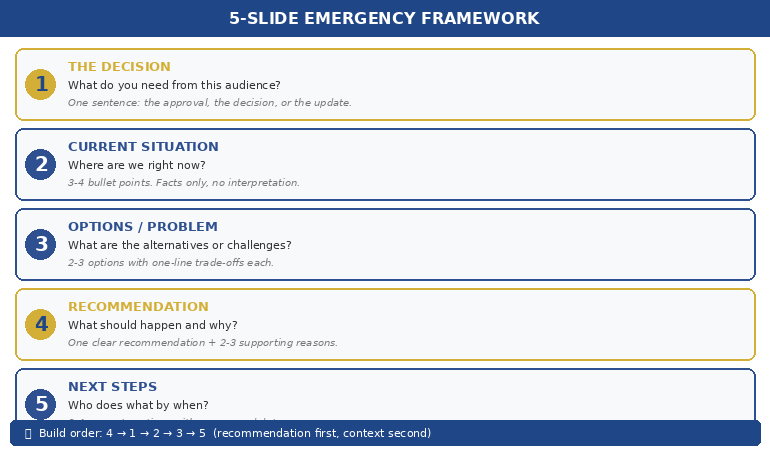

Five-slide emergency presentation framework showing Decision, Situation, Options, Recommendation, and Next Steps cards

The reason this works under pressure is that each slide has exactly one job. You’re not deciding what to include — the framework decides for you. Your only task is filling in the specifics. That’s the difference between building a deck and filling in a structure.

📊 Want this framework pre-built in a reusable template?

The Executive Slide System includes the emergency 5-slide structure, sequencing rules, and messaging templates for every executive scenario.

Get the Executive Slide System → £39

The Order You Build It (Not the Order You Present It)

Here’s a counter-intuitive rule: don’t build the deck in the order you present it. Build it in the order that’s fastest to think through.

Build first: Slide 4 (Recommendation). You probably already know what you think should happen. Write it down. One sentence. This anchors everything else — because once you know what you’re recommending, you know what context and evidence to include (and what to leave out).

Build second: Slide 1 (The Decision). Now frame the ask. “I’m recommending X. The committee needs to approve / reject / modify.” This takes thirty seconds because you’ve already written the recommendation.

Build third: Slide 2 (Current Situation). What facts support your recommendation? Don’t include everything you know — include only the 3–4 data points that make your recommendation feel inevitable. This is where most people go wrong under pressure: they include everything because they’re afraid of getting caught without an answer. But including everything actually weakens your recommendation by burying the signal in noise.

Build fourth: Slide 3 (Options/Problem). If there are alternatives, list them briefly. If not, describe what’s changed. This slide exists to show you’ve considered the landscape — not to present a balanced analysis.

Build last: Slide 5 (Next Steps). By now, the next steps are obvious because they flow directly from your recommendation. Write three actions with names and dates.

This sequence — recommendation first, context second, evidence third — is the same principle behind the preparation order that doubles approval rates. It works under pressure because it eliminates the hardest part of building a deck: deciding what to include. When you know your recommendation, the filter is automatic.
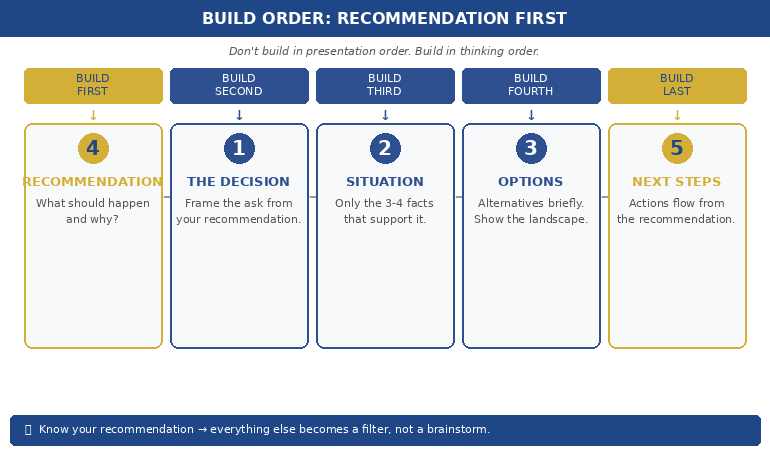

Counter-intuitive build order for emergency presentations showing Recommendation first then Decision, Situation, Options, Next Steps

PAA: What is the best structure for a quick presentation?
The 5-slide structure: Decision/Ask, Current Situation, Options/Problem, Recommendation, Next Steps. Each slide has a single clear headline and one supporting point. This structure works because it mirrors how executives process information — they want to know the ask, the context, the options, your view, and what happens next. Anything else is optional. Build the recommendation slide first, then work backwards to the supporting slides.

30 Minutes Is Enough — If You Have the Right Structure

The Executive Slide System eliminates the blank-screen problem permanently. Pre-built frameworks for emergency presentations, steering committees, board updates, and approval decks. Open the template. Fill in the structure. Present with confidence.

Get the Executive Slide System → £39

Used in high-stakes approvals and funding pitches. Built from 24 years in corporate banking + 15 years training executives.

What to Cut When You Have 15 Minutes (Not 30)

Sometimes you don’t have thirty minutes. You have fifteen. Or ten. Here’s what to cut — in order.

Cut first: Slide 3 (Options). If time is critical, go straight from situation to recommendation. Your audience can ask about alternatives in Q&A. The options slide is the most expendable because its job — showing you’ve considered the landscape — can be done verbally.

Cut second: Slide 2 detail. Reduce the current situation from 3–4 bullets to 1–2. Keep only the data points that directly support your recommendation. “Revenue is at 87% of target with two months remaining” is enough if your recommendation is about closing the gap.

Never cut: Slides 1, 4, and 5. The ask, the recommendation, and the next steps are non-negotiable. Even if you’re presenting verbally with zero slides, these three elements must be present. “Here’s what I need from you. Here’s what I recommend. Here’s what happens next.” That’s a complete presentation in three sentences.

The extreme version: 3 slides in 10 minutes. Decision + Recommendation + Next Steps. This works when your audience already has context (they’ve been in the meetings, they’ve read the reports, they know the situation). Don’t repeat what they already know. Just cut to the decision.

📊 Need a system you can deploy in minutes, not hours?

Pre-built frameworks for 5-slide emergency, 8-slide steering committee, and 12-slide board update — all ready to fill.

Get the Executive Slide System → £39

When You Have Zero Minutes: Presenting Without Slides

Sometimes there’s no time for slides at all. Your boss pulls you into a meeting already in progress: “Can you update us on the project?” Here’s how to structure a verbal-only last minute presentation.

The 60-Second Structure:

“Let me give you three things.” (This signals structure — your audience relaxes because they know it’s bounded.)

“First, where we are: [one sentence on current status].”
“Second, the main issue we’re navigating: [one sentence on the challenge].”
“Third, what I need from this group: [one sentence on the ask or decision].”

Then stop talking. Let them ask questions. The questions will tell you what they actually need to know — which is almost never the twenty points you would have included in a full deck.

This verbal structure works because it follows the same logic as the 5-slide framework: situation, problem, ask. It just strips out the options and recommendation slides because in a verbal context, those emerge naturally through discussion.
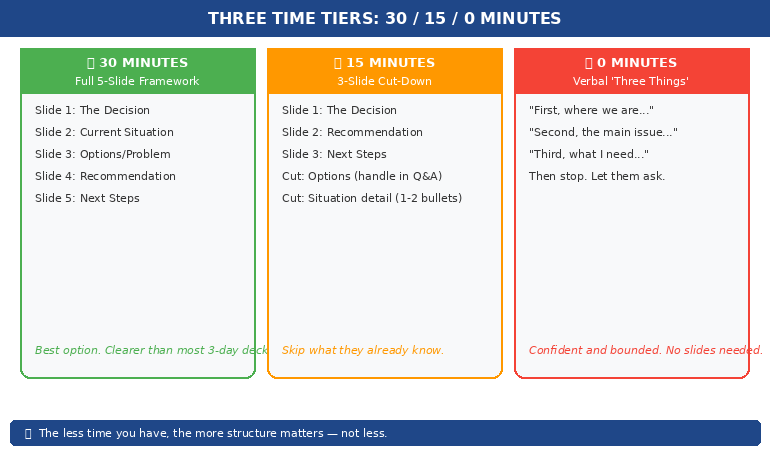

Three time tiers for last minute presentations showing 30-minute, 15-minute, and zero-minute frameworks

The principles behind this approach are the same ones that define effective executive presentation structure — lead with what matters, cut everything that doesn’t, and trust your audience to ask for what they need.

PAA: How do you present without preparation or slides?
Use the “three things” verbal framework: state where you are, what the main issue is, and what you need from the audience. Signal structure at the start (“Let me give you three things”) so your audience knows it’s bounded. Then stop and let questions guide the rest. Verbal presentations without slides are often more effective than rushed slide decks because they feel confident and conversational rather than frantic and over-packed.

Stop Starting From Scratch. Start From Structure.

The Executive Slide System is the presentation framework executives use when the stakes are high and the time is short. Pre-built structures for emergency presentations, board updates, steering committees, and approval decks — so you never face a blank screen again.

Get the Executive Slide System → £39

Used in board updates, steering committees, and approval meetings across every industry. Built from 24 years in corporate banking + 15 years training executives.

Frequently Asked Questions

Should I apologise for having a short deck?

Never. The moment you say “Sorry, I only had thirty minutes to prepare this,” you’ve given your audience permission to lower their expectations. Present the five slides as if they’re exactly what you intended. Executives respect brevity — a focused five-slide deck signals confidence and prioritisation, not lack of preparation. The most senior people in the room will assume you’re concise by design.

What if I’m asked about something not in my five slides?

Say: “That’s a great question — I don’t have the data in front of me, but I’ll follow up by end of day.” This is a perfectly acceptable response at every level of corporate life. It’s far better than guessing or including unverified information in rushed slides. The follow-up email after the meeting is often where the real decision gets finalised anyway.

How do I handle last minute presentations when I’m not the subject expert?

Focus on the structure, not the depth. The 5-slide framework works even with surface-level knowledge because it’s asking: what’s the situation, what are the options, what do you recommend? You don’t need to be the deepest expert — you need to be the clearest communicator. If there are technical questions you can’t answer, name the person who can: “James has the detail on the migration timeline — I’ll connect you directly.”

Is the 5-slide framework only for emergency presentations?

No. Most of the executives I work with use it as their default structure for every presentation, then add slides only when the context demands it. The emergency version is the minimum viable deck. The planned version adds depth to each section. But the bones — Decision, Situation, Options, Recommendation, Next Steps — work whether you have thirty minutes or three weeks.

📬 The Winning Edge Newsletter

Weekly strategies for executive presentations, leadership communication, and career-critical stakeholder conversations. No fluff.

Subscribe free →

🎯 Free: Executive Presentation Checklist

The pre-presentation checklist I give every executive before a high-stakes meeting — including the emergency 5-slide framework, slide headline formulas, and the three questions every executive audience silently asks.

Download free →

Related: Last minute presentations don’t just test your slide skills — they trigger imposter syndrome. If the panic is less about the slides and more about the voice in your head saying “they’re going to find out I’m not ready,” read the imposter syndrome pre-presentation reset — it’s a 4-minute protocol designed for exactly this moment.

A last minute presentation isn’t a crisis. It’s a clarity test. Five slides. Build the recommendation first. Add only the context that supports it. Rehearse the transitions once. And walk in like you planned the whole thing.

🎯 Next time you get the tap on the shoulder, be ready in minutes — not hours.

Get the Executive Slide System → £39 — the pre-built framework for every executive presentation, including the emergency 5-slide structure.

About the Author

Mary Beth Hazeldine is the Owner & Managing Director of Winning Presentations. With 24 years of corporate banking experience at JPMorgan Chase, PwC, Royal Bank of Scotland, and Commerzbank, she has trained executives through high-stakes approvals and funding pitches — including more last minute presentations than she can count.

A qualified clinical hypnotherapist and NLP practitioner, Mary Beth combines executive communication expertise with the psychology of performance under pressure. She helps leaders communicate with clarity and confidence — especially when there’s no time to prepare.

Book a discovery call | View services

15 Feb 2026
Professional presenting pilot programme results at a whiteboard in a modern office, navy blazer, warm lighting, engaged and confident

The Pilot Worked. Now You Need the Slides to Prove It.

Quick answer: Most pilot programs that deliver strong results still fail to get full rollout approval — because the presentation focuses on what happened instead of what should happen next. The winning pilot results presentation follows an 8-slide structure: context, hypothesis, results, what surprised us, risk if we don’t scale, rollout recommendation, resource ask, and decision question. Lead with the recommendation. Prove it with the pilot. Make the decision easy.

My client’s pilot saved £1.2 million in twelve weeks.

The data was clean. The operations team loved it. The finance team had validated the numbers independently. By any rational measure, full rollout was the obvious next step.

She walked into the executive committee meeting with 34 slides. Fourteen of them were methodology. Eight were charts showing week-by-week performance. Four were appendix slides about the control group. She buried the recommendation on slide 29.

The CFO interrupted on slide 11. “What are you asking us to do?”

She stumbled. Started explaining the statistical model again. The CEO checked his phone. The meeting ran out of time before she reached the ask. They scheduled a follow-up — which took six weeks to land in diaries. By then, the pilot momentum was gone. A competitor launched a similar initiative. The rollout was approved eventually, but at half the budget she’d originally needed.

I’ve watched this pattern destroy pilot programs at JPMorgan Chase, Royal Bank of Scotland, and Commerzbank. The pilot works. The presentation doesn’t. Not because the data is weak — but because the structure treats executives like scientists instead of decision-makers.

Why Most Pilot Results Presentations Fail

The problem is structural, not intellectual. People who run successful pilots are usually rigorous thinkers. They’ve spent weeks or months collecting data, managing variables, documenting outcomes. When it’s time to present, they default to the format that feels most comfortable: the research report.

Executives don’t want a research report. They want three things answered in the first 90 seconds: What did you find? What do you recommend? What do you need from me?

The most common mistakes I see in pilot results presentations:

Leading with methodology. You spent months on the pilot design. Nobody in the room cares about your control group methodology unless they specifically ask. Start with what happened, not how you measured it.

Drowning in data. Every data point you collected feels important to you. Executives need three to five proof points, not thirty. The question isn’t “how much data do I have?” but “what’s the minimum evidence required for this decision?”

Burying the recommendation. If your recommendation appears after slide 15, you’ve already lost. The decision-maker is silently asking “where is this going?” from the moment you start speaking. Tell them immediately. Then prove it.

Ignoring the “what if we don’t” question. Every approval decision involves two risks: the risk of scaling and the risk of not scaling. Most presenters only address the first. The second is often more powerful — because executives are more motivated by what they might lose than what they might gain.

PAA: How do you present pilot results to executives?
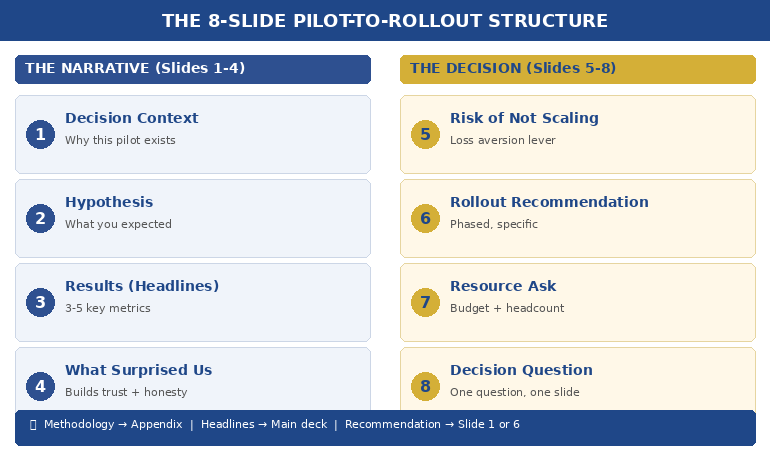
Lead with your recommendation, not your data. Use the 8-slide structure: context (why we piloted), hypothesis (what we expected), results (what happened), surprises (what we didn’t expect), risk of inaction (what happens if we don’t scale), recommendation (what to do next), resource ask (what you need), and decision question (the specific yes/no). Keep methodology in the appendix for anyone who asks.

Your Pilot Delivered Results. Your Slides Need to Deliver a Decision.

The Executive Slide System gives you the exact slide structures, sequencing, and layouts that senior leaders expect — including decision decks, recommendation frameworks, and executive summary formats. Stop rebuilding from scratch every time you need approval.

Get the Executive Slide System → £39

Built from 24 years in corporate banking + 15 years training executives. Includes decision deck templates, slide-by-slide guidance, and the recommendation-first structure used in board updates, steering committees, and approval decks.

The 8-Slide Pilot-to-Rollout Structure

After helping executives present pilot results across banking, consulting, and corporate strategy for 24 years, this is the structure that consistently gets decisions — not just compliments.

Slide 1: The Decision Context. One sentence: why this pilot exists and what decision it was designed to inform. “We piloted [X] to determine whether [Y] should be rolled out across [Z].” This isn’t background. It’s a frame. You’re telling the room: you will make a decision today.

Slide 2: The Hypothesis. What you expected to happen. This matters because it shows intellectual honesty. If the results matched your hypothesis, it builds confidence. If they didn’t, it shows you’re presenting truth, not advocacy. Either way, it signals rigour without forcing anyone to sit through your methodology.

Slide 3: The Results (Headline Format). Three to five key metrics, each with a single headline: “Customer processing time: reduced 41% (target was 25%)”“Error rate: down 67%”“Team adoption: 94% within 3 weeks.” No charts yet. Headlines first. Let executives absorb the story before you prove it.

Slide 4: What Surprised Us. This is the slide that builds the most trust. Every pilot produces unexpected findings — things that went better than expected, things that were harder than anticipated, edge cases you hadn’t considered. Presenting them demonstrates that you’re not selling — you’re reporting honestly. Executives fund people they trust, not people who only share good news.

Slide 5: The Risk of Not Scaling. This is the slide most people forget — and it’s often the most persuasive. What happens if the pilot stays a pilot? Competitor implications, cost of delay, team morale impact, missed market window. Frame it as: “If we don’t move to full rollout, here’s what we’re accepting.”

Slide 6: The Rollout Recommendation. Clear, specific, actionable. Not “we recommend scaling” but “we recommend Phase 1 rollout to the Northern region by Q3, followed by full deployment by Q1 next year.” Include the phasing — executives are far more likely to approve a staged rollout than an all-at-once launch.

Slide 7: The Resource Ask. What you need: budget, headcount, timeline, executive sponsorship. Be specific. “£340K over 18 months, 4 additional FTE, and a named executive sponsor from Operations.” Vague asks get vague responses. Specific asks get decisions.

Slide 8: The Decision Question. One question, on one slide, in one sentence. “Do we approve Phase 1 rollout to the Northern region at a cost of £340K, with a go/no-go review at month 6?” This is the slide that forces the room to decide rather than discuss. Without it, you’ll get “let us think about it” — which, in most organisations, means “we’ll forget about this.”


8-slide pilot-to-rollout decision deck structure showing the framework from context through recommendation to decision question

📊 Need the decision deck structure? The Executive Slide System (£39) includes the recommendation-first sequencing and slide-by-slide templates you can adapt to any pilot, any industry.

The Data Executives Actually Need (Not What You Collected)

Here’s a rule I teach every executive I work with: the data that ran the pilot is not the data that sells the rollout.

During the pilot, you tracked everything — daily metrics, edge cases, process variations, team feedback, system performance. That’s operational data. It’s essential for running the pilot. It’s terrible for presenting the results.

Executives need decision data. Decision data answers one question: is the evidence strong enough to commit resources?

The translation works like this:

Operational data: “We processed 1,247 transactions across 14 business days with a 3.2% exception rate, down from 8.7% in the control period, representing a…”
Decision data: “Error rate dropped 63%. At full scale, that’s £2.1M in annual savings.”

Operational data: “User adoption followed a standard S-curve with early adopter engagement at day 3, majority adoption by day 11…”
Decision data: “94% team adoption in 3 weeks. No additional training budget required.”

The operational data goes in your appendix — available if anyone asks. The decision data goes on your slides. If you’re presenting data to non-technical executives, this translation is the single most important skill you can develop.

PAA: What data should you include in a pilot results presentation?
Focus on three to five headline metrics that directly support the scale/kill/pivot decision. Each metric should include: the result, the target (so executives can see if you exceeded or missed), and the business impact at full scale. Keep raw data, methodology, and detailed analysis in appendix slides — available on request but not cluttering the decision narrative.

Stop Translating Data Into Slides From Scratch

The Executive Slide System includes decision deck templates with pre-built layouts for results slides, recommendation slides, and resource ask slides — the exact formats that get pilot programs funded for full rollout.

Get the Executive Slide System → £39

Built from 24 years in corporate banking at JPMorgan Chase, PwC, RBS, and Commerzbank. The same frameworks used in board-level funding presentations and executive approval decks.

How to Present Scale, Kill, or Pivot Honestly

Not every pilot succeeds. And even successful pilots sometimes reveal that the original plan needs adjusting. The best pilot results presentations are honest about all three outcomes — scale, kill, or pivot — because intellectual honesty is what makes executives trust you with larger budgets.

If the recommendation is Scale: Lead with it. Don’t hedge. “The pilot exceeded targets on all three primary metrics. We recommend full rollout.” Then prove it with the data. Hedging a clear success makes executives question whether you’re confident in your own results.

If the recommendation is Kill: This is the presentation that builds the most career credibility, and most people avoid it. Saying “the pilot didn’t work, and here’s why, and here’s what we learned” demonstrates the kind of judgment that gets you trusted with bigger initiatives. Frame it as: “The pilot answered the question it was designed to answer. The answer is no — and here’s what that saves us.” Include the cost avoided by not scaling something that wouldn’t have worked.

If the recommendation is Pivot: This is the most common real-world outcome — and the hardest to present. The pilot partially worked, or it worked differently than expected, or it revealed a better opportunity than the original hypothesis. Structure it as: “The pilot validated [X] but revealed that [Y] is the higher-value opportunity. We recommend pivoting the rollout to focus on [Y], using the pilot learnings as the foundation.”

Whatever the recommendation, the 3-slide decision framework gives executives what they need: a clear recommendation, the evidence behind it, and a specific ask.

📊 Scale, kill, or pivot? The Executive Slide System (£39) includes the recommendation-first slide order for all three scenarios — so you never figure out the structure from scratch.

The Slide Nobody Includes: What Happens If We Don’t Scale

In 24 years of watching executive decisions, the single most persuasive slide I’ve seen in pilot results presentations is the one that answers: what do we lose by doing nothing?

Executives are loss-averse. Behavioural economics research consistently shows that the fear of losing something is approximately twice as motivating as the prospect of gaining something equivalent. This is why “we could save £2M” is less compelling than “we’re currently losing £2M per year by not scaling this.”

Your “risk of inaction” slide should include:

Competitive exposure. If you’ve piloted something that works, how long before competitors figure it out? “Three competitors are piloting similar approaches. First-mover advantage has a 6-month window.”

Cost of delay. Every month you don’t scale is a month of unrealised savings or revenue. Quantify it. “Each quarter of delay costs £520K in continued manual processing.”

Team momentum. Pilot teams lose energy when decisions stall. “The pilot team has been waiting 8 weeks for a decision. Two key team members have been approached by competitors.”

Sunk cost clarity. Not in the psychological fallacy sense — in the practical sense. “We’ve invested £180K in this pilot. Without rollout approval, that investment generates zero ongoing return.”

This isn’t manipulation. It’s giving executives the complete picture. They’re weighing two risks — the risk of acting and the risk of not acting. Most presenters only address the first. The complete picture, honestly presented, is what the approval packet method is designed to deliver.

PAA: How do you convince executives to scale a successful pilot?
Don’t try to convince — present the complete decision picture. Show the pilot results (headline metrics, not raw data), the risk of not scaling (competitor exposure, cost of delay, team attrition), the specific rollout recommendation (phased, with milestones), and the resource ask. Executives fund clarity, not enthusiasm. The strongest persuasion is a well-structured decision deck that makes saying yes easier than saying “let me think about it.”

The Pilot Worked. Don’t Let the Presentation Kill the Rollout.

The Executive Slide System gives you decision deck structures, recommendation-first sequencing, and executive summary formats — designed for the moments when your slides need to secure budget, headcount, and go-ahead. Built from real boardroom experience across banking, consulting, and corporate strategy.

Get the Executive Slide System → £39

Built from 24 years in corporate banking + 15 years training executives. Instant access to slide templates, sequencing guides, and the structures used in board updates, steering committees, and approval decks.

Frequently Asked Questions

How many slides should a pilot results presentation be?

Eight to twelve slides for the main deck, with appendix slides for methodology and detailed data. The 8-slide structure (context, hypothesis, results, surprises, risk of inaction, recommendation, resource ask, decision question) covers everything executives need. If someone wants the detail behind a number, that’s what appendix slides are for — available on request, not forced on everyone.

What if my pilot results are mixed — some metrics hit target and some didn’t?

Present honestly. Mixed results are the most common real-world outcome and executives respect transparency. Structure it as: “The pilot met or exceeded targets on [X, Y] and fell short on [Z]. Our recommendation accounts for this — we’re proposing a modified rollout that focuses on the validated elements while addressing [Z] through [specific adjustment].” Trying to spin mixed results as a clean win destroys credibility faster than the data itself.

Should I present pilot results differently to different audiences?

Yes — but the structure stays the same. For a CFO, lead with the financial metrics and ROI projection. For an operations executive, lead with efficiency and team impact. For a CEO, lead with strategic alignment and competitive positioning. The 8-slide structure accommodates this by adjusting which metrics you headline on Slide 3 and which risk you emphasise on Slide 5. The recommendation and ask stay identical regardless of audience.

How do I handle the “let’s extend the pilot” response?

“Let’s extend the pilot” is usually code for “I’m not confident enough to decide.” Address this directly: “I understand the instinct to gather more data. The risk is that extending the pilot for another quarter costs us [£X] in delayed savings and [competitive risk]. The data we have answers the question the pilot was designed to answer. If there’s a specific metric that would change the decision, I’d like to understand what that is so we can target it.” This reframes extension as a decision — not a default.

📬 The Winning Edge Newsletter

Weekly executive presentation strategies, decision deck frameworks, and career-critical communication insights. No fluff.

Subscribe free →

🎯 Free: Executive Presentation Checklist

The pre-presentation checklist I give every executive before a high-stakes meeting. Covers structure, messaging, audience preparation, and the decision deck essentials.

Download free →

Related: If presenting your pilot results triggers nerves — especially when the stakes are this high — read about why introverted executives often present better than extroverts. The calm, evidence-led delivery style that suits pilot presentations is exactly where introverts have the edge.

Your pilot did the hard work. The data exists. The results speak for themselves — if your slides let them. Use the 8-slide structure. Lead with the recommendation. Include the risk of not scaling. Make the decision question unavoidable.

And if you want the slide templates that make this structure effortless, the Executive Slide System (£39) has you covered.

About the Author

Mary Beth Hazeldine is the Owner & Managing Director of Winning Presentations. With 24 years of corporate banking experience at JPMorgan Chase, PwC, Royal Bank of Scotland, and Commerzbank, she has helped executives present pilot results, business cases, and funding requests in boardrooms across three continents.

A qualified clinical hypnotherapist and NLP practitioner, Mary Beth combines executive communication expertise with evidence-based techniques for managing high-stakes presentations. She has spent 15 years training executives in decision deck structure, stakeholder communication, and confident delivery.

Book a discovery call | View services

14 Feb 2026
Executive mapping stakeholder names and influence dynamics on whiteboard before high-stakes presentation

The Political Landscape Map: Who Blocks, Who Enables, Who Decides

The Political Landscape Map: Who Blocks, Who Enables, Who Decides

Quick answer: Most presentations fail because of politics, not content. Before you build a single slide, you need to map three things: who has the power to say yes, who will quietly block you, and who can champion your recommendation when you’re not in the room. This article gives you the framework to identify all three — and a system for navigating each.

The best deck I ever helped a client build got rejected in seven minutes.

It wasn’t the content. The data was solid. The recommendation was clear. The slides were tight — twelve of them, structured exactly right. My client, a Head of Strategy at a mid-cap bank, had rehearsed until the delivery was calm and confident.

The problem was a person he’d never spoken to. A Group Risk Director sitting three chairs from the decision-maker. She had concerns about implementation timelines that nobody had surfaced before the meeting. When the CFO looked at her for a reaction, she shook her head. Meeting over.

Afterwards, my client said: “I prepared for every question. I just didn’t prepare for every person.”

That sentence changed how I teach presentation strategy. In 24 years of corporate banking at JPMorgan Chase, PwC, Royal Bank of Scotland, and Commerzbank, I watched this pattern repeat hundreds of times: brilliant content, devastating political blindspot. The people who consistently got approvals weren’t the best presenters. They were the ones who mapped the room before they entered it.

That mapping process is what I now call the Political Landscape Map.

Why Politics Kills More Presentations Than Bad Slides

Here’s something most presentation training ignores entirely: the decision about your recommendation is rarely made during your presentation.

It’s made before, in conversations you weren’t part of. In hallway exchanges between stakeholders. In the silent risk calculations happening while you’re still on slide two. In the relationship dynamics between people who have history you know nothing about.

When executives decide, they silently ask three questions: What happens if I say yes and it goes wrong? What happens if I say no and miss out? Can I defend this decision to my peers? Your slides can answer the first two. Only political preparation can answer the third.

The uncomfortable truth is that most professionals prepare exclusively for the content challenge — clearer data, better structure, tighter delivery. But in rooms where decisions involve multiple stakeholders, political dynamics determine outcomes more often than presentation quality.

This doesn’t mean content doesn’t matter. It means content is necessary but not sufficient. You need both the right slides and the right relationships with the people evaluating them.

PAA: Why do good presentations still get rejected?
Good presentations get rejected when the presenter addresses the content but not the politics. If a key stakeholder has concerns that weren’t surfaced before the meeting, or if someone in the room feels bypassed or threatened by the recommendation, no amount of data will overcome that resistance. Mapping the political landscape before you present is as important as building the deck itself.

The System for Getting Decisions — Not Just Delivering Presentations

The Executive Buy-In Presentation System teaches you how decisions actually get made in senior rooms — and how to position yourself on the right side of that decision before you open your mouth. 7 modules covering decision psychology, stakeholder mapping, proof strategy, and pressure response.

Includes: Decision Definition Canvas • Stakeholder Landscape Map template • Proof Selector Matrix • Executive Buy-In Blueprint • Pressure Response Playbook with scripts

Get the Executive Buy-In System → £199

Self-study programme with modules released over 4 weeks + live Q&A calls. Currently £199 — price rises to £499 (self-study) / £850 (live cohort) on March 1st.

The Three Roles in Every Decision Room

Every room where a significant decision gets made contains three types of people. Your job is to identify all of them before you present — not during.

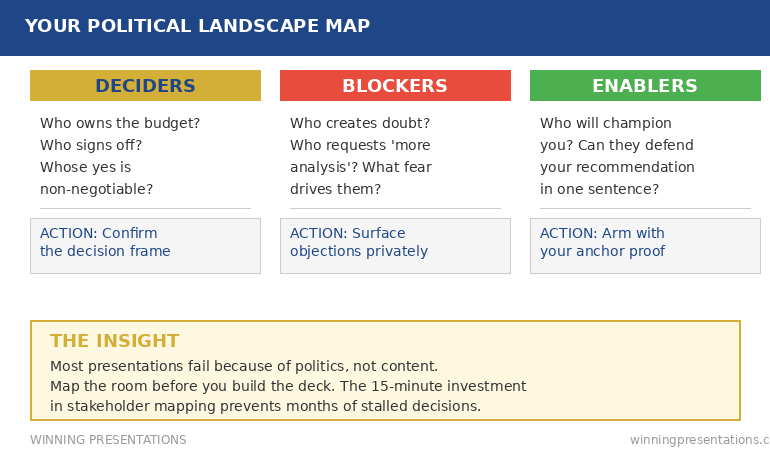
I call this framework the Decider / Blocker / Enabler model — a political landscape map that categorises every stakeholder by their role in the decision, not their title on the org chart. It’s the same approach used in change management and consulting, adapted specifically for high-stakes executive presentations where the politics of the room matter as much as the quality of the slides.

The Decider. This is the person whose “yes” actually matters. In some rooms, it’s obvious — the CEO, the CFO, the Board Chair. In others, it’s not. I once watched a VP present to a room of eight people, addressing his entire pitch to the most senior person present. The actual decision-maker was a Commercial Director two levels below, who controlled the budget line. The VP never made eye contact with her. The proposal died.

The Decider isn’t always the most senior person. They’re the person who owns the budget, the risk, or the political capital required to move forward. Ask yourself: Who actually signs off on this? Whose approval is non-negotiable?

The Blocker. This is the person who can prevent your recommendation from being approved — even if they can’t approve it themselves. Blockers don’t always announce themselves. They ask careful questions. They raise “concerns for consideration.” They request “further analysis.” My client’s Group Risk Director was a classic blocker: she didn’t reject the proposal directly. She simply signalled doubt, and the room followed.

Blockers are motivated by different fears. Some worry about career risk — what if this makes me look bad? Some worry about territorial loss — does this reduce my influence? Some have legitimate technical concerns that haven’t been addressed. The key is understanding which fear is driving the resistance, because each requires a different response.

The Enabler. This is the person who will champion your recommendation when you’re not in the room. Enablers are the most underutilised asset in executive presentations. They’re the colleague who says “I’ve seen the analysis, it’s solid” in the pre-meeting conversation. They’re the board member who turns to the Decider and says “I think this addresses my concern from last quarter.”

You can’t create enablers in the presentation itself. You create them before it — through pre-meeting alignment conversations that give them the information and confidence to support you publicly.

Do this in 60 seconds before your next deck:

Write down the names of everyone in the room. Label each person: D (Decider), B (Blocker), or E (Enabler).

If you can’t label them, you’re not ready to present yet.

Fix it fast: The Executive Buy-In Presentation System (£199 — rises March 1st) includes a ready-to-use Political Landscape Map template + the Decision Definition Canvas so you can do this properly in under 10 minutes.


Executive mapping stakeholder names and influence dynamics on whiteboard before high-stakes presentation

The Executive Buy-In Presentation System includes the Decision Definition Canvas and the Proof Selector Matrix — tools specifically designed to map stakeholder dynamics and match your approach to each person’s concerns. Learn more about the Executive Buy-In System (£199).

Building Your Political Landscape Map

The map itself takes 15 minutes. The intelligence it reveals can save you months of stalled decisions.

For every significant presentation, before you build a single slide, write down every person who will be in the room (or who influences people in the room). Then answer four questions about each:

1. What is their role in this decision? Decider, Blocker, or Enabler. Some people are genuinely neutral — they’ll follow whoever has the strongest signal. Mark them too. They matter because they’re the audience your Enablers are trying to influence.

2. What is their primary fear? Career risk, financial risk, reputation risk, or timing risk. This isn’t about what they’ll say — it’s about what they’re silently calculating. A CFO who asks “What’s the ROI?” is usually asking “What happens to me if this loses money?” Those are different questions requiring different answers.

3. What is their relationship to your recommendation? Does this increase or decrease their influence? Does it create work for their team? Does it solve a problem they’ve been publicly advocating for — or does it contradict something they’ve championed before? People don’t evaluate recommendations in isolation. They evaluate them through the lens of their own position.

4. What would make them feel safe saying yes? This is the critical question. Not “what evidence would convince them?” but “what would reduce their perceived risk enough to support this?” For some, it’s precedent. For others, it’s a guarantee of reversibility. For others, it’s simply being consulted before the meeting so they don’t feel ambushed.

PAA: How do you identify stakeholder dynamics before a presentation?
Start by listing everyone in the room and categorising them as Decider, Blocker, Enabler, or Neutral. Then identify each person’s primary concern — career risk, financial risk, reputation risk, or timing risk. Finally, have one-on-one conversations before the meeting to surface objections and build support. The goal is to know the room’s dynamics before you enter it.

Decisions Happen Before the Meeting. Your Preparation Should Too.

Module 1 of the Executive Buy-In System includes the Decision Definition Canvas — a diagnostic that maps the decision, the decision-maker, the perceived risk, and the success criteria in under 10 minutes. Module 4 teaches you how to match proof to each stakeholder’s specific fear type.

Get the Executive Buy-In System → £199

Study at your own pace with live Q&A calls for support. 7 modules, 36 lessons, built from real boardroom experience where political preparation consistently separated approved proposals from stalled ones.

Presenting this week? Do this in 15 minutes:

1. List every attendee + two influencers who won’t be in the room but shape opinions.
2. Label each: D (Decider) / B (Blocker) / E (Enabler) / N (Neutral).
3. Write each person’s likely fear: career risk, financial risk, reputation risk, or timing risk.
4. Schedule one 10-minute conversation with the most likely Blocker.
5. Add one slide that directly addresses the Blocker’s concern.
6. Confirm the decision question with the Decider’s office.

How to Work the Map Before You Present

The map is useless if you build it and then present as though you haven’t. Here’s how to act on it.

For Deciders: Confirm the decision frame. Before the meeting, have a brief conversation with the Decider (or their gatekeeper) to confirm what decision they’re actually expecting. “I want to make sure I’m structuring this around the right question — is the decision whether to proceed, or which option to proceed with?” This single question has saved my clients more time than any slide redesign. It also signals competence — you’re thinking about their decision, not your content.

For Blockers: Surface the objection privately. This is the most important step, and the one most people skip. Meet the Blocker before the presentation. Not to persuade them — to listen. “I’m presenting the X recommendation next week. I’d value your perspective before I finalise the approach.” Most Blockers don’t want to destroy your proposal. They want their concern acknowledged. When they feel heard in private, they’re far less likely to ambush you in public.

If you discover a concern you can address, build it into your presentation explicitly: “Sarah in Risk flagged the implementation timeline, and I’ve adjusted the phasing to reflect that.” This does two things: it neutralises the objection and it publicly credits the Blocker, which converts them from opponent to contributor.

For Enablers: Arm them with your anchor proof. Your Enabler can only champion your recommendation if they can articulate why it’s the right call — in one sentence, from memory, to sceptics. Give them that sentence. “The anchor proof is [X]. If anyone pushes back on [concern], the response is [Y].” When your champion can defend your recommendation as confidently as you can, the decision doesn’t depend solely on your performance in the room.

For Neutrals: Make the default easy. Neutral stakeholders will follow the strongest signal. If your Enabler speaks first and confidently, Neutrals tend to follow. Structure your presentation so the ask is clear and the next step is simple. People default to “yes” when saying yes is easier than asking more questions.

If you’re interested in the broader stakeholder mapping process for your executive presentations, I’ve written a detailed tactical guide.

The Executive Buy-In System covers this entire process in depth — from the Decision Definition Canvas (Module 1) through pressure response scripts for when Blockers challenge you in the room (Module 6). See the full Executive Buy-In System syllabus (£199).

What to Do When the Politics Are Against You

Sometimes you map the landscape and the picture isn’t good. The Blocker is powerful. Your Enabler is junior. The Decider is risk-averse. What then?

Don’t present until the ground is prepared. The biggest mistake I see is professionals walking into rooms they haven’t prepared politically because “the meeting is already scheduled.” Postponing a meeting to do proper alignment work is almost always a better outcome than presenting into a hostile or uncertain room. You lose a week. You gain a decision.

Reframe the ask to reduce perceived risk. If the political landscape suggests a full “yes” is unlikely, consider presenting a smaller ask: a pilot, a phased approach, a “proceed to next stage” rather than “approve the full programme.” This isn’t weakness — it’s reading the room accurately and adapting. Executives trust people who propose manageable risks over those who push for everything at once.

Use the Blocker’s language in your framing. If you’ve had a pre-meeting conversation with the Blocker, use their exact words in your presentation. “As [Name] rightly pointed out in our earlier conversation, the implementation timeline needs careful sequencing.” This isn’t manipulation — it’s demonstrating that you’ve listened. It’s remarkably difficult for someone to oppose a recommendation that explicitly incorporates their concern.

PAA: What do you do when executives resist your presentation recommendation?
First, diagnose the type of resistance. Is it a content objection (they need more evidence), a risk concern (they need reassurance), a political dynamic (they have competing interests), or a trust issue (they don’t yet believe you can deliver)? Each requires a different response. The psychology of executive buy-in is about addressing the real concern, not just the stated one.

Stop Presenting Into Rooms You Haven’t Read

The Executive Buy-In Presentation System teaches you how senior people actually decide — and how to structure your approach around their psychology, their politics, and their risk calculations. 7 modules: decision clarity, buy-in structure, credibility, proof strategy, AI execution, pressure response, and your personal executive playbook.

Get the Executive Buy-In System → £199

⏰ Launch pricing ends March 1st. The price rises to £499 (self-study) / £850 (live cohort). Lock in £199 before it changes.

Self-study modules + live Q&A calls. Built from 24 years in corporate banking where political preparation consistently separated approved proposals from stalled ones.

Frequently Asked Questions

How far in advance should I map the political landscape?

For high-stakes presentations (board approvals, budget requests, major client pitches), start mapping at least two weeks before. You need time for one-on-one conversations with Blockers and Enablers. For routine updates, a quick mental map the day before is usually sufficient — but even five minutes of stakeholder thinking prevents most political blindspots.

What if I can’t get access to the Blocker before the meeting?

If direct access isn’t possible, find someone who has it. Ask a mutual colleague: “What’s [Name]’s main concern about this area right now?” Even indirect intelligence is better than walking in blind. If you truly can’t get any information, acknowledge the gap in your presentation: build in a slide that explicitly addresses the most likely objection from that person’s position. Showing you’ve anticipated their concern — even without a conversation — signals respect for their perspective.

Is this approach manipulative?

Stakeholder mapping is standard practice in change management, consulting, and programme leadership. It’s not about manipulating anyone — it’s about understanding what different people need in order to feel confident making a decision. The pre-meeting conversations are about listening, not persuading. The goal is to build a presentation that genuinely addresses everyone’s legitimate concerns, not to circumvent them.

How do I handle a situation where two stakeholders have conflicting interests?

This is more common than most people realise. When stakeholders conflict, your job is to name the tension rather than pretend it doesn’t exist. “I’m aware that this recommendation creates different priorities for Operations and Finance, and I’ve tried to structure a phased approach that addresses both.” Naming the conflict demonstrates political awareness. Ignoring it guarantees that one side will surface it — on their terms, not yours.

📬 The Winning Edge Newsletter

Weekly executive presentation strategies, stakeholder navigation techniques, and career-critical communication insights. No fluff.

Subscribe free →

🎯 Free: Executive Presentation Checklist

The pre-presentation checklist I give every executive before a high-stakes meeting. Covers structure, messaging, and audience preparation — including a stakeholder mapping section.

Download free →

Related: If you’ve recently been promoted and you’re presenting to a room where you don’t yet know the political dynamics, read The Presentation You Give After Getting Promoted (Most Get It Wrong) — the listening-led approach is your fastest path to mapping a new political landscape. And if the politics of presenting trigger anxiety, introverted executives often have an advantage in these situations because they observe dynamics rather than performing over them.

The best presentation in the world fails when it’s delivered into a room you haven’t read. Map the Deciders, the Blockers, and the Enablers. Have the conversations before the meeting. Build your slides around their concerns, not just your content.

Start with the Executive Buy-In Presentation System (£199 — launch pricing ends March 1st) — and learn the decision psychology that turns political awareness into consistent approvals.

About the Author

Mary Beth Hazeldine is the Owner & Managing Director of Winning Presentations. With 24 years of corporate banking experience at JPMorgan Chase, PwC, Royal Bank of Scotland, and Commerzbank, she spent over a decade navigating the political dynamics of boardroom decisions before teaching others to do the same.

A qualified clinical hypnotherapist and NLP practitioner, Mary Beth combines executive communication expertise with decision psychology and stakeholder strategy. She has trained thousands of professionals and helps leaders turn political complexity into consistent buy-in.

Book a discovery call | View services

14 Feb 2026
Executive presenting to engaged boardroom audience during first leadership presentation after promotion

The Presentation You Give After Getting Promoted (Most Get It Wrong)

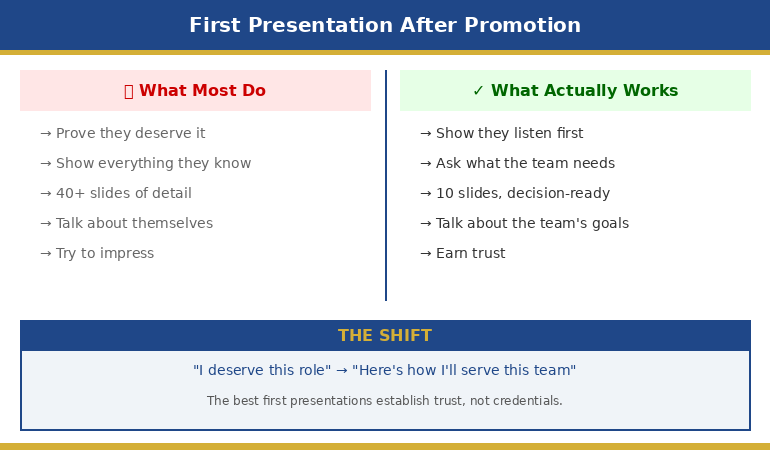
Quick answer: Your first presentation after a promotion isn’t about proving you deserve the role — it’s about showing your team you understand what they need. The leaders who earn trust fastest open with listening, not credentials. Structure your first deck around three things: what you’ve heard, what you’ll prioritise, and what you need from them.

Three weeks after getting promoted to Managing Director at a global bank, a client of mine — let’s call him David — stood up in front of his new team and delivered what he thought was the perfect first presentation.

Forty-two slides. Every restructuring initiative mapped. Every metric benchmarked. Every strategic pillar colour-coded. He’d worked on it for three weekends straight.

The room was silent when he finished. Not impressed-silent. Uncomfortable-silent.

Afterwards, a trusted colleague pulled him aside: “David, nobody in that room wanted your strategic vision. They wanted to know if you’re going to fire them.”

He’d answered questions nobody was asking, and ignored the only question that mattered: What does this change mean for me?

I’ve watched this pattern repeat across dozens of newly promoted executives. The instinct after a promotion is to prove you belong. But your audience already knows you got the role. What they don’t know is whether you’ll listen, whether you understand their reality, and whether working for you will be better or worse than what came before.

That’s what your first presentation needs to answer.

Your First Deck Sets the Tone for Everything That Follows

The Executive Slide System gives you the exact structure, slide order, and decision frameworks that earn trust in your first presentation — not your fifteenth.

Get the Executive Slide System → £39

Built from 24 years in corporate banking + executive training work — designed for senior-stakeholder audiences.

The Mistake Almost Every New Leader Makes

The promotion presentation trap works like this: you’ve just been told you’re good enough. Your brain immediately begins building a case to confirm that judgment. So your first instinct is to demonstrate competence.

That instinct creates presentations that:

Lead with your strategic vision (before anyone’s asked for it). Showcase deep analysis (proving you’ve done your homework). Reference your previous successes (establishing credentials). Cover everything (because you don’t know what matters yet).

The problem isn’t that any of this is wrong. It’s that it’s premature.

PAA: What should I present in my first meeting as a new leader?
Your first presentation should focus on three things: what you’ve heard from the team so far, what you plan to prioritise in the short term, and what you need from them to succeed together. Save strategy for later — trust comes first.

Your new team isn’t evaluating your intellect. They already know you’re capable — the promotion proved that. They’re evaluating your character. Specifically: do you listen? Do you understand what it’s actually like in the trenches? Will you protect them or throw them under the bus when things go wrong?

A 42-slide strategic masterpiece answers none of those questions. A 10-slide trust-building presentation answers all of them.


Before and after comparison showing common first presentation after promotion mistakes versus trust-building approach

If you’re preparing your first presentation in a new role, the Executive Slide System (£39) includes the exact slide frameworks that establish credibility without the 40-slide trap.

The Trust-First Presentation Structure

In 24 years of corporate banking — across JPMorgan Chase, PwC, Royal Bank of Scotland, and Commerzbank — I’ve observed that the leaders who earn trust fastest after a promotion share one trait: they present what they’ve learned, not what they already know.

The trust-first structure flips the typical presentation on its head:

Traditional post-promotion deck: Here’s my vision → Here’s my plan → Here’s what I need from you → Questions?

Trust-first deck: Here’s what I’ve heard from you → Here’s what I think matters most → Here’s what I need help understanding → What am I missing?

The shift is subtle but powerful. The traditional structure positions you as the expert arriving with answers. The listening-led structure positions you as a leader who arrived with questions — and actually listened to the answers.

PAA: How do I make a good first impression after being promoted?
The strongest first impression comes from demonstrating that you’ve spent your first days listening, not planning. Reference specific things team members told you. Acknowledge the challenges they face. Show that your priorities reflect their reality, not just your ambitions.

David — the MD from my opening story — rebuilt his presentation using this structure. The second version was 10 slides. He opened with direct quotes from one-on-one meetings he’d had with every team member in his first two weeks. The energy in the room was completely different. People leaned forward. They felt seen.

Stop Building Decks That Impress. Start Building Decks That Earn Trust.

The Executive Slide System includes the Leadership Transition Trust Deck (10 slides), recommendation-first formats, and decision frameworks designed for high-scrutiny senior audiences. Customise in 30 minutes.

Get the Executive Slide System → £39

Designed for senior stakeholders in high-scrutiny environments where clarity earns trust.

The 10-Slide Order That Works

Here’s the slide structure I recommend to every newly promoted executive. Notice what’s not here: no org chart, no biographical slide, no “About Me” section.

Slide 1 — The Listening Slide: “In my first [X] days, I’ve had conversations with [number] of you. Here’s what I heard.” Three to five direct themes, paraphrased from actual conversations. This slide alone earns more trust than 20 slides of strategy.

Slide 2 — The Acknowledgement: Name the elephant. If there was a difficult departure, restructuring, or period of uncertainty before your arrival — acknowledge it. Don’t paper over it. Your team will respect the honesty.

Slide 3 — The Three Priorities: Not twelve priorities. Not seven strategic pillars. Three things you’ll focus on in the next 90 days. Fewer priorities signal confidence. More priorities signal anxiety.

Slides 4-6 — One Slide Per Priority: Each slide answers: What’s the problem? What’s the first step? Who’s involved? Keep these tight. You’re not presenting solutions — you’re presenting direction.

Slide 7 — What I Won’t Change: This is the slide most new leaders forget. Your team is terrified you’ll break what’s working. Tell them explicitly what stays the same. It costs you nothing and earns enormous goodwill.

Slide 8 — What I Need From You: Specific, concrete asks. Not “I need your best effort.” More like: “I need honest feedback in our one-on-ones, even when it’s uncomfortable.”

Slide 9 — How to Reach Me: Your actual communication preferences. When to email, when to walk in, when to escalate. This practical slide signals you’re approachable, not just saying you are.

Slide 10 — The Question Slide: Not “Any questions?” but a specific prompt: “What’s the one thing I should know that nobody will tell me unprompted?” Then be quiet. Let the silence work.

The entire thing should take 15 minutes to deliver — maximum. The remaining 45 minutes should be conversation. That ratio — 25% presenting, 75% listening — is exactly what a team-first leader looks like.

Want this exact 10-slide deck as a ready-to-customise template? It’s inside the Executive Slide System (£39) — look for the Leadership Transition Trust Deck.

What to Say in Your Opening (3 Scripts You Can Use Today)

The number-one search behind “first presentation after promotion” is simply: what do I actually say? Here are three opening scripts I’ve used with clients, each suited to a different situation.

Script 1 — The Listening-Led Opening (best for most situations):
“Over the past [two weeks / ten days], I’ve had one-on-one conversations with [number] of you. I asked everyone the same question: what’s the one thing that frustrates you most about how things work right now? Three themes came up consistently. I want to walk through all three today — and I want your honest reaction to what I’m proposing we do about them.”

Script 2 — The Steady Confidence Opening (best when the team needs reassurance):
“I know transitions create uncertainty, so let me be direct about three things: what’s not changing, what I’m planning to look at first, and how I want us to work together. I’ll take about 15 minutes to walk through that, and then I want the rest of this hour to be your questions — the harder, the better.”

Script 3 — The Reset Opening (best when you were promoted over internal candidates):
“Before I get into any slides, I want to acknowledge something. I know this transition isn’t straightforward for everyone in this room, and I respect the contributions that got this team to where it is. I’m not here to overhaul what’s working. I’m here to build on it — and I need your help to do that well. Here’s what I’ve heard so far.”

The Best Closing Question (Pick One)

How you close matters almost as much as how you open. Don’t end with “Any questions?” — it invites silence. Try one of these instead:

Option A: “What’s the one thing I should know about this team that nobody will tell me unprompted?”

Option B: “If you could change one thing about how we operate — starting tomorrow — what would it be?”

Option C: “What am I missing? What haven’t I asked about yet?”

Then be quiet. Count to ten in your head if you have to. The silence is where the real answers live.

What to Cut (Even If It Feels Important)

The hardest part of your first presentation after promotion isn’t what to include — it’s what to leave out. Everything you cut will feel important. Cut it anyway.

Cut your background slide. They already know your CV. They read the announcement email. If you spend three minutes on your career history, you’ve just told the room that your credentials matter more than their concerns.

Cut the 90-day plan. I know this feels counterintuitive. But a detailed 90-day plan in week two tells people you’ve already decided what matters — before you’ve listened long enough to know. Share priorities, not plans. The plan can come at day 30.

Cut the vision statement. “Our vision is to become the premier…” Stop. Nobody remembers vision statements. They remember whether you asked about their workload and whether you followed through.

Cut the benchmarking data. Your team doesn’t care how your new division compares to your old one. Comparisons feel like judgment.

PAA: How many slides should my first presentation as a new manager have?
Aim for 10 slides maximum, delivered in 15 minutes or less. Your first presentation should prioritise listening over presenting. The shorter your deck, the more time for the conversation that actually builds trust.

If you’re struggling to cut, ask yourself this: “Am I including this because my team needs to hear it, or because I need to say it?” That question eliminates half the slides in every post-promotion deck I’ve ever reviewed.

The First Five Minutes That Set Your Tenure

How you open your first presentation becomes the story people tell about you. Not what you said on slide 7. Not the Q&A. The first five minutes.

One client of mine — newly promoted VP at a tech company — opened with: “I’ve spent the last two weeks asking every person in this room what frustrates them most. Three themes kept coming up. I want to talk about all three today.”

That single opening accomplished more than any strategy presentation could: it demonstrated humility, preparation, and commitment to action.

Compare that with the typical opening: “I’m thrilled to be in this role. Let me share my background and then walk you through my strategic vision for the next twelve months.”

The first opening says: I’m here for you. The second opening says: I’m here for me.

Your team will decide in those first five minutes whether you’re a leader who listens or a leader who lectures. Every promotion presentation I’ve helped executives build starts with what they heard, not what they think.

If you’re also managing the anxiety that comes with presenting in a new role — especially at a higher level where the scrutiny feels sharper — you’re not alone. I’ve written about why introverted executives often present more effectively than their extroverted peers, and the reasons might surprise you.

Your Promotion Was the Hard Part. Don’t Let Your First Deck Undo It.

The Executive Slide System includes the Leadership Transition Trust Deck, decision frameworks, and the exact slide order covered in this article. Built from 24 years in corporate banking — designed for high-scrutiny audiences where trust is the currency.

Get the Executive Slide System → £39

Includes the 10-slide trust deck template. Customise and present in under an hour.

Frequently Asked Questions

Should I present my strategic vision in my first week?

No. Presenting a strategic vision before you’ve spent meaningful time listening signals that you’ve already made up your mind. The most effective newly promoted leaders present priorities (not plans) in the first two weeks, then share a more developed strategy at the 30-day mark after genuine consultation.

What if my boss expects a detailed strategic presentation right away?

Have a direct conversation with your manager about timing. Most senior leaders will respect the argument that a well-informed 30-day strategy will outperform a rushed week-two vision. If they insist, deliver the strategic overview but frame it explicitly as preliminary and subject to revision after team consultation.

How do I handle the team if I was promoted over internal candidates?

Acknowledge the situation directly in your opening remarks. Something like: “I know this transition isn’t easy for everyone, and I respect the contributions every person in this room has made.” Then prove through your presentation structure — by featuring what you’ve heard from the team, not what you’ve planned alone — that you’re not here to override, but to build on what exists.

What’s the biggest mistake in a post-promotion presentation?

Talking about yourself. The moment you spend more than 60 seconds on your background, experience, or credentials, you’ve made the presentation about validation rather than trust. Your team already knows you were chosen. What they need to hear is that you understand their reality and that your priorities reflect what they care about.

📬 The Winning Edge Newsletter

Weekly executive presentation strategies, slide structures, and career-critical communication insights. No fluff.

Subscribe free →

🎯 Free: Executive Presentation Checklist

The pre-presentation checklist I give every executive before a high-stakes meeting. Covers structure, messaging, and audience preparation.

Download free →

Related: If the promotion has made presenting feel more high-stakes than ever, read Why Introverted Executives Present Better Than Extroverts — the research on this is counterintuitive and worth understanding before your next big moment.

Your first presentation after a promotion isn’t a performance. It’s a conversation with a few slides. Keep it short. Keep it human. Keep it about them. The strategic brilliance can come later. Right now, trust is the only currency that matters.

The Executive Slide System (£39) gives you the exact structure to make that first deck your strongest.

About the Author

Mary Beth Hazeldine is the Owner & Managing Director of Winning Presentations. With 24 years of corporate banking experience at JPMorgan Chase, PwC, Royal Bank of Scotland, and Commerzbank, she spent over a decade delivering high-stakes presentations before training others to do the same.

A qualified clinical hypnotherapist and NLP practitioner, Mary Beth combines executive communication expertise with evidence-based techniques for managing presentation anxiety. She has trained thousands of professionals and helps leaders structure decision-focused decks that earn trust quickly.

Book a discovery call | View services

13 Feb 2026
Executive facing boardroom questions after presentation with confident composed posture

The Presentation Was Perfect. The Q&A Lost the Deal.

Quick answer: Senior executives rarely make decisions during your slides. They use the presentation to gather context, then use Q&A to test your thinking, probe your assumptions, and decide whether they trust your judgement. Most presenters spend 90% of preparation on slides and 10% on Q&A. The ratio should be closer to 50/50. Below: the strategic Q&A preparation system that turns the most dangerous part of your presentation into the most persuasive.

47 Slides. Standing Ovation. Zero Approval.

A client of mine — a senior director at a financial services firm — spent three weeks building what he called the best presentation of his career. A £3.2M technology investment. Beautiful slides. Compelling narrative. Clear ROI. The kind of deck that makes you think, “This is going to be easy.”

He delivered it flawlessly. Twenty-two minutes, no stumbles, perfect pacing. The CFO nodded throughout. The CTO leaned forward twice. When he finished, there was a pause — the good kind, the kind that feels like the room is absorbing what you’ve said.

Then the CFO asked one question: “What happens to the existing vendor contract if we approve this in Q2 instead of Q1?”

He didn’t know. Not because the answer was complicated — it was a straightforward penalty clause he hadn’t reviewed. He said, “I’ll need to come back to you on that.” The CTO followed with, “And what’s the migration risk if we run both systems in parallel?” He wasn’t sure about that either.

Two questions. Two “I’ll come back to you” answers. The CFO said, “Let’s reconvene when you have the full picture.” The project was delayed four months. By the time he got back in the room, the budget had been reallocated.

His slides were perfect. His Q&A preparation was almost zero. And that’s where the deal died.

In 25 years of banking across JPMorgan Chase, PwC, RBS, and Commerzbank, I’ve watched this pattern repeat in boardroom after boardroom. The presentation goes well. The Q&A collapses. And the presenter walks away confused because they thought the hard part was the slides.

Looking for a structured way to prepare? The Executive Q&A Handling System walks through the question mapping, response architecture, and recovery scripts covered in this article — useful if you’d rather work from a system than build one from scratch.

🎯 Stop Losing Deals in Q&A

The Executive Q&A Handling System gives you the complete preparation framework for the part of your presentation that actually decides outcomes. Question mapping templates, the 3-part executive response structure, “I don’t know” recovery scripts, and hostile question deflection techniques — built from real boardroom situations across banking and consulting.

Designed for senior professionals preparing for board reviews, funding requests, and major proposals where Q&A decides the outcome.

Get the Executive Q&A Handling System → £39

Instant download — use it for your next Q&A this week.

Why Executives Actually Decide During Q&A (Not During Your Slides)

Here’s something most presenters don’t understand about senior audiences: they don’t use your presentation to make a decision. They use it to build a mental model of your proposal. The decision-making happens during Q&A.

There’s a reason for this. Senior executives sit through presentations all day. They’ve learned that slides represent the presenter’s best case — the version where everything works, the risks are manageable, and the ROI is compelling. Of course it looks good. You built it to look good.

What they can’t see in your slides is how you think under pressure. Whether you’ve considered the second-order consequences. Whether you understand the risks you didn’t put on the slide. Whether your confidence comes from deep understanding or surface preparation.

Q&A reveals all of this in minutes.

When a CFO asks “what happens if the timeline slips by six months?” she’s not looking for a perfect answer. She’s looking at how you respond. Do you have the number? Do you have a framework for thinking about it? Do you panic, deflect, or engage? That response tells her more about the viability of your proposal than your entire slide deck.

This is why the same presentation can succeed or fail depending entirely on what happens after “Any questions?” The slides get you to the table. The Q&A decides whether you leave with approval.

The 90/10 Preparation Mistake (And What the Ratio Should Be)

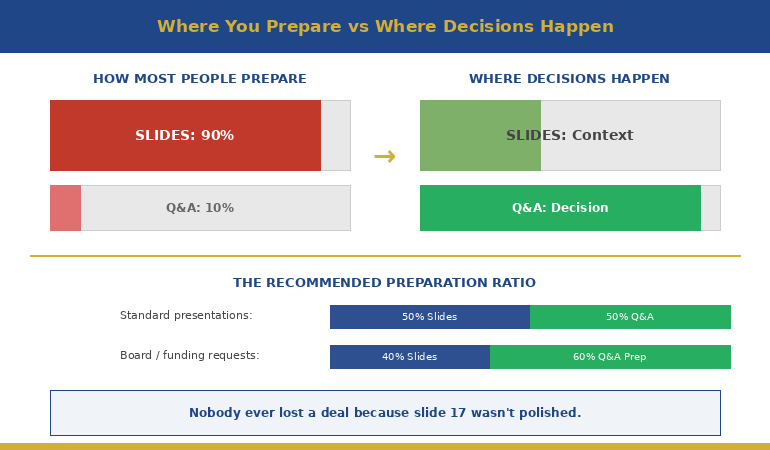
Most presenters spend roughly 90% of their preparation time on slides — designing, refining, rehearsing the narrative — and leave maybe 10% for thinking about questions. Often that 10% happens the night before, when you lie in bed imagining worst-case scenarios without actually preparing responses.

The problem isn’t that slides don’t matter. They do. A poor executive presentation structure will lose your audience before you reach Q&A. But once your slides are solid — clear structure, clear recommendation, clear ask — additional slide refinement produces diminishing returns. The marginal value of your twentieth revision of slide 14 is close to zero.

The marginal value of preparing for the CFO’s top three questions? Enormous.


Diagram showing presentation preparation ratio versus where executive decisions actually happen during Q&A

Here’s the preparation ratio I recommend to my clients: once your slides are structurally sound, split your remaining preparation time 50/50 between rehearsing the presentation and preparing for Q&A. For a high-stakes presentation — a board approval, a funding request, a major proposal — I’d go further: 40% slides, 60% Q&A preparation.

That feels counterintuitive. It felt counterintuitive to the senior director who lost the £3.2M deal too. But after working with hundreds of executives through high-stakes presentations, I can tell you: nobody ever lost a deal because slide 17 wasn’t polished enough. Plenty have lost deals because they couldn’t answer question two.

Don’t want to build the question map from scratch?

The Executive Q&A Handling System gives you the question mapping templates, response structures, and recovery scripts ready to run before any high-stakes presentation. £39, instant download — keep them for every future Q&A.

Get the Q&A Handling System →

The Question Map: Predicting What They’ll Ask

The biggest myth about Q&A is that questions are unpredictable. They’re not. In my experience, you can predict the majority of the questions you’ll receive — if you prepare systematically rather than hoping for the best.

I teach my clients a technique called Question Mapping. Before any high-stakes presentation, you build a map of likely questions organised by stakeholder and by category. Here’s how it works:

Step 1: List every person in the room and their primary concern.

The CFO cares about cost, risk, and return. The CTO cares about technical feasibility and integration. The COO cares about operational disruption. The CEO cares about strategic alignment and timing. Each person will ask questions through their lens. Knowing the lens tells you the question before it’s asked.

Step 2: For each person, write the three questions they’re most likely to ask.

Not the questions you’d like them to ask — the questions they’ll actually ask based on their role, their concerns, and any history you have with them. If the CFO challenged your timeline last time, she’ll challenge your timeline again. Prepare for that specific challenge.

Step 3: For each question, prepare your answer AND your evidence.

The answer is what you’ll say. The evidence is what you’ll show — a backup slide, a data point, a reference to a comparable situation. This is where appendix slides become essential. They’re not afterthoughts; they’re your Q&A arsenal.

Step 4: Identify the two or three questions you can’t answer yet — and prepare honest responses for those too.

Knowing what you don’t know is just as important as knowing what you do. We’ll cover how to handle these in a moment.

When my client lost the £3.2M deal, I asked him afterwards: “Did you do a question map?” He looked at me blankly. He’d spent three weeks on slides and zero minutes mapping the questions his audience was guaranteed to ask. The CFO’s question about the vendor contract penalty wasn’t obscure — it was the most obvious financial question in the room. Ten minutes of question mapping would have caught it.

Answer Architecture: The 3-Part Executive Response

Knowing what they’ll ask is half the battle. The other half is structuring your answer so it lands with a senior audience. Most people answer executive questions the way they’d answer in conversation — they think out loud, circle around the point, add context, and eventually arrive at the answer. For a peer, this is fine. For a CFO with six more meetings after yours, it’s fatal.

I teach a three-part response structure that works for virtually any executive question:

Part 1: Direct Answer (first sentence)

Start with the answer. Not the context, not the caveat, not the background. The answer. “The migration risk is moderate — we estimate two weeks of parallel running with a 15% contingency built in.” The executive now has what they need. Everything after this is supporting detail.

Part 2: One Supporting Point (second sentence)

Give one piece of evidence or reasoning that strengthens your answer. “We’ve based that on the migration timeline from the Singapore rollout last year, which had similar complexity.” One point. Not three. Not a data dump. One credible reference that shows your answer isn’t a guess.

Part 3: The Bridge (optional third sentence)

If it’s useful, connect back to a point from your presentation or redirect to a related strength. “That’s actually why we’ve built the phased approach I showed on slide 8 — it gives us an exit ramp at each stage.” This turns a defensive moment (answering a question) into an offensive one (reinforcing your proposal).

Three sentences. Sometimes two. Never seven. The discipline of brevity in Q&A communicates the same thing it communicates in your slides: you know what matters and you’re not afraid to be direct about it.

📊 Question Maps + Response Frameworks + Recovery Scripts

The Executive Q&A Handling System gives you the complete toolkit: question mapping templates for every stakeholder type, the 3-part response structure with worked examples, “I don’t know” recovery scripts, hostile question techniques, and preparation checklists you can run before any high-stakes presentation.

Get the Executive Q&A Handling System → £39

Instant download. Built from 25 years of real boardroom Q&A across JPMorgan Chase, PwC, RBS, and Commerzbank.

The Most Powerful Answer: “I Don’t Know, But…”

Here’s something that surprises most of my clients: the executives I’ve worked with over 25 years don’t expect you to know everything. What they can’t tolerate is pretending you do when you don’t.

When you bluff in Q&A, senior people can tell. They’ve sat through thousands of presentations. They know the difference between someone who’s genuinely confident in their answer and someone who’s constructing one in real time. Bluffing doesn’t just fail to convince them — it actively undermines every other answer you’ve given, including the ones you were right about.

“I don’t know” — when it’s honest — is a trust-building statement. But it needs a second half.

The formula: “I don’t have that figure yet. Here’s what I do know: [related fact]. I’ll have the specific answer to you by [date].”

Three elements: honest admission, related context that shows you understand the territory, and a specific commitment to follow up. The admission shows integrity. The related context shows competence. The commitment shows accountability. Together, they communicate something more valuable than the actual answer: that you’re someone who can be trusted with a £3.2M decision.

My client who lost the deal said “I’ll need to come back to you on that” — which is close but missing the middle element. He didn’t demonstrate that he understood the territory around the question. Compare that with: “I don’t have the exact penalty clause figure, but I know the contract has a 90-day notice period and we’d be within that window for a Q2 start. I’ll confirm the specific financial impact by Friday.”

Same honesty. Completely different impression. The first version says “I didn’t prepare for this.” The second says “I understand the landscape even though I’m missing one data point.”

For a deeper dive into handling the really difficult questions — the hostile ones, the ambush questions, the ones designed to put you on the spot — this guide covers specific techniques for those situations.

How do you prepare for Q&A after an executive presentation?

Use a Question Map: list every person in the room and their primary concern, write the three most likely questions each will ask, prepare direct answers with supporting evidence, and identify the questions you can’t answer yet. Aim to spend at least 50% of your remaining preparation time on Q&A once your slides are structurally sound.

Why do good presentations still fail to get approval?

Because executives don’t decide during slides — they decide during Q&A. Your slides present your best case. Q&A reveals how deeply you’ve thought about risks, alternatives, and second-order consequences. Two unanswered questions can undo twenty-two minutes of perfect delivery.

What’s the best way to answer questions from senior executives?

Use the 3-part structure: direct answer first (one sentence), one supporting point (evidence or reasoning), then an optional bridge back to your presentation. Keep responses under three sentences. Brevity in Q&A signals confidence and clarity — rambling signals uncertainty.

🎓 25 Years of Boardroom Q&A. One System.

The Executive Q&A Handling System is built from 25 years of corporate banking and 16 years coaching senior professionals across financial services, healthcare, technology, and government. Every framework — the question map, the 3-part response, the “I don’t know” recovery script — comes from real boardroom situations where Q&A decided whether the room said yes.

Designed for senior professionals who present to boards, investment committees, and executive sponsors where Q&A is the deciding moment.

Get the Executive Q&A Handling System → £39

Instant download — lifetime access to every framework and template.

Frequently Asked Questions

How long should I spend preparing for Q&A versus preparing slides?

Once your slide structure is solid, split remaining preparation time at least 50/50 between presentation rehearsal and Q&A preparation. For board-level or funding presentations, consider 40/60 in favour of Q&A. No executive ever rejected a proposal because slide 17 wasn’t polished — but many have rejected proposals because the presenter couldn’t answer question two.

What if I’m asked a question I genuinely haven’t thought of?

Use the “I don’t know, but…” formula: honest admission, one related fact that shows you understand the territory, and a specific commitment to follow up with the answer by a named date. This builds more trust than a bluffed answer that unravels under follow-up questioning.

Should I invite questions during the presentation or only at the end?

For senior audiences, invite questions throughout. Executives don’t wait well — if they have a question on slide 4, they won’t be listening to slides 5 through 20. Saying “I welcome questions at any point” also signals confidence. If the question is answered on a later slide, say so: “Great question — I cover that in two slides. Shall I jump ahead or continue?”

How do I handle it when the Q&A goes completely off-topic?

Acknowledge the question’s value, then redirect: “That’s an important point, and it deserves proper attention. Can I take that offline with you after this meeting so we can give it the time it needs? I want to make sure we cover [the decision you need] in the time we have left.” This respects the questioner while protecting your agenda.

📬 The Winning Edge Newsletter

Weekly executive presentation strategies — Q&A preparation, slide structures, and boardroom techniques that actually work. No filler.

Subscribe Free →

Related reading: The breathing technique that stopped my pre-presentation vomiting — managing the physical side of high-stakes presentations, including Q&A anxiety.

Your next step: Before your next presentation, take fifteen minutes and build a Question Map. List every person in the room, their primary concern, and the three questions they’re most likely to ask. Prepare a direct answer for each one. That fifteen minutes will do more for your outcome than another three hours of slide refinement. And if you want the complete Q&A preparation system — question maps, response frameworks, recovery scripts, and hostile question techniques — the Executive Q&A Handling System (£39) gives you everything you need to turn the most dangerous part of your presentation into the most persuasive.

About the Author

Mary Beth Hazeldine is the Owner & Managing Director of Winning Presentations. With 25 years of corporate banking experience at JPMorgan Chase, PwC, Royal Bank of Scotland, and Commerzbank, she has delivered high-stakes presentations in boardrooms across three continents.

A qualified clinical hypnotherapist and NLP practitioner, Mary Beth combines executive communication expertise with evidence-based techniques for managing presentation anxiety. She has trained senior professionals and executive audiences over many years and supported high-stakes funding and approval presentations throughout her career.

Book a discovery call | View services

11 Feb 2026
Engaged steering committee reviewing transformation program wins on boardroom screen

Transformation Program Updates That Make Executives Want to Fund You

The CEO leaned forward and said five words I’d never heard in a steering committee: “How can we do more?”

My client had just finished her transformation update. Same programme that six months earlier had executives checking their watches. Same steering committee that used to rush through her slot to get to “more important” agenda items.

But something had changed. Not the programme — the programme was on track, same as before. What changed was how she presented it.

She’d stopped reporting status. She’d started showcasing momentum. And suddenly, the executives who had been passive observers became active champions.

I’m seeing a shift in 2026: executives are drowning in transformation initiatives — digital, AI, sustainability, operating model. The programmes that survive aren’t necessarily the best-run ones. They’re the ones whose leaders know how to make the steering committee feel invested in their success.

Quick answer: The transformation updates that generate executive enthusiasm share three characteristics: they lead with outcomes achieved (not activities completed), they make wins visible and credit shared, and they create opportunities for executives to contribute rather than just observe. Structure your updates around momentum and possibility rather than status and risk, and you’ll transform passive steering committees into active sponsors who fight for your budget.

The transformation my client led wasn’t unusual — a digital modernisation programme at a mid-sized financial services firm. Good progress, reasonable challenges, nothing dramatically wrong or right.

But her first six months of updates had been… forgettable. Milestone trackers. RAG statuses. Risk registers. The steering committee nodded politely and moved on.

When we redesigned her approach, we didn’t change the facts. We changed the story. Instead of “here’s where we are,” she started telling “here’s what we’ve unlocked.” Instead of “here’s what might go wrong,” she started asking “here’s where you can help us go further.”

The executives didn’t just approve her next phase. They volunteered resources from their own teams. One board member mentioned the programme in an investor call — as an example of “the innovative work we’re doing.”

Same programme. Different narrative. Completely different level of sponsorship.

The Momentum Mindset

Most programme managers think their job is to report status. It’s not. Your job is to maintain momentum — and momentum is as much about perception as reality.

Consider two ways to present the same fact:

Status mindset: “Phase 2 is 73% complete. We have 14 tasks remaining. Timeline is on track.”

Momentum mindset: “Phase 2 unlocked three capabilities that weren’t possible last quarter. Operations is already using the new workflow, and they’re asking when Phase 3 features arrive.”

Both are true. But one sounds like a progress report, and the other sounds like a success story. Guess which one makes executives want to invest more?

Why Momentum Matters More Than Status

Transformation programmes live or die by executive sponsorship. And executive sponsorship depends on executives feeling that:

  • Their investment is paying off — They can see tangible returns, not just completed tasks
  • The team is winning — There’s energy and progress, not just competent execution
  • They’re part of something important — The programme matters to the organisation’s future
  • Their involvement makes a difference — They have a role beyond rubber-stamping updates

Status updates address none of these. Momentum updates address all of them.

📊 The Executive Slide System

Build updates that generate executive enthusiasm, not polite nods. The Executive Slide System includes momentum-focused templates, outcome showcase frameworks, and structures that turn steering committees into active champions for your programme.

Get the Executive Slide System → £39

Instant download. Includes transformation update templates, executive engagement frameworks, and sponsor activation guides.

The 5-Slide Structure That Builds Champions

After working with transformation leaders across banking, consulting, and FTSE 100 companies, this is the structure that consistently turns passive steering committees into active advocates:

Slide 1: The Win Wall (60 seconds)

Start with what’s been achieved — not completed, achieved. There’s a difference.

“Completed” is internal: “We finished the data migration.”

“Achieved” is external: “Customer service teams now resolve queries 40% faster because they have unified data access.”

Your Win Wall should feature 3-4 outcomes that matter to the business. Each one framed as: what changed, who benefits, and what it enables next.

This slide sets the tone for everything that follows. It says: “This programme is delivering value. Now let’s talk about how to deliver more.”

Slide 2: The Momentum Metrics (30 seconds)

Show movement, not position. Executives don’t need to know you’re “73% complete.” They need to know you’re accelerating, on pace, or (if necessary) recalibrating.

Choose 3-4 metrics that demonstrate forward motion:

  • Adoption velocity: How fast are people using what you’ve built?
  • Value realisation: What benefits are already being captured?
  • Capability unlocks: What can the organisation do now that it couldn’t before?
  • Stakeholder sentiment: How do users and sponsors feel about progress?

Notice: none of these are “tasks completed” or “budget spent.” Those are inputs. Executives care about outputs.


Transformation program update structure showing momentum-focused 5-slide format

Slide 3: The Spotlight Story (90 seconds)

Every month, feature one specific success in detail. A team that’s transformed their workflow. A customer outcome that exceeded expectations. A capability that’s generating unexpected value.

This does three things:

  • Makes abstract progress concrete and human
  • Gives executives a story they can retell (“Did you hear what the transformation team achieved in operations?”)
  • Creates heroes within the organisation who become programme advocates

Rotate your spotlight across different areas of the programme. Everyone who gets featured becomes invested in overall programme success.

Slide 4: The Opportunity Horizon (60 seconds)

This is where you invite executive engagement — not by asking them to solve problems, but by showing them possibilities.

“Based on what we’ve learned in Phase 2, we see three opportunities to accelerate value in Phase 3…”

“The operations team is asking whether we could extend this capability to [adjacent area]. If the steering committee sees strategic value, we could scope this for Q3…”

You’re not asking for permission. You’re asking for guidance on where to create more value. That’s a conversation executives want to have.

The Executive Slide System (£39) includes “Opportunity Horizon” templates that frame expansion possibilities in ways executives find compelling.

Slide 5: The Ask (30 seconds)

End with one clear request — but make it an opportunity to contribute, not a problem to solve.

Instead of: “We need budget approval to continue Phase 3.”

Try: “Phase 3 is ready to launch. We’d like your endorsement to proceed — and your input on which business units should pilot first.”

The difference: one positions executives as gatekeepers. The other positions them as strategic partners. Guess which one generates more enthusiasm?

⚡ Presenting this week?

If your Slide 1 doesn’t state the outcome achieved and the decision ask in one line, executives assume you don’t have one. Fix it in 60 seconds with ready-to-use templates.

Get the Executive Slide System → £39

How to Showcase Wins Without Bragging

Some programme managers resist the momentum approach because it feels like self-promotion. “I don’t want to oversell. What if we hit problems next month?”

Here’s the reframe: showcasing wins isn’t about you. It’s about the organisation.

The Credit Distribution Principle

Every win you present should credit someone other than your programme team:

  • “The operations team embraced the new workflow and found three efficiency improvements we hadn’t anticipated.”
  • “Finance’s early adoption created the proof points that convinced other departments to accelerate their timeline.”
  • “The steering committee’s decision to prioritise data quality in Q1 is why we’re seeing these customer experience gains now.”

When you distribute credit, you’re not bragging — you’re celebrating collective success. And everyone you credit becomes an advocate for continued programme investment.

The “Because Of” Frame

Connect wins to decisions executives made:

“Because the board approved accelerated investment in January, we were able to deliver three months ahead of the original timeline.”

“Because the CFO championed cross-functional data sharing, we’re seeing benefits that weren’t in our original business case.”

This isn’t flattery. It’s accountability — showing that executive decisions produced executive-level results. It makes them feel invested in your success because they’re partly responsible for it.

🏆 Templates That Celebrate Without Overselling

The Executive Slide System includes Win Wall templates, Spotlight Story frameworks, and credit distribution guides — everything you need to showcase momentum while keeping executives invested in your continued success.

Get the Executive Slide System → £39

Built for steering-committee and C-suite updates in banking and consulting-style environments. Instant download.

Turning Observers Into Advocates

The ultimate goal isn’t just approval — it’s advocacy. You want steering committee members actively championing your programme in conversations you’re not part of.

Create Retellable Moments

Executives talk to other executives. Board members talk to investors. Your updates should give them stories worth retelling.

A forgettable update: “The transformation programme is on track.”

A retellable moment: “The new customer portal went live in 8 weeks instead of 6 months, and NPS jumped 15 points in the first month.”

When you give executives impressive specifics, they become your marketing team.

Assign Meaningful Roles

Don’t just inform executives — involve them. Specific, valuable involvement:

  • “We’d value your perspective on which market segment to pilot next.”
  • “Could you introduce us to your counterpart at [partner company] who faced a similar integration?”
  • “The board presentation would benefit from your narrative on strategic alignment.”

Each ask makes them more invested. Each contribution makes them more likely to defend the programme when budget pressures arise.

The sponsor engagement frameworks in the Executive Slide System (£39) show you exactly how to create these involvement opportunities.

Maintaining Energy Across the Programme Lifecycle

Transformation programmes are marathons, not sprints. Maintaining executive energy over 18-24 months requires deliberate effort.

The Energy Curve Challenge

Most programmes follow a predictable pattern:

  • Launch: High executive attention, lots of enthusiasm
  • Middle months: Attention fades, “business as usual” takes over
  • Final stretch: Renewed interest as outcomes become visible

The middle months are where programmes lose sponsorship — not because anything went wrong, but because executives stopped paying attention.

Breaking the Attention Fade

Combat mid-programme drift with deliberate momentum markers:

Quarterly “State of Transformation” sessions: Bigger than monthly updates. Invite broader leadership. Celebrate cumulative progress.

Value realisation milestones: Don’t wait until the end to show ROI. Identify early wins that demonstrate the business case is working.

External validation: Industry recognition, analyst mentions, customer testimonials. Third-party credibility renews internal enthusiasm.

Expansion announcements: “Based on success in Division A, we’re extending to Division B.” Growth signals success.

The Narrative Arc

Think of your transformation as a story with chapters. Each steering committee update should feel like progress in that story — not a disconnected status report.

“Last month we unlocked the foundation. This month we’re seeing the first benefits. Next month we’ll expand to new areas.”

Executives stay engaged with stories. They disengage from spreadsheets.

📋 Everything You Need for Champion-Building Updates

The Executive Slide System gives you:

  • 5-slide momentum update template
  • Win Wall and Spotlight Story frameworks
  • Momentum metrics dashboard structure
  • Opportunity Horizon presentation format
  • Credit distribution and sponsor engagement guides
  • Quarterly “State of Transformation” template

Get the Executive Slide System → £39

Instant download. Transform your steering committees from passive observers to active champions.

📬 PS: Weekly strategies for executive communication and transformation leadership. Subscribe to The Winning Edge — practical tactics from 24 years in corporate transformation.

Frequently Asked Questions

What if my programme has genuine problems I need to report?

Report them — but in context. Problems within a momentum narrative sound different: “We hit a vendor delay that pushed integration back three weeks. We’ve already recovered two of those weeks and expect to be back on timeline by month end.” Challenges within progress feel manageable. Challenges within a status report feel like failure.

How do I showcase wins when we’re still in early stages?

Early wins exist — you just need to recognise them. Successful stakeholder alignment, strong team formation, faster-than-expected technical setup, enthusiastic pilot volunteers. Frame early progress as “foundation that enables everything that follows.” The story arc matters even before the climax.

Won’t executives see through this as spin?

Momentum framing isn’t spin — it’s emphasis. You’re not inventing wins or hiding problems. You’re choosing to lead with what’s working rather than what might go wrong. Executives appreciate leaders who can see and communicate progress. That’s confidence, not deception.

How do I handle a steering committee that only wants to discuss risks?

Give them a dedicated risk section — but don’t lead with it. “Before we discuss risks, let me show you what we’ve achieved this month.” Once executives see momentum, risk discussions become problem-solving sessions rather than anxiety spirals. Context changes everything.

Related: Even positive updates can trigger presentation anxiety. If your voice or confidence falters in steering committees, read When Your Voice Cracks Mid-Sentence: The Recovery Nobody Teaches for techniques that work in high-pressure executive settings.

That CEO who asked “How can we do more?” became my client’s biggest advocate. He mentioned the programme in three board meetings, secured additional funding without being asked, and personally called to congratulate the team when they hit a major milestone.

None of that happened because the programme suddenly got better. It happened because the story changed.

Your transformation programme is probably doing good work. The question is whether your steering committee knows it — whether they feel it, whether they want to be part of it.

Stop reporting status. Start showcasing momentum. Lead with wins. Create champions.

The executives in your steering committee want to support something exciting. Give them that story, and they’ll fight for your budget, your timeline, and your success.

About the Author

Mary Beth Hazeldine is the Owner & Managing Director of Winning Presentations. With 24 years in corporate banking at JPMorgan Chase, PwC, Royal Bank of Scotland, and Commerzbank, she has led transformation communications and supported programme leaders across major change initiatives on three continents.

A qualified clinical hypnotherapist and NLP practitioner, Mary Beth combines executive communication expertise with evidence-based techniques for high-pressure presentation environments. She helps transformation leaders turn steering committees from passive observers into active champions.

Book a discovery call | View services

09 Feb 2026
Executive presenting difficult news to team in boardroom with empathetic body language

I Had to Present 200 Redundancies. Here’s What I Learned About Trust.

The CFO handed me the deck at 4pm. “Present this tomorrow. 200 roles. Be clear but compassionate.”

I looked at the slides. Twelve pages of financial rationale. Charts showing declining margins. A timeline of “workforce optimisation.” Not a single word about the humans whose lives were about to change.

That night, I rebuilt the entire presentation. Because I’d seen what happens when cost reduction presentations focus on the numbers instead of the trust. I’d watched leaders lose their teams’ respect in 15 minutes — respect that took years to build and would never fully return.

The presentation the next morning wasn’t easy. But six months later, the remaining team was still engaged, still productive, and still willing to go the extra mile. That almost never happens after restructuring announcements.

Here’s what I learned about presenting cost cuts without destroying the trust you’ll need to rebuild.

Quick answer: Cost reduction presentations destroy trust when they lead with financial justification and treat people as line items. To preserve trust: acknowledge the human impact first, explain the business reality second, be specific about what’s happening and when, answer the questions people are actually thinking, and commit to specific next steps. The sequence matters as much as the content.

Why Trust Dies in Cost Reduction Presentations

I’ve watched dozens of cost reduction presentations over 24 years in banking and consulting. The ones that destroy trust share the same pattern:

They lead with the business case.

“Market conditions have changed. Our margins are compressed. We need to reduce operating costs by 15%.”

The moment you start with numbers, you’ve lost them. Because everyone in that room is doing the same mental calculation: “Am I a cost? Am I being reduced?”

They’re not hearing your carefully constructed rationale. They’re scanning for threat signals. Their nervous systems have already shifted into fight-or-flight. And everything you say after that opening gets filtered through fear.

The trust equation shifts instantly.

Before the presentation, your team believed you cared about them as people. The moment you lead with financial justification, they recategorise you. You’re no longer “leader who has my back.” You’re “person who sees me as a number.”

That recategorisation takes seconds. Reversing it takes years — if it’s even possible.

For more on delivering difficult news, see my guide on how to present bad news to executives.

The 5-Part Framework That Preserves Credibility

After that 200-person restructuring presentation, I codified what worked into a framework I’ve used — and taught — ever since.

Five-part framework for presenting cost cuts while maintaining trust

Part 1: Acknowledge the Elephant (First 60 Seconds)

Before anything else, name what everyone is feeling.

“I know why you’re here. I know what you’re expecting to hear. And I know that whatever I say in the next few minutes is going to affect how you feel about this company, about this team, and about me. I’m not going to pretend this is easy news.”

This does something crucial: it signals that you see them as humans, not audience members to be managed. It also prevents the mental drift that happens when people are anxious — they’ll actually hear what you say next.

Part 2: State the Decision Clearly (No Euphemisms)

“We are reducing our workforce by 200 positions. This affects the following departments…”

Don’t say “workforce optimisation.” Don’t say “right-sizing.” Don’t say “strategic realignment of human capital.”

Euphemisms don’t soften the blow. They signal that you’re either ashamed of the decision or think your audience is too stupid to understand plain language. Neither builds trust.

Part 3: Explain the Why (But Not First)

Now — and only now — explain the business context. But keep it brief and honest.

“Here’s why this is happening: our revenue dropped 23% this year. We explored every alternative — hiring freezes, salary reductions, project deferrals. This was the option that gives us the best chance of protecting the remaining roles long-term.”

Notice what’s different: you’re not justifying. You’re explaining. The tone is “here’s the reality” not “here’s why you should be okay with this.”

Part 4: Answer the Unasked Questions

Everyone in that room has the same questions. Answer them before they have to ask:

  • “Is my role affected?” — Be specific about who knows what and when.
  • “When will I find out?” — Give exact timelines.
  • “What support is available?” — Be concrete about severance, outplacement, references.
  • “What happens to my projects?” — Show you’ve thought about continuity.
  • “Can I trust what you’re telling me?” — Address this directly: “I’m telling you everything I know right now.”

Part 5: Commit to Specific Next Steps

“By end of day Friday, every affected person will have a one-on-one with their manager. By next Wednesday, HR will have individual packages prepared. I will send a written summary of everything I’ve said today within two hours.”

Specificity signals competence. Vague promises (“we’ll support everyone through this”) signal that you haven’t actually planned what happens next.

📊 Difficult Conversations Require Clear Structure

Cost reduction presentations fail when leaders improvise. The Executive Slide System gives you proven frameworks for structuring sensitive communications — including templates for restructuring announcements that preserve trust while delivering clarity.

  • 10 executive slide templates (including difficult news formats)
  • Recommended-first structures that work for sensitive topics
  • Opening and closing frameworks that set the right tone

Get the Executive Slide System → £39

Built from 24 years in corporate banking and consulting. Designed for restructuring, cost reduction, and high-stakes stakeholder meetings.

What Never to Say (And What to Say Instead)

Some phrases seem professional but actually destroy trust. Here’s what to avoid:

❌ “This was a difficult decision.”

Everyone knows it was difficult. Saying it sounds like you’re asking for sympathy — which should be flowing the other direction.

✓ Instead: “I wish I had better news.”

❌ “We’re all in this together.”

If you’re not losing your job, you’re not in this together. This phrase infuriates people.

✓ Instead: “I know this affects some of you more than others.”

❌ “This is an opportunity for the company to emerge stronger.”

True, perhaps. But saying it in a redundancy announcement makes you sound like you’re celebrating.

✓ Instead: Save this for three months later, when you’ve earned the right to look forward.

❌ “HR will handle the details.”

This makes you look like you’re delegating the hard part. Even if HR does handle details, you need to own the communication.

✓ Instead: “I’ll be working with HR to ensure everyone gets individual support. Here’s exactly what that looks like…”

The Executive Slide System includes specific language frameworks for sensitive presentations — phrases that land and phrases to avoid.

The Slide Structure That Works

If you must use slides (and sometimes you must, for documentation or remote teams), here’s the structure that maintains trust:

Slide 1: The Decision

One sentence. No charts. No logos. Just the news.

“We are reducing our workforce by [X] positions, effective [date].”

Slide 2: Who Is Affected

Departments, locations, roles. Be specific. Don’t make people guess.

Slide 3: The Timeline

When people will be notified. When last day is. When support begins.

Slide 4: Support Available

Severance terms. Outplacement services. Reference policies. Healthcare continuation.

Slide 5: What Happens Next

Specific actions with specific dates. Who to contact. When the next communication will happen.

Slide 6 (Optional): Business Context

If you include this, keep it to one slide. This is not the time for a 20-slide market analysis.

Notice what’s missing: no “journey” language, no vision statements, no “exciting future” positioning. Those come later, if ever.

For more on presentation structure, see my guide on executive presentation structure.

🎯 Structure Sensitive Presentations With Confidence

The difference between a cost reduction presentation that preserves trust and one that destroys it often comes down to structure. Get it wrong, and you lose your team’s respect permanently. Get it right, and you maintain the credibility needed to rebuild.

Get the Executive Slide System → £39

Designed for restructuring announcements, difficult conversations, and crisis communications.

What Happens After the Presentation

The presentation is just the beginning. Trust is built or destroyed in what comes next.

Within 2 hours: Send a written summary of exactly what you said. No softening, no additions. This creates a record and shows consistency.

Within 24 hours: Every affected person should have had an individual conversation. Not an email — a conversation.

Within 1 week: Check in with your remaining team. Not to sell them on the future — to listen to their concerns. The people who stay are watching how you treat the people who leave.

Within 1 month: Acknowledge the transition openly. “We’re a smaller team now. Here’s how we’re adapting. Here’s what I need from you.”

The biggest mistake leaders make post-announcement: acting like it never happened. Your team remembers. Pretending it’s “business as usual” insults their intelligence and damages whatever trust remains.

For more on this topic, see my article on restructuring announcement presentations.

Presenting Cost Cuts Without Losing Your Team

Here’s what it comes down to:

Your team will remember how you made them feel during the hardest moments. Not your financial rationale. Not your market analysis. Not your carefully worded euphemisms.

They’ll remember whether you looked them in the eye. Whether you spoke plainly. Whether you answered their real questions. Whether you followed through on what you promised.

The Executive Slide System gives you the structural frameworks. But the trust comes from how you deliver them.

That 200-person presentation? It wasn’t my finest hour. But the team that remained trusted me enough to rebuild. And that trust started with acknowledging that I was about to deliver news that would change lives — before I said anything else.

📋 Ready to Structure High-Stakes Presentations?

Whether you’re presenting cost reductions, restructuring announcements, or any difficult news — structure determines whether you preserve trust or destroy it. The Executive Slide System gives you proven templates for sensitive executive communications.

  • 10 executive-ready slide templates
  • Difficult news presentation frameworks
  • Opening scripts that acknowledge reality
  • 30-day email support if you get stuck

Get the Executive Slide System → £39

Built from 24 years in corporate banking and consulting + 15 years training senior executives.

Frequently Asked Questions

Should I rehearse a cost reduction presentation?

Yes, but not for polish — for emotional preparation. Rehearse so you can deliver the difficult parts without hesitating, stumbling, or showing discomfort that makes you seem uncertain about the decision. Your team needs to see that you’ve fully processed this, even if they haven’t.

What if I don’t agree with the cost cuts?

This is one of the hardest leadership moments. You have three options: advocate privately until the decision changes, present the decision as your own (which it becomes the moment you deliver it), or resign before delivering news you can’t stand behind. What you cannot do is subtly distance yourself from the decision during the presentation — your team will sense it, and it destroys trust in both you and the organisation.

Should I take questions during the presentation?

Yes, but manage the format. Say: “I’ll answer questions after I’ve covered everything. That way, some of your questions might already be addressed.” This prevents derailment while still showing openness. Have a clear time limit for Q&A and commit to following up on anything you can’t answer immediately.

What if someone gets emotional during the presentation?

Acknowledge it. “I understand this is difficult to hear.” Then pause. Give them space. Don’t rush past it. The worst thing you can do is pretend it’s not happening or quickly move to the next slide. Human reactions deserve human responses.

Related: Difficult presentations affect your nervous system long after they’re over. If you’re still carrying the weight of past presentations, see Why Your Nervous System Remembers That Awful Presentation From 2019.

About the Author

Mary Beth Hazeldine is the Owner & Managing Director of Winning Presentations. With 24 years in corporate banking and consulting — including roles at JPMorgan Chase, PwC, Royal Bank of Scotland, and Commerzbank — she has delivered and supported high-stakes presentations in boardrooms across three continents, including restructuring announcements affecting thousands of employees.

A qualified clinical hypnotherapist and NLP practitioner, Mary Beth combines executive communication expertise with evidence-based techniques for navigating difficult conversations. She has trained thousands of executives on presenting with clarity, credibility, and composure under pressure.

Book a discovery call | View services

08 Feb 2026
Executive mid-answer during boardroom Q&A with presentation screen visible behind

Appendix Slides: The 5 Backup Slides That Win Executive Q&A

The CFO asked a question I wasn’t expecting. I froze — then said, “I actually have a slide on that.”

As I flipped to my appendix, I watched her expression shift from skepticism to something like respect. The question was about our methodology assumptions — the kind of challenge that derails presenters who haven’t thought three steps ahead.

But I had thought three steps ahead. Not because I’m smarter than anyone else in the room. Because I’d learned something most presenters never figure out: appendix slides (also called backup slides) aren’t for “extra information.” They’re pre-built answers to the questions you’ll be asked.

After 25 years in corporate banking and consulting, I’ve noticed a pattern. The people who look most prepared in boardrooms aren’t the ones who memorised every data point. They’re the ones who anticipated the questions — and had slides ready.

Here’s how to build appendix slides that transform Q&A from a threat into an opportunity.

Quick answer: Effective appendix slides (backup slides) aren’t repositories for leftover data — they’re strategically prepared answers to anticipated questions. Build five types: (1) methodology backup for “how did you calculate that?”, (2) deeper data cuts for “what about segment X?”, (3) scenario alternatives for “what if we did Y instead?”, (4) historical context for “how does this compare to last time?”, and (5) risk mitigation for “what could go wrong?” Having these ready transforms Q&A from a threat into an opportunity to demonstrate thorough preparation.

⚡ Presenting to leadership this week?

Build these 3 appendix slides before anything else:

  1. The “How We Got This Number” slide. Whatever your key recommendation relies on — have the calculation visible and ready.
  2. The “What About [Their Pet Topic]” slide. Every senior leader has something they always ask about. Prepare for it.
  3. The “Plan B” slide. If they say no to your first recommendation, what’s the alternative? Have it ready.

These three slides cover 80% of the questions that catch presenters off guard.

If you don’t have the “How we got this number” slide ready, you’re not presenting — you’re negotiating credibility.

Looking for a structured way to build appendix slides? The Executive Slide System walks through the 5 categories, scenario playbooks, and Q&A-ready templates covered in this article — useful if you’d rather work from a system than build one from scratch.

Why Most Appendix Advice Is Useless

Search “appendix slides” and you’ll find the same advice everywhere: “Put extra information at the end of your presentation.” “Include detailed data that doesn’t fit in your main slides.” “Add references and sources.”

This advice is technically correct and practically useless.

It treats appendix slides as a dumping ground — a place to put things you couldn’t fit elsewhere. That’s backwards. It’s like saying “put a fire extinguisher somewhere in the building” without teaching people where fires actually start.

The real purpose of appendix slides is strategic anticipation.

Every presentation to senior leaders follows a predictable pattern. You present. They listen. Then they ask questions designed to test whether you’ve actually thought this through — or whether you’re just presenting someone else’s analysis.

The questions they ask fall into recognisable categories. And if you’ve prepared slides that answer those categories, something interesting happens: you stop dreading Q&A. You start looking forward to it. Because every question becomes an opportunity to demonstrate that you’re not just a messenger — you’re someone who thinks at their level.

For more on how senior leaders process presentations, see my guide on what executives actually read on your slides.

The 5 Types of Appendix Slides That Actually Matter

After observing thousands of executive presentations — and noting which questions consistently surface — I’ve identified five categories of backup slides that cover nearly every challenging question you’ll face.

Five categories of appendix slides with example questions for each type

Type 1: Methodology Backup (“How did you calculate that?”)

This is the most common challenge in data-heavy presentations. Someone questions your numbers — not because they think you’re wrong, but because they need to understand the foundation before they’ll trust the conclusion.

Your methodology backup slide should include:

  • Data sources (where the numbers came from)
  • Key assumptions (what you held constant)
  • Calculation logic (the formula or approach, simplified)
  • Sensitivity notes (what changes if assumptions shift)

When someone asks “How did you get to that 15% figure?”, you flip to this slide and walk them through it in 60 seconds. Their next response is almost always a nod, not a follow-up challenge.

Type 2: Deeper Data Cuts (“What about segment X?”)

Senior leaders often want to see how aggregate numbers break down. If you’re showing total revenue, someone will ask about revenue by region. If you’re showing overall customer satisfaction, someone will ask about enterprise vs. SMB.

Anticipate the two or three most likely segmentation questions and prepare slides that show:

  • The breakdown they’re likely to ask about
  • Whether the segment trend matches or diverges from the aggregate
  • Any notable outliers worth flagging

The magic phrase: “Great question — let me show you the breakdown.” Then flip to the slide you already prepared.

Type 3: Scenario Alternatives (“What if we did Y instead?”)

Decision-makers rarely accept the first option without exploring alternatives. If you’re recommending Option A, someone will ask what happens with Option B or C.

Your scenario alternative slides should show:

  • The alternative approach (briefly described)
  • Key differences in outcome (cost, timeline, risk, impact)
  • Why you’re not recommending it (the trade-off that makes it inferior)

This demonstrates that you didn’t just fall in love with your recommendation — you evaluated alternatives and made a reasoned choice.

Type 4: Historical Context (“How does this compare to last time?”)

Institutional memory runs deep in senior leadership. They remember the last time someone proposed something similar. They remember how it turned out.

Your historical context slide should address:

  • Previous similar initiatives (briefly)
  • What happened (outcome)
  • What’s different this time (why history won’t repeat)

If you don’t prepare this slide, someone will bring up the past anyway — and you’ll be caught defending against a comparison you didn’t anticipate.

Type 5: Risk Mitigation (“What could go wrong?”)

Every approval involves accepting risk. Leaders want to know you’ve thought about what could fail — and that you have a plan if it does.

Your risk mitigation slide should include:

  • Top 2-3 risks (the realistic ones, not the theoretical)
  • Likelihood and impact (brief assessment)
  • Mitigation approach (what you’ll do if each risk materialises)

This slide transforms “What could go wrong?” from a trap into an opportunity to show thorough thinking.

Build Your Main Deck and Appendix Fast — Without Starting From Blank

The Executive Slide System — £39, instant access — gives you the complete framework to structure your recommendation deck and prepare for Q&A: 26 templates, 93 AI prompt cards, and 16 scenario playbooks. Build presentations that anticipate challenges before they’re asked.

Get the Executive Slide System → £39

Instant download. 30-day guarantee.

What’s inside:

  • 26 executive slide templates (recommendation, decision, update, and Q&A-ready structures)
  • 93 AI prompt cards for ChatGPT and Copilot (draft → refine → executive polish)
  • 16 scenario playbooks (board meetings, budget decisions, quarterly reviews, client escalations)
  • Master checklist + framework reference + 30-day money-back guarantee

Use it today: Download → pick the recommendation template → drop in your key numbers → add 3 appendix slides using the framework above → present with confidence.

How to Predict Which Questions You’ll Be Asked

Building the right appendix slides requires knowing which questions are coming. Here’s how to predict them.

Step 1: Know Your Audience’s Patterns

Every senior leader has favourite questions. The CFO always asks about ROI assumptions. The COO always asks about implementation timeline. The CEO always asks about competitive response.

Before any presentation, ask yourself: What does each person in this room always want to know? Build an appendix slide for each pattern.

Step 2: Identify Your Weakest Points

You know where your argument is strongest — and where it’s vulnerable. The vulnerable spots are where questions will land.

Be honest with yourself: Which part of my recommendation would I challenge if I were in their seat? Build an appendix slide that addresses that challenge head-on.

Step 3: Anticipate the “Yes, But” Reactions

When you make your recommendation, imagine someone saying “Yes, but…” and completing the sentence. Common completions:

  • “Yes, but we tried something similar before…”
  • “Yes, but what about the risk of…”
  • “Yes, but how does this affect department X…”
  • “Yes, but the timeline seems aggressive…”

Each “yes, but” is an appendix slide waiting to be built.

Step 4: Ask Someone Who’s Been in the Room

If you haven’t presented to this group before, find someone who has. Ask them: “What questions did they ask you?” and “What caught you off guard?”

Their experience becomes your preparation advantage.

For more on handling difficult questions, see my guide on handling difficult questions in presentations.

Don’t want to predict and build appendix slides from scratch?

The Executive Slide System gives you 26 templates, 93 AI prompt cards, and 16 scenario playbooks — structured for boardroom Q&A and built around the appendix categories covered above. £39, instant download.

Get the Executive Slide System →

The “Flip-Back” Technique for Q&A Confidence

Having appendix slides is only half the battle. Using them smoothly is the other half.

Here’s the technique I teach:

Step 1: Acknowledge the Question

“That’s a great question” or “I’m glad you asked that” — something brief that shows you’re not thrown off.

Step 2: Signal That You’re Prepared

“I actually have some data on that” or “Let me show you what we found when we looked at that specifically.”

This moment — before you’ve even shown the slide — is when perception shifts. You’re not scrambling. You anticipated this.

Step 3: Navigate Smoothly

Know your appendix slide numbers. Practice the navigation so you don’t fumble. In PowerPoint, you can type the slide number and press Enter to jump directly there.

Step 4: Answer Concisely

Don’t over-explain. Show the slide, make your point in 30-60 seconds, and ask if that addresses their question. Less is more.

Step 5: Return to Your Flow

After answering, return to where you were in your main presentation — or to your recommendation slide if you were near the end. Don’t let one question derail your entire narrative.

The Psychological Effect

When you flip to a prepared slide during Q&A, something subtle happens in the room. The questioner feels heard (you took their concern seriously enough to prepare for it). The rest of the room sees competence (you thought ahead). And you feel confident (you’re not improvising — you’re executing).

This is why appendix slides change the entire dynamic of executive presentations.

Why Building Appendix Slides First Changes Everything

Here’s a counterintuitive practice that transformed how I prepare presentations: build your appendix slides before your main deck.

Most people do the opposite. They build their main presentation, then throw some extra slides at the end as an afterthought. But this order is backwards.

When you build appendix slides first, you’re forced to think about:

  • What questions will this presentation raise?
  • What challenges will my recommendation face?
  • What context does my audience need that I might forget to include?

This thinking improves your main presentation. You realise which points need more support. You identify gaps in your logic before someone else points them out. You build a stronger argument because you’ve already stress-tested it.

The practical workflow:

  1. Draft your recommendation (one sentence)
  2. List every question or challenge you can imagine
  3. Build appendix slides for the top 5-8 challenges
  4. Now build your main presentation, informed by that thinking
  5. Review: did any appendix content belong in the main deck after all?

This approach takes slightly longer upfront but dramatically reduces revision cycles and — more importantly — transforms your Q&A performance.

For more on executive presentation structure, see my guide on executive presentation structure.

The pattern is consistent — the executives who handle Q&A best almost always built appendix slides ahead of time, anticipating the harder questions before the meeting.

Stop Dreading Q&A. Start Looking Forward to It.

The Executive Slide System (£39, instant access) gives you the complete framework — 26 deck templates plus 16 scenario playbooks with structure for building appendix slides in every question category. Build presentations that anticipate challenges before they’re asked.

Get the Executive Slide System → £39

Instant download. 30-day guarantee.

Frequently Asked Questions

How many appendix slides should I have?

Quality matters more than quantity. Aim for 5-10 well-prepared appendix slides that cover the most likely questions. Having 30 appendix slides you can’t navigate quickly is worse than having 5 you know inside out. Focus on the five types described above and you’ll cover most scenarios.

Should I mention my appendix slides during the presentation?

Generally, no. Let them discover your preparation during Q&A — that’s when the “I have a slide on that” moment creates the strongest impression. The exception: if you’re presenting something controversial and want to pre-empt objections, you might say “I have backup data on our methodology in the appendix if anyone wants to dig deeper.”

What if someone asks a question I don’t have an appendix slide for?

It happens. Acknowledge the question, answer as best you can verbally, and offer to follow up with more detail. The goal isn’t to have every possible answer prepared — it’s to have the most likely answers ready. Even covering 70% of questions with prepared slides dramatically improves your Q&A performance.

How do I quickly navigate to appendix slides during a live presentation?

In PowerPoint, type the slide number and press Enter to jump directly there. Know your appendix slide numbers before you present. Some presenters add a small index on their final main slide (visible only to them in presenter view) showing which appendix slides cover which topics. Practice the navigation until it’s smooth.

Your Next Step

Before your next executive presentation, try this: after you’ve drafted your recommendation, spend 30 minutes building appendix slides for the three most likely challenges. Just three.

Then notice how your confidence shifts. You’re no longer hoping they don’t ask hard questions. You’re ready for them. And that readiness shows — in your body language, your voice, and your willingness to engage with whatever comes.

The best-prepared person in the room isn’t the one who knows everything. It’s the one who anticipated what would matter — and prepared accordingly.

📧 Get the Winning Edge Newsletter

Weekly insights on executive communication, presentation structure, and high-stakes delivery — from someone who’s spent 25 years in boardroom-style decision meetings.

Subscribe free →

Related reading: Once you’ve built your appendix slides, make sure your main deck is structured for how senior leaders actually scan. Read What Executives Actually Read on Your Slides (In the First 5 Seconds) to ensure your key content lands in the high-attention zones.

About the Author

Mary Beth Hazeldine is the Owner & Managing Director of Winning Presentations. With 25 years in corporate banking and consulting — plus years training senior professionals — she has seen exactly what gets challenged in executive Q&A and what separates presenters who look brilliant from those who look blindsided.

She now helps professionals build presentations that anticipate questions before they’re asked.

08 Feb 2026
Senior executive woman reviewing presentation slides on laptop with focused analytical expression in modern office

What Executives Actually Read on Your Slides (In the First 5 Seconds)

I watched a CFO flip through 47 slides in under two minutes. She stopped on three of them.

This was during my banking career, sitting in on a budget approval meeting. The presenter had spent weeks building what he thought was a comprehensive deck. Beautiful charts. Detailed analysis. Supporting data for every claim.

The CFO’s eyes landed on the slide titles. Then the recommendation boxes. Then the numbers in bold. Everything else — the carefully crafted explanations, the background context, the methodology sections — might as well have been invisible.

After 24 years in corporate banking and consulting, I can tell you: most slides are built for the wrong reader.

They’re built for someone who will read every word. Senior leaders don’t.

Here’s what they actually look at — and what they skip entirely.

Quick answer: Senior leaders read in a predictable pattern: slide title first (to decide if the slide is relevant), then any boxed recommendation or conclusion, then bolded numbers or outcomes, then the first bullet only. They skip methodology, background context, detailed explanations, and anything that looks like “supporting information.” Structure every slide so the most important content appears in those four high-attention zones.

⚡ Presenting to executives this week?

Quick fixes that take 15 minutes:

  1. Rewrite your slide titles as conclusions. Not “Q3 Sales Analysis” but “Q3 Sales Exceeded Target by 12%”
  2. Add a recommendation box to every decision slide. Bold border, 2 sentences maximum, top-right position.
  3. Bold the numbers that matter. Revenue, headcount, timeline, cost — the figures they’ll be asked about later.

These three changes put your key content where executive eyes actually land.

If your slide title doesn’t contain the decision or outcome, senior leaders assume you don’t have one.
Fix your titles first — then drop your content into templates built for executive scanning.

Get the Executive Slide System → £39

The Executive Reading Pattern

Senior leaders don’t read slides. They scan them.

This isn’t because they’re lazy or don’t care. It’s because they’re making decisions all day, and reading every word of every presentation would be impossible. They’ve developed a filtering system — a rapid triage that separates “need to know” from “nice to know.”

Understanding this pattern changes how you build slides.

The scan takes about 3-5 seconds per slide. In that window, a decision-maker determines: Is this slide relevant to me? Is there a decision required? What’s the key number or outcome? Do I need to dig deeper or can I move on?

If your most important content isn’t visible in those 3-5 seconds, it doesn’t exist.

The Executive Reading Pattern showing what executives look at first second and skip on slides

Here’s the scanning sequence I’ve observed across hundreds of boardroom presentations:

First: Slide title (0.5 seconds)
This is the gatekeeper. The title tells them whether to invest attention or flip to the next slide. Titles that describe content (“Market Analysis”) get skipped. Titles that state conclusions (“Market Share Dropped 8% — Action Required”) get attention.

Second: Boxes and call-outs (1 second)
Anything visually separated — recommendation boxes, key takeaway sections, highlighted conclusions — draws the eye next. Decision-makers have learned that presenters put important things in boxes.

Third: Bold numbers (1 second)
Revenue figures. Headcount. Timelines. Percentages. Costs. Leaders are trained to find numbers because numbers are what they’ll be asked about in the next meeting.

Fourth: First bullet point (1-2 seconds)
If they’re still on the slide, they’ll read the first bullet. Maybe the second. Rarely the third. Almost never the fourth or fifth.

Then: Decision to engage or move on
Based on those 3-5 seconds, they either ask a question, request you to slow down, or mentally move to the next topic.

For more on structuring presentations for senior audiences, see my guide on executive presentation structure.

Build Slides That Get Read in the First 5 Seconds

The Executive Slide System includes templates pre-structured for how senior leaders actually scan — with recommendation boxes, conclusion-first titles, and visual hierarchy that puts key content where eyes land first.

Get the Executive Slide System → £39

Built from 24 years of presenting in boardroom-style decision meetings.

What They Actually Read (In Order)

Let’s break down each high-attention zone and how to use it.

1. Slide Titles: Your 8-Word Headline

Most presenters write titles that describe what’s on the slide. “Revenue Overview.” “Project Timeline.” “Risk Assessment.”

These titles are useless to someone scanning quickly. They don’t answer the only question that matters: “What do I need to know?”

Better approach: Write titles that state the conclusion.

Descriptive Title (Skip) Conclusion Title (Read)
Q3 Sales Performance Q3 Sales Beat Target by £2.4M
Project Status Update Project On Track for March Launch
Budget Analysis Budget Request: £450K for Q2
Risk Factors Three Risks Require Board Decision

Notice the pattern: conclusion titles tell the reader what to think about the slide before they’ve read anything else. They can decide instantly whether to engage deeply or move on.

For more examples of this transformation, see my guide on slide titles before and after.

2. Recommendation Boxes: The Decision Zone

Decision-makers are trained to look for recommendations. Put your “ask” in a visually distinct box — border, background colour, positioned top-right or bottom of slide.

A good recommendation box contains:

  • What you’re recommending (one sentence)
  • What it costs or requires (one sentence)
  • Nothing else

Example: “Recommendation: Approve £200K for pilot programme. Decision required by March 15.”

That’s it. The supporting argument is in the rest of the slide — but the recommendation stands alone in its box, scannable in under two seconds.

3. Bold Numbers: The Facts They’ll Quote Later

When leaders leave your presentation, they’ll be asked: “What was the number?” Make sure the important numbers are visually unmissable.

Bold these categories consistently:

  • Revenue/cost figures
  • Headcount impacts
  • Timeline milestones
  • Percentage changes
  • Decision thresholds

Don’t bold for emphasis. Bold for memorability. If the audience can’t recall the key figure 30 minutes later, it wasn’t bold enough.

4. First Bullets: Your One Chance at Detail

If you have supporting points, the first bullet is prime real estate. The second bullet is acceptable. The third is rarely read. The fourth and fifth are essentially invisible.

This means: front-load your bullet lists. Put the most important point first, not last. Don’t build to a conclusion — start with it.

For more on what senior leaders look for, see my guide on the executive summary slide.

What They Skip Entirely

Equally important: knowing what decision-makers don’t read. This is where most presenters waste time and slide space.

Background and context sections

You know that “Background” slide at the beginning? The one that sets up why this topic matters? It gets skipped. The audience already knows why they’re in the meeting. Context that seems essential to you is old news to them.

Methodology explanations

“How we arrived at this recommendation” is rarely read unless someone challenges the conclusion. Lead with the answer; keep methodology in the appendix for questions.

Detailed timelines

Gantt charts with 47 task lines? Skipped. They want three things: when does it start, when does it end, what are the major milestones in between. Everything else is operational detail they’ll delegate.

Supporting data tables

Raw data is for analysts. Senior audiences want the interpretation. “Sales grew 12%” is readable. A table with 24 monthly figures that demonstrates 12% growth is not.

Paragraphs of any kind

If your slide has a paragraph on it, that paragraph is invisible. They don’t read paragraphs in presentations. They read headlines, bullets, and numbers. Paragraphs signal “this isn’t important enough to summarize” — so they skip them.

Anything below the fold

Content that requires scrolling or appears at the very bottom of a dense slide is effectively hidden. If it matters, it should be visible without effort.

How to Structure Slides for Executive Eyes

Here’s the slide structure that works for senior-level scanning:

Top of slide: Conclusion title
State what the slide proves in 8 words or fewer.

Top-right: Recommendation box (if decision slide)
What you want them to approve, and what it requires.

Middle: Visual or key data
One chart, one table, or 3-4 bullets maximum. Bold the numbers that matter.

Bottom: Source line (tiny) or next steps
If there’s a “so what” action, put it here. Otherwise, just the data source in small font.

What’s missing from this structure? Background. Methodology. Explanation. Context. All of that lives in your speaker notes or the appendix — not on the slide itself.

The 10-Second Test

Before finalising any slide, show it to someone for exactly 10 seconds, then hide it. Ask them: “What was that slide about? What’s the key number? What’s the recommendation?”

If they can answer all three questions, your slide is structured correctly. If they can’t, the important content isn’t in the high-attention zones.

For more on board-level presentations, see my guide on board presentation best practices.

Stop Building Slides That Get Skipped

The Executive Slide System gives you templates that put your content where senior eyes actually land — conclusion titles, recommendation boxes, and visual hierarchy built for 3-second scanning. Stop guessing. Start structuring for how decisions actually get made.

Get the Executive Slide System → £39

Instant download. Built from 24 years of boardroom experience.

Frequently Asked Questions

What if my executive audience wants detail?

Some do — but they want detail on demand, not upfront. Structure your slides for scanning, then have detailed appendix slides ready for questions. When someone asks “How did you calculate that?”, you can flip to the methodology. But don’t put methodology on the main slide where it will be skipped by the three people who don’t ask.

How many bullets are too many?

Three is ideal. Four is acceptable. Five is pushing it. Beyond five, you’re writing a document, not a slide. If you have more than five points, you either need multiple slides or you need to group points into categories.

Should I read my slides aloud during the presentation?

Never read content they can scan faster than you can speak. Instead, use your speaking time to add context, tell stories, and address the “so what” — the things that don’t fit in a scannable format. Your slides and your speaking should complement each other, not duplicate.

What about technical presentations with complex data?

The same principles apply, but with one addition: a “headline chart” that summarises the complex data before you show the detail. The audience wants to understand what the data means before they see the data itself. Give them the interpretation first, then offer to go deeper if they want.

Your Next Step

The next time you build a presentation, imagine your most senior audience member scanning each slide for 3-5 seconds. Ask yourself: In that window, can they see the conclusion? The recommendation? The key number?

If not, move that content to where their eyes actually land.

Your deck might look different — fewer words, more conclusion titles, bolder numbers. But it will work better. Because it’s built for how decision-makers actually read.

Ready to build slides that get read in the first 5 seconds?

Get the Executive Slide System → £39

📧 Get the Winning Edge Newsletter

Weekly insights on executive communication, presentation structure, and high-stakes delivery — from someone who’s spent 24 years in boardroom-style decision meetings.

Subscribe free →

Related reading: If the thought of Monday’s presentation is already keeping you up tonight, read The Night Before the Biggest Presentation of Your Career for the protocol that actually helps you rest before high-stakes moments.

About the Author

Mary Beth Hazeldine is the Owner & Managing Director of Winning Presentations. With 24 years of corporate banking experience at JPMorgan Chase, PwC, Royal Bank of Scotland, and Commerzbank, she has sat through thousands of executive presentations — and learned exactly where senior leaders look and what they skip.

She now helps professionals build slides that work for how decisions actually get made, not how presenters wish they were made.

07 Feb 2026
Female executive delivering a restructuring announcement at a corporate town hall with employees in background

Restructuring Announcement Presentation: What HR Won’t Tell You

I watched a CEO destroy ten years of trust in twelve minutes.

The restructuring was necessary. Everyone in the room knew the numbers didn’t work. But the way he delivered it — reading from a script that Legal had clearly written, avoiding eye contact, rushing through the “people impact” slide like it was a quarterly metric — turned necessary change into organisational trauma.

Three months later, 40% of the people he’d asked to stay had already left. Not the ones he’d let go. The ones he’d kept.

I’ve witnessed many restructuring announcements at JPMorgan Chase, Royal Bank of Scotland, and Commerzbank. I’ve sat in rooms where careers ended and futures became uncertain. And I’ve learned that how you deliver this news matters as much as the news itself.

HR will give you the legal language. Legal will give you the liability protection. But neither will tell you how to keep your credibility — and your remaining team — intact.

That’s what this guide is for.

Quick answer: Restructuring announcements fail when leaders prioritise legal protection over human connection. The most effective structure has three phases: Context (why this is happening), Impact (who is affected and how), and Path Forward (what happens next for everyone). Lead with honesty, not corporate euphemisms. Acknowledge the human cost before discussing business rationale. And never, ever read from a script.

⚡ Announcing a restructuring tomorrow?

If you’re short on time, focus on these three things:

  1. Open with acknowledgment, not business case. “I know this news will be difficult” before “Here’s why we’re doing this.”
  2. Be specific about what you know and don’t know. Vagueness breeds fear. “Decisions will be finalised by Friday” beats “over the coming weeks.”
  3. Tell people what to do next. Uncertainty is paralysing. Give everyone a concrete next step, even if it’s just “Your manager will meet with you individually by 3pm today.”

These won’t make the news easy. But they’ll preserve trust when you need it most.

📊 If you must use slides, here are the only 4 you need:

Slide Purpose
1. Timeline Key dates: when decisions are final, when transitions begin, when support ends
2. Support Available Severance, outplacement, counselling, references — what people can expect
3. Who to Contact HR contacts, manager availability, confidential questions channel
4. Next Steps (Today) What happens in the next 2-4 hours for everyone in the room

Everything else — the why, the context, the acknowledgment — should come from you directly, not a screen.

Why Most Restructuring Announcements Fail

Most restructuring announcements are designed by committee — Legal, HR, Communications, Finance — each adding their requirements until the message becomes a corporate word salad that protects the company but alienates the people.

Here’s what typically goes wrong:

The euphemism problem. “Right-sizing.” “Workforce optimisation.” “Strategic realignment.” Everyone knows what these words mean. Using them signals that you think your audience is stupid — or that you’re too cowardly to say what’s actually happening. Neither builds trust.

The script problem. Reading from prepared remarks in a restructuring announcement sends a devastating message: this moment doesn’t matter enough for me to speak to you directly. People can tell when you’re reading Legal’s words versus speaking your own.

The speed problem. Leaders often rush through restructuring announcements because they’re uncomfortable. But speed signals callousness. When you’re telling someone their job is at risk, moving quickly through slides feels like you’re trying to get it over with — because you are.

The sequence problem. Most announcements lead with business rationale: market conditions, financial pressures, strategic imperatives. By the time you get to the human impact, you’ve already signalled that spreadsheets matter more than people.

The vagueness problem. “Some positions will be affected.” “Changes will be implemented over the coming weeks.” “We’ll share more details soon.” Vagueness might feel kinder, but it creates anxiety that’s worse than bad news. People fill uncertainty with worst-case scenarios.

For more on delivering difficult news effectively, see my guide on how to present bad news without destroying credibility.

Structure High-Stakes Announcements With Confidence

The Executive Slide System includes frameworks for the presentations that matter most — including restructuring announcements, difficult news delivery, and crisis communication. Slide structures that maintain credibility when the stakes are highest.

Get the Executive Slide System → £39

Built from 24 years in corporate banking and leadership communication delivery.

The Three-Phase Announcement Structure

Effective restructuring announcements follow a specific structure that balances honesty, clarity, and humanity. Here’s the framework I’ve used across three banks and dozens of organisational changes:

The three-phase restructuring announcement framework showing Context Impact and Path Forward with timing guidelines

Phase 1: Context (3-5 minutes)

Before you explain what’s happening, you need to acknowledge the moment. This is where most leaders go wrong — they jump straight to business rationale.

Start with humanity:

“I want to begin by acknowledging that what I’m about to share will be difficult to hear. I wish I were standing here with different news. But I owe you honesty, and I owe you the full picture.”

Then, and only then, provide context:

  • What market or business conditions have changed
  • What options were considered and why this path was chosen
  • What this means for the organisation’s future

Keep this section factual but not detached. You’re explaining why, but you’re doing it as a human being who understands the weight of what you’re saying.

Phase 2: Impact (5-7 minutes)

This is the hardest part — and the part most leaders rush through. Don’t.

Be specific about:

  • How many roles are affected (exact number, not “some”)
  • Which teams or functions are impacted
  • The timeline for decisions and transitions
  • What support will be provided (severance, outplacement, references)

Be equally specific about what’s NOT changing. People in unaffected roles need reassurance that this news doesn’t apply to them — otherwise everyone spends the next week assuming the worst.

Crucially: if you don’t know something yet, say so explicitly. “Individual decisions will be communicated by Friday” is better than vague promises of “soon.”

Phase 3: Path Forward (3-5 minutes)

After delivering difficult news, people need to know what happens next. Not just for the organisation — for them, personally, today.

Cover three things:

  1. Immediate next steps: “Your manager will meet with you individually within the next two hours to discuss how this affects your role specifically.”
  2. Resources available: “HR will be available in Conference Room B until 5pm for questions. Here’s the email address for confidential concerns.”
  3. Your commitment: “I will be here. I will answer your questions. And I will not hide behind process or policy.”

End with your door being open — and mean it.

For more on structuring town hall presentations, see my guide on town hall presentation templates for leaders.

What to Say (And What Never to Say)

The words you choose in a restructuring announcement carry enormous weight. Here’s what works — and what destroys trust:

Say this:

  • “We’re eliminating [X] positions” — Direct and honest
  • “I wish I had different news” — Acknowledges the human cost
  • “Here’s exactly what happens next” — Reduces anxiety through clarity
  • “I don’t know yet, but I will by [specific date]” — Honest about uncertainty
  • “This was my decision” — Takes accountability (if true)

Never say this:

  • “We’re right-sizing the organisation” — Corporate euphemism that insults intelligence
  • “This is actually an exciting opportunity” — Tone-deaf and dismissive
  • “We’re all in this together” — You’re not; some people are losing their jobs
  • “It’s not personal” — It’s deeply personal to the people affected
  • “We had no choice” — There’s always a choice; own the one you made

The accountability principle:

If you made this decision, say so. “I decided” is more trustworthy than “It was decided.” Passive voice in restructuring announcements signals that no one is willing to own the impact — which makes everyone distrust leadership more.

If the decision came from above you, you can acknowledge that while still taking responsibility for how you’re implementing it: “The board made this decision, and I’m accountable for how we execute it and how we treat people through this process.”

The 48 Hours After: What Most Leaders Miss

The announcement is just the beginning. What you do in the 48 hours after determines whether you keep or lose your remaining team.

Be visible. The instinct after a difficult announcement is to retreat to your office and let HR handle the fallout. Resist it. Walk the floor. Be available. Let people see that you’re not hiding.

Follow through on every commitment. If you said managers would meet with people by 3pm, that needs to happen by 3pm. If you said HR would be available until 5pm, they need to be there until 5pm. Broken commitments after a restructuring announcement compound the damage exponentially.

Listen more than you talk. People need to process. They need to vent. They need to ask questions — sometimes the same questions multiple times. Your job in these 48 hours is to absorb, not to convince anyone that the decision was right.

Watch for the second wave. The people you’re keeping often have stronger reactions than the people you’re letting go. Survivor guilt, fear of being next, anger at losing colleagues — these emotions surface in the days after the announcement, not during it.

Document what you’re hearing. The questions and concerns that surface after a restructuring announcement are valuable data. They tell you what wasn’t clear, what fears remain, and what you need to address in follow-up communications.

For more on crisis communication, see my guide on crisis communication slides: the 5 things you must never say.

Navigate High-Stakes Presentations With Confidence

The Executive Slide System gives you proven structures for the presentations that define careers — restructuring announcements, board presentations, budget requests, and strategic recommendations. Frameworks that work when the stakes are highest.

Get the Executive Slide System → £39

Built for board-level and town-hall moments where credibility matters.

Frequently Asked Questions

Should I use slides for a restructuring announcement?

Minimal slides, if any. A restructuring announcement should feel like a human conversation, not a presentation. If you use slides, limit them to factual information people will want to reference later: timeline, support resources, who to contact, next steps. Never put the “why” on slides — that needs to come from you directly, not from a screen.

How do I handle questions I can’t answer yet?

Be honest that you don’t have the answer, and be specific about when you will. “I don’t know yet” is acceptable. “I don’t know yet, but I will have that answer by Thursday at noon and will email everyone directly” is better. The key is converting uncertainty into a specific commitment.

What if I disagree with the restructuring decision?

If you’re delivering the announcement, you need to own it — regardless of whether you agreed with the decision. You can acknowledge complexity (“This was a difficult decision with no perfect answer”) without undermining the decision itself. If you genuinely can’t support the decision, consider whether you should be the one delivering it. Half-hearted delivery is worse than no delivery.

How do I handle emotional reactions in the room?

Expect them and don’t rush past them. If someone is visibly upset, acknowledge it: “I can see this is hitting hard. That’s understandable.” Don’t try to fix the emotion or move quickly to the next point. Give people space to react. Silence after difficult news isn’t awkward — it’s necessary.

Your Next Step

If you’re facing a restructuring announcement, remember: the news itself is fixed, but how you deliver it is entirely in your control.

Lead with humanity. Be specific about impact and timeline. Take accountability for the decision. And be visible in the aftermath.

The people you’re keeping are watching how you treat the people you’re letting go. That’s what they’ll remember long after the restructuring is complete.

Need a structure for your next high-stakes presentation?

Get the Executive Slide System → £39

📧 Get the Winning Edge Newsletter

Weekly insights on executive communication, crisis leadership, and high-stakes presentations — from 24 years in corporate banking.

Subscribe free →

Related reading: Delivering a restructuring announcement is one of the highest-anxiety presentation moments a leader faces. If you’re struggling with the night before, read The Night Before the Biggest Presentation of Your Career for techniques that actually help.

About the Author

Mary Beth Hazeldine is the Owner & Managing Director of Winning Presentations. With 24 years of corporate banking experience at JPMorgan Chase, PwC, Royal Bank of Scotland, and Commerzbank, she has delivered restructuring announcements, led teams through organisational change, and learned firsthand what preserves trust when delivering difficult news.

Now she teaches senior professionals how to navigate high-stakes communication moments with confidence and credibility. She combines executive communication expertise with evidence-based techniques for managing difficult conversations.