

What I Watched Three Executives Do the Night Before Delivering Terrible News
Quick answer: When you have to present terrible news, the pre-meeting preparation that keeps you functional in the room is structural, not emotional. The eight-hour protocol that senior leaders run between learning the news and standing up to deliver it has three phases: writing the brief in four sentences before doing anything else, sleeping with the brief written and a single read-through scheduled for the morning, and rehearsing the opening aloud three times in the ninety minutes before the meeting. The senior leaders who follow some version of this protocol are functional in the room even when the news is catastrophic. The senior leaders who spend the night rewriting the brief, rehearsing affect, or trying to compose themselves are reliably worse in the live moment because they have spent their reserves on the wrong work. Functioning under pressure is a function of structural preparation, not personal composure.
JUMP TO:
In 2018 I worked through the night with a chief operating officer at a mid-sized healthcare services group who had been told at six in the evening that the regulator had opened a formal investigation into a clinical safety failure and that an emergency board call had been scheduled for seven the following morning. She had thirteen hours to absorb what had happened, understand the scope of the failure, structure a presentation to the board that did not yet have a finished response plan, and find a way to sleep at some point in between. Her instinct was to spend the night rebuilding the deck. My instinct, from having watched senior leaders try to present terrible news both well and badly over fifteen years, was that the deck was almost the wrong work for the night. We wrote a four-sentence brief by quarter past eight in the evening. She was asleep, exhausted but functional, by half past eleven. At six in the morning she read the four-sentence brief once, rehearsed the opening aloud three times between six and quarter past six, and walked into the seven o’clock board call functional in a way the chair specifically noted afterwards. The clinical safety response that followed was structured, considered, and largely successful in containing the regulatory engagement. The eight-hour protocol that night was a meaningful part of why.
I have now watched approximately twenty senior leaders prepare for the kind of presentation where the news is genuinely terrible — not difficult, not awkward, not “challenging”, but terrible — a fatality, a major regulatory enforcement, a catastrophic failure of a programme they personally led, a board-level confidence loss. The pattern that separates the leaders who function in the room from the ones who do not is almost never personal resilience. It is almost always the structural shape of the preparation in the hours between learning the news and standing up to deliver it. The leaders who walk into the room functional have used those hours to write the brief, sleep, and rehearse the opening. The leaders who walk in less functional have used those hours to rewrite the deck four times, to try to compose themselves, and to lie awake catastrophising. The first group is not braver. They have used their preparation hours on the right work.
(This article was created with AI assistance; all stories and insights are based on 35 years of real client work.)
The three executives whose protocols I want to focus on in this article delivered presentations of genuinely terrible news in different sectors over a span of about four years. All three followed some version of the same eight-hour protocol: brief written in four sentences early in the evening, real sleep in the middle, opening rehearsed aloud in the ninety minutes before the meeting. None of them rehearsed affect. None of them worked on the deck after midnight. None of them tried to compose themselves. Two of them survived the presentation in a way that allowed them to keep leading. One of them was eventually moved out of her role over the following six months because the underlying failure was too serious to recover from, but even she described the morning of the presentation as the part of the whole experience she was most proud of, because she had been functional in the room when she had to be. The protocol is not magic, and it does not undo the underlying news. It does, reliably, allow the presenter to function in the room.
The structural preparation that lets you function in the room when the news is genuinely terrible:
Conquer Your Fear of Public Speaking covers the pre-meeting protocol for high-pressure presentations, the four-sentence brief structure, the rehearsal sequence that holds under acute stress, and the recovery work for senior leaders who present under pressure regularly. £39, instant access.
Why the night before matters more than the morning of
The morning of a terrible-news presentation is, for most senior leaders, the wrong time to be doing the work that determines whether they will be functional in the room. The body is running on adrenaline, the mind is running on whatever sleep it managed to get, and the time horizon is so compressed that any attempt to rebuild the deck or restructure the brief becomes a stress amplifier rather than a preparation activity. The work that decides the morning’s outcome is done the night before, and specifically in the hours between learning the news and going to sleep. The leaders who use those hours well walk into the morning with most of the heavy work already complete and only the opening rehearsal left to do. The leaders who use those hours poorly walk into the morning with the heavy work still pending and no time to complete it.
The specific work that has to be done the night before is the brief itself. Not the deck — the deck can be done by a team, by the morning if necessary, or even on the same day. The brief is the four-sentence statement of situation, scale, response, and ask that the leader will actually say out loud in the first three minutes of the meeting. That four-sentence statement is what the leader’s reserves will be carrying in the live moment, and it cannot be written under acute stress in the room. It has to be written when the leader is still functional, which for most people is between learning the news and approximately ten o’clock at night. After ten, the cognitive quality of writing drops sharply, and the brief written at one in the morning will be the wrong brief.
The brief written by eight or nine in the evening can then sit overnight, be read once in the morning, and be delivered. The brain does meaningful work on it during sleep — consolidating the sentences, smoothing the connections between them, finding the natural rhythm of delivery — in a way that no amount of waking rehearsal can replicate. The leader who writes the brief early and then sleeps is using the night well. The leader who is still rewriting the brief at one in the morning is using the night badly. The difference shows in the morning in a way the chair can see within the first ninety seconds.
The eight-hour protocol between learning the news and standing up
The eight-hour protocol has three phases, with rough timings that can be adjusted depending on when the news lands and when the meeting is scheduled. The structural shape is what matters, not the exact clock times. The phases are: write the brief between learning the news and ten in the evening, sleep with the brief written from approximately eleven until six, and rehearse the opening aloud three times between six and seven thirty, with the meeting itself starting shortly after.
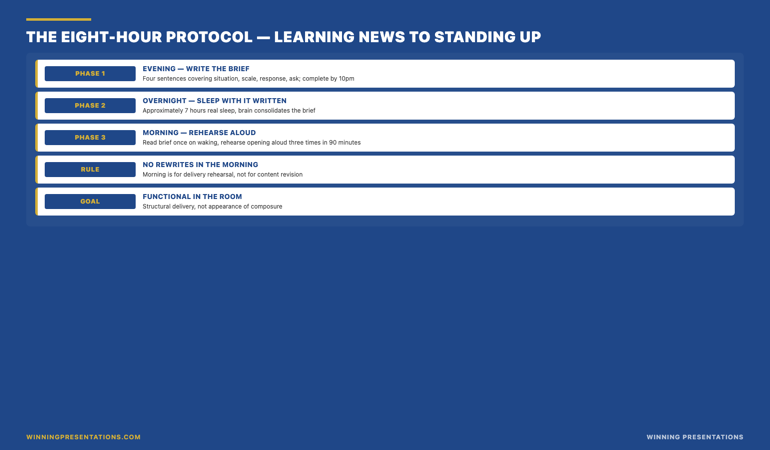
Phase one is the four-sentence brief. The four sentences are: what has happened (the situation), how big it is (the scale, in concrete numbers wherever they exist), what is already being done (the response, with the chain of command named), and what the meeting needs to authorise or be aware of (the ask). Each sentence is one sentence, not a paragraph. The discipline is in the compression. The leader who finds the four sentences hard to write is usually one of two cases: either the underlying facts are still being scoped (in which case the brief honestly says “still scoping” in the relevant part), or the leader is struggling to accept the gravity of what has happened (in which case the brief writing itself becomes part of the acceptance work). Both cases require the same response: write the four sentences as accurately as possible with what is known at nine in the evening, and accept that the brief may be refined in the morning if new facts arrive overnight.
Phase two is sleep. The leader who has written the four-sentence brief by ten can usually sleep by eleven, even on a night when sleep feels impossible at the start. The brief is the cognitive offload that lets the body rest; without it, the mind cycles through the same content all night and produces no sleep and no improvement to the brief. With it, the mind has a stable artefact to hold and can release into rest. Most leaders I have worked with through these nights describe being amazed at how much sleep they got once the four-sentence brief was on paper. The brain consolidates the content during sleep in a way that produces a clearer, smoother delivery in the morning than any amount of late-night rehearsal would have produced.
Phase three is the morning rehearsal. From six until approximately seven thirty — longer if the meeting is later in the morning, shorter if the meeting is earlier — the leader reads the brief aloud three times. Once to themselves, once to a senior colleague or coach on the phone, and once in front of a mirror or to an empty room. The three rehearsals produce a settled delivery in the live moment. The leader is not rewriting; they are rehearsing what was already written the night before. Any urge to rewrite in the morning is resisted — the morning brain is not the writing brain, and revisions made under morning stress are usually worse than the original. The morning is for delivery rehearsal, not for content revision.
Functioning in the room is not the same as appearing composed
The thing the eight-hour protocol produces is functional capacity in the room, not the appearance of composure. These are different and frequently confused. Functional capacity is the ability to deliver the four-sentence brief in the order it was written, answer questions accurately, take notes when notes are needed, and hold the room’s attention long enough for the meeting to do its work. Composure is the absence of visible affect — calm voice, steady hands, level eye contact. The leader can be functional without being composed; they can also be composed without being functional, which is the worse outcome.
The room does not need the leader to appear composed. The room needs the brief delivered, the questions answered, and the chain of command made clear. A leader who is visibly tired, visibly tense, or quietly emotional can do all three of those things if the brief is structurally tight and the rehearsal has been done. The board reads the structural delivery, not the affect. A chair I worked with in 2019, after watching a chief executive deliver a presentation about a fatality in clear emotional difficulty, told me afterwards that he had read the chief executive’s visible distress as evidence of seriousness and ownership rather than as weakness. The brief was delivered cleanly. The emotion was visible. The two together signalled exactly what the room needed to see.
The leader who spends the morning trying to compose themselves is doing the wrong work. Composure is not a preparation activity; it is a downstream outcome of structural preparation. The leader who has written the brief, slept, and rehearsed the opening will be as composed as they are going to be, regardless of how much additional composure work they try to do in the morning. The leader who has not done the structural work cannot make up the deficit by trying harder to appear calm; they will appear calm and be non-functional, which the chair reads as a worse signal than emotional difficulty paired with a clean brief. The protocol prioritises functional capacity, and lets composure be whatever it ends up being.
The pre-meeting protocol that holds when the news is terrible and you have hours, not days.
Conquer Your Fear of Public Speaking covers the eight-hour protocol, the four-sentence brief, the morning rehearsal sequence, and the longer-term recovery work for senior leaders who present under acute pressure with any regularity. £39, instant access, lifetime access to materials.
- Pre-meeting protocols for acute pressure presentations
- Structural rehearsal sequences for senior leaders
- Recovery work for repeated high-stress board presentations
- Instant download, lifetime access, no subscription
What not to do in the hours before delivering terrible news
The eight-hour protocol is also a list of what not to do, which is sometimes more useful than the list of what to do. The first thing not to do is rebuild the deck. The deck is what the supporting team will be working on overnight if there is one; the senior leader’s job is the four-sentence brief, not the deck. Senior leaders who insist on rebuilding the deck themselves overnight are usually doing it because rebuilding the deck feels productive and writing the four-sentence brief feels small. The four sentences are the work. The deck is the supporting material.
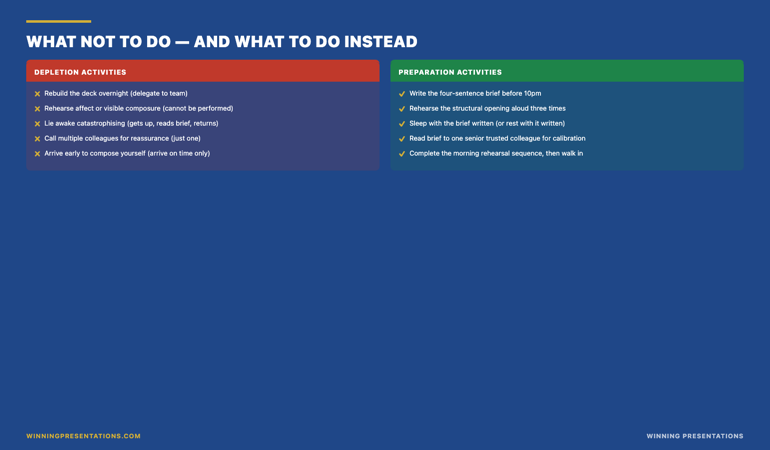
The second thing not to do is rehearse affect. The leader who spends the morning trying to project the appropriate level of seriousness, gravity, or composure is rehearsing the wrong thing. The brief is what is rehearsed. The affect will be whatever the brief plus the underlying emotion produces, and any attempt to layer affect on top of the delivery produces a wooden, slightly false quality that the chair can hear immediately. Rehearse the opening aloud three times. Let the affect look after itself. The room would rather see honest emotion paired with a clean brief than rehearsed gravity paired with a wobbly brief.
The third thing not to do is lie awake catastrophising. This is the hardest one, because lying awake feels involuntary, especially when the news is genuinely terrible. The eight-hour protocol works specifically because writing the brief before bed is what allows sleep. If the brief is written by ten and read once before bed, most leaders find they can sleep. If sleep does not arrive after thirty minutes, the recommendation is to get up, read the brief once more, then return to bed — not to lie in bed cycling through scenarios. The brain will consolidate the brief whether the leader sleeps for seven hours or four, but four hours of actual sleep is better than seven hours of lying awake. The aim is structural rest, not optimal sleep.
The fourth thing not to do is call multiple colleagues for emotional reassurance. Calling one senior trusted colleague to read the brief back to them, and to receive a calibrated read on whether the four sentences are tight, is structural preparation. Calling four people in succession to talk through how bad the news is and how worried the leader feels is depletion. The first call uses preparation hours productively; the second uses them up. Senior leaders preparing for terrible-news presentations are limited in their reserves; the protocol exists to spend those reserves on the work that affects the outcome, not on the work that feels productive but does not.
For senior leaders who already present under acute pressure regularly and want the structural board-level frameworks that pair with the pre-meeting protocol, look at the Executive Buy-In Presentation System (£499). It is a self-paced programme with seven modules covering board structural communication including crisis briefings, regulatory presentations, and high-stakes terrible-news scenarios. The buy-in framework pairs with the pre-meeting protocol covered here — the protocol gets you into the room functional, the framework gives the room what it needs once you are in. See the Executive Buy-In Masterclass overview for the full board structural protocol and the broader catalogue at our services page.
Frequently asked questions
Is Conquer Your Fear of Public Speaking worth £39 if I am already a confident senior presenter?
If you are already a confident senior presenter in normal conditions, the value of Conquer Your Fear of Public Speaking is in the pre-meeting protocols for acute pressure — the rare but high-stakes moments when the usual confidence does not transfer because the underlying news has changed the room. Most senior leaders present competently for years and then encounter one or two genuinely terrible-news moments over a career, often without warning. The pre-meeting protocol is the work they wish they had practised when those moments arrive. The product is not a remedial confidence programme; it is a structural preparation reference for senior leaders preparing for the kind of presentation where the usual default does not hold. If you have a known high-stakes presentation in the next eight weeks, the £39 case is straightforward. If you do not, the product sits on the shelf until needed.
What is the most common mistake senior leaders make the night before a terrible-news presentation?
The most common mistake is rebuilding the deck instead of writing the brief. The deck feels productive because it is visibly content-rich, whereas the four-sentence brief feels small. But the brief is what the leader will be carrying in the live moment, and the deck is the supporting material that the team can polish overnight. Senior leaders who spend the night rebuilding the deck arrive in the morning exhausted, with a slightly improved deck and an unrehearsed brief; senior leaders who spend the night writing the brief and sleeping arrive with a rested mind, the brief already consolidated, and the supporting deck handled by the team. The second outcome is reliably better in the room.
How long does it take to see results from the eight-hour protocol?
The eight-hour protocol produces results in the next presentation it is used for, which is usually within forty-eight hours of learning the protocol. It is not a skill that has to be built over months; it is a checklist that has to be followed once. The skill that does build over time is the cognitive discipline to use the protocol when under acute stress. The first time a senior leader follows it under live pressure is often the hardest; the second and third times are easier. Most leaders who use the protocol once report that it becomes their default for any high-stakes briefing thereafter, because the contrast with the unprotocolled night is so visible the morning after.
Does this work the same way for in-person versus virtual board presentations?
Yes, with minor variation. The four-sentence brief, the overnight sleep, and the morning rehearsal apply identically. The variation is in the morning sequence: in a virtual meeting, the ninety minutes before the call should also include a check of the video setup, the audio, and any screen-share material, ideally as the second-to-last rehearsal so it is fresh in the leader’s mind. In-person meetings replace the technical check with the journey to the meeting room and any pre-meeting interactions, which should be minimised to preserve reserves. The structural shape of the protocol is the same; the surrounding logistics differ.
What if the news arrives so late that I do not have eight hours before the meeting?
The protocol compresses. If the leader has only four hours, the four-sentence brief is written in the first hour, sleep takes two of the remaining three hours, and rehearsal takes the final hour. If the leader has only two hours — which happens with genuinely urgent crisis briefings — the brief is written in the first thirty minutes, the leader rests (not sleeps) for an hour with the brief written, and the final thirty minutes are the rehearsal. The structural shape holds across compression; what cannot be compressed away is the brief itself. Without the four-sentence brief written before the meeting, the leader walks into the room with the structural work undone, regardless of how good the deck is or how composed the affect.
The Winning Edge newsletter: weekly editorial on the structural patterns senior leaders use to function under pressure — crisis briefings, terrible-news presentations, regulatory engagements. Sent every Thursday morning to senior leaders presenting at board level.
Walk into your next high-pressure briefing with the eight-hour protocol installed.
Conquer Your Fear of Public Speaking covers the four-sentence brief structure, the morning rehearsal sequence, and the recovery work for senior leaders who present under acute pressure. £39, instant access, lifetime access to materials.
The next time you learn terrible news the night before a meeting — not the everyday difficult kind, but the genuinely terrible kind — write the four-sentence brief before ten in the evening, sleep with the brief written, and rehearse the opening aloud three times in the ninety minutes before the meeting. Do not rebuild the deck. Do not rehearse affect. Do not lie awake catastrophising. The room reads structural delivery, not composure, and structural delivery is what eight hours of well-used preparation produces. For senior leaders who want the broader catalogue of board-readiness assets, see The Complete Presenter bundle.
ABOUT THE AUTHOR
Mary Beth Hazeldine is Owner & Managing Director of Winning Presentations. She has 24 years in corporate banking at JPMorgan Chase, PwC, Royal Bank of Scotland, and Commerzbank, and 16 years coaching senior professionals across financial services, healthcare, technology, and government. She advises senior leaders on the structural preparation that holds when the underlying news is genuinely terrible.
Winning Presentations Ltd, founded in 1990, is a UK consultancy specialising in executive presentation methodology and senior leadership communication.