

Quick Answer
Stakeholder alignment is the work that happens before your presentation, not inside it. Identify the two or three people whose silence or resistance could derail your proposal, meet them individually beforehand, and address their concerns directly. Executives who walk into decision meetings with informed support rather than hopeful assumptions achieve faster approvals and fewer unexpected deferrals.
In This Article
- Why the decision is usually made before the meeting
- Mapping your stakeholder landscape in advance
- The pre-meeting formula: what to cover one-to-one
- Reading resistance versus polite uncertainty
- When a yes in private becomes silence in the room
- How pre-alignment changes your formal presentation
- Common alignment mistakes to avoid
- Frequently asked questions
Kwame had every reason to feel confident walking into the committee room. He had spent three weeks building the proposal, modelled three financial scenarios, addressed the likely objections in the appendix, and rehearsed the narrative twice. He believed the room would be receptive.
It wasn’t. Within ten minutes, the Chief Risk Officer had raised a concern about regulatory exposure that Kwame had not prepared for. Two other committee members, who had said nothing before the meeting, aligned themselves with her position. The session ended with a request for a revised paper at the next quarter’s cycle.
Kwame reviewed what had gone wrong. The CRO had spoken informally to a colleague about regulatory risk several weeks earlier. That conversation had shaped her view long before the formal session. Kwame had been building a presentation; his opponent had been building a coalition. He had assumed the formal meeting was where the decision would be made. In practice, it had already been made — against him.
Most presentation preparation focuses on what happens in the room. The executives who consistently secure approvals focus on what happens before it.
Preparing a proposal for a major decision meeting?
The Executive Slide System includes scenario playbooks and slide frameworks designed for executive decision presentations, including pre-meeting structuring and stakeholder-specific slide approaches.
Why the Decision Is Usually Made Before the Meeting
Formal decision meetings rarely change minds. By the time a proposal reaches a board or committee, the people in that room have already formed a view — either through their own analysis, through conversations with colleagues, or through a prior experience with the presenting team. The formal session is not the moment of decision. It is the moment where existing positions are ratified or challenged.
This is not a criticism of how decisions are made. It reflects how senior leaders actually operate. They gather intelligence informally, form provisional views, and use the formal meeting to test those views against the group. An executive who walks in hoping to persuade a room from a standing start is working against this process rather than with it.
The implication is significant: if stakeholder alignment is not done before the meeting, the presentation itself becomes an uphill argument against positions that were formed without your input. The objections raised in the room are almost always objections that existed before the room convened. They simply were not surfaced earlier because no one asked.
Pre-meeting alignment is not about lobbying or soft manipulation. It is about making sure that the people who will influence the decision have had a genuine opportunity to raise their concerns — with you, directly, in advance — so those concerns can be understood, addressed, and either incorporated into the proposal or prepared for in the room.
Mapping Your Stakeholder Landscape in Advance
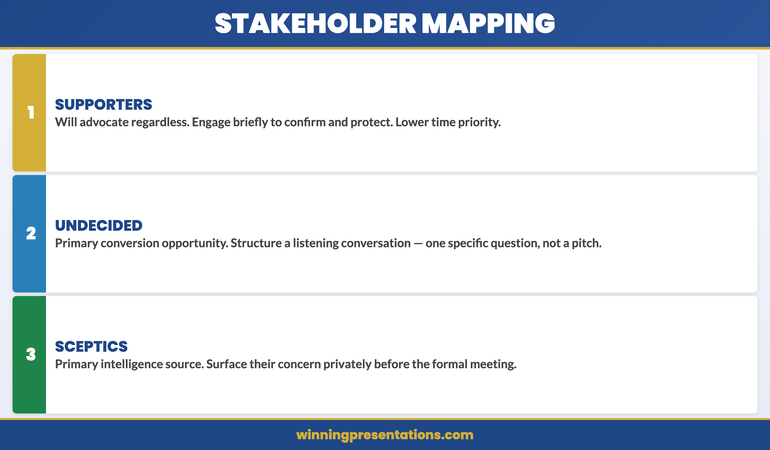
Before any alignment conversation takes place, map the landscape. For a typical executive decision meeting, this means identifying three categories of stakeholder: those who are likely to support the proposal, those who are genuinely undecided, and those whose instinct will be sceptical or resistant.
The supporters matter less than you think. They will advocate regardless. The undecided are your primary opportunity: a well-structured pre-meeting conversation with an undecided stakeholder often converts a tentative abstention into active support. The sceptics are your primary intelligence source: understanding their specific concerns before the meeting allows you to address them directly in your presentation or to prepare substantive responses rather than improvised ones.
To map accurately, consider three factors. First: authority weight. Who in the room carries disproportionate influence over others? A single sceptic with high authority is more consequential than three undecided voices. Second: domain expertise. Who will be most credible on the technical or commercial dimensions of the proposal? If the CFO is sceptical about the financial model, that carries more weight than a peer-level concern. Third: prior exposure. Has anyone on the committee heard a version of this proposal before? Prior exposure creates expectations — either positive or negative — that shape how the new version is received.
The Pre-Meeting Formula: What to Cover One-to-One
An alignment conversation is not a pre-sell. It is a structured listening exercise that happens to include a briefing. The distinction matters because the purpose is to learn, not to persuade. Going into a pre-meeting with the goal of converting a sceptic will produce a conversation that feels transactional and may harden their position. Going in with the goal of understanding their concern produces a conversation that often resolves the concern naturally.
A well-structured pre-meeting covers three areas. First, context: give the person a brief overview of what you are proposing and why it is coming to this particular committee at this particular time. Keep this to two minutes. Second, invitation: ask a specific question. Not “what do you think?” but something more targeted, such as “What would you want to understand about the financial model before the session?” or “From your experience with similar projects, what tends to create the most friction in approvals like this?” These questions surface real concerns without feeling interrogative. Third, direct ask: at the end of the conversation, confirm understanding. “Is there anything in what I’ve covered that would give you pause at the meeting?”
That final question is uncomfortable to ask and extremely valuable to hear. It gives sceptics a private, low-stakes forum in which to raise their concern. Most will. And a concern raised privately is significantly easier to address than one launched in a formal committee session in front of peers.
The Executive Slide System
Executive decisions are won through structure, not persuasion. The Executive Slide System — £39, instant access — includes slide frameworks and scenario playbooks designed for high-stakes proposals, including how to structure a presentation for a room where views are already partially formed.
- Slide templates for executive decision scenarios
- AI prompt cards to build decks fast
- Scenario playbooks for board, budget, and approval meetings
- Framework guides for structuring high-stakes proposals
Get the Executive Slide System →
Designed for executives preparing high-stakes presentations and proposals.
Reading Resistance Versus Polite Uncertainty
Not every sceptic sounds like one in a pre-meeting. Some express genuine enthusiasm but are privately unconvinced. Others raise procedural questions that feel neutral but signal substantive concern. Learning to distinguish between “wait and see” and “fundamentally opposed” is one of the most valuable skills in stakeholder alignment.
Genuine support tends to be specific. A supporter will name what they find compelling, ask about implementation or timing, and use inclusive language (“when this is approved” rather than “if this goes ahead”). Polite uncertainty tends to be general. Someone who is unconvinced but unwilling to say so will offer vague encouragement (“very interesting work”), redirect to process (“has legal reviewed this?”), or ask questions that test your preparation without engaging with your argument.
The most telling signals are the questions that are not asked. If someone who has domain expertise in a critical area of your proposal asks nothing about that area in a pre-meeting, they either have no concern or they have already decided they will raise it formally rather than privately. The latter is more common. A subject-matter expert who asks nothing has usually formed a view they consider settled.
When you encounter this pattern, do not push for their opinion. Instead, name the gap directly: “I noticed I haven’t covered the operational implications — is that an area you’d want more detail on before the session?” This gives them a structured opening. If there is a concern, it will usually surface at this point. If there genuinely isn’t, they will say so clearly.
If you are structuring a follow-up presentation after an inconclusive meeting, pre-meeting alignment becomes even more important: you need to understand what shifted between the previous session and the current one before you can present effectively.
When a Yes in Private Becomes Silence in the Room
One of the most disorienting experiences in executive presenting is walking into a formal meeting with four verbal commitments from individual stakeholders and watching three of them say nothing while a fifth person raises an objection that changes the room’s direction.
This happens for a predictable reason. A private yes is a personal position. A public yes is a social commitment with professional consequences. Senior leaders manage their reputations carefully. If a peer raises a concern in a formal session that another executive did not anticipate, that executive may stay silent to avoid appearing poorly briefed rather than speak up for a position they privately hold.
The lesson is not that pre-meeting commitments are unreliable. It is that they are conditional on what happens in the room. To protect the value of your pre-meeting work, there are two practical steps. First, close each alignment conversation with a specific commitment: “If no new information comes up before Thursday, can I count on your support at the meeting?” That language shifts the implied commitment from unconditional to bounded — and gives you a cleaner read of where each person actually stands. Second, build your formal presentation to pre-empt the concerns you identified in pre-meetings. If you know the CFO is worried about the capital expenditure timeline, address that directly and early in the presentation itself. This signals to the CFO that you listened, and it reduces the likelihood that they will raise it as a public challenge.
Understanding how to close a presentation so executives take action becomes significantly easier when stakeholder alignment has already established the direction of their thinking before the final slides appear.
If you want to strengthen your approach to executive decision presentations, the Executive Slide System includes scenario playbooks specifically designed for multi-stakeholder approval meetings.
How Pre-Alignment Changes Your Formal Presentation
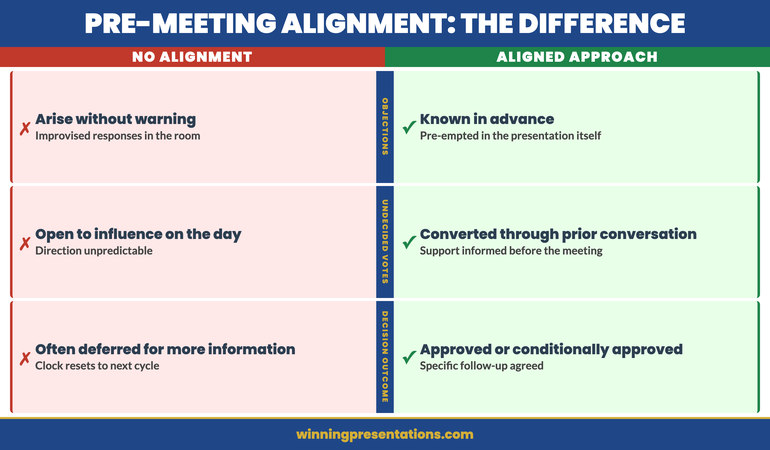
A presentation built without stakeholder alignment intelligence is constructed around what the presenter assumes the room needs to hear. A presentation built after alignment conversations is constructed around what the room has already told you it needs to hear. The difference in persuasive effectiveness is substantial.
Concretely, pre-alignment changes three structural decisions. First, it changes what you emphasise. If your mapping has identified that the CFO is undecided and the CEO is supportive, you structure the proposal so that the financial case is front-loaded and comprehensive. If the operational committee is your swing vote, operational feasibility becomes the centrepiece. You are not changing the proposal; you are calibrating the emphasis to match the decision-making framework of the people who matter most.
Second, it changes how you handle objections. Without alignment intelligence, you respond to objections as they arise. With it, you can pre-empt the most significant ones. “One question that came up in my preparation was the impact on the current capital allocation cycle — I want to address that directly before we move to Q&A.” This signals thoroughness, reduces the dramatic impact of the objection if it still arises, and demonstrates respect for the committee’s specific concerns.
Third, it changes your structure if you have a formal executive presentation outline. Instead of a linear case-building structure, a pre-aligned presentation often leads with the decision itself, addresses the two or three specific concerns identified in pre-meetings early, and reserves the detailed evidence for stakeholders who want it rather than presenting it to everyone as though none of them have a view yet.
Common Alignment Mistakes to Avoid
The most common error is treating alignment as optional rather than structural. Many executives view pre-meetings as a favour to important stakeholders, something done when there is time rather than as a non-negotiable step in the presentation process. When pressed on preparation time, they deprioritise alignment in favour of slide refinement. This trades the thing most likely to improve the outcome (understanding the room) for the thing most visible in preparation (polishing the deck).
The second error is aligning too broadly. Speaking to every member of the committee in advance creates logistical difficulty and can create the impression that you are lobbying rather than consulting. Focus on three to five people: the one with the most authority, the one most likely to be sceptical, and one who has previously expressed interest in similar proposals. These conversations will tell you more than speaking to ten people at a more superficial level.
The third error is seeking endorsement rather than understanding. Going into a pre-meeting with the goal of securing a “yes” creates conversations that feel manipulative and tend to produce hollow agreements. Going in with the goal of understanding genuine concerns produces conversations that are substantively useful. The distinction lies in the questions you ask: “What would you need to see?” is more valuable than “Can you see yourself supporting this?”
The fourth error is not following up. If a stakeholder raises a concern in a pre-meeting and you address it in your revised presentation, send them a brief note before the formal session: “Following our conversation last week, I’ve updated the proposal to reflect your point about the timeline. Section three now covers that directly.” This closes the loop, confirms you listened, and reminds them of their prior engagement with the process in a way that makes it harder to raise the same concern again as though it is new.
The Executive Slide System
Slide frameworks designed for multi-stakeholder executive decisions — including scenario playbooks for proposals where different stakeholders have different priorities. £39, instant access.
Get the Executive Slide System →
Designed for executives preparing structured proposals for senior decision meetings.
Frequently Asked Questions
How much time before a presentation should stakeholder alignment happen?
Alignment conversations should happen at least five to seven working days before the formal meeting. This gives you time to incorporate significant concerns into your proposal and gives stakeholders enough notice that the conversation feels deliberate rather than last-minute. For high-stakes or complex proposals, begin alignment two to three weeks in advance. The earlier you understand the room’s concerns, the more substantive your response can be.
What if a key stakeholder refuses to meet in advance?
If a stakeholder declines a pre-meeting, this is itself useful information. It usually signals one of three things: they are too busy to engage at this stage, they have a strong prior view that they do not want to moderate through private discussion, or they prefer to see how the formal meeting develops before committing. In any of these cases, invest extra effort in understanding their known priorities and likely concerns through other channels — conversations with their direct reports, recent public statements on similar proposals, or the records of previous meetings where they have engaged on related topics. Design your formal presentation to pre-empt the most predictable version of their concern.
Can pre-meeting alignment backfire?
It can if handled badly. Speaking to too many people, sharing sensitive details prematurely, or creating the impression of a coordinated lobbying effort can generate resistance rather than support. Two principles reduce this risk. First, approach each pre-meeting as a listening exercise, not a persuasion exercise. Second, keep the conversations focused on the proposal’s merits and the specific concerns of that individual — do not reference what other stakeholders said or imply that you are building consensus against someone.
The Winning Edge — A Newsletter for Executives Who Present
Every Thursday: one practical technique for structuring, presenting, or defending a high-stakes proposal. Designed for executives who need to communicate with authority, not just confidence.
Also available: the Executive Presentation Checklist — a free pre-presentation checklist for senior decision meetings.
If you are building a proof-of-concept presentation, the same alignment principles apply — with an additional layer of technical credibility to manage.
About the Author
Mary Beth Hazeldine is the Owner and Managing Director of Winning Presentations. With 25 years of corporate banking experience at JPMorgan Chase, PwC, Royal Bank of Scotland, and Commerzbank, she advises executives across financial services, healthcare, technology, and government on structuring presentations for high-stakes funding rounds and approvals.