

Why Pitching for Approval in July Quietly Costs You the Decision
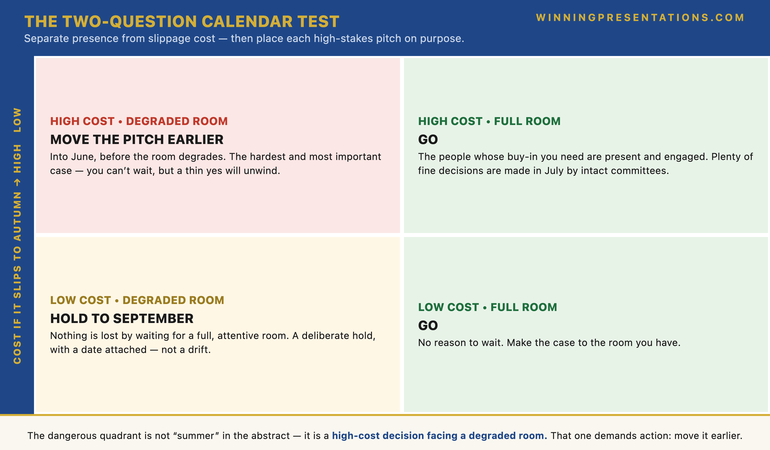
Quick answer: Pitching a high-stakes approval into a half-present July room often costs you the decision in a way that is invisible at the time, because the room either defers it — pushing the next hearing to September and a lost quarter — or grants a thin yes that the absent stakeholder re-opens when they return. The fix is to treat your second-half approvals as a calendar to be planned, not a queue to be worked through. For each high-stakes pitch, run two questions: will the specific people whose active buy-in you need actually be present and engaged, and what does it cost you if the decision slips to the autumn? High slippage cost with a degraded room means move the pitch earlier, into June, while the deciders are still around; low slippage cost with a degraded room means hold it deliberately to September; a full, attentive room means go. Confirm the call with the empty-chair test: for every absent or checked-out seat in the July room, ask whether your approval needs that person’s active support or merely their absence of objection. If it needs their support, do not pitch it into a room they are not in.
JUMP TO:
In 2016 I worked with a senior leader who had a significant investment to get approved and a committee that met for the last time in late July before the summer scattered everyone. He was ready — genuinely ready, with a strong case and a clean deck — and he took the meeting because it was there. Two of the seven seats were empty that day, including the one belonging to the director whose function would carry most of the operational risk. The room, light on numbers and keen to clear its agenda before the break, gave him a yes. He left elated. In the second week of September the absent risk director came back, read the approved proposal for the first time, and raised an objection that had real force — the kind that, raised in July, might have reshaped the whole thing. Because he had not been in the room, he felt no ownership of the decision, and he had the standing to re-open it. The approval was effectively unwound and sent back for rework. The leader had not lost in July; he had won in a way that guaranteed he would lose in September, and the lost time was worse than if he had never pitched at all.
(This article was created with AI assistance; all stories and insights are based on 35 years of real client work.)
That September unwinding taught him the discipline I now press on every senior person heading into a summer with decisions to land: the calendar is not neutral, and a pitch is not something you simply slot into the next available meeting. Where in the year you make an approval ask — and crucially, who is actually in the room when you make it — changes the odds and the durability of the outcome as much as the quality of the case. The July room looks like an opportunity because it is a meeting that exists; it is often a trap, because a decision made by a partial room is a decision that the absent members can reverse. This piece sets out the way senior leaders plan a second-half pitch calendar rather than working a queue: the two-question test that tells you whether a given July slot is a real window or a false one, the empty-chair test that catches the durability problem before it bites, and the move-it-or-hold-it decision that keeps a thin summer yes from becoming an autumn defeat.
Timing the pitch is half the battle; the structure of the ask is the other half.
The free 7 Presentation Frameworks Quick Reference Card puts the core structures behind a persuasive approval ask — problem, stakes, recommendation, decision — on a single page, so once you have chosen the right room and the right week, the case itself is built on a shape that carries a decision rather than just filling slides. Free download, no email gate.
The thin yes that costs more than a no
The instinct to take the meeting that is in front of you is reasonable and, in summer, often wrong. A pitch into a degraded room has three possible outcomes, and two of them are worse than they look. The first is a clean deferral — the room declines to decide with people missing, and your item rolls to the next meeting, which in a pre-summer slot can mean September. That costs you a quarter, but at least it is honest. The second outcome is the dangerous one: a thin yes. A light, agenda-clearing room approves the proposal without the scrutiny it would have drawn from a full house, and you leave with a decision that has not actually been stress-tested and does not carry the commitment of the people who were not there. The third outcome, an outright no from a partial room, is rare precisely because a light room would rather defer than reject — which is why the thin yes is the trap you actually need to watch for.
A thin yes is fragile in a specific, predictable way. A decision’s durability comes from the buy-in of the people who can later challenge it, and buy-in is built by being in the room when the decision is made — by raising your concern, hearing it answered, and committing to the outcome in front of your peers. A stakeholder who was absent has none of that. They did not voice their objection, did not hear your response, and feel no ownership of a decision that happened without them. When they return, they encounter the approval as a fait accompli imposed in their absence, and a senior person with standing does not quietly accept that — they re-open it. So the thin yes you celebrated in July becomes the contested decision of September, and you fight the same battle twice, the second time from the weaker position of someone defending a decision rather than proposing one. The psychology of how senior people grant and withdraw buy-in is the whole reason a partial-room approval is structurally unstable.
The reframe is that a deferral is not always the failure it feels like, and a yes is not always the win. If the choice is between a thin yes from a half-present July room and a clean decision from a full September one, the September decision is very often the better outcome — it costs you weeks but it produces an approval that holds. The error senior people make is to treat the calendar as a series of chances to be seized, when high-stakes approvals are better treated as a small number of decisions to be placed in the right room at the right time. Seizing every chance is how you end up with a thin summer yes that unwinds; placing the decision deliberately is how you get one that survives the autumn.
The two-question calendar test
The two-question calendar test is how you decide, for each high-stakes approval, whether a given summer slot is a real window or a false one. You run it on every important pitch in your second-half calendar, ideally before the summer diaries close, and it turns a vague unease about “pitching in July” into a clear placement decision. The two questions are deliberately blunt.
Question one: will the people whose active buy-in you need actually be present and engaged? Not whether the meeting will be quorate — a technical quorum is easy to hit and almost irrelevant — but whether the specific individuals who can later make or break this decision will be in the room, attentive, and able to commit. List them by name, then check them against the summer calendar. Question two: what does it cost you if this decision slips to the autumn? Be concrete: a delayed approval might mean a missed budget cycle, a competitor moving first, a project start pushed by a quarter, or it might mean almost nothing because the work cannot start until autumn anyway. The honest answer ranges from “a lost quarter we cannot afford” to “no real cost.” Together the two answers place the pitch on a simple grid. High slippage cost and a degraded room is the hardest case — you cannot afford to wait, but you cannot afford a thin yes either, so the answer is to move the pitch earlier, into June, before the room degrades. Low slippage cost and a degraded room is easy: hold it to September and lose nothing. A full, engaged room means go, regardless of the date. Sequencing a strategy approval across a year is largely the discipline of running this test on each decision in advance, rather than discovering the room is half-empty on the day.
What makes the test useful is that it forces the two variables apart. Presenters who feel uneasy about a summer pitch usually collapse the decision into a single fuzzy worry — “August is a bad time” — and either push through anyway or delay without a plan. Separating presence from slippage cost shows you that the right move depends on both, and that the genuinely dangerous quadrant is not “summer” in the abstract but specifically a high-cost decision facing a degraded room. That is the case that demands action — and the action is almost always to move the pitch earlier, not to gamble it into a thin July room or to passively let it slip.
Walk into your next approval meeting with the room already won — not hoping a thin yes holds.
The Executive Buy-In Presentation System is the self-paced programme behind securing durable agreement from senior stakeholders — seven modules covering how to read who actually decides, frame the case, and structure the ask so the people in the room commit rather than merely nod. It is built for the kind of approval that has to survive contact with the people who were not in the room the first time.
- 7 self-paced modules on stakeholder analysis, case construction, and the structure of a durable ask
- Optional live Q&A sessions with Mary Beth — fully recorded, so you watch back at your own pace
- New cohort opens every month; enrol whenever suits you, no deadlines, no mandatory attendance
- Lifetime access to all materials — £499
The empty-chair test
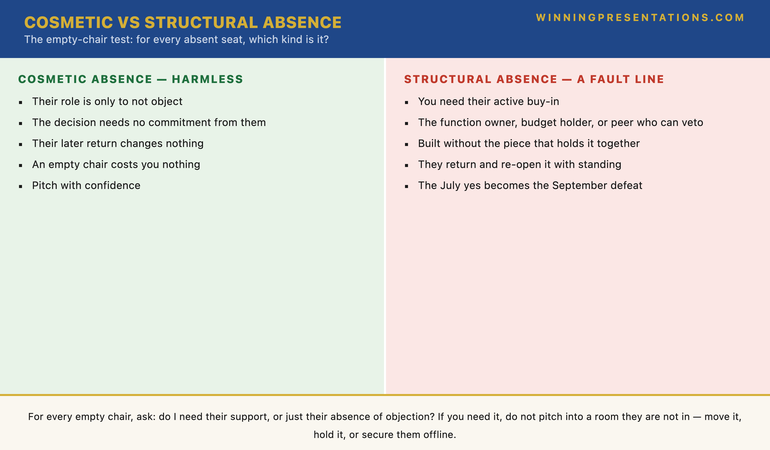
The calendar test tells you whether a slot is workable; the empty-chair test tells you, with more precision, whether a specific degraded room is safe to pitch into. It takes a few minutes and you run it once you know who will actually attend. Picture the room you will pitch into — the real attendance, not the invite list — and look at every chair that will be empty or occupied by someone visibly checked out before the break. For each of those chairs, ask one question: does my approval need this person’s active buy-in, or merely their absence of objection? Some decisions need only that nobody actively blocks them; for those, an empty chair is harmless. Other decisions depend on a particular person’s genuine commitment — the function owner who must execute it, the budget holder who must fund it, the peer who can later veto it — and for those, an empty chair is a decision waiting to be re-opened.
The test works because it distinguishes between two kinds of absence that feel identical in the moment but behave completely differently afterward. An absent stakeholder whose role is merely to not object costs you nothing by being away; the decision does not depend on their commitment, so their later return changes nothing. An absent stakeholder whose active buy-in the decision requires is a structural fault line: the approval was built without the one piece that holds it together, and it will fail at that seam the moment they come back and exert the standing they have. Most presenters do not make this distinction — they see “the room was mostly there” and feel reassured — which is exactly why they are surprised in September. The empty-chair test makes you name, in advance, whether each absence is cosmetic or structural.
The test also tells you what to do, not just whether to worry. If the empty chair belongs to someone whose active buy-in you need, you have three options and they are all better than pitching anyway: move the pitch earlier so the chair is filled, hold it until they are back, or — if neither is possible — secure their buy-in offline before the meeting so that, even absent, they have genuinely committed and will defend rather than re-open the decision. That third path is the pre-wire applied to the timing problem: you cannot put them in the room, so you put the room’s key conversation to them in advance. Securing a sponsor’s genuine commitment before the meeting is the move that lets an unavoidable summer pitch survive an absent decision-maker, and it is far cheaper than fighting the decision twice.
Once the room and the week are right, the deck still has to carry the decision on the day.
The Executive Slide System gives you board-grade templates and 16 scenario playbooks for approval decks, plus 93 AI prompts and 7 checklists, so the case you have timed so carefully arrives in a structure built to get a decision rather than just inform. Instant access, lifetime use — £39.
When to move a pitch, when to hold it
The two tests produce one of three instructions, and the skill is in acting on them rather than rationalising the comfortable default of pitching into whatever meeting is next. In 2019 I worked with a programme director facing exactly the high-cost, degraded-room quadrant: a funding decision that genuinely could not wait until autumn without losing a delivery window, and a July committee that would be missing two of the people whose commitment the programme needed. The passive move was to take the July slot and hope. Instead she moved the pitch forward by five weeks, into early June, while the full committee was still in place and attentive. It meant bringing her case to readiness faster than she would have liked, but the decision was made cleanly, by a full room, with the function owners committed — and it held. When the summer came, there was nothing to re-open, because everyone who could re-open it had been in the room and had said yes. Moving the pitch earlier cost her three weeks of compressed preparation; pitching it into July would have cost her the autumn.
The hold decision is the mirror image and is just as deliberate. When the slippage cost is genuinely low — the work cannot start until autumn regardless, the budget cycle does not turn until then, nothing is lost by waiting — a degraded summer room is simply the wrong place to spend a high-stakes decision, and holding it to a full September meeting is not procrastination but placement. The mistake is to treat a hold as a failure of nerve. Choosing to present a contested decision to a complete, rested, attentive room in September rather than a depleted one in July is a stronger move than forcing it through early, provided you have honestly established that waiting costs little. The discipline is to make the hold a decision, with a date attached and the September runway already planned, rather than a drift in which the pitch slips because you never got to it.
The go decision needs the least explanation but one caution. A full, engaged room is a green light regardless of the date — plenty of excellent decisions get made in July by committees that happen to be intact — but “full” means the people whose buy-in you need, not merely a quorum. It is easy to talk yourself into a go because the meeting is technically valid while the one person who actually matters is the empty chair. Run the empty-chair test even on a room that looks full, because the failure mode is not an obviously depleted room — you would catch that — it is a room that looks fine with a single structurally important absence you waved past because everyone else was there. The whole point of planning a pitch calendar is to make these placements on purpose, in advance, instead of discovering on the day that the chair that mattered was the one that was empty.
Build the case your stakeholders cannot quietly unwind once the summer is over.
The Executive Buy-In Presentation System works on the durability problem directly: how to construct an ask and read a room so that the people who matter genuinely commit, rather than nodding through a decision they will reconsider later. It is a self-paced framework — seven modules — for senior people whose approvals have to survive the return of everyone who was not there the first time.
- The framework for securing buy-in that holds, not a yes that erodes the moment scrutiny returns
- Self-paced with monthly cohort enrolment — start with the next cohort, work at your own pace
- Optional, fully recorded Q&A sessions; no deadlines, no mandatory attendance
- Lifetime access to all materials — £499
Why presence is really about buy-in
Underneath all of this is a single idea that the summer calendar makes unusually visible: an approval is only as durable as the buy-in of the people who can later challenge it, and buy-in is overwhelmingly built by presence at the moment of decision. We tend to think of a board or committee decision as a binary event — approved or not, on a particular date — but a decision is really a state of shared commitment that has to hold over time, through execution, through the inevitable moment when someone asks “why did we agree to this?” The people who were in the room when the case was made, who raised their concerns and heard them answered, carry that commitment; they will defend the decision when it is questioned because they own it. The people who were absent carry none of it, and when the decision is questioned they are the ones most likely to do the questioning.
This is why the summer timing problem is not really about summer. July simply makes the absent-stakeholder problem common and visible — lots of empty chairs at once — but the same dynamic operates whenever a key decision-maker misses the meeting, in any month. A reorganisation that pulls a director out, a clash with another board, a sudden travel commitment: any of these can leave you pitching a decision that needs someone’s buy-in into a room they are not in, with the same September-style re-opening waiting on the other side. The pitch calendar is a summer-specific application of a year-round principle: never spend a high-stakes decision in a room missing the people whose commitment the decision depends on. Learn to see it in July and you will see it the rest of the year too.
The deeper lesson for senior people is that managing the calendar is part of managing buy-in, not separate from it. The leaders who are good at getting durable approvals are not only good in the room; they are good at choosing which room, and which week, to be in — placing each decision where the people who matter can genuinely commit to it. That is a planning skill as much as a presenting one, and it is invisible from the outside, which is why it is so often overlooked. The leader who pitched into July and lost the autumn was an excellent presenter; what he lacked was the habit of treating the calendar as a variable he controlled rather than a constraint he accepted. Building that habit is what turns a strong presenter into someone whose decisions reliably stick.
One thing to do with your second-half calendar
Before the summer diaries close, do one concrete thing: open your calendar for the next three months, write down every high-stakes approval you need to land, and against each one note two things — the named people whose active buy-in it actually requires, and what it costs you if the decision slips to the autumn. Then check those named people against the summer schedule. Any approval that needs a specific person’s commitment and faces a room they will not be in gets a decision now, while you still have room to act: move it earlier into June, hold it deliberately to September, or secure that person’s buy-in offline before any meeting. Do this in the next week, not in July, because the entire advantage of a pitch calendar comes from making these placements before the diaries fill — once the empty chairs are fixed, your only remaining choice is to gamble or to wait, and you will have given away the one move that mattered.
Frequently asked questions
Isn’t a yes always better than a deferral, even from a partial room?
Not when the yes is fragile and the people who can reverse it were absent. A clean deferral costs you time but leaves the decision intact to be made properly later; a thin yes from a half-present room costs you the same time plus the work of defending a decision that the returning stakeholders never committed to and can re-open from a position of standing. The question is not “yes or no?” but “will this yes hold?” If the people whose buy-in the decision needs were in the room and committed, a July yes is excellent. If they were the empty chairs, the yes is a liability dressed as a win, and you are usually better served by a deferral that lets you pitch to a full room in the autumn. Durability, not the date on the approval, is what you are actually optimising for.
What if everything is high-stakes and high-cost — I can’t move or hold all of it?
Then you triage by durability risk, not by urgency alone. Rank your high-cost approvals by how exposed each is to an absent decision-maker: the ones that depend on a specific person’s active buy-in and face an empty chair are your top priority to move earlier, because those are the ones that will unwind. Approvals that are high-cost but need only the room’s absence of objection can safely take a degraded summer slot, because no single return will reverse them. You almost never have to move everything; you have to move the small number of decisions that combine high slippage cost with a structural absence. Identifying which those are is exactly what the two tests do, and it usually leaves you with a manageable handful to reschedule rather than an impossible calendar to rebuild.
How do I move a pitch earlier without my case looking rushed?
Move the date, not the standard — bring the preparation forward rather than thinning it. A pitch pulled into June should arrive just as complete as it would have in July; what changes is that you compress the runway, not that you cut corners on the case. In practice this means starting the objection-mapping and the pre-wire conversations sooner, which is easier in June than July precisely because people are still around to talk to. If genuine readiness simply is not possible in the earlier window, that is real information: it tells you the decision may need to hold to September rather than be forced into either summer slot half-built. The goal is a complete case in front of a full room, and the calendar move serves that goal — it never justifies presenting an unready case early.
Does this apply to client and sales pitches, or only internal approvals?
It applies to any decision that depends on specific people committing, which includes most serious client and sales pitches. A buying decision inside a client organisation has the same structure as an internal approval: there are people whose active support you need and people whose mere non-objection is enough, and a summer pitch into a client team missing its real decision-maker produces the same fragile outcome — a champion’s enthusiasm that evaporates when the economic buyer returns and was never part of the conversation. The empty-chair test transfers directly: find out who actually decides on the client side, check whether they will be present and engaged, and treat their absence as a reason to move or hold the pitch exactly as you would internally. The principle is indifferent to whether the room is yours or theirs.
The Winning Edge — weekly newsletter
The Winning Edge is a weekly (Thursday) newsletter for senior professionals who pitch to boards, committees, and investors. One short email a week on the structural moves — including the timing ones — that separate the approvals that hold from the ones that quietly unwind. Subscribe to The Winning Edge →
For the full set of skills behind an approval that sticks — slides, storytelling, confidence, and delivery — the seven-product Complete Presenter bundle brings them together as a single resource — £99 for everything, lifetime access.
About the author
Mary Beth Hazeldine is Owner & Managing Director of Winning Presentations Ltd. With 24 years of corporate banking experience at JPMorgan Chase, PwC, Royal Bank of Scotland, and Commerzbank, she advises senior professionals across financial services, insurance, consulting, and technology on the structural moves that turn a strong proposal into a decision a board can act on.