

Presentation Coaching Due Diligence: 7 Questions to Ask First
QUICK ANSWER
Presentation coaching due diligence is the work a senior buyer does before paying. The single most useful question is “Who have you actually trained?” — and six others sit beside it. Together they reveal sector fit, method, format, refusal cases, time commitment, fallback if it does not work, and what the buyer actually walks away with. Most senior professionals skip this step because coaching feels like a soft purchase. It is not. It is a senior consultant engagement and deserves the same scrutiny.
JUMP TO
Why senior buyers skip due diligence ·
1. Who have you trained? ·
2. What outcomes have you observed? ·
3. What is your method’s source? ·
4. Who is this not for? ·
5. Format and time commitment ·
6. What if it does not work? ·
7. What is the deliverable? ·
What good answers look like ·
FAQ
Mei had been quoted £1,800 an hour. The coach came recommended by a peer in her network, had a slick site, and held a forty-five minute discovery call that left her feeling listened to. Three weeks later, two sessions into a six-session package, she realised that the coach had spent most of his career working with TEDx speakers and conference keynote presenters. Mei was preparing for a regulator hearing.
The work they had done together was not bad work. It was simply the wrong work. The coach was rehearsing her opening line, her vocal modulation, her stage presence. The regulator did not care about her opening line. The regulator wanted to see whether she could hold up a methodological argument under twenty minutes of clinical questioning, and the coaching had not touched that at all.
Mei had paid for a senior consultant engagement. She had not run senior consultant due diligence on it. The discovery call was warm and the references were impressive, but she had not asked the questions that would have surfaced the mismatch in fifteen minutes. By the time she did, she had spent £3,600 on the wrong programme.
This is a common pattern, and a fixable one. Presentation coaching is variable as an industry. Some of it is excellent. Some of it is generic public speaking work dressed in executive language. The senior buyer’s job is not to sort the industry. It is to ask seven questions in the first call that make the fit, or the lack of fit, visible early.
Sizing up coaching options before paying?
If you are evaluating presentation coaches or programmes and want a structured way to ask the right questions in the discovery call, the questions below double as a one-page checklist. Many senior buyers print them, work through them, and only book a follow-up call if the answers hold up.
Why senior buyers skip the due diligence they would normally run
Senior professionals who would never sign a £20,000 advisory contract without checking a CV, a method statement, and three references will sometimes book a £6,000 coaching package on the strength of one warm conversation. The reasons are predictable. Coaching is framed as a personal purchase rather than a professional engagement. The buyer is often slightly embarrassed about needing it, which makes scrutiny feel impolite. The discovery call is designed to feel reassuring rather than diagnostic. And the cost, on a per-hour basis, looks small next to the kind of contracts the buyer signs in their day job.
The result is that a domain that should be evaluated like any other senior consultancy is often evaluated like a wellness service. The mismatch is not the buyer’s fault. The industry has, broadly, set itself up to be evaluated this way. The fix is to bring the same instinct a senior buyer would bring to any other procurement decision: not adversarial, but specific. The seven questions below are the minimum useful set.
This is also where the presentation skills gap at VP level often hides. Not in a lack of training, but in three rounds of training that all addressed the wrong layer.
1. Who have you actually trained?
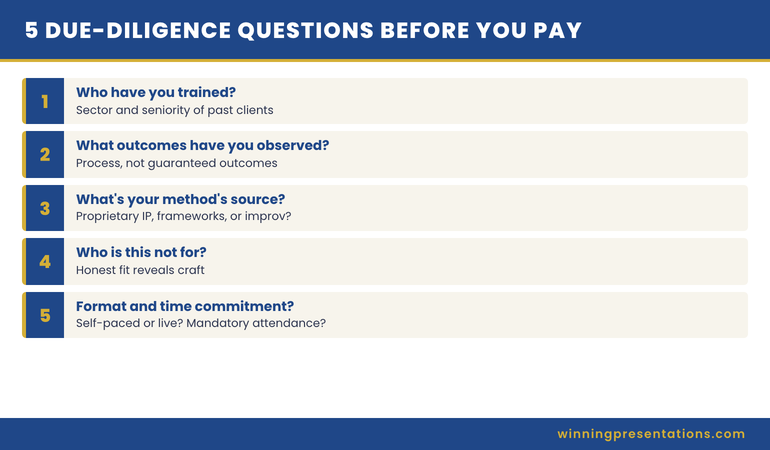
This is the first question and the one that surfaces the most. The answer worth listening for is specific in two ways: sector and seniority. A coach who has worked extensively with conference keynote speakers, founders pitching at demo days, and TEDx finalists has a real practice. It just may not be your practice. A coach who has worked with VP-level professionals across financial services, pensions, biotech, government, or regulated industries is doing different work, and their answer should make that visible without prompting.
The answer to listen for is concrete. “I have worked with senior leaders across asset management, retail banking, and pharma over the last decade” is a real answer. “I work with executives at all levels” is a marketing line. The question is not designed to embarrass anyone. It is designed to surface where the practice actually sits, because the practice that sits in keynote-land cannot be fully translated to credit committee work in three sessions.
The follow-up question is “what kind of presentations were you helping them with?” A coach whose past clients were all delivering quarterly all-hands sessions has different muscle memory from a coach whose past clients were facing investment committees, board approvals, regulator meetings, or M&A defence sessions. Neither is wrong. Only one is the right fit for what you are about to walk into.
2. What outcomes have you observed in past clients?
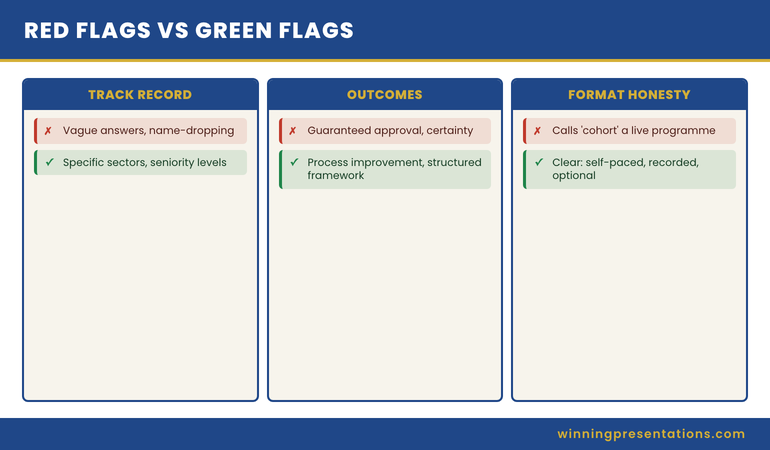
This is the question where the wrong coach will overpromise and the right coach will be careful. The wrong answer sounds like a guarantee. “My clients always get the funding,” “your board will approve,” “I have a 95% success rate.” All three are red flags. Senior outcomes have too many moving parts for any external coach to control them, and a coach who claims otherwise either does not understand the senior environment or is hoping the buyer does not.
The right answer is process-shaped. “My clients tend to walk in feeling more prepared for the question session,” “their slide structures end up tighter and harder to challenge,” “they tell me afterwards that they recovered better when the room pushed back.” Those are the things a coach can actually influence. They are also what an experienced senior buyer wants to hear, because they describe craft rather than fortune-telling.
If a coach answers this question by listing logos, ask the same question in a different way. The logo answer is unverifiable from the outside, and it tends to substitute for the harder, more useful answer about what was different about the work.
3. What is your method’s source?
Coaches inherit their methods from somewhere. The honest answer to “where does your method come from?” reveals a great deal about what kind of work you are about to do. Three broad sources dominate the industry. The first is improvisation and theatre training, which builds presence, listening, and recovery. The second is rhetoric and speechwriting, which builds opening, narrative arc, and signature line. The third is structured business communication, which builds case construction, slide architecture, and objection pre-handling.
None of these is wrong. They produce different work. A coach trained in improvisation will help with calmness and on-the-spot recovery. A coach trained in rhetoric will help with the shape of the talk. A coach trained in structured business communication will help with the deck and the case behind it. The senior buyer’s job is to know which one they are buying, because most senior presentations need the third type and most coaches sell the first two.
This question also surfaces whether the coach has a method at all, or whether the work is freestyle. Both can be valid. Freestyle senior coaching from someone with twenty years of senior client work can be genuinely useful. Freestyle coaching from someone with three years of generalist experience is often expensive trial-and-error. The question makes the distinction visible. The deeper analysis of coaching vs online courses covers when method-based programmes outperform freestyle work.
4. Who is this not for?
This is the question that separates marketing-led practices from professional ones. A coach who cannot name a kind of buyer they are not the right fit for is a coach who will sell you the package whether or not it suits you. A coach with a clear practice can name the audiences they do not work well with. “I am not the right person for very early-career professionals,” “I do not work with TEDx-style keynotes,” “I am not the right fit if the issue is content rather than delivery.”
The honest answer here is unusually informative. It tells you that the coach has thought about fit, that they know the boundaries of their own work, and that they are not optimising the conversation for closing. A coach who answers “I work with everyone” is either inexperienced, undifferentiated, or both. The senior buyer’s instinct that something feels off in those conversations is usually correct.
If you are unsure how to ask this directly, the indirect version works almost as well: “what would make me a poor fit for your programme?” The wording invites the same answer and lowers the social temperature of asking. A confident professional will give you a clear answer in two sentences.
THE EXECUTIVE BUY-IN PRESENTATION SYSTEM
Built around the curriculum the seven questions point to
Built for senior professionals across financial services, pensions, biotech, government, and regulated industries — the audiences where the case has to hold up to clinical scrutiny rather than land emotionally. The programme covers stakeholder analysis, case construction, slide architecture, and objection pre-handling, in the structures used in real senior rooms.
- Self-paced programme with monthly cohort enrolment
- 7 modules, no deadlines, no mandatory session attendance
- Optional live Q&A sessions, fully recorded — watch back anytime
- Lifetime access to materials
- Framework for securing buy-in from senior stakeholders
The Executive Buy-In Presentation System — £499. Designed for senior professionals presenting to decision audiences.
Self-paced. Lifetime access. No mandatory live attendance.
5. What is the format and time commitment?
This is the question that catches the practical mismatches. A senior professional who travels three days a week cannot meaningfully attend a programme that requires live Tuesday-evening attendance for six weeks running. A buyer who needs to work the material around irregular regulator deadlines cannot use a programme that is structured around fixed cohort milestones.
The honest answer covers four things. Whether the work is one-to-one, small group, large cohort, or self-paced. Whether sessions are live, recorded, or both. Whether attendance at live sessions is mandatory. And how long the engagement runs — three sessions, six weeks, three months, ongoing. A clear coach answers all four in the first call without prompting. A vague answer here is usually a sign that the format is whatever the buyer wants it to be in the sales conversation, and something more rigid in practice.
Self-paced and recorded are not lower-quality formats by default. For senior professionals with unpredictable diaries, they are often the only formats that survive contact with reality. The question is whether the design is actually self-paced — usable on the buyer’s schedule, with materials that hold up without live attendance — or whether the programme is technically self-paced but assumes you will attend most live sessions to get value.
6. What happens if it does not work for me?
The right answer here is concrete. The wrong answer is reassuring without being specific. A coach with a real practice has thought about what happens when a client and the work do not click. They will tell you about the refund window, the option to retake material, the route to extending the engagement, or the fallback to written feedback if the format is not landing.
A coach who has not thought about this — who answers “I am sure it will work” or “in twenty years I have never had that happen” — is signalling either inexperience with the senior buyer or unwillingness to discuss the downside. Neither is fatal. Both are worth knowing before the contract is signed. The senior buyer’s instinct should be the same here as it is for any other professional engagement: a clear escalation path is a feature, not a sign of weakness.
This is also where you can ask about the support after the formal programme ends. Senior presentations do not arrive on the schedule of the coaching programme. The board meeting that matters most might be six months after the last session. A coach with a real practice has thought about that and has an answer that does not feel improvised.
If the gap is structure rather than coaching
Sometimes the seven questions surface that the buyer does not need coaching at all — they need cleaner slide structures and a working library of senior-context patterns. The Executive Slide System gives you 26 templates, 93 AI prompts, 16 scenario playbooks, a master checklist, and a framework reference. £39, instant access.
7. What is the actual deliverable?
The final question is the one that should be the easiest, and is often the most evasive. What do you walk away with? A senior consultant engagement produces a tangible output. So should a coaching engagement, in some form. The deliverable might be a refined deck, a finished call sheet of objection responses, a recording of the dress rehearsal with annotated coach notes, a written framework, or a library of patterns to apply to future presentations.
A coach who answers “you walk away with confidence” or “the work happens in the room” is describing a service rather than a deliverable. That is fine for some buyers. For senior professionals running multiple high-stakes presentations a year, it is usually not enough. The reason is that confidence does not survive the gap between the last coaching session and the next presentation. Tangible deliverables do.
The most useful version of this question is “show me a sample of what a past client walked away with.” A coach with a real practice will have anonymised samples ready. A coach who has not produced tangible deliverables will tell you, politely, that the work is too bespoke to share. Both answers are informative. Only one is consistent with what most senior buyers actually need. The article on training fatigue covers why intangible engagements rarely stick across multiple presentations.
Once you have run these seven questions, the executive presentation coaching online page covers the logistics of a properly structured senior engagement, including format, deliverables, and the specific work that holds up across financial services, pensions, biotech, and regulated environments.
What good answers look like in practice
Good answers across the seven questions tend to share four properties. They are concrete rather than promotional. They are sector-specific rather than universal. They acknowledge limitation. And they describe craft rather than fortune.
A concrete answer names the kind of work, the kind of audience, and the kind of deliverable. A sector-specific answer maps to your environment without forcing translation. An answer that acknowledges limitation tells you who the coach is not the right fit for, and what the programme will not do. A craft-shaped answer talks about how the work changes the presenter’s preparation, structure, and recovery — not about what the senior audience will or will not approve.
If the answers across all seven questions sit inside those four properties, you are looking at a professional engagement worth paying for. If two or three of the answers feel slippery, that is the diagnostic signal. The slippery answers are the ones to revisit before the contract is signed. The work is rarely fixed by the second call. It is usually fixed by walking away to a more specific provider, or by switching to a structured programme where the curriculum and the format are visible up front.
THE EXECUTIVE BUY-IN PRESENTATION SYSTEM
Removes the fit-mismatch problem the seven questions are designed to catch
Self-paced programme with monthly cohort enrolment. Seven modules covering stakeholder analysis, case construction, slide architecture, and objection pre-handling — the curriculum the seven due-diligence questions point to. £499, lifetime access to materials, no mandatory session attendance.
Optional live Q&A sessions, fully recorded.
For senior professionals already running through the questions and weighing structured programmes against one-to-one coaching, the presentation skills course for executives page covers the trade-offs in more detail. The short version is that structured programmes win on consistency and tangible deliverables, and one-to-one coaching wins on bespoke work for a single high-stakes engagement. Both are valid. The seven questions help you see which one you are about to buy.
Frequently asked questions
How much should presentation coaching for executives cost?
Pricing varies widely. One-to-one senior coaching commonly sits in the range of £400 to £2,000 per hour, depending on the coach’s seniority and sector. Structured online programmes typically sit between £200 and £2,000. Cost is not the most useful filter on its own. The questions about sector fit, method source, format, and deliverable are more diagnostic than the price tag, because expensive coaching can still be the wrong coaching for the buyer’s actual environment.
Is coaching or a structured online programme better for senior professionals?
Neither is universally better. One-to-one coaching is well suited to a specific upcoming high-stakes presentation where the work is on this deck, this audience, this set of likely objections. Structured online programmes are better suited to building a durable library of patterns that holds up across multiple senior presentations over years. Many senior professionals end up using both — the structured programme as a foundation, and one-to-one coaching for individual high-stakes events.
What is the single biggest red flag in a presentation coaching discovery call?
An outcome guarantee. “Your board will approve,” “I have a 95% success rate,” “my clients always get the funding.” Senior outcomes are too multi-causal for any coach to guarantee, and the willingness to imply otherwise tends to correlate with other shortcuts in the engagement. The right coach talks about process — preparation, structure, recovery, calmness under scrutiny — not about outcomes that depend on dozens of factors outside the coaching.
Should I ask for references before paying for presentation coaching?
Yes, and the question to ask the references is more useful than the existence of the references themselves. Useful questions: “what did you walk away with?”, “what kind of presentation were you preparing for?”, “what would you have wanted the coach to do differently?” These produce honest answers. Logo lists and testimonial pull-quotes do not. A coach who declines to provide references should be able to explain why in a way that is not vague.
The Winning Edge
A weekly newsletter for senior professionals who present at board level. One specific structural idea per issue, drawn from real boardroom and committee work. No filler.
If this article landed for you, the natural next read is the executive presentation coaching online page. It walks through how a properly structured senior engagement is shaped, what the deliverables look like, and where coaching outperforms generic public speaking work for senior professionals across financial services, pensions, biotech, and government.
Next step: if you have a coaching call booked or a programme on your shortlist, print the seven questions and run them through in the order above. The questions that produce slippery answers are the ones worth revisiting before the contract is signed. Most fit-mismatches are catchable in the first fifteen minutes if you ask in the right order.
If structured programmes have moved up your shortlist after running the seven questions, the executive presentation training online page covers what good programmes look like, what to compare across them, and how to map programme content to your own senior environment.
THE EXECUTIVE BUY-IN PRESENTATION SYSTEM
Designed to pass the seven-question test
If you have just run the seven questions and your shortlist has narrowed, this is what a structured programme designed for senior professionals looks like. Everything is visible in advance — the curriculum, the format, the time commitment, and the deliverable.
- Self-paced programme with monthly cohort enrolment — format is fixed, not improvised
- 7 modules with no deadlines and no mandatory session attendance
- Optional live Q&A sessions, fully recorded — watch back anytime
- Lifetime access to materials — the work survives the gap between sessions and your next presentation
- Framework for securing buy-in from senior stakeholders, with tangible deliverables you keep
The Executive Buy-In Presentation System — £499. Designed for senior professionals across financial services, pensions, biotech, and regulated environments.
Lifetime access. No mandatory live attendance. Materials are yours to keep.
Mary Beth Hazeldine is the Owner & Managing Director of Winning Presentations. With 24 years of corporate banking experience at JPMorgan Chase, PwC, Royal Bank of Scotland, and Commerzbank, she advises senior professionals across financial services, healthcare, technology, and government on structuring presentations for high-stakes funding rounds and approvals. She speaks German and works extensively with the German-speaking financial markets.