
The Executive Appendix: When and How to Use Backup Slides in a Board Deck
Quick answer: Executive appendix slides are most useful when they answer specific, predictable questions a board member is likely to ask — and most damaging when they look like material the presenter could not bring themselves to cut from the main deck. The rule is functional, not stylistic: every appendix slide must map to a named anticipated question, must be retrievable in under fifteen seconds, and must be designed to be read silently while the presenter speaks. Anything that fails those three tests does not belong in the appendix. It belongs in a working file the presenter never opens.
Jump to
Declan Ostrowski is a deputy CIO at a mid-cap UK asset manager. Last September he presented a quarterly portfolio review to the investment committee. Slide 18 carried a chart of rolling three-year tracking error, broken down by sector. The CFO read it for nine seconds, looked up, and asked: “What was the tracking error in industrials in the second half of 2024, after the methodology change, and how does it compare to the figure before the change?” Declan had not built an appendix slide for it. He answered from memory, was approximately right, and was politely corrected by the head of risk eleven minutes later when the actual number turned up in a different report.
The committee decision did not change. Declan’s standing in the room did. The damage was not the wrong answer. The damage was the visible absence of a defended position.
Six months later he presented again with twenty-three appendix slides, each mapped to a specific anticipated question from a specific committee member. The CFO asked about a sector breakdown. Declan said: “Appendix slide A4 has the rolling figures with the methodology change isolated.” Eight seconds of clicking. The slide appeared. The CFO read it. The conversation moved on. That is what an executive appendix is for — not for material the presenter could not bring themselves to cut, but for material the presenter expects to need under direct questioning, designed to be retrievable in seconds and readable while someone is talking.
Looking for a structured framework for building executive decks — including the appendix?
The Executive Slide System gives senior professionals 26 templates, 93 AI prompts, 16 scenario playbooks, a master checklist, and a framework reference for building board-grade decks. Appendix design is built into the structural patterns.
Why most executive appendices fail
The most common failure mode is that the appendix is built as a dumping ground rather than a defensive structure. The presenter pushes detail to the back of the deck without designing for retrieval. By the time a question lands, the presenter is scrolling through forty-seven untitled slides. The authority of the answer is gone before it arrives.
The second failure mode is the inverse: the appendix is meticulously curated but never used, because the presenter built it without modelling the questions the room would actually ask. They built the appendix that was easy — the data they had — rather than the appendix that would be useful — the data the committee would press on.
The third failure mode is psychological. The presenter uses the appendix as a security blanket, does not internalise the material, and reaches for slides instead of answering directly. The act of reaching tells the room they did not know the number cold. A useful appendix complements direct command of the material. A misused appendix substitutes for it.
What actually belongs in an executive appendix
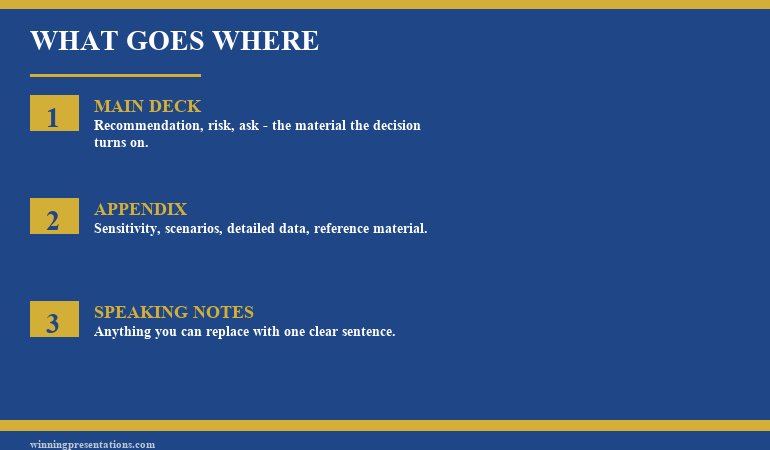
First, anticipated detail behind a main-deck claim. If the main deck carries a finding — “three regions account for sixty per cent of the addressable market” — the appendix should carry the regional breakdown, the methodology, and the data source. Senior decision-makers read main-deck slides for findings, not methods, but they will press on methods the moment a finding surprises them.
Second, sensitivity analysis on key numbers. If your case rests on a forecast, the committee will want to know what happens if the forecast is wrong. An appendix slide showing the case under three scenarios — base, downside, severe downside — pre-empts the question and signals that the analysis was done.
Third, competitor or comparison data. If your proposal involves benchmarking — pricing, performance, valuation — the appendix is the right place for the underlying comparison table. The main deck states the conclusion. The appendix carries the workings.
Fourth, regulatory or compliance reference. For boards in financial services, healthcare, or regulated infrastructure, every material claim has a regulatory framing. Carry the relevant regulation and the dates of any policy change in a single appendix slide per topic. Never read it aloud. Have it ready for the procedural question the chief risk officer or general counsel always asks.
Fifth, decision history. For any decision being revisited, the appendix should carry the timeline of prior decisions, the reasons given at the time, and what has changed since. This is the category that protects you when a committee member says “I thought we already decided this.”
What does not belong, no matter how tempting
Material that did not earn its place in the main deck does not earn a place in the appendix as consolation. If a slide was cut because the argument was redundant or the data thin, putting it in the appendix does not rehabilitate it. The appendix is not a cemetery for slides you liked.
Source-document screenshots without commentary do not belong. A screenshot of an analyst report is not an answer — it is evidence that you did not build one. If the report contains material the committee needs, summarise it on a structured slide that names the source.
Anything you would not read silently to the room while you talk does not belong. If the slide is a wall of dense numbers with no visual hierarchy, you have inflicted reading work on the people you are trying to persuade. Data presentations to executives need a structured visual logic in every slide that lands on screen, including appendix slides.
Detailed organisational charts not relevant to the decision do not belong. Detailed Gantt charts, unless implementation timing is the question. Detailed budget lines, unless the budget itself is what is being approved. Every appendix slide must trace to a question someone will plausibly ask. If you cannot name the asker and the phrasing, the slide is not earning its space.
Build the structural patterns once, use them on every executive deck
The Executive Slide System is the framework senior professionals use to construct board-grade decks — main deck and appendix. £39, instant access. 26 templates, 93 AI prompts, 16 scenario playbooks (board approval, investment committee, steering committee, audit committee and more), a master checklist, and a framework reference. Three files. Complete system.
- 26 executive slide templates covering recurring board scenarios
- 93 AI prompts for slide drafting, editing, and headline sharpening
- 16 scenario playbooks for high-stakes presentation contexts
- Master checklist for pre-meeting deck review
- Framework reference document for structural decisions
Get the Executive Slide System →
Designed for senior professionals presenting to boards, investment committees, and senior stakeholders.
Design rules for appendix slides that work under pressure
An appendix slide has a different design brief. It will be pulled up under time pressure, often after a question that has unsettled the presenter. Five design rules separate appendix slides that work from those that embarrass.
First, name every slide with a question, not a topic. “What is the rolling tracking error in industrials before and after the methodology change?” — not “Industrials tracking error.” When you scroll under pressure, the question-as-title is what your eye catches.
Second, number the appendix sequentially with a clear prefix — A1, A2, A3 — and reference those numbers in the speaker notes of the corresponding main-deck slide. When a question lands, you do not search. You know it is A4, you go to A4, you display A4.
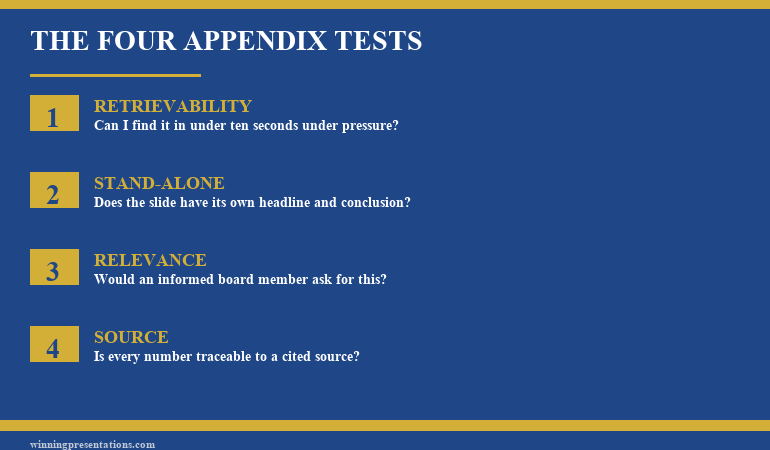
Third, design every slide to be readable in fifteen seconds. One headline finding at the top. One chart or one table. One source line at the bottom. If the slide cannot be absorbed in fifteen seconds of silent reading, the design has failed.
Fourth, never put more than one piece of analysis on a single slide. The cost of combining is that when the committee asks one specific question, the slide answers three at once and the relevant answer is buried. One slide, one answer.
Fifth, build the appendix index slide that nobody else builds. A single slide listing every appendix slide as a question with its number — A1 through A23. This slide is for you, not for them. It is your live retrieval map.
Using the appendix live without breaking your authority
The way you reach for an appendix slide tells the room as much as the slide itself. Three rules govern the moment of retrieval.
First, answer first, then bring up the slide. When a question lands, give your direct answer in one sentence — the number, the position, the conclusion — and only then say “let me show you the breakdown — appendix slide A4”. Reaching before answering tells the room you do not know the answer until the slide gives it to you. When you have to cut a board deck under time pressure, the retrieval discipline matters even more, because every second of fumbling reads as panic.
Second, bring up the slide once and do not return to it. Display, hold for the committee to read, and move on. Toggling between A4 and the main deck confirms that you are using slides as a substitute for thinking.
Third, know which appendix slides you will not bring up no matter what. Some appendix material is there for protection, not as the first answer offered. If a sensitive number is in A12 and the question can be answered without it, answer without it. The appendix is your reserve, not your front line.
For the structural patterns behind each of these, the Executive Slide System includes scenario playbooks for investment committee, board approval, and audit committee contexts where appendix design carries real weight.
Strengthen the Q&A side of the appendix as well
The Executive Q&A Handling System — £39, instant access — is the structural framework for handling difficult board questions in real time. It complements appendix design with the verbal patterns that turn a hard question into a defended answer, whether or not you reach for an appendix slide.
The cost of getting the appendix wrong
An executive committee remembers two things: whether the conclusion landed, and whether the presenter could defend it under pressure. The main deck addresses the first. The appendix addresses the second. A weak appendix tells the room the defensive work has not been done. A strong appendix, used sparingly and visibly, tells the room the opposite.
Building a strong appendix is largely the work of modelling the room. Who will ask first. What they will ask. What evidence they will press for. The slides are easy. The thinking that earns each slide its place distinguishes senior preparation from junior preparation.
Stop losing rooms over questions you should have anticipated
The Executive Slide System gives you the structural patterns for main deck and appendix together — £39, instant access. 26 templates, 93 AI prompts, 16 scenario playbooks, master checklist, framework reference.
FAQ
How many appendix slides should an executive board deck have?
There is no fixed number, but a useful working range is one appendix slide per anticipated material question, typically eight to twenty-five for a substantive board or investment committee paper. The discipline is functional rather than numerical: every appendix slide must map to a specific anticipated question with a named likely asker. If you cannot name the question for a given slide, the slide does not belong in the deck.
Should the appendix be sent in advance or only used live?
This depends on board protocol. Many UK boards expect pre-reads and the appendix forms part of that pack. In that case, design it to read well silently, with question-style titles and a clear index. Other settings — particularly investment committees in private capital — keep the appendix as a live-only retrieval tool. Confirm the convention with the company secretary or committee chair, and never assume.
Is a separate appendix document better than appendix slides at the back of the main deck?
For most executive contexts, appendix slides at the back of the same deck are more practical. They share the file, design system, and numbering. A separate document introduces friction during retrieval. The exception is when the appendix is genuinely large and dense — full financial models, regulatory technical documents — in which case a separate annex is appropriate, and the main deck appendix carries summary slides that reference it.
The Winning Edge — Thursday newsletter
Every Thursday, The Winning Edge delivers one structural insight for executives presenting to boards, investment committees, and senior stakeholders. No general tips. No motivational framing. One specific technique, one executive scenario, one action. Subscribe to The Winning Edge →
Not ready for the full system? Start here instead: download the free Executive Presentation Checklist — a single-page review you can run on any board deck, including its appendix, before sending it for distribution.
Next step: take the next board deck on your calendar and audit its appendix against three functional tests. Does every slide map to a named anticipated question? Is each retrievable in under fifteen seconds? Is each readable silently while you stay quiet? Cut anything that fails. Build what is missing.
Related reading: what executives actually read on a slide and how to design for that pattern, and how to cut a board deck when you are running over time without losing the case.
About the author. Mary Beth Hazeldine is Owner & Managing Director of Winning Presentations Ltd, founded in 1990. With 24 years of corporate banking experience at JPMorgan Chase, PwC, Royal Bank of Scotland, and Commerzbank, she advises executives across financial services, healthcare, technology, and government on structuring presentations for high-stakes funding rounds, approvals, and board-level decisions.