

Career Pivot Presentation: How to Frame a Lateral Move to Senior Leadership
Quick Answer
A career pivot presentation succeeds when it closes the perceived gap between where you are and where you want to go. Senior leaders are not opposed to lateral moves — they are opposed to unclear logic and unmanaged risk. Show the transferable value you bring, acknowledge the learning curve honestly, and make the case that developing this capability serves the organisation as well as your own growth. The executives who secure lateral moves do so by making the decision easy, not by making the request compelling.
In This Article
- Why lateral moves are harder to pitch than promotions
- The gap problem: naming it before they do
- The transferable value frame: what actually convinces leadership
- Addressing the learning curve without undermining your case
- The structure of a credible career pivot deck
- What not to say: the four phrases that sink pivot pitches
- Frequently asked questions
Tomás had spent eight years in finance. He was technically excellent, politically well-positioned, and genuinely respected by the CFO. When a senior commercial role opened in the business development team, he believed the transition made obvious sense: he understood the numbers better than any BD candidate on the shortlist, he had managed relationships with external partners, and he had spent years advising on deals from the financial side. He could not understand why the decision-makers seemed hesitant.
The hesitation was not about his capability. It was about the narrative. Tomás was presenting a career story in which the pivot was obvious because he could see all the evidence. The hiring committee saw a finance director asking to move into a commercial role without a clear explanation of why now, why this role, and how his particular strengths would serve BD’s specific challenges rather than finance’s. He had the content. He had not built the frame.
A career pivot presentation is not primarily about demonstrating readiness. It is about making the logic of the move legible to people who do not share your internal experience of why it is the right thing to do. That requires a different kind of preparation from a standard promotion case.
Building a structured case for a senior career decision?
The Executive Slide System includes proposal frameworks and slide templates designed for high-stakes executive presentations, including career and strategic positioning decks.
Why Lateral Moves Are Harder to Pitch Than Promotions
A promotion pitch tells a linear story. The evidence is cumulative: you have done more of the same things at a higher level, and the organisation already has a framework for evaluating readiness. Decision-makers are assessing degree, not direction. The question is whether you are ready for the next step on a path they can already see.
A lateral move asks decision-makers to evaluate a different kind of question: whether someone whose entire track record is in one domain can genuinely contribute to a different one. This is harder to assess because the comparison set is different. A finance director being evaluated for a finance director role is compared with other finance directors. A finance director being evaluated for a commercial role is compared with commercial directors — people who have been doing that specific work for years. The bar is not lower because you are changing direction. It is, in some ways, higher, because you have to establish a plausible case for competence in a domain where you have less evidence to offer.
The implication for your presentation is significant. You cannot rely on your existing track record to carry the argument. You need to translate it — to show explicitly how what you have done in your previous domain is directly relevant to what the new role requires. That translation is the core job of a career pivot presentation, and it is the step most people skip because the connection feels obvious to them.
The Gap Problem: Naming It Before They Do
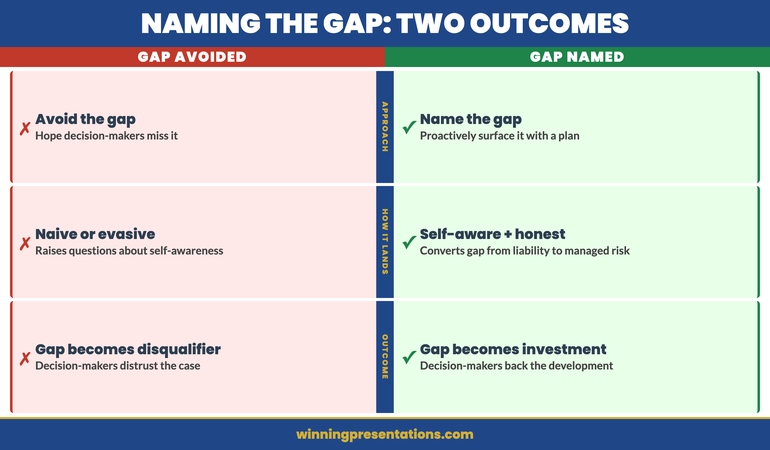
Every career pivot has a gap. There is something in the target role that you have not done directly, a skill set you are developing rather than bringing fully formed, or an industry context you are entering rather than inheriting. Senior leaders will identify that gap. The question is whether they identify it as a disqualifying absence or as a known, managed risk.
The fastest way to turn a gap into a disqualifier is to avoid mentioning it. When decision-makers raise a concern that you have not addressed, it suggests either that you are unaware of the gap (which raises questions about your self-assessment) or that you are hoping they won’t notice (which raises questions about your transparency). Either reading creates doubt that is difficult to recover from in a single conversation.
Naming the gap proactively has the opposite effect. When you surface it clearly — “I recognise that I’m coming into this from a financial rather than a commercial background, and the direct client relationship management is an area where I’ll be developing quickly” — you demonstrate self-awareness, signal honesty, and convert the gap from a hidden liability into a named and managed item on the table. Decision-makers who feel that you have been straight with them about the learning curve are significantly more willing to invest in your development than those who feel you have been evasive.
The gap acknowledgement should be followed immediately by a development plan: how you intend to close the gap, what exposure you have already sought, and what support you are requesting. A gap without a plan is a confession. A gap with a plan is a professional risk assessment.
The Transferable Value Frame: What Actually Convinces Leadership
The transferable value frame is the core of a successful lateral pitch. It answers a single question: given that you are not coming from the exact background this role traditionally draws from, what specific capabilities do you bring that are more valuable than what a direct-path candidate would offer?
This is a harder question to answer than it looks, because most people answer it by listing generic strengths rather than domain-specific advantages. “Strong analytical ability,” “senior stakeholder management,” “commercial awareness” — these are standard attributes that every candidate will claim. They do not differentiate you as a lateral mover, and they do not address the specific question on the decision-maker’s mind, which is: what does this person bring that someone from within this function would not?
The more powerful version is function-specific. If you are moving from finance to commercial, the honest answer might be: “I understand the margin dynamics of our product portfolio in more detail than most commercial directors because I’ve built the models that underpin them. I’ve been in the room where deals were rejected on financial grounds, so I know what the commercial team is working against. And I have relationships with external partners that were built on financial credibility rather than commercial positioning, which opens conversations that standard BD relationships don’t always access.” That is transferable value that a direct-path candidate genuinely cannot claim.
Building this frame requires honest analysis. Start with the specific challenges the receiving role faces — not generic responsibilities but the actual problems the team is trying to solve right now. Then map your experience against those specific challenges, not against the generic job description. Where your background gives you a meaningful advantage over a direct-path candidate, name it explicitly. Where it does not, address the gap with a development plan. The ratio of advantage to gap determines how credible your case is.
The Executive Slide System
Career pivot decks are high-stakes proposals that require a precise structure. The Executive Slide System — £39, instant access — includes proposal frameworks, AI prompt cards, and scenario playbooks for structuring executive-level cases where the argument needs to work across multiple sceptical audiences.
- Slide templates for executive proposal scenarios
- AI prompt cards to build persuasive decks fast
- Framework guides for high-stakes career and advancement pitches
- Scenario playbooks for multi-stakeholder approval meetings
Get the Executive Slide System →
Designed for executives preparing structured proposals for senior decision meetings.
Addressing the Learning Curve Without Undermining Your Case
The learning curve is the most delicate element of a career pivot presentation. Acknowledge it too little and you appear naive. Acknowledge it too much and you appear unready. The right balance comes from framing the learning curve as a defined, time-limited investment rather than an open-ended uncertainty.
Decision-makers are not afraid of a learning curve. They manage them constantly. What they are afraid of is an unclear picture of how long the investment will take and what it will cost in reduced productivity. When you can give them a specific, credible picture of your ramp time — “I expect to be operating at full effectiveness in the commercial relationship management aspects of this role within ninety days, based on the three clients I’ve already worked with from the finance side” — you replace uncertainty with a risk profile they can evaluate.
The elements of a credible learning curve frame are: a clear assessment of which parts of the role you can do immediately, which parts you will be developing in, and the specific milestones by which your progress can be evaluated. This is not asking for a reduced performance expectation. It is proposing a structured onboarding plan that gives both sides a fair way to assess whether the move is working.
If you have already begun developing the relevant skills — through voluntary projects, secondments, or external learning — surface this explicitly. Nothing reduces concern about a learning curve faster than evidence that you took the initiative to close part of it before the formal conversation began.
The same principle applies when you are preparing a 90-day presentation in a new role: the framing that earns trust is not “I know everything” but “I know what I know, I know what I’m learning, and here is how I am managing both.”
The Structure of a Credible Career Pivot Deck
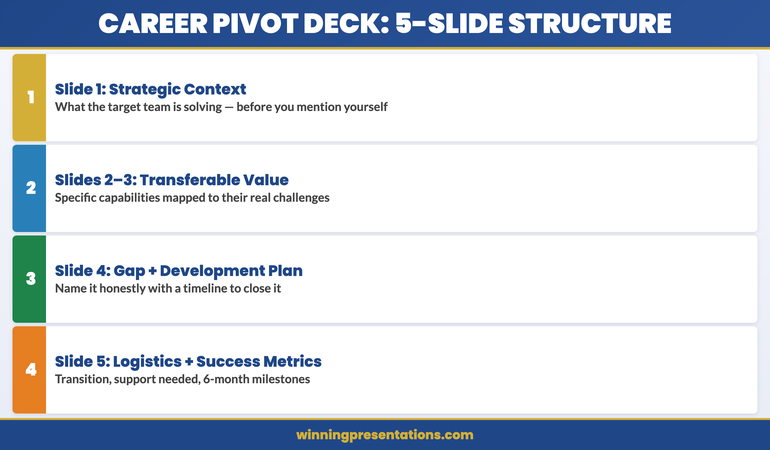
A career pivot presentation follows a different structure from a standard promotion case. The promotion case is primarily backward-looking: evidence, track record, impact. The pivot case is primarily forward-looking: strategic fit, transferable value, development plan. Building the deck in the wrong order creates a presentation that feels more like a CV review than a strategic proposal.
A credible pivot deck typically runs five to seven slides. The opening slide establishes the strategic context: what the target function or role is working towards, where the most significant opportunities or challenges sit, and why this moment is the right time for this move. This is not about you yet. It is about demonstrating that you understand the domain you are entering well enough to speak credibly about its priorities.
The second section presents your transferable value: two or three specific capabilities drawn from your current background that are directly relevant to the challenges you have just framed. Each capability should be grounded in a concrete example from your track record, mapped explicitly to a current need in the target domain. This is where the translation work matters most.
The third section addresses the gap and development plan honestly. One slide, clearly structured: what the gap is, how you intend to close it, and what the timeline looks like.
The final section covers logistics: proposed transition, support needed, and how success would be measured in the first six months. Decision-makers who can see a concrete success framework are significantly more comfortable with career pivot risks than those who are left to imagine the risk for themselves.
When managing stakeholder alignment around a pivot pitch, applying the same pre-meeting principles used in stakeholder alignment before major proposals is equally effective: identify the two or three people whose position will matter most and address their specific concerns before the formal meeting.
If you want to build this kind of structured pitch efficiently, the Executive Slide System includes proposal frameworks and scenario playbooks that give you the starting structure for exactly this type of executive-level case.
What Not to Say: The Four Phrases That Sink Pivot Pitches
The content of a career pivot pitch matters. So does the language. These four phrases consistently undermine credibility in pivot conversations, and they appear in almost every poorly received pitch.
“I’m ready for a new challenge.” This is the personal case dressed up as a business case. It signals that the primary motivation is your own stimulation rather than the organisation’s need. It also positions the conversation as one where you are asking for something rather than proposing something. Replace it with a statement about the specific contribution you intend to make.
“I can learn quickly.” This is an assertion without evidence. Every candidate says this, and it tells the decision-maker nothing about how you actually approach unfamiliar domains. Replace it with a specific example of a time you entered a new area without full expertise, what you did to close the gap, and how quickly you were effective.
“I’ve always been interested in this area.” Interest is not capability. A sustained interest that has produced no concrete preparation, shadowing, study, or exposure reads as a hobby aspiration rather than a professional commitment. If you have a genuine interest, demonstrate it through what you have actually done to develop it.
“I think I could add a lot of value.” This is hedged and vague. The word “think” signals uncertainty; “a lot” signals imprecision. Replace it with a specific, grounded statement about the particular value you bring and the evidence that supports it.
Frequently Asked Questions
How do you justify a lateral move when a direct-path candidate is available?
Acknowledge the direct-path candidate directly and turn it into a differentiator rather than a weakness. A lateral mover brings cross-functional perspective that a direct-path candidate, by definition, does not have. If you can articulate specifically what that perspective enables — in terms of the actual problems the role needs to solve — you reframe the comparison from “less experienced in this domain” to “brings something the direct-path candidate cannot.” The argument only works if you can be specific. Generic claims about cross-functional value will not hold up against a candidate who has been doing the job for ten years.
Should you address your salary expectations in a lateral move pitch?
Not in the initial presentation. The business case and the compensation conversation are separate, and conflating them creates the impression that you are negotiating before you have been selected. If the role involves a reduction in level or compensation, that is worth addressing briefly — confirming that you have considered the implications and are proceeding deliberately rather than naively — but keep it short and move back to the capability conversation quickly. Detailed compensation discussions happen after the business case has been accepted.
How long should a career pivot pitch take?
In a formal meeting, fifteen to twenty minutes for the structured pitch, followed by open conversation. The mistake most people make is over-presenting: spending forty minutes walking through every element of their background in chronological order, leaving no time for the decision-maker to engage. The pivot pitch should be concise enough that the majority of the meeting is dialogue, not presentation. Decision-makers form their view in conversation, not in passive listening. Give them the structure in fifteen minutes and then let them ask the questions that matter to them.
The Winning Edge — A Newsletter for Executives Who Present
Every Thursday: one practical technique for structuring, presenting, or defending a high-stakes proposal. Designed for executives who need to communicate with authority, not just confidence.
Also available: the Executive Presentation Checklist — a free pre-presentation checklist for senior decision meetings.
The Executive Slide System
Proposal frameworks and scenario playbooks for high-stakes executive presentations — including career pivot and advancement decks for senior audiences where the logic of the move needs to be made explicit. £39, instant access.
Get the Executive Slide System →
Designed for executives preparing structured proposals for senior decision meetings.
If you are managing the more complex process of an internal transfer pitch that involves both a current manager and a receiving team, the structural principles are similar but the political sequencing requires a different approach.
About the Author
Mary Beth Hazeldine is the Owner and Managing Director of Winning Presentations. With 25 years of corporate banking experience at JPMorgan Chase, PwC, Royal Bank of Scotland, and Commerzbank, she advises executives across financial services, healthcare, technology, and government on structuring presentations for high-stakes funding rounds and approvals.