

Account Review Presentation: How to Retain a Client Without Cutting Your Price
A strong account review presentation does more than summarise activity — it reframes your relationship around the client’s current strategic priorities. The goal is not to justify your fees but to make the cost of switching feel far greater than the cost of staying. This article sets out a structured approach to building slides that retain clients on the basis of demonstrated value, not discounted price.
Jump to a section
- Why Account Reviews Feel Like Audits — and How to Change That
- The Retention Framework: Four Questions Your Slides Must Answer
- Building Slides That Show Value, Not Activity
- Handling the Competitor Threat Without Mentioning Competitors
- Closing the Review With a Mutual Commitment
- Frequently Asked Questions
Marcus had prepared for weeks. As a senior account director at a consulting firm, he walked into his client’s boardroom knowing the renewal was at risk — word had reached him that a competitor had put in a compelling proposal. He had slides. Plenty of them. Slide after slide of activity metrics: number of engagements delivered, hours logged, reports submitted, calls taken. What he did not have was a single slide that spoke to where the client was trying to go in the next twelve months. The room was polite but restless. The CFO glanced at her phone. The conversation never quite landed. Marcus had prepared a presentation about himself when his client needed a presentation about them. The renewal came through — but only after a painful negotiation that cost margin he could not afford to lose.
Prefer to start with ready-made frameworks?
If you would rather work from structured slide templates designed for client-facing executive presentations — including account reviews, renewals, and commercial proposals — the Executive Slide System gives you the frameworks to build your deck without starting from a blank slide.
Why Account Reviews Feel Like Audits — and How to Change That
Most account review presentations fail at the first slide. The structure that gets inherited from year to year — “here is what we did, here is what we delivered, here is what we plan to do next” — positions you as a supplier reporting on a contract rather than a partner contributing to an outcome. The client enters that room already wondering whether you are worth the renewal fee. A slide deck full of activity data confirms their suspicion that you think the relationship is transactional.
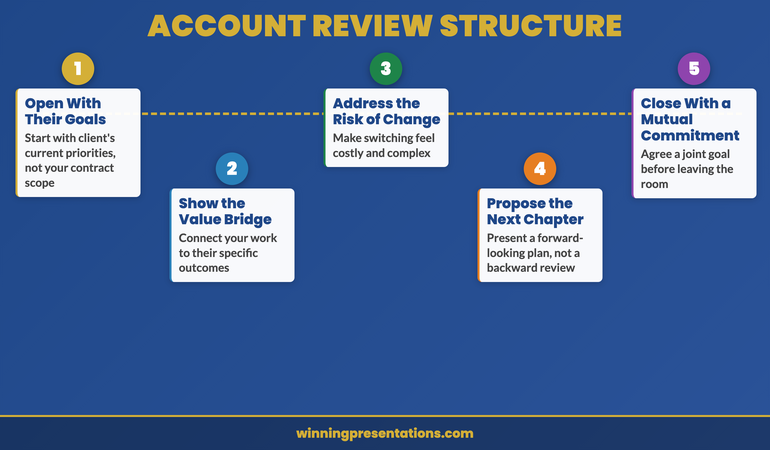
The shift that changes retention dynamics is deceptively straightforward: the presentation must open with where the client is going, not where you have been. Before you build a single slide, you need to understand what your client’s leadership team is focused on right now. What pressure are they under? What has changed in their market since you last sat in a room together? What internal initiative is consuming their attention this quarter?
When you open an account review by demonstrating that you understand the client’s current reality — not the reality that existed when the contract was signed — you immediately reposition yourself. You are no longer the vendor seeking renewal approval. You are the partner who has been paying attention. That one structural change, from “here is our scorecard” to “here is where you are and here is how we fit into that”, is the difference between a review that feels like an audit and one that feels like a strategic conversation.
It also changes the emotional temperature of the room. Clients who feel understood are far less likely to push aggressively on price. The competitor’s lower quote becomes less compelling when you have already demonstrated something the competitor cannot: institutional knowledge of this specific client’s world. That knowledge needs to be visible in your slides, not implied in your relationship.
The Retention Framework: Four Questions Your Slides Must Answer
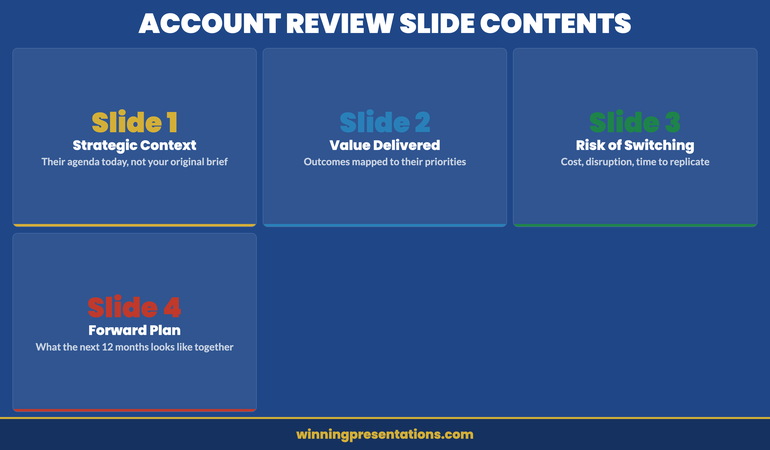
A well-constructed account review presentation needs to answer four questions — not in a literal question-and-answer format, but as the invisible logic that shapes what each slide communicates. If your deck cannot answer all four by the time you reach the final slide, the presentation is incomplete, regardless of how polished the design looks.
Question one: What is the client trying to achieve? This goes beyond the original contract scope. Clients’ strategic priorities shift constantly. A professional services firm that signed with you to support a regulatory compliance programme may now be equally focused on a market expansion or a post-merger integration. Your opening slides need to show that you are current with their agenda, not anchored to the brief from eighteen months ago.
Question two: What have we actually moved forward together? This is where activity data has its place — but only when it is connected to outcome. “We delivered 47 workshops” is activity. “We delivered 47 workshops, which contributed to a 23% reduction in compliance incidents across three divisions” is outcome. The distinction matters enormously. Every metric on your slides should have a line of sight to something the client cares about strategically, not operationally.
Question three: What would it cost them to switch? You do not answer this question directly — that would feel defensive and heavy-handed. Instead, your slides should surface the depth of context, integration, and institutional knowledge that you carry. Show timelines that demonstrate how long it took to reach current performance levels. Reference the internal relationships, the bespoke processes, the customised outputs. Make the switching cost visible without ever framing it as a threat.
Question four: Where do we go from here? The final section of a retention-focused account review should not be a list of deliverables for the coming year. It should be a proposed direction — shaped around the client’s evolving priorities — that requires your continued involvement to execute. Think of it as a forward-looking proposal embedded inside the review. You are not renewing a contract; you are co-designing the next chapter. This approach aligns closely with what executives want from presentations: strategic clarity, not administrative detail.
Executive Slide System
The Templates Behind Retention-Focused Account Reviews
Building your account review presentation from scratch takes time that most senior professionals do not have in the run-up to a renewal meeting. The Executive Slide System gives you structured slide templates designed for the executive scenarios where the stakes are highest.
- →Slide templates structured for client retention, renewal, and account review presentations
- →AI prompt cards to help you populate each section quickly and accurately
- →Framework guides that walk you through the logic behind each slide
- →Covers executive scenarios including commercial reviews, board presentations, and client-facing pitches
Get the Executive Slide System → £39
Designed for executives preparing high-stakes presentations
Building Slides That Show Value, Not Activity
The most common structural error in account review slides is the performance dashboard that reads like a supplier report. Volume metrics, utilisation rates, response times — these figures matter for operational conversations, but they carry almost no weight in a retention discussion with a senior decision-maker. The executives in that room are not evaluating your contract compliance. They are deciding whether the relationship is worth the continued investment.
Value slides are built differently. They start with the client’s objective — stated in the client’s language, not yours — and then draw a direct line to a specific outcome that your work contributed to. Where possible, that outcome is quantified. Where quantification is not available, it is described in terms of risk reduced, speed gained, or capability built. The goal is for the client to look at each slide and recognise their own priorities reflected back at them.
One technique that works particularly well in client-facing executive presentations is the “before and after” narrative structure. Rather than listing what you did chronologically, you present a snapshot of where the client was at the start of the engagement on a particular dimension, and where they are now. This is not about dramatising your contribution — it is about giving the client a reference point that makes the journey visible. Progress is easy to miss when you are inside it. Your slides can make it legible.
It is also worth considering what you leave off. An account review presentation that covers every piece of work completed over the past twelve months will almost certainly dilute its own impact. Selectivity is not dishonesty — it is editorial judgement. Choose the three to five outcomes that most directly connect to what the client cares about most right now, and build your slides around those. Everything else can be available as an appendix if the conversation requires it, but the main deck should be focused and deliberate.
This discipline in slide construction is the same principle that applies when you are preparing a pipeline review presentation for a sales leadership audience — the instinct to include everything must be overridden by the question of what actually moves the conversation forward. In both contexts, less structured content delivered with clarity will outperform comprehensive data delivered without narrative.
Handling the Competitor Threat Without Mentioning Competitors
When a client is seriously considering switching suppliers, the worst thing you can do in your account review presentation is acknowledge the competitor directly. Responding to an alternative proposal by attacking it — on price, on capability, on track record — is almost always counterproductive. It signals anxiety, and it shifts the frame of the conversation to the competitor’s territory rather than yours.
The more effective approach is to make the switching cost visible without ever naming a rival. This means dedicating a section of your presentation to what you have built together: the institutional knowledge you hold about this client’s business, the relationships that exist across multiple stakeholders, the processes that have been customised to their specific context, the accumulated understanding of what works and what does not in their particular environment.
A timeline slide can be particularly effective here. Map out the relationship from inception: the early challenges, the moments where your work had a measurable impact, the evolution of the scope as the client’s needs changed. This is not nostalgia — it is a visual representation of investment. The client has invested time, attention, and internal resource in building a working relationship with you. That investment has a value, and a well-constructed timeline makes that value concrete.
You should also prepare for the price conversation without centring your deck around it. If a client raises a competitor’s lower fee, the right response is to acknowledge it calmly and redirect to the question of value: “I understand cost is a genuine consideration. What I would like to make sure is that we are comparing like for like — let me show you specifically what the relationship delivers at a strategic level.” This reframe only works if your slides have already done the groundwork. If your deck has demonstrated value clearly, the price objection arrives in a different context. It becomes a negotiation, not a verdict.
There is a parallel worth noting here: the same principle applies in formal procurement settings. If you have ever been through a structured vendor selection presentation, you will know that the buyer’s stated criteria rarely capture everything that actually drives the decision. Demonstrated understanding of the client’s world — more than feature lists or pricing tables — is what creates differentiation in competitive situations.
If you want a structured framework for building your account review slides, the Executive Slide System includes templates designed for client-facing executive scenarios including renewals and commercial reviews.
Closing the Review With a Mutual Commitment
Most account review presentations end with a slide labelled “Next Steps” followed by a list of action items. This is a missed opportunity. The final section of a retention-focused review should close with a mutual commitment — a shared direction that the client and your team are agreeing to pursue together. The language of partnership matters here. You are not presenting a renewed contract for signature; you are proposing a continued collaboration with a clear forward agenda.
The closing section of your deck should do three things. First, it should restate the client’s strategic priorities as you understand them — making clear that everything you have discussed has been framed around what matters to them. Second, it should present two or three specific areas where your continued work will have the greatest impact in the coming period. These are not generic deliverables but targeted contributions tied to named priorities. Third, it should invite the client to shape the direction. Phrase it as a collaborative question rather than a unilateral proposal: “Given where you are focused for the next twelve months, these are the areas we think our work together will make the biggest difference — do these align with your priorities, and is there anything you would adjust?”
This structure transforms the closing from a handshake to a co-creation moment. The client is no longer being asked to approve a renewal; they are being invited to shape what happens next. That distinction shifts the psychology of the decision entirely. Clients who feel they have contributed to the direction of a relationship are substantially more committed to it than those who feel they are simply accepting or rejecting a proposal.
It is also worth preparing for a scenario where the review surfaces genuine concerns or dissatisfaction. If a client has been frustrated with aspects of the service, the worst possible response is to acknowledge it minimally and then pivot quickly to the forward plan. Take time in the room to understand the concern fully. Let the client speak without interruption. Then respond with a specific commitment — not a general reassurance — about how that concern will be addressed. Clients who have expressed a concern and seen it taken seriously are often more loyal after the review than those who had no concerns to raise at all.
High-stakes client conversations — including account reviews where the relationship is genuinely at risk — require the same level of structural discipline as any other executive presentation. If you are navigating a particularly sensitive client situation, it may also be worth reviewing how communication frameworks apply in contexts where the stakes are reputational as well as commercial. The article on building a data breach communication presentation explores how to structure transparent, credible communication under pressure — a set of principles that translate directly to any high-stakes client conversation where trust needs to be rebuilt or preserved.
Stop Improvising Your Account Reviews
Build Your Next Client Review From a Structured Framework, Not a Blank Slide
Walking into a renewal meeting without a clear slide structure is one of the most avoidable risks in client relationship management. The Executive Slide System gives you templates designed for exactly the situations where improvisation is most costly — account reviews, commercial renewals, and client-facing executive presentations.
Frequently Asked Questions
How many slides should an account review presentation include?
There is no universally correct number, but most effective account review presentations for senior audiences run between ten and sixteen slides, excluding any appendix material. The priority is not comprehensive coverage but clarity of narrative. A deck that answers the four retention questions — what the client is trying to achieve, what you have moved forward together, what switching would cost, and where you go next — can do so in twelve well-constructed slides. Anything beyond that risks diluting the strategic message with operational detail that belongs in a separate working document rather than the main presentation.
What should I do if the client raises a competitor’s lower price during the review?
Acknowledge the concern directly and without defensiveness, then redirect to a value comparison rather than a price comparison. The key is to avoid either dismissing the competitor’s offer or immediately conceding ground on price. Instead, use the conversation to ensure the client is comparing equivalent scope and depth of service, not headline figures. If your account review presentation has been structured effectively, the switching cost will already be visible in your slides — the relationship depth, the institutional knowledge, the bespoke processes built over time. That context makes the price conversation substantially easier to navigate without compromising your margin.
How far in advance should I prepare an account review presentation?
Preparation for a retention-critical account review should begin at least three weeks before the meeting. The first week should focus on intelligence-gathering: reviewing the client’s recent public communications, speaking with your internal team members who interact with the client day-to-day, and identifying any shifts in the client’s priorities or business context since the last formal review. The second week should be used to draft the narrative structure and core slides. The third week is for refinement, rehearsal, and ensuring that any supporting data is accurate and contextualised. Rushing preparation into the final few days significantly increases the risk of defaulting to an activity-based format — which is precisely the format that tends to put renewals at risk.
Free Weekly Newsletter
The Winning Edge
Each week: practical frameworks, slide structure advice, and executive communication insights — written for senior professionals who present to boards, clients, and leadership teams.
Not ready for the full system? Start here instead: download the free Executive Presentation Checklist — a practical checklist to prepare before any high-stakes client presentation.
About the Author
Mary Beth Hazeldine is the founder of Winning Presentations. She draws on 24 years of corporate banking experience at JPMorgan Chase, PwC, Royal Bank of Scotland, and Commerzbank to help executives build presentations that are clear, credible, and commercially effective.