

Why Therapy Didn’t Fix My Presentation Fear (Until I Tried This)
I sat in my therapist’s office for the forty-seventh time, and she asked how the presentation went.
“I threw up in the car park beforehand,” I said. “Then I rushed through it so fast nobody could follow. Then I couldn’t sleep for two days replaying every mistake.”
She nodded sympathetically. We’d been working on my anxiety for eighteen months. I understood my childhood patterns. I could identify cognitive distortions. I had breathing techniques and grounding exercises and a meditation practice.
None of it helped when I stood up to present.
It took me another two years—and training as a clinical hypnotherapist—to understand why. Traditional therapy is excellent for many things. Presentation fear often isn’t one of them.
Quick answer: Traditional therapy (including CBT) often fails to resolve presentation anxiety because it addresses the wrong level of the problem. Presentation fear isn’t primarily a thinking problem—it’s a nervous system problem. Your body has learned that presenting equals danger, and it responds automatically before your rational mind can intervene. Talk therapy can help you understand your fear, but understanding doesn’t change the automatic physiological response. Effective treatment requires working at the nervous system level—through techniques like anchoring, somatic work, and hypnotherapy—to change the learned threat response itself. This article explains why traditional approaches fall short and what actually works.
⚡ Presenting This Week? The 60-Second Reset
If you have a presentation coming up and therapy hasn’t helped, try this before you present:
- 30 seconds before: Press your thumb and forefinger together firmly while taking one slow breath. Hold 4 seconds. This creates a physical anchor point.
- While walking in: Drop your shoulders, unclench your jaw, soften your hands. Your body posture signals safety to your nervous system.
- First sentence: Start with a statement, not a question. “I’m here to share…” gives you control of the first moment.
This won’t cure presentation fear, but it interrupts the panic spiral. For the complete nervous system approach, keep reading.
Why Traditional Therapy Often Fails for Presentation Fear
Let me be clear: therapy is valuable. It helped me understand anxiety patterns I’d carried for decades. It improved my relationships, my self-awareness, my general wellbeing.
But it didn’t stop me from panicking before presentations.
Here’s what I learned after years of trying—and then training to understand why:
Traditional therapy treats presentation fear as a thinking problem. The assumption is that if you understand why you’re afraid, challenge your irrational beliefs, and develop coping strategies, the fear will diminish.
This works for many anxiety types. It doesn’t work well for performance anxiety because the fear doesn’t live primarily in your thoughts. It lives in your nervous system.
When you stand up to present, your amygdala—the threat-detection centre of your brain—triggers a cascade of physiological responses before your rational mind can intervene. Your heart races. Your hands shake. Your voice changes. Your digestive system rebels.
This happens in milliseconds. No amount of cognitive restructuring can outrun it. By the time you’re trying to remember your CBT techniques, your body has already decided you’re in danger.
For more on the physiology behind presentation fear, see my article on what glossophobia actually is.
The Wrong Level of Intervention
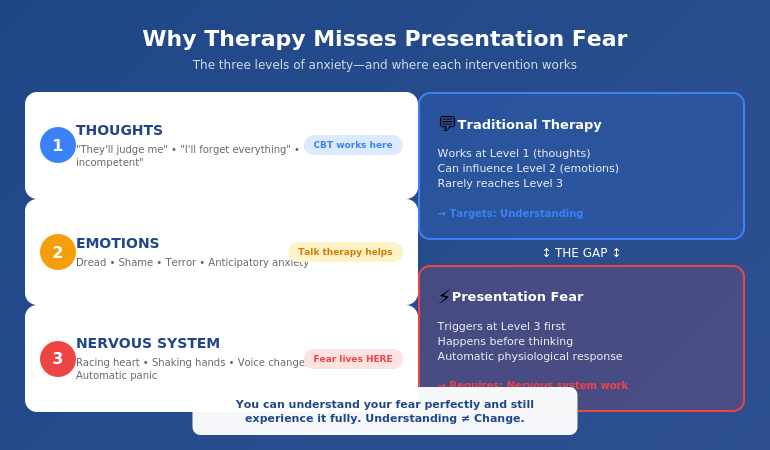
Think of anxiety as operating on three levels:
Level 1: Thoughts — What you think about presenting (“They’ll judge me,” “I’ll forget everything,” “I’ll look incompetent”)
Level 2: Emotions — What you feel about presenting (dread, shame, terror, anticipatory anxiety)
Level 3: Nervous System — What your body does automatically (fight-or-flight activation, adrenaline release, physical symptoms)
Traditional talk therapy—including CBT—works primarily at Level 1. You learn to identify and challenge unhelpful thoughts. This can reduce the intensity of Level 2 emotions over time.
But Level 3 operates independently. Your nervous system learned that presenting is dangerous through past experiences—embarrassments, freezes, visible anxiety, perceived failures. It doesn’t care what you think about those experiences now. It responds to the trigger (standing up to present) with the learned response (full physiological panic).
This is why you can know your fear is irrational and still experience it fully. Understanding doesn’t change the automatic response. Your therapist can help you see that the audience isn’t actually dangerous. Your amygdala disagrees—and it controls your body.
🧠 Address the Right Level
Conquer Speaking Fear (£39, instant download) works at the nervous system level—where presentation anxiety actually lives. These are clinical hypnotherapy and NLP techniques specifically designed for performance anxiety, not general talk therapy approaches.
What’s inside:
- Nervous system reprogramming protocols
- The Anchor Technique for pre-presentation calm
- Somatic release methods for stored fear
- The Exposure Reframe (changing the threat response itself)
Developed by a clinical hypnotherapist who spent years in traditional therapy first.
The Nervous System Problem
Your nervous system is a learning machine. It observes patterns and creates automatic responses to keep you safe.
At some point—maybe in school, maybe early in your career—you had a negative experience while presenting. Perhaps you froze. Perhaps people laughed. Perhaps you forgot everything. Perhaps you just felt intensely uncomfortable and visible.
Your nervous system registered this as: Presenting = Danger. Avoid or prepare for threat.
Every subsequent presentation reinforced this learning. Even if the presentations went “okay,” your body was in threat mode throughout. That reinforcement strengthened the association.
Now, decades later, the pattern is deeply embedded. The moment you know you have to present—sometimes weeks in advance—your nervous system starts preparing for danger. The anticipatory anxiety. The sleep disruption. The growing dread.
Then you stand up, and everything your nervous system learned kicks in automatically:
- Adrenaline floods your system (energy for fighting or fleeing)
- Blood flows away from your brain (making thinking harder)
- Your heart races (preparing for physical exertion)
- Your hands shake (excess adrenaline with nowhere to go)
- Your voice changes (vocal cords tighten under stress)
- Your digestive system shuts down (causing nausea)
This is not a thinking problem. It’s a learned physiological response. And it requires intervention at the level where it lives.
For more on managing the physical symptoms, see my guide on presentation anxiety before meetings.
🎯 Ready to work at the nervous system level? Conquer Speaking Fear (£39) includes the clinical protocols I developed after traditional therapy failed me.
What Actually Works
If traditional therapy works at the wrong level, what works at the right level?
After training as a clinical hypnotherapist and working with professionals across banking, consulting, and tech who struggled with presentation anxiety, I’ve identified the approaches that actually change the nervous system response:
1. Anchoring
Anchoring creates a physical trigger associated with a calm, confident state. Through repetition, you train your nervous system to access that state on demand.
The technique: While in a deeply relaxed state, you create a physical anchor (like pressing thumb and forefinger together). You repeat this pairing until the physical action automatically triggers the calm state. Before presenting, you fire the anchor—and your nervous system responds with calm rather than panic.
This works because you’re creating a new automatic response, not trying to think your way out of the old one.
2. Somatic Release
Your body stores past fear experiences. Somatic techniques help discharge that stored energy, reducing the intensity of the automatic response.
This might include specific breathing patterns that activate the parasympathetic nervous system, physical movements that release tension, or body-awareness practices that interrupt the fear cascade.
3. Hypnotherapy
Clinical hypnotherapy accesses the subconscious mind—where the learned fear response lives—and creates new associations. Under hypnosis, you can rehearse successful presentations while deeply relaxed, teaching your nervous system that presenting can be safe.
This is different from stage hypnosis entertainment. Clinical hypnotherapy is a recognised therapeutic approach with research support for anxiety conditions.
4. Gradual Exposure with New Associations
Exposure therapy can work for presentation fear—but only when paired with positive experiences at each stage. The goal isn’t to “push through” fear (which often reinforces it) but to create new evidence that presenting is safe.
This means starting with very low-stakes presentations where you can remain relatively calm, then gradually increasing the challenge while maintaining that calm baseline.
🧠 The Nervous System Approach
Conquer Speaking Fear (£39, instant download) teaches all four approaches—anchoring, somatic release, hypnotic rehearsal, and graduated exposure—in a structured programme designed for professionals who need results, not just understanding.
From someone who tried everything else first.
My Breakthrough
After eighteen months of therapy that helped everything except presenting, I was desperate enough to try something different.
I enrolled in clinical hypnotherapy training—not because I wanted to become a hypnotherapist, but because I wanted to understand why I couldn’t fix myself with all the tools I’d learned.
What I discovered changed my understanding of anxiety completely.
The techniques I learned worked at a different level than anything I’d tried before. Instead of understanding my fear (which I could already do perfectly), I was changing the automatic response itself.
The first time I presented after learning anchoring techniques, something remarkable happened: my body didn’t panic. Not because I’d suppressed the panic—because the panic didn’t come. My nervous system had learned a new response.
It wasn’t instant. It took practice. But within a few months, I went from vomiting before presentations to feeling… normal. Not fearless. Not artificially confident. Just normal—like presenting was a professional task rather than a survival threat.
That transformation is why I do this work now. Traditional therapy has its place. But for presentation-specific fear, you need presentation-specific solutions that work at the nervous system level.
For more on overcoming presentation fear generally, see my comprehensive guide on how to overcome fear of public speaking.
🧠 What Traditional Therapy Couldn’t Give Me
Conquer Speaking Fear (£39, instant download) is what I wish existed during my years of struggling with therapy that didn’t work for presenting. Clinical techniques that work at the nervous system level—where presentation fear actually lives.
The programme includes:
- The Anchor Technique (pre-presentation calm on demand)
- Somatic release protocols
- Hypnotic rehearsal methods
- The Exposure Reframe system
- The Confidence Compound approach
For professionals who’ve tried therapy and need something that actually works for presenting.
Frequently Asked Questions
Does therapy help with fear of public speaking?
Traditional therapy can help you understand your fear and may reduce general anxiety levels, but it often fails to eliminate presentation-specific panic. This is because presentation fear operates primarily at the nervous system level—as a learned automatic response—rather than as a thinking problem. Therapy that works at the cognitive level (like standard CBT) addresses thoughts and beliefs but doesn’t change the physiological response that triggers before rational thought can intervene.
Why doesn’t CBT work for presentation anxiety?
CBT works by identifying and challenging unhelpful thoughts. For presentation anxiety, you can successfully challenge thoughts (“the audience isn’t dangerous”) while still experiencing the full physiological fear response. This is because your amygdala triggers fight-or-flight before your rational mind processes the situation. CBT can reduce anticipatory anxiety and improve recovery after presenting, but it rarely eliminates the in-the-moment panic that defines presentation fear.
What is the best treatment for glossophobia?
The most effective treatments work at the nervous system level rather than the cognitive level. These include clinical hypnotherapy (creating new associations under relaxed states), NLP anchoring techniques (establishing physical triggers for calm), somatic approaches (releasing stored fear from the body), and carefully structured exposure with positive reinforcement. Many professionals find the best results from combining multiple nervous system approaches rather than relying on talk therapy alone.
Should I stop therapy if it’s not helping my presentation fear?
Not necessarily—therapy may be helping with other aspects of anxiety even if presentation fear persists. However, if presentation anxiety is your primary concern and you’ve been in therapy for 6+ months without improvement in that specific area, it’s reasonable to add or switch to approaches that work at the nervous system level. Many professionals benefit from combining general therapy with presentation-specific techniques like hypnotherapy or NLP.
Is hypnotherapy better than CBT for public speaking anxiety?
For presentation-specific fear, hypnotherapy often produces faster results because it works at the subconscious level where the fear response is encoded. CBT is excellent for general anxiety and helpful for anticipatory worry, but it struggles to change the automatic physiological response that happens in the moment of presenting. That said, some people benefit from combining both—using CBT for thought patterns and hypnotherapy for the nervous system response.
How is presentation-specific treatment different from general anxiety therapy?
General anxiety therapy addresses broad patterns of worry and avoidance. Presentation-specific treatment focuses on the performance context—the unique combination of visibility, evaluation, and real-time pressure that triggers a distinct fear response. Effective presentation treatment often includes rehearsal under relaxed states, anchoring techniques tied to presenting scenarios, and gradual exposure specific to speaking situations. Generic anxiety tools rarely transfer directly to the presenting moment.
Can medication help if therapy hasn’t worked?
Beta blockers (like propranolol) can reduce physical symptoms by blocking adrenaline’s effects—slowing heart rate, reducing trembling, stabilising voice. Many professionals use them as a bridge while developing other skills. However, medication doesn’t address the underlying fear; it manages symptoms. Some people feel “disconnected” or “flat” on beta blockers. Medication works best as part of a broader approach that includes nervous system retraining, not as a standalone solution. Always consult a doctor before using any medication for anxiety.
📧 The Winning Edge Newsletter
Weekly insights on presentation confidence, evidence-based anxiety techniques, and what actually works for professionals who need to present.
Not ready for the full nervous-system programme? Start here instead: download the free 7 Presentation Frameworks — structured blueprints that reduce pre-presentation anxiety by removing the uncertainty.
About the Author
Mary Beth Hazeldine is the Owner & Managing Director of Winning Presentations. With 25 years of corporate banking experience at JPMorgan Chase, PwC, Royal Bank of Scotland, and Commerzbank, she has delivered high-stakes presentations in boardrooms across three continents.
A qualified clinical hypnotherapist and NLP practitioner, Mary Beth combines executive communication expertise with evidence-based techniques for managing presentation anxiety. She works with senior professionals across financial services, healthcare, technology, and government on high-stakes presentation preparation.
Your Next Step
If you’ve been in therapy and your presentation fear hasn’t improved, you’re not failing at therapy. You’re using the wrong tool for this specific problem.
Presentation fear requires intervention at the nervous system level—where the automatic response lives. Traditional therapy works at the cognitive level, which is why it helps with understanding but not with the panic that hijacks your body when you stand up to speak.
The good news: nervous system approaches can work relatively quickly once you apply them. I spent years in therapy without progress on presenting. I saw significant change within weeks of using the right techniques.
You don’t need more sessions doing the same thing. You need a different approach entirely.
Related: If preparation anxiety is adding to your stress, see today’s companion article on the preparation order that actually reduces panic—because better structure means less for your nervous system to worry about.