Tag: presentation anxiety treatment

22 Apr 2026

Presentation Anxiety Treatment for Executives: Evidence-Based Approaches That Work

If you are searching for presentation anxiety treatment as an executive, Conquer Speaking Fear is a 30-day structured programme that combines nervous system regulation with clinical hypnotherapy — designed specifically for professionals whose anxiety shows up in high-stakes presenting situations rather than in everyday life. This is not general anxiety management. It is a targeted treatment approach for a specific pattern: the executive who is capable, experienced, and composed in most professional contexts, but whose body and mind respond to the presenting environment as though it were a genuine threat. It is available now at £39, instant access. This page covers what the programme addresses, how it works, and whether it fits your situation.

The Problem: Why Executive Presentation Anxiety Persists Despite Experience

Presentation anxiety at the executive level is counterintuitive — and that is partly why it persists. You have given hundreds of presentations. You know the content. You have navigated far more demanding situations than a 20-minute board update. And yet the anxiety remains, sometimes worsening as the stakes increase rather than diminishing with experience.

This happens because presentation anxiety is not a knowledge problem or a preparation problem. It is a nervous system response — a learned pattern in which the brain treats the act of presenting as a threat and triggers the same physiological cascade it would deploy in a genuinely dangerous situation. The voice tightens. Thoughts scatter. The body enters a mode designed for survival, not for articulate persuasion.

Most treatment approaches for executives stop at the cognitive level: reframe your thinking, prepare more thoroughly, practise in front of colleagues. These strategies have a role, but they do not reach the mechanism that drives the response. The nervous system operates faster than conscious thought — by the time you are telling yourself to stay calm, your physiology has already decided otherwise.

Understanding how anticipatory anxiety before presentations works at the physiological level helps clarify why willpower-based approaches so often fall short under genuine pressure.

The Solution: Conquer Speaking Fear

Conquer Speaking Fear is a 30-day structured treatment programme that works at two levels simultaneously: the nervous system (where the anxiety response originates) and the subconscious associations (where the brain has learned to classify presenting as threatening). It does not replace clinical therapy for generalised anxiety, but for presentation-specific anxiety — the pattern that shows up reliably in speaking contexts and not elsewhere — it is precisely targeted.

The nervous system regulation component gives you practical techniques that interrupt the physiological response before and during a presentation. These are not breathing exercises in the abstract — they are calibrated to the specific timeline of executive presenting: the days before, the minutes before entering the room, the moment a difficult question arrives, and the recovery period afterwards.

The clinical hypnotherapy sessions work at the subconscious level, gradually shifting the associations your brain has built around the presenting environment. This is where lasting change happens — not in what you consciously tell yourself, but in how your brain categorises the situation before conscious thought engages. The programme builds these sessions progressively over 30 days, creating durable change rather than temporary relief.

For executives who want to understand the cognitive dimension alongside the nervous system approach, the guide to cognitive restructuring for presentation anxiety covers the thinking-level techniques that complement this programme well.

What You Get

  • 30-day structured programme — daily modules building progressively, designed to fit around a senior professional’s schedule
  • Nervous system regulation techniques — practical methods for managing the physiological response at every stage of the presentation timeline
  • Clinical hypnotherapy audio sessions — targeted sessions that address subconscious threat associations with the presenting environment
  • In-the-moment symptom management — techniques for use during live presentations when the anxiety response activates
  • Post-incident recovery module — dedicated support for executives recovering from a presentation that went significantly wrong
  • Instant access — start immediately, work at your own pace within the 30-day structure

Price: £39 — instant access, no subscription.

Stop Managing Presentation Anxiety — Treat the Pattern That Drives It

Conquer Speaking Fear gives you a structured, 30-day treatment programme combining nervous system regulation and clinical hypnotherapy — designed specifically for executives whose anxiety shows up in the presenting environment, not in everyday professional life. £39, instant access.

  • ✓ 30-day programme with daily structured modules
  • ✓ Nervous system regulation for executive presenting contexts
  • ✓ Clinical hypnotherapy sessions targeting presentation anxiety
  • ✓ In-the-moment techniques for live high-stakes presentations

Get Conquer Speaking Fear → £39

Instant access · £39 · No subscription

Is This Right for You?

Conquer Speaking Fear is designed for executives and senior professionals who experience a consistent anxiety pattern specifically in presenting contexts. It is most relevant if you have tried cognitive approaches — more preparation, positive self-talk, generic confidence workshops — and found that they help in lower-pressure situations but do not hold reliably when the stakes are genuinely high.

It is right for you if: you experience physical symptoms under presentation pressure (voice tightening, mind blanking, elevated heart rate); anticipatory dread affects your preparation in the days before a significant presentation; you find yourself avoiding high-visibility speaking opportunities; or a past presenting experience has created a pattern that persists.

It is not designed for executives who want to improve their slide structure or delivery technique without an anxiety component — presentation skills training addresses those needs more directly. It is also not a replacement for clinical support if your anxiety extends significantly beyond presenting contexts into daily life. In that situation, working alongside a qualified therapist while using this programme is entirely appropriate.

The guide to grounding techniques for presentation anxiety covers practical in-the-moment methods that complement the nervous system work in this programme.

Frequently Asked Questions

Is this a clinical anxiety treatment?

Conquer Speaking Fear is a structured self-directed programme, not clinical therapy. It uses techniques drawn from clinical practice — specifically nervous system regulation and clinical hypnotherapy — applied to the presentation-specific anxiety pattern. If your anxiety is primarily triggered by presenting situations rather than being generalised across your daily life, this programme addresses that pattern directly. If you are experiencing broad anxiety that affects multiple areas of daily functioning, working with a qualified therapist alongside this programme is advisable.

How is this different from presentation skills coaching?

Presentation skills coaching focuses on delivery technique, slide design, and message structure — how to present well. Conquer Speaking Fear focuses on the anxiety response itself — why your body and mind react to presenting as a threat, and how to change that pattern at the nervous system level. Many executives have strong presentation skills but still experience significant anxiety. This programme addresses the anxiety directly, independent of skill level.

Will this work for someone who has presented for 20+ years?

Yes — and lengthy experience presenting is common among participants. Presentation anxiety often intensifies rather than diminishes with seniority, because the stakes increase faster than familiarity can compensate. The programme does not assume you lack experience. It addresses the nervous system pattern that operates independently of how many presentations you have given or how well you know the material.

Can I use this alongside medication for anxiety?

Yes. The techniques in Conquer Speaking Fear do not conflict with prescribed anxiety medication. If you are currently taking medication for anxiety — whether specifically for presenting situations or more broadly — this programme can complement that treatment by addressing the learned nervous system response that medication manages but does not retrain. Mention your use of this programme to your prescribing clinician so they have a complete picture of your anxiety management approach.

What if I have a major presentation before I finish the 30 days?

The programme is designed so that several techniques are immediately usable from the first week — particularly the nervous system regulation methods for the minutes before and during a presentation. You do not need to complete all 30 days before your next presentation. The early modules focus on in-the-moment management precisely because many participants begin the programme with an upcoming high-stakes presentation in mind. The deeper subconscious work develops over the full programme period.

The Winning Edge

Weekly insights on executive presentations, speaking confidence, and high-stakes communication — delivered every Thursday.

Subscribe Free

About the author

Mary Beth Hazeldine, Owner & Managing Director, Winning Presentations. With 25 years of corporate banking experience at JPMorgan Chase, PwC, Royal Bank of Scotland, and Commerzbank, and 16 years working with executives on high-stakes presentations, she advises senior professionals across financial services, healthcare, technology, and government on structuring and delivering presentations under pressure.

11 Apr 2026
Professional speaking confidently to an executive audience — visible calm, open posture, boardroom setting, editorial photography style

Exposure Ladder for Presentation Anxiety: A Systematic Approach to Building Speaking Confidence

Quick Answer

An exposure ladder for presentation anxiety works by building a hierarchy of speaking situations from low-anxiety to high-anxiety, then moving through them deliberately and repeatedly until each step becomes manageable. Unlike willpower-based approaches, systematic desensitisation changes the nervous system’s threat response — not just your attitude toward presenting.

Ngozi had presented at every level of her organisation for eleven years. She had closed deals, led strategy reviews, and presented to the board. By any external measure she was an accomplished presenter. But for the past three years, the week before any significant presentation had become a period of progressive dread — poor sleep, a constant low-level nausea, and an inability to concentrate on anything else. The presenting itself was manageable. The anticipation had become unbearable.

She had tried all the standard advice. She had recorded herself presenting. She had meditated. She had told herself the anxiety was excitement. None of it made a lasting difference. What changed, eventually, was working through a structured exposure hierarchy — not to presentations she was already doing, but to a deliberate sequence of lower-stakes speaking situations she had quietly been avoiding for years. Speaking in a meeting when she did not need to. Offering opinions without being asked. Presenting informally to three people without slides.

The exposure ladder did not make Ngozi comfortable with presenting because she practised presenting more. It worked because it systematically reduced her nervous system’s baseline threat response to being observed and evaluated — the underlying mechanism that was driving the dread. Once that baseline came down, the anticipatory anxiety reduced with it.

This article explains how to build and use an exposure ladder for presentation anxiety — and why the clinical logic behind it is the most reliable route out of a pattern that willpower alone rarely shifts.

Is presentation anxiety limiting your career progression?

Conquer Speaking Fear is a 30-day programme that combines nervous system regulation and clinical hypnotherapy techniques, designed specifically for professionals whose anxiety is persistent despite years of presenting experience.

Explore the Programme →

Why Exposure Works When Everything Else Doesn’t

Presentation anxiety is not fundamentally a confidence problem. It is a threat response. The amygdala — the part of the brain responsible for threat detection — has learned, through repeated association, that being observed and evaluated in front of an audience is dangerous. It responds to that stimulus the same way it would respond to a physical threat: elevated cortisol, accelerated heart rate, restricted breathing, heightened vigilance. The cognitive experience of this response is dread, self-consciousness, and the urge to avoid.

This is why approaches that work at the cognitive level — reframing your thoughts, replacing negative self-talk, visualising success — produce limited results for people with persistent anxiety. The threat response is not cognitive in origin. It does not respond reliably to cognitive correction. You can tell yourself rationally that the presentation is not dangerous, while your nervous system continues to respond as though it is. The rational argument and the threat response operate in different systems.

Exposure therapy works at the level of the nervous system itself. By repeatedly experiencing the feared stimulus — in a controlled, gradual way — without the catastrophic outcome the nervous system anticipates, the amygdala progressively updates its threat assessment. The technical term is habituation: the response to a stimulus decreases with repeated, non-catastrophic exposure. This is not a motivational insight. It is a neurobiological process. It works whether or not you believe in it, and it works for people whose anxiety has been resistant to every cognitive approach they have tried.

The critical requirement is gradation. Throwing yourself into high-stakes presentations does not produce habituation — it can reinforce the threat response if the experience is sufficiently distressing. The ladder structure exists to ensure that each step is challenging enough to activate the anxiety response, but manageable enough that repeated exposure produces habituation rather than reinforcement. This is the clinical insight that makes the difference between an exposure programme that works and one that makes anxiety worse.

For professionals whose anxiety has been resistant to standard approaches, the exposure ladder is often the first intervention that produces a measurable, sustained change — because it is the first intervention that works at the level where the anxiety actually lives.

How to Build Your Personal Exposure Ladder

An exposure ladder is a personally constructed hierarchy of speaking situations, ordered from least to most anxiety-provoking. It is not a generic list — it is built from your specific pattern of avoidance and your specific anxiety triggers. Two people with presentation anxiety will often have completely different ladders, because the situations they find most threatening are different.

Begin by listing every type of speaking or being-observed situation that produces anxiety for you — not just formal presentations. Include meetings where you speak up, phone calls with people you find intimidating, informal updates in team settings, social situations where you are introduced to groups, and any other context where you experience the same anticipatory or in-the-moment anxiety response. This list is your raw material.

Next, rate each situation on a scale of 0–10 for the anxiety it produces, where 0 is no anxiety and 10 is the highest anxiety you can imagine. These ratings are subjective and they will not be consistent — a situation that feels like a 7 one week may feel like a 5 a month later. That variability is normal and expected. For now, use your current honest rating.

Organise your list from lowest to highest anxiety rating. This is your exposure ladder. You will work from the bottom up — beginning with situations rated 2–3, working toward situations rated 8–9. The principle is that you do not move to the next rung until the current rung no longer consistently produces a significant anxiety response. For most people this means repeating a situation three to five times, over days or weeks, until the anxiety rating for that situation drops to 2 or below.

The ladder should have enough rungs that the gaps between adjacent steps are small — typically no more than one to two points on the anxiety rating scale. If you find a large gap between two adjacent items, insert an intermediate situation. The goal is a gradual gradient, not a series of large jumps.

How to build a personal exposure ladder for presentation anxiety: listing situations, rating anxiety, ordering from low to high

The First Rungs: Low-Stakes Practice That Actually Counts

The most common mistake people make when starting an exposure programme is skipping the lower rungs because they seem too easy or too unrelated to presentations. This is a significant error. The lower rungs are where the neurobiological work of reducing baseline threat response happens — and that baseline reduction is what makes the higher rungs easier when you reach them.

For many professionals with presentation anxiety, typical first-rung situations include: asking a question in a meeting with three or four people present; making a comment in a small team discussion when you did not feel obligated to; speaking to a stranger in a professional context; introducing yourself in a group of five to eight people. These may feel trivially low-anxiety, or they may feel more significant than that — either way, they belong at the bottom of your ladder if they are situations you have been avoiding or find uncomfortable.

The discipline of the first rungs is repeatability. You are not trying to have one good experience — you are trying to accumulate repeated, non-catastrophic experiences until the situation loses its anxiety charge. A first rung situation should be practised multiple times per week, in naturally occurring opportunities, until the anxiety rating consistently stays at 2 or below. Only then should you move up.

It is also worth noting that the situations that belong on the lower rungs are often the situations that high-functioning professionals with presentation anxiety have been unconsciously managing around for years. They contribute to meetings in writing but not verbally. They send emails rather than picking up the phone. They arrive early and leave before social conversation starts. These avoidance patterns maintain the anxiety — each avoidance confirms to the nervous system that the situation is dangerous. The first rungs of the exposure ladder directly address this maintenance cycle.

Conquer Speaking Fear includes structured exercises for this phase of the work — specifically the progression from daily low-stakes vocal presence to deliberate speaking situations in professional environments. If the lower rungs are where you need the most support, the 30-day programme provides a week-by-week structure for this exact progression.

A 30-Day Programme for Persistent Presentation Anxiety

Conquer Speaking Fear is a structured 30-day programme combining nervous system regulation and clinical hypnotherapy techniques. Designed for professionals whose anxiety persists despite years of presenting experience — not a confidence course, but a clinical-grade approach to changing your nervous system’s response to speaking situations.

  • 30-day programme with progressive nervous system regulation exercises
  • Clinical hypnotherapy techniques for acute and anticipatory anxiety
  • Structured exposure progression for professional speaking contexts
  • Framework for managing anxiety during high-stakes presentations

Get Conquer Speaking Fear →

Designed for executives and professionals whose presentation anxiety has been resistant to standard techniques.

The Middle Rungs: Structured Escalation in Professional Settings

The middle section of the ladder — typically situations rated 4–6 — is where the most practically significant progress happens for professionals. This is the range that includes the everyday speaking situations that presentation anxiety is quietly limiting: contributing substantively in larger meetings, presenting updates informally to senior colleagues, volunteering to lead a section of a team discussion, speaking at a workshop or professional event.

The principle remains the same: deliberate, repeated exposure to each situation until the anxiety rating drops consistently to 2 or below. But the middle rungs require more intentional engineering of opportunities, because the situations do not occur as frequently as lower-rung situations, and because the stakes involved mean that avoidance is more tempting when the anxiety is present.

One effective strategy for the middle rungs is to create low-consequence versions of higher-stakes situations. Before presenting to a senior leadership team, present the same material to a trusted peer or a small team. Before speaking at an industry event, present informally at an internal team meeting. Before delivering a board update, walk through your slides in a small pre-meeting. These are not rehearsals — they are genuine exposure steps, because the anxiety they produce and the habituation that follows are both real, even when the stakes are modest.

The middle rungs also surface the cognitive distortions that accompany anxiety — the conviction that your voice will shake visibly, that people will notice your anxiety, that you will lose your thread and be unable to recover. Repeated middle-rung experiences provide direct evidence against these predictions, which is why cognitive restructuring approaches are most effective when combined with exposure rather than used in isolation. The exposure creates the evidence; the cognitive work makes that evidence legible to a mind that has been filtering it out.

People also ask: How long does it take for exposure therapy to work for public speaking? The timeline varies considerably by individual, by the severity of the anxiety, and by the consistency of practice. For professionals with moderate presentation anxiety, consistent work through an exposure ladder typically produces noticeable reduction in lower-rung anxiety within four to eight weeks. Progress to high-stakes situations often takes three to six months of sustained practice. The programme is not linear — anxiety will be higher on some days than others, and there will be setbacks. The measure of progress is the trend over time, not any individual session.

Approaching High-Stakes Presentations Without Regression

The upper rungs of the exposure ladder — board presentations, large conference speeches, high-visibility client pitches — are the situations that professionals with presentation anxiety most want to resolve. They are also the situations where the work of the lower and middle rungs pays the largest dividend, because the baseline threat response that drove the dread has been systematically reduced.

The risk at the upper rungs is regression — returning to high anxiety after a difficult experience. A presentation that goes poorly, a tough question you struggled to answer, or an audience that appeared unresponsive can temporarily reset anxiety ratings upward. This is normal and does not signal that the exposure programme has failed. What matters is returning to the practice rather than returning to avoidance. Avoidance after a difficult experience is the single most reliable way to maintain and deepen anxiety. Re-exposure, at a slightly lower rung if necessary, is the path through.

High-stakes presentations also benefit from two specific preparation approaches that work in conjunction with the lower anxiety baseline the exposure ladder creates. Physiological regulation — box breathing, slow exhalation, deliberate postural adjustment — directly modulates the acute threat response in the minutes before a presentation. And cognitive decoupling — separating your evaluation of the presentation’s quality from your evaluation of yourself — reduces the self-referential threat response that drives much of the anticipatory anxiety in high-performing professionals.

The pattern of recovery from anxiety relapse is also predictable. If a difficult high-stakes presentation temporarily reactivates anxiety that had reduced, the recovery through the ladder typically happens faster than the original progression — because the nervous system retains habituation more efficiently than it retains threat learning. This is a useful frame for understanding presentation anxiety relapse: the setback is real, but the recovery is faster than the original work.

Exposure ladder progression from low-stakes daily situations through middle rungs to high-stakes board and conference presentations

Common Mistakes That Stall Progress Up the Ladder

Three patterns reliably stall progress through an exposure ladder, and all three are driven by the same underlying mechanism: avoiding the anxiety response rather than experiencing it.

Safety behaviours. A safety behaviour is anything you do during an exposure to reduce or manage the anxiety rather than experiencing it. Reading from notes rather than speaking from memory. Focusing entirely on the screen rather than making eye contact. Presenting standing behind a lectern when you could present without one. Safety behaviours prevent habituation because they prevent the full anxiety response — and therefore prevent the nervous system from learning that the full response is survivable. Identifying and gradually removing safety behaviours is as important as adding new rungs to the ladder.

Moving up too quickly. Impatience is the most common structural mistake. Moving to the next rung before the current rung has habituated means you are working at anxiety levels that are too high to produce reliable habituation. The discomfort of repeated middle-rung exposure is the work — shortcutting it by jumping to higher rungs creates distress rather than habituation, and can make the upper rungs feel harder rather than easier.

Treating single positive experiences as evidence that the anxiety is resolved. Anxiety is variable. One good presentation does not reset the pattern — and the next difficult one does not undo the progress. The consistency of the practice, not the quality of any individual experience, is what produces lasting change. People who stop their exposure practice after a run of good presentations often find that the anxiety returns when the stakes rise again, because the nervous system has not been habituated fully to the highest-anxiety situations on the ladder.

For a structured approach to maintaining progress and avoiding these stall patterns, the Conquer Speaking Fear programme includes week-by-week guidance on pacing, safety behaviour removal, and recovery from setbacks.

A Structured Path Through Persistent Presentation Anxiety

Conquer Speaking Fear — £39 — is a 30-day programme combining nervous system regulation and clinical hypnotherapy techniques for professionals whose anxiety persists despite years of presenting. If you have tried reframing and positive thinking and found them insufficient, this programme works at the level where the anxiety actually lives.

Get Conquer Speaking Fear →

Designed for executives and professionals with persistent, anxiety that has resisted standard confidence-building approaches.

Frequently Asked Questions

Can I build an exposure ladder on my own, or do I need a therapist?

For presentation anxiety that is persistent but does not significantly impair daily functioning, a self-directed exposure ladder is a reasonable starting point. The principles are straightforward, and many professionals make meaningful progress through structured self-practice. The challenges of self-directed work are consistency, pacing, and identifying safety behaviours — these are easier to monitor with an external guide. If your anxiety is severe, accompanied by panic attacks, or has been present for many years without any period of reduction, working with a therapist trained in exposure-based approaches is worth pursuing alongside or instead of a self-directed programme.

Is systematic desensitisation the same as exposure therapy?

Systematic desensitisation and exposure therapy are closely related but not identical. Systematic desensitisation, developed by Joseph Wolpe in the 1950s, combines a hierarchy of feared situations with progressive muscle relaxation — the original clinical model involved practising relaxation responses while imagining feared situations in order. Modern exposure therapy typically focuses on live (in-vivo) exposure without requiring a specific relaxation component, and the evidence base for live exposure is stronger than for imaginal exposure alone. The exposure ladder approach described in this article draws primarily on the in-vivo exposure model — deliberate, graduated exposure to real situations rather than imagined ones.

What if my anxiety is worse than usual during an exposure practice?

Variable anxiety during exposure practice is entirely normal and does not signal that the approach is failing. Anxiety tends to be higher when you are tired, stressed, or facing other pressures — and exposure sessions that happen to fall on high-stress days may feel harder than usual. The principle is to continue the practice rather than avoid it, even on difficult days — but to reduce the step if necessary rather than forcing an exposure that is significantly beyond your current capacity. If a situation that was previously a 3 on your anxiety scale suddenly feels like a 7, drop back one rung on your ladder and repeat from there. Progress is measured over weeks and months, not individual sessions.

Get weekly insight on presentation confidence in your inbox

Every Thursday, The Winning Edge delivers one actionable insight for professionals working to build sustainable presentation confidence — including practical techniques drawn from clinical anxiety research.

Subscribe to The Winning Edge →

About the Author

Mary Beth Hazeldine is Owner & Managing Director of Winning Presentations. With 25 years of corporate banking experience at JPMorgan Chase, PwC, Royal Bank of Scotland, and Commerzbank, she advises executives across financial services, healthcare, technology, and government on overcoming presentation anxiety and structuring high-stakes presentations for board and executive audiences.

02 Feb 2026
Professional woman in therapy session looking frustrated that treatment hasn't resolved her public speaking fear

Why Therapy Didn’t Fix My Presentation Fear (Until I Tried This)

I sat in my therapist’s office for the forty-seventh time, and she asked how the presentation went.

“I threw up in the car park beforehand,” I said. “Then I rushed through it so fast nobody could follow. Then I couldn’t sleep for two days replaying every mistake.”

She nodded sympathetically. We’d been working on my anxiety for eighteen months. I understood my childhood patterns. I could identify cognitive distortions. I had breathing techniques and grounding exercises and a meditation practice.

None of it helped when I stood up to present.

It took me another two years—and training as a clinical hypnotherapist—to understand why. Traditional therapy is excellent for many things. Presentation fear often isn’t one of them.

Quick answer: Traditional therapy (including CBT) often fails to resolve presentation anxiety because it addresses the wrong level of the problem. Presentation fear isn’t primarily a thinking problem—it’s a nervous system problem. Your body has learned that presenting equals danger, and it responds automatically before your rational mind can intervene. Talk therapy can help you understand your fear, but understanding doesn’t change the automatic physiological response. Effective treatment requires working at the nervous system level—through techniques like anchoring, somatic work, and hypnotherapy—to change the learned threat response itself. This article explains why traditional approaches fall short and what actually works.

⚡ Presenting This Week? The 60-Second Reset

If you have a presentation coming up and therapy hasn’t helped, try this before you present:

  1. 30 seconds before: Press your thumb and forefinger together firmly while taking one slow breath. Hold 4 seconds. This creates a physical anchor point.
  2. While walking in: Drop your shoulders, unclench your jaw, soften your hands. Your body posture signals safety to your nervous system.
  3. First sentence: Start with a statement, not a question. “I’m here to share…” gives you control of the first moment.

This won’t cure presentation fear, but it interrupts the panic spiral. For the complete nervous system approach, keep reading.

Or explore the full programme →

Why Traditional Therapy Often Fails for Presentation Fear

Let me be clear: therapy is valuable. It helped me understand anxiety patterns I’d carried for decades. It improved my relationships, my self-awareness, my general wellbeing.

But it didn’t stop me from panicking before presentations.

Here’s what I learned after years of trying—and then training to understand why:

Traditional therapy treats presentation fear as a thinking problem. The assumption is that if you understand why you’re afraid, challenge your irrational beliefs, and develop coping strategies, the fear will diminish.

This works for many anxiety types. It doesn’t work well for performance anxiety because the fear doesn’t live primarily in your thoughts. It lives in your nervous system.

When you stand up to present, your amygdala—the threat-detection centre of your brain—triggers a cascade of physiological responses before your rational mind can intervene. Your heart races. Your hands shake. Your voice changes. Your digestive system rebels.

This happens in milliseconds. No amount of cognitive restructuring can outrun it. By the time you’re trying to remember your CBT techniques, your body has already decided you’re in danger.

For more on the physiology behind presentation fear, see my article on what glossophobia actually is.

The Wrong Level of Intervention

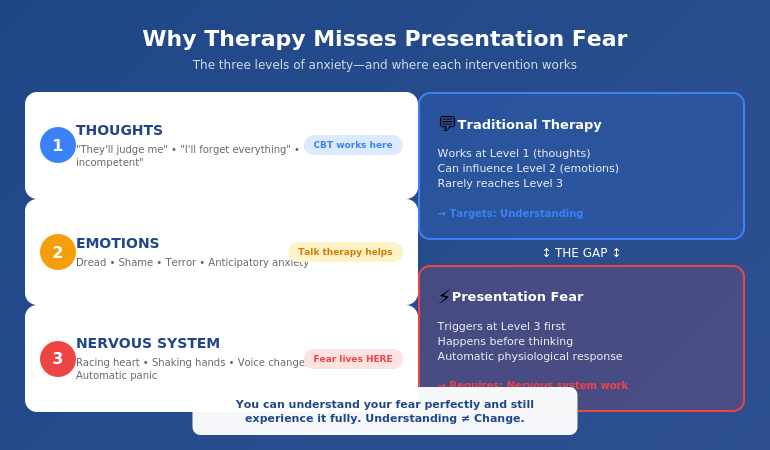
Think of anxiety as operating on three levels:

Level 1: Thoughts — What you think about presenting (“They’ll judge me,” “I’ll forget everything,” “I’ll look incompetent”)

Level 2: Emotions — What you feel about presenting (dread, shame, terror, anticipatory anxiety)

Level 3: Nervous System — What your body does automatically (fight-or-flight activation, adrenaline release, physical symptoms)

Traditional talk therapy—including CBT—works primarily at Level 1. You learn to identify and challenge unhelpful thoughts. This can reduce the intensity of Level 2 emotions over time.

But Level 3 operates independently. Your nervous system learned that presenting is dangerous through past experiences—embarrassments, freezes, visible anxiety, perceived failures. It doesn’t care what you think about those experiences now. It responds to the trigger (standing up to present) with the learned response (full physiological panic).

This is why you can know your fear is irrational and still experience it fully. Understanding doesn’t change the automatic response. Your therapist can help you see that the audience isn’t actually dangerous. Your amygdala disagrees—and it controls your body.

Three levels of anxiety showing thoughts emotions and nervous system with therapy addressing level one while presentation fear operates at level three

🧠 Address the Right Level

Conquer Speaking Fear (£39, instant download) works at the nervous system level—where presentation anxiety actually lives. These are clinical hypnotherapy and NLP techniques specifically designed for performance anxiety, not general talk therapy approaches.

What’s inside:

  • Nervous system reprogramming protocols
  • The Anchor Technique for pre-presentation calm
  • Somatic release methods for stored fear
  • The Exposure Reframe (changing the threat response itself)

Get Conquer Speaking Fear →

Developed by a clinical hypnotherapist who spent years in traditional therapy first.

The Nervous System Problem

Your nervous system is a learning machine. It observes patterns and creates automatic responses to keep you safe.

At some point—maybe in school, maybe early in your career—you had a negative experience while presenting. Perhaps you froze. Perhaps people laughed. Perhaps you forgot everything. Perhaps you just felt intensely uncomfortable and visible.

Your nervous system registered this as: Presenting = Danger. Avoid or prepare for threat.

Every subsequent presentation reinforced this learning. Even if the presentations went “okay,” your body was in threat mode throughout. That reinforcement strengthened the association.

Now, decades later, the pattern is deeply embedded. The moment you know you have to present—sometimes weeks in advance—your nervous system starts preparing for danger. The anticipatory anxiety. The sleep disruption. The growing dread.

Then you stand up, and everything your nervous system learned kicks in automatically:

  • Adrenaline floods your system (energy for fighting or fleeing)
  • Blood flows away from your brain (making thinking harder)
  • Your heart races (preparing for physical exertion)
  • Your hands shake (excess adrenaline with nowhere to go)
  • Your voice changes (vocal cords tighten under stress)
  • Your digestive system shuts down (causing nausea)

This is not a thinking problem. It’s a learned physiological response. And it requires intervention at the level where it lives.

For more on managing the physical symptoms, see my guide on presentation anxiety before meetings.

🎯 Ready to work at the nervous system level? Conquer Speaking Fear (£39) includes the clinical protocols I developed after traditional therapy failed me.

What Actually Works

If traditional therapy works at the wrong level, what works at the right level?

After training as a clinical hypnotherapist and working with professionals across banking, consulting, and tech who struggled with presentation anxiety, I’ve identified the approaches that actually change the nervous system response:

1. Anchoring

Anchoring creates a physical trigger associated with a calm, confident state. Through repetition, you train your nervous system to access that state on demand.

The technique: While in a deeply relaxed state, you create a physical anchor (like pressing thumb and forefinger together). You repeat this pairing until the physical action automatically triggers the calm state. Before presenting, you fire the anchor—and your nervous system responds with calm rather than panic.

This works because you’re creating a new automatic response, not trying to think your way out of the old one.

2. Somatic Release

Your body stores past fear experiences. Somatic techniques help discharge that stored energy, reducing the intensity of the automatic response.

This might include specific breathing patterns that activate the parasympathetic nervous system, physical movements that release tension, or body-awareness practices that interrupt the fear cascade.

3. Hypnotherapy

Clinical hypnotherapy accesses the subconscious mind—where the learned fear response lives—and creates new associations. Under hypnosis, you can rehearse successful presentations while deeply relaxed, teaching your nervous system that presenting can be safe.

This is different from stage hypnosis entertainment. Clinical hypnotherapy is a recognised therapeutic approach with research support for anxiety conditions.

4. Gradual Exposure with New Associations

Exposure therapy can work for presentation fear—but only when paired with positive experiences at each stage. The goal isn’t to “push through” fear (which often reinforces it) but to create new evidence that presenting is safe.

This means starting with very low-stakes presentations where you can remain relatively calm, then gradually increasing the challenge while maintaining that calm baseline.

🧠 The Nervous System Approach

Conquer Speaking Fear (£39, instant download) teaches all four approaches—anchoring, somatic release, hypnotic rehearsal, and graduated exposure—in a structured programme designed for professionals who need results, not just understanding.

Get Conquer Speaking Fear →

From someone who tried everything else first.

My Breakthrough

After eighteen months of therapy that helped everything except presenting, I was desperate enough to try something different.

I enrolled in clinical hypnotherapy training—not because I wanted to become a hypnotherapist, but because I wanted to understand why I couldn’t fix myself with all the tools I’d learned.

What I discovered changed my understanding of anxiety completely.

The techniques I learned worked at a different level than anything I’d tried before. Instead of understanding my fear (which I could already do perfectly), I was changing the automatic response itself.

The first time I presented after learning anchoring techniques, something remarkable happened: my body didn’t panic. Not because I’d suppressed the panic—because the panic didn’t come. My nervous system had learned a new response.

It wasn’t instant. It took practice. But within a few months, I went from vomiting before presentations to feeling… normal. Not fearless. Not artificially confident. Just normal—like presenting was a professional task rather than a survival threat.

That transformation is why I do this work now. Traditional therapy has its place. But for presentation-specific fear, you need presentation-specific solutions that work at the nervous system level.

For more on overcoming presentation fear generally, see my comprehensive guide on how to overcome fear of public speaking.

🧠 What Traditional Therapy Couldn’t Give Me

Conquer Speaking Fear (£39, instant download) is what I wish existed during my years of struggling with therapy that didn’t work for presenting. Clinical techniques that work at the nervous system level—where presentation fear actually lives.

The programme includes:

  • The Anchor Technique (pre-presentation calm on demand)
  • Somatic release protocols
  • Hypnotic rehearsal methods
  • The Exposure Reframe system
  • The Confidence Compound approach

Get Conquer Speaking Fear →

For professionals who’ve tried therapy and need something that actually works for presenting.

Frequently Asked Questions

Does therapy help with fear of public speaking?

Traditional therapy can help you understand your fear and may reduce general anxiety levels, but it often fails to eliminate presentation-specific panic. This is because presentation fear operates primarily at the nervous system level—as a learned automatic response—rather than as a thinking problem. Therapy that works at the cognitive level (like standard CBT) addresses thoughts and beliefs but doesn’t change the physiological response that triggers before rational thought can intervene.

Why doesn’t CBT work for presentation anxiety?

CBT works by identifying and challenging unhelpful thoughts. For presentation anxiety, you can successfully challenge thoughts (“the audience isn’t dangerous”) while still experiencing the full physiological fear response. This is because your amygdala triggers fight-or-flight before your rational mind processes the situation. CBT can reduce anticipatory anxiety and improve recovery after presenting, but it rarely eliminates the in-the-moment panic that defines presentation fear.

What is the best treatment for glossophobia?

The most effective treatments work at the nervous system level rather than the cognitive level. These include clinical hypnotherapy (creating new associations under relaxed states), NLP anchoring techniques (establishing physical triggers for calm), somatic approaches (releasing stored fear from the body), and carefully structured exposure with positive reinforcement. Many professionals find the best results from combining multiple nervous system approaches rather than relying on talk therapy alone.

Should I stop therapy if it’s not helping my presentation fear?

Not necessarily—therapy may be helping with other aspects of anxiety even if presentation fear persists. However, if presentation anxiety is your primary concern and you’ve been in therapy for 6+ months without improvement in that specific area, it’s reasonable to add or switch to approaches that work at the nervous system level. Many professionals benefit from combining general therapy with presentation-specific techniques like hypnotherapy or NLP.

Is hypnotherapy better than CBT for public speaking anxiety?

For presentation-specific fear, hypnotherapy often produces faster results because it works at the subconscious level where the fear response is encoded. CBT is excellent for general anxiety and helpful for anticipatory worry, but it struggles to change the automatic physiological response that happens in the moment of presenting. That said, some people benefit from combining both—using CBT for thought patterns and hypnotherapy for the nervous system response.

How is presentation-specific treatment different from general anxiety therapy?

General anxiety therapy addresses broad patterns of worry and avoidance. Presentation-specific treatment focuses on the performance context—the unique combination of visibility, evaluation, and real-time pressure that triggers a distinct fear response. Effective presentation treatment often includes rehearsal under relaxed states, anchoring techniques tied to presenting scenarios, and gradual exposure specific to speaking situations. Generic anxiety tools rarely transfer directly to the presenting moment.

Can medication help if therapy hasn’t worked?

Beta blockers (like propranolol) can reduce physical symptoms by blocking adrenaline’s effects—slowing heart rate, reducing trembling, stabilising voice. Many professionals use them as a bridge while developing other skills. However, medication doesn’t address the underlying fear; it manages symptoms. Some people feel “disconnected” or “flat” on beta blockers. Medication works best as part of a broader approach that includes nervous system retraining, not as a standalone solution. Always consult a doctor before using any medication for anxiety.

📧 The Winning Edge Newsletter

Weekly insights on presentation confidence, evidence-based anxiety techniques, and what actually works for professionals who need to present.

Subscribe Free →

Not ready for the full nervous-system programme? Start here instead: download the free 7 Presentation Frameworks — structured blueprints that reduce pre-presentation anxiety by removing the uncertainty.

About the Author

Mary Beth Hazeldine is the Owner & Managing Director of Winning Presentations. With 25 years of corporate banking experience at JPMorgan Chase, PwC, Royal Bank of Scotland, and Commerzbank, she has delivered high-stakes presentations in boardrooms across three continents.

A qualified clinical hypnotherapist and NLP practitioner, Mary Beth combines executive communication expertise with evidence-based techniques for managing presentation anxiety. She works with senior professionals across financial services, healthcare, technology, and government on high-stakes presentation preparation.

Book a discovery call | View services

Your Next Step

If you’ve been in therapy and your presentation fear hasn’t improved, you’re not failing at therapy. You’re using the wrong tool for this specific problem.

Presentation fear requires intervention at the nervous system level—where the automatic response lives. Traditional therapy works at the cognitive level, which is why it helps with understanding but not with the panic that hijacks your body when you stand up to speak.

The good news: nervous system approaches can work relatively quickly once you apply them. I spent years in therapy without progress on presenting. I saw significant change within weeks of using the right techniques.

You don’t need more sessions doing the same thing. You need a different approach entirely.

Related: If preparation anxiety is adding to your stress, see today’s companion article on the preparation order that actually reduces panic—because better structure means less for your nervous system to worry about.