

Persuasive Presentation Opening: The First 10 Seconds That Determine Everything
Two presentations. Same recommendation. Same data. Completely different outcomes.
The first opened with: “Today I’ll walk you through our Q3 marketing analysis and recommendations for budget reallocation.”
The board checked their phones within 30 seconds.
The second opened with: “We’re leaving £2.3 million on the table every quarter. I’m going to show you exactly where it’s going and how to capture it.”
The board leaned forward.
Same presenter. Same room. Same data. The only difference was the first 10 seconds.
After watching hundreds of pitches succeed and fail at JPMorgan, I became obsessed with what separates openings that persuade from openings that lose the room before you’ve even started.
The difference isn’t charisma. It’s psychology.
⭐ Want a Structured Framework Instead?
If you want ready-made slide structures that guide your delivery — so you spend less time rehearsing and more time connecting — the Executive Slide System gives you exactly that.
⭐ Slides That Persuade From Slide One
The Executive Slide System includes opening slide frameworks designed to capture attention and prime agreement—not just inform. Your first slide sets the psychological frame for everything that follows.
Why the First 10 Seconds Determine Everything
Your audience isn’t a blank slate. They arrive with competing priorities, natural skepticism, and limited attention. In the first 10 seconds, they’re unconsciously answering one question:
“Is this worth my attention?”
Open with your agenda, and the answer is “probably not.” Open with something that activates a problem they already feel, and the answer is “tell me more.”
This isn’t manipulation. It’s recognising that persuasion has a sequence. You can’t convince someone of your solution until they’re engaged with the problem. And you can’t engage them with the problem by talking about yourself.
The first 10 seconds set the frame. Everything after either reinforces that frame or fights against it.
For the complete psychology of influence in presentations, see our guide to persuasive presentations.
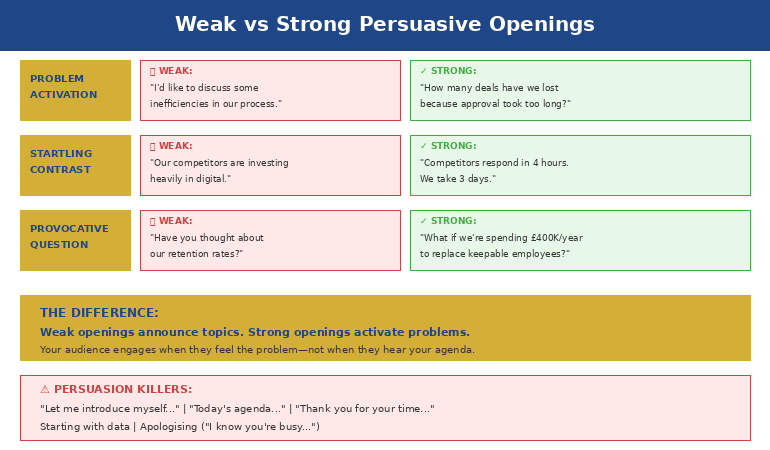
Three Persuasive Opening Techniques
1. The Problem Activation
Start with a problem your audience already feels—not one you need to convince them exists.
Weak: “I’d like to discuss some inefficiencies in our approval process.”
Strong: “How many deals have we lost because approval took too long?”
The weak version announces a topic. The strong version activates a frustration they’ve already experienced. Now they want to hear your solution.
2. The Startling Contrast
Juxtapose where they are with where they could be.
Weak: “Our competitors are investing heavily in digital transformation.”
Strong: “Our competitors respond to customer inquiries in 4 hours. We take 3 days. That gap is costing us market share every week.”
The contrast creates urgency. The specificity makes it real.
3. The Provocative Question
Ask something they can’t ignore.
Weak: “Have you thought about our retention rates?”
Strong: “What if I told you we’re spending £400,000 a year to replace employees we could have kept?”
The question engages their mind. The specific number demands attention.
These techniques are part of a broader framework for persuasive presentations that work at every level.
What to Avoid in Persuasive Openings
The most common persuasion-killers I’ve seen in 25 years:
- “Let me introduce myself…” — They don’t care about you yet. Make them care about the problem first.
- “Today’s agenda covers…” — Agendas are administrative, not persuasive. Save them for after you’ve hooked attention.
- “Thank you for your time…” — Gratitude is fine, but it signals you’re about to take, not give.
- Starting with data — Numbers without context invite analysis, not agreement. Establish why the numbers matter first.
- Apologising — “I know you’re busy” or “This might be boring” primes them to disengage.
Every one of these openings puts the focus on you or on neutral information. Persuasive openings put the focus on a problem the audience cares about solving.
🏆 Master Executive Persuasion
The Executive Buy-In Presentation System teaches the complete psychology of persuading senior leadership—from opening frames to closing techniques that get yes.
Frequently Asked Questions
Why are the first 10 seconds so important for persuasion?
Your audience decides in the first 10 seconds whether to engage or resist. Open with data, and they’re already forming counterarguments. Open by activating a problem they feel, and they’re primed to hear your solution. You’re not just starting—you’re setting the psychological frame for everything that follows. More techniques in our persuasive presentations guide.
What’s the best way to open a persuasive presentation?
Start with a problem your audience already feels, not with your solution. “What would it mean if you could cut approval time in half?” activates desire before resistance. Then your recommendation becomes the answer to their question, not an idea they need to evaluate.
Should I start a persuasive presentation with data or story?
Neither—start with a question or statement that activates a felt problem. Data invites analysis; stories take time to land. A sharp question that hits an existing pain point creates immediate engagement. Save data and stories for after you’ve captured attention. See our full persuasive presentations framework for sequencing.
📥 Free Download: 7 Presentation Frameworks
Get structured structures for persuasive presentations—including opening frameworks that capture attention and prime agreement.
Related: Persuasive Presentations: How to Change Minds Without Manipulation
Mary Beth Hazeldine spent 25 years at JPMorgan, PwC, RBS, and Commerzbank. She’s a clinical hypnotherapist and MD of Winning Presentations.