

Quick Answer: A stakeholder buy-in presentation course worth the investment teaches three things: how to diagnose the real decision-blockers, how to structure a presentation around those blockers rather than the proposal, and how to earn commitment without needing approval in the room. The Executive Buy-In Presentation System (£499) is the structured self-paced programme covering this material. Most alternatives teach generic influence techniques; few teach the specific presentation mechanics that move senior stakeholder decisions.
JUMP TO:
Tomás had been trying to get cross-functional approval for a supply chain redesign for eight months. He had presented four times — to the executive committee, twice to operations, and once to a joint session of finance and procurement. Each time, the meeting ended with “interesting, let us think about it.” The proposal died quietly during the fifth attempt at scheduling.
The post-mortem was telling. Tomás had not failed to present. The slides were clean. The analysis was sound. The business case was defensible. What he had failed to do was diagnose why the senior stakeholders he needed were not actually making the decision. Three of the five were pattern-matching to a failed 2019 initiative. One was worried about losing headcount reporting lines. One simply did not engage because the finance person in the room had not signalled support. Tomás had spent eight months presenting the proposal to a decision that was never going to be made on proposal quality.
This is the gap that most stakeholder buy-in presentation courses do not address. Generic influence training teaches vocabulary and rhetorical technique. What Tomás needed — and what actually moves senior stakeholder decisions — is a structural discipline: diagnose the blockers, map the dependencies, and build the presentation around the specific decision mechanics rather than the proposal itself.
If this is the problem you are solving
The Executive Buy-In Presentation System is the structured self-paced programme for executives preparing high-stakes stakeholder presentations. Enrolment is open.
Why stakeholder buy-in usually fails
Stakeholder buy-in is not primarily a persuasion problem. It is a diagnostic problem. Most presentations that fail to earn buy-in fail because the presenter is solving a problem the stakeholders do not have — at least not in the form presented. Three patterns recur.
First, the presenter has not identified who actually makes the decision. In senior stakeholder groups, decision authority is often distributed or informal. The person nominally responsible often defers to the person whose area is most affected, or the person whose credibility is highest on the specific topic. Presenting to the whole group without understanding this structure means nobody feels addressed.
Second, the presenter treats objections as information deficits. “Once they see the data, they will agree” rarely holds. Objections usually reflect risk positioning, political context, or pattern-matching to prior experience — not missing information. Adding more data to the deck does not address any of these.
Third, the presentation tries to earn commitment in the room. Senior stakeholders rarely commit live. They commit through a sequence: understanding, informal signalling to peers, a chance to surface objections privately, and finally a structured decision moment. A single presentation that tries to collapse this sequence into forty-five minutes almost always fails.
A stakeholder buy-in presentation course that does not teach diagnosis of these three failures is teaching rhetoric, not buy-in.
What a real buy-in course should teach
The material that actually changes presentation outcomes covers four areas:
Stakeholder mapping. Who makes the decision, who influences the decision, who can veto the decision, who needs to be carried but not persuaded. Most presenters can name the attendees. Few can map the dynamics. The course should provide a concrete, repeatable method for mapping — not a general discussion.
Blocker diagnosis. For each stakeholder, what is the actual objection underneath the surface question? Is it risk appetite, political exposure, pattern-matching, or genuine technical disagreement? Each of these has a different response. Conflating them produces generic responses that work on none.
Presentation structuring around the blockers. Once the blockers are mapped, the presentation is built to address them in sequence. The deck structure is not generic — it is shaped by the specific blocker configuration of the specific room. A strong course teaches this as a repeatable method, not as a style exercise.
The sequencing of decision moments. Almost no significant stakeholder decision is made in a single meeting. The course should teach how to design the sequence — pre-meetings, informal soundings, structured objection surfacing, the decision meeting itself, and the follow-up that secures commitment. A course that focuses only on the main meeting teaches only a fraction of the skill.

THE EXECUTIVE BUY-IN PRESENTATION SYSTEM — £499
Stop losing eight months on initiatives that die in the buy-in phase
The Executive Buy-In Presentation System is a structured, self-paced programme that covers stakeholder mapping, blocker diagnosis, presentation structuring, and decision sequencing — the four disciplines that move senior stakeholder decisions. Optional live coaching sessions (fully recorded for watch-back). £499 per seat. Enrolment is open — join at your own pace.
Designed for executives preparing multi-stakeholder, multi-meeting decision sequences.
What to avoid in a course
The market for presentation training is crowded. Not all of it is useful for the specific problem of stakeholder buy-in at senior levels. Four patterns to watch for.
Generic communication skills. If the course teaches “the power of storytelling”, “executive presence”, or “how to structure a great talk”, that is general presentation skills training — worth having, but not the same skill as buy-in. The diagnostic and sequencing work is distinct.
Rhetorical technique over structural method. Courses that focus heavily on vocabulary, phrasing, and delivery polish often skip the strategic work. Better delivery of the wrong presentation does not change the outcome. The course should spend at least as much time on what to present as on how to present it.
Motivational content. If a significant portion of the course is devoted to confidence, mindset, or identity work, you are probably buying a different product than the one you need. That material is valuable for people whose challenge is presentation anxiety. For people whose challenge is winning senior stakeholder approval, it is mostly filler.
Case studies without a transferable method. Case studies are useful illustration. They are not a substitute for method. A course should leave you with a repeatable structure you can apply to your next presentation — not a library of examples from other people’s industries.
Related: the stakeholder alignment workshop framework covers the pre-meeting discipline that most courses overlook entirely.
The Executive Buy-In Presentation System
The Executive Buy-In Presentation System is a structured, self-paced programme on the Maven platform (£499 per seat). It runs as a defined curriculum across eight modules, with optional live coaching sessions that are fully recorded for watch-back. Enrolment is continuous — new cohorts open monthly, participants join at their own pace.
The programme is built around the four-pillar structure: stakeholder mapping, blocker diagnosis, presentation structuring, and decision sequencing. Each pillar is taught as a repeatable method with worked examples from real executive decisions, followed by applied exercises on a presentation the participant is actively preparing.
The distinguishing feature of the programme is the applied element. Participants bring an actual upcoming high-stakes presentation. The programme is structured so the stakeholder map, blocker diagnosis, presentation structure, and decision sequence are built for that specific presentation during the programme. By completion, the participant has not only learned the method — they have applied it to a real decision. For most participants, that presentation is the one that justifies the programme cost by itself.
The optional live coaching sessions are twice during the cohort. They are optional and fully recorded. Participants who cannot attend live watch back and still get the full content. This makes the programme genuinely self-paced — no mandatory attendance.
Who is this course for
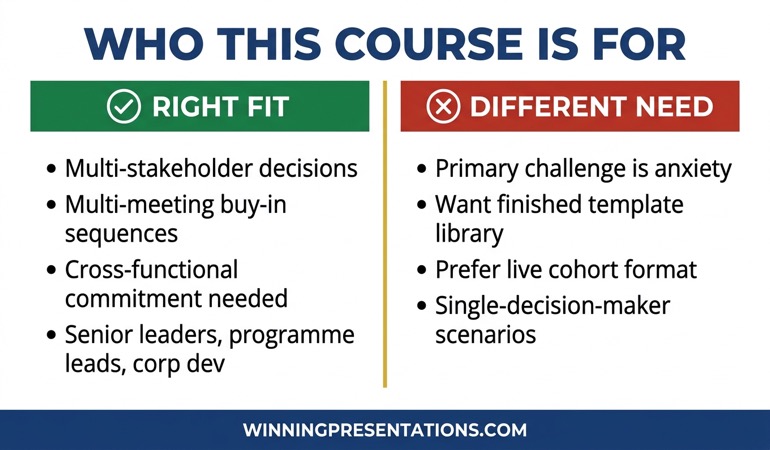
The Executive Buy-In Presentation System is designed for a specific profile. It is most useful for:
- Senior leaders and directors who regularly present to multi-stakeholder groups where decisions are distributed across several senior people.
- Programme and change leads who need cross-functional commitment for initiatives with significant resource implications.
- Corporate development and strategy executives preparing investment committee or board approval presentations.
- Technology and digital leaders pitching transformation initiatives to business-side stakeholders who evaluate the proposal on commercial rather than technical criteria.
- Internal consultants presenting recommendations to executive sponsors whose commitment determines whether the work gets implemented.
The common thread is multi-stakeholder, multi-meeting decisions where the presentation itself is only one component of the buy-in process. For single-decision-maker presentations, the material is still relevant but more than you need — simpler approaches apply. For genuinely committee-driven decisions where no individual stakeholder dominates, this is the right programme.
If you are dealing primarily with a single risk-averse decision-maker, the risk-averse CEO presentation framework covers that one-to-one dynamic. And if your challenge is specifically the objection-handling phase, the Q&A objection handling framework is the right starting point.
Who it is not for
Honest pre-qualification prevents mismatched expectations. The programme is not the right fit for:
People whose primary challenge is presentation anxiety. If the reason stakeholder buy-in feels difficult is that presenting itself feels difficult, the structural work in this programme will be useful but incomplete. The foundation needed is presentation confidence first.
People looking for a template library. The programme teaches a method, not a set of templates. Participants who want to download finished slide decks and reuse them will find the Executive Slide System a better fit for that need.
People who prefer pure live instruction. The programme is self-paced. Live coaching exists but is optional. Participants who specifically want a live, cohort-driven experience with real-time group work will find the self-paced structure less engaging than a fully live programme would be.
People preparing a single presentation with no cross-functional complexity. If the buy-in problem is genuinely one presentation to one decision-maker, a simpler approach applies. The programme’s complexity is structured for multi-stakeholder, multi-meeting decisions.
Related: the Executive Slide System is a lower-cost template library for executives whose challenge is building individual decks quickly rather than navigating complex stakeholder dynamics.
MULTI-STAKEHOLDER DECISIONS, SOLVED STRUCTURALLY
Applied method for the initiatives that actually need to land
The Executive Buy-In Presentation System — eight modules, optional recorded coaching, applied work on your actual upcoming presentation. Self-paced. £499 per seat. Enrolment is open — join at your own pace.
Frequently Asked Questions
Is this programme live or self-paced?
Self-paced. Optional live coaching sessions are scheduled during the cohort, but they are fully recorded for watch-back. Participants who cannot attend live receive the full content. New cohorts open regularly — you join when ready and progress at your own pace.
What is the time commitment?
Most participants complete the programme in four to six weeks, working approximately two to four hours per week. The applied element — working on your own upcoming presentation — scales with how significant the presentation is. Some participants finish faster if their upcoming decision has a hard deadline. Others take longer if no immediate presentation is in play.
How is this different from other presentation courses?
Most presentation courses teach how to deliver content. This programme teaches how to diagnose the decision mechanics and structure a presentation around them. The focus is on multi-stakeholder, multi-meeting scenarios where delivery alone does not earn commitment. If your challenge is public-speaking confidence or slide design, a different course is the right fit.
Can multiple people from my organisation enrol together?
Yes. For organisations sending multiple participants, bring real, shared upcoming presentations. The programme’s applied work benefits from having colleagues who can cross-review each other’s stakeholder maps and decision sequences. Reach out directly for group enrolment arrangements.
Is there a guarantee?
The programme includes a standard Maven refund policy. Participants who decide within the first two weeks that the programme is not the right fit can request a refund. The programme is not a magic formula — it is a structured method. The refund policy exists because fit matters, and fit is clearest after a few modules of engagement.
Weekly frameworks for executive presentation moments
The Winning Edge is a weekly newsletter on the structural mechanics of high-stakes presentations. It includes frameworks that support the Executive Buy-In material but in concise weekly form.
Partner post: For the related skill of reporting on mixed results to senior stakeholders, the investor update deck structure framework covers the recurring-meeting discipline that underlies buy-in retention.
Your next step: If you have a specific presentation coming up where the buy-in matters, the fastest diagnostic is to list every stakeholder who will be in the room and write one sentence next to each: “what would make them say no.” If you cannot write that sentence for each name, the diagnosis is where the work needs to start.
About the Author
Mary Beth Hazeldine is Owner & Managing Director of Winning Presentations Ltd. With 24 years of corporate banking experience at JPMorgan Chase, PwC, Royal Bank of Scotland, and Commerzbank, she advises executives across financial services, healthcare, technology, and government on structuring presentations for high-stakes funding rounds and approvals.