
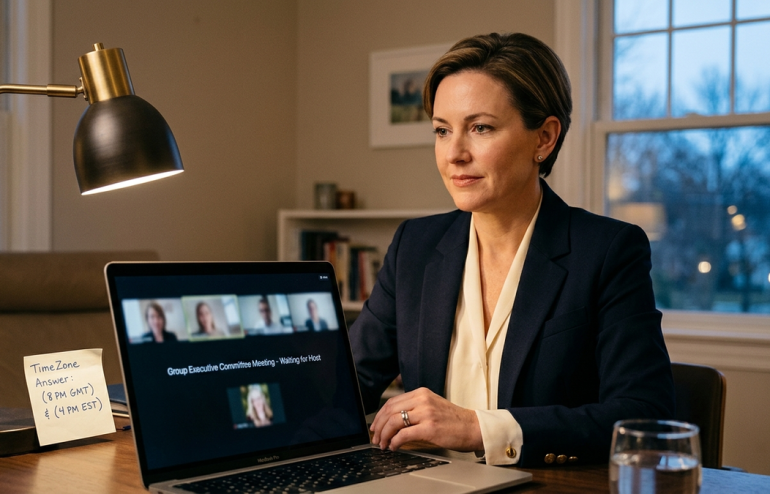
Quick answer: The board member who asks “why are you joining at 11pm?” in a cross-timezone executive call is not making polite conversation. The question is a credibility test the senior leader needs to answer in two sentences without apology, without oversharing, and without inviting the committee’s attention to drift toward your personal logistics rather than the substance you joined the call to deliver. Junior presenters apologise (“sorry it’s late on my side, the headquarters meeting time slot was the only one that worked for the chair”), overshare (“the kids are asleep, I’ve been up since 6am for the European book, this is the third late call this week”), or under-explain (“timezones, what can you do”). Senior presenters give the committee a two-sentence answer that confirms competence, signals that the timezone decision was deliberate not unfortunate, and returns the room to the substantive agenda inside fifteen seconds. The answer is rehearsed before the call. The committee’s remaining engagement budget for the rest of the session depends on which version they hear.
JUMP TO:
- Why the “why 11pm” question is a credibility test, not casual interest
- The three failure modes of the unprepared answer
- The two-sentence answer senior leaders give
- What the committee thinks about you after each answer pattern
- The five-minute rehearsal before the late call
- One thing to do before the next late-night cross-timezone call
- Frequently asked questions
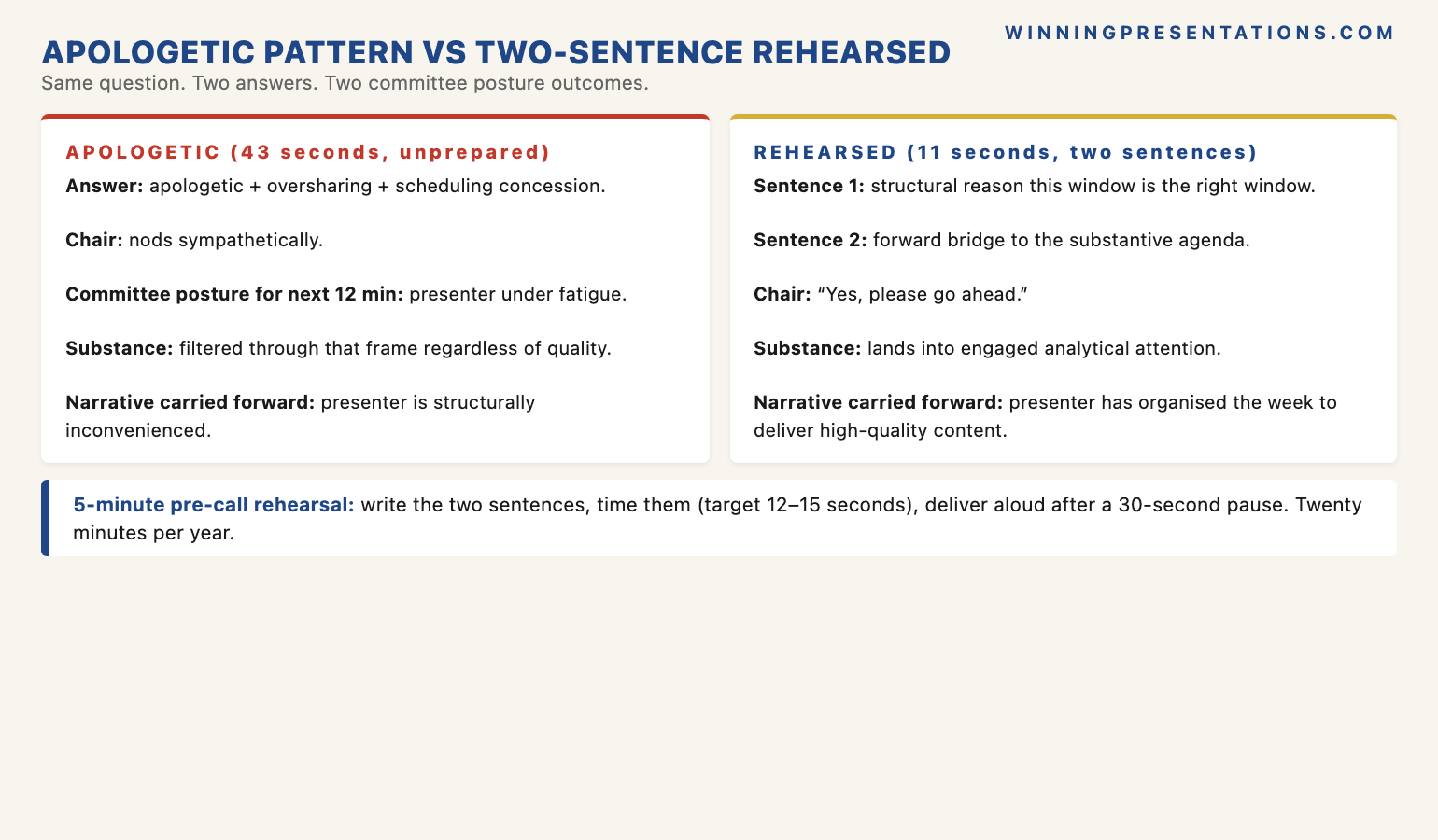
In February 2023 I observed a senior managing director at an Asia-Pacific arm of a global insurance group join the group executive committee meeting at 23:00 Singapore Standard Time. The meeting was the monthly group exec convened from headquarters in Zurich at 16:00 Central European Time. The agenda item the Singapore MD was on was the Asia-Pacific Q4 outlook, the third item on a five-item agenda, and her time slot was budgeted at twelve minutes. The chair welcomed her into the call at the start of her slot and, before she had spoken to the agenda item, said simply: “Before you start — thanks for joining us so late on your side. Why eleven on your end? Is there a way we should be doing this differently?” The MD’s answer was unrehearsed. She said: “Oh, thank you, no, it’s genuinely fine, this is the time slot that worked for the European agenda, it’s actually not that late, well, it’s a bit late but it’s manageable, I’ve had a bit of a long day with the regional reviews but I’m good to present.” Forty-three seconds. By the end of those forty-three seconds the chair had nodded sympathetically, the CFO had glanced at his watch, two of the other committee members had given the polite nod of mild concern, and the room’s attention for the next twelve minutes was filtered through a frame of “the Singapore MD is presenting under fatigue” rather than “the Singapore MD is presenting the Asia-Pacific Q4 outlook.” The substance of her twelve minutes was strong. The committee’s engagement with that substance was not.
(This article was created with AI assistance; all stories and insights are based on 35 years of real client work.)
This piece walks through why the apparently casual question “why are you joining at 11pm?” in a cross-timezone executive call is structurally a credibility test, how the three unprepared answer patterns each undercut the presenter in a different way, and the two-sentence answer senior leaders prepare in advance to land the question cleanly inside fifteen seconds and return the room to the substantive agenda. The two-sentence answer is rehearsed before the call. It carries no apology, no oversharing, no under-explanation. It confirms competence, signals deliberate choice rather than passive acceptance, and lets the committee’s remaining engagement budget land on the substance the presenter joined the call to deliver. The question will come; the answer is what changes.
Before your next late-night cross-timezone call, five minutes of rehearsal on the timezone answer is worth running.
The Virtual Presentation Quick-Start Checklist includes the late-call timezone answer rehearsal — the two-sentence script senior leaders prepare in advance so the question doesn’t derail the substance. Free download, no email gate.
Why the “why 11pm” question is a credibility test, not casual interest
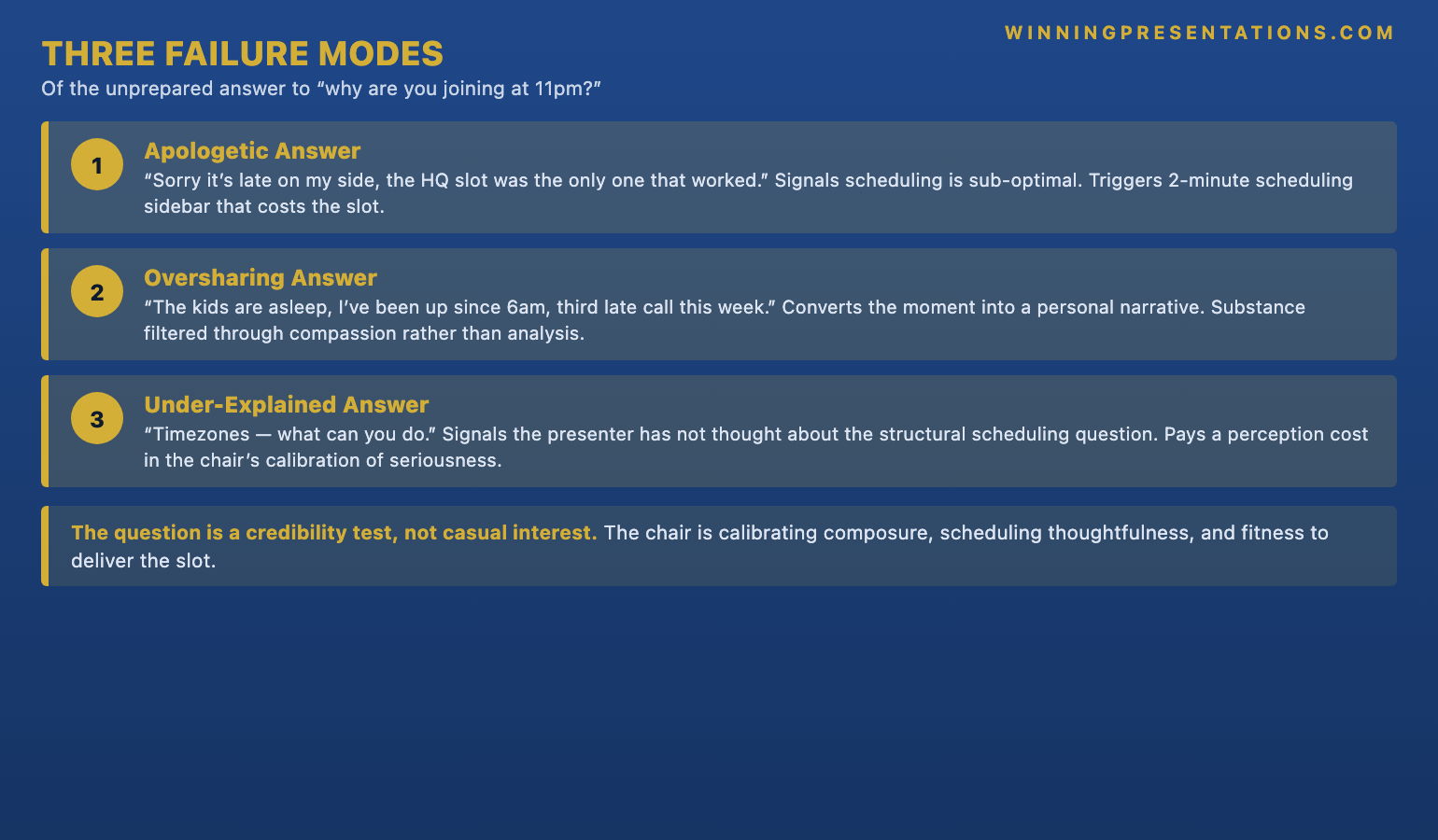
The chair’s question reads as casual courtesy on the surface and the presenter’s first instinct is to treat it as such. Structurally, the question is doing something else. The committee chair, faced with a presenter joining at an obviously inconvenient hour, has three things to calibrate quickly before the substantive slot begins. First: is the presenter going to be functionally diminished by fatigue in a way that affects how seriously the committee should engage with what they are about to hear. Second: is the timezone arrangement a one-off necessity or a sign of a structural scheduling problem the committee chair should fix at the group level. Third: does the presenter have the composure to handle an off-agenda question gracefully under the visible pressure of a 23:00 start. The two-sentence answer the presenter gives in the first ten seconds is the calibrating input on all three of those questions.
The committee chair is not trying to derail the presenter. The chair is doing the work a chair is supposed to do at the top of an agenda item, which is to ensure the committee is set up to engage productively with the substance about to be presented. If the presenter signals fatigue, the committee will engage less seriously with the substance because the substance is being delivered by a presenter who has just confirmed they are functionally diminished. If the presenter signals that the scheduling is a structural problem, the committee will spend the first part of the slot discussing the scheduling rather than the substance. If the presenter signals composure and deliberate choice, the committee will engage with the substance from the first sentence. The question is the calibration moment. The answer is the calibration input. The presenter who treats it as casual courtesy gives a casual answer and accidentally signals one of the first two patterns rather than the third.
The Singapore MD in February 2023 was not less competent than her Zurich-based peers. Her Asia-Pacific Q4 outlook was sound. The conditioning that landed on the committee’s engagement with her twelve minutes was the perception frame her unrehearsed forty-three-second answer installed: “presenting under fatigue, scheduling is sub-optimal, composure is uncertain.” The committee then read her twelve minutes through that frame. The CFO’s glance at his watch was not impatience with her substance; it was the chair’s anxiety transferring to him because the room had collectively absorbed the signal that the presenter was tired and was now spending the slot watching for evidence of that fatigue. The “you look tired” comment and how senior presenters respond to personal observations mid-presentation covers the closely related dynamic when the same calibration test arrives as a personal-observation comment rather than a question.
The three failure modes of the unprepared answer
The unprepared answer fails in one of three patterns. The first pattern is the apologetic answer: “Sorry it’s late on my side, the headquarters meeting time slot was the only one that worked for the chair, hopefully we can find something earlier next time.” The apology signals that the timezone decision was a sub-optimal compromise the presenter is conceding to. The committee reads it as a sign that the scheduling is a structural problem and starts to feel responsible for fixing it. The chair, who probably approved the scheduling, feels mildly implicated. The next two minutes go to a scheduling-discussion sidebar that has nothing to do with the substance the presenter joined the call to deliver. The slot loses a sixth of its time before the substantive content begins.
The second pattern is the oversharing answer: “The kids are asleep, I’ve been up since 6am for the European review, this is the third late call this week, but I’m good to present.” The oversharing converts the timezone moment into a personal-narrative moment. The committee absorbs the personal narrative and the personal narrative becomes the listening frame for the rest of the slot. The committee is not reading the substance; the committee is reading the substance underneath an awareness that the presenter has been up for seventeen hours, has spent the day on a different geography’s book, and has had a difficult week. The substance is filtered through compassion rather than through analytical engagement. Compassion is the wrong frame for an executive committee meeting. The presenter has invited it inadvertently by personalising the timezone question.
The third pattern is the under-explained answer: “Timezones, what can you do.” The shrug answer is the opposite failure mode. It signals to the chair that the presenter does not take the question seriously, which signals that the presenter has not thought about the structural scheduling implications the chair was probing on. The chair, who was looking for a calibrating input on whether the timezone arrangement is sustainable, gets no calibrating input and is left to fill in the blank. The chair’s default fill-in is “the presenter has not thought about it,” which translates into the committee’s reading of the substance: a presenter who has not thought about the meeting logistics is the kind of presenter who may not have thought about the substantive issues either. The shrug answer escapes the apology trap and the oversharing trap, but it pays a different perception cost.
Stop guessing what the chair’s seemingly casual question is actually testing.
The Executive Q&A Handling System is the structured framework senior leaders use to handle the questions that look casual on the surface but carry credibility-testing weight underneath — the late-night timezone question, the “you look tired” comment, the “walk me through line 47” deep-dive, the “just give me the facts” instruction, the “what does your boss think” political probe. Designed for senior professionals presenting to boards, investment committees, executive committees, and parent-group oversight bodies where the apparently casual question is rarely casual.
- Response frameworks for the most common categories of credibility-testing questions senior executives face
- The two-sentence answer structure that lands a calibration moment cleanly inside fifteen seconds
- Bridge statements that return the room to the substantive agenda without abandoning the question
- Red-line discipline — what not to say when the question is probing personal logistics, political alignment, or operational vulnerability
- Instant download, lifetime access — usable across every committee cycle, not just the one in front of you now — £39
The two-sentence answer senior leaders give
The two-sentence answer is rehearsed in advance and runs in roughly twelve seconds. Sentence one names the timezone arrangement as a deliberate choice with a structural reason rather than an unfortunate compromise. Sentence two returns the room to the substantive agenda with a forward bridge that re-anchors the slot to the content the presenter joined the call to deliver. The structure is fixed; the specific wording adapts to the presenter’s actual situation.
The Singapore MD in February 2023, with the rehearsed answer, would have said: “The 23:00 Singapore slot is the one that works for the Asia-Pacific exec rhythm — the regional reviews finish in the late afternoon and this is the window where I can come in with the full quarter’s data fresh. Happy to walk straight into the Q4 outlook if the chair is comfortable.” Two sentences. Twenty-eight words. Eleven seconds. The first sentence reframes the timezone decision from passive acceptance into deliberate choice, with a substantive operational reason (regional reviews finish in the late afternoon, this window has the full quarter’s data fresh). The second sentence offers the chair the explicit handoff back to the agenda. The chair, having received the calibrating input that signals competence, deliberate choice, and composure, will almost always say “Yes, please go ahead,” and the slot begins on the substantive agenda from second twelve.
The structural reason in sentence one matters because it converts the timezone arrangement from a complaint about timezones into a feature of the operating model. The chair hears that the presenter has thought about which window produces the best-prepared presentation and has chosen the late-evening window deliberately because it delivers higher-quality content than an earlier window would. The committee’s reading of the rest of the slot is now anchored to “this presenter has organised their week around delivering the highest-quality content to this committee,” which is the perception frame that supports engaged listening. The same Asia-Pacific Q4 outlook lands into a committee that is paying attention to the substance because the timezone question was handled in a way that earned the attention. The bridging-versus-blocking discipline in executive Q&A handling covers the broader structural work of returning the room to the substantive agenda after a credibility-testing question.
What the committee thinks about you after each answer pattern
The four answers — apologetic, oversharing, under-explained, two-sentence rehearsed — produce four different post-meeting narratives the committee carries into subsequent quarters. The apologetic answer produces the narrative that the presenter is on the wrong end of a scheduling decision the group needs to fix. The chief of staff will likely raise the scheduling at the next executive operating committee, which gets the presenter a slightly more convenient slot but at the cost of the chair’s perception that the presenter is structurally inconvenienced. The oversharing answer produces the narrative that the presenter is overworked, which translates into the chair quietly downgrading the substantive engagement the presenter is offered at subsequent committee meetings — not because the presenter is being protected from work, but because the chair has read fatigue as a signal that the presenter does not have capacity for additional ask. Both narratives are subtle. Both compound across quarterly cycles.
The under-explained answer produces the narrative that the presenter does not engage thoughtfully with off-agenda questions, which the chair will note as a small reservation about the presenter’s composure under broader unstructured discussion. The narrative is mild but cumulative; over four or five committee cycles it builds into a perception that the presenter is good at delivering prepared content but less good at handling the unscripted moments. The rehearsed two-sentence answer produces the narrative that the presenter handles edge moments with composure, has structured their operating model deliberately, and is worth engaging substantively with on the agenda items they bring. The four narratives are not symmetrical in their consequences. The two-sentence answer is the only one that compounds positively across quarters.
The five-minute rehearsal before the late call
The pre-call rehearsal takes five minutes the day of the call. Write down the two-sentence answer in advance. Sentence one names the structural reason this timezone window is the right window for the substance. Sentence two offers the chair the explicit handoff back to the agenda. Read both sentences aloud once. Time them with the phone stopwatch — the target is twelve to fifteen seconds total. If the two sentences run longer than fifteen seconds, the structural reason in sentence one is probably over-explaining; tighten it. If they run shorter than ten seconds, the answer may feel curt to the chair; add three or four words of structural reasoning to sentence one.
Then sit in silence for a thirty-second pause. Imagine the chair asking the question. Deliver the two sentences aloud as if to the chair, with the composure you would want the committee to hear. The deliberate pause is the moment the answer becomes available in the response layer rather than requiring conscious recall during the actual call — the same structural reason rehearsal is the cost of having the recovery script available when a Zoom freeze hits, which the parallel three-phrase Zoom freeze recovery script senior leaders use describes. The principle is the same: rehearse the response when there is no pressure, so the response is available under pressure. The five-minute cost the day of the call is the difference between landing the timezone question in fifteen seconds and losing three or four minutes of the substantive slot to an unprepared answer the committee then carries through the rest of the call.
Why the rehearsed answer matters more for senior presenters than for junior ones
A junior presenter joining a senior committee at 23:00 is given a generous allowance on the timezone question. The committee notes the awkwardness, mentally adjusts, and engages with the substance anyway. The same casual question to a senior MD is calibrated differently. The committee’s expectation of a senior operator is that they have organised their week to deliver high-quality content to the committee and that the timezone arrangement is a deliberate choice rather than a scheduling accident. A senior MD whose answer signals scheduling-accident, fatigue, or under-thought engagement is paying a perception cost that a junior presenter would not pay. The same question is structurally testing different things at different seniority levels, and the cost of the wrong answer is asymmetric upward.
The cost compounds across quarterly cycles in the same way the perception cost of the British-understatement opener compounds, and in the same way the perception cost of the headline-number remote townhall opener compounds. Four quarters of unrehearsed timezone-question answers build a committee-level narrative about the presenter’s composure and operational thoughtfulness that the substance the presenter is delivering cannot fully reverse. The five minutes of pre-call rehearsal per quarter is the cheapest available insurance against the cumulative narrative. Twenty minutes per year. The structural cost is small. The perception cost of skipping it is significant.
One thing to do before the next late-night cross-timezone call
Five minutes before the next late-night cross-timezone call, write the two-sentence answer to the “why are you joining at this hour” question. Sentence one: the deliberate structural reason this timezone window is the right window for the substance you are delivering. Sentence two: the forward bridge handing back to the chair on the substantive agenda. Read both sentences aloud once. Time them — aim for twelve to fifteen seconds. Imagine the chair asking the question and deliver the two sentences as if to the chair. Walk into the call with the answer available in the response layer. When the question comes, deliver it cleanly in fifteen seconds and return the room to the substantive agenda. The committee will register your composure. The substance you joined the call to deliver will land into engaged attention.
Frequently asked questions
What if I genuinely am tired — isn’t the rehearsed answer a kind of performance?
The rehearsed answer is not a performance of being not-tired; it is a structural framing of why the timezone arrangement is the right one for the substance. You can be tired and still deliver the two-sentence answer truthfully. The committee’s question is not asking how you feel; the committee’s question is asking whether the scheduling is structurally sound and whether you are composed enough to handle the slot. The rehearsed answer addresses both without lying about your physical state. If you are too tired to present the slot well, the right move is not to take the slot — reschedule it. If you are taking the slot, the right move is to give the committee the structural answer that lets them engage with the substance rather than with your fatigue. The two are not in conflict.
What if the chair persists with follow-up questions about the scheduling?
This is rare when sentence one of the rehearsed answer is structurally substantive, because the structural reason closes off the easiest follow-up routes. The chair’s typical follow-up to an apologetic answer is “Is there a better time we should be using?” The chair’s typical follow-up to a structurally substantive answer is “Right, makes sense — over to you on the Q4 outlook.” If the chair does persist (“Are we asking too much of you with this slot?”), the right response is the second-line bridge: “The Asia-Pacific operating rhythm makes this window the right one for the next two or three quarters — happy to revisit if anything changes. Let me move to the Q4 outlook.” The structural reason in sentence one gives you the material to deflect the follow-up without conceding the scheduling discussion.
Doesn’t the chair already know why I’m joining at 11pm? Isn’t the question rhetorical?
The chair knows the timezones; the chair does not know how you have organised your week around the slot. The question is testing your engagement with the structural choice, not asking you to explain the geography. A rhetorical question would be answered with a rhetorical response — a smile, a small acknowledgement, a return to the agenda. The chair’s question is rarely rhetorical at senior level; it is genuinely calibrating something. The right reading is that the question is structurally testing your composure and your operating-model thoughtfulness, and the right response is the two-sentence rehearsed answer rather than a smiling deflection.
Does the rehearsed answer work the same way for early-morning calls in the other direction?
Yes, with sentence one adapted. A 06:00 start call from London into a Tokyo or Sydney committee will provoke an equivalent question (“thanks for joining at that hour”) and benefits from the same two-sentence structure. Sentence one: “The early window works well because it’s the start of the European day — the overnight Asia-Pacific operational data is available and I can come in with the full update.” Sentence two: the forward bridge back to the agenda. The structural pattern is the same: name the timezone arrangement as a deliberate choice with a substantive operational reason, then return the room to the substance. The principle generalises across any cross-timezone slot where the presenter is on the unconventional end of the clock.
The Winning Edge — weekly newsletter
The Winning Edge is a weekly (Thursday) newsletter for senior professionals who present at the executive level. One short email a week, focused on the structural moves that separate the credibility-testing moments that get handled cleanly in fifteen seconds from the ones that take three or four minutes of the substantive slot and compound across quarters. Subscribe to The Winning Edge →
For the broader picture across slides, Q&A handling, storytelling, confidence, and delivery, the Complete Presenter library — seven products in one bundle is the resource most senior professionals find useful as a single library — £99 for everything, lifetime access.
About the author
Mary Beth Hazeldine is Owner & Managing Director of Winning Presentations Ltd. With 24 years of corporate banking experience at JPMorgan Chase, PwC, Royal Bank of Scotland, and Commerzbank, she advises senior professionals across financial services, insurance, consulting, and technology on the structural Q&A discipline that separates the credibility-testing moments that get handled cleanly in fifteen seconds from the ones that take three or four minutes of the substantive slot.