

Quick answer: The first board meeting after a VP promotion is won or lost in the opening five minutes, not the closing argument. Three structural moves separate the newly promoted VPs who land their first board meeting from the ones who merely survive it: a recommendation that arrives before any context, a chair-facing acknowledgement that names the seniority change explicitly without dwelling on it, and a pre-meeting one-pager circulated to the chair’s office forty-eight hours before. The newly promoted VP who tries to “earn” the room by walking through their analysis loses the room within four slides; the one who treats the meeting as a decision-needed-now conversation is read as ready. None of this requires more confidence. It requires a leadership presentation structure built for a board audience rather than for the operating committee the new VP just left.
JUMP TO:
In 2014 I coached a newly promoted VP at a publicly-listed industrials manufacturer through her first board meeting. She had been promoted in March after eight strong years on the operating side, was scheduled to present a strategic capital allocation proposal in May, and had spent six weeks building a meticulously well-researched forty-three-slide deck. She walked into the room with the deck under her arm at quarter past nine, opened with a fourteen-minute industry context section that her boss had told her she “had to” include for the new directors, and watched the chair quietly close the deck folder on slide nine and lean back in his chair. She finished the presentation. The discussion that followed was polite. The capital allocation was deferred to the next quarter for “further analysis”. The vote that mattered — the chair’s read of whether the newly promoted VP was board-ready — had already happened by slide nine, and the rest of the meeting was a courtesy.
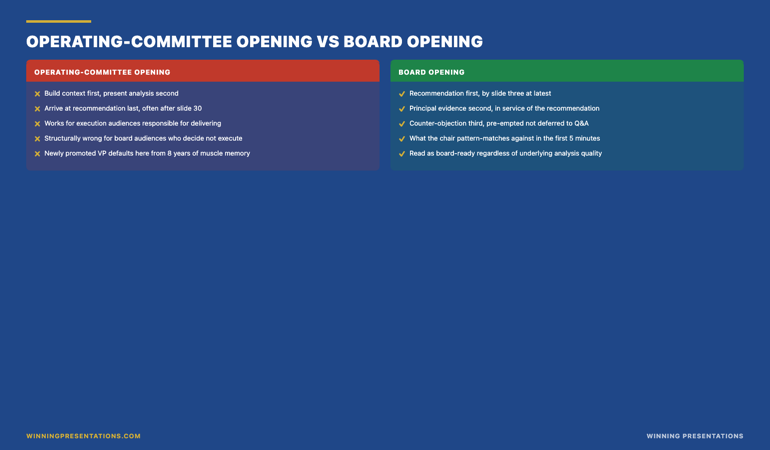
I have now worked with somewhere between forty and fifty newly promoted VPs going into their first board meeting across financial services, professional services, healthcare, and technology. The pattern is the same almost every time. The promotion is well-deserved. The technical content is strong. The deck is overprepared. The room is lost in the first five minutes because the leadership presentation structure that worked at the operating-committee level — build context, present analysis, arrive at recommendation — is structurally wrong for a board. The board does not want the journey. They want to know whether the new VP can carry a board-level conversation, and they are looking for that signal in the first five minutes, not in the closing summary slide.
(This article was created with AI assistance; all stories and insights are based on 35 years of real client work.)
The three newly promoted VPs I want to focus on in this article all presented to their respective boards within a single calendar year between 2015 and 2016. None of them named names; none of them knew each other. All three were technically strong, all three had been hand-picked by their respective chairs as future committee members, and all three were nervous in exactly the same structural way — not about the content, but about whether they would be seen as belonging in the room. The two who landed their first board meeting did the same three things in roughly the same sequence. The one who did not landed in exactly the position the first VP did in 2014: technically polished, structurally wrong, deferred for further analysis. The pattern is reliable enough now that I treat it as a near-checklist when I prepare any newly promoted VP for their first board appearance.
Walk into your first board meeting as a newly promoted VP prepared:
The Executive Buy-In Presentation System gives you 7 self-paced modules covering stakeholder analysis, case construction, and the presentation structures that hold up at board level. Monthly cohort enrolment, optional recorded Q&A calls, lifetime access to materials. Newly promoted VPs use it most often in the eight weeks before their first board appearance.
Why the first board meeting is decided in the first five minutes
A board is not an audience the same way an operating committee is. The board is a small group of senior people whose primary job in any given meeting is to make decisions on the matters in front of them and, secondarily, to maintain a continuous read on the people running the organisation. When a newly promoted VP appears for the first time, the second job becomes acute. Every director in the room is — consciously or not — running a pattern-match in the first five minutes against every previous newly promoted VP they have watched present at this level. Did they orient to the room as a board, or did they treat it as a larger operating committee? Did the opening arrive at a decision-needed-now framing, or was it a context-setting essay? Did the VP look at the chair when the chair was the one who needed convinced, or did they look at the room evenly as if everyone had equal weight? These reads happen quickly, they happen quietly, and they are very difficult to reverse once the early signal lands the wrong way.
The first five minutes do not need to be brilliant. They need to be structurally correct for the room. The opening that works for a board is not the opening that works for an operating committee, and the newly promoted VP who has spent eight years presenting successfully at the operating level has eight years of muscle memory pulling them toward the wrong opening. The corrective work is not about confidence and not about polish. It is about installing a different opening pattern fast enough that it survives the live moment in front of the board, where every nervous instinct will reach for the familiar operating-committee opening the VP has used hundreds of times before. The board reads the opening as the signal of whether the new VP understands the room. If the opening reaches for context, the read is “not yet”. If the opening leads with the recommendation, the read is “let’s see what they do with it”.
The reason this happens specifically to newly promoted VPs and not to long-tenured executives is that the operating committee promotion path rewards exactly the wrong opening pattern for board work. At the operating level, walking the room through context, building the analysis, and arriving at the recommendation last is structurally correct — the room needs to be brought along, because the room is partly responsible for executing whatever the recommendation turns out to be. At board level, the room does not execute. The room decides. And the room decides faster if the recommendation is on the table from the start, with the analysis serving the recommendation rather than building toward it. The newly promoted VP who has not made this switch is presenting in the structurally wrong direction for the room, and the chair can usually feel the structural mismatch within the first slide and a half.
The operating-committee trap newly promoted VPs walk into
The operating-committee trap is the most common structural mistake newly promoted VPs make in their first board meeting, and it is almost never caught in advance because the VP’s boss — usually the executive who promoted them — is themselves a successful product of the operating-committee path and tends to give “make sure you walk through the context” as advice, in good faith, in the weeks before the meeting. The advice is wrong for a board audience, but the advice-giver has been giving it for years to operating-level VPs and it has worked there. The new VP, deferring to a more senior person who they want to impress, builds the deck around the advice. The deck arrives at the recommendation on slide thirty-one of a forty-three-slide deck, the recommendation is well-argued, and the board has already mentally checked out by slide nine because the opening did not arrive at the question they were called into the room to decide on.
I worked with a newly promoted VP at a mid-sized European insurance group in 2015 who had been given exactly this advice by her promoting executive. She built a forty-eight-slide deck for her first board meeting. The deck arrived at the recommendation on slide thirty-four. She presented it competently and the recommendation was — not rejected — “noted for further discussion at the next quarterly”. She was devastated, because she knew the analysis was airtight. The post-meeting feedback from the chair, conveyed through the company secretary three weeks later, was almost word-for-word what the chair had said in 2014 to the first VP I mentioned: “Strong work. We would have benefited from seeing the recommendation earlier in the presentation.” It was the same structural mistake from a completely different sector, with the same outcome, given essentially identical feedback by an entirely separate chair. That is the moment I started treating the operating-committee trap as a teachable pattern rather than an individual coaching observation, because the structural shape of the failure is identical across people and sectors.
The two newly promoted VPs in 2016 who did not fall into the operating-committee trap had something the first two did not, and it was not personality and not seniority. It was a structural rule they had been given before the meeting that overrode the operating-committee advice they were also receiving. The rule was: recommendation by slide three, full stop, no exceptions, regardless of what your boss says about context. They had been given the rule by an external coach in one case and by a sympathetic non-executive director in the other, and in both cases the rule held under the live pressure of the meeting because it was specific, time-bounded, and testable. The recommendation arrived early. The chair leaned forward rather than back. The questions came in service of the recommendation rather than against it. The decision was made in the meeting. The pattern is reproducible, which is why the Executive Buy-In Presentation System builds the recommendation-first opening into module three rather than leaving it to the discretion of the presenter to figure out under pressure.
The three structural moves that separate ready from surviving
The first move is the recommendation-first opening already described. The deck must arrive at the recommendation by slide three at the latest, ideally by slide two. The recommendation must be a single line a director can repeat back without distortion: not “we should consider a multi-year approach to the capital allocation question, taking into account the various structural factors involved” but “We recommend approving the seventy-million pound allocation to Programme A over three years, beginning in Q3, with a stage gate at month nine.” The first version reads as analysis-in-progress. The second reads as a decision-needed-now. The board sees the difference inside fifteen seconds. The newly promoted VP who has been told to “build context first” by their boss has to find a structural way to honour that advice while still leading with the recommendation, and the simplest way is to compress the context into a one-line preamble that frames the recommendation rather than delaying it. “Following the strategic review committee’s work in March and the operating committee’s alignment in April, we recommend [decision].” That sentence does both jobs in one breath.
The second move is naming the seniority change at the start without dwelling on it. The board knows the VP is new in the role. The newly promoted VP often pretends, in the meeting, that they are not new — either out of nervousness or out of a misguided sense that acknowledging it would weaken their position. The opposite is true. A single sentence near the top of the meeting that names the seniority change explicitly — “This is my first board appearance in this role, so I want to be very direct in how I’ve structured the recommendation” — releases the board from having to wonder about it and signals self-awareness without weakness. The board hears it as evidence that the VP understands their own position in the room, which is itself a board-level skill. The VP who avoids the acknowledgement leaves the elephant on the table; the board notices and reads the avoidance as a small but real signal of unreadiness.
The third move is the chair-facing pattern of attention during the presentation. The newly promoted VP, trained at operating-committee level to look around the room evenly, has to learn that at board level the chair is the lever and the rest of the board is the field. The recommendation lands or fails primarily because the chair leans in or leans back. The VP who looks at the chair when delivering the recommendation, when answering the chair’s first question, and when offering the close gives the chair the room they need to decide. The VP who looks evenly around the room is being polite to the wrong audience. None of this means ignoring the other directors — they get full attention when they speak. It means recognising that the chair’s positioning is the strongest single signal of which way the meeting is going, and that the VP who is reading and responding to the chair’s positioning in real time has access to information the VP scanning the room does not.
Turn reluctant stakeholders into active advocates.
The Executive Buy-In Presentation System is a self-paced programme with 7 modules. Enrol with this month’s cohort, work through at your own pace — optional live Q&A calls are fully recorded. The module on the recommendation-first opening is the one most newly promoted VPs report changes their first board meeting. £499, lifetime access to materials.
- 7 modules of self-paced course content covering stakeholder analysis, case construction, and presentation structure
- Optional live Q&A / coaching calls, fully recorded — watch back anytime
- Monthly cohort enrolment — join the next cohort whenever suits you
- Lifetime access to all course materials, no deadlines
The forty-eight-hour chair pre-read most VPs do not know about
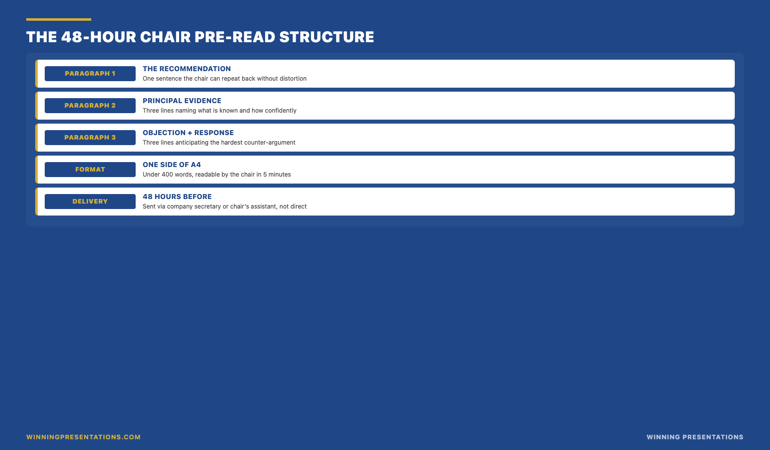
The single highest-leverage move available to a newly promoted VP before their first board meeting is the forty-eight-hour pre-read to the chair’s office. Most newly promoted VPs do not know this exists as an option because their boss has never offered it explicitly. The pattern is straightforward: a one-page summary of the recommendation, the principal evidence, and the principal objection-and-response, sent through the company secretary or the chair’s assistant approximately forty-eight hours before the board meeting. The chair reads it in the spare twenty minutes between other commitments the day before the meeting and walks into the room having already absorbed the structural shape of the recommendation. The meeting then becomes a conversation around the pre-read rather than a transmission from the VP to the room.
The pre-read does three things at once. It signals respect for the chair’s time. It pre-positions the recommendation so the meeting starts from a higher floor. And it gives the chair the chance to flag, privately, anything they want addressed differently in the meeting — a particular concern they want named, a particular director whose objection they want pre-empted, a specific framing of the recommendation that will land better with the wider room. The newly promoted VP who walks into their first board meeting with the chair already on-side because of a well-structured pre-read is in a structurally different position from the VP who walks in cold, regardless of how strong either presentation is. The pre-read does not replace the presentation. It primes the room before the presentation begins, which is the structural shape of every board meeting that goes well. See the Executive Buy-In Masterclass overview for the full pre-meeting protocol, and the broader catalogue of board-readiness assets at our services page.
The structural template for the pre-read is short: one paragraph stating the recommendation in a single sentence, one paragraph naming the principal evidence in three lines, one paragraph naming the principal objection and the principal response in three lines. Four hundred words at the absolute most. The whole document fits on one side of A4. The chair reads it in five minutes. The newly promoted VP who has never sent a chair pre-read before will worry that it presumes too much; in practice, every chair I have spoken to about this prefers to be sent the pre-read and to discard it unread if they choose, rather than to walk into a meeting cold. The presumption objection is almost always the VP projecting their own discomfort with the seniority change onto the chair, who has no such discomfort.
For newly promoted VPs who want the slide-level structure that supports the recommendation-first opening — the actual templates the board pre-read summarises — pair the Buy-In framework with the Executive Slide System (£39). It contains the 26 executive templates the recommendation-first opening uses, 93 AI prompts for structuring the case, and 16 scenario playbooks including the first-board-meeting scenario specifically. Most newly promoted VPs use the slide system to build the deck the pre-read summarises, and the buy-in framework to handle the live moment in the room.
Built on 24 years in corporate banking and 16 years coaching senior professionals across financial services, insurance, consulting, and technology.
The Executive Buy-In Presentation System — 7 modules, self-paced, monthly cohort enrolment, optional recorded Q&A calls. £499, lifetime access to materials. The structural framework newly promoted VPs use to land the first board meeting rather than survive it.
Frequently asked questions
What if my boss insists I include the context section at the start of the deck?
Compress the context into a single one-line preamble that frames the recommendation rather than delaying it. The sentence that does both jobs is “Following the [committee or workstream] work in [month], we recommend [decision].” That structure satisfies your boss’s “include the context” instruction while preserving the recommendation-first opening the board needs. If your boss insists on a longer context section despite this, ask whether the context belongs in a pre-circulated appendix rather than in the live deck. Most operating executives, once shown the pre-read option, will agree to that structure. The conversation is easier to have before the meeting than to repair after it.
Is the forty-eight-hour pre-read appropriate for my first board meeting, or will it look presumptuous?
It is appropriate for any board meeting, including your first. The presumption concern is almost always the newly promoted VP projecting their own discomfort with the seniority change onto the chair, who has no such discomfort and would generally prefer to walk into the room having read a structured one-pager. Send it through the company secretary or the chair’s executive assistant rather than direct, frame it as “a brief structural summary ahead of Tuesday’s meeting, in case useful”, and let the chair decide whether to read it. Most chairs read it. A few read it and ask for a small adjustment to the framing — which is itself a strong outcome, because you get the adjustment before the live meeting rather than after it.
What is the most common mistake newly promoted VPs make about board nerves?
Treating board nerves as a confidence problem rather than a structure problem. The newly promoted VPs I have worked with who were most nervous were almost always the ones who had built a deck that would not work for the board audience — long context, late recommendation, no chair pre-read. Their nerves were structurally rational because the deck was structurally wrong. Once the deck is restructured for the board audience and the pre-read is in place, the nerves usually settle without any specific confidence-building work, because the VP is no longer carrying the structural anxiety of presenting in the wrong shape for the room. The fastest route to a calmer first board meeting is a better-structured deck and a chair pre-read, not breathing exercises.
How long should the deck be for a newly promoted VP’s first board meeting?
Materially shorter than the deck the VP would have built at the operating-committee level. The typical guidance is eight to twelve content slides plus a brief appendix, which is usually about a third of the length of the deck the VP’s first instinct would produce. The shorter deck signals that the VP understands the board does not need to see every line of analysis — the appendix is there if a director wants to drill into a specific figure, but the live presentation focuses on the recommendation and the principal evidence. Newly promoted VPs who insist on the longer deck almost always end up presenting less than half of it before the chair moves to discussion, and the slides that go unpresented are usually the ones the VP spent the most time on, which is structurally painful.
The Winning Edge — weekly newsletter
The Winning Edge is a weekly newsletter for senior professionals who present at the executive level. One short email a week on the structural moves that separate decks committees back from decks they defer. Subscribe to The Winning Edge →
For the wider library of presentation assets a newly promoted VP draws on across their first eighteen months at this level — slide system, storytelling primer, Q&A taxonomy, delivery references — the Complete Presenter bundle (£99) collects them in one place.
About the author
Mary Beth Hazeldine is Owner & Managing Director of Winning Presentations Ltd. With 24 years of corporate banking experience at JPMorgan Chase, PwC, Royal Bank of Scotland, and Commerzbank, she advises executives across financial services, healthcare, technology, and government on structuring presentations for high-stakes funding rounds, board approvals, and strategic decisions.
The next time you face your first board meeting as a newly promoted VP, do three things instead: restructure the opening so the recommendation arrives by slide three; send a one-page pre-read through the company secretary forty-eight hours before; and look at the chair when you deliver the recommendation, when you take the first question, and when you offer the close. The first board meeting is decided in the first five minutes. The newly promoted VP who structures those five minutes deliberately gets read as board-ready. The newly promoted VP who walks the room through context the way the operating committee taught them gets read as not-yet, regardless of how strong the underlying analysis is. Restructure the first five minutes and the rest of the meeting moves.


