

Quick answer: When your authority is challenged mid-presentation, the neutral voice technique is the most effective first move. Drop the pitch of your voice slightly, slow your pace, and answer the substance without matching the challenger’s emotional charge. Neutral voice signals composure, keeps the room’s trust, and buys you the seconds you need to reset. It works because it interrupts the physiological escalation that hostile energy triggers in most presenters.
A senior technology director — I’ll call her Rafaela — was halfway through a board-level recommendation in early 2024 when the non-executive chair interrupted her. “I’m going to stop you there. I don’t think you’ve actually understood what this committee asked for.” The room went still. Two other board members looked down at their papers.
Rafaela felt her chest tighten and her pulse climb. Her first instinct was to defend — to explain what she had understood, correct the chair, demonstrate that the work had been sound. That instinct, she later told me, was the single biggest risk of the whole meeting. If she had followed it, she would have raised her voice, accelerated her speech, and escalated the confrontation. She would have lost the room.
Instead, she did something she had rehearsed for exactly this moment. She paused. She lowered the pitch of her voice by a noticeable amount. She slowed her pace. And she answered the substance of the challenge without matching its energy. Ten minutes later, the chair was nodding along with her recommendation.
That tool — the neutral voice technique — is one of the most effective responses available when your authority is challenged mid-presentation. It is not a scripted line. It is a physiological move that signals composure and gives you back the seconds you need to think clearly.
Want the neuroscience-based system behind staying calm under pressure?
Calm Under Pressure covers the nervous system mechanics behind composure in high-stakes professional moments — including the exact physiological steps that make the neutral voice technique reliable rather than hit-and-miss.
What actually happens when your authority is challenged
A challenge mid-presentation does two things simultaneously. At the social level, it puts your credibility into question in front of an audience that was until that moment willing to listen. At the physiological level, it triggers a threat response — the same one that fires when you are physically confronted — in under a second.
The threat response pushes blood flow to the limbs and away from the prefrontal cortex. Heart rate and breathing rate increase. Pitch rises. Speech speeds up. These are not signs of weakness; they are the body preparing to defend, attack, or flee. The problem is that none of these preparations help you handle a challenge from a board chair. What you need is deliberate, slow, clear thought — and the body has just removed the conditions for it.
The second problem is perception. Everyone in the room notices the physiological response. The rising pitch and faster speech read as defensiveness. The room shifts from “listening to a recommendation” to “watching a presenter under pressure”. That shift is difficult to reverse once it has happened.
The neutral voice technique addresses both problems at the same time. Dropping the pitch and slowing the pace forces the body to override the threat response, and it signals to the room that the presenter is not going to let the challenge dominate the moment. Both effects are fast — measurable within the first sentence of the response.
The neutral voice technique, step by step
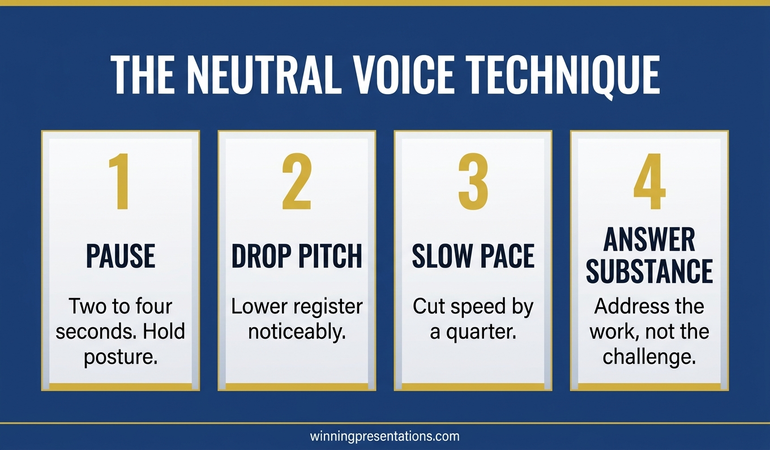
The technique has four steps. Each one takes under two seconds. Combined, they produce a response that lands as composed even when the challenge was aggressive.
Step one: pause for two to four seconds. Do not rush to answer. The pause is not hesitation — it is deliberate composure. Hold your posture. Keep eye contact with the challenger. The silence interrupts the expected escalation pattern and resets the emotional tempo of the room.
Step two: drop the pitch of your voice. Lower it by a noticeable amount — roughly equivalent to the difference between your normal speaking voice and the voice you use when you are thinking aloud. The drop has to be real; a half-hearted version is audible to the room as an attempt rather than a shift. Practice beforehand so you know what the target pitch feels like.
Step three: slow your pace. Cut your speaking speed by roughly a quarter. Put small deliberate gaps between phrases. Slow pace communicates that you are not rushed and that you are not intimidated into producing a fast defence. The room reads slow, controlled pace as seniority.
Step four: answer the substance, not the challenge. Address what was said about the work, not what was implied about you. If the challenger said “you don’t understand what we asked for”, the response is to articulate what you understood — calmly — and invite correction. “What I understood was X. If that is not what the committee wanted, I would find it useful to hear what the gap is.” This takes the heat out of the exchange by converting it into a question about information.
Closely related to voice control is the broader voice command technique for executive presentations, which covers the mechanical side of pitch, pace, and breath under pressure.
Why neutral voice holds the room
Audiences read tone before content. When a presenter is challenged, the room instinctively watches how the presenter responds before registering what they say. A calm, composed tone communicates that the presenter can be trusted to handle pressure. A defensive or escalated tone communicates the opposite, regardless of how accurate the underlying response is.
Neutral voice works because it sends three signals simultaneously. It signals that the challenge has not destabilised you. It signals that you take the substance seriously enough to respond carefully rather than reflexively. And it signals that you are willing to keep the exchange professional even if the challenger has not.
The third signal is the most important. The challenger has set an emotional tone; if you match it, the conversation continues on their terms. If you do not match it, the mismatch is audible to the whole room. Most audience members will side with the calmer voice, because composure under pressure is what they are implicitly looking for in a senior presenter.
This is why neutral voice holds even when the challenger is senior. A board chair who raises their voice and is met with a calm, lower-pitched response does not look more senior; they look less composed. The dynamic changes not because you have contradicted the chair but because you have declined the emotional register they tried to set.
The neuroscience-based system that makes composure reliable
Calm Under Pressure is the neuroscience-based confidence system for senior professionals who need clear thinking in high-stakes moments. It covers nervous system regulation, in-the-moment recovery, and the specific physiological mechanics behind techniques like neutral voice. Not presentation-specific — applies to any high-stakes professional situation.
- Nervous system regulation for pre-presentation and in-the-moment use
- Physiological protocols for pitch, pace, and breath recovery
- Cognitive reframes for handling the moment of challenge
Designed for senior professionals who need calm, clear thinking under pressure.
£19.99, instant download. Neuroscience-based system.
The three common responses that make it worse
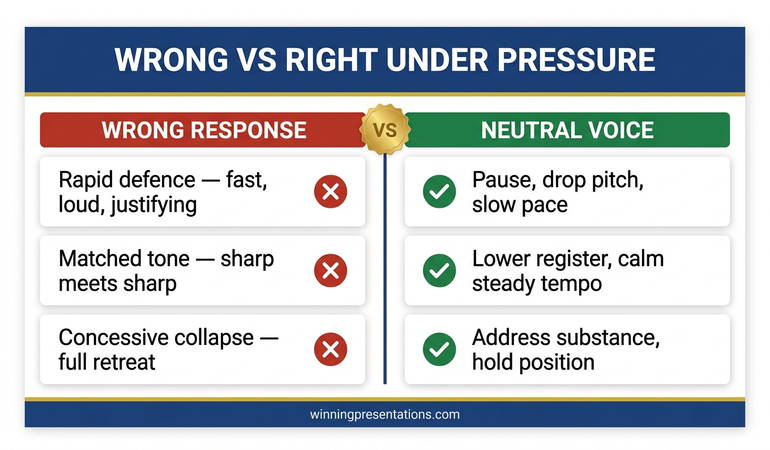
Understanding what to avoid is as useful as knowing what to do. Three responses to a mid-presentation challenge make things predictably worse.
The rapid defence. The most common response is to answer immediately, at speed, with a detailed justification of why the challenger is wrong. The rapid defence reads as insecurity. It also compounds the problem physiologically — the faster you speak, the more the threat response escalates. By the time you finish the first defence, your pitch is up, your pace is up, and the room has already formed a view.
The matched tone. The second pattern is to match the challenger’s tone — if they are sharp, you become sharp; if they are dismissive, you become firm. This is the trap that even experienced presenters fall into, because it feels strong. The problem is that matching tone in a confrontation escalates it; the audience then watches two people trade sharpness while the content disappears. Whoever the audience perceives as escalating first loses authority.
The concessive collapse. The third pattern is the opposite — full concession. “You’re right, I think I may have misunderstood, let me go back and look at it.” This sounds humble but reads as collapse when the underlying work is actually sound. It also teaches the challenger that aggressive framing produces concessions, which makes the next challenge worse. Full concession is appropriate when the challenge is accurate; it is damaging when the challenge is merely confident.
The neutral voice technique is a deliberate middle path. It neither defends nor concedes; it converts the challenge into a substantive conversation about the work. Where there is a genuine gap, the conversation reveals it. Where there is not, the composed response demonstrates that the work holds up.
A related pattern worth managing is the priority order for managing physical symptoms under pressure — voice, breath, and visible tremor all respond to similar protocols.
Practising it before you need it
Neutral voice is a physiological skill. You cannot install it in the middle of a real challenge. You have to rehearse it in low-stakes situations so that when a real challenge comes, the body knows what to do without conscious thought.
Solo rehearsal. Record yourself reading a short paragraph at your normal speaking voice. Then read the same paragraph with the pitch dropped and the pace slowed. Listen back. Most people are surprised how different the two recordings sound, and how much more authoritative the neutral version is. Do this for five minutes once a week until you can switch between the two on demand.
Structured simulation. Ask a colleague to interrupt your practice presentation with a hostile challenge — ideally one that feels slightly unfair. Rehearse the four-step response. The first few simulations will feel artificial. By the fifth, the body starts to associate challenge with pause-and-drop rather than with defend-and-speed. That association is what you are trying to install.
Morning protocol. On the day of a high-stakes presentation, spend two minutes in a private room practising the neutral voice pitch. Reading a few sentences aloud in the target tone primes the voice for the meeting. This combines well with the broader morning protocol for presentation day, which covers body, voice, and mindset preparation.
Partner post: the “actually…” question and how to handle correction attempts is the specific-case companion to the general neutral voice technique.
For the deeper pattern of presentation anxiety
Conquer Your Fear of Public Speaking (£39) is a neuroscience-based programme for presentation anxiety — the underlying pattern that makes moments of challenge feel harder than they need to. Designed for senior presenters who want to address the root, not just the symptom.
The composure that comes from preparation
The thing about neutral voice is that it does not look like a technique when it works. From the audience, it simply looks like the presenter is unflappable. The challenge came, the response was calm, the substance was addressed, and the presentation moved on. The work the presenter did internally — the pause, the pitch drop, the pace adjustment, the decision to answer substance — is invisible.
That invisibility is the point. Senior presenters are not expected to look as though they are managing themselves under pressure. They are expected to just be composed. The only way to produce that appearance reliably is to have practised the physiological moves beforehand, so that in the moment the body does the work without requiring conscious thought.
Start with the simplest version. Next time you feel your pitch rising during a meeting — not even a challenge, just a moment of mild pressure — drop it deliberately. Slow the next sentence. Notice what happens to your own thinking and to the room. The skill scales from there.
Reliable composure in high-stakes professional moments
The neuroscience-based confidence system for senior professionals who need clear thinking when the pressure arrives. Not presentation-specific — applies to every high-stakes moment.
Get Calm Under Pressure → £19.99
Instant download. Neuroscience-based system.
Frequently asked questions
What if the challenger is senior to me?
Seniority of the challenger does not change the technique. Neutral voice is not a challenge to the hierarchy; it is a response to the emotional register. A senior challenger who raises their voice and is met with calm, substantive reply does not feel contradicted — they feel responded to. The room reads the composure as appropriate respect, not as insubordination.
What if the challenge is partly right?
Acknowledge the correct part, clearly, without collapsing the rest. “You are right that we did not include the Q3 figures; we had a cut-off decision to make and I can explain the reasoning. On the second point, we did include the sensitivity analysis — it is on page seven of the pre-read.” Neutral voice is compatible with concession on the merits. What it is not compatible with is wholesale retreat.
What if my voice cracks or shakes?
Pause for longer, breathe through the nose, and start the sentence at a lower pitch than feels natural. A voice cracks when it is trying to produce sound at a pitch higher than the current breath support can hold. Dropping the pitch below the break point stabilises it. This is the same mechanism behind the broader technique for voice recovery under pressure.
Does this work in virtual meetings?
Yes, and the technique is particularly useful on video calls. Audio compression flattens the emotional register of both challenger and responder, so the pitch drop and pace slowdown stand out more sharply. Maintain eye contact with the camera during the pause, and slightly exaggerate the pace change — video lag can compress perceived timing.
Get The Winning Edge
One email each Thursday. Named techniques from real boardroom work — composure, voice, framing — that senior professionals can try in the next presentation.
Not ready for the full system? Start here instead: download the free Executive Presentation Checklist — the one-page reference senior presenters use to pressure-test a deck before a senior meeting.
Next step: rehearse the neutral voice shift for five minutes this week, so it is available to you the next time pressure arrives.
About the author
Mary Beth Hazeldine is Owner & Managing Director of Winning Presentations Ltd. With 24 years of corporate banking experience at JPMorgan Chase, PwC, Royal Bank of Scotland, and Commerzbank, she advises executives across financial services, healthcare, technology, and government on structuring presentations for high-stakes funding rounds and approvals.