Quick Answer
A technology roadmap presentation succeeds at board level when it frames technology decisions as business decisions. Executives don’t approve IT roadmaps — they approve investments in business capability, risk reduction, and competitive advantage. Structure your deck around those three levers, not around technical architecture, and the conversation shifts from “do we understand this?” to “when do we start?”
In this article
Henrik had prepared for six weeks.
The technology roadmap he was presenting covered the next three years of the company’s IT infrastructure: legacy system migration, cloud consolidation, cybersecurity uplift, and three new customer-facing platforms. He had worked with his team to cost every workstream, build the implementation timeline, and map out the interdependencies between each phase.
The board gave him twelve minutes before the chair interrupted. “Henrik, I appreciate the detail. But what I really need to understand is — if we approve this, what does the business look like in three years that it doesn’t look like today?”
Henrik hadn’t built that slide. He had built a technology roadmap. The board was asking for a business transformation story. Those are not the same presentation, even when they cover the same material.
That question — “what does the business look like in three years?” — is the question your technology roadmap presentation must answer before the chair has to ask it.
Taking a technology investment to the board this quarter?
The Executive Slide System gives you the templates to present technical decisions in the language executives actually use to approve investments — business capability, risk, and competitive positioning.
Why Technology Roadmaps Fail at Board Level
The most common reason a technology roadmap presentation fails with a board or executive committee is not the technology. It’s the framing. Technical leaders build roadmaps from the inside out — starting with what the current architecture looks like, what needs to change, and how those changes will be implemented. Boards think from the outside in — starting with where the business needs to go and working backwards to what capabilities are required to get there.
When a technology roadmap is presented in technical sequence, it requires the board to do the translation work: to take what they’re being shown about infrastructure and API consolidation and reverse-engineer the business implication. Most boards won’t do that work. They’ll ask for a summary, defer the decision, or approve a smaller scope than you needed — because the full case didn’t land.
The fix is not to simplify the roadmap. It’s to reframe how the roadmap is presented. The technical detail should be available — in an appendix, in supporting slides, in a pre-read. But the main deck should tell the business story, with technology appearing as the mechanism that enables it rather than the subject of the presentation.
The approach that consistently works with boards is the same one that underpins effective digital transformation board presentations: lead with the outcome, justify with the evidence, close with the decision.
Translating Technical Decisions Into Business Language
Every major item on a technology roadmap maps to one of three business concerns: capability (what we can do), risk (what could hurt us), or efficiency (how much it costs to operate). Your job before you build a single slide is to make this mapping explicit — for yourself first, and then for your audience.
Capability language describes what the business will be able to do after the investment that it cannot do today. “We will be able to launch new products in six weeks instead of six months.” “Our sales team will have real-time visibility of customer activity across all channels.” “We will be able to process transactions in markets we are currently locked out of.” This is the language that makes boards lean forward.
Risk language describes what the business is exposed to if it does not invest. “Our current system has not received security patches since 2019 — every day it runs is a regulatory risk.” “We are operating on hardware for which spare parts are no longer available.” “Three of the five engineers who understand this architecture are planning to retire in the next two years.” Boards have strong risk appetite awareness. A well-framed risk case often moves faster than a capability case.
Efficiency language describes the cost of the current state versus the cost of the future state. “Our current architecture requires 14 separate integrations to do what a modern platform does natively.” “We are paying for five different systems that do essentially the same thing.” “Each new feature requires four weeks of development time because of the current technical debt.” This is the most straightforward translation — it’s a cost reduction story with a capital investment requirement.
Once you have mapped your roadmap to these three languages, building the board-facing deck becomes considerably more straightforward. Every technical decision has a business translation, and every business translation belongs in the main deck.
The Deck That Gets Technology Investment Approved
Translating a technical roadmap into a business case is one of the hardest things IT and technology leaders have to do. The Executive Slide System — £39, instant access — is built for exactly this challenge:
- Slide templates for technology investment and digital transformation cases
- Business case frameworks that translate technical decisions into board language
- AI prompt cards to build ROI models and risk assessments slide by slide
- Executive summary templates that lead with outcome, not architecture
Get the Executive Slide System →
Designed for executives presenting investment decisions to boards and senior committees.
The Slide Structure That Earns Executive Approval
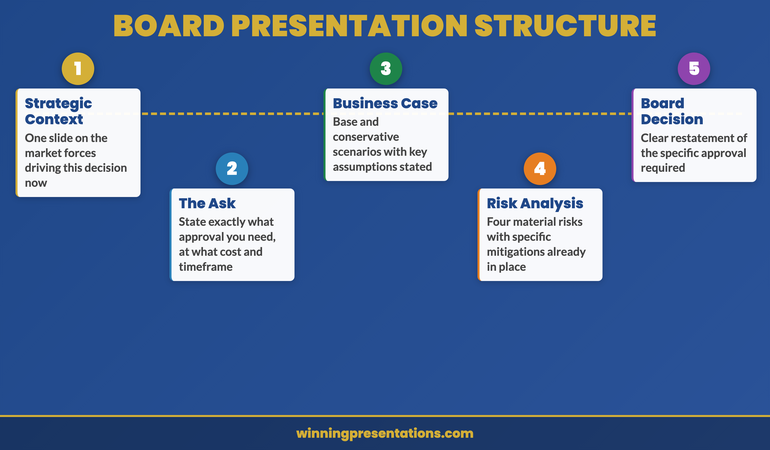
The most effective technology roadmap presentations for boards follow a structure that starts with the strategic context, moves to the business case, and arrives at the technical plan — rather than the other way around.

Slide 1 — Strategic context
Where is the business now, and where does it need to be? This slide establishes the business direction that the technology roadmap is responding to. It should reference the organisation’s strategic priorities — not the IT strategy — and show the gap between current technical capability and what will be needed. Boards approve technology investments they can see are connected to business direction. They stall on investments that appear to be driven by internal IT preference.
Slides 2–3 — The business case
This is the capability, risk, and efficiency case translated into financial and operational terms. What is the cost of the current state? What does the improved future state deliver? What is the investment required, and over what timeline does the return accrue? Include a single summary table that shows the key numbers — total investment, operating cost change, expected capability outcomes, and risk reduction. Boards make investment decisions from this table. Everything else in the deck supports it.
Slide 4 — Roadmap overview
Show the three-year roadmap as a visual — phased by year, with each phase labelled by the business outcome it enables rather than the technical workstream it contains. “Year 1: Remove critical security risk and consolidate platforms” is more useful for a board than “Year 1: Network segmentation, patch management uplift, and SaaS consolidation.” The technical detail sits in supporting slides. The overview slide is for decision-making, not education.
Slide 5 — Investment requirements by phase
Break the total investment by year and by category: capital, operating, internal resource, and external partners. Show the dependencies — which phases are required before others can proceed, and what happens to the timeline and cost if phases are deferred or descoped. This slide is where boards often want to negotiate; having the dependency logic visible makes those conversations considerably more productive.
Slide 6 — Governance and oversight
How will the programme be governed? Who is accountable for each phase? What are the decision points at which the board will be asked to review progress? Boards are more willing to approve large investments when they can see they will have meaningful oversight of how the investment is being spent. A clear governance model signals maturity and professionalism; its absence raises the question of whether the technology leader has done this before.
Slide 7 — Recommendation and immediate next steps
As with any executive decision deck, end with the specific ask. “We are requesting approval of phase one investment of £X, with a programme review at the six-month stage before phase two funding is released.” This gives the board a bounded decision — they are not being asked to commit to the full three-year investment upfront, they are being asked to approve the first phase with defined review points.
The board presentation best practices that apply to technology roadmaps are the same as for any major investment: answer the strategic question first, justify the numbers clearly, and give the board a decision they can make in the room.
The Executive Slide System includes the investment case and roadmap slide templates that make this structure straightforward to build, even when you’re working with complex multi-year programmes.
How to Present Prioritisation Decisions Without Losing Credibility
One of the most delicate elements of any technology roadmap presentation is explaining why certain investments have been prioritised and others deferred. Boards understand that not everything can happen at once. What they are less tolerant of is a prioritisation rationale that appears arbitrary, politically driven, or disconnected from business need.
The strongest approach is to make your prioritisation criteria explicit before you show the roadmap. State the two or three criteria by which investments have been ranked: typically some combination of business impact, risk reduction, technical dependency (some things must happen before others), and investment required. Show the board your prioritisation matrix — which investments score highest across all criteria, which were deferred because they scored lower or are dependent on earlier phases, and which were excluded entirely and why.
This approach does two things. First, it demonstrates that the roadmap is the output of a disciplined process, not a wish list. Second, it gives board members a framework for asking questions: “Why does this score lower than that on business impact?” is a much more productive conversation than “Why isn’t X on the roadmap?”
Where items have been deferred due to budget rather than priority, say so directly. “We have included this in a future phase not because it’s lower priority but because the investment profile of phase one is at the limit of what we believe the organisation can absorb in a single year.” This is the kind of transparency that builds credibility with boards rather than eroding it.

Handling the Questions Boards Always Ask
Technology roadmap presentations generate a predictable set of board questions. Preparing for these in advance significantly reduces the risk of the presentation stalling.
“What happens if we only fund phase one?”
Have a clear answer for the partial investment scenario. What does phase one deliver in isolation? Is it useful on its own or is it a prerequisite for the phases that follow? If phase one is only valuable as the foundation for subsequent investment, say that directly — and explain what the cost is of then having to decommission or restart if the subsequent phases are not approved. This prevents boards from approving a small piece and then finding the full investment is required anyway.
“Have you considered buying rather than building?”
This is almost always worth including proactively in the deck. Show the build versus buy analysis — what you considered, why you selected the approach you’re recommending, and what the cost, capability, and risk trade-offs are. Boards that raise this question themselves feel it hasn’t been considered. Boards that see you’ve already addressed it feel confident the recommendation is robust.
“How do we know the costs won’t escalate?”
Reference your contingency provision and your governance model. Technology programmes routinely cost more than estimated — boards know this. What they want to see is that you have built this reality into your investment case rather than assumed everything will go to plan. A programme with a fifteen to twenty per cent contingency provision and a defined process for managing scope changes is more credible than one that presents a single-point estimate.
See also today’s related articles on converting a successful pilot into a contract, eliminating the delivery habits that undermine your credibility, and building lasting presentation capability at work.
Stop Watching Technology Budgets Stall in “Further Review”
The Executive Slide System — £39, instant access — gives you the business case templates and investment frameworks that translate technical decisions into the language boards use to approve spending. Build your next technology roadmap presentation in a fraction of the time.
Get the Executive Slide System →
Designed for executives presenting investment decisions to boards and senior committees.
Want the complete toolkit?
A clean technology-roadmap deck is one of seven skills senior presenters need to win board buy-in. The Complete Presenter Bundle pulls all seven products together — slides, Q&A, anxiety, storytelling, delivery, openers, cheat sheets — for £99 (save £91.97 vs buying separately). Lifetime access.
Frequently Asked Questions
How do you present a multi-year technology roadmap without overwhelming the board?
Focus the main deck on the first phase and the high-level arc of the full programme. Show what the board is being asked to approve now, what they will see at each review point, and what the three-year destination looks like. The detail behind each subsequent phase belongs in supporting slides or a pre-read document. Boards that feel overwhelmed by detail defer decisions; boards that see a clear first phase with defined review points are considerably more likely to approve.
What is the right level of technical detail for a board technology presentation?
Almost none in the main deck. Board members are not evaluating your technical choices — they are evaluating the business logic of the investment. Technical architecture diagrams, system integration maps, and development methodology detail belong in appendix slides that you reference if specific questions arise. The main deck should be comprehensible to a non-technical director who is asking: “Does this make business sense?”
How do you handle a board member who is a technology expert and wants more detail?
Acknowledge their expertise and offer a deeper technical conversation outside the board session. In the main presentation, keep the business framing intact — changing pace and detail level for one board member risks losing the rest. Offer to send supporting technical documentation in advance of the next meeting, or propose a separate technical deep-dive with the interested director. This respects their interest while maintaining a presentation that works for the full board.
The Winning Edge — Weekly Presentation Intelligence
Every Thursday, frameworks and techniques from 24 years of presenting in boardrooms. Join The Winning Edge →
Not ready for the full system? Download the free Executive Presentation Checklist — a one-page reference for the structure and slides every board presentation needs.
About the Author
Mary Beth Hazeldine is the Owner & Managing Director of Winning Presentations. With 24 years of corporate banking experience at JPMorgan Chase, PwC, Royal Bank of Scotland, and Commerzbank, she advises executives across financial services, healthcare, technology, and government on structuring presentations for high-stakes funding rounds and approvals.