

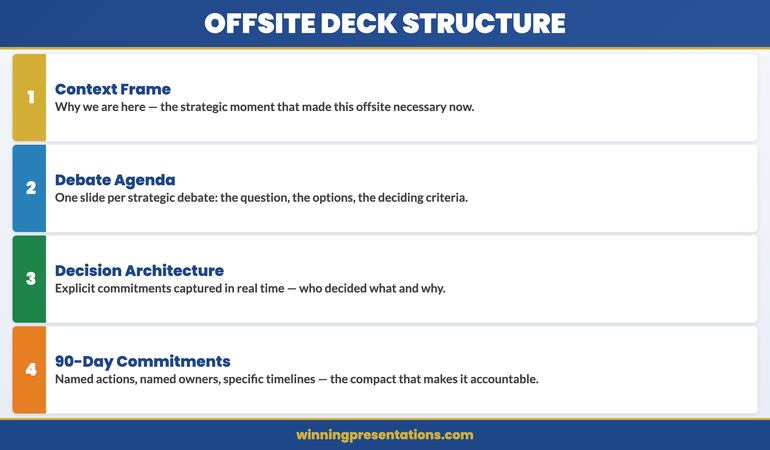
An offsite strategy presentation should frame a 3-day executive agenda — not attempt to replicate it in slides. Structure it around four components: the strategic context, the debate agenda, the decisions required, and the 90-day commitments. The deck is a navigation tool, not a content delivery vehicle. Most offsite presentations fail because they try to do too much. A focused, 20-slide deck that guides three days of genuine strategic conversation outperforms a 90-slide masterwork that eliminates the conversation entirely.
→ Why offsite presentations fail
→ The strategic constraint: what to cut
→ The opening frame that earns attention
→ The four-part structure that works
→ Visual principles for offsite decks
→ Handling Q&A across a 3-day format
→ Frequently Asked Questions
Henrik was twelve days out from a three-day leadership offsite when his CEO forwarded a single message: “Can you send the deck?” He had a 94-slide PowerPoint that covered every business unit update, every market headwind, every strategic initiative and its dependencies. He sent it across at 11 pm, confident it was comprehensive.
The CEO replied the next morning: “This is a lot. I’m not sure we can get through all of this in three days. Can we talk about what we actually need to decide?” That single reply landed like cold water. Henrik had spent three weeks building a document instead of designing a conversation.
He rebuilt the deck in two days. 22 slides. One opening frame, four strategic debates, three non-negotiable decisions, and a 90-day commitment grid. The offsite ran differently. People argued more — and agreed more. Henrik later said the 22-slide version had done in 20 minutes what the 94-slide version couldn’t have done in three days: it told the team what the offsite was actually for.
If you’re building an offsite strategy presentation — or any high-stakes executive deck — the Executive Slide System gives you slide templates, AI prompt cards, and scenario playbooks for exactly these situations.
Why Offsite Strategy Presentations Fail
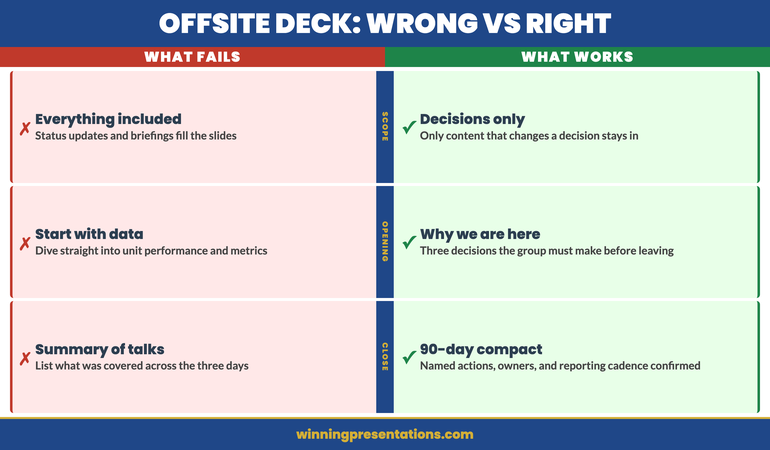
The most common failure mode is treating the offsite presentation as a status update at scale. Executives bring every report, every metric, every initiative that has been in progress since the last offsite. The result is a deck that functions like an extended board paper — complete, exhaustive, and almost entirely unsuited to the purpose of three days in a room together.
A second failure mode is structural: decks that have no clear decision architecture. The slides present problems, but never force a choice. Attendees leave an offsite feeling informed but uncommitted — because the presentation never positioned them as decision-makers. It positioned them as an audience.
A third failure is mismatched depth. Presenters give ten slides to a topic that needs twenty minutes of discussion, and two slides to a topic that should anchor an entire afternoon. The deck’s internal weighting rarely matches the organisation’s strategic priorities in that moment. This can only be corrected if the designer first understands what decisions need to be made — and works backward from there.
What all three failure modes share is a confusion between documentation and facilitation. An offsite strategy presentation is not a record of where the organisation stands. It is a structured invitation to move the organisation forward. That distinction shapes every decision about what goes in, what stays out, and how much space each topic receives.
The Strategic Constraint: What to Cut
The single most useful discipline when building an offsite strategy presentation is the removal constraint: before you add a slide, ask whether removing it would change a decision. If the answer is no, it does not belong in the deck. It belongs in a pre-read document — distributed two to three days before the offsite begins, with a cover note that says, “You’re expected to have read this before we arrive.”
Status updates — divisional performance, year-to-date financials, pipeline snapshots — belong in the pre-read. Market context, competitor intelligence, and regulatory landscape belong in the pre-read. These are the shared baseline that makes the strategic debate possible. They should not consume offsite presentation time.
What belongs in the live deck are the topics that only the room can resolve: strategic choices that require debate, resource allocation decisions that require authority, and cultural commitments that require buy-in from the leaders present. These cannot be resolved asynchronously. They require the friction of real-time conversation, which is why the offsite exists.
A useful test: if a slide could be replaced with a pre-read paragraph and a question — “Given what you’ve read, what is your position on X?” — remove it from the deck. The offsite presentation is not a briefing. It is the architecture for a conversation that has already been adequately briefed.
For advice on structuring other high-stakes executive formats, the piece on the difference between a board paper and a board presentation gives useful framing on when to use each vehicle.
Executive Slide System — £39, instant access
Build Executive Decks That Drive Decisions — Not Just Discussion
The Executive Slide System gives you the slide templates, AI prompt cards, and scenario playbooks used to build decks for boards, leadership offsites, and high-stakes funding rounds. Designed for executives who need to present once and get the decision — not present repeatedly and wait for consensus.
- Slide templates built for executive scenarios including offsites, budget reviews, and governance updates
- AI prompt cards to build structured decks without starting from a blank slide
- Framework guides for opening frames, decision architecture, and closing sequences
- Scenario playbooks for the presentations most likely to derail without structure
Get the Executive Slide System →
Designed for leaders who present to boards, investors, and senior leadership teams.
The Opening Frame That Earns Attention
An offsite strategy presentation must answer one question within its first three slides: why are we here, and what will be different when we leave? If the opening frame cannot answer that question, the entire three days are at risk of drifting. Senior leaders fill ambiguity with their own agendas. An explicit opening frame prevents that drift before it starts.
The opening frame typically contains three elements. First, a one-sentence articulation of the strategic moment: what has changed in the external environment, or the organisation’s position, that makes this offsite necessary now rather than at the usual quarterly cadence? This creates urgency without alarm. Second, a statement of the three decisions that must be made before the group leaves. Not the topics for discussion — the specific decisions. “By close of Thursday, we will have agreed: our investment priority for H2, the structure of the new operating model, and the leadership appointments for the two new regions.” Third, the rules of engagement: how the three days will run, and what is expected from participants.
This opening frame should be no more than three slides. Its function is orientation, not persuasion. Executives do not need convincing that strategic planning matters — they need clarity about what this particular offsite is trying to achieve. The opening frame is the only part of the deck that addresses the group as a whole before breaking into individual strategic debates.
If you are presenting at a year-end leadership offsite, the approach overlaps significantly with the format discussed in the article on structuring a year-end review presentation. The distinction is that year-end reviews look backward by design; offsite presentations must balance backward context with forward commitment.
The Four-Part Structure That Works
Effective offsite strategy presentations follow a consistent four-part logic. This structure works because it mirrors how strategic decisions actually get made: context is established, options are debated, commitments are made, and accountability is assigned.
Part One: Context Frame (3 slides). As described above — why we’re here, what decisions must be made, and how we will work. This anchors the three days and prevents the offsite from becoming a free-floating strategy conversation with no defined output.
Part Two: Strategic Debate Agenda (4–8 slides, one per debate). Each strategic topic gets its own single slide — a crisp framing of the debate, the options available, and the criteria by which a decision should be made. These slides do not resolve the debate. They start it. Good debate agenda slides use a consistent format: “The Question” at the top, two or three strategic options in the body, and a prompt at the bottom: “What do we believe is true about this?” Not “What do we decide?” — because the group is not ready to decide before they have debated.
Part Three: Decision Architecture (3–5 slides). After debates have been run, the presentation moves into explicit decision territory. Each decision gets its own slide — the decision statement, the option selected, and the immediate implications. These slides are where the organisation formally commits on record. They should be drafted in advance as hypotheses and updated in real time as decisions are made. A skilled offsite facilitator often projects the decision slide at the close of each debate so the room can see their position being captured.
Part Four: 90-Day Commitments (2–3 slides). The offsite should not close without a concrete commitment grid: who will do what, by when, and how progress will be reported. This is not a project plan — it is a leadership compact. The 90-day commitment grid converts strategic decisions into traceable action, and it is the only slide set that will be revisited at the next quarterly review. Its presence makes the offsite accountable. Its absence makes the offsite forgettable.
If the offsite includes a capital investment decision, the framing from the article on structuring a capital expenditure presentation applies directly to Part Three — particularly the decision architecture for resource allocation under uncertainty.
You can find further guidance on handling the financial elements of strategic discussions in today’s companion piece on structuring a budget variance presentation — specifically when offsite conversations surface spending gaps that require immediate leadership alignment.
The full four-part format typically lands between 18 and 25 slides. If you find yourself approaching 40 slides, you have migrated content that belongs in the pre-read back into the live deck. Return to the removal constraint: does this slide change a decision? If not, remove it.
The Executive Slide System includes scenario playbooks for exactly this kind of multi-phase offsite structure, with templates that allow you to build the four-part framework without designing from scratch.
Visual Principles for Offsite Decks
Offsite presentations are frequently projected in non-standard environments: hotel conference rooms with inconsistent lighting, large screens that amplify visual clutter, or breakout spaces where participants are sitting at odd angles to the display. The visual approach must accommodate these conditions. High-contrast, clean slide design is not aesthetic preference — it is functional necessity.
Dark backgrounds with light text read well in bright rooms. Single-column layouts with large type are easier to read from a distance. Decision slides should use a consistent visual signature — perhaps a distinct colour band or a specific header format — so participants immediately recognise when they have moved from debate to commitment.
Avoid complex data visualisations in the live deck unless the data is central to the decision. Complex charts slow the room down while individuals decode them individually. Data visualisations belong in appendix slides or in the pre-read, where participants can study them at their own pace. In the live deck, reduce every data point to its strategic implication: not the chart, but the conclusion the chart supports.
Slide titles should be declarative statements rather than topic labels. “Revenue Growth” is a label. “Revenue growth is concentrated in two markets — that concentration is our primary strategic risk” is a statement. Declarative titles tell the room what to think before discussion opens. They are also more useful when the deck is reviewed six months later as a record of the leadership team’s position at the time of the offsite.
Handling Q&A Across a 3-Day Format
An offsite is not a presentation with a Q&A segment. It is a sustained Q&A environment with occasional presentation segments. This distinction matters because it changes how you manage questions. In a standard board presentation, you manage Q&A at the end of a defined slot. In an offsite, questions arise continuously, and the presenter’s role shifts between facilitator, responder, and recorder.
Build an explicit “parking lot” into the offsite structure — a shared space, whether digital or on a physical flipchart, where off-agenda questions are captured and scheduled for later. This prevents a single challenging question from derailing an entire session. When a question is parked, the response is: “That’s an important question and I want to give it proper time. I’ve added it to the parking lot — we’ll address it this afternoon.” This is not avoidance. It is discipline.
For questions that challenge the strategic assumptions underpinning the presentation, the right response is to invite the assumption to be made explicit: “You’re questioning whether the market growth assumption holds. Let me put that on the decision slide — is the group’s position that we should retest that assumption before committing to the investment?” Converting a challenge into a decision point moves the conversation forward rather than into a recursive debate.
Also see today’s piece on handling repeated questions in presentations — a pattern that surfaces frequently at offsites when a strategic concern is not being adequately addressed by the group’s debate structure.
Executive Slide System — £39, instant access
The Slides Behind High-Stakes Leadership Decisions
Offsite presentations, board decks, budget reviews — the Executive Slide System gives you the templates and AI prompt cards to build each format with authority, without designing from a blank slide under time pressure.
Get the Executive Slide System →
Designed for executives presenting to boards, leadership teams, and investors.
Frequently Asked Questions
How many slides should an offsite strategy presentation have?
Most effective offsite strategy presentations run between 18 and 25 slides for a three-day format. The four-part structure — context frame, debate agenda, decision architecture, and 90-day commitments — typically fills this range comfortably. Anything beyond 35 slides usually indicates that pre-read material has migrated into the live deck, or that status updates are included where they don’t belong. The test is simple: does each slide either set up a debate or record a decision? If not, it belongs in the appendix or the pre-read.
Should each business unit present its own section at the offsite?
Individual business unit presentations at offsites are one of the most reliable ways to convert a strategic conversation into a series of operational briefings. If each unit is given 30 minutes to present its performance, the offsite becomes a three-day board meeting rather than a leadership strategy event. Business unit performance belongs in the pre-read. What belongs in the live session is the cross-cutting strategic debate: where should we invest, where should we consolidate, and where do we have a structural competitive advantage that we are not fully exploiting?
What do you do when a debate runs over time and the agenda slips?
When a debate runs over, it is usually a signal that either the question was not framed narrowly enough, or the group has surfaced a genuinely more important issue than the one scheduled. In the first case, park the debate, sharpen the question overnight, and return to it the next morning with a 20-minute time box. In the second case, name what is happening explicitly: “This conversation has revealed that we have an unresolved assumption about X that we haven’t formally debated. I want to propose we add this to the decision architecture and defer one of the scheduled debates.” Offsites that stick rigidly to the agenda when something more important has emerged rarely produce better outcomes than ones that adapt with discipline.
Subscribe to The Winning Edge — Mary Beth’s weekly briefing for executives on presentation strategy, Q&A mastery, and high-stakes communication.
Also available: Free Executive Presentation Checklist — a quick-reference guide for high-stakes presentations.
About the Author
Mary Beth Hazeldine is Owner & Managing Director of Winning Presentations. With 25 years of corporate banking experience at JPMorgan Chase, PwC, Royal Bank of Scotland, and Commerzbank, she advises executives across financial services, healthcare, technology, and government on structuring presentations for high-stakes funding rounds, board approvals, and leadership strategy events.


