
QUICK ANSWER
Fear of public speaking training in the UK ranges from open-enrolment workshops aimed at general audiences to senior-context programmes designed for executives presenting to boards, regulators, and investment committees. The right choice depends on the audience you actually present to, the moments where the fear shows up, and how much of the work you can do self-paced versus in-person. The wrong choice is generic stage-fright training when the real problem is senior-context scrutiny.
JUMP TO
What options exist in the UK ·
Who each format fits ·
What to look for ·
What to avoid ·
Why senior context matters ·
What it costs ·
FAQ
Astrid had been searching for “fear of public speaking training UK” for two weeks before she stopped. Every option she found was either a Toastmasters club fifteen minutes from her house, a weekend stage-skills workshop in central London, or a £4,000 corporate package that wanted six months of her diary. None of these matched what she actually needed. She presented to credit committees once or twice a quarter. Her fear did not show up at meetings or on stage. It showed up in the four days before, in the tightness in her chest as the meeting approached, and in the moment in Q&A when she realised she had not prepared the answer.
The training landscape has not, until recently, been built for what Astrid needed. The mass-market end is built around generic stage performance. The high-end is built around long-form corporate engagements. The middle — senior-context training, calibrated to the rooms senior professionals actually present in, with structures you can use this week — is the gap most senior professionals fall into when they search for help.
This article walks through what options exist, who each one fits, what to look for, and what to avoid. The context is the UK market specifically, where the format and pricing landscape differs from the US and where some of the well-known names do not transfer cleanly.
Senior-context speaking fear, addressed as a system
Conquer Your Fear of Public Speaking is built around the specific patterns senior professionals face — credit committees, board rooms, regulators — not generic stage fright. Self-paced, instant access. Designed for the rooms you actually present in.
What fear of public speaking training options exist in the UK
The UK landscape has, broadly, five categories. Each solves a slightly different problem. Knowing which category you are in is more important than which provider you choose inside it.
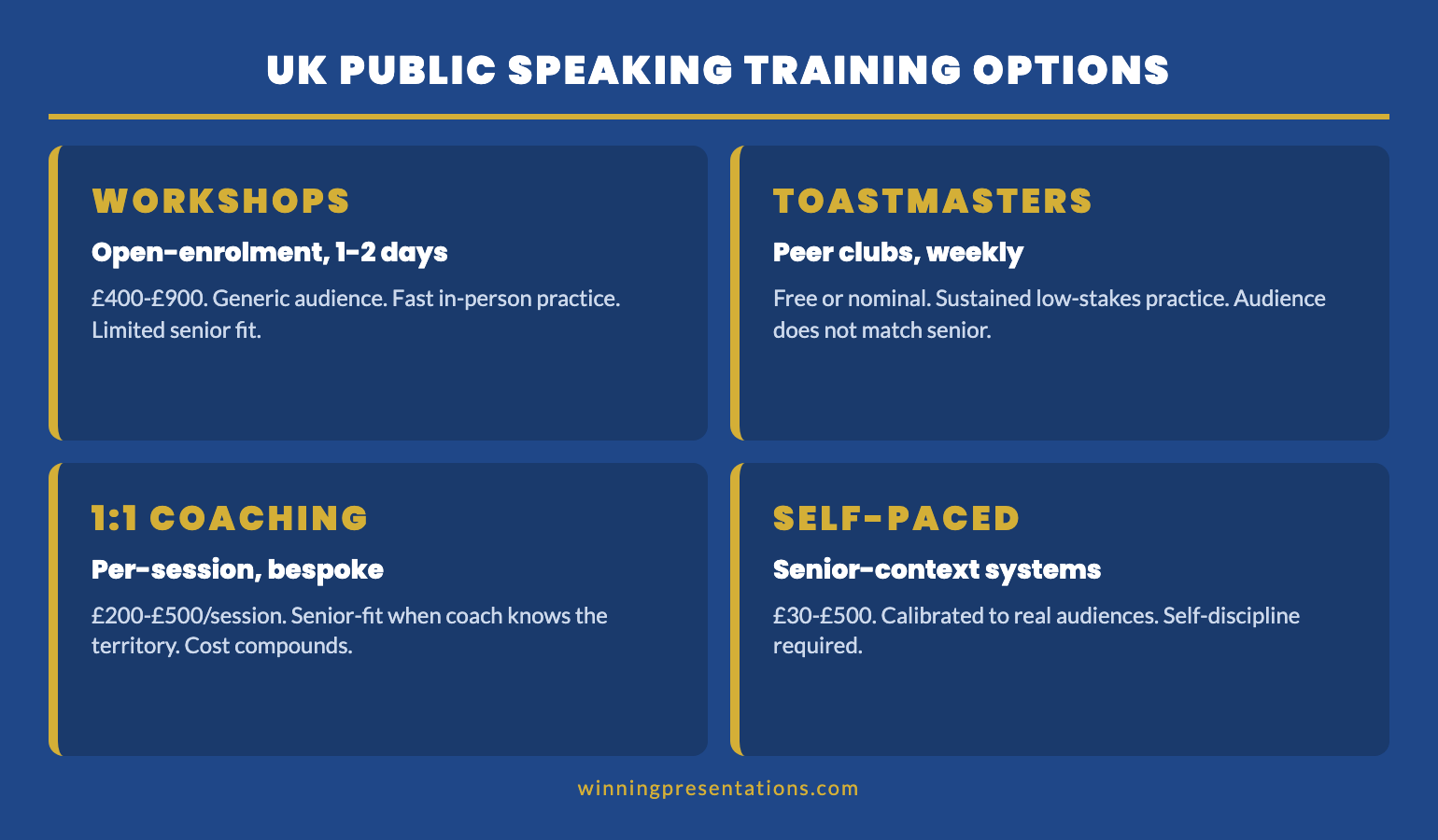
Open-enrolment workshops. One- or two-day courses, typically in London, Manchester, Edinburgh, or Bristol. £400 to £900. Aimed at general audiences — junior managers, mid-career professionals, sometimes graduate students. Strengths: fast, in-person, immediate practice in front of strangers. Weaknesses: rarely calibrated to senior-context audiences. The exercises tend to assume a friendly room and prepared material.
Toastmasters and equivalent peer clubs. Free or nominal cost. Long-running. Excellent for sustained low-stakes practice if you can sustain attendance. Weaknesses for senior professionals: the audience is supportive, the material is general, and the rhythm of weekly meetings does not match the rhythm of senior-level presentations, which tend to be infrequent and high-stakes.
One-to-one coaching. £200 to £500 per session in the UK, sometimes more for coaches with broadcast or theatre backgrounds. Strengths: bespoke, addresses your specific patterns, can be senior-context-calibrated if the coach knows the territory. Weaknesses: cost adds up quickly, and quality varies sharply with the coach’s familiarity with your kind of audience.
Corporate packages. Multi-week or multi-month engagements with a consultancy or training provider, typically £3,000 to £15,000. Aimed at organisational rollouts. Often excellent material. Weaknesses for individuals: most senior professionals cannot self-fund this, and the format is built around groups rather than individuals.
Self-paced senior-context systems. Online courses and frameworks designed specifically for senior professionals presenting to decision audiences. £30 to £500. Strengths: works around senior diaries, calibrated to the actual rooms senior professionals present in, and can be applied immediately to a real upcoming presentation. Weaknesses: self-paced means self-disciplined — the work has to be done.
Who each format fits
Open-enrolment workshops fit professionals who have not done much public speaking and want immediate in-person practice. They tend to fit less well for senior professionals whose fear is calibrated to specific audiences (boards, regulators, sponsors), because the workshop audience does not resemble the real audience.
Toastmasters fits professionals who want a sustained habit of low-stakes practice and have the diary space for weekly meetings. It fits less well for senior professionals whose fear sits in the gap between “infrequent, high-stakes” and “frequent, low-stakes.” The skills are real, but the transfer is partial.
One-to-one coaching fits senior professionals who can identify a coach with relevant senior-context experience and can budget two to six sessions. It is excellent when calibrated correctly. It is expensive when the coach’s instincts come from a different context (theatre, broadcast, general corporate).
Corporate packages fit organisations rolling out training. They rarely fit individuals and are usually inaccessible without sponsorship.
Self-paced senior-context systems fit senior professionals who present occasionally rather than constantly, want to work around their own diary, and want material calibrated to the rooms they actually present in. The trade-off is self-discipline. Professional public speaking training online walks through how the senior-context online format works in more detail.
What to look for
Across all five formats, the same four signals separate training that will help senior professionals from training that will not.
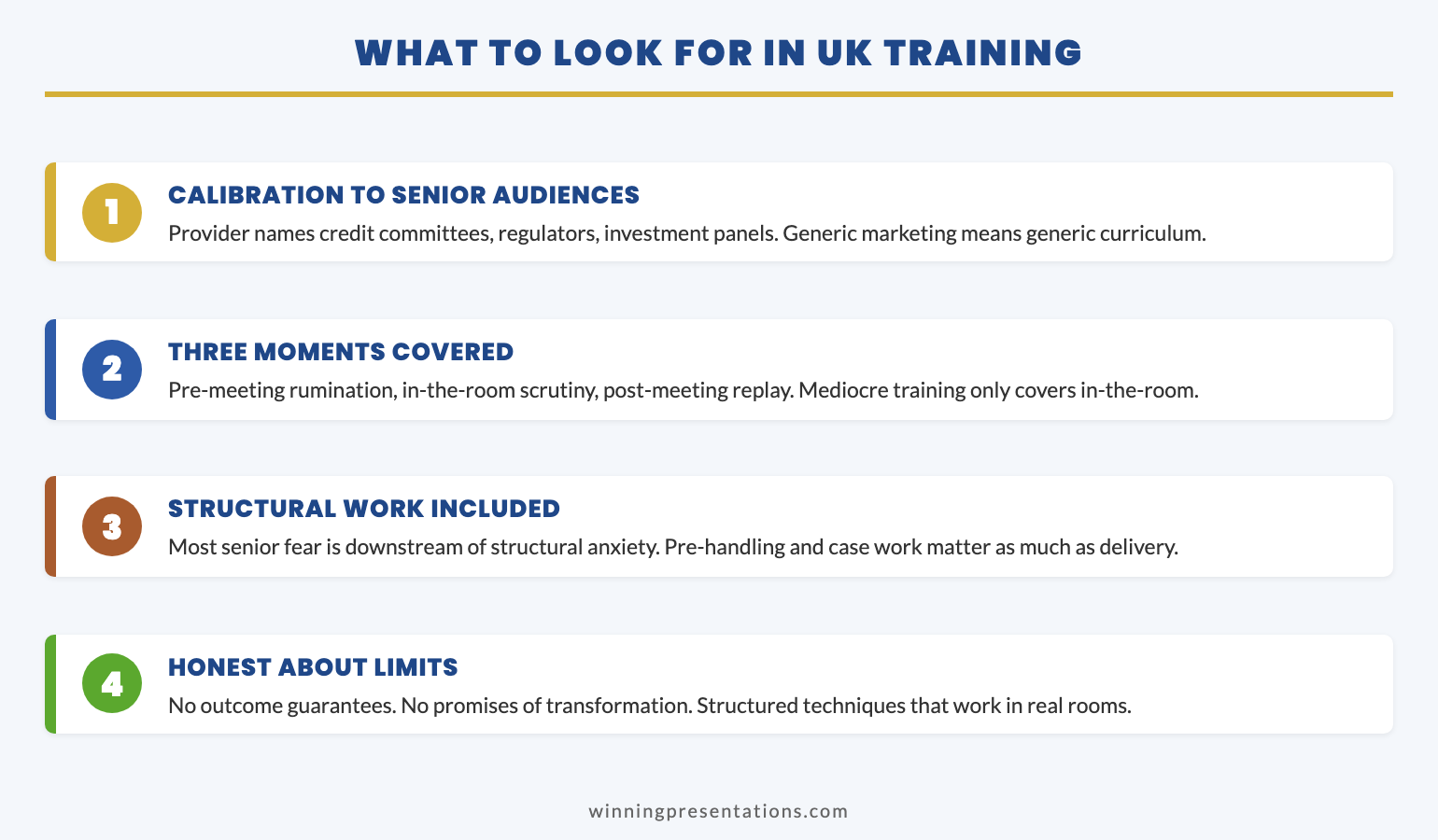
Calibration to senior decision audiences. The provider should be able to describe the specific rooms the training is built for — credit committees, regulator hearings, investment panels, board sponsors — rather than general “public speaking.” If the marketing language is generic, the curriculum almost certainly is too.
Specific work on the moments fear shows up. Senior fear shows up in three places: the four days before, the moment in the room where the case is challenged, and the post-meeting rumination. Good training addresses all three. Mediocre training addresses only the in-the-moment delivery.
Structural and pre-handling work, not just delivery. Most senior speaking fear is downstream of structural anxiety — “I do not have the answer to the question they will ask.” Training that includes the structural and pre-handling layer addresses this upstream cause. Training that is purely delivery-focused does not.
Honesty about what training cannot do. Good training does not promise that you will never feel fear again. It does not guarantee outcomes from your specific stakeholders. It teaches structured techniques that work in real rooms. Promises of “transformation” or “guaranteed confidence” are usually a sign that the training is overselling.
What to avoid
The UK market has a few patterns worth treating with caution.
Stage-skills training mis-sold for senior contexts. Training built for keynote speakers, stage performers, or general business audiences often markets itself to senior professionals on the assumption that the skills transfer. Some do; many do not. The warning sign is when the marketing emphasises “stage presence,” “commanding the room,” or “audience impact” rather than handling scrutiny, interruption, and unscripted Q&A.
Programmes that treat fear as a willpower problem. “Just feel the fear and do it anyway” works for some people. For most senior professionals it does not, because the fear is not the problem — the fear is a symptom of a structural gap. Training that does not address the structural layer often produces a short-term confidence boost followed by a reversion under real senior pressure.
Open-ended packages without clear deliverables. Some UK providers sell “executive coaching” with no clear curriculum, no clear endpoint, and no specific deliverables. The conversation is pleasant; the outcomes are diffuse. Useful coaches have a clear method. Be wary of vagueness about what you will actually get.
Outcome guarantees. No legitimate training programme guarantees that your board will approve your next proposal or that your nerves will disappear. Senior approval depends on factors outside the training (the case, the politics, the timing). Promises of guaranteed outcomes are a Rule 10 violation in this industry — unverifiable, and a signal to walk away.
CONQUER YOUR FEAR OF PUBLIC SPEAKING
Senior-context speaking fear, addressed as a system
Conquer Your Fear of Public Speaking is built specifically for senior professionals presenting to credit committees, boards, regulators, and investment panels — not for stage performers or general business audiences. Self-paced, instant access, calibrated to the rooms you actually present in.
- Senior-context-specific patterns for the four days before, the moment in the room, and the post-meeting period
- Structured techniques for the moments where nerves show most
- Voice, breath, and recovery work tied to executive scenarios
- Self-paced, instant access on purchase
Conquer Your Fear of Public Speaking — £39, instant access. Designed for senior professionals who present to decision audiences.
Designed for senior decision audiences, not general stage performance.
Why senior context matters more than UK location
The most consequential filter is not “is this UK-based” but “is this calibrated to senior decision audiences.” Senior fear is its own pattern. It is not an intensified version of generic stage fright. It is anxiety about being assessed as a colleague rather than supported as a speaker, anxiety about a question you have not prepared for, anxiety about a structural gap in the case being exposed in front of people whose opinion of your judgement matters for the next decade of your career.
Generic public speaking training treats none of these directly. It treats the symptoms (shaking voice, racing heart, dry mouth) and assumes the underlying problem is “fear of audiences.” For senior professionals it usually is not. The underlying problem is fear of being found unprepared in a room where preparation is the visible signal of judgement. The remedy looks different.
This is why a senior-context system — whether £30, £300, or £3,000 — almost always outperforms a generic public speaking course that costs more, in the specific dimension that matters for senior professionals. The same money buys more in the right format. Overcoming fear of public speaking at senior level walks through this distinction in more detail.
What it costs in the UK
Realistic UK pricing in 2026:
Self-paced online systems: £30 to £500 depending on depth. Senior-context-calibrated systems sit at the lower end of this range when they are well-designed. Lifetime access is common.
Open-enrolment workshops: £400 to £900 for a one- or two-day course. Often available in London, Manchester, Edinburgh, Bristol. Cost includes lunch and venue.
One-to-one coaching: £200 to £500 per session. Senior-context coaches with relevant client backgrounds sit at the upper end. Most senior professionals find a four to six session arc is what produces durable change.
Corporate packages: £3,000 to £15,000 for organisational engagements. Typically inaccessible to individuals without sponsorship.
Maven-style cohort programmes: £400 to £700 for self-paced cohort enrolment with optional live calls. Sit between online courses and corporate packages in depth and price.
The most cost-effective starting point for a senior professional with a real upcoming presentation is usually a self-paced senior-context system, applied immediately to that presentation. The fastest visible improvement comes from doing the work on a live case. The training that does not get applied does not produce change at any price point.
If the issue is in-the-moment recovery rather than chronic fear
When the difficulty is less about general fear and more about specific moments mid-meeting (voice tremor, breath, the moment a question lands the wrong way), Calm Under Pressure is the targeted system for those moments. £19.99, instant access — the recovery toolkit you can build before the next high-stakes meeting.
A short framework for choosing
If you are searching for fear of public speaking training in the UK as a senior professional, the practical question to start with is: in which moments does the fear actually show up? Pre-meeting rumination, in-the-room scrutiny, post-meeting replay. Each has a different curriculum.
For pre-meeting and structural anxiety: senior-context systems that emphasise structural rigour and pre-handling. For in-the-room scrutiny: targeted recovery work, voice and breath techniques calibrated to senior rooms. For post-meeting rumination: the longer-arc work that separates technical events from their meaning.
Most senior professionals find the work breaks roughly into “set up the case so the worst moments do not happen” and “have a system for the moments that still do.” The two halves can be built in parallel, and the cost-effective starting point is the half that fits the next real presentation in your diary.
CONQUER YOUR FEAR OF PUBLIC SPEAKING
For the rooms senior professionals actually present in
Self-paced system covering the patterns of senior-level public speaking nerves — calmness under scrutiny, voice and breath under pressure, recovery techniques tied to executive scenarios. £39, instant access — built for senior decision audiences, not for the TED stage.
Designed for credit committees, boards, regulator meetings, and senior client presentations.
Frequently asked questions
What is the best fear of public speaking training in the UK for senior professionals?
The best fit is rarely the most-marketed name. It is the format that matches when and where the fear actually shows up. For senior professionals presenting to boards, committees, and regulators, senior-context-calibrated training (self-paced systems built specifically for senior decision audiences, or coaches with directly relevant client backgrounds) usually outperforms general public speaking workshops or stage-skills programmes, even at lower price points.
Should I do a one-day workshop or a longer programme?
One-day workshops are useful for general practice in front of strangers. They tend to fit less well for senior professionals whose fear is calibrated to specific audiences (boards, regulators, sponsors), because the workshop audience does not resemble the real one. A longer self-paced programme, applied to a real upcoming presentation, usually produces more durable change.
Is Toastmasters worth it for senior executives?
For sustained low-stakes practice, yes. Toastmasters builds a reliable habit of speaking in front of strangers and is free or nominal cost. The transfer to senior-level rooms is partial, because the audience and stakes are different. Many senior professionals find Toastmasters useful as a baseline practice habit but supplement it with senior-context-specific training for the rooms that actually matter.
How long does it take to overcome fear of public speaking?
The visible signs of nerves (shaking voice, racing heart, tight chest) often improve within weeks of structured technique work. The deeper sense of dread before high-stakes meetings tends to take longer — usually a small number of real meetings where the new techniques are applied and the experience does not match the prediction. Most senior professionals find that the first round of meaningful change happens around the third or fourth real presentation after starting the work.
Do I need in-person training, or does online work?
Online works well for the structural, pre-handling, and recovery layers, which is most of the work for senior professionals. In-person practice in front of strangers can be useful for general public speaking comfort, but it tends not to be the bottleneck for senior fear. Online self-paced systems calibrated to senior rooms, applied to a real upcoming presentation, are usually the most efficient starting point.
The Winning Edge
A weekly newsletter for senior professionals who present at board level. One specific structural idea per issue, drawn from real boardroom and committee work. No filler.
Not ready for the full system? Start here instead: download the free Executive Presentation Checklist — the pre-flight checks that catch the structural mistakes most senior professionals make in the last 24 hours before a high-stakes meeting.
If this article landed for you, Public speaking for executives vs everyone is the natural next read. It walks through the broader distinction between general public speaking and senior-level public speaking and where the disciplines diverge.
Next step: identify the next senior-level presentation in your diary. Pick one of the three layers (pre-meeting, in-the-room, post-meeting) where the fear shows up most for you. That is where the first round of training should focus.
Mary Beth Hazeldine is the Owner & Managing Director of Winning Presentations. With 24 years of corporate banking experience at JPMorgan Chase, PwC, Royal Bank of Scotland, and Commerzbank, she advises senior professionals across financial services, healthcare, technology, and government on structuring presentations for high-stakes funding rounds and approvals. She speaks German and works extensively with the German-speaking financial markets.