Quick Answer
A clinical hypnotherapy session for public speaking is not stage hypnosis and it is not relaxation therapy. It is a structured 50–60 minute session with three components: an intake conversation that maps the specific anxiety pattern, a focused induction that produces a state of relaxed concentration, and targeted work on the embodied response — the body’s pre-meeting baseline rather than the in-the-moment symptom. You remain aware throughout. You remember the session afterwards. And the work addresses the layer that conscious cognitive techniques do not reach.
On this page
The first time Reyhaneh — a senior fund manager in Edinburgh — sat down for a clinical hypnotherapy session for her returning presentation anxiety, she expected something cinematic. A swinging pocket watch, a hushed voice telling her she felt sleepy, a sense of waking up afterwards with no memory of what had happened. None of that is what the work is. She remained fully aware throughout the entire session. She remembered every word. And the shift she noticed in her body before her next investment committee meeting was the kind of change she had been trying to produce with breathing exercises and beta blockers for two years without success.
The cultural picture of hypnotherapy is so distorted by stage hypnosis and old film tropes that most senior professionals never seriously consider it as an option for presentation anxiety. The therapeutic version of the work bears almost no resemblance to the entertainment version. It is a structured clinical practice with measurable outcomes for specific conditions — and presentation anxiety in senior professionals is one of the conditions where the evidence base is strongest.
I have been running clinical hypnotherapy work for senior professionals with presentation anxiety since I recovered from my own. The questions I am most often asked are the same questions Reyhaneh asked before her first session: what actually happens, why does it work when other techniques have not, and what is the practitioner doing while I am sitting there. This article answers those questions in detail, written from inside the practice rather than from the marketing material around it.
If you are considering clinical hypnotherapy for presentation anxiety
The reasonable place to start is with the recorded sessions designed specifically for senior professionals carrying years of accumulated meeting memory. The same therapeutic structure as a one-to-one session, listened to at home before the high-stakes meeting cycle.
What clinical hypnotherapy actually is — and what it is not
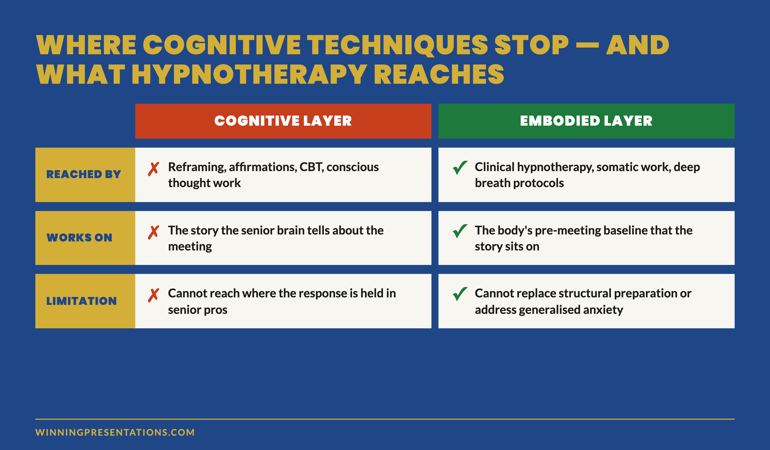
Clinical hypnotherapy is the use of focused attention and relaxed concentration to access the layer of the nervous system that holds embodied responses — the body’s automatic patterns, learned over years, that conscious thought cannot override directly. For presentation anxiety, that layer matters because the anxiety lives there. The cognitive story (“I should be fine, I have done this hundreds of times”) and the embodied response (“racing heart, tight chest, dry mouth”) are produced by different parts of the system. Cognitive techniques work on the cognitive layer. They do not reach the embodied one.
What clinical hypnotherapy is not, in three brief negatives:
It is not stage hypnosis. The chicken impressions and the unreliable witness routines on television are an entertainment performance using suggestible volunteers in a high-arousal social context. They have nothing in common with the therapeutic work. A clinical hypnotherapist would never ask you to do anything against your values, and you would not comply if they did — clinical hypnotherapy does not override consent.
It is not unconsciousness. You remain aware throughout. You can open your eyes, speak, stand up, leave the room, and return to ordinary alertness in seconds. The state is closer to the absorbed concentration of reading a good book or driving a familiar route on autopilot than to sleep. You are listening to the practitioner the entire time.
It is not memory loss. You remember the session afterwards. You can recall what was said, what you noticed in your body, and what shifted. The lack of dramatic forgetting is one of the things that surprises clients used to the cinematic picture — it can initially feel like nothing has happened, until they walk into the next high-stakes meeting and notice the difference.
The structure of a session — minute by minute
A first clinical hypnotherapy session for presentation anxiety runs 75–90 minutes. Subsequent sessions run 50–60 minutes. The structure is consistent across most clinical practitioners working with this condition, though the language and emphasis vary.
Minutes 0–20 — Intake conversation
The session opens with a structured conversation about the specific anxiety pattern — when it shows up, what it looks like in the body, what the meeting context is, what has been tried before. This is not psychotherapy or general life coaching. It is targeted information gathering: the practitioner is mapping which layer of the nervous system holds the response and which type of induction will be most effective for this client. The questions are practical. What does the morning before a high-stakes meeting feel like? Where in the body does the anxiety land first? Has anything ever produced a meaningful reduction, even briefly?
Senior professionals often find this conversation easier than expected. Naming the pattern out loud to a practitioner who is not surprised by any of it is, in itself, a small intervention. The body relaxes a degree before the formal work has even begun.
Minutes 20–35 — Induction
The induction is the practitioner’s spoken sequence that guides the client into the state of relaxed concentration where the work happens. Different practitioners use different induction styles — some are slow and progressive, working through the body from feet to head; some use visualisation of a specific calm place; some use breathing focus combined with verbal grounding. None of them involve the swinging pocket watch.
The state itself feels distinctive but not strange. Most clients describe it as a deeper version of the absorption that happens when reading a book and losing track of time. The body settles. The breath slows. Awareness narrows to the practitioner’s voice and the internal experience the voice is guiding. The eyes are usually closed, though they do not have to be.
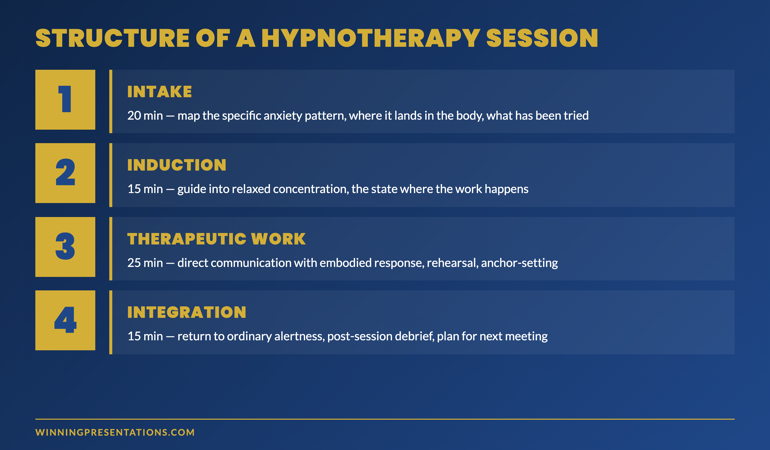
Minutes 35–60 — Therapeutic work
The therapeutic work itself happens once the relaxed concentration state is established. For presentation anxiety, the work usually has three threads. The first is direct communication with the embodied response — the practitioner speaks to the body’s pre-meeting pattern, naming it specifically and offering a different settling pattern that the body can adopt. The second is rehearsal — guiding the client through a vivid mental run of the upcoming high-stakes meeting with the new settled response in place, so the body has a memory of the new pattern before the actual meeting. The third is anchor-setting — establishing a sensory anchor (often a specific breath pattern or a small physical gesture) that the client can use to re-access the settled state when needed during the meeting itself.
None of this involves uncovering childhood trauma or excavating buried memories. The work is forward-facing and behavioural. The practitioner is not interested in why the anxiety started; they are interested in changing what the body does next time.
Minutes 60–75 — Integration and post-session debrief
The session closes with a guided return to ordinary alertness, followed by 10–15 minutes of conversation about what was noticed. The post-session debrief matters more than most clients expect — it is where the new pattern gets named consciously and connected to the meeting it is meant to support. Senior professionals leave the session with a specific anchor and a specific plan for the next high-stakes meeting, not with a vague sense of having relaxed.
Clinical hypnotherapy structure as recorded sessions
Conquer Your Fear of Public Speaking — for senior professionals
- Recorded clinical hypnotherapy sessions following the same structure as the one-to-one practice — intake framing, induction, therapeutic work, integration
- Designed specifically for senior professionals with returning presentation anxiety after years of confident presenting
- Listen at home before the high-stakes meeting cycle — most participants notice a shift inside two weeks of regular use
- Built on five years of recovery work after my own presentation anxiety in financial services
Conquer Your Fear of Public Speaking — £39, instant access, lifetime use.
Get Conquer Your Fear of Public Speaking →
For senior professionals whose presentation anxiety has not responded to surface techniques.
Why it works on presentation anxiety specifically
Most techniques offered to senior professionals for presentation anxiety operate on the cognitive layer. Reframe the situation, challenge the catastrophic thought, repeat the affirmation, change your inner dialogue. These techniques work to a point — for mild anxiety in someone whose body has not yet learned a strong embodied response, they can be enough. For senior professionals carrying decades of accumulated meeting memory, they often are not.
The reason is that the anxiety is not coming from the cognitive layer. The senior brain knows the meeting will probably go well. The senior brain knows the audience is reasonable. The senior brain has rehearsed every objection and has structured responses ready. None of that prevents the body’s pre-meeting pattern from activating, because the pattern lives somewhere the cognitive work cannot reach. Trying to reason with the embodied response is like trying to talk a startled horse into being calm — the horse is not arguing with you; it is responding to a different signal than the one you are giving.
Clinical hypnotherapy works at the level the embodied response is held. The relaxed concentration state allows the practitioner’s language to communicate with the part of the system that produces the response, rather than the part of the system that thinks about the response. This is why the work often produces shifts that years of cognitive technique have not — not because hypnotherapy is magical, but because it is operating on the right layer.
The accumulated meeting memory factor matters here. Younger presenters with newer presentation anxiety sometimes respond well to cognitive techniques alone — the embodied response is not yet deeply established. Senior professionals at midlife with returning anxiety, or with anxiety that has been present for decades, are working with a body that has practised the response thousands of times. The cognitive layer is not where the rehearsal happened. The settling work needs to happen in the same layer the rehearsal did.
For a more complete picture of why surface techniques often miss in this population, see Conquer Your Fear of Public Speaking, which walks through the embodied-response model the recorded sessions are built on.
What clinical hypnotherapy cannot do
The work has clear limits. Naming them honestly is part of being a serious practitioner.
It cannot replace structural preparation. A senior professional who walks into an executive committee meeting unprepared will be appropriately anxious — the body is correctly registering that the situation is high-risk. Clinical hypnotherapy does not produce calm in the absence of preparation. It produces calm in someone who is prepared and whose body has not yet caught up with the reality of being prepared.
The same is true at the strategic level: the structural work of preparing senior-grade decks lives elsewhere. Conquer Your Fear of Public Speaking addresses the embodied layer; structural preparation addresses the cognitive one. Both are needed.
It cannot address presentation anxiety that is one symptom of a broader condition. Where the presentation anxiety is part of a generalised anxiety disorder, a major depressive episode, or a post-traumatic stress response, clinical hypnotherapy is not the primary intervention. It can play a supporting role within a broader treatment plan led by a psychiatrist or clinical psychologist, but it should not be the standalone treatment. Senior professionals in this category should be referred to specialist medical care, not started on hypnotherapy alone.
It does not work in a single session. Marketing claims of one-session cures are not consistent with how the embodied response actually shifts. A first session often produces a noticeable change. Sustained reduction usually takes three to six sessions over six to twelve weeks, with the recorded versions used between live sessions to reinforce the work. Practitioners who promise dramatic single-session results are usually drawing from the entertainment side of the field rather than the clinical one.
It does not eliminate the activation that high-stakes meetings correctly produce. The aim is not to walk into a board presentation with the same physiological state as a Sunday afternoon at home. The aim is to settle the inappropriate over-activation — the response that is meaningfully larger than the meeting requires — so the body produces the alert, focused state that high-stakes meetings actually benefit from. The work brings the response back into proportion with the situation, not below it.
For the in-the-moment physical symptoms — shaking, racing heart, dry mouth
The deeper hypnotherapy work shifts the baseline. Calm Under Pressure covers rapid-response techniques you can use in the room, in the moment, when a symptom surges during the meeting itself. The two layers complement each other. £19.99, instant access.
Rapid-response techniques for shaking hands, racing heart, trembling voice — without anyone noticing.
Frequently asked questions
Will I lose control or do something embarrassing during a session?
No. The relaxed concentration state does not override your awareness, your judgement, or your consent. You can open your eyes, speak, stand up, or end the session at any moment. Practitioners working clinically would never ask you to do anything you would not do in ordinary alertness, and you would not comply if they did. The cinematic picture of losing control is from stage performances using high-arousal social pressure, not from the therapeutic version of the work.
How is clinical hypnotherapy different from CBT for presentation anxiety?
Cognitive behavioural therapy works on the conscious thoughts and behaviours that surround the anxiety — identifying catastrophic thinking, rehearsing alternative responses, gradually exposing yourself to the feared situation. It is well-evidenced and works well for many people. Clinical hypnotherapy works on the embodied response held below the conscious layer. The two approaches are complementary rather than competing — many senior professionals benefit from both, sometimes sequentially. CBT often works on the cognitive scaffolding; hypnotherapy often shifts the underlying physiological pattern.
Can clinical hypnotherapy be done remotely or via recordings, or does it have to be in person?
All three formats work, with different strengths. In-person is most powerful for the first session because the practitioner can read the body’s response and adjust in real time. Remote video sessions retain most of the benefit and are now the default for many practitioners. Recorded sessions are effective for ongoing reinforcement once the pattern has been mapped — they are less precise than live work but they extend the practice into the daily routine. Most senior professionals end up using a combination: live sessions for the depth, recordings for the maintenance.
How quickly does it work?
Most senior professionals notice some shift after the first session, often a small one — slightly easier sleep the night before a meeting, or a degree less activation in the morning. The substantive shift typically comes between sessions three and six. By session six, the new baseline is usually established and the work moves into maintenance — occasional refresher sessions and the recordings used as needed. Practitioners promising results faster than this are usually overstating; the embodied response shifts on its own timescale.
Is the recorded version genuinely as effective as a live session?
For some senior professionals, yes — particularly those whose anxiety pattern is well-mapped and who use the recordings consistently between meetings. For others, the live work is meaningfully more effective because the practitioner can adjust the language in the moment to what the body is actually doing. The honest answer is that recorded sessions are a high-quality entry point and a strong maintenance tool; live sessions add a layer of precision that recordings cannot match. Many senior professionals start with recordings, see whether the approach helps, and add live sessions if they want to go deeper.
The Winning Edge — weekly newsletter for senior presenters
One framework, one micro-story, one slide pattern — every Thursday morning, ten minutes’ read. For senior professionals who want my best material before it appears anywhere else.
Not ready for the full programme? Start here: download the free Executive Presentation Checklist — a one-page reference for the structural questions every executive deck must answer before the meeting.
For more on why presentation anxiety often returns mid-career, see presentation anxiety at 50+ and what rebuilds confidence.
Mary Beth Hazeldine — Owner & Managing Director, Winning Presentations Ltd. After 24 years in corporate banking at JPMorgan Chase, PwC, Royal Bank of Scotland and Commerzbank, and five years recovering from her own presentation anxiety, she works with senior professionals across financial services, healthcare, and technology on the embodied side of high-stakes presenting.