

Quick Answer: Skip-level meetings — where your boss’s boss engages directly with you — carry a distinct Q&A dynamic. Senior leaders ask differently from your direct manager: they operate at a higher level of abstraction, they test your strategic thinking rather than your operational knowledge, and they pay close attention to how you handle uncertainty. Preparation requires mapping the questions they are likely to ask, practising responses that demonstrate judgement rather than just facts, and knowing how to redirect operational detail back to the strategic level without appearing evasive.
Tomás had run his division’s operations for three years. His direct manager trusted him completely. When the group CEO announced a series of skip-level conversations with senior managers, Tomás wasn’t particularly concerned. He knew his numbers. He knew his team. He had delivered consistently.
The CEO’s first question was: “If you had to restructure this division to be twenty percent more efficient without reducing output, where would you start?” Tomás answered with an operational plan — headcount distribution, process changes, technology investments. The CEO listened politely, then said: “That’s useful. I was asking where the biggest strategic constraint is.”
Tomás had answered the question he was comfortable with rather than the one that was asked. He had given operational detail in response to a request for strategic judgement. The CEO moved on. Tomás knew, walking out, that the conversation had not gone the way he needed it to.
It was a recoverable situation — Tomás followed up by email with a more strategic framing, and the CEO later described him positively in a talent review. But the preparation gap was clear: he had been ready for the operational meeting he expected, not the strategic conversation that actually happened.
If you have a skip-level meeting coming up
The Executive Q&A Handling System includes a framework for predicting the questions senior leaders ask, structuring your responses at the right level of abstraction, and handling the difficult moments — the stretch questions, the challenges to your assumptions, the questions you didn’t anticipate.
Why Skip-Level Q&A Is Different From Any Other Meeting
Skip-level meetings — where a senior leader engages directly with someone two or more levels below them — serve a specific organisational function: they give senior leadership an unfiltered view of how the organisation thinks and operates below the layer of direct management. This purpose shapes every question a senior leader asks in these settings.
Your direct manager assesses whether you are executing well on defined objectives. A skip-level senior leader is assessing something different: whether you have the strategic thinking, the judgement under pressure, and the professional credibility to operate at the next level. They are using the conversation to calibrate your potential, not just your current performance.
This changes the preparation requirement significantly. Preparing for your direct manager’s questions means knowing your operational data deeply. Preparing for skip-level questions means being able to step above the operational data and discuss what it means at a strategic level — what the implications are, where the constraints lie, and what you would do if you were making the decisions rather than executing them.
The emotional dynamic is also different. Most executives are more comfortable being challenged by their direct manager — the relationship has context, history, and established trust. A senior leader who challenges an assumption in a skip-level meeting does so without that context. The challenge can feel more exposing, and the temptation to become defensive or to over-explain is higher. Knowing this in advance — and having specific strategies for managing it — is part of effective skip-level preparation.
Executive Q&A Handling System
Predict the Questions, Structure the Answers, Handle the Pressure
The Executive Q&A Handling System — £39, instant access — gives you a systematic approach to predicting the questions senior executives ask, structuring answers at the right level, and managing the high-pressure moments that define how you are perceived in the room. Designed for executives who present to, or are questioned by, decision-makers more senior than their direct line.
- Question prediction frameworks for skip-level and senior leadership contexts
- Response structure guides for strategic, operational, and challenge questions
- Techniques for handling the questions you didn’t predict — without losing credibility
- Scenario playbooks for investment committee, board, and skip-level meeting Q&A
Designed for executives who are questioned by senior decision-makers in high-stakes contexts.
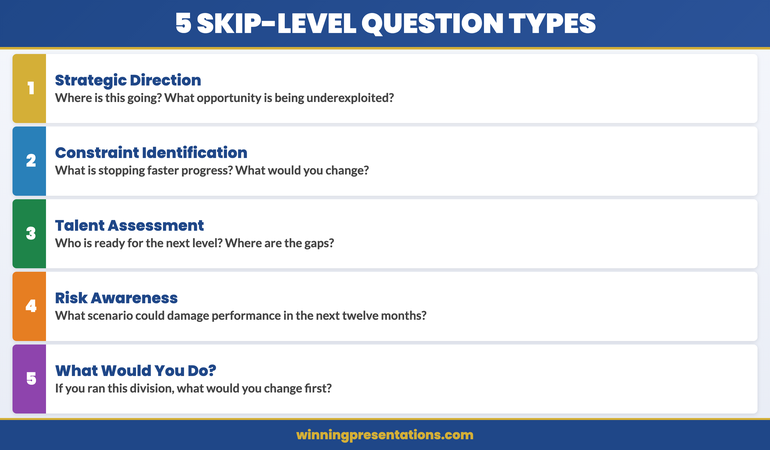
The Five Question Types Senior Leaders Use
Skip-level questions cluster into five recognisable types. Knowing these in advance allows you to prepare answers that operate at the right level — not too operational, not too vague.
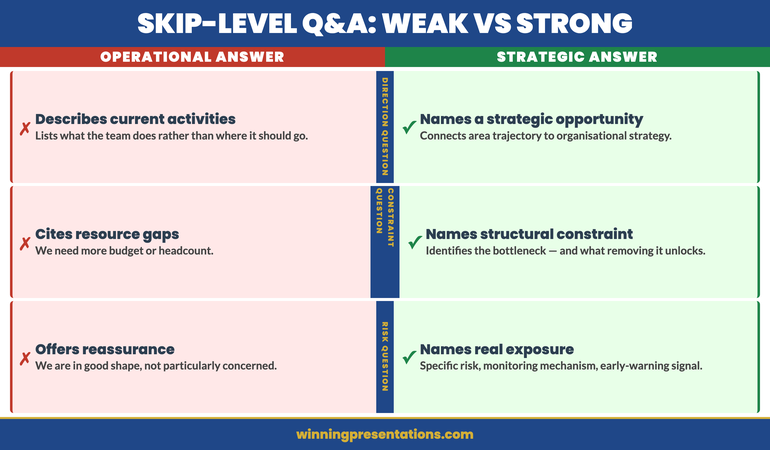
1. Strategic direction questions. “Where do you see this business in three years?” or “What’s the biggest opportunity your team is underexploiting?” These questions invite you to demonstrate that you think above your day-to-day responsibilities. The trap is giving an operational answer — describing what your team does rather than where it should go. The strong response connects your area’s trajectory to the wider organisational strategy and names a specific opportunity or constraint that you believe is underweighted.
2. Constraint identification questions. “What’s stopping you from moving faster?” or “What would you change if you had the authority?” These are diagnostic questions. Senior leaders use them to identify organisational bottlenecks and to assess whether middle management has a clear view of what is holding back performance. The weak response is to describe a resource constraint — “we need more budget or headcount.” The strong response names a structural or strategic constraint — a process, a decision-making dependency, or a talent gap — and articulates what removing it would unlock.
3. Talent and team questions. “Who on your team is ready for the next level?” or “Where are the talent gaps that worry you most?” These questions assess your people judgement and your investment in your team’s development. Have a specific answer — naming individuals where relevant — and demonstrate that you think deliberately about succession and capability rather than managing the team as an undifferentiated group.
4. Risk and challenge questions. “What keeps you up at night?” or “What’s the scenario that could significantly damage performance in the next twelve months?” These questions test your risk awareness and your honesty about vulnerability. Executives who answer with reassurance — “we’re in good shape, I’m not particularly concerned” — miss the point. A thoughtful risk response names a genuine concern, explains the monitoring mechanism in place, and identifies the early-warning signal that would trigger action.
5. The “what would you do” question. “If you were running the division, what’s the first thing you’d change?” This is a test of strategic confidence and intellectual courage. The safest-seeming answer — “that’s not my decision to make” — is the one that signals you are not thinking above your role. The strong response articulates a clear view, grounds it in specific evidence, and frames it as a perspective rather than a criticism of current strategy.
A Preparation Framework That Works at Any Level
Effective skip-level preparation follows a three-layer structure. Each layer prepares you for a different type of question and a different dimension of the conversation.
Layer 1 — Know your brief. What does this senior leader already know about your area? What recent decisions or events have shaped their view of your division? What is their stated agenda for the skip-level series — are they gathering strategic input, conducting a talent assessment, or investigating a specific performance question? Knowing the context of the conversation lets you frame your answers in terms they will find relevant rather than comprehensive.
Layer 2 — Prepare your positions. For each of the five question types above, develop a clear, confident position. This is not a scripted answer — it is a considered point of view. On strategy: where does your area need to go and why? On constraints: what is genuinely holding back performance? On talent: who is ready for more and who needs development? On risk: what is the real exposure? On what you would change: what is your honest view?
Layer 3 — Anticipate the follow-up. Senior leaders who ask a question and get a polished first answer often follow up with something harder — a challenge to an assumption, a request for more specificity, or a question that follows the logic of your answer to an uncomfortable place. For each prepared position, ask yourself: what is the most challenging follow-up question this answer could generate, and what is my response? This is where most skip-level preparation fails: the first answer is prepared, the follow-up is not.
For the underlying approach to Q&A preparation in high-stakes settings, see The Q&A Briefing Document: The Five Sections Every Executive Needs Before a High-Stakes Q&A.
If your skip-level meeting involves formal Q&A — or if you want a systematic approach to predicting and preparing for the questions senior leaders ask — the Executive Q&A Handling System provides the question prediction and response structuring framework in one place.
Handling Questions in the Room
No matter how well you prepare, a skip-level meeting will generate at least one question you didn’t predict. How you handle the unpredicted question is often more revealing than how you handle the prepared ones.
When a question catches you off-guard, the effective response sequence is: pause briefly, clarify if necessary, then answer at the highest level you can before offering to follow up with more specificity. “That’s an important question. My current thinking is [position]. I’d want to check [specific data point] before I give you a more precise answer — can I send that through to you by end of week?” This response demonstrates intellectual honesty, shows that you distinguish between your current thinking and confirmed data, and keeps the conversation moving without bluffing.
When a senior leader challenges an assumption in your answer, don’t immediately capitulate or immediately defend. Both responses look weak — capitulation suggests you weren’t confident in your original position, and over-defence suggests you can’t distinguish between a good challenge and a bad one. Instead, engage with the challenge: “That’s a useful pushback. The reason I landed on [position] is [reasoning]. If [alternative factor the leader raised] is weighted more heavily, I can see how the answer changes.” This demonstrates that you can think in the room, not just recite prepared positions.
When you genuinely don’t know the answer to a question, say so clearly and briefly. “I don’t have that data to hand, but I can get it to you by [specific date]” is a stronger answer than a hedged, half-informed response that a senior leader will see through. The willingness to say “I don’t know” clearly — without excessive apology — is a mark of confidence, not of weakness. See also The Bridging Technique: How to Handle Difficult Questions Without Losing the Room.
The Three Traps That Derail Skip-Level Q&A
Understanding what derails other executives in skip-level meetings is as valuable as knowing what works. Three patterns come up consistently.
Trap 1: Trying to impress rather than inform. Skip-level conversations derail most often when the executive treats it as a performance — an opportunity to demonstrate how impressive they are — rather than as a dialogue. Senior leaders are highly attuned to impression management and discount it quickly. The executive who speaks plainly, admits uncertainty where it exists, and demonstrates genuine thinking is almost always more credible than the one who delivers polished answers that say less than they appear to.
Trap 2: Staying too close to your direct manager’s position. One of the purposes of skip-level meetings is for senior leadership to hear perspectives that may differ from what the management layer above you reports. If you align all your answers with your direct manager’s stated positions, you signal that you are a reliable executor rather than an independent thinker. Have a view. Where it differs from your manager’s, you can acknowledge the difference respectfully: “My manager and I have discussed this — my own read of the situation is slightly different, and I think both perspectives are legitimate.”
Trap 3: Over-managing upward. Some executives use skip-level meetings primarily to manage how they are perceived by the senior leader — steering away from topics where performance has been weak and toward areas of strength. Senior leaders recognise this pattern quickly. A question about a difficult area that gets redirected to a comfortable one signals that the executive is managing the conversation rather than engaging with it. Addressing a difficult topic directly — “I know Q3 performance in my area was below expectation. Here is my assessment of what happened and what we’ve changed” — is far more credible than a smooth deflection. For related techniques, see Regulatory Review Q&A: What Compliance Officers Actually Want to Hear.
After the Meeting: Following Through on What You Said
Skip-level meetings leave two kinds of residue: the impression you created in the room, and the commitments you made during the conversation. Both require active management after the meeting ends.
Within twenty-four hours, send a brief follow-up note to the senior leader’s PA or directly, depending on the level of formality. The note should do two things: thank them for the time and confirm any specific follow-up items you committed to. “Following our conversation this morning, I’ll send through the Q3 variance analysis by Friday and the talent pipeline summary by end of next week.” This demonstrates that you take the conversation seriously, that you are organised, and that commitments made in the room are honoured.
Deliver the follow-up items on time — or earlier. A commitment made to a senior leader that is late, or that requires chasing, signals unreliability at exactly the moment when you want to be creating the opposite impression. If something unexpected delays a follow-up item, communicate proactively rather than waiting to be asked.
After the meeting, brief your direct manager on what was discussed. This is professional protocol — your manager should not hear about the conversation through other channels — and it gives you the opportunity to get their input on whether your answers aligned with the division’s official positions. If you expressed a view that differs from your manager’s, this conversation is important: it surfaces the difference in a direct, constructive way rather than leaving it to emerge through the senior leader’s subsequent communications.
Prepare Systematically, Not Just Thoroughly
The Q&A System That Covers What You Can’t Predict
The Executive Q&A Handling System — £39, instant access — includes question prediction frameworks, response structuring guides, and techniques for handling the challenging moments that no amount of preparation fully eliminates. Designed for executives facing Q&A from senior leadership, investment committees, and boards.
Frequently Asked Questions
Should I tell my direct manager about a skip-level meeting before it happens?
Yes, always. Attending a skip-level meeting without briefing your direct manager creates an unnecessary trust issue. Most managers understand that skip-level conversations are a normal organisational practice — but they expect to know about them. Before the meeting, let your manager know it is happening, ask if there are any topics you should be aware of, and agree on which areas you have authority to speak to independently. After the meeting, debrief them on what was discussed. This approach keeps the relationship with your manager intact while allowing you to have a genuine, direct conversation with the senior leader.
What if a senior leader asks me about a topic that falls outside my brief?
Acknowledge the boundary clearly and briefly, then offer what you can. “That sits primarily with [function or colleague]. My perspective, from what I observe in working with that team, is [observation].” This response demonstrates self-awareness about your scope without appearing unwilling to engage. Senior leaders often value the cross-functional perspective — your observation, clearly framed as an outside view, can be genuinely useful. The trap is either claiming authority you don’t have or refusing to engage with anything outside your immediate remit.
How should I handle a question where my honest answer reflects badly on the organisation?
Honesty is the correct approach, but framing matters. A response that simply delivers a critical assessment — “morale is poor and I don’t think the restructuring was handled well” — without context or solution-orientation is difficult for a senior leader to do anything with. The more useful framing names the issue, offers your assessment of its cause, and identifies what you believe would address it. This positions you as someone who is engaged with the problem rather than just observing it. Senior leaders generally value candour from executives who can pair it with constructive thinking.
The Winning Edge — Free Weekly Newsletter
Practical frameworks for Q&A handling, executive communication, and presenting to senior leadership. Every Thursday.
About the Author
Mary Beth Hazeldine is Owner & Managing Director of Winning Presentations. With 25 years of corporate banking experience at JPMorgan Chase, PwC, Royal Bank of Scotland, and Commerzbank, she advises executives across financial services, healthcare, technology, and government on structuring presentations for high-stakes funding rounds and approvals.