

Quick answer: A business review presentation course for senior leaders should teach four structural moves that distinguish the H1 or quarterly review the committee acts on from the one it absorbs and forgets — the four-line verdict slide built first not last, the single named delta against plan with cause attached, the explicit H2 (or next-quarter) ask with date, and the leader’s own exposure on the next-period commitments. Most leaders do not need more analytical depth; they need a structural method for converting analytical work into the leadership read the committee can engage with. The Executive Buy-In Presentation System — the self-paced programme this article recommends — is built around exactly these four moves, plus the rehearsal pattern that pressure-tests them before the committee runs the same test live. The Executive Slide System is the slide library that ships the templates these structural moves sit inside. The combination is what senior leaders use to walk into the business review with the committee already in support.
JUMP TO:
- What a business review presentation course should actually teach
- Self-paced versus live: which works for senior leaders
- The Executive Buy-In Presentation System: what it covers
- The slide library that ships alongside
- Who the course is for — and who it is not
- One thing to do before enrolling
- Frequently asked questions
In autumn 2018, I was running a workshop at one of the European insurance groups for thirty mid-career managing directors who had each been promoted into senior operating-line roles within the previous two years. The workshop was scheduled for two days; the topic was business reviews. On the morning of day one, the group’s chief operating officer dropped in for the opening hour and put a question to the room. He asked them to put their hands up if they had ever attended a formal course on how to structure a senior business review presentation. Three hands went up — out of thirty senior leaders, all of whom were the people the firm relied on to present quarterly and half-yearly reviews to the group executive committee. The COO asked the room what they had used instead. The answers, paraphrased, were the same answers I have heard in roughly that workshop in roughly a dozen firms over the last fifteen years: I watched my predecessor do it. I copied a template from a colleague. I worked it out as I went. I was told by my director not to worry, that the analytical work would speak for itself. The COO told the room, on the way out, that the analytical work would not speak for itself, and that the firm was about to invest in a programme to do something about it.
(This article was created with AI assistance; all stories and insights are based on 35 years of real client work.)
This piece walks through what a business review presentation course should teach senior leaders, why most of the available options fail to teach it, and the two specific resources I recommend to senior leaders looking for a practical programme. The recommendation has been the same for about eighteen months across the leaders I have worked with: the Executive Buy-In Presentation System as the structural programme, and the Executive Slide System as the slide library that ships the templates the programme’s methods sit inside. Both are self-paced, both are built around the kind of senior business-review work this article walks through, and both are usable across a leader’s career rather than tied to a single review cycle. The combination is not the only thing on the market. It is the combination I have watched produce the most visible improvement in the senior reviews of the leaders who use it.
Before enrolling in a course, a structural check on the current state of your review deck is worth fifteen minutes.
The Executive Presentation Checklist walks through the structural moves senior committees actually engage with — the named verdict, the single named delta, the explicit ask, and the commitments. Free download, no email gate.
What a business review presentation course should actually teach
A business review presentation course for senior leaders should be structural rather than stylistic. The leaders who present at the senior level have, almost without exception, sufficient delivery competence — they can stand up, hold the room’s attention, manage their nerves, and articulate what they mean. The gap is not delivery. The gap is structural: the leader does not know which slide the senior approver in the room reads first, what makes a verdict slide land or fail, how to write a named delta with the cause attached, what an explicit ask looks like at the senior level, or how to write H2 commitments that read as personal accountability rather than corporate hedging. Those are structural questions that have specific, learnable answers. A good business review course teaches those answers. A stylistic course — the “executive presence” programme that focuses on body language, vocal pacing, and stage presence — teaches material the leader has, in most cases, already mastered, and leaves the structural gap untouched. The structural gap is what costs the leader the H1 review.
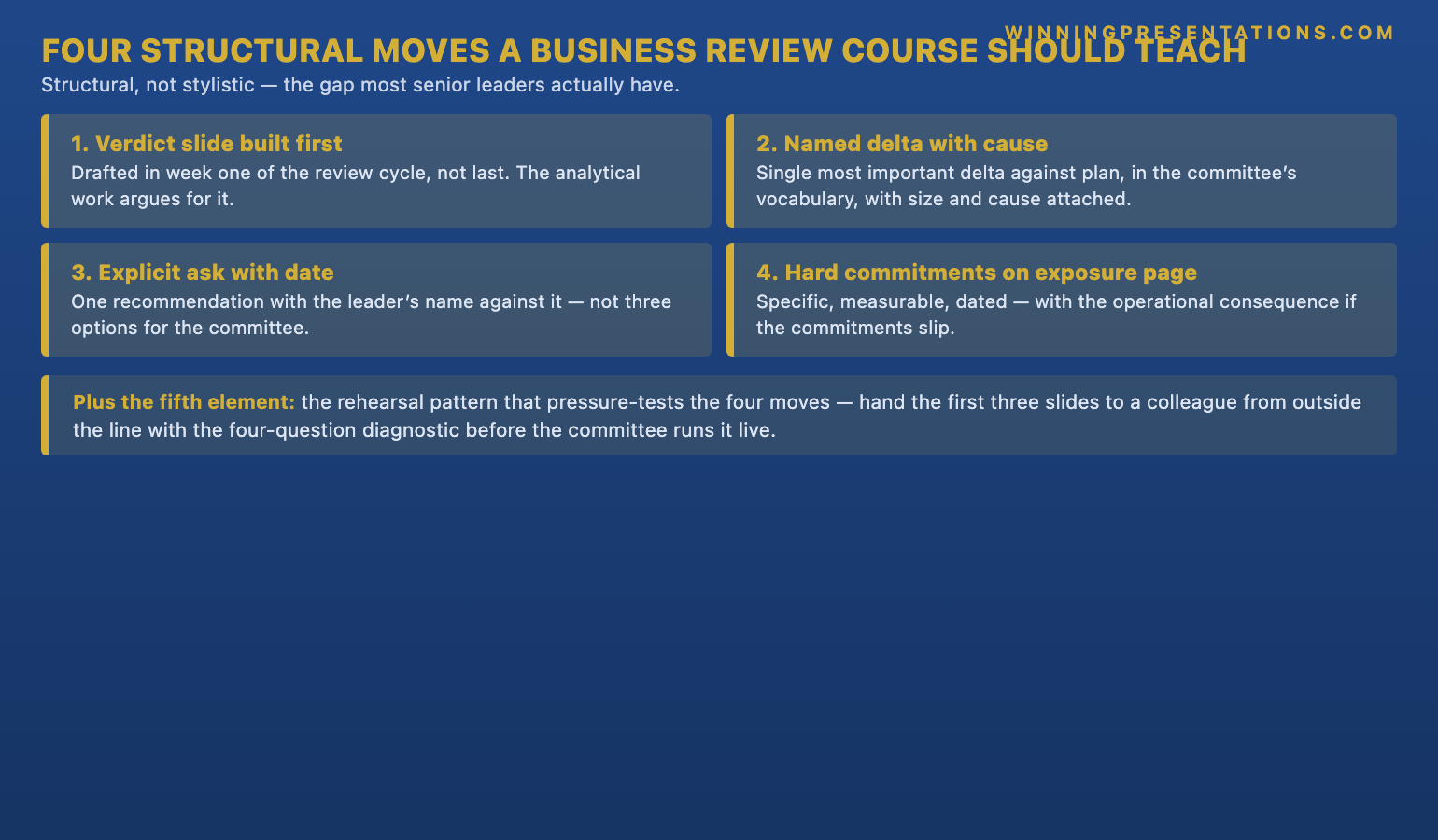
The four structural moves a good course teaches are the verdict slide built first, the named delta with cause attached, the explicit H2 ask, and the leader’s own exposure on the next-period commitments. The verdict slide built first — before the analytical work is finished, in draft form on a sticky note in week one of the review cycle — is the leadership move that changes how the analytical work itself gets run. The named delta with cause attached converts the bridge analysis from a status report into a leadership statement. The explicit H2 ask is the single sentence that turns the review from a meeting into a decision. The personal exposure on the next-period commitments is the trust signal that gets the committee’s engagement. Four moves, learnable, applicable across H1 reviews, quarterly business reviews, board updates, and audit-committee sessions. The leaders who learn the four moves perform consistently better in senior reviews than the leaders who do not, regardless of analytical depth.
The rehearsal pattern is the fifth element a good course needs to teach — the way the four structural moves get pressure-tested in the days before the committee, by colleagues from outside the line, with a specific four-question diagnostic. Most leaders rehearse the wrong way for senior reviews: they walk through the deck out loud, time the run-through, smooth out the transitions. The rehearsal pattern that works for senior reviews tests the structural integrity of the verdict, the named delta, the ask, and the commitments by handing the first three slides to a colleague from outside the line and watching them try to answer the four questions cleanly. The rehearsal pattern is not stylistic; it is structural diagnostic. A course that does not teach this pattern is teaching the wrong skill for senior reviews. A course that teaches it changes the leader’s preparation routine permanently. The 3Ps framework rehearsal cadence covers the same discipline in more depth as a free-standing reference article.
Self-paced versus live: which works for senior leaders
The question senior leaders most often ask when looking at a business review presentation course is whether they need a live programme — a scheduled cohort with weekly classes — or whether a self-paced programme is sufficient. The answer, in my experience with the leaders I coach, is that self-paced is materially better suited to senior leaders for three specific reasons. Senior leaders cannot reliably commit to a fixed weekly slot for 6-8 weeks; the operational calendar at the senior level is interrupted by board meetings, regulatory commitments, client moments, and travel that any live cohort would struggle to accommodate. Self-paced removes the scheduling friction entirely. The leader works through the material around the rhythm of their own committee preparation, when the material is most useful to them, rather than when the cohort calendar dictates.
The second reason is that self-paced programmes can be re-entered. A leader who works through a course in March, preparing for an April review, returns to the same material in October preparing for the year-end review and gets value from the second pass that the first pass did not deliver. Live cohorts run once and end. The material may be available afterwards as recordings, but the active engagement structure of the cohort is not re-entered. Senior leaders who have invested in the structural learning need it to compound across multiple review cycles, and self-paced material compounds in a way live cohorts do not.
The third reason is that the cohort dynamic in a typical live programme is calibrated to mid-career professionals working through the material together, with peer interaction as part of the learning. Senior leaders frequently find the peer-interaction element less valuable than the material itself, particularly when the cohort includes mid-career professionals working on different review scales than the senior leader’s. The senior leader benefits from the structural content; the cohort interaction is, for them, friction. Self-paced removes the friction and delivers the content directly. Optional recorded live Q&A calls — which the better self-paced programmes include — give the senior leader the option of engaging with the peer dynamic if it adds value, without making it mandatory if it does not. This is the structure the Executive Buy-In Presentation System uses.
The Executive Buy-In Presentation System is the self-paced programme senior leaders use to land the four structural moves and the rehearsal pattern that pressure-tests them.
It is built around the framework for securing buy-in from senior stakeholders — the four structural moves that distinguish the business review the committee acts on from the one it absorbs and forgets. Self-paced with monthly cohort enrolment. Optional live Q&A sessions, fully recorded — watch back anytime. Built on 24 years in corporate banking and 16 years coaching senior professionals across financial services, insurance, consulting, and technology.
- Self-paced programme with monthly cohort enrolment — start when your next review cycle opens, not when a course timetable says so
- 7 modules covering the verdict slide, the named delta, the explicit ask, the commitments page, and the rehearsal pattern that pressure-tests them
- No deadlines, no mandatory session attendance — work through the material around the rhythm of your own review preparation
- Optional live Q&A sessions, fully recorded — watch back anytime, including the sessions covering committee-specific scenarios you can return to ahead of future reviews
- Lifetime access to materials — usable across every business review cycle, not just the one in front of you now
- Join the next cohort — new enrolment opens every month — £499
The Executive Buy-In Presentation System: what it covers
The Executive Buy-In Presentation System is structured as 7 modules of self-paced material. Module one covers the verdict slide — the four-line structure, the built-first discipline, the named-verb test, and the pressure test that confirms the verdict survives the analytical work. Module two covers the named delta — the bridge analysis structure, the cause-attached framing, the committee-vocabulary translation, and the size-of-delta calibration. Module three covers the explicit H2 (or next-quarter) ask — the single-sentence framing, the named-recommendation discipline, the implicit-to-explicit conversion, and the date attachment that turns the ask into a decision the committee can act on. Module four covers the commitments page — the hard-versus-soft contrast, the personal exposure framing, the dated-and-measurable discipline, and the year-end implication of writing the commitments down at the H1 mark. Modules five through seven cover the rehearsal pattern, the diagnostic, and the structural responses to the most common committee questions, with worked examples from senior committees across financial services, consulting, and operating businesses.
The programme is built around the framework for securing buy-in from senior stakeholders — the four structural moves and the rehearsal pattern apply directly to the H1 review, the quarterly business review, the board update, and the strategic decision presentation. The buy-in framing is not abstract; it is the practical answer to the question of how a senior leader walks into a committee with the room already in support before the deck opens. The same framework that gets a board approval also gets an H1 review approved cleanly. The course covers both applications and the structural variations between them.
The format is self-paced, with optional live Q&A sessions that are fully recorded and watchable back at any time. The cohort is the enrolment batch, not a live structured programme; the cohort meaning is administrative rather than pedagogical. New cohorts open every month, so a leader can enrol when the next review cycle is on the calendar and work through the material in the weeks leading up to the review. Lifetime access to the materials means the same content is available for the H2 review, the next year’s H1, and the H1 after that. The investment is £499 once. The cost is recouped, in my experience with the leaders who use it, on the first review where the structural moves change the committee’s engagement.
The slide library that ships alongside
The Executive Slide System is the slide library senior leaders use alongside the Executive Buy-In Presentation System — the templates the four structural moves sit inside, the slide formats committees actually engage with, and the AI prompts that compress the deck-build time from six hours to ninety minutes per slide. The two products are complementary: the Buy-In System teaches the structural method, the Slide System ships the templates. Senior leaders frequently buy both at the same time and use them in parallel during the deck preparation. The Slide System on its own is the right answer for leaders who already understand the structural method and need the templates; the Buy-In System on its own is the right answer for leaders who need the structural method first and will build their own templates afterwards. Most senior leaders find both useful.
The slide templates the four structural moves sit inside.
The Executive Slide System ships 26 Executive Templates, 93 AI Prompts, 16 Scenario Playbooks, and 7 Checklists — including the verdict-slide format, the named-delta bridge layout, the H2-ask page, and the commitments page. Instant download, lifetime access. £39.
Who the course is for — and who it is not
The Executive Buy-In Presentation System is built for senior professionals who present business reviews at the executive committee or board level. That includes operating-line heads in banks, insurance groups, asset-management firms, and consulting partnerships; division heads in operating businesses; partners and managing directors in professional services; and senior leaders in healthcare, biotech, and technology firms who present to executive committees, investment committees, audit committees, or boards. The structural content is sector-agnostic. The audience profile is the senior leader who is making decisions in front of senior approvers, with the firm’s capital, risk, or strategic direction on the table.
The programme is not the right answer for early-career professionals working on their first internal presentations. The structural moves it teaches assume the leader has the analytical content already and needs the leadership-stance moves to layer on top. Early-career professionals are usually working on the analytical content itself, and a programme calibrated to senior reviews moves at the wrong altitude for them. There are other resources better suited to early-career presentation skills; this programme is not one of them.
The programme is also not the right answer for leaders whose specific challenge is acute presentation anxiety rather than structural deck weakness. The four structural moves reduce the ambiguity anxiety feeds on, but the underlying anxiety work, if it is acute, is different work and needs a different starting point. Leaders in that situation are better served by Calm Under Pressure or Conquer Your Fear of Public Speaking first, and the Buy-In System afterwards once the anxiety foundation is in place. The two pieces of work are complementary but sequenced. The executive buy-in framework covers the structural method as a free-standing reference for leaders who want to test the approach before enrolling.
One thing to do before enrolling
Pull out the most recent business review deck you presented — the H1, the quarterly, or the most recent committee paper. Read slide one aloud. Then read the verdict slide, wherever it sits in the deck. Then look for the explicit ask. If slide one names what the committee was being asked to do, the verdict is on slide three or earlier in committed leadership language, and the ask is somewhere in the deck as a single sentence with a date attached, the structural method is largely already in place and the programme will refine the work rather than introduce it. If the verdict sits on slide twenty-something, slide one names a process, or the ask is implicit in the analytical pages without ever being written as one sentence, the structural method is the gap, and the programme is built for exactly that gap. Five minutes with the most recent deck is the diagnostic for whether to enrol. The decks tell their own story.
Frequently asked questions
Is this worth £499 if I already present business reviews and my deliveries go down well?
The question turns on a specific distinction. “Going down well” can mean two structurally different things. One: the committee absorbs the deck cordially, asks polite clarifying questions, and the leader walks out without an explicit decision — the “come back next month with a tighter version” pattern. Two: the committee engages with the substance, takes the explicit decision the leader has asked for, and the leader walks out with the next-period plan approved. The first pattern feels like a successful presentation; the second pattern is a successful presentation. The programme is built to convert pattern one into pattern two. If your reviews are already consistently in pattern two, the programme will refine your work rather than introduce new methods. If they are in pattern one and you have been treating that as the natural shape of senior reviews, the programme is built for exactly the gap you may not have named yet.
How long does it take to work through the seven modules?
Most senior leaders working at the pace their schedule allows complete the seven modules in four to six weeks of intermittent engagement — roughly two to three hours per module, spaced across whatever evenings or weekend slots are available, with a typical pattern of two modules in week one, the rehearsal pattern module in week two, and the remaining modules across weeks three and four. The course is not designed to be completed in a fixed period; the lifetime access means leaders can stretch the engagement across a full review cycle (returning to specific modules as the cycle exposes the relevant gaps) or compress it into a focused two-week sprint before a specific review. Both patterns work. The leaders who get the most out of the programme tend to return to the modules across multiple cycles rather than treating it as a one-pass course.
Are there company-specific or industry-specific scenarios in the course?
The worked examples in the modules come from financial services, consulting, insurance, and operating-business contexts — the sectors I have spent the most time coaching senior leaders in over the last sixteen years. The structural method is sector-agnostic and applies directly in healthcare, biotech, technology, and government leadership reviews, but the worked examples are drawn from the sectors above. Leaders in adjacent sectors typically find the structural method transfers cleanly and the vocabulary translation between sectors takes about an hour of personal reflection on the specific committee they are presenting to. Optional live Q&A sessions are an opportunity to bring sector-specific questions, and the recordings of past sessions cover a range of sector applications.
Can I use the programme if I am in a new senior role and have not yet presented my first business review in the new seat?
The programme is particularly useful in this case. The first business review in a new senior seat is often the moment the structural gap between the analytical content and the leadership-stance moves becomes visible to the leader, and walking into the first review with the four structural moves already learned is a different experience from learning them under the live pressure of the review itself. Several of the leaders I have coached through their first H1 in a new role have used the programme in the eight to twelve weeks before the first review, and have reported that the structural foundation made the first review materially easier to prepare for and walk into. The lifetime access means the same material is then available for the second and third reviews in the same role, with the leader returning to specific modules as the cycle exposes the relevant gaps.
The Winning Edge — weekly newsletter
The Winning Edge is a weekly (Thursday) newsletter for senior professionals who present at the executive level. One short email a week, focused on the structural moves that separate the business reviews committees act on from the ones they absorb and forget. Subscribe to The Winning Edge →
For the broader picture across slides, storytelling, confidence, and delivery, the seven-product Complete Presenter library is the bundle most senior professionals find useful as a single resource — £99 for everything, lifetime access.
About the author
Mary Beth Hazeldine is Owner & Managing Director of Winning Presentations Ltd. With 24 years of corporate banking experience at JPMorgan Chase, PwC, Royal Bank of Scotland, and Commerzbank, she advises senior professionals across financial services, insurance, consulting, and technology on the structural method for senior business reviews, H1 and quarterly committee presentations, and the buy-in framework that gets the room in support before the deck opens.