

Quick Answer: A presentation skills workshop for executives is the wrong format if it teaches the basics of slide design or public speaking. The right one starts from the assumption that you can already present and works on the structural patterns that earn senior decisions — deck architecture, decision-first framing, and Q&A under pressure. Self-paced formats with optional live coaching now outperform multi-day in-person workshops for most senior calendars.
JUMP TO:
Rafaela had been promoted to chief operating officer of a mid-market healthcare company three months earlier. She knew her board was watching her quarterly presentations more closely than her predecessor’s. She was already a competent presenter — she had been doing it for fifteen years. What she needed was a structural step-up. She asked her HR partner to find her “a good presentation skills workshop for executives”.
What came back was a list of seven options. A two-day in-person residential at a well-known leadership institute (£3,500). A six-week live cohort programme delivered by a US-based university (£2,800). A self-paced online programme with optional live coaching (£499). A one-on-one coaching arrangement at £850 per session. Three local UK training providers offering customised in-house workshops at varying price points.
She did not know how to evaluate them. Most of the marketing copy promised the same outcomes. The price range was wide enough that “you get what you pay for” felt unreliable as a heuristic. She wanted to know what an executive at her level should actually look for, not what the brochures said.
If you are evaluating presentation training for an executive role
The Maven AI-Enhanced Presentation Mastery programme is built specifically for senior leaders — self-paced, with optional live coaching, designed around real executive scenarios rather than generic public speaking technique.
Why most presentation workshops fail senior leaders
Most presentation skills workshops are designed for an audience that does not match a senior executive’s situation. The implicit user is a mid-career professional who needs to learn the basics of slide design, vocal projection and structuring a presentation. The content reflects that.
For a senior executive, this is the wrong starting point. You can already structure a presentation. You can already deliver in front of a room. The skill gap is structural and audience-specific: how to architect a deck that earns a decision from a risk-averse CEO, how to handle Q&A from an investment committee, how to land a strategic case in front of a board that is allocating capital. A workshop that spends two hours on body language fundamentals is wasting the time of an executive who needs the next-level material.
Three patterns of workshop that frequently underperform for senior leaders:
The all-purpose corporate training course. Often delivered by HR-procured providers, designed for cohorts that include managers, technical leads and senior leaders together. The content is set at the level of the most junior participant. The senior executive learns nothing new and dis-engages within the first hour.
The motivational keynote speaker. Polished delivery, strong presence, branded methodology. The content is largely about confidence, charisma and personal storytelling. None of it transfers to a Tuesday morning capex committee. Senior leaders who attend these report enjoying them and applying very little.
The residential leadership institute. Multi-day, expensive, designed around peer learning and reflection. Useful for mid-career leaders building their executive identity. Less useful for an executive who needs specific structural fixes for the meetings they have on the calendar this quarter. The cost-to-applicability ratio is poor.
What an executive-grade workshop actually teaches
An executive-grade presentation programme — whether delivered as a workshop, a course, or a coaching engagement — covers a specific set of competencies that the generic workshops skip.
- Deck architecture by audience type. A board deck, a finance committee deck, an investor pitch and a customer presentation each have different structural rules. A workshop that teaches “how to structure a deck” generically teaches none of them well.
- Decision-first framing. The opening sentence, opening slide and opening five minutes of any high-stakes executive presentation should anchor the decision being asked for. Most generic workshops still teach “tell them what you’re going to tell them” openings, which actively hurt executive credibility.
- Risk and downside structure. Senior executives present to senior decision-makers, who are usually risk-aware. The structure for surfacing downside, naming residual risk and proposing mitigation is what earns approval — and it is rarely covered in generic training.
- Q&A under pressure. The hostile question, the question you cannot answer, the question that reveals a gap in your case — all of these have specific techniques that the generic workshops do not address.
- Remote, hybrid and in-person variants. The structural rules for each format differ enough that an executive needs to be fluent in all three. A workshop that only addresses one format is incomplete.
- Slide design at executive standard. Not “use less text”. Specific patterns — the question-led title, the headline-answer slide, the appendix navigation pattern — that experienced executives recognise as senior.
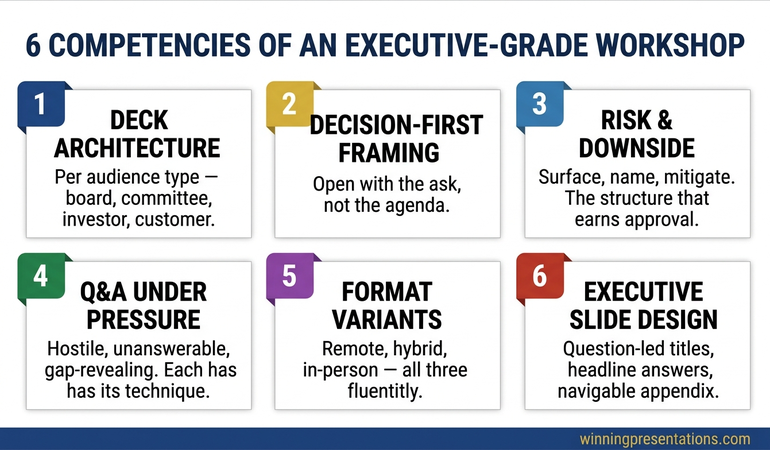
If a programme cannot show you specifically how it teaches each of these six competencies, it is not built for an executive audience — regardless of how the marketing positions it.
MAVEN AI-ENHANCED PRESENTATION MASTERY — £499
A self-paced executive programme with optional live coaching
AI-Enhanced Presentation Mastery is the self-paced Maven programme for senior leaders — 8 modules, 83 lessons, optional live coaching sessions with Mary Beth (fully recorded). Built around the executive scenarios listed above, with AI-assisted slide preparation patterns. New cohorts open every month. £499 per seat. Enrolment is open — join at your own pace.
Designed for senior leaders presenting to boards, investment committees and senior stakeholders.
Formats: live, self-paced, hybrid
The format question matters as much as the content question. A two-day in-person residential delivers content that a five-hour self-paced programme can also deliver, often at a fraction of the price. The choice depends on what an executive actually needs.
Live in-person workshop (1–3 days). Best for: leaders whose primary need is peer interaction, role-play and direct feedback in front of others. Cost typically £1,500–£5,000 per seat. Time investment is significant — including travel, this is usually 3–5 days out of the calendar.
Live virtual cohort (multi-week). Best for: leaders who value structured pacing, peer accountability and live discussion but cannot lose multiple days to travel. Cost typically £500–£3,000. Calendar load is 1–2 hours per week over several weeks.
Self-paced online programme. Best for: senior executives whose calendars cannot accommodate fixed live sessions. Cost typically £200–£800. Time investment is fully under the executive’s control. The trade-off is no live peer cohort — though some self-paced programmes now offer optional live coaching to bridge this.
One-on-one coaching. Best for: a specific upcoming high-stakes presentation, or a leader who has identified one or two structural patterns to fix. Cost typically £400–£1,500 per session. Highly targeted; less suited to broader skill development.
Hybrid programmes. A growing number of providers now combine self-paced course material with optional live coaching sessions and an asynchronous cohort. This is the format that has performed best for the senior executives I work with in 2025–2026 — it removes the calendar pain of pure live programmes while preserving access to coaching when it is genuinely useful.
The Maven AI-Enhanced Presentation Mastery programme runs in this hybrid format: self-paced lessons with optional, fully recorded live coaching sessions and a community of peers progressing at their own pace.
For executives whose specific need is the senior-stakeholder presentation skill set, the related senior executive presentation skills guide covers the competency map in more detail.
The questions to ask any provider before committing
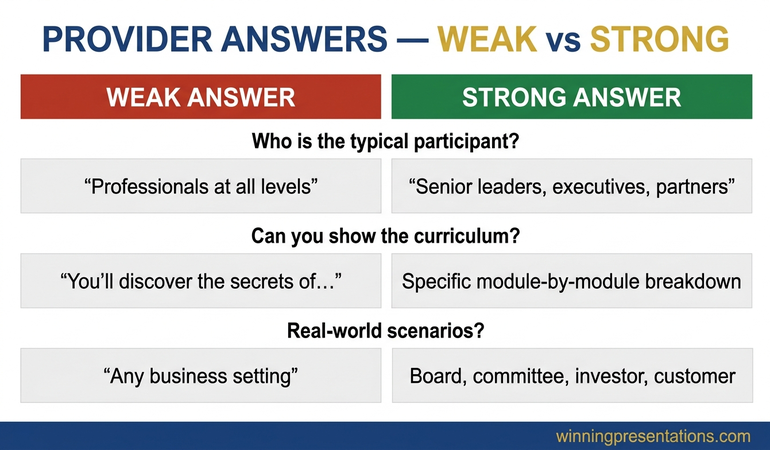
Five questions that will quickly tell you whether a presentation skills workshop is built for senior executives or for a broader audience.
Who is the typical participant? The right answer is some version of “senior leaders, executives, partners, directors”. The wrong answer is “professionals at all levels”. A workshop that aims at all levels will land at the level of the most junior participant.
Can you show me the curriculum module by module? A serious provider can. A provider running a generic workshop will offer marketing language (“you’ll discover the secrets of…”) instead of specific module titles. The curriculum tells you what the workshop actually teaches.
What real-world executive scenarios does the programme work through? The right answer names specific scenarios — board presentations, investor pitches, committee approvals, stakeholder briefings. The wrong answer is generic (“you’ll be able to present in any business setting”).
Who delivers it, and what is their executive background? A workshop for executives should be delivered by someone with substantive experience advising executives — not by a trainer who has only delivered training. Ask for the lead instructor’s biography. Look for evidence they have advised at the level you operate at.
Can I speak to a recent senior participant? If the answer is yes — with a specific reference name, not “we’ll send you some testimonials” — that is a strong signal. If the answer is evasive, that is a weak signal regardless of how good the marketing looks.
What to budget
For an individual senior executive choosing for themselves, the practical budget bands are:
- Under £100: A book, a short course or a single piece of structured material. Useful for a specific narrow skill. Not a substitute for a programme.
- £100–£500: A self-paced executive programme or a focused short course. The most cost-effective tier for a competent presenter who needs a structural step-up.
- £500–£1,500: A hybrid programme with live coaching, a multi-week virtual cohort, or one or two coaching sessions. The right tier when you have a specific upcoming presentation challenge.
- £1,500–£5,000: Live in-person workshops, residential programmes or extended coaching engagements. The right tier when peer learning, immersive practice or in-person feedback is the primary need.
- £5,000+: Bespoke executive coaching, multi-month engagements, custom in-house workshops for a leadership team. The right tier when the development is part of a broader executive transition.
The pattern most senior executives in 2026 use is to start in the £500–£1,500 band with a hybrid programme, and add one or two targeted coaching sessions only if a specific gap remains afterwards.
Choosing for yourself versus your team
Choosing a workshop for yourself is one decision. Procuring training for a team of senior leaders is a different one. The procurement choice has additional considerations.
For a leadership team, fewer formats work well. In-person residential programmes scale poorly — they impose the same calendar burden on every participant simultaneously. Self-paced programmes scale better — each leader works through the material at their own pace, with optional cohort or coaching elements where useful. Hybrid programmes (self-paced plus live coaching) are now the dominant format for senior team development for this reason.
If you are choosing on behalf of a team, the additional questions to ask: Does the provider offer a team licence model that does not require everyone to be in the same cohort? Can the lead instructor deliver one or two custom sessions specifically for your team’s context? What does the post-programme reinforcement look like — the gap between training delivery and actual on-the-job application is where most workshops fail.
For team members who specifically need the executive-PowerPoint and AI-assisted slide skills, the related executive PowerPoint training online guide covers that specific competency.
FOR SENIOR LEADERS WHO NEED THE STRUCTURAL STEP-UP
A self-paced executive programme designed around real scenarios
Maven AI-Enhanced Presentation Mastery covers the six executive competencies referenced above — deck architecture, decision-first framing, risk structure, Q&A, format variants and slide design — in a self-paced format with optional live coaching. New cohorts open every month. £499 per seat.
Frequently Asked Questions
Are in-person workshops better than online for senior executives?
Not generally. In-person formats deliver more peer interaction and immersive practice, but at a high calendar cost. For most senior executives, the decision criterion is whether peer interaction or live coaching is the primary need. If yes, live formats add value. If the primary need is structural skill development, well-designed self-paced or hybrid programmes deliver equivalent outcomes at a lower cost and time burden.
How long should a presentation skills workshop for executives take to complete?
The realistic time investment is 8–15 hours of focused learning, plus practice on real upcoming presentations. Programmes that promise transformation in two hours usually deliver inspiration without skill change. Programmes that require 40+ hours over multiple months tend to lose senior leaders to calendar pressure. The 8–15 hour band is where most credible executive programmes land.
Is one-on-one coaching better than a workshop for executives?
It depends on the goal. For a specific upcoming high-stakes presentation, targeted coaching is more efficient. For broader skill development, a structured programme covers more ground than coaching for the same investment. Many senior executives use both — a programme for the structural skills, coaching as needed for specific events.
What if my employer pays for training — should I pick something more expensive?
The price tier matters less than the fit. An employer-funded £3,000 in-person workshop that does not address your actual gap is worse value than a self-funded £499 programme that does. Use the budget to pick the right format and content rather than the most expensive option. If the budget is significant, consider combining a structured programme with one or two coaching sessions for the highest impact.
Presentation playbooks, delivered Thursdays
The Winning Edge newsletter covers the structures real executives use for high-stakes meetings — the practical frameworks the workshops do not always teach. One issue per week, typically read in four minutes.
Not ready for a full programme? Start here instead: download the free Executive Presentation Checklist — a one-page structural review for any high-stakes presentation you are preparing.
Partner post: If your immediate need is a virtual board presentation rather than broader skill development, the virtual board meeting presentation guide covers the structural rules for that scenario.
Your next step: Before you compare workshops, write down the three specific presentation scenarios you have on the calendar in the next quarter. Use them as the test for any programme. If the curriculum does not address those scenarios specifically, it is not the right programme — regardless of price.
About the Author
Mary Beth Hazeldine is Owner & Managing Director of Winning Presentations Ltd. With 24 years of corporate banking experience at JPMorgan Chase, PwC, Royal Bank of Scotland, and Commerzbank, she advises executives across financial services, healthcare, technology, and government on structuring presentations for high-stakes funding rounds and approvals.