

Quick answer: Presenting to the C-suite for the first time calls for a 7-day preparation protocol that works backwards from the meeting. Day 7: read the room (who, what they care about, what is on their plate). Day 6: write the recommendation in one sentence. Day 5: build the case behind it. Day 4: pre-empt the three hardest questions. Day 3: rehearse the opening cold. Day 2: send the pre-read. Day 1: rest, walk, light review. The protocol is about removing surprises, not about adding polish. C-suite audiences punish unfamiliarity, not imperfection.
Jump to:
Henrik had been promoted into a director role six weeks earlier when the calendar invite landed: forty minutes on the executive committee agenda, two weeks out, presenting the technology investment case that would shape the next eighteen months of the function. He had presented to senior managers many times. He had never presented to the C-suite. The preparation he applied was the preparation he knew — build the deck, rehearse the narrative, refine the slides. By the time the meeting arrived, the deck was strong. The meeting was difficult. The deck answered questions the room was not asking, and skipped past the ones the room actually had.
A first C-suite presentation is not a scaled-up version of a senior manager presentation. The audience is structurally different. The reading habits are different. The questions arrive in a different order. The preparation that works at the senior management level — sharpen the deck, rehearse the narrative, walk in confident — is the preparation that misses the point at the executive committee level. The room is reading the proposal differently before the presenter has spoken a word.
The 7-day preparation protocol below is the structure senior leaders use when preparing for a first C-suite presentation. It works backwards from the meeting and front-loads the work that most first-timers skip. The protocol is about removing surprises before the meeting starts, not about adding polish at the end. C-suite audiences punish unfamiliarity with the room far more than they punish minor imperfections in the deck.
If your first C-suite presentation is on the calendar
The Executive Buy-In Presentation System covers the structures senior professionals use when an executive committee decision rides on a single presentation. 7 self-paced modules including stakeholder analysis, case construction, and the slide structures that hold up under C-suite scrutiny. Monthly cohort enrolment, optional recorded Q&A sessions.
Why a C-suite audience is structurally different
Senior managers commission work, evaluate progress, and decide on tactical questions inside a function. C-suite audiences allocate capital, make trade-offs across functions, and decide what the organisation does and does not do. The shift in altitude changes how decks are read. A senior manager reads the analysis. A C-suite executive reads the recommendation, the trade-off, and the implication for resources. Three different reads happen in the first ninety seconds, and the deck has to answer all three.
The C-suite is also reading you. Function leaders watch the executive committee for promotability signals — the ability to think across functions, the comfort with trade-offs, the absence of operational reflexes when the room is asking strategic questions. A presenter who walks the room through the analysis is reading as operational. A presenter who walks the room through the trade-off, the alternative considered, and the resource implication is reading as strategic. The difference is preparation, not personality.
Time pressure compounds the difference. Most C-suite agendas allocate twenty to forty minutes per topic. Within that, the discussion takes more than half. Twelve to fifteen minutes of presenting time is typical. A senior manager presentation that runs forty-five minutes will not survive the compression. The deck and the narrative both need to be cut to fit, without losing the elements the room actually needs.
The 7-day preparation protocol, day by day
The protocol works backwards from the meeting. Day 7 is the day before the meeting. The earlier days are numbered counting back. Each day has one main task. The protocol is intentionally structured to keep deck-building work in the middle, with reading, framing, and recovery on either side.
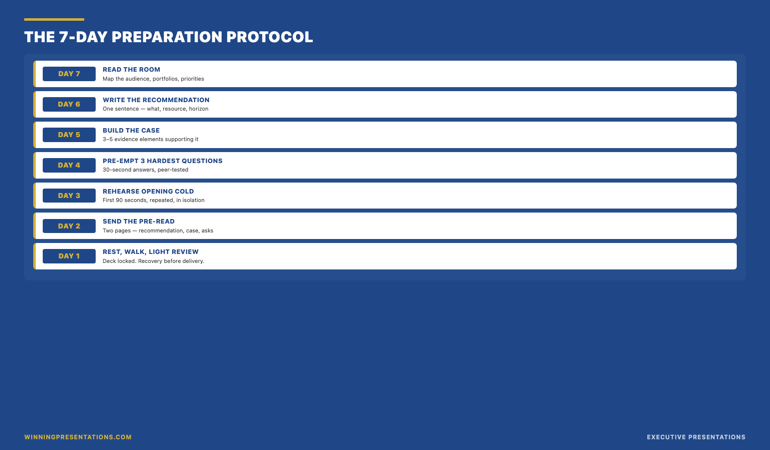
Day 7 (one week out) — Read the room. Spend two to three hours mapping the audience. Who is on the executive committee. What each member’s portfolio is. What is on each member’s plate this quarter — the strategic priorities, the ongoing tensions, the topics under scrutiny in their function. Not gossip. Public information, sponsor briefings, prior meeting minutes, recent townhalls. Most first-time C-suite presenters skip this step entirely and walk in with a deck that is structurally strong but audience-blind. Reading the room is the highest-leverage hour of the seven-day protocol.
Day 6 — Write the recommendation in one sentence. Before any slide is built, write the recommendation as a single sentence on a single piece of paper. The sentence has to do three things: name what is being recommended, name the resource implication, and name the time horizon. If any of those three is missing, the sentence is not yet ready. Most first-time presenters discover that the recommendation they thought was clear becomes vague when forced into one sentence. The clarification is where the presentation actually starts.
Day 5 — Build the case behind the recommendation. The recommendation from Day 6 is the conclusion. Day 5 builds the evidence that supports it. Three to five evidence elements: the data, the strategic logic, the alternative considered, the resource trade-off, the timing rationale. Each element is one slide or one section. The discipline is to prove the recommendation, not to walk the room through the analytical journey that produced it. Senior managers value the journey. C-suite audiences value the proof.
Day 4 — Pre-empt the three hardest questions. Spend an hour identifying the three questions you are most afraid will come up. Write a thirty-second answer to each. Then test them on someone whose judgement you trust. The test is not whether the answer sounds good — it is whether the answer holds up to one or two follow-up questions. If the answer collapses on the second follow-up, the answer is not yet ready. Most first-time presenters under-prepare for hard questions because preparing for them feels like inviting them. The opposite is true. The questions arrive whether or not you have prepared, and prepared answers convert challenge into credibility.
For senior leaders preparing for a first C-suite presentation
The Executive Buy-In Presentation System — the framework senior professionals use when an executive committee decision rides on one meeting
Walk into your first C-suite meeting with the structure that surfaces the answers the room needs in the order it needs them. The Executive Buy-In Presentation System is a self-paced framework — 7 modules covering stakeholder analysis, case construction, and the slide structures that produce sign-off at executive committee level. Monthly cohort enrolment.
- 7 self-paced modules covering stakeholder analysis, case construction, and the structures that earn senior approval
- Optional live Q&A / coaching calls — fully recorded, watch back at your own pace
- No deadlines, no mandatory live attendance, lifetime access to materials
- Monthly cohort enrolment — enrol any time, start with the next cohort
£499 · Self-paced · Lifetime access to materials · Next cohort enrolment opens monthly
Day 3 — Rehearse the opening cold. The first ninety seconds set the room. Rehearse the opening — the first three sentences and the first slide — as a stand-alone unit. Cold, no warm-up, no second take. Then again. Then again. Most first-time presenters rehearse the whole deck and never rehearse the opening separately. The opening rehearsed in isolation lands more cleanly because it has been said aloud enough times that the body does not interfere with the words. The rest of the deck rehearses faster once the opening is solid.
Day 2 — Send the pre-read. Most C-suite meetings expect a pre-read forty-eight hours in advance. The pre-read is not the deck. It is a two-page summary: the recommendation, the case in three bullets, the trade-off, the asks. The pre-read does the work the deck cannot do — it lets the room arrive with the case already in mind, which means the meeting becomes a conversation about specific concerns rather than a first encounter with the proposal. Skipping the pre-read is the most common first-time error. The meeting is materially harder when it has not been pre-read.
Five preparation mistakes first-timers make
Day 1 — Rest, walk, light review. The day before the meeting is for cognitive recovery, not for last-minute changes. A walk, a meal, a light review of the recommendation and the opening. Heavy preparation on Day 1 introduces volatility — last-minute slide edits create uncertainty about which version is current, last-minute rehearsals tire the voice, last-minute “what if I added” thoughts become the rabbit holes that ruin sleep. The deck is locked the day before. The presenter is rested. The meeting goes better when both are true.
Mistake one — preparing the deck before reading the room. The most consequential first-time error. The deck gets built around the topic rather than around the audience, and the topic-driven deck answers questions the room is not asking while skipping the ones the room actually has. The fix is to spend Day 7 reading the room before any slide is touched, and to build the deck on Day 5 with the audience map open on the desk.
Mistake two — over-preparing the analysis. Senior managers reward analytical depth. C-suite audiences reward analytical clarity. Forty slides of detailed methodology will read as operational thinking at the executive committee level, regardless of how rigorous the analysis is. The preparation effort is better spent on the trade-off, the alternative considered, and the resource implication — the questions that distinguish strategic thinking from tactical execution.
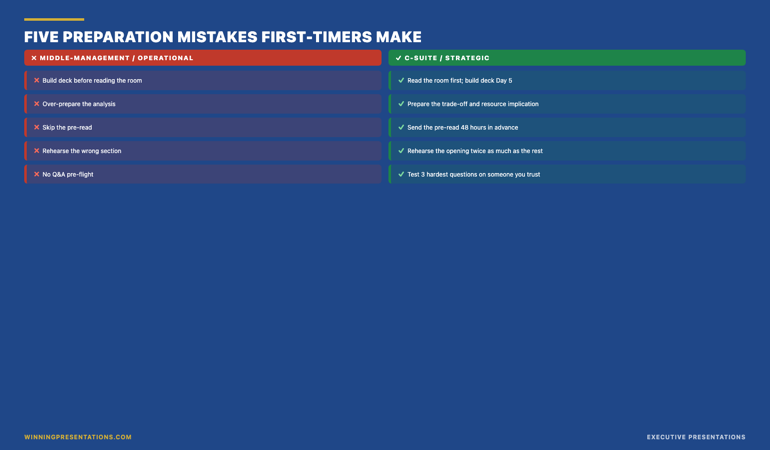
Mistake three — skipping the pre-read. The pre-read is not optional at executive committee level. Walking into a C-suite meeting with no pre-read sent forces the meeting to become a first encounter with the case, which compresses the time available for the actual decision. The pre-read takes ninety minutes to write and saves five to ten minutes of meeting time — minutes that are otherwise lost to context that should already be known.
Mistake four — rehearsing the wrong section. First-time presenters tend to rehearse the slides they are most worried about delivering well. The slides that matter for the meeting are the opening and the recommendation. Those are the slides that set the room. Rehearsing the middle slides is useful but lower-leverage. Rehearse the opening twice as many times as anything else.
Mistake five — walking in without a Q&A pre-flight. The Q&A is where the meeting decides. Many first-time presenters prepare the deck thoroughly and prepare the Q&A barely at all. The pre-flight is the Day 4 task — three hardest questions, thirty-second answers, tested on someone whose judgement you trust. A presenter who has done the pre-flight handles the Q&A with composure. A presenter who has not done it improvises, and the improvisation rarely lands as well as the prepared answer.
Reading the room before the meeting
The Day 7 task — reading the room — is what distinguishes the C-suite preparation protocol from a senior manager preparation protocol. It is the work most first-timers skip and the work that most reliably changes the meeting. The room reading is not gossip and not psychoanalysis. It is the audience map that tells the presenter which member is going to read which slide most critically.
The CFO reads the financial slide first. Whatever else is happening in the deck, the CFO is calibrating against the resource implication. A pre-read that does not name the resource implication on page one is a pre-read the CFO will read in a different order than the rest of the room — searching for the number, then reading backwards from there. Naming the resource implication early aligns the CFO’s read with everyone else’s, which produces a meeting where the CFO and the chair are reading the same case at the same time.
The CEO reads the strategic alignment. The CEO is testing whether the proposal coheres with the broader portfolio of decisions the executive committee is making. A proposal that is internally rigorous but doesn’t explicitly connect to one of the strategic priorities is read as plausible but unfunded — the CEO will challenge the proposal not on its own merits but on the relative claim it has on attention. The fix is one paragraph in the pre-read that names the strategic alignment explicitly.
The functional peers read the cross-functional implications. If the proposal touches another function’s resources or commitments, that function’s leader is reading the deck for the implication on their own portfolio. A surprise in that slide creates a moment of resistance that takes the room minutes to recover from. Pre-empting the cross-functional implication — naming it in the pre-read, having had a private conversation with the affected function leader before the meeting — is what removes the surprise. The structural patterns of board-level presentations apply at the executive committee level too — same audience reading habits, slightly different decision rights.
Slide structure for the C-suite deck
The Executive Slide System — board-ready slide templates for executive committee decks
The Executive Slide System covers 26 slide templates, 93 AI prompts, and 16 scenario playbooks for senior presenters — including recommendation slides, trade-off layouts, and resource implication structures designed for executive audiences. £39, instant download. Explore the slide system →
The opening that earns the next ten minutes
The first ninety seconds of a C-suite presentation determine how the room reads the rest of the deck. An opening that lands cleanly produces a room that listens. An opening that lands badly produces a room that starts asking pre-emptive questions before the case has been made. Most first-time presenters waste the opening on context the room already has — the project background, the team, the methodology used. The C-suite opening earns its time by doing three specific things in three specific sentences.
Sentence one — name what you are recommending. Not what the project is, not what the analysis showed. What is being recommended, in commitment terms. “Today I am asking the committee to approve a £4M two-year investment in X, with implementation starting Q3 and the first measurable outcome by Q1 next year.” The recommendation lands first. Everything else in the deck supports it. A deck that builds up to the recommendation over fifteen minutes loses the room before slide eight.
Sentence two — name the case in one line. The case for the recommendation, in one sentence that fits on a slide title. “The case is that X currently costs the firm an estimated Y per quarter in lost revenue, and the proposal addresses Z of that without committing the firm to a longer programme.” The case is the strategic logic. It does not have to be exhaustive. It has to be testable.
Sentence three — name the constraint or trade-off. What the room is being asked to give up to make this possible. The trade-off is the C-suite signal that the presenter is thinking strategically rather than operationally. “The proposal requires reallocating two FTEs from the current Y programme, which slows that programme by approximately one quarter — and the recommendation is that the trade is worth making because…” The trade-off sentence is what most first-time presenters skip. It is what most C-suite audiences are listening for.
Frequently asked questions
How long should a first C-suite presentation be?
Twelve to fifteen minutes of presenting, leaving room for substantive Q&A within the typical twenty- to forty-minute slot. Most first-time presenters prepare a thirty- to forty-minute version because that is what felt complete in rehearsal — and then either rush through it badly or get cut off ten minutes in. Aim for the shorter version from the start. The deck that runs twelve minutes lands more strongly than the deck that runs twenty-five.
Should I show every analytical step or just the conclusions?
Conclusions in the deck, analytical steps in the appendix or a separate working document. The C-suite is not testing whether the analysis was rigorous. It assumes rigour. It is testing whether the conclusions are sound and the trade-offs are well-reasoned. Walking the committee through methodology slides reads as operational thinking — the audience interprets it as a presenter who is more comfortable in the analysis than in the decision. The analytical depth is in the appendix for the executive who wants to dig in. The deck holds the conclusions and the trade-offs.
What do I do if the meeting starts running over and I am cut off?
Have a “compressed close” rehearsed in advance. Two sentences that name the recommendation, the trade-off, and the ask. If the chair signals time, deliver the compressed close cleanly and stop. The compressed close is rehearsed during the Day 3 opening practice — it is the same recommendation framing condensed into two sentences. Presenters who do not have a compressed close in their pocket tend to keep going past the time signal and damage the relationship with the chair. Presenters who have one rehearsed close cleanly and earn the chair’s respect for handling the constraint.
Should my sponsor open the meeting or should I?
The sponsor opens. A first-time presenter is helped substantially by a sponsor who frames the proposal in thirty to sixty seconds before handing over — the framing carries the proposal’s legitimacy, which the presenter does not yet have at C-suite level. The sponsor names the proposal, names why it is on the agenda today, and hands over. The presenter starts on sentence one of the prepared opening. The sponsor’s framing is not a courtesy — it is a structural part of how the room reads the proposal.
Maven cohort enrolment — open this month
Walk into your next C-suite meeting prepared for the trade-off conversation
The Executive Buy-In Presentation System teaches the case construction, stakeholder dynamics, and slide structures that produce sign-off at executive committee level. 7 self-paced modules. Monthly cohort enrolment.
£499 · Self-paced · Lifetime access · Optional recorded Q&A calls
The Winning Edge — weekly
One short note each Thursday on board-level presentation patterns, structural shortcuts, and the behaviours senior presenters use under scrutiny. Written for professionals who do not have time for newsletters that read like newsletters.
Want a structural starting point first? The free Executive Presentation Checklist covers the structural fundamentals senior presenters use before designing the deck.
For the sister discussion of audience-specific reading habits, see how to present to a CFO — many of the same dynamics apply when the CFO is one member of a wider executive committee rather than the sole audience.
Next step: Open the calendar. Find the meeting. Count back seven days. Block the Day 7 hour to read the room. The seven-day protocol works because the early days are blocked before the deck-building urge takes over. The meeting goes better when the audience map exists before the first slide is built.
Mary Beth Hazeldine is the Owner & Managing Director of Winning Presentations. With 25 years of corporate banking experience at JPMorgan Chase, PwC, Royal Bank of Scotland, and Commerzbank, she advises senior professionals across financial services, healthcare, technology, and government on structuring presentations for high-stakes board meetings, executive committees, and investment sessions. She speaks German and works extensively with the German-speaking financial markets.