

Quick answer: A regulatory finding presentation to the board is decided on slide one, not on slide forty. The chair, the audit committee chair, and any regulator dialled into the call are all reading the same first slide for the same signal: does the organisation understand the finding, own the response, and have the structural seriousness to act on it without the regulator having to escalate. The presenter who opens with the finding stated in the regulator’s own words, the scope of the breach in concrete numbers, and the remediation owner named on slide one is read as serious. The presenter who opens with a context section about the broader regulatory environment is read as the wrong person to be leading the response. The structural shape of slide one decides whether the next six months are a remediation programme or an escalation.
JUMP TO:
In 2003 I worked with a compliance director at a corporate banking division of a publicly-listed group who had been handed the job of presenting a supervisory letter finding to the board’s audit committee. The finding had landed on the chief executive’s desk on a Tuesday. The audit committee meeting was scheduled for the following Monday. The compliance director had been told he had twenty minutes on the agenda, with the regulator’s deputy director on a conference dial-in for the first part of the session. He sent me a thirty-six-slide draft on the Thursday afternoon. The deck opened with a twelve-slide context section about the broader supervisory environment, a three-slide history of the firm’s prior relationship with the regulator, and arrived at the actual finding — in the regulator’s own words — on slide nineteen. The audit committee chair, I knew from prior conversations, was not a man who tolerated context-led briefings. The regulator, on the line, would be listening specifically for whether the firm understood the finding as written or had translated it into something more comfortable. We cut the deck to nine slides over the weekend. Slide one stated the finding verbatim from the supervisory letter, named the affected business line, and named the remediation owner. The presentation landed. The next six months were a structured remediation programme. Had slide one been different, the deputy director would have been making a different recommendation to the regulator’s enforcement committee on the Tuesday.
I have watched approximately twenty regulatory finding presentations to boards and audit committees across financial services, healthcare, and a couple of energy clients in the years since. The pattern that separates the presentations that close down to a remediation programme from the ones that escalate is almost always the structural shape of slide one. The chair, the audit committee chair, and any regulator on the call are all running the same first read: does this organisation understand the finding, own it, and have the structural seriousness to act. That read is locked in on slide one. The forty-slide deck that follows can be brilliant, but if slide one signals the wrong things — context-led framing, softened language, ambiguous ownership — the read is locked in and the rest of the deck is a courtesy.
(This article was created with AI assistance; all stories and insights are based on 35 years of real client work.)
The two regulatory finding presentations I want to focus on in this article were delivered approximately five years apart, both to audit committees with the assigned supervisor on the call, both following supervisory letters of broadly similar gravity. The one that closed down to a remediation programme had slide one written in the regulator’s own words with the remediation owner named explicitly. The one that escalated had slide one written in the firm’s preferred translation of the finding with the remediation described as “to be assigned” pending board decision. The deputy directors on each call — different people, different firms — both made their assessment of the firm’s seriousness within the first slide. The first deputy director closed the call by confirming the remediation programme as adequate. The second deputy director closed the call by saying the regulator would be back in touch with a more specific request. The cost of the second outcome ran into approximately seven figures of additional supervisory engagement, external counsel, and remediation overhead over the following eighteen months. Slide one was where that cost was incurred.
Walk into your next regulatory presentation with slide one structurally correct:
The Executive Buy-In Presentation System covers the structural pattern for board-level regulatory presentations, the audit-committee opening protocol, and the rehearsal sequence that holds when the regulator is on the call. Self-paced modules, optional live Q&A calls, lifetime access.
Why slide one decides the next six months of the relationship
The audit committee meeting at which a regulatory finding is presented is structurally different from a normal-time board meeting in one specific respect: there is a third party in the room or on the line who is not on the firm’s side. The regulator’s representative is not adversarial in the everyday sense, but they are watching the firm’s response with a specific question in mind: does this organisation understand what was found, take it seriously, and have the internal authority to remediate it without supervisory escalation. The presenter who opens with context loses the regulator on the call within the first slide, because the regulator is not there for the firm’s framing of the broader environment. The regulator is there to see whether the firm can name the finding as written and own the response.
The audit committee chair is doing a parallel read. The chair knows, from years of prior regulatory engagements, that the firm’s relationship with the regulator over the next six months is set by the audit committee’s response in this meeting. If the response signals seriousness — finding stated verbatim, scope named in concrete numbers, owner identified by name and seniority — the regulator usually accepts the response as adequate and the engagement closes down to a structured remediation programme. If the response signals softening, ambiguity, or context-first framing, the regulator’s deputy director almost always escalates, either by formal follow-up letter or by referral to the supervisory team for deeper engagement. The audit committee chair has seen this pattern before, and they are reading slide one for the signal.
The cost of getting slide one wrong is not theoretical. The seven-figure escalation cost I mentioned at the top of this article is a midpoint estimate for the kind of firm that escalates a moderate supervisory finding because slide one was structurally weak. The cost is borne in additional supervisory hours, external counsel, internal remediation overhead, and the opportunity cost of senior leadership attention being absorbed by the regulatory engagement for the following twelve to eighteen months. The compliance director who gets slide one right is not just landing a good presentation; they are saving the organisation a multiple of their annual cost in remediation overhead. The structural shape of slide one is one of the highest-leverage individual decisions a senior compliance leader will make in any given year.
Naming the finding in the regulator’s own words
The first rule of slide one in a regulatory finding presentation is that the finding is stated in the regulator’s own words, verbatim from the supervisory letter or formal notification. The temptation to translate the finding into the firm’s preferred phrasing is strong — usually motivated by a sense that the regulator’s language is harsher than necessary — and it is always wrong. The regulator on the call is reading slide one specifically for whether the firm has accepted the finding as written, and translation is interpreted as resistance even when it is not intended that way. The audit committee chair is reading slide one for the same signal. Verbatim quotation of the finding, with the date of the supervisory letter and the regulator’s reference number, signals acceptance. Any departure from the regulator’s wording signals negotiation, which is the wrong posture for the audit committee meeting.
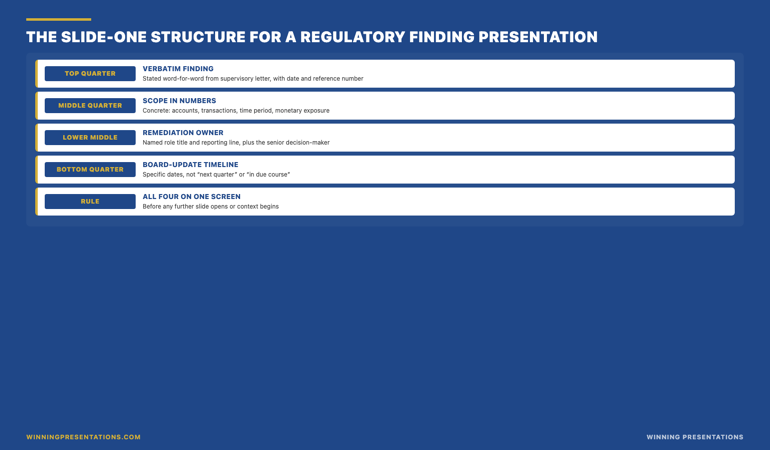
The second rule is that the supporting context for the finding lives on slides three and onwards, not on slide one and not on slide two. Slide two is the scope of the affected activity, stated in concrete numbers. Slide three is the remediation owner with named seniority and reporting line. Only from slide four onwards does the deck begin to provide context, history, or framing. Inverting this order — putting context on slides one and two and arriving at the finding on slide three or later — is the most common structural failure in regulatory presentations, and it is the failure most reliably read by the regulator on the call as evidence of insufficient seriousness. The order matters more than the content.
The third rule, which most senior presenters discover only after their first escalation, is that the audit committee chair will sometimes ask the presenter to read the finding aloud verbatim from slide one before any further discussion proceeds. This is a deliberate check. The chair wants the room, and any regulator on the call, to hear the presenter say the finding in the regulator’s words without softening or translation. The presenter who has rehearsed slide one as a verbatim statement of the finding can read it aloud cleanly. The presenter who has built slide one as a paraphrase or translation cannot, because they have rehearsed the paraphrase rather than the original. The hesitation when reading the original aloud, even if it is only two or three seconds, is itself read by the chair as the wrong signal.
The scope-and-owner test for the first three slides
The scope-and-owner test is a simple diagnostic the presenter can run on their own deck before the audit committee meeting. The test is: hand the first three slides to a senior colleague who has not seen them before. Ask them, after thirty seconds, to tell you in their own words (a) what the regulator found, (b) how big the affected activity is in concrete numbers, and (c) who owns the remediation. If the senior colleague can answer all three questions from the first three slides without referring back, the structure is doing its work. If they can answer one or two but not all three, the structure is incomplete. If they cannot answer any of them — which is more common than presenters expect — the first three slides are context, history, or framing, and the actual finding has been pushed back to slide nine or later.
The test is deceptively simple, and it catches almost every structural problem with a regulatory finding presentation. The most common failure mode is that the senior colleague can answer “what was found” but cannot answer “how big” or “who owns it”. The scope is buried in a paragraph of qualified language (“material”, “significant”, “broadly within the expected range”), and the owner is named only in the footer of slide seven. The audit committee chair will not be running this test consciously, but they will be running an equivalent unconscious read in the first ninety seconds of the presentation, and a deck that fails the scope-and-owner test will fail the chair’s unconscious read for the same reason.
The structural pattern that closes regulatory engagements down to remediation, not escalation.
The Executive Buy-In Presentation System covers the audit-committee opening structure, the slide-one verbatim-finding pattern, the scope-and-owner test, and the chair pre-read protocol for regulatory presentations. Seven self-paced modules, monthly cohort enrolment, optional live Q&A calls fully recorded. Lifetime access to materials.
- Seven modules of self-paced course content covering high-stakes board presentation structure
- Optional live Q&A and coaching calls, fully recorded for asynchronous viewing
- Monthly cohort enrolment — join the next available cohort whenever suits you
- Lifetime access to all course materials, no deadlines
What the audit committee chair is reading when the regulator is on the line
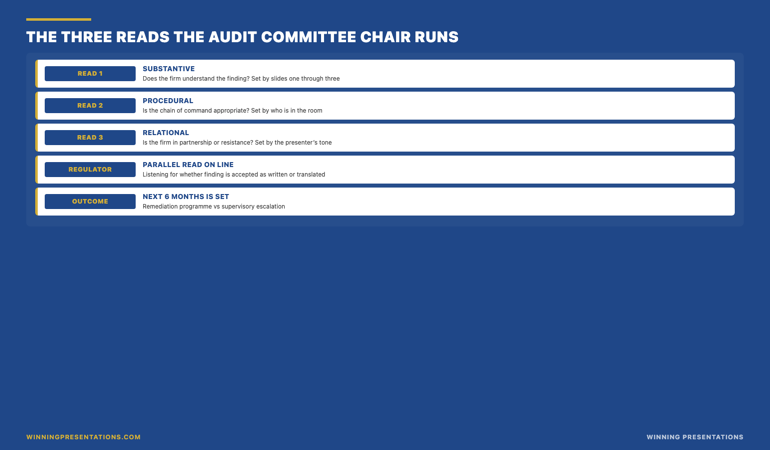
The audit committee chair, in a meeting with a regulator on the line, is doing three reads simultaneously. The first read is the substantive read: does the firm understand the finding and have an adequate remediation plan. The second read is the procedural read: is the chain of command in the response appropriate to the gravity of the finding, with senior enough ownership and clear escalation paths. The third read is the relational read: is the firm’s posture toward the regulator one of accepted partnership in the remediation, or is it one of subtle resistance.
The substantive read is largely a function of slide one through slide three: the finding stated verbatim, the scope in concrete numbers, the owner named. If those three slides are clean, the substantive read lands quickly and the chair moves on to the procedural read. The procedural read is set by who is in the room. If the audit committee chair sees that the chief executive, the chief risk officer, and the general counsel are all present for the presentation — in person or on the dial — the procedural read is that the response has appropriate senior gravity. If the only senior leader in the room is the presenting compliance director, with everyone else “in the office but not joining for the audit committee item”, the procedural read shifts toward “not yet escalated to the right level” regardless of what slide one says.
The relational read is the most subtle of the three and the one most likely to misfire if the presenter has not rehearsed slide one verbatim. The regulator on the call is reading the presenter’s tone of voice when stating the finding for whether the firm has internalised it or is reciting it under sufferance. The presenter who has rehearsed the verbatim statement enough times to deliver it in a calm, accepting tone signals partnership. The presenter who delivers it stiffly, or with audible reluctance, signals resistance even if the words themselves are exactly right. The relational read is what determines whether the next supervisory letter, if there is one, takes a partnership tone or an escalation tone, and that distinction shapes the next six months of engagement. See the Executive Buy-In Masterclass overview for the rehearsal protocol that builds this tonal calibration, and the broader catalogue of board-readiness assets at our services page.
For senior compliance leaders who want the slide-level structure that supports the verbatim-finding-first opening — the actual templates the scope-and-owner slides use — pair the Buy-In framework with the Executive Slide System (£39). It includes twenty-six executive slide templates, including formats for regulatory finding slide one, scope-of-affected-activity slides, remediation-owner slides, and remediation-timeline slides. Ninety-three AI prompts for structuring regulatory briefs, and sixteen scenario playbooks including a regulatory-presentation scenario. Most senior compliance leaders use the slide system to build the supporting deck and the buy-in framework to handle the live audit-committee moment.
Frequently asked questions
Is it worth investing in a structured programme like the Executive Buy-In Presentation System if I only present regulatory findings occasionally?
If you present regulatory findings only occasionally, the case for a structured programme is actually stronger, not weaker. Senior leaders who present regulatory findings every quarter develop their own intuitive structure through repetition; senior leaders who present them once every eighteen months do not have the repetition to build the intuition, and the cost of a single weak presentation runs to a multiple of any programme fee. The Buy-In Presentation System is most useful for the audit committee chair, chief compliance officer, or general counsel who knows a regulatory presentation is coming in the next eight to twelve weeks and wants the structural opening installed before the meeting. It is less useful for the leader who already presents at audit committee level every month and has internalised the pattern.
What is the most common mistake compliance leaders make in regulatory presentations?
The most common mistake is the soft translation of the finding. The supervisory letter says something specific and pointed; the compliance leader, often in coordination with internal communications or general counsel, builds slide one as a slightly softer version of the finding that is intended to be more palatable to the board. The regulator on the call hears the softening immediately and reads it as resistance. The chair hears the softening and reads it as the same thing. Both reads compound, and the meeting starts from a worse position than it needs to. The fix is not to be harsh on the firm; it is to state the finding exactly as the regulator wrote it, with date and reference number, and to handle any framing or context on slides four and onwards rather than in the opening.
Does the verbatim-finding approach work even when the finding is debatable or partially disputed?
Yes, and arguably it works better in that scenario. When the firm disputes a finding, the audit committee meeting is not the place to argue the dispute. The dispute, if it exists, is handled in the firm’s formal response to the supervisory letter, which is a separate document going to the regulator’s supervisory team. The audit committee meeting is for the board to be briefed on what the regulator has said and what the firm is doing about it. Presenting the verbatim finding does not commit the firm to accepting it as final; it commits the firm to taking the finding seriously enough to respond formally. The senior compliance leader who tries to handle the dispute in the audit committee meeting loses both audiences — the board, who is confused about whether the finding is accepted, and the regulator, who hears the resistance.
How should the deck handle remediation timelines that are still being scoped?
Slide three names the remediation owner. Slide five or six names the remediation timeline. If the timeline is still being scoped, the timeline slide states the scoping process, the scoping owner, and the date by which the full timeline will be brought back to the audit committee. “Full remediation timeline to be presented to the audit committee at the next scheduled meeting on [specific date].” That sentence is structurally complete and lets the chair and the regulator absorb that the firm is moving but is not yet able to commit to a final timeline. Vague language about “in due course” or “as soon as practicable” is read as the firm not yet owning the response, even if the underlying scoping work is being done diligently in parallel.
Should the chief executive be in the room for a regulatory finding presentation?
For all but the smallest findings, yes. The procedural read the audit committee chair is running in the meeting is partly a read of who is in the room. The presence of the chief executive, the chief risk officer, and the general counsel signals that the response has appropriate senior gravity. The absence of one or more of them signals that the firm has not yet escalated the response to the appropriate level, and the chair will sometimes ask the question explicitly: “Is the chief executive aware of this finding?” The structural cleanest answer is for the chief executive to be in the room and to be visibly engaged during the presentation. Even if they do not speak, their presence does part of the procedural read’s work for the firm.
The Winning Edge newsletter: weekly editorial on regulatory communication, board readiness, and the structural patterns senior leaders use in high-stakes audit committee meetings. Thursday morning to senior leaders presenting at board level.
Walk into your next audit committee with slide one structurally correct.
The Executive Buy-In Presentation System covers the slide-one verbatim-finding pattern, the scope-and-owner test, the chair pre-read, and the audit-committee opening protocol. Seven self-paced modules, £499, lifetime access. Optional live Q&A calls fully recorded.
The next time you are asked to present a regulatory finding to the audit committee — whether the supervisory letter landed last Tuesday or you have eight weeks to prepare — write slide one with the finding stated verbatim, including the regulator’s reference number and date. Read it aloud three times. Hand the first three slides to a senior colleague and run the scope-and-owner test. If they can answer all three questions in thirty seconds, slide one is doing its work, and the next six months will probably be a remediation programme rather than an escalation. For the broader catalogue of board-readiness assets that pair with the Buy-In framework, see The Complete Presenter bundle.
ABOUT THE AUTHOR
Mary Beth Hazeldine is Owner & Managing Director of Winning Presentations. She has 24 years in corporate banking at JPMorgan Chase, PwC, Royal Bank of Scotland, and Commerzbank, and 16 years coaching senior professionals across financial services, healthcare, technology, and government. She advises senior compliance leaders, general counsel, and audit committee chairs on the structural shape of high-stakes regulatory communications.
Winning Presentations Ltd, founded in 1990, is a UK consultancy specialising in executive presentation methodology and senior leadership communication.