

Quick answer: The restructuring presentation team trust outcome is decided by three structural moves the leader makes before the deck is built, not by the empathy or warmth of the delivery on the day. Move one: name the cost to the affected team in the leader’s own voice on slide one, before any operating-model context, before any reasoning. Move two: separate the announcement of the decision from the explanation of the reasoning — the room cannot process both in the same five minutes, and conflating them reads as deflection. Move three: hand the room a thirty-day window with three or four named-owner events the leader will personally chair, not a generic “we will keep you informed” commitment. Three moves. Built before the slides. The leader who makes them holds the affected functions through the consultation window. The leader who substitutes warmth on the day for structure in the preparation triggers the corridor collapse the consultation feedback document records six weeks later.
JUMP TO:
- Why warmth on the day cannot rescue a structurally weak announcement
- Move one: name the cost to the team in the leader’s own voice
- Move two: separate the decision from the reasoning
- Move three: named-owner events across the thirty-day window
- The chief-of-staff sentence test and the corridor walk
- The corridor collapse pattern and how it shows up in the feedback document
- Frequently asked questions
In the spring of 2017, a newly-promoted divisional managing director at one of the European specialty-chemicals groups I was supporting walked into the restructuring all-hands she had been preparing for nine weeks. The session was held in the main meeting room of the divisional headquarters, a converted conference hall with floor-to-ceiling windows along one wall, holding 290 people in the room with another 360 on the company’s video bridge from the continental sites. The restructuring was real and substantial — the closure of one of the three divisional product lines, the consolidation of two regional commercial teams into one, and approximately 110 roles at risk across the affected functions. She had worked with the change-management firm engaged for the programme for three months on the announcement, and she had personally rehearsed the delivery six times in the week before the meeting. She opened with a slide showing four photographs — a research lab, a manufacturing line, the company’s annual partner conference from the previous summer, and a wide shot of the divisional headquarters — under the headline “Our People, Our Strength”. She spoke for three minutes about the history of the division, the contributions of the affected teams over the previous decade, and her personal respect for the work they had done. Then she moved to slide two and began walking through the operating-model logic of the restructuring decision. The substantive announcement — the closure of the product line, the consolidation, the role-at-risk numbers — appeared on slide seven, fourteen minutes into the session. By minute six I watched a long-tenured operations director three rows back stop taking notes. By minute nine, the room was visibly different from the room that had been there in the first sixty seconds. The MD walked out believing the announcement had landed because the Q&A had been quiet and her personal warmth had been visible throughout. Six weeks later, the consultation feedback document recorded the deepest trust loss the division had logged in three programmes, and a third of the long-tenured operations directors had begun quiet conversations with executive recruiters.
(This article was created with AI assistance; all stories and insights are based on 35 years of real client work.)
This piece walks through the three structural moves that separate restructuring announcements that hold the trust of the affected functions from announcements that trigger the corridor collapse the feedback document records six weeks later. The moves are not delivery techniques. They are structural decisions made in the preparation phase — days and weeks before the announcement — that determine what the deck has to do on the day. The article covers each of the three moves in detail, the chief-of-staff sentence test that validates whether the first move has been made honestly, the corridor-walk diagnostic that catches a collapsing announcement in the first 48 hours after the meeting, and the collapse pattern that the framework is specifically built to prevent.
Before the next restructuring announcement, a one-page structural check is worth a look.
The Executive Presentation Checklist walks through the structural moves senior leaders are using to hold trust through difficult announcements — the named-cost opening, the decision-before-reasoning sequencing, the named-owner thirty-day window, and the chief-of-staff sentence test. Free download, no email gate.
Why warmth on the day cannot rescue a structurally weak announcement
The instinct most senior leaders bring to a difficult restructuring announcement is to lead with warmth. The thinking is straightforward and humane: the news is hard, the affected functions have served the organisation well, and the right way to soften the blow is to honour the contribution before delivering the decision. The instinct is well-meaning. It is also, in the rooms I have worked alongside over twenty-four years in corporate banking and the sixteen years of coaching senior leaders that have followed, the single most consistent driver of restructuring announcements that collapse in the consultation period. The affected functions do not read warmth-on-slide-one as honouring their contribution. They read it as the leader buying time before delivering the news they already know is coming. The warmth, however genuine, becomes the structural signal of evasion, and the consultation period inherits the result.
What the room is reading in the first five minutes of a restructuring announcement is not the leader’s emotional register but the structural sequence of what gets named when. Senior operating people in the room have sat through enough difficult announcements across their careers to have built a fast pattern-match for the sequence: leaders who lead with warmth and arrive at the substantive announcement on slide six or seven are leaders who have not yet made peace with the difficulty of what they are about to ask the room to absorb, and the room calibrates its trust accordingly. Leaders who name the cost in the first ninety seconds, before any operating context, before any thanks, before any history, are signalling that they have absorbed the difficulty themselves and are not asking the room to do that absorption work on their behalf. The trust signal is structural, not tonal. The leader who gets the sequence right does not need to perform warmth on the day; the warmth becomes visible in the structural respect for the room’s time and intelligence.
The reason the structural sequence matters more than the delivery tone is that the affected functions will replay the announcement in their corridor conversations over the following 48 hours, not the leader’s vocal warmth. The pattern is consistent across every restructuring I have observed: within 24 hours, line managers in the affected functions begin the team huddles that translate the announcement into operational reality for each affected individual, and the structural sequence of the announcement — what was named first, what was named with specificity, what was deferred to a later forum — becomes the framework those huddles run inside. A line manager whose team asks “why didn’t she just tell us the closure decision first?” cannot answer that question with reference to the warmth of the opening. They can only answer it with reference to the structural sequence, and the answer the structural sequence gives in a warmth-first announcement is “because she was buying time” — an answer that compounds across the consultation period regardless of the leader’s actual intent.
Move one: name the cost to the team in the leader’s own voice
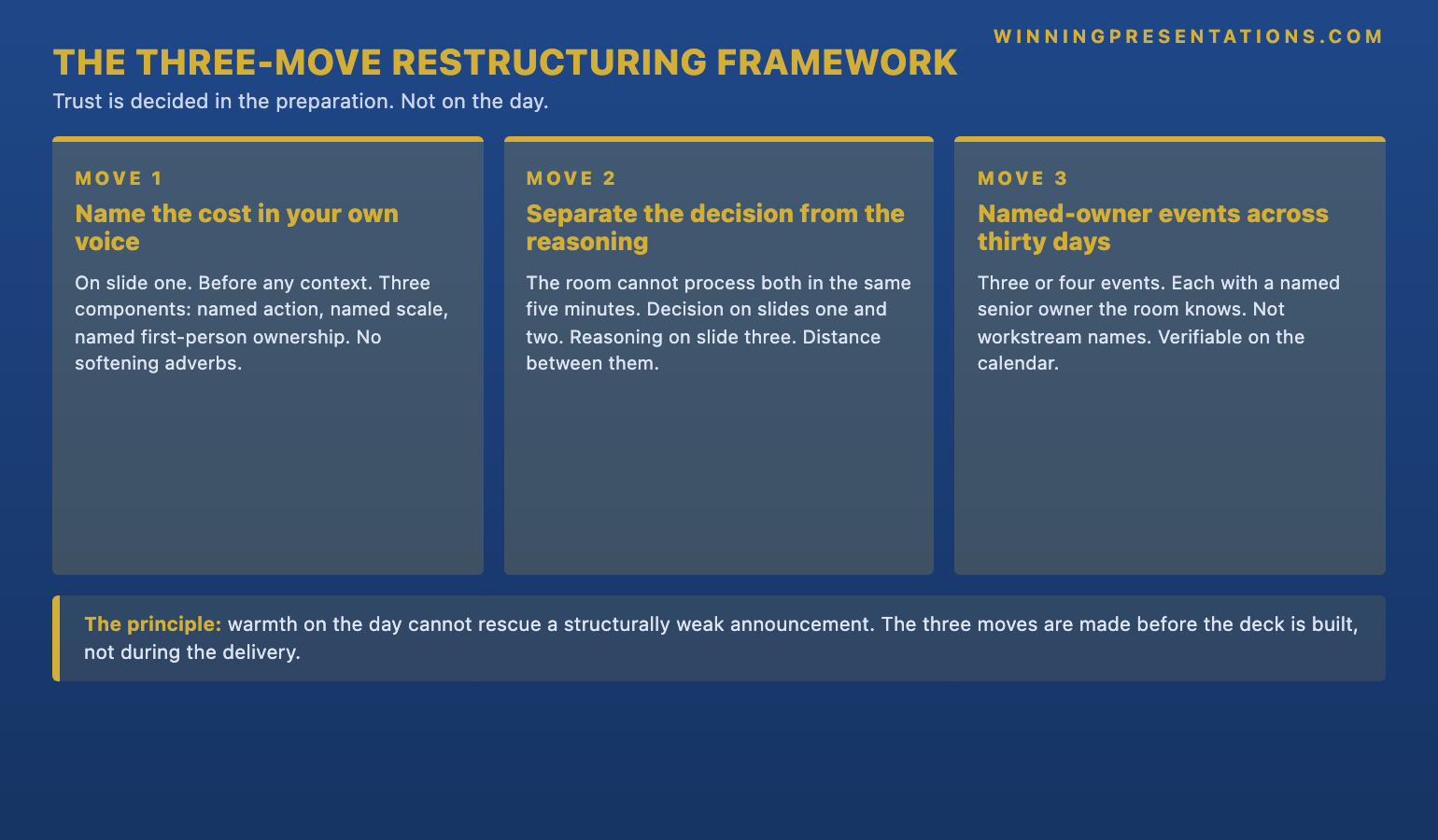
Move one is to name the cost to the affected team on slide one, in the leader’s own voice, before any context, any reasoning, any thanks, and any history. The sentence has three components and all three must be present. First, the named action: “Today I am announcing the closure of the X product line, with consolidation of the European and US commercial teams into one global team from 1 October.” Second, the named scale: “Approximately 110 roles will be at risk across the affected functions, with the consultation programme opening this afternoon.” Third, the named first-person ownership: “I am the leader who has signed this decision off, I will personally chair the consultation review, and I will write personally to every individual whose role is at risk by Friday next week.” Three components, one slide, said inside the first ninety seconds before any other slide goes up.
The discipline of move one is the first-person ownership. The instinct, particularly for leaders who inherited the restructuring rather than designed it, is to attribute the decision upwards or sideways: “The executive committee has reached a decision”, “The board has signed off a programme”, “Group has asked the division to deliver”. The attribution is structurally accurate and emotionally protective — the leader is signalling that they personally would not have made this decision in this way. The room reads the attribution as the opposite of what the leader intends. Senior operating people in the room know that the leader carries the announcement regardless of who designed the decision, and they read upward attribution as the leader trying to maintain personal distance from the difficulty rather than absorbing it. The fix is to use the first-person voice for the decision, the first-person voice for the chair role through the consultation, and the first-person voice for the personal writing commitment. The leader who cannot say these sentences in the first person on slide one is not yet ready to deliver the announcement.
The second discipline of move one is the absence of softening adverbs. The cost sentence does not contain “unfortunately”, “regrettably”, “sadly”, or “with a heavy heart”. The softening adverbs are well-intentioned and they break the first move. They signal that the leader is performing the emotional difficulty for the room rather than absorbing it before walking in. The room can tell the difference within the first sentence, and the difference matters: a leader who says “Today I am announcing the closure of the X product line” is delivering a decision; a leader who says “Unfortunately, today, with great regret, I have to announce the closure of the X product line” is asking the room to share the burden of the leader’s own discomfort with the announcement. The first is what move one requires. The second is what move one is specifically built to prevent.
Move two: separate the decision from the reasoning
Move two is to separate the announcement of the decision from the explanation of the reasoning, with at least one slide of structural distance between them. The room cannot process both in the same five minutes; the cognitive load of the news consumes the available attention budget, and any reasoning offered in the same window gets heard as deflection rather than as explanation. The structural fix is to deliver the decision in full on slides one and two — the named cost in the leader’s own voice, the named scale, the named first-person ownership, the named implication by function — and only then to open the reasoning on slide three. The room needs the pause between the announcement and the explanation in order to absorb the first before it can hear the second. The pause is uncomfortable for the leader, particularly for leaders who have spent six weeks living inside the operating-model logic of the decision and want to defend the rigour of the work behind it; the discomfort is what move two requires.
The diagnostic for move two is whether the reasoning slide could be removed from the deck entirely without the announcement losing its operational meaning. If the announcement collapses without the reasoning — if slide one cannot stand alone as a clear, complete announcement — then the announcement has been written backwards from the reasoning rather than forwards from the decision, and the room will read the reasoning slide as the missing piece of the announcement rather than as supporting context. If the announcement stands alone on slides one and two and the reasoning on slide three is genuinely supplementary — useful for the questions that will come in the Q&A and the corridor conversations that follow, but not necessary for the announcement itself to land — then move two has been made correctly. The test is structural; the test is whether the slides can be deleted and the announcement still works.
The reason move two matters beyond the immediate announcement is that the reasoning slide, when conflated with the announcement, becomes the slide the line managers in the affected functions cannot use in their team huddles over the following 48 hours. Line managers need to be able to deliver the announcement to their teams in their own words; if the reasoning is welded to the announcement, the line managers either deliver the reasoning at length (which extends the cognitive load they are asking their teams to absorb) or deliver the announcement without the reasoning (which strips the explanatory context the announcement assumed in the original deck). Separating the decision from the reasoning gives the line managers two distinct artefacts to work with: the announcement they deliver in the team huddle the morning after, and the reasoning they reference in the one-to-ones that follow over the next two weeks. The upstream change management presentation that aligns senior stakeholders before the announcement uses the same separation discipline at the board level, with the same operational logic.
A restructuring announcement holds team trust because the three moves were made in the preparation — not because the leader is naturally good at difficult news.
The Executive Buy-In Presentation System is the self-paced programme senior leaders use to make the three structural moves before the deck gets built — the framework for naming the cost in the leader’s own voice, separating the decision from the reasoning, mapping the affected functions’ likely objections, and designing the thirty-day window so the announcement lands as a co-ordination rather than a one-way broadcast. 7 modules, self-paced with no mandatory session attendance, monthly cohort enrolment, optional recorded Q&A calls available to watch back anytime. £499, lifetime access to materials.
- 7 self-paced modules — covering the structural moves before the deck, the named-cost opening discipline, the decision-from-reasoning separation, the personal commitment framework, and the consultation-period preparation work that decides the feedback outcome
- Designed for senior leaders facing reorganisations, closures, redeployments, and other difficult announcements where the consultation period determines whether the change actually lands
- Monthly cohort enrolment — new cohort opens every month, enrol whenever suits you, no deadlines, no mandatory live attendance
- Optional live Q&A calls, fully recorded — watch back anytime that fits the operating rhythm
- Built on 24 years in corporate banking and 16 years coaching senior professionals through difficult announcements across financial services, insurance, consulting, and technology
- Lifetime access to all course materials — £499
Move three: named-owner events across the thirty-day window
Move three is to hand the room a thirty-day window with three or four named-owner events the leader will personally chair, published on a slide and committed to in the leader’s own voice. “Between now and the next all-hands on 14 July, four things will land. The consultation pack distributed Monday, with HR director Priya Iyer as owner. The first round of function-by-function workshops opening the following Tuesday, with me personally chairing the operations function workshop. The redeployment options document published Friday 28 March, with the COO as owner. The consultation feedback session in this room on 12 April, with the divisional MD and me both present.” Four events, four named owners, four dates, said aloud and shown on the slide. The room photographs the slide on the way out; the line managers reference the slide in the team huddles the next day; the consultation period inherits the tempo.
The discipline of move three is the named-owner attachment to every event. The instinct, particularly with the change-management firm engaged for the programme, is to populate the slide with workstream names — the “People Workstream”, the “Operating Model Workstream”, the “Communications Workstream” — rather than with named senior leaders. The instinct is operationally accurate; the workstreams are doing the work. The room reads named-workstream events differently from named-leader events. Workstreams are read as machinery the leader will deflect to if the events do not land; named leaders are read as accountable owners the room can call in if the events slip. The fix is to attach a senior leader the room knows by name to every event, even if the leader is not doing the day-to-day workstream work, because the named-leader attachment is what carries operational weight inside the room. Naming the COO, the HR director, the divisional MD, or the leader themselves against an event signals the event is chaired at executive level. Naming a workstream signals the opposite.
The other discipline of move three is the limit. Three or four events maximum on the slide. The temptation is to populate the slide with eight or ten events covering every milestone of the programme; the slide collapses under the weight, the room cannot hold ten events in working memory across the corridor conversation that follows, and the line managers in the affected functions cannot use a ten-event slide in the team huddles the next morning. The events selected for the slide should be the events the affected functions most need to see land in the next thirty days, not the events the programme management office most needs the room to know about. The selection conversation between the leader and the programme office in the days before the announcement is one of the more frequently contested conversations in the deck preparation, and the leader who insists on three or four events with named owners makes the slide that lands and the slide the line managers use the next morning.
The chief-of-staff sentence test and the corridor walk
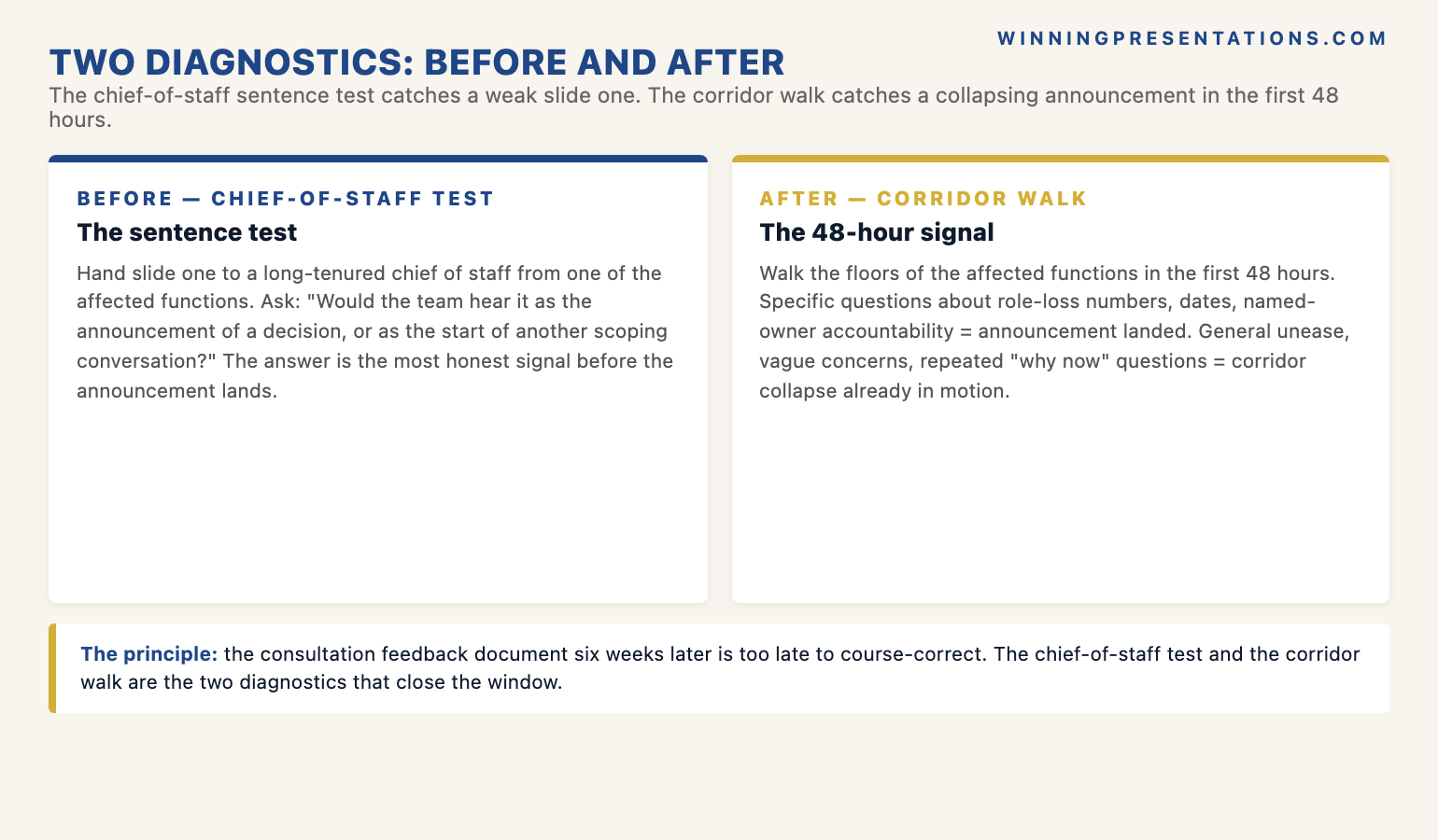
The chief-of-staff sentence test validates whether move one has been made honestly. Hand the slide-one sentence to a long-tenured chief of staff from one of the affected functions, not from the leader’s own office. Ask the chief of staff one question: “If I read this sentence to your team tomorrow morning, would they hear it as the announcement of a decision, or as the start of another scoping conversation?” The chief of staff’s answer is the most honest signal the leader will get before the announcement lands. If the answer is “they would hear it as the announcement”, the first move has been made correctly. If the answer is “they would hear it as a scoping conversation” or “they would wait for the actual announcement to come on the next slide”, the first-person voice has been softened or the named cost has been hedged, and the slide will fail on the morning regardless of what comes after it. The fix is always to rewrite slide one with the chief of staff’s feedback specifically in mind, then run the test again with a different chief of staff from a different affected function.
The corridor walk is the second diagnostic and the one that catches the collapse in the first 48 hours after the announcement, when remediation is still possible. The discipline is to walk the floors of the affected functions in the 24 to 48 hours after the announcement, with no agenda, no pre-arranged meetings, and no formal information-gathering frame. The leader walks the floor, makes informal contact with people who were in the room, and listens to what comes up. The questions that surface in those corridor conversations are the questions that did not get asked in the Q&A, and they are the early warning signal for what will appear in the consultation feedback document six weeks later. A corridor walk that surfaces specific questions about role-loss numbers, redeployment timing, or named-owner accountability is a corridor walk that confirms the announcement landed. A corridor walk that surfaces general unease, vague concerns about “the direction of the division”, or repeated questions about “why now” is a corridor walk that signals the announcement did not land and that the next two weeks need to be spent on the targeted one-to-one conversations the announcement should have made unnecessary.
The contrast worth illustrating is between the specialty-chemicals MD described at the top of this piece and a different leader I worked alongside two years later, this time a divisional head at one of the European insurance groups where I was supporting a structural change announcement in 2019. The room was comparable in size, around 270 in the room and another 320 on the video bridge. The restructuring was comparable in scale — the consolidation of two business lines and approximately 95 roles at risk. He had worked through the three moves with his own chief of staff in the two weeks before the announcement. He opened with the named cost in the first person, the named scale, the named first-person ownership of the consultation chair role and the personal-writing commitment to the at-risk individuals. He paused. He moved to the named implication by function on slide two, with consultation dates attached. Only on slide three did he open the reasoning, and only after he had given the room thirty seconds of pause between slides. Slide four was his personal commitment for the consultation period. Slide five was four named-owner events across the thirty-day window. He spent ten minutes on the five slides, not fifteen. He walked the floor over the following 48 hours and surfaced three specific questions in the corridor conversations that he was able to address in writing the same week. The consultation feedback document six weeks later recorded a trust loss that was real but within the bounds the executive committee had budgeted for, and the redeployment process closed on time with the new operating model standing up on the date the announcement had named. The difference between the two outcomes was not the relative talent of the two leaders. It was the three moves, made before the deck was built.
The corridor collapse pattern and how it shows up in the feedback document
The corridor collapse pattern is worth naming explicitly because it is the pattern the three moves are specifically built to prevent. The pattern has four stages and the leader is in none of the rooms where it plays out, which is why most senior leaders do not recognise it as it is happening. Stage one is the warmth-first announcement on the day, with the substantive news on slide six or seven, the reasoning conflated with the announcement, and the thirty-day window populated with workstream names rather than named-owner events. The Q&A is quiet because the cultural pattern in most senior corporate environments is to defer the difficult questions to the next forum rather than ask them of a leader who has just delivered a difficult announcement. The leader walks out believing the announcement landed.
Stage two plays out in the team huddles the line managers run with their teams the next morning. The line managers, who were in the announcement meeting and read the structural sequence, have no good answers to the questions their teams immediately ask: “Why didn’t she just tell us first?”, “Why was the closure decision buried on slide seven?”, “Who is actually accountable for this if it goes wrong?”. The line managers, in good faith, report back up to the leader that “the team is processing the news”, which the leader reads as a signal of orderly absorption rather than as the early warning signal it actually is. Stage three is the two-week period after the announcement during which the corridor conversations in the affected functions translate the structural sequence into a trust judgement about the leader. The judgement is rarely about the decision itself — the affected functions have usually had enough lead-time to anticipate the decision — and almost always about the leader’s sequence of disclosure. The judgement compounds inside the function and does not reach the leader because the leader is not in the corridor conversations.
Stage four is the consultation feedback document, six to twelve weeks after the announcement, recording a deeper trust loss than the executive committee had budgeted for. The leader is genuinely surprised because the announcement “went well”. The trust loss takes two quarters to repair, requires personal one-to-one engagement with the affected leaders the original announcement never reached, and absorbs operating bandwidth that was supposed to be deployed against the new operating model the restructuring was designed to enable. The cost of the warmth-first opening sits in the deferred-execution column of the programme, where it is rarely accounted for inside the formal cost-benefit analysis, but it shows up in the next two quarterly business reviews as slippage against the operating-model implementation timeline. The upstream restructuring board briefing covers the equivalent dynamic in the executive-committee approval meeting; the downstream version of the same dynamic, in the all-hands announcement meeting that follows, is what the corridor collapse pattern describes. The board buy-in presentation skills training programme covers the structural sequencing discipline at the board level, where the same separation of decision from reasoning earns the executive committee’s tolerance for the operational consequences that follow.
When the three structural moves are made, the deck still has to be built.
The Executive Slide System is the slide library senior leaders use to build the named-cost opening, the decision-from-reasoning separation, the implication-by-function layout, the personal-commitment page, and the named-owner thirty-day window without rebuilding them from scratch every restructuring cycle. 26 templates, 93 AI prompts, 16 scenario playbooks including the restructuring all-hands deep-dive. £39, instant download, lifetime access.
One thing to do before the next restructuring announcement
Block two hours, two weeks before the announcement, with a long-tenured chief of staff from one of the affected functions in the room. Write the slide-one sentence in front of them. Ask them the chief-of-staff sentence test question: would the team hear it as the announcement of a decision, or as the start of another scoping conversation. Rewrite the sentence until the answer is “the announcement of a decision”. Then write the slide-three reasoning slide separately, on a different piece of paper, and confirm that slide one could stand alone without it. Then write the four named-owner events for the thirty-day window, with the chief of staff present to push back on any event that doesn’t have a senior leader attached. The two hours are the single highest-leverage two hours the leader will spend on the announcement. The deck that gets built afterwards is the deck the affected functions will trust through the consultation period, and the difference will not be visible in the announcement Q&A but will be visible in the feedback document twelve weeks later.
Frequently asked questions
Doesn’t leading with the cost on slide one feel brutal, especially when the team has served the organisation well?
The instinct that leading with the cost is brutal is the instinct that produces the warmth-first openings the framework is built to prevent. The affected functions do not experience the named-cost opening as brutal; they experience it as respectful of their intelligence and their time. They already know a restructuring has been announced internally before the all-hands meeting, they have spent the previous weeks privately speculating about what is being decided, and they are sitting in the room waiting to hear the substantive news. The leader who delivers the news in the first ninety seconds is taking less of their attention budget than the leader who delays the news to slide seven. The respect for the team’s contribution belongs in the personal-writing commitment, in the named-owner events for the consultation period, and in the corridor walks the leader does in the following 48 hours — not in the opening slide of the announcement deck. The structural respect is what holds trust; the tonal warmth, delivered without the structural respect, reads as evasion.
What is the most common mistake newly-promoted leaders make in a restructuring announcement?
The most common mistake is leading with a slide of photographs — the research lab, the manufacturing line, the company conference — under a headline like “Our People, Our Strength”. The intent is to honour the affected teams’ contribution before delivering the difficult news. The effect, in a room that has been waiting weeks for the substantive announcement, is to signal that the leader is not yet ready to deliver the news and is using the photograph slide to buy time. The room reads the slide as evasion within the first sixty seconds. The fix is not to remove the recognition of the team’s contribution; the fix is to move it to the personal-writing commitment in slide four (“I will write personally to every individual whose role is at risk”) and to the corridor walks in the following 48 hours, where the recognition lands operationally rather than as part of the opening sequence of the announcement deck.
How long does it take to see whether a restructuring announcement actually landed?
The first signal arrives in the corridor walk over the 24 to 48 hours immediately after the announcement; the second arrives in the line-manager feedback to the executive office in the second week after the announcement; the formal signal arrives in the consultation feedback document six to twelve weeks after the announcement, depending on the length of the consultation window. The leader who waits for the formal feedback document to assess whether the announcement landed is waiting too long — by that point, the trust outcome is largely set and the remediation work that could have been done in the first two weeks is significantly more expensive to do at the formal-feedback stage. The corridor walk in the first 48 hours is the single most actionable diagnostic; the structural moves before the announcement deck is built are what determine whether the corridor walk surfaces specific questions the leader can address or general unease that signals a deeper collapse.
Does this framework work when the restructuring is being driven by external pressure such as a market collapse?
It works particularly well in externally-driven restructurings because the reasoning the affected functions are most likely to push back on — “Why now? Why this scale? Why this division specifically?” — gets answered most credibly when the announcement leads with the cost and then opens the reasoning separately. The affected functions are less defensive about externally-driven restructurings than about internally-driven ones, but they read the structural sequence of the announcement just as carefully. The leader who tries to soften an externally-driven restructuring by leading with reassurances about the organisation’s strategic position is sending the same evasion signal as the leader who leads with photographs of the team. The fix is the same: name the cost on slide one in the first-person voice, separate the decision from the reasoning, hand the room three or four named-owner events. The external driver becomes the slide-three reasoning, where it belongs.
Won’t the senior HR business partner push back on the named-cost opening as too direct for the affected teams?
The senior HR business partner’s pushback is the most common operational obstacle to the framework and the one most worth engaging seriously with rather than overriding. The pushback is rarely about whether the named-cost opening is right; it is usually about whether the line managers in the affected functions are prepared to support their teams through the operational consequences of the directness. The fix is to bring the senior HR business partner into the preparation work two weeks before the announcement, walk them through the chief-of-staff sentence test, and use their pushback to shape the personal-writing commitment in slide four and the named-owner events in slide five. The HR business partner’s concern is operationally valid and structurally addressable; the answer is rarely to soften the slide-one opening and almost always to strengthen the slide-four personal commitment and the slide-five thirty-day window. The HR business partner who sees the strengthened slides four and five usually becomes an advocate for the named-cost opening rather than a resistor.
The Winning Edge — weekly newsletter
The Winning Edge is a weekly (Thursday) newsletter for senior professionals who present at the executive level. One short email a week, focused on the structural moves that separate restructuring announcements the room trusts from announcements the consultation feedback document records as a trust collapse. Subscribe to The Winning Edge →
For the broader picture across slides, storytelling, confidence, and delivery, the seven-product Complete Presenter library covers the full set of structural disciplines — £99 for everything, lifetime access.
About the author
Mary Beth Hazeldine is Owner & Managing Director of Winning Presentations Ltd. With 24 years of corporate banking experience at JPMorgan Chase, PwC, Royal Bank of Scotland, and Commerzbank, she advises executives across financial services, healthcare, technology, and government on structuring presentations for restructurings, reorganisations, and high-stakes change communications.